
DEFINITIONS Transvenous epicardial pacing are temporary methods of
- Slides: 1
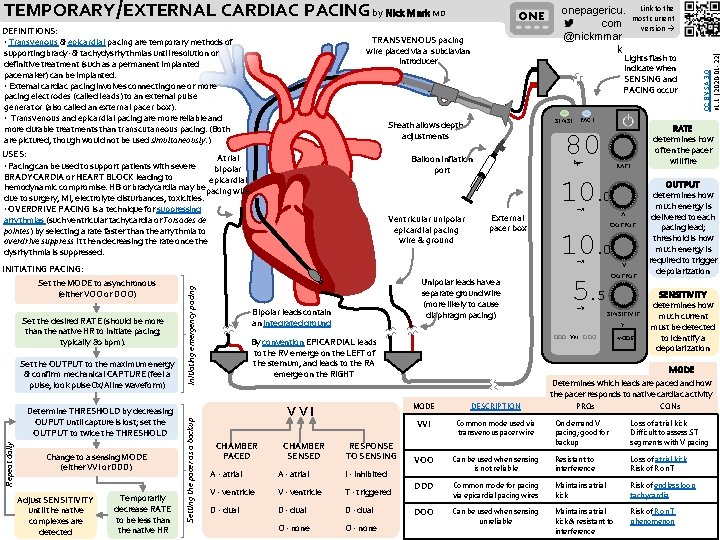
DEFINITIONS: · Transvenous & epicardial pacing are temporary methods of supporting brady- & tachydysrhythmias until resolution or definitive treatment (such as a permanent implanted pacemaker) can be implanted. · External cardiac pacing involves connecting one or more pacing electrodes (called leads) to an external pulse generator (also called an external pacer box). · Transvenous and epicardial pacing are more reliable and more durable treatments than transcutaneous pacing. (Both are pictured, though would not be used simultaneously. ) ONE TRANSVENOUS pacing wire placed via a subclavian introducer Lights flash to indicate when SENSING and PACING occur SENSE PACE Sheath allows depth adjustments USES: Atrial · Pacing can be used to support patients with severe bipolar BRADYCARDIA or HEART BLOCK leading to epicardial hemodynamic compromise. HB or bradycardia may be pacing wire due to surgery, MI, electrolyte disturbances, toxicities. · OVERDRIVE PACING is a technique for suppressing arrythmias (such ventricular tachycardia or Torsades de pointes) by selecting a rate faster than the arrythmia to overdrive suppress it then decreasing the rate once the dysrhythmia is suppressed. Repeat daily Determine THRESHOLD by decreasing OUPUT until capture is lost; set the OUTPUT to twice the THRESHOLD Change to a sensing MODE (either VVI or DDD) Adjust SENSITIVITY until the native complexes are detected Temporarily decrease RATE to be less than the native HR Initiating emergency pacing Set the OUTPUT to the maximum energy & confirm mechanical CAPTURE (feel a pulse, look pulse. Ox/Aline waveform) Setting the pacer as a backup Set the desired RATE (should be more than the native HR to initiate pacing; typically 80 bpm). RATE 80 Balloon inflation port bpm RATE 10. 0 Ventricular unipolar epicardial pacing wire & ground External pacer box m. A Unipolar leads have a separate ground wire (more likely to cause diaphragm pacing) 10. 0 Bipolar leads contain an integrated ground CHAMBER PACED CHAMBER SENSED RESPONSE TO SENSING A - atrial I - inhibited V - ventricle T - triggered D - dual O - none m. V determines how much energy is delivered to each pacing lead; threshold is how much energy is required to trigger depolarization SENSITIVITY SENSITIVIT Y DDD VVI DDO By convention EPICARDIAL leads to the RV emerge on the LEFT of the sternum, and leads to the RA emerge on the RIGHT VVI V OUTPUT 5. 5 determines how often the pacer will fire OUTPUT A OUTPUT m. A INITIATING PACING: Set the MODE to asynchronous (either VOO or DOO) Link to the most current version → onepagericu. com @nickmmar k CC BY-SA 3. 0 v 1. 1 (2020 -01 -22) TEMPORARY/EXTERNAL CARDIAC PACING by Nick Mark MD MODE determines how much current must be detected to identify a depolarization MODE Determines which leads are paced and how the pacer responds to native cardiac activity MODE DESCRIPTION VVI Common mode used via transvenous pacer wire VOO PROs CONs On demand V pacing; good for backup Loss of atrial kick Difficult to assess ST segments with V pacing Can be used when sensing is not reliable Resistant to interference Loss of atrial kick Risk of R on T DDD Common mode for pacing via epicardial pacing wires Maintains atrial kick Risk of endless loop tachycardia DOO Can be used when sensing unreliable Maintains atrial kick & resistant to interference Risk of R on T phenomenon