
definitions of terms uses of electrolysis learn to





- Slides: 83
• definitions of terms • uses of electrolysis • learn to predict products of electrolysis – molten compounds – aqueous solutions • construct ionic equations for the rxns • describe electrolysis of copper(II) sulphate, as means of purification • electroplating of metals • electricity from simple cells
Electrolysis
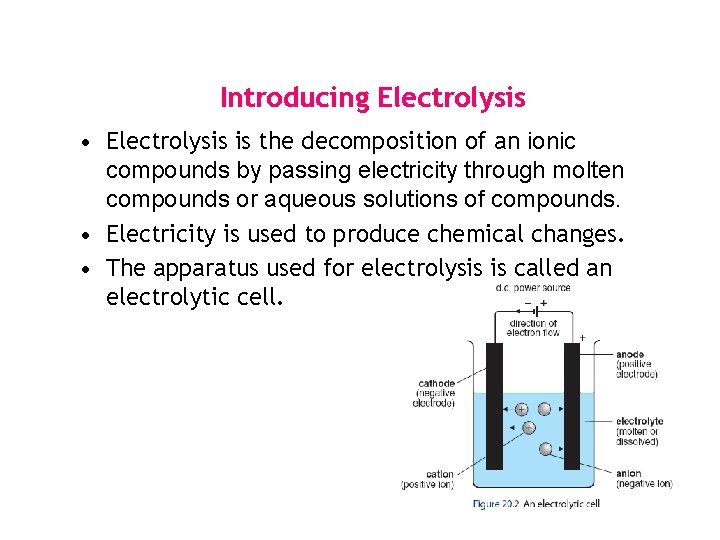
Introducing Electrolysis • Electrolysis is the decomposition of an ionic compounds by passing electricity through molten compounds or aqueous solutions of compounds. • Electricity is used to produce chemical changes. • The apparatus used for electrolysis is called an electrolytic cell.
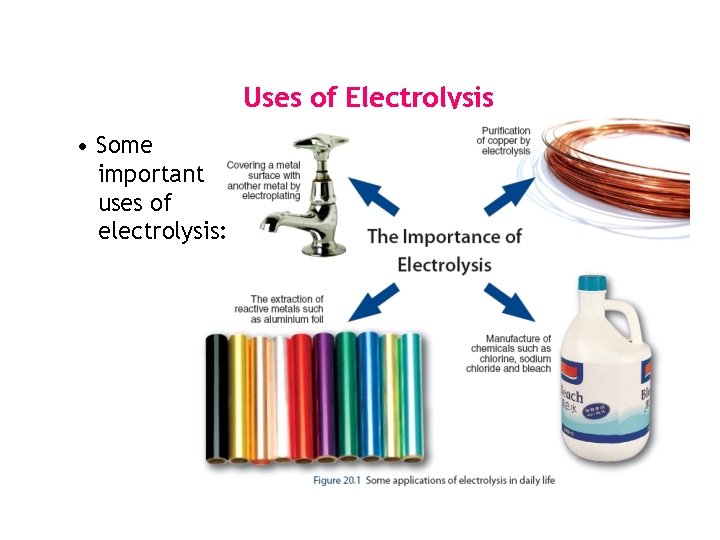
Uses of Electrolysis • Some important uses of electrolysis:
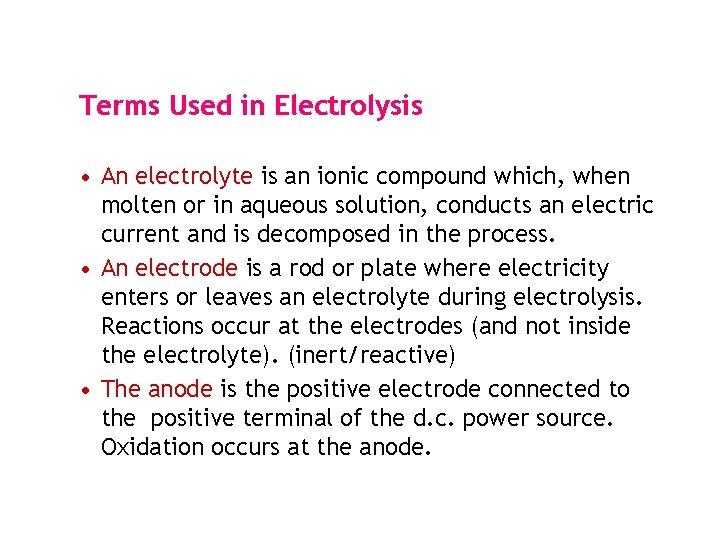
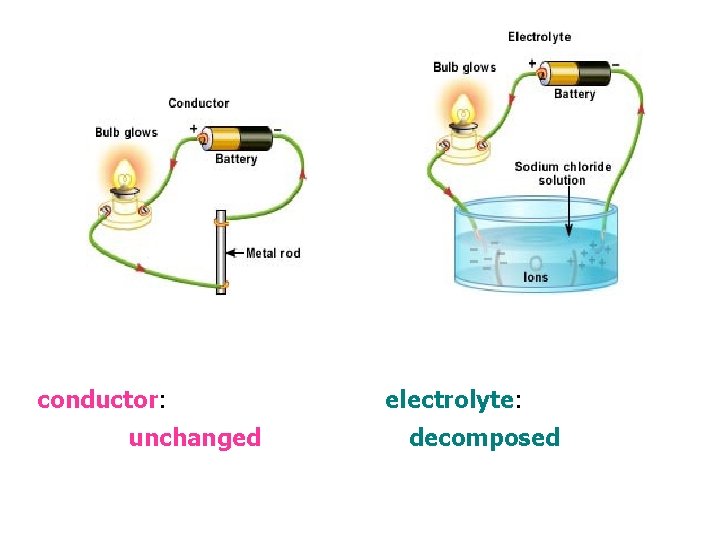
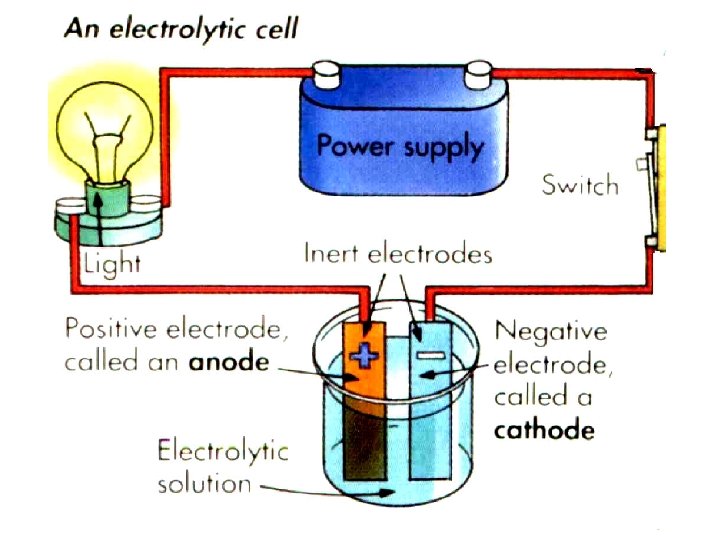
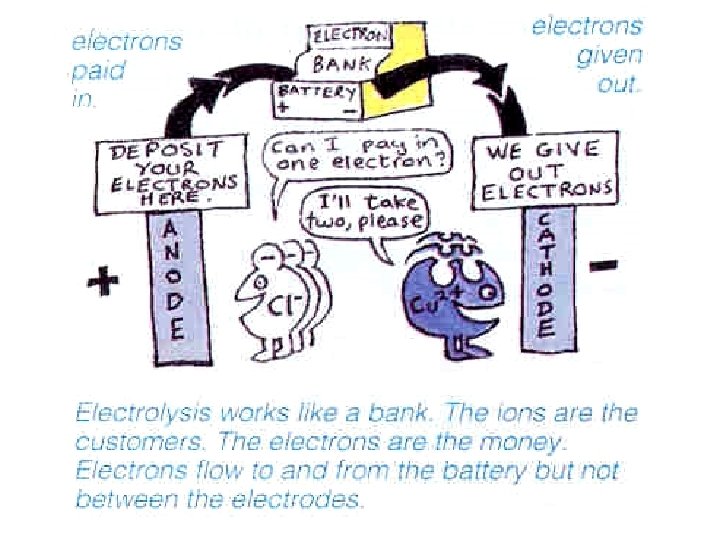
Terms Used in Electrolysis • An electrolyte is an ionic compound which, when molten or in aqueous solution, conducts an electric current and is decomposed in the process. • An electrode is a rod or plate where electricity enters or leaves an electrolyte during electrolysis. Reactions occur at the electrodes (and not inside the electrolyte). (inert/reactive) • The anode is the positive electrode connected to the positive terminal of the d. c. power source. Oxidation occurs at the anode.
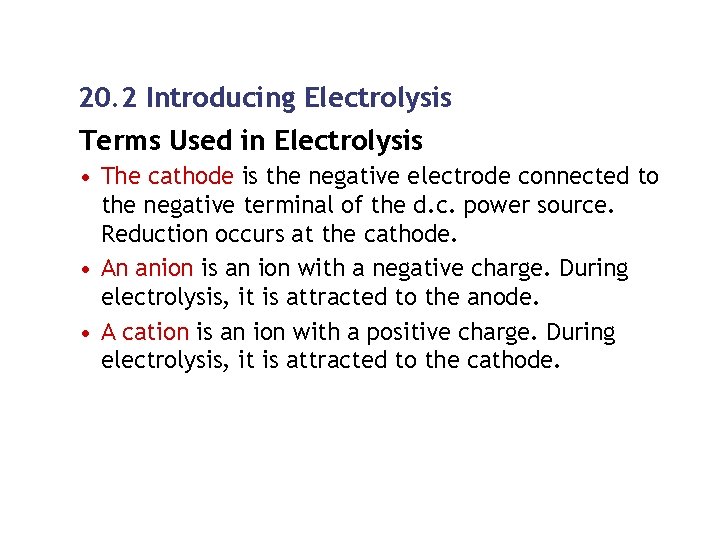
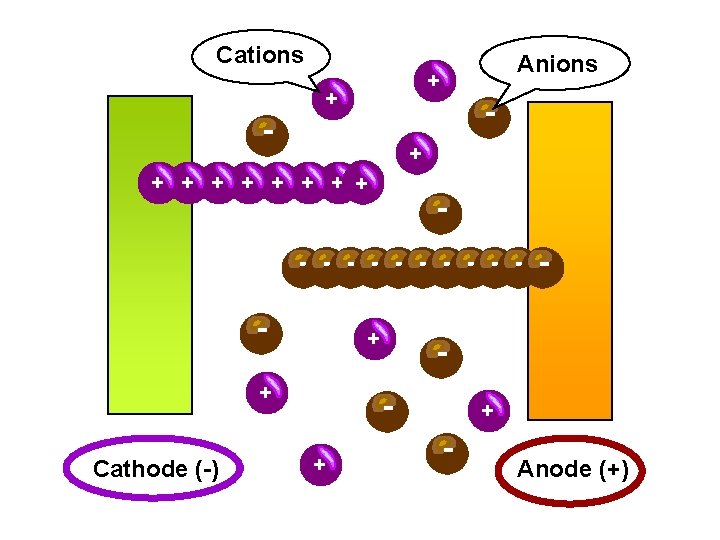
20. 2 Introducing Electrolysis Terms Used in Electrolysis • The cathode is the negative electrode connected to the negative terminal of the d. c. power source. Reduction occurs at the cathode. • An anion is an ion with a negative charge. During electrolysis, it is attracted to the anode. • A cation is an ion with a positive charge. During electrolysis, it is attracted to the cathode.
• In electrolysis, a compound in the molten state or in aqueous solution, conducts electricity and is decomposed by it.
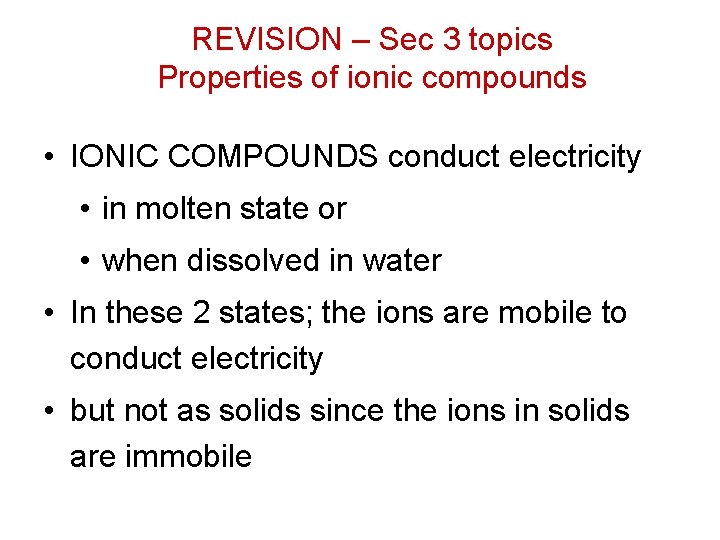
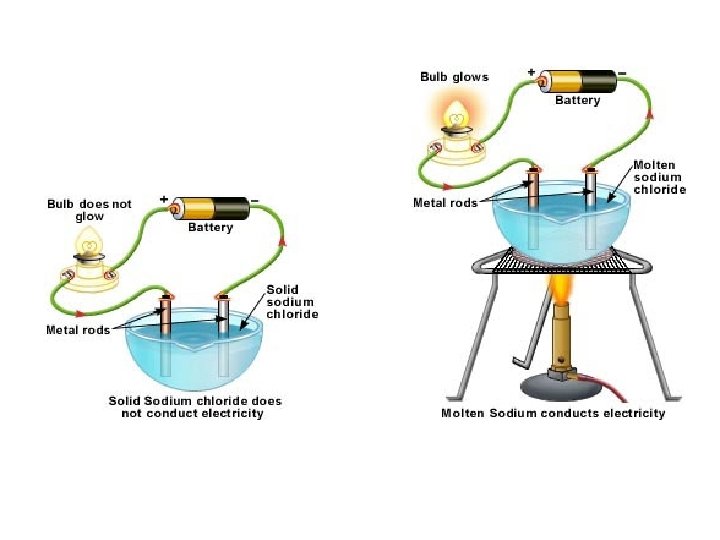
REVISION – Sec 3 topics Properties of ionic compounds • IONIC COMPOUNDS conduct electricity • in molten state or • when dissolved in water • In these 2 states; the ions are mobile to conduct electricity • but not as solids since the ions in solids are immobile
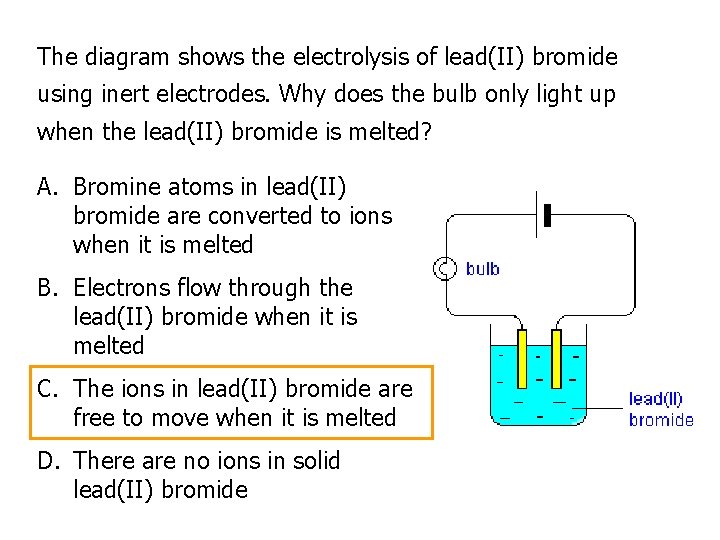
The diagram shows the electrolysis of lead(II) bromide using inert electrodes. Why does the bulb only light up when the lead(II) bromide is melted? A. Bromine atoms in lead(II) bromide are converted to ions when it is melted B. Electrons flow through the lead(II) bromide when it is melted C. The ions in lead(II) bromide are free to move when it is melted D. There are no ions in solid lead(II) bromide
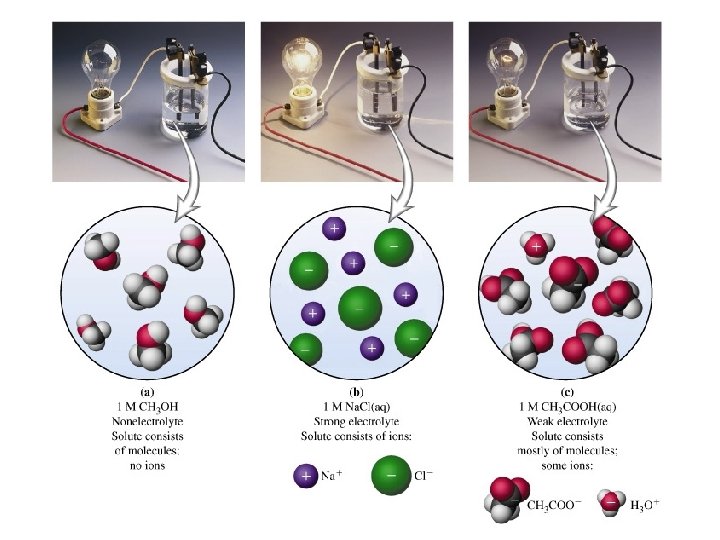
• Exceptions • acids such as HCl and H 2 SO 4 • as they form H+ ions in water they behave as an electrolyte • In general, strong acids and alkali are strong electrolytes • weak acids and alkalis are weak electrolytes
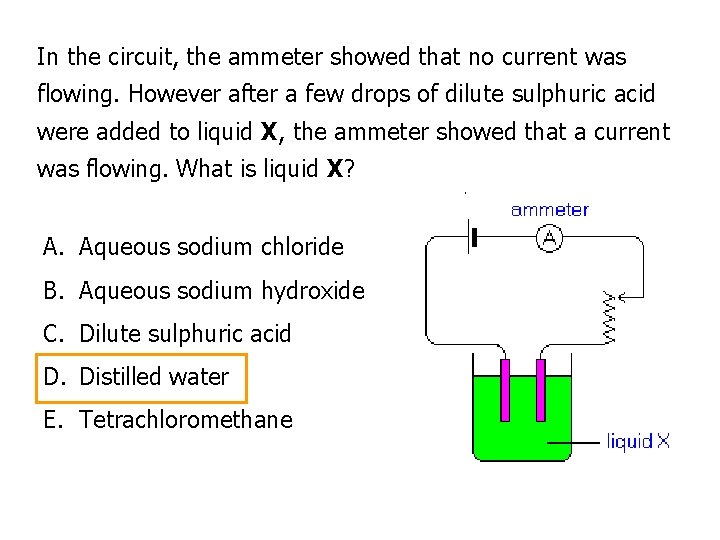
In the circuit, the ammeter showed that no current was flowing. However after a few drops of dilute sulphuric acid were added to liquid X, the ammeter showed that a current was flowing. What is liquid X? A. Aqueous sodium chloride B. Aqueous sodium hydroxide C. Dilute sulphuric acid D. Distilled water E. Tetrachloromethane
Conduction of electricity by conductor: the conductor electrolyte: the electrolyte remains unchanged is decomposed
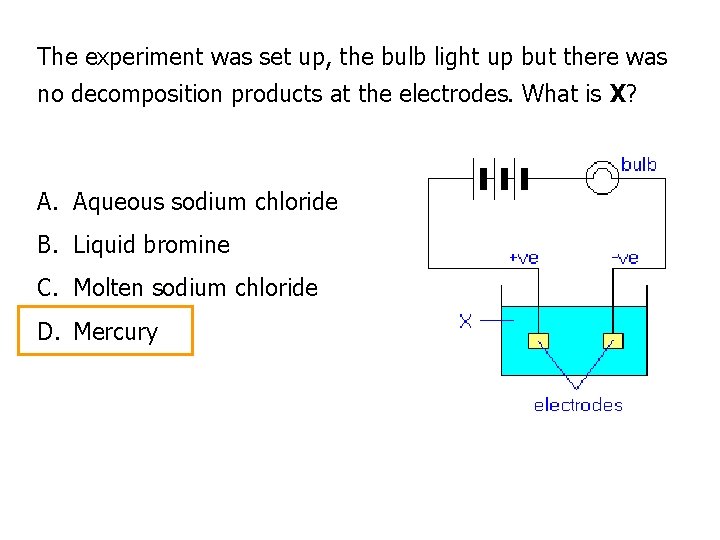
The experiment was set up, the bulb light up but there was no decomposition products at the electrodes. What is X? A. Aqueous sodium chloride B. Liquid bromine C. Molten sodium chloride D. Mercury
Cations Anions + + - - + + + + + - - - + + Cathode (-) - + + - Anode (+)
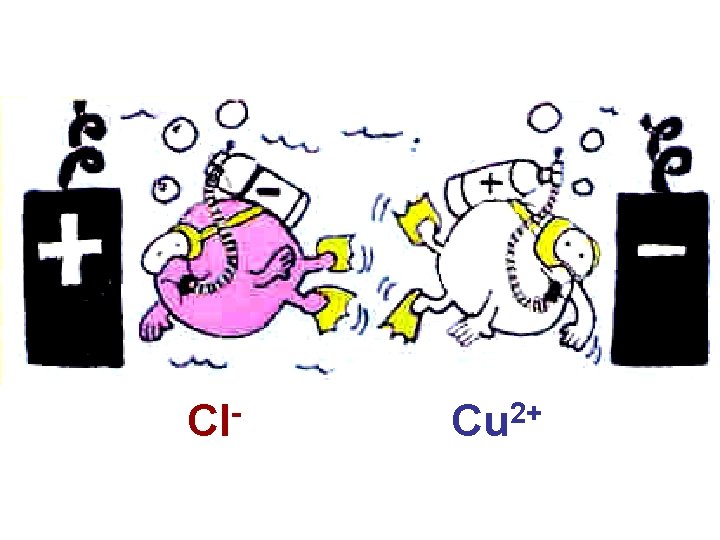
Cl 2+ Cu
Electrolysis of Molten compounds (using inert electrodes)
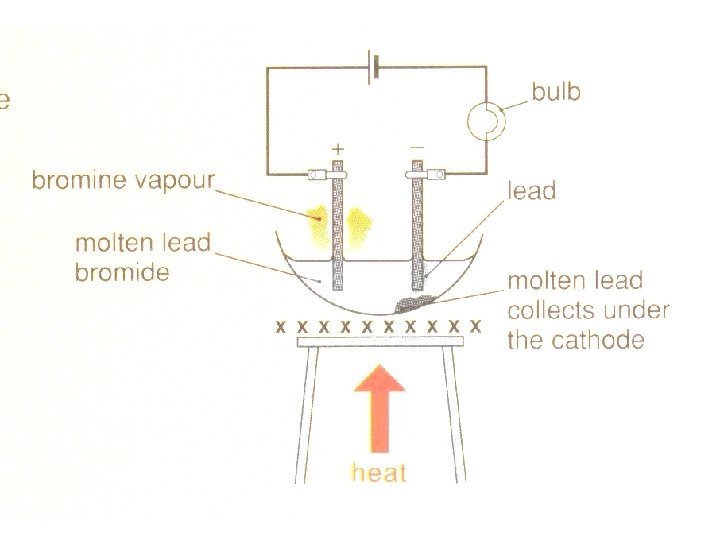
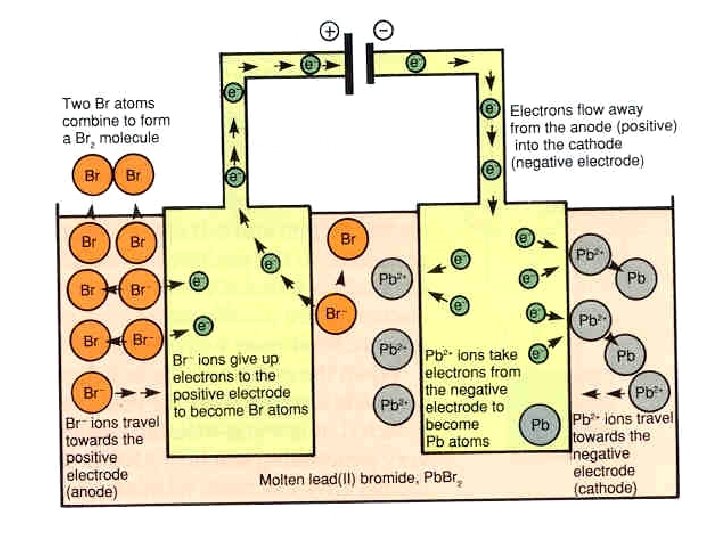
Lead(II) bromide Pb. Br 2 • The ions present : • Pb 2+ and Br • In the molten electrolyte, charged ions are free to move • When current is passed through, chemical changes occur at both the electrodes
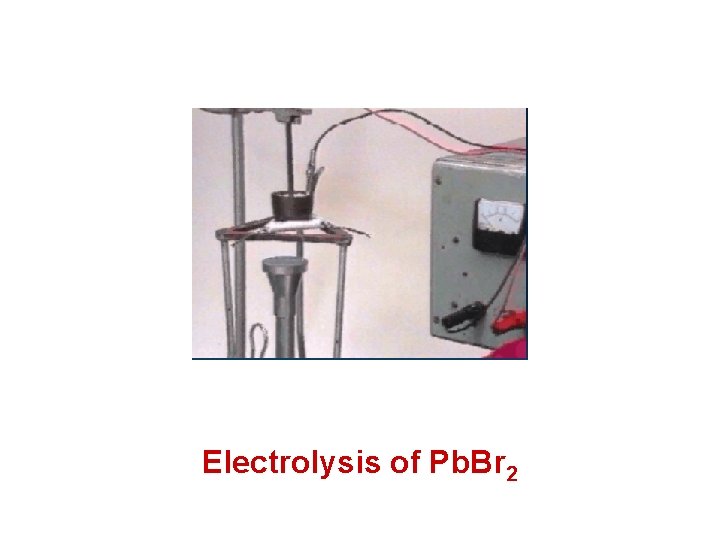
Electrolysis of Pb. Br 2
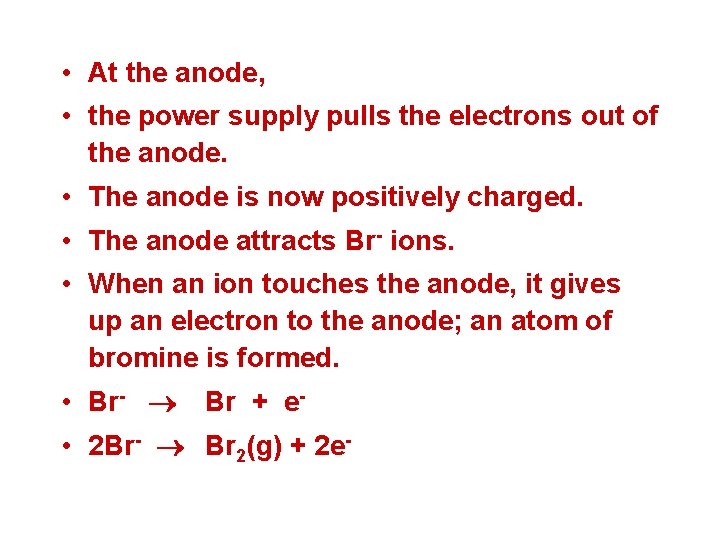
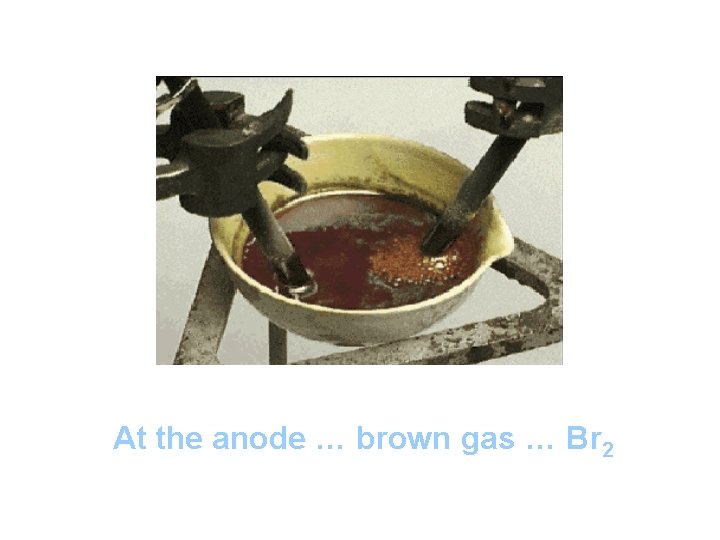
• At the anode, • the power supply pulls the electrons out of the anode. • The anode is now positively charged. • The anode attracts Br- ions. • When an ion touches the anode, it gives up an electron to the anode; an atom of bromine is formed. • Br- Br + e- • 2 Br- Br 2(g) + 2 e-
At the anode … brown gas … Br 2
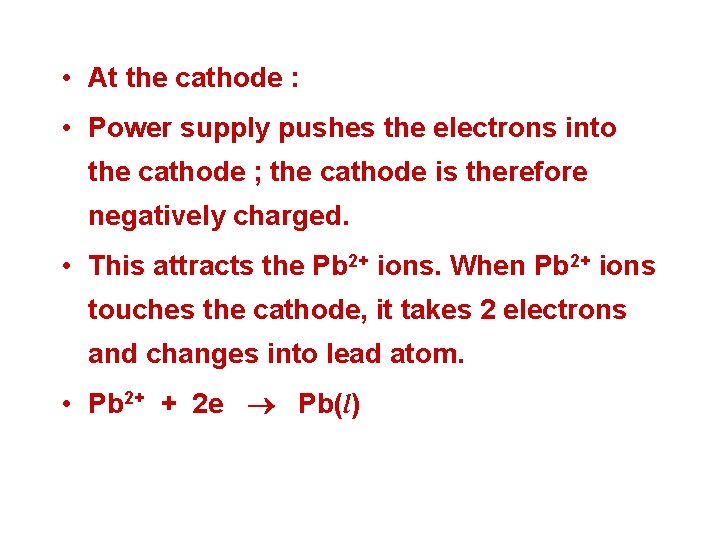
• At the cathode : • Power supply pushes the electrons into the cathode ; the cathode is therefore negatively charged. • This attracts the Pb 2+ ions. When Pb 2+ ions touches the cathode, it takes 2 electrons and changes into lead atom. • Pb 2+ + 2 e Pb(l)
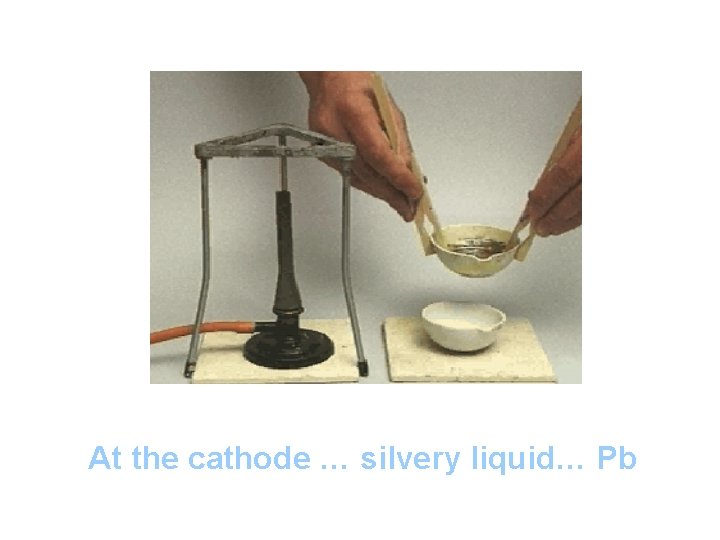
At the cathode … silvery liquid… Pb
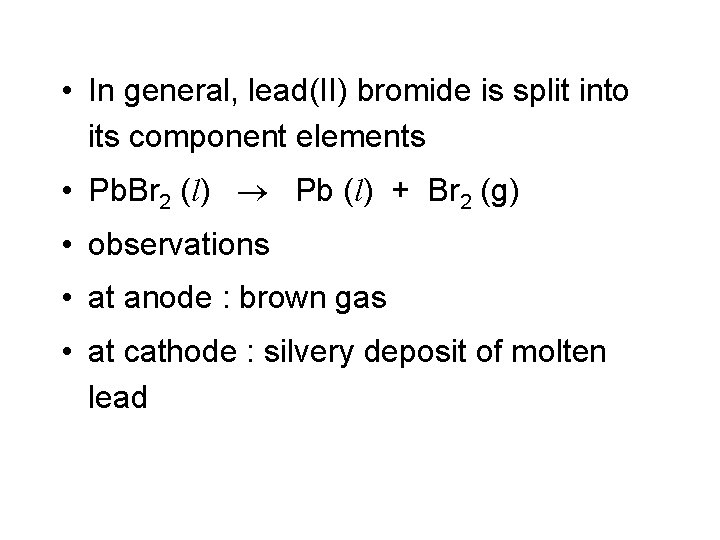
• In general, lead(II) bromide is split into its component elements • Pb. Br 2 (l) Pb (l) + Br 2 (g) • observations • at anode : brown gas • at cathode : silvery deposit of molten lead
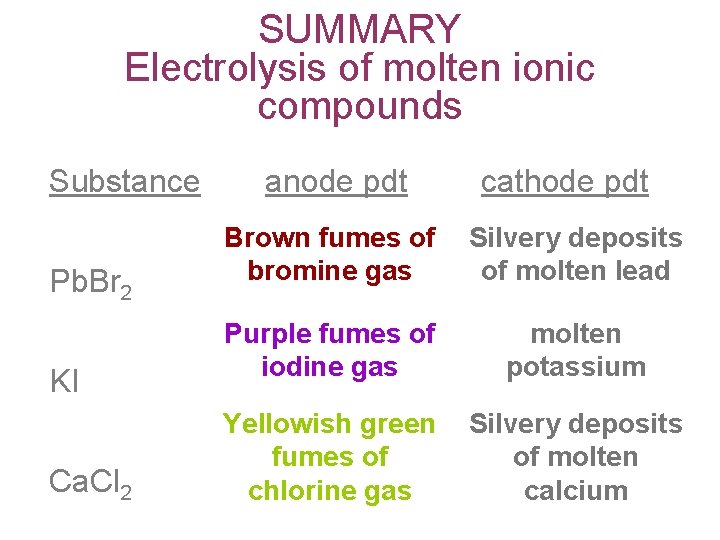
SUMMARY Electrolysis of molten ionic compounds Substance Pb. Br 2 KI Ca. Cl 2 anode pdt cathode pdt Brown fumes of bromine gas Silvery deposits of molten lead Purple fumes of iodine gas molten potassium Yellowish green fumes of chlorine gas Silvery deposits of molten calcium
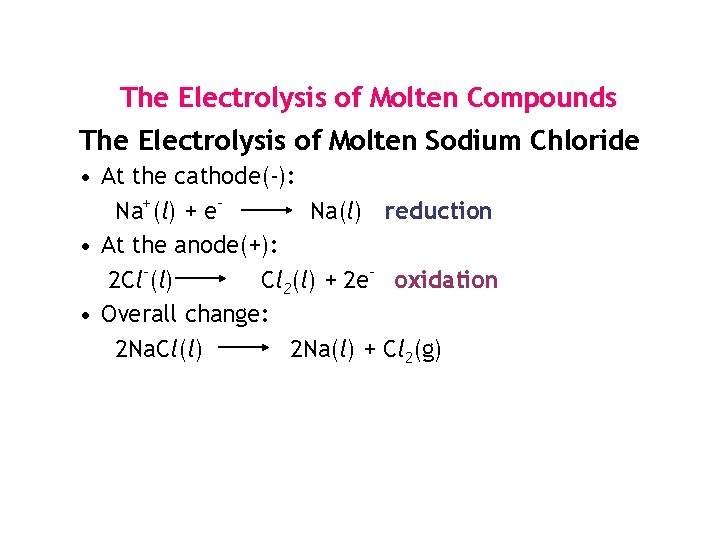
The Electrolysis of Molten Compounds The Electrolysis of Molten Sodium Chloride • At the cathode(-): Na+(l) + e. Na(l) reduction • At the anode(+): 2 Cl-(l) Cl 2(l) + 2 e- oxidation • Overall change: 2 Na. Cl(l) 2 Na(l) + Cl 2(g)
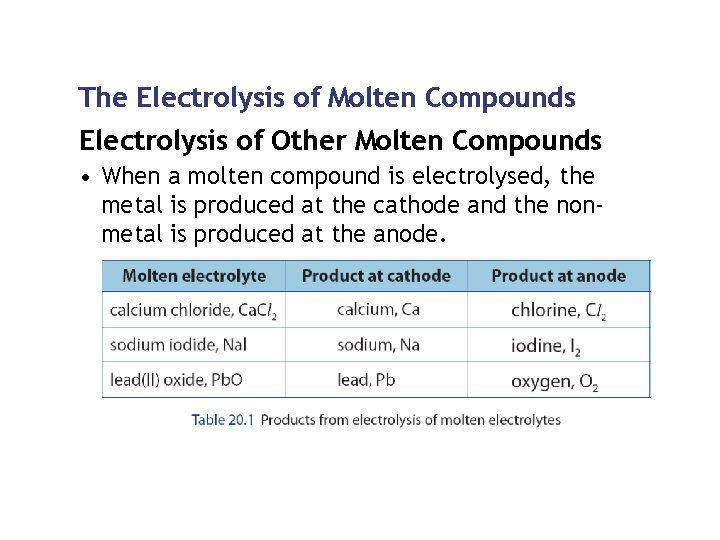
The Electrolysis of Molten Compounds Electrolysis of Other Molten Compounds • When a molten compound is electrolysed, the metal is produced at the cathode and the nonmetal is produced at the anode.
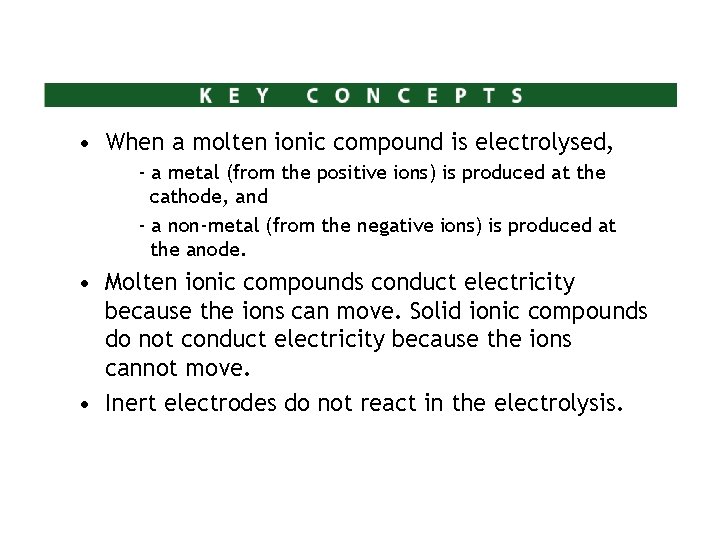
• When a molten ionic compound is electrolysed, - a metal (from the positive ions) is produced at the cathode, and - a non-metal (from the negative ions) is produced at the anode. • Molten ionic compounds conduct electricity because the ions can move. Solid ionic compounds do not conduct electricity because the ions cannot move. • Inert electrodes do not react in the electrolysis.
Electrolysis of aqueous ionic compounds (using inert electrodes)
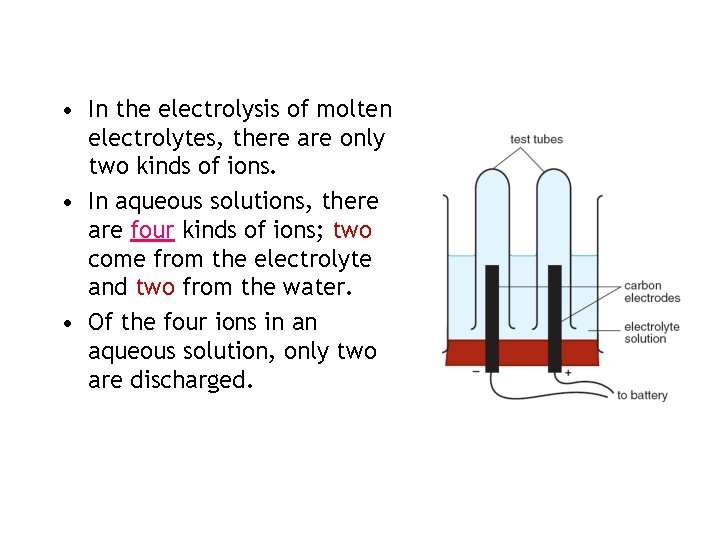
• In the electrolysis of molten electrolytes, there are only two kinds of ions. • In aqueous solutions, there are four kinds of ions; two come from the electrolyte and two from the water. • Of the four ions in an aqueous solution, only two are discharged.
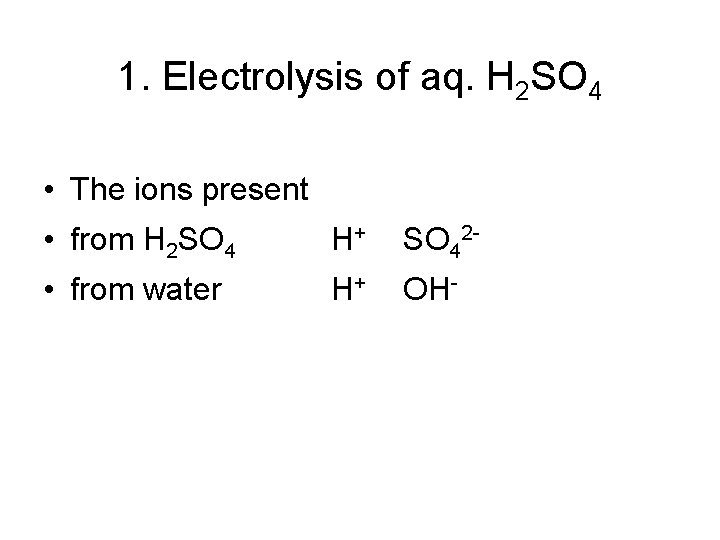
1. Electrolysis of aq. H 2 SO 4 • The ions present • from H 2 SO 4 H+ SO 42 - • from water H+ OH-
Factors affecting Electrolysis • Electrochemical series • Concentration • Type of electrode
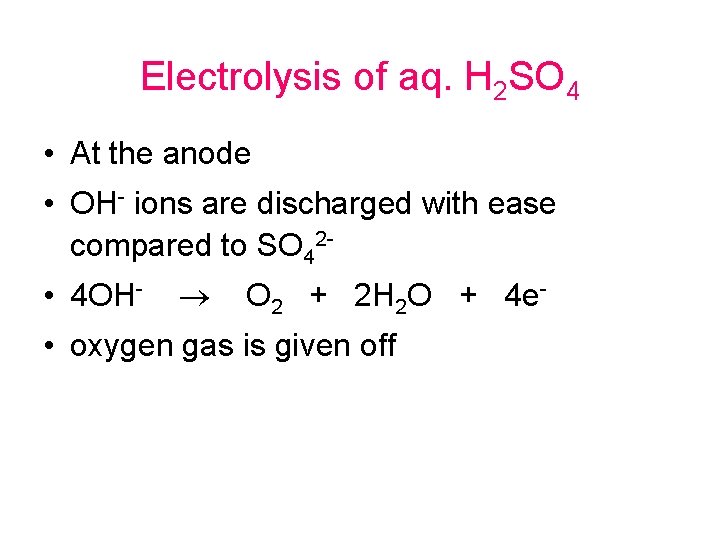
Electrolysis of aq. H 2 SO 4 • At the anode • OH- ions are discharged with ease compared to SO 42 • 4 OH- O 2 + 2 H 2 O + 4 e- • oxygen gas is given off
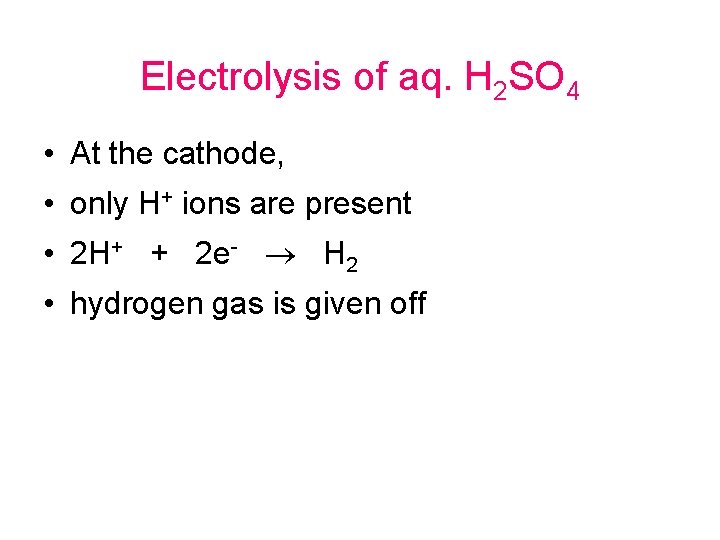
Electrolysis of aq. H 2 SO 4 • At the cathode, • only H+ ions are present • 2 H+ + 2 e- H 2 • hydrogen gas is given off
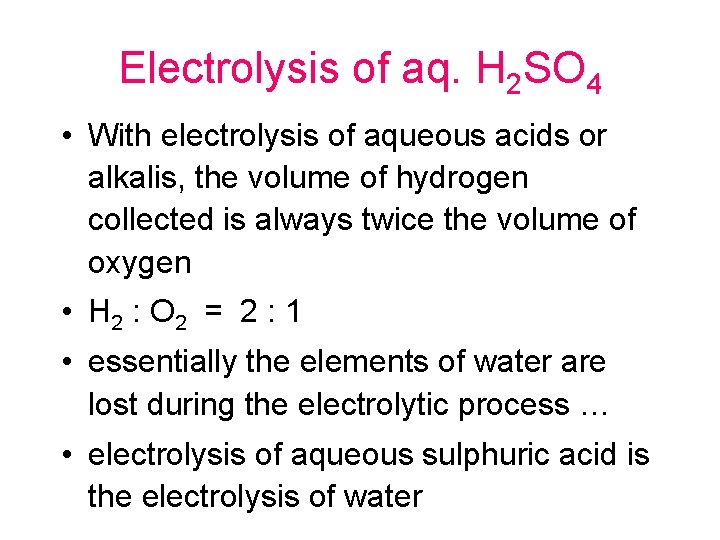
Electrolysis of aq. H 2 SO 4 • With electrolysis of aqueous acids or alkalis, the volume of hydrogen collected is always twice the volume of oxygen • H 2 : O 2 = 2 : 1 • essentially the elements of water are lost during the electrolytic process … • electrolysis of aqueous sulphuric acid is the electrolysis of water
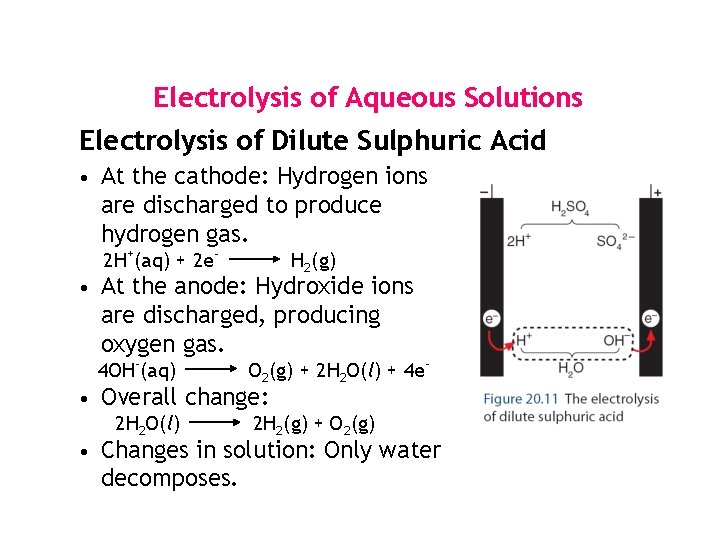
Electrolysis of Aqueous Solutions Electrolysis of Dilute Sulphuric Acid • At the cathode: Hydrogen ions are discharged to produce hydrogen gas. 2 H+(aq) + 2 e- • At the anode: Hydroxide ions are discharged, producing oxygen gas. 4 OH-(aq) • O 2(g) + 2 H 2 O(l) + 4 e- Overall change: 2 H 2 O(l) • H 2(g) 2 H 2(g) + O 2(g) Changes in solution: Only water decomposes.
Since water is a covalent compound, pure or distilled water is a non-electrolyte. A few drops of ionic compound like dilute sulphuric acid are enough to make the water become an electrolyte
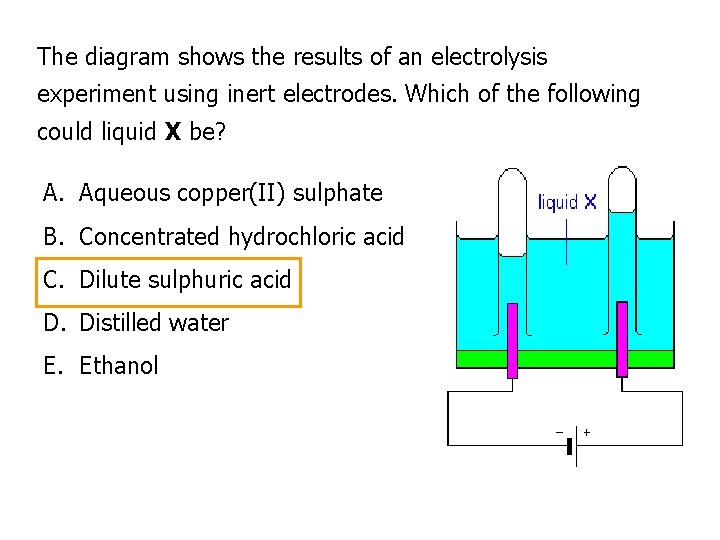
The diagram shows the results of an electrolysis experiment using inert electrodes. Which of the following could liquid X be? A. Aqueous copper(II) sulphate B. Concentrated hydrochloric acid C. Dilute sulphuric acid D. Distilled water E. Ethanol
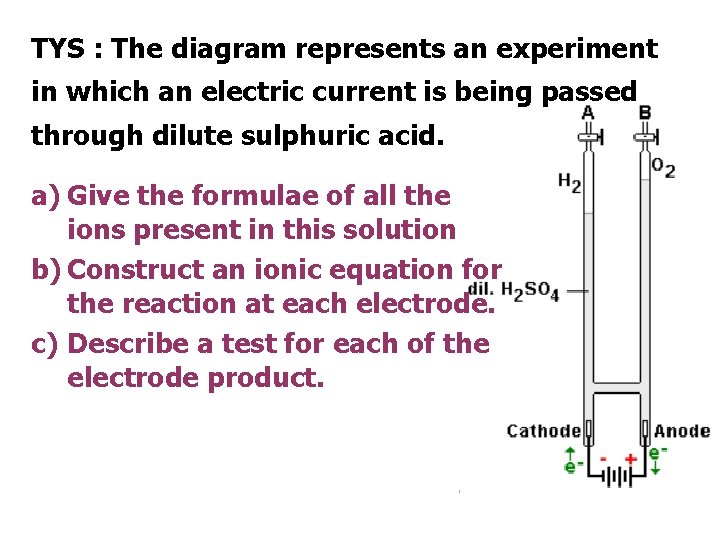
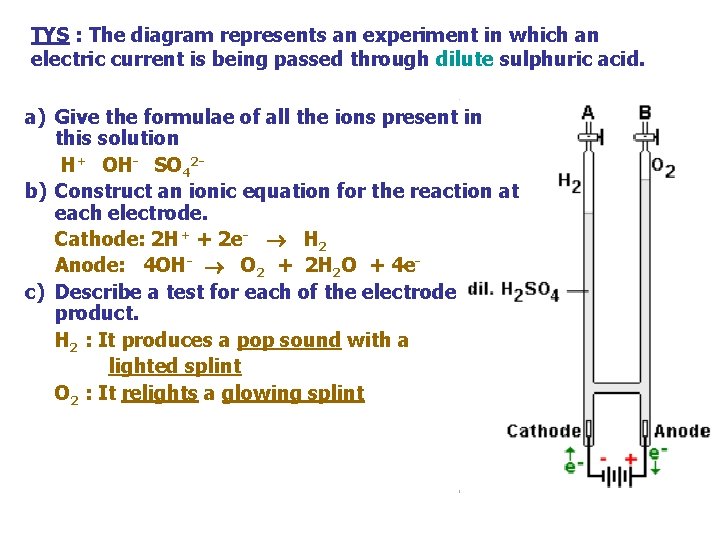
TYS : The diagram represents an experiment in which an electric current is being passed through dilute sulphuric acid. a) Give the formulae of all the ions present in this solution b) Construct an ionic equation for the reaction at each electrode. c) Describe a test for each of the electrode product.
TYS : The diagram represents an experiment in which an electric current is being passed through dilute sulphuric acid. a) Give the formulae of all the ions present in this solution H+ OH- SO 42 b) Construct an ionic equation for the reaction at each electrode. Cathode: 2 H+ + 2 e- H 2 Anode: 4 OH- O 2 + 2 H 2 O + 4 ec) Describe a test for each of the electrode product. H 2 : It produces a pop sound with a lighted splint O 2 : It relights a glowing splint
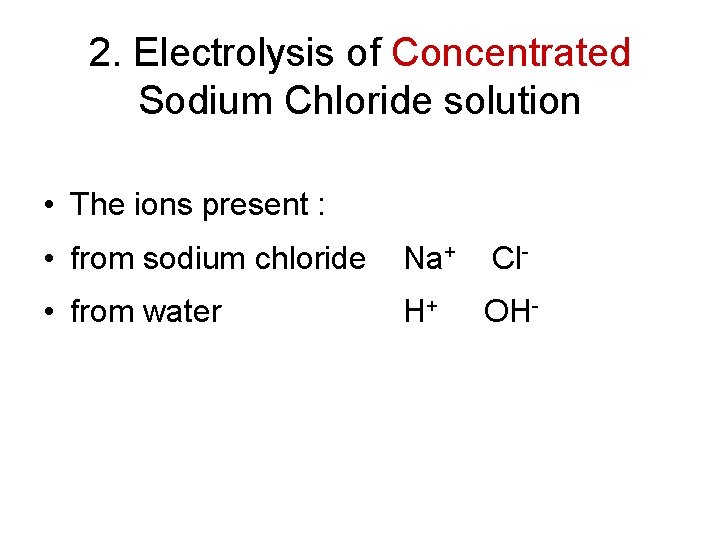
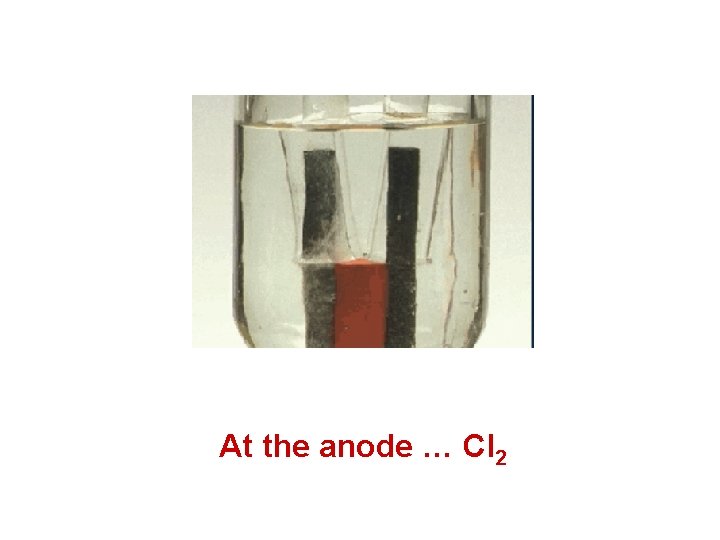
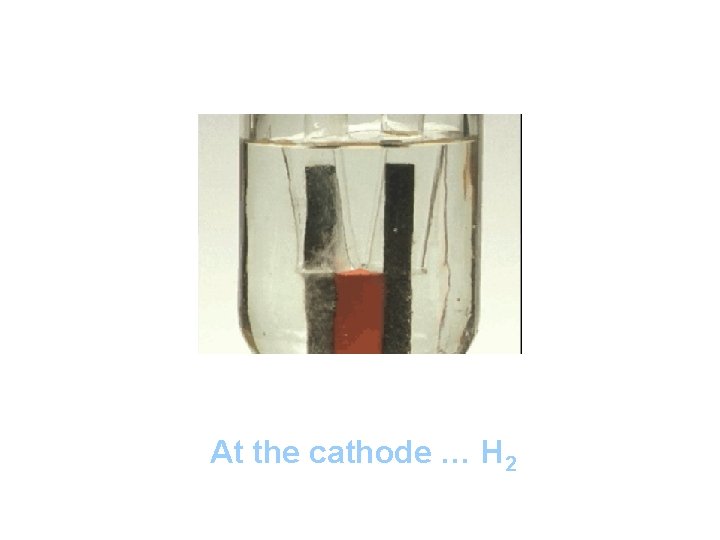
2. Electrolysis of Concentrated Sodium Chloride solution • The ions present : • from sodium chloride Na+ Cl- • from water H+ OH-
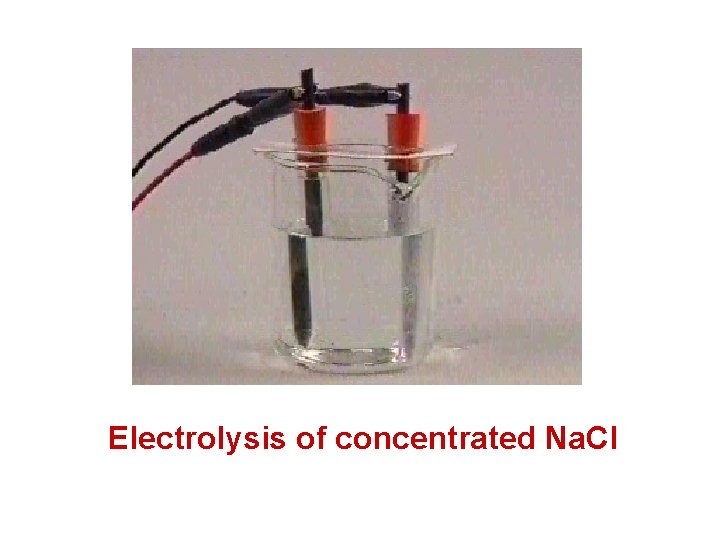
Electrolysis of concentrated Na. Cl
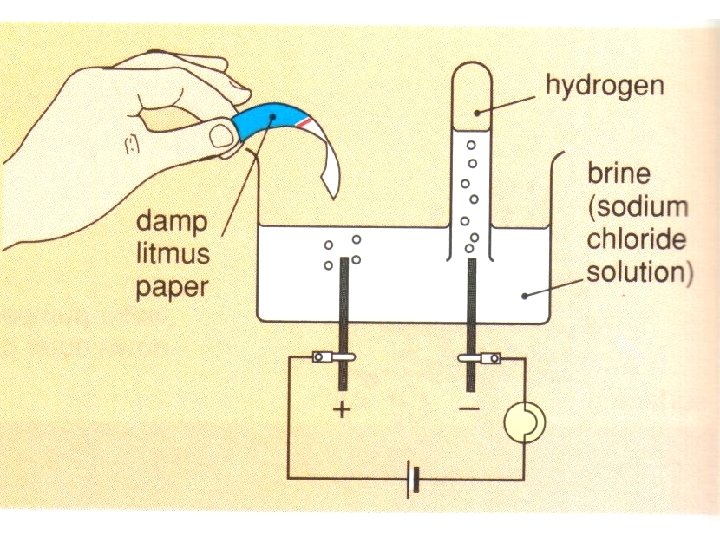
At the anode … Cl 2
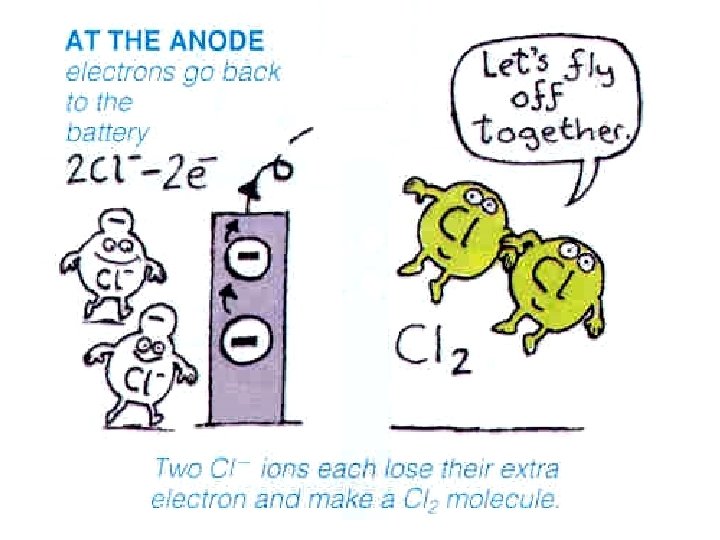
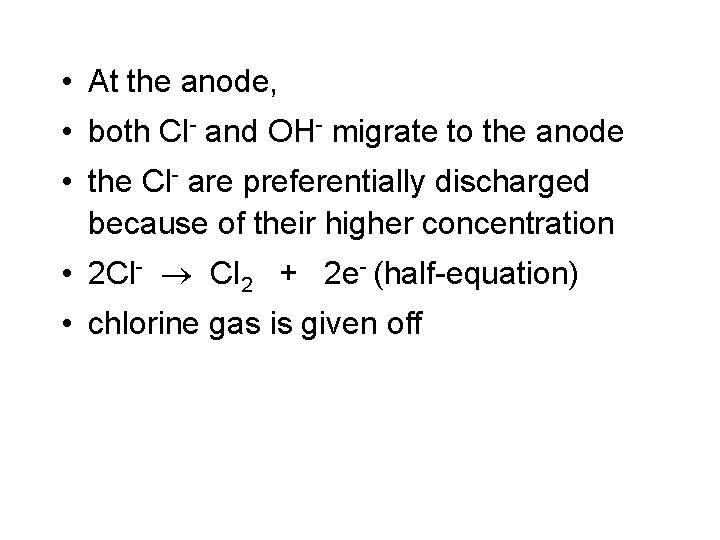
• At the anode, • both Cl- and OH- migrate to the anode • the Cl- are preferentially discharged because of their higher concentration • 2 Cl- Cl 2 + 2 e- (half-equation) • chlorine gas is given off
At the cathode … H 2
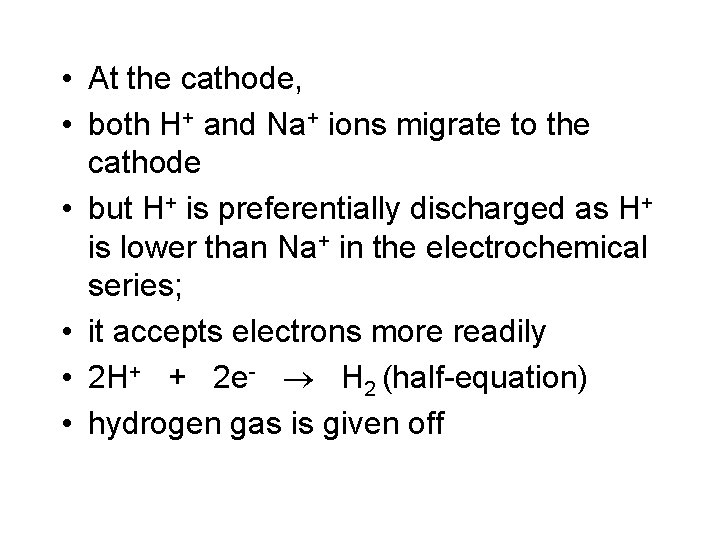
• At the cathode, • both H+ and Na+ ions migrate to the cathode • but H+ is preferentially discharged as H+ is lower than Na+ in the electrochemical series; • it accepts electrons more readily • 2 H+ + 2 e- H 2 (half-equation) • hydrogen gas is given off
• Eventually, • there will be a depletion of H+ and Clions in the solution • the Na+ and OH- however remains • so solution will become Na. OH • which is alkaline !
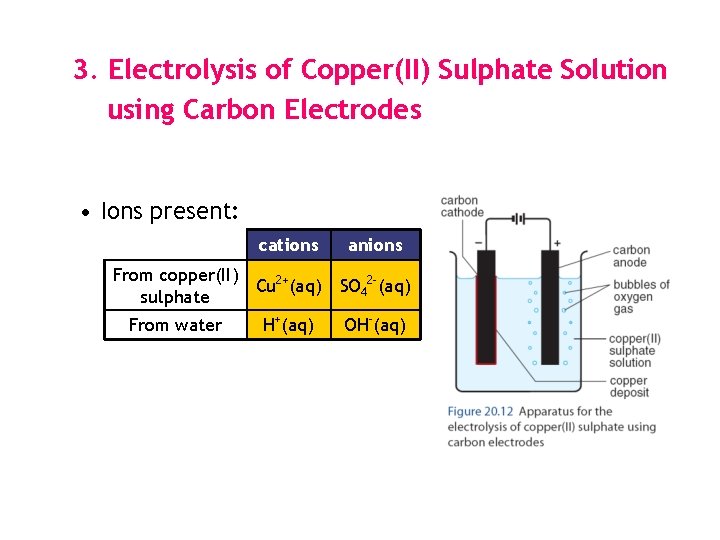
3. Electrolysis of Copper(II) Sulphate Solution using Carbon Electrodes • Ions present: cations From copper(II) Cu 2+(aq) sulphate From water H+(aq) anions SO 42 -(aq) OH-(aq)
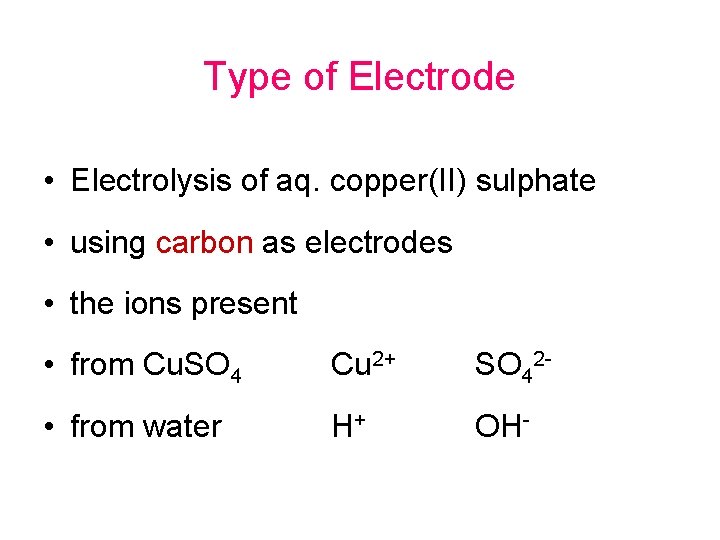
Type of Electrode • Electrolysis of aq. copper(II) sulphate • using carbon as electrodes • the ions present • from Cu. SO 4 Cu 2+ SO 42 - • from water H+ OH-
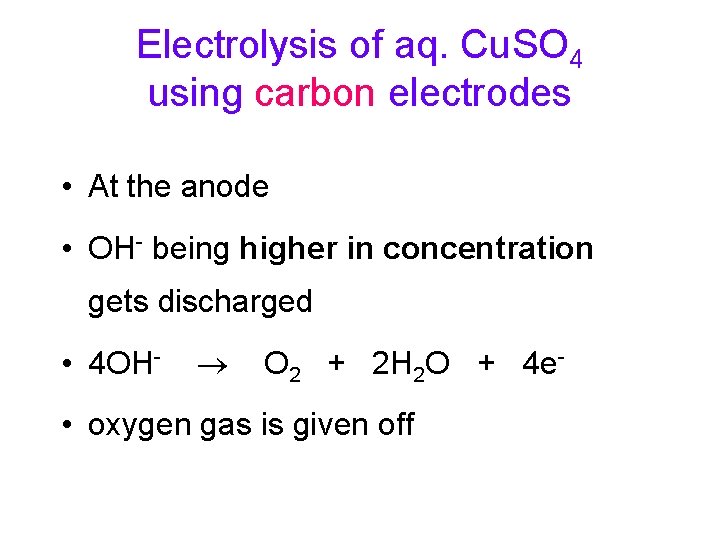
Electrolysis of aq. Cu. SO 4 using carbon electrodes • At the anode • OH- being higher in concentration gets discharged • 4 OH- O 2 + 2 H 2 O + 4 e- • oxygen gas is given off
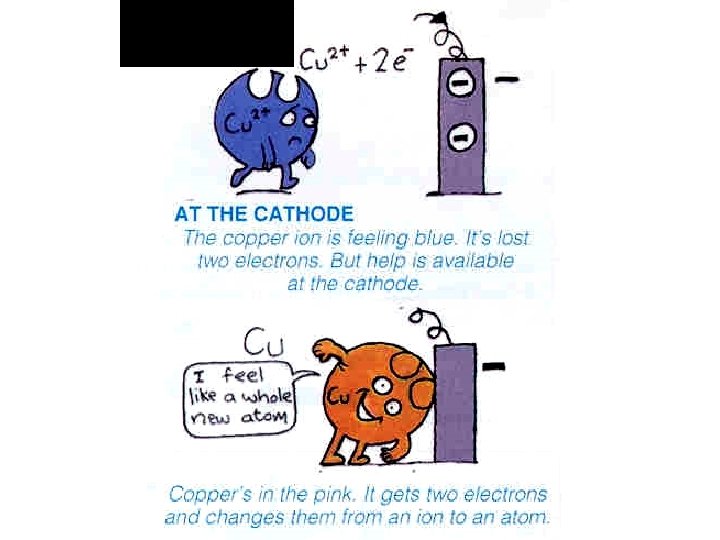
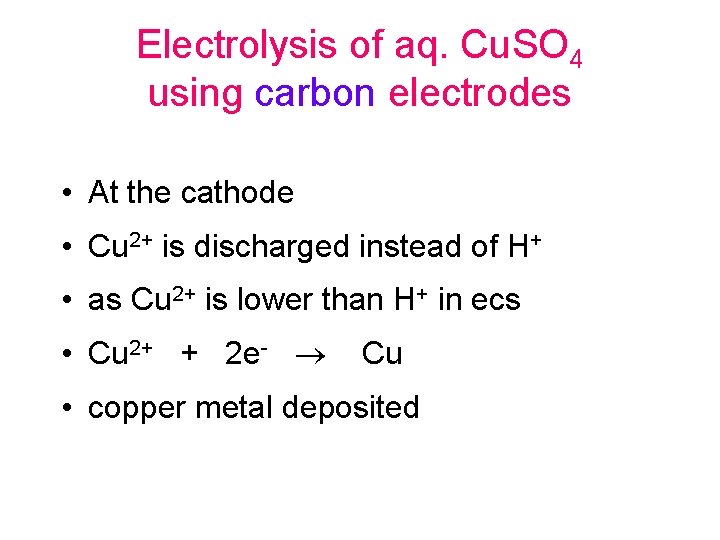
Electrolysis of aq. Cu. SO 4 using carbon electrodes • At the cathode • Cu 2+ is discharged instead of H+ • as Cu 2+ is lower than H+ in ecs • Cu 2+ + 2 e- Cu • copper metal deposited
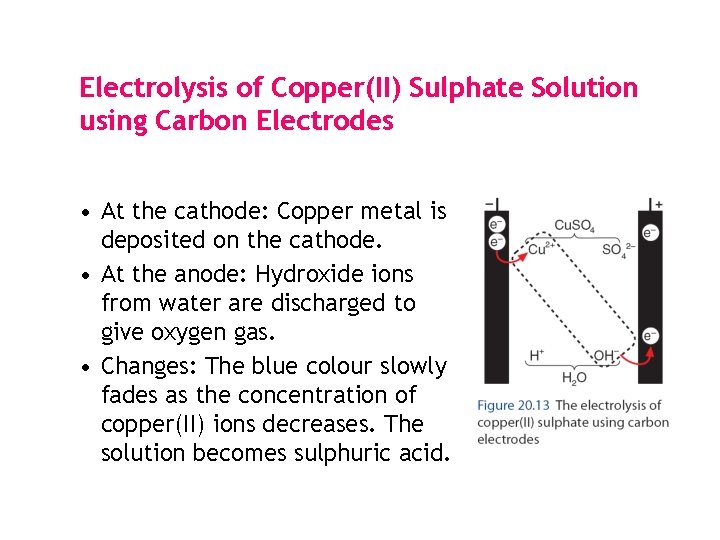
Electrolysis of Copper(II) Sulphate Solution using Carbon Electrodes • At the cathode: Copper metal is deposited on the cathode. • At the anode: Hydroxide ions from water are discharged to give oxygen gas. • Changes: The blue colour slowly fades as the concentration of copper(II) ions decreases. The solution becomes sulphuric acid.
REACTIVE ELECTRODES
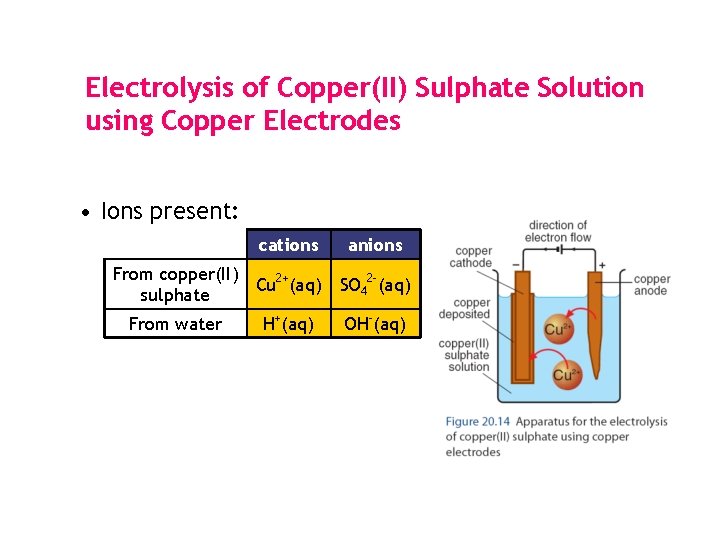
Electrolysis of Copper(II) Sulphate Solution using Copper Electrodes • Ions present: cations From copper(II) Cu 2+(aq) sulphate From water H+(aq) anions SO 42 -(aq) OH-(aq)
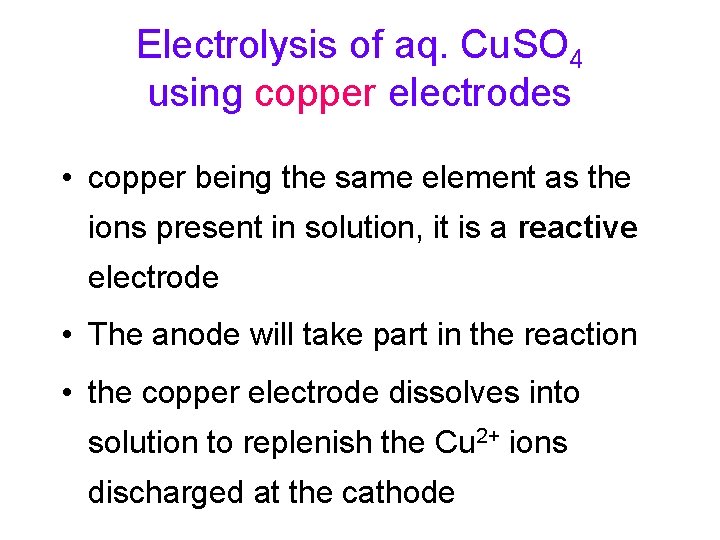
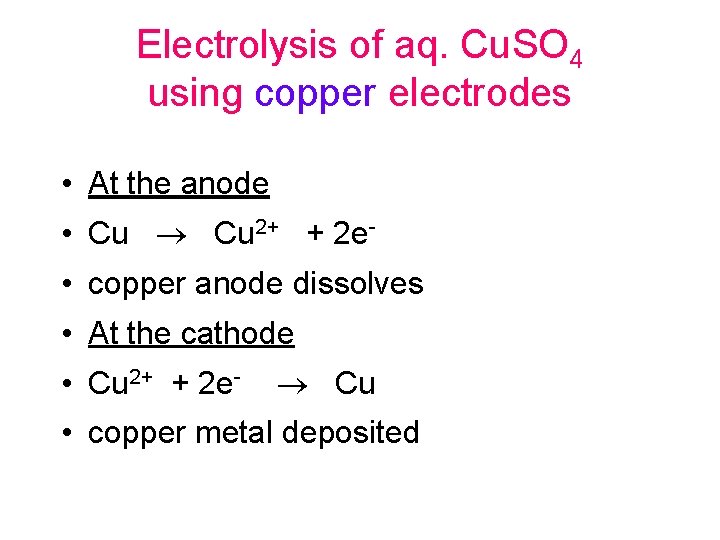
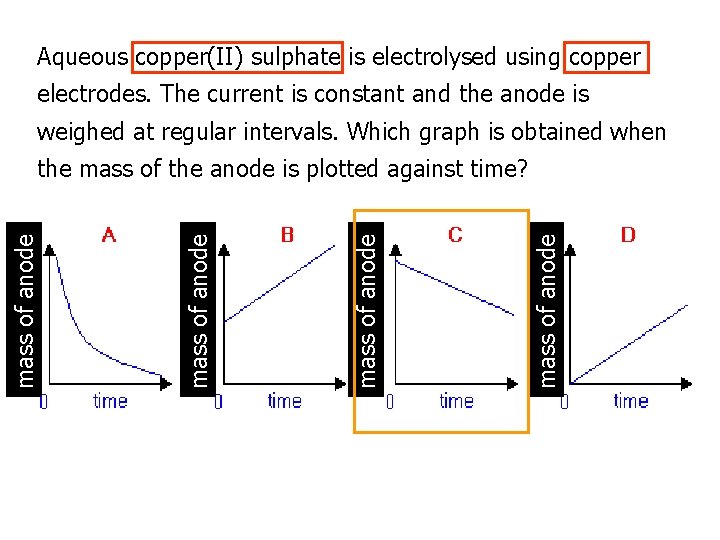
Electrolysis of aq. Cu. SO 4 using copper electrodes • copper being the same element as the ions present in solution, it is a reactive electrode • The anode will take part in the reaction • the copper electrode dissolves into solution to replenish the Cu 2+ ions discharged at the cathode
Electrolysis of aq. Cu. SO 4 using copper electrodes • At the anode • Cu 2+ + 2 e • copper anode dissolves • At the cathode • Cu 2+ + 2 e- Cu • copper metal deposited
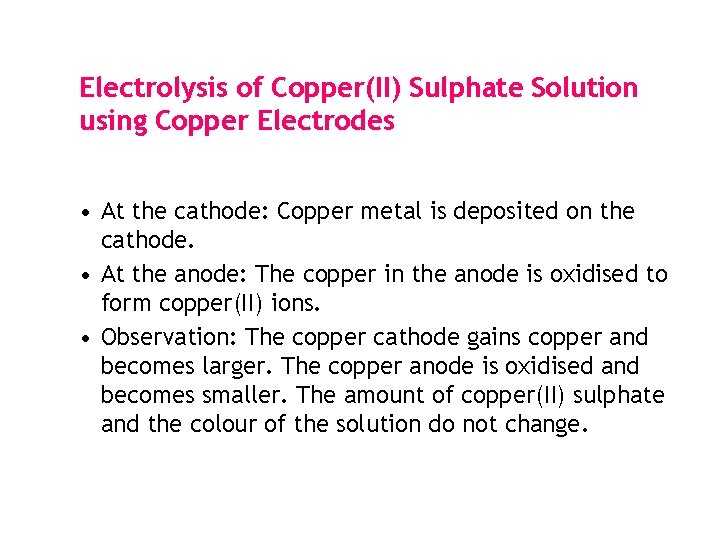
Electrolysis of Copper(II) Sulphate Solution using Copper Electrodes • At the cathode: Copper metal is deposited on the cathode. • At the anode: The copper in the anode is oxidised to form copper(II) ions. • Observation: The copper cathode gains copper and becomes larger. The copper anode is oxidised and becomes smaller. The amount of copper(II) sulphate and the colour of the solution do not change.
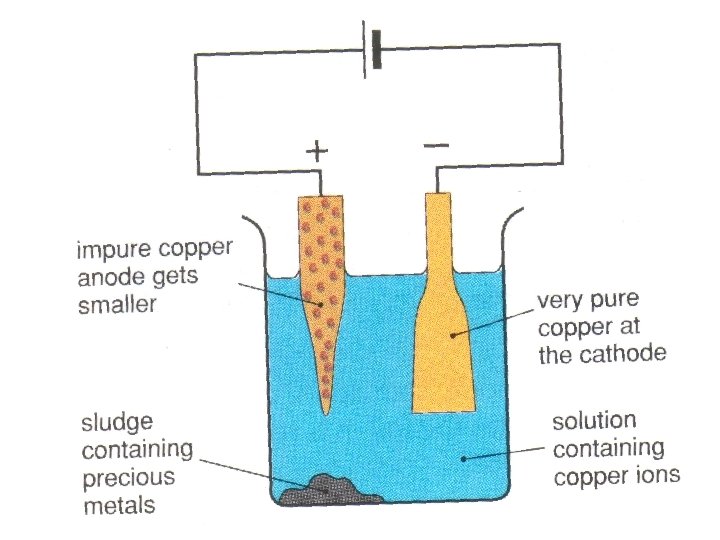
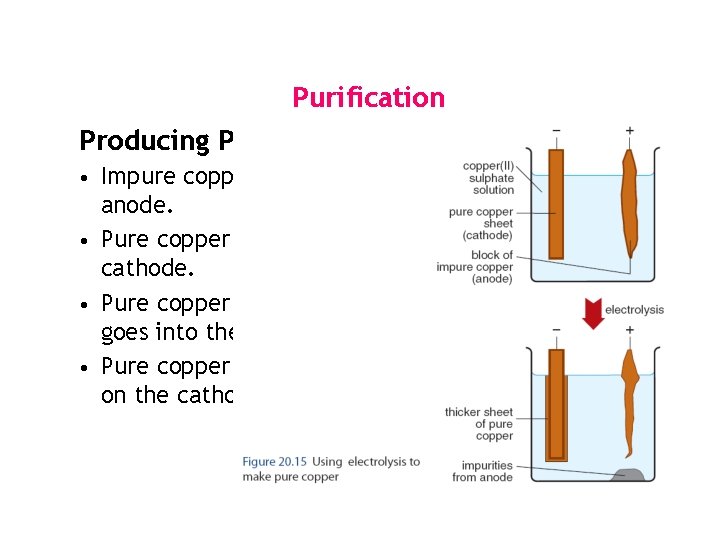
Purification Producing Pure Copper Impure copper is made the anode. • Pure copper is used as the cathode. • Pure copper from the anode goes into the electrolyte. • Pure copper is then deposited on the cathode. •
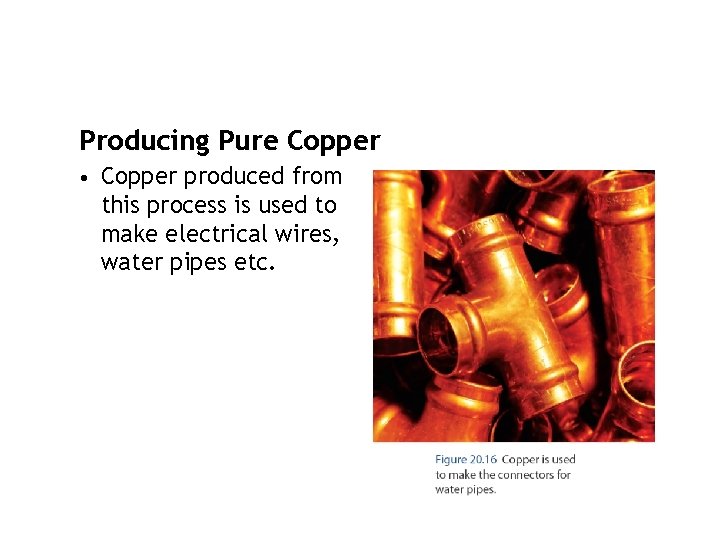
Producing Pure Copper • Copper produced from this process is used to make electrical wires, water pipes etc.
• During electrolysis of aqueous solutions, the products at the electrodes can come from the electrolyte or from the water. The product at the cathode is a metal or hydrogen. The product at the anode is a non-metal. • Reactive metals are not formed at the cathode. Instead, hydrogen from the water is produced. • Sulphate and nitrate ions are not discharged at the anode. Instead, oxygen from the water is produced.
• In concentrated solutions, halide ions and not hydroxide ions are discharged; in dilute solutions, hydroxide ions are discharged. • When the anode is made of a metal, it often goes into the electrolyte as the metal ions. For example, a copper anode goes into the copper(II) sulphate solution as copper(II) ions. • Carbon and platinum are inert electrodes. They do not react with or dissolve in the electrolyte. • Copper is refined by the electrolysis of copper(II) sulphate solution using copper electrodes.
Aqueous copper(II) sulphate is electrolysed using copper electrodes. The current is constant and the anode is weighed at regular intervals. Which graph is obtained when mass of anode the mass of the anode is plotted against time?
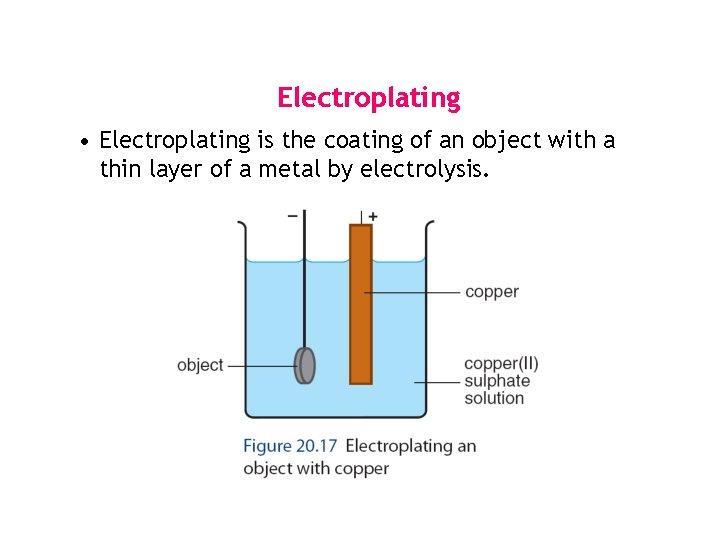
Electroplating • Electroplating is the coating of an object with a thin layer of a metal by electrolysis.
Electroplating • The electrolyte is copper(II) sulphate solution. The object is made the cathode and a piece of copper is used as the anode. • At the anode: Cu(s) Cu 2+(aq) + 2 e • At the cathode: Cu 2+(aq) + 2 e. Cu(s) • The overall change is that copper is transferred from the anode to the object. • The copper(II) sulphate remains unchanged.
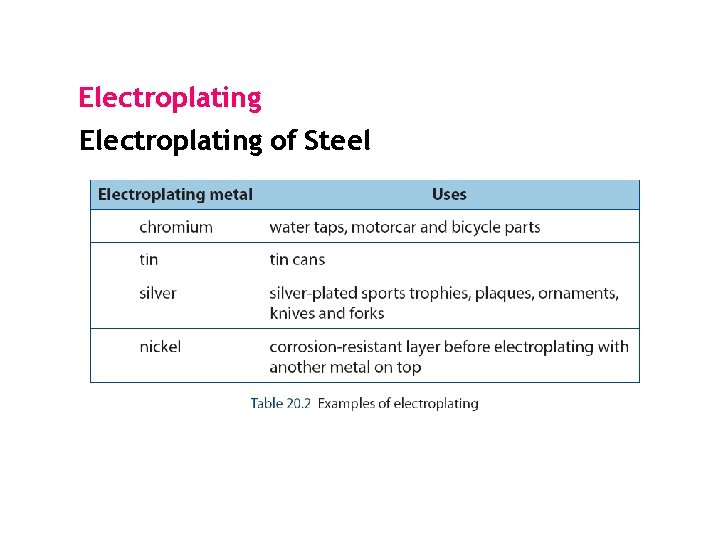
Electroplating of Steel • Steel objects are electroplated to protect the steel from corrosion and to give the object an attractive appearance. • The metals used to electroplate steel objects are corrosion resistant, shiny and are usually low in the reactivity series.
Electroplating of Steel
• Objects are electroplated to protect them from corrosion and to give them an attractive appearance. • To electroplate an object with a metal: - the object is made the cathode, - the electroplating metal is made the anode, and - the electrolyte is a solution of the metal ions.
Electric cells
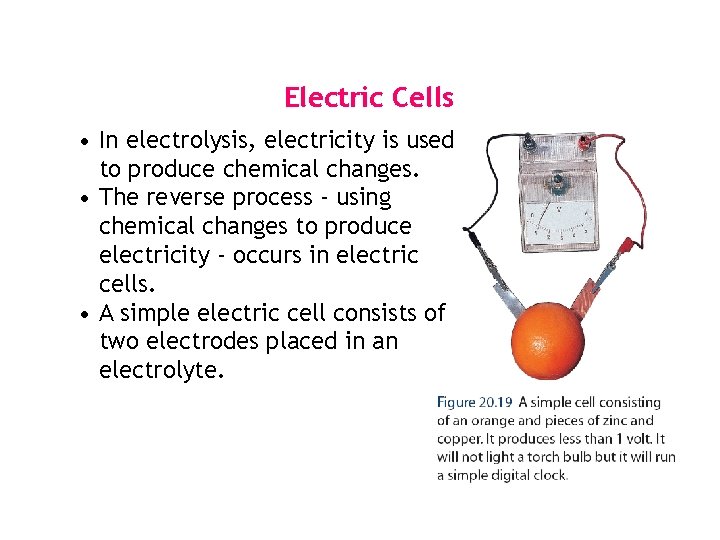
Electric Cells • In electrolysis, electricity is used to produce chemical changes. • The reverse process - using chemical changes to produce electricity - occurs in electric cells. • A simple electric cell consists of two electrodes placed in an electrolyte.
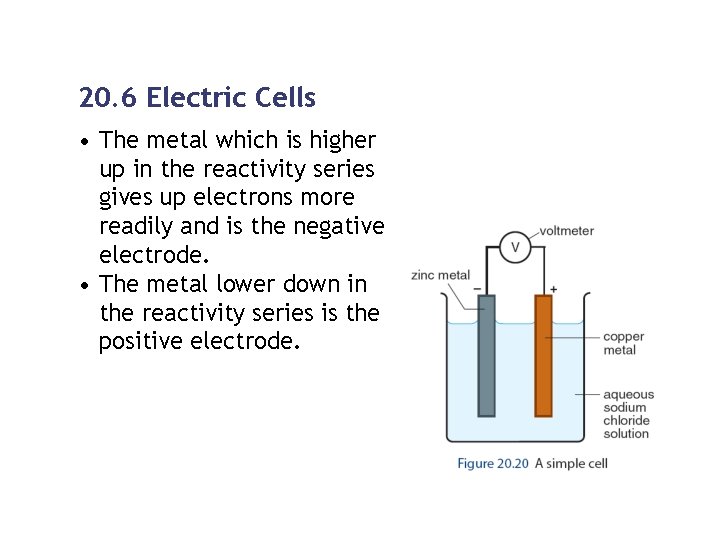
20. 6 Electric Cells • The metal which is higher up in the reactivity series gives up electrons more readily and is the negative electrode. • The metal lower down in the reactivity series is the positive electrode.
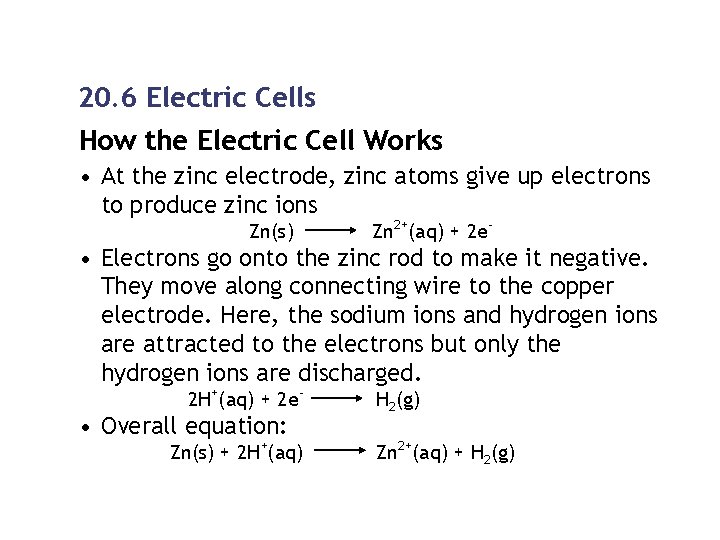
20. 6 Electric Cells How the Electric Cell Works • At the zinc electrode, zinc atoms give up electrons to produce zinc ions Zn(s) Zn 2+(aq) + 2 e- • Electrons go onto the zinc rod to make it negative. They move along connecting wire to the copper electrode. Here, the sodium ions and hydrogen ions are attracted to the electrons but only the hydrogen ions are discharged. 2 H+(aq) + 2 e- • Overall equation: Zn(s) + 2 H+(aq) H 2(g) Zn 2+(aq) + H 2(g)
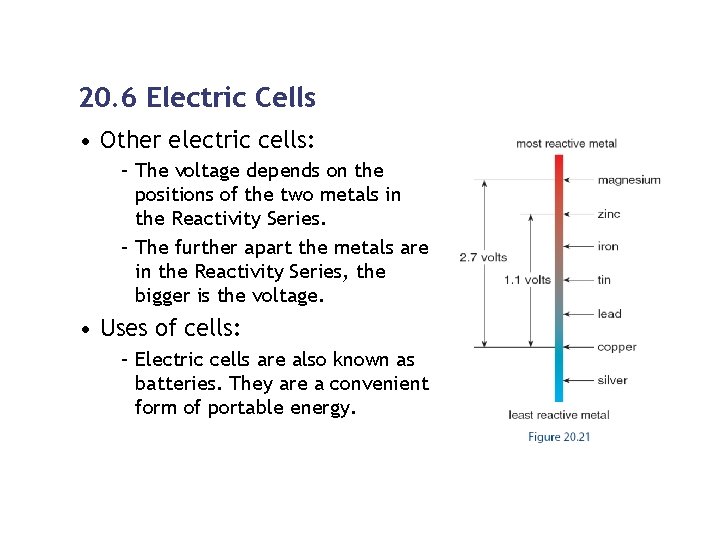
20. 6 Electric Cells • Other electric cells: – The voltage depends on the positions of the two metals in the Reactivity Series. – The further apart the metals are in the Reactivity Series, the bigger is the voltage. • Uses of cells: – Electric cells are also known as batteries. They are a convenient form of portable energy.
• A simple electric cell consists of two different metals and an electrolyte. • The metal higher up in the reactivity series is the negative electrode. • The further apart the metals are in the reactivity series, the bigger the voltage of the cell.