
definitions methods of measurement Cp CV Cp CV


- Slides: 25
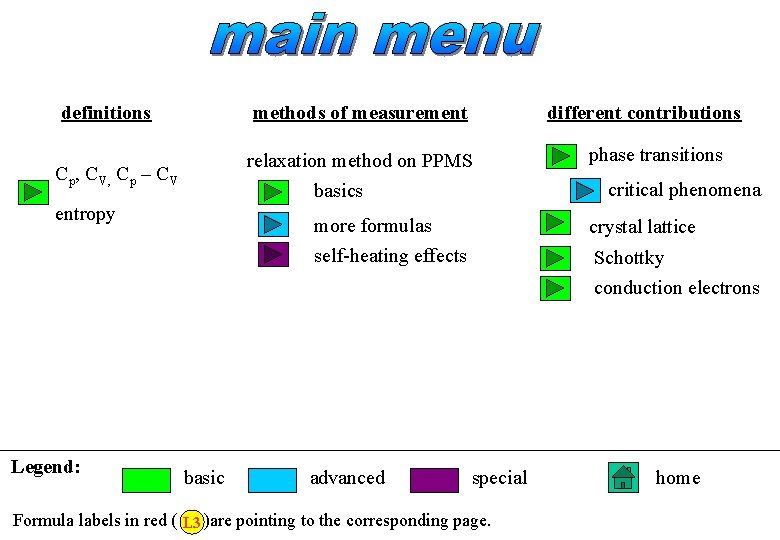
definitions methods of measurement Cp, CV, Cp – CV relaxation method on PPMS basics entropy Legend: basic different contributions phase transitions critical phenomena more formulas crystal lattice self-heating effects Schottky conduction electrons advanced special Formula labels in red ( L 3 )are pointing to the corresponding page. home
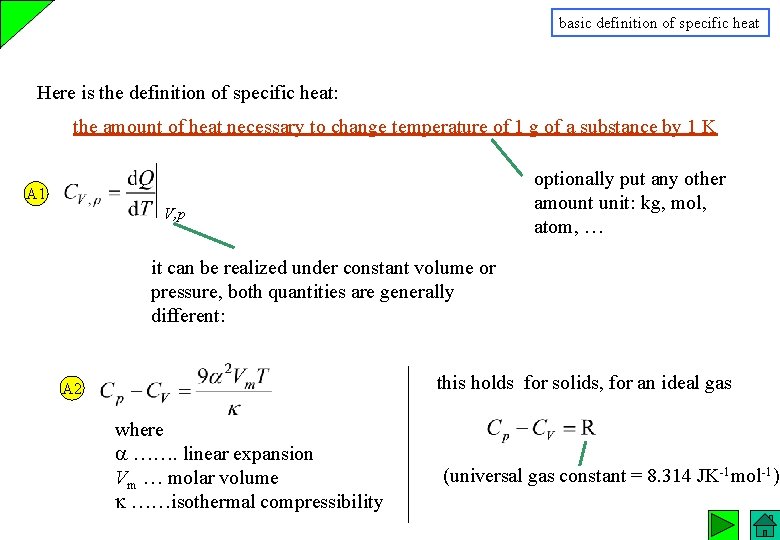
basic definition of specific heat Here is the definition of specific heat: the amount of heat necessary to change temperature of 1 g of a substance by 1 K optionally put any other amount unit: kg, mol, atom, … A 1 V, p it can be realized under constant volume or pressure, both quantities are generally different: this holds for solids, for an ideal gas A 2 where ……. linear expansion Vm … molar volume k ……isothermal compressibility (universal gas constant = 8. 314 JK-1 mol-1)
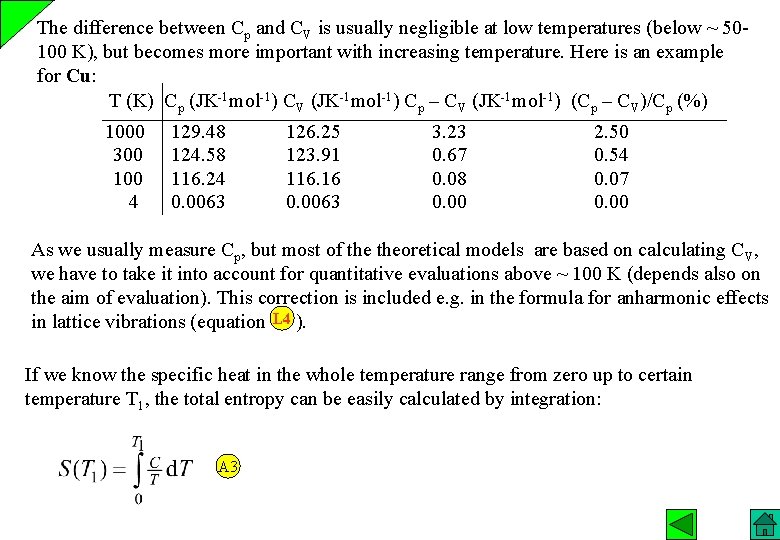
The difference between Cp and CV is usually negligible at low temperatures (below ~ 50100 K), but becomes more important with increasing temperature. Here is an example for Cu: T (K) Cp (JK-1 mol-1) CV (JK-1 mol-1) Cp – CV (JK-1 mol-1) (Cp – CV)/Cp (%) 1000 300 100 4 129. 48 124. 58 116. 24 0. 0063 126. 25 123. 91 116. 16 0. 0063 3. 23 0. 67 0. 08 0. 00 2. 50 0. 54 0. 07 0. 00 As we usually measure Cp, but most of theoretical models are based on calculating CV, we have to take it into account for quantitative evaluations above ~ 100 K (depends also on the aim of evaluation). This correction is included e. g. in the formula for anharmonic effects in lattice vibrations (equation L 4 ). If we know the specific heat in the whole temperature range from zero up to certain temperature T 1, the total entropy can be easily calculated by integration: A 3
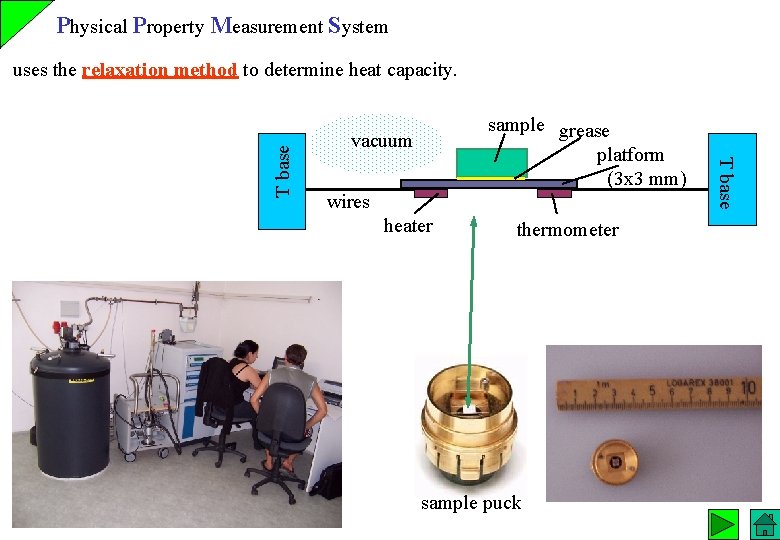
Physical Property Measurement System sample grease platform (3 x 3 mm) vacuum wires heater thermometer sample puck T base uses the relaxation method to determine heat capacity.
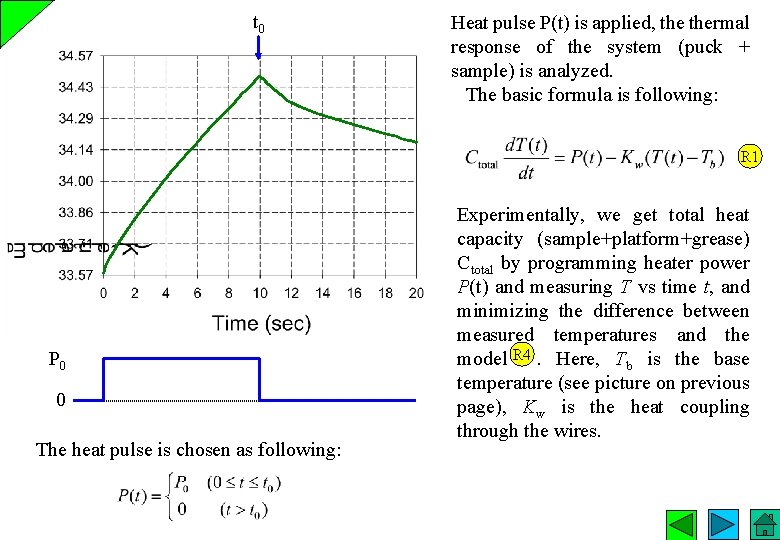
t 0 Heat pulse P(t) is applied, thermal response of the system (puck + sample) is analyzed. The basic formula is following: R 1 P 0 0 The heat pulse is chosen as following: Experimentally, we get total heat capacity (sample+platform+grease) Ctotal by programming heater power P(t) and measuring T vs time t, and minimizing the difference between measured temperatures and the model R 4. Here, Tb is the base temperature (see picture on previous page), Kw is the heat coupling through the wires.
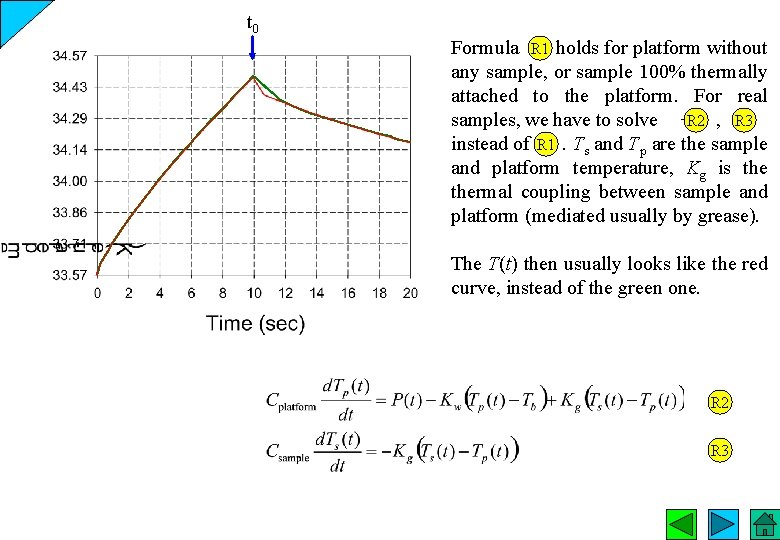
t 0 Formula R 1 holds for platform without any sample, or sample 100% thermally attached to the platform. For real samples, we have to solve +R 2 , R 3 instead of R 1. Ts and Tp are the sample and platform temperature, Kg is thermal coupling between sample and platform (mediated usually by grease). The T(t) then usually looks like the red curve, instead of the green one. R 2 R 3
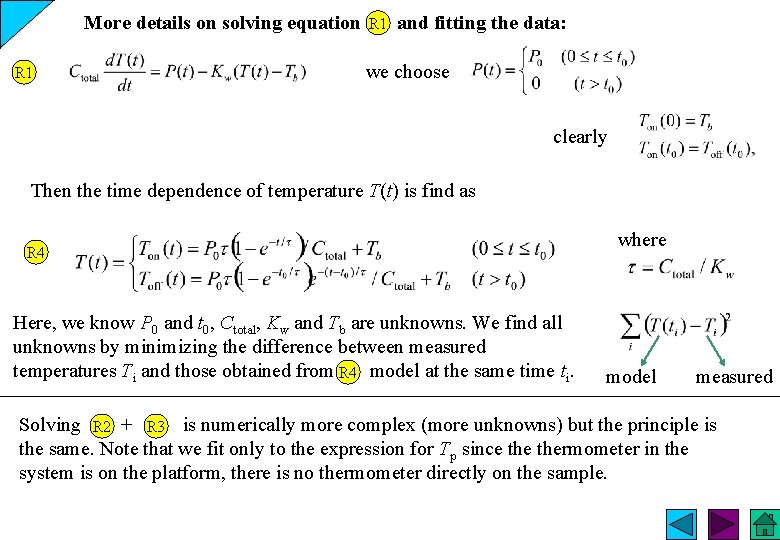
More details on solving equation R 1 and fitting the data: we choose clearly Then the time dependence of temperature T(t) is find as R 4 Here, we know P 0 and t 0, Ctotal, Kw and Tb are unknowns. We find all unknowns by minimizing the difference between measured temperatures Ti and those obtained from R 4 model at the same ti. where model measured Solving R 2 + R 3 is numerically more complex (more unknowns) but the principle is the same. Note that we fit only to the expression for Tp since thermometer in the system is on the platform, there is no thermometer directly on the sample.
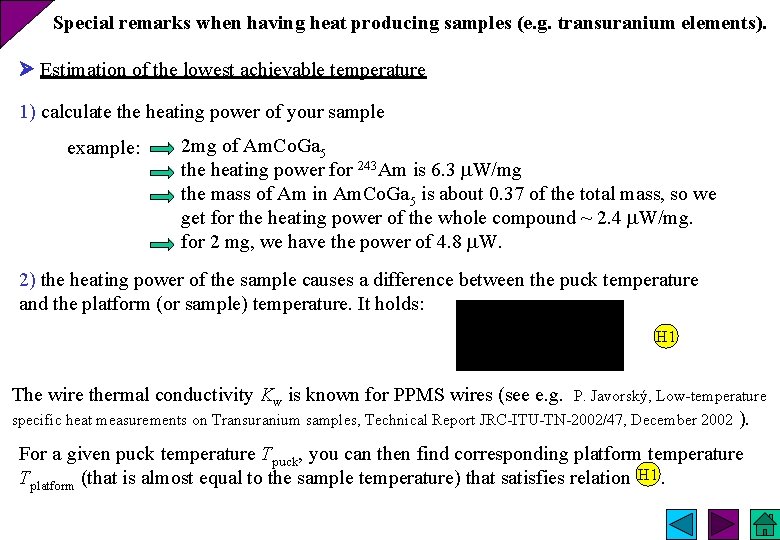
Special remarks when having heat producing samples (e. g. transuranium elements). Estimation of the lowest achievable temperature 1) calculate the heating power of your sample example: 2 mg of Am. Co. Ga 5 the heating power for 243 Am is 6. 3 W/mg the mass of Am in Am. Co. Ga 5 is about 0. 37 of the total mass, so we get for the heating power of the whole compound ~ 2. 4 W/mg. for 2 mg, we have the power of 4. 8 W. 2) the heating power of the sample causes a difference between the puck temperature and the platform (or sample) temperature. It holds: H 1 The wire thermal conductivity Kw is known for PPMS wires (see e. g. P. Javorský, Low-temperature specific heat measurements on Transuranium samples, Technical Report JRC-ITU-TN-2002/47, December 2002 ). For a given puck temperature Tpuck, you can then find corresponding platform temperature Tplatform (that is almost equal to the sample temperature) that satisfies relation H 1.
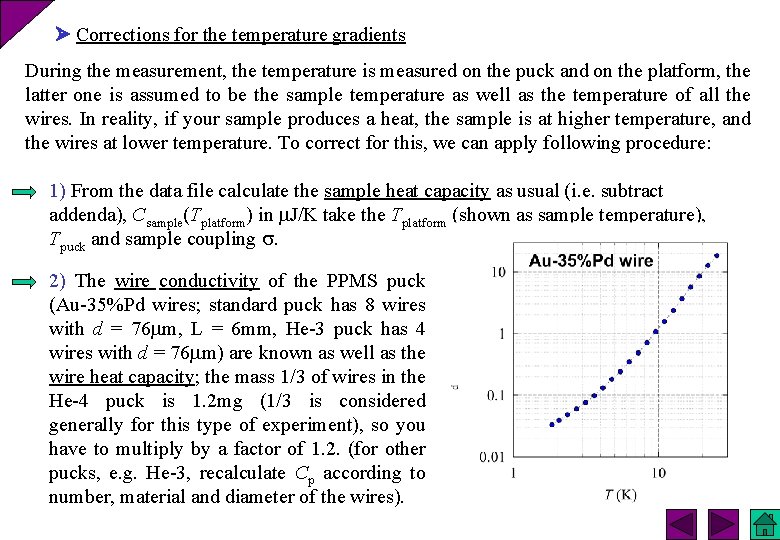
Corrections for the temperature gradients During the measurement, the temperature is measured on the puck and on the platform, the latter one is assumed to be the sample temperature as well as the temperature of all the wires. In reality, if your sample produces a heat, the sample is at higher temperature, and the wires at lower temperature. To correct for this, we can apply following procedure: 1) From the data file calculate the sample heat capacity as usual (i. e. subtract addenda), Csample(Tplatform) in J/K take the Tplatform (shown as sample temperature), Tpuck and sample coupling . 2) The wire conductivity of the PPMS puck (Au-35%Pd wires; standard puck has 8 wires with d = 76 m, L = 6 mm, He-3 puck has 4 wires with d = 76 m) are known as well as the wire heat capacity; the mass 1/3 of wires in the He-4 puck is 1. 2 mg (1/3 is considered generally for this type of experiment), so you have to multiply by a factor of 1. 2. (for other pucks, e. g. He-3, recalculate Cp according to number, material and diameter of the wires).
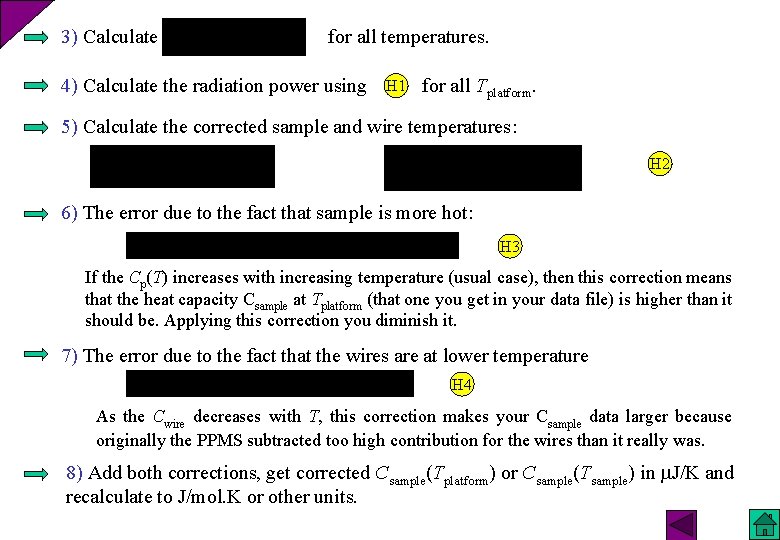
3) Calculate for all temperatures. 4) Calculate the radiation power using H 1 for all Tplatform. 5) Calculate the corrected sample and wire temperatures: H 2 6) The error due to the fact that sample is more hot: H 3 If the Cp(T) increases with increasing temperature (usual case), then this correction means that the heat capacity Csample at Tplatform (that one you get in your data file) is higher than it should be. Applying this correction you diminish it. 7) The error due to the fact that the wires are at lower temperature H 4 As the Cwire decreases with T, this correction makes your Csample data larger because originally the PPMS subtracted too high contribution for the wires than it really was. 8) Add both corrections, get corrected Csample(Tplatform) or Csample(Tsample) in J/K and recalculate to J/mol. K or other units.
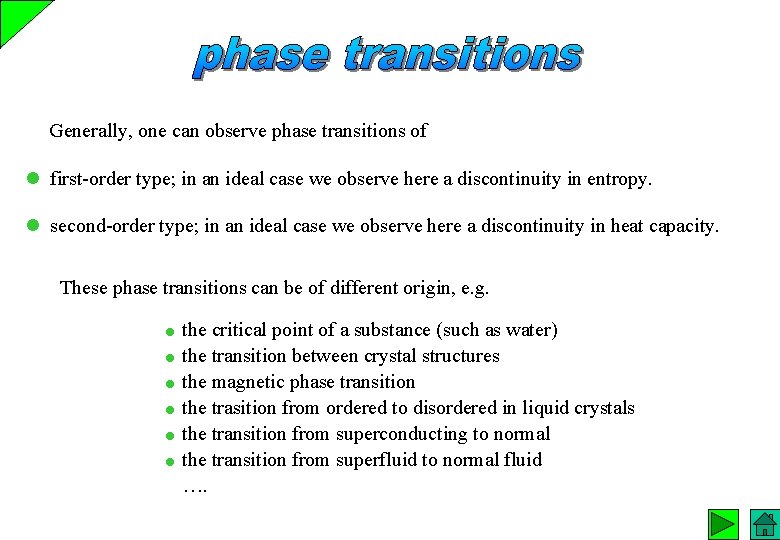
Generally, one can observe phase transitions of first-order type; in an ideal case we observe here a discontinuity in entropy. second-order type; in an ideal case we observe here a discontinuity in heat capacity. These phase transitions can be of different origin, e. g. the critical point of a substance (such as water) the transition between crystal structures the magnetic phase transition the trasition from ordered to disordered in liquid crystals the transition from superconducting to normal the transition from superfluid to normal fluid ….
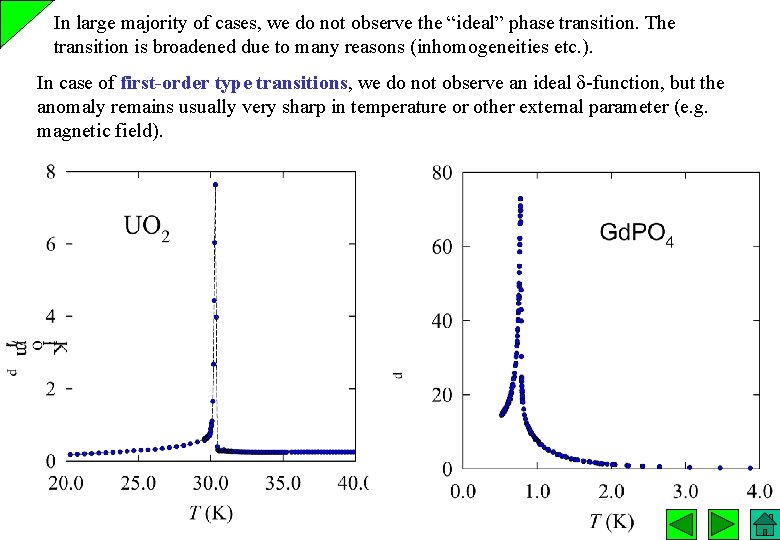
In large majority of cases, we do not observe the “ideal” phase transition. The transition is broadened due to many reasons (inhomogeneities etc. ). In case of first-order type transitions, we do not observe an ideal -function, but the anomaly remains usually very sharp in temperature or other external parameter (e. g. magnetic field).
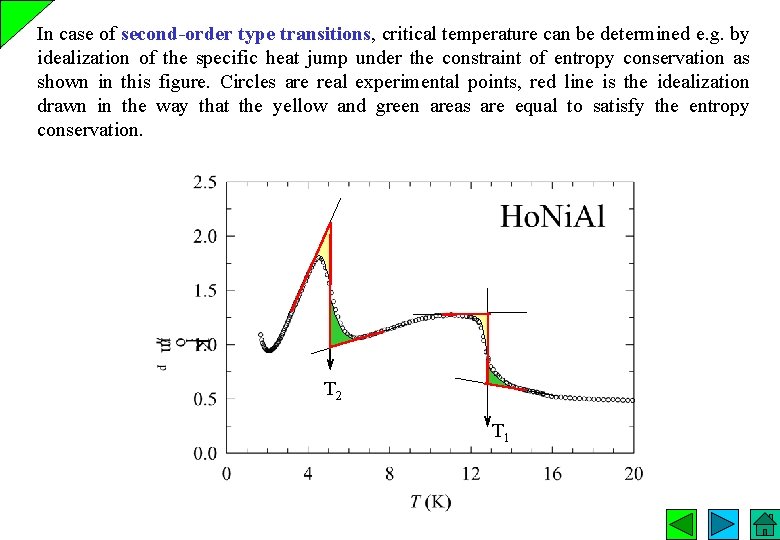
In case of second-order type transitions, critical temperature can be determined e. g. by idealization of the specific heat jump under the constraint of entropy conservation as shown in this figure. Circles are real experimental points, red line is the idealization drawn in the way that the yellow and green areas are equal to satisfy the entropy conservation. T 2 T 1
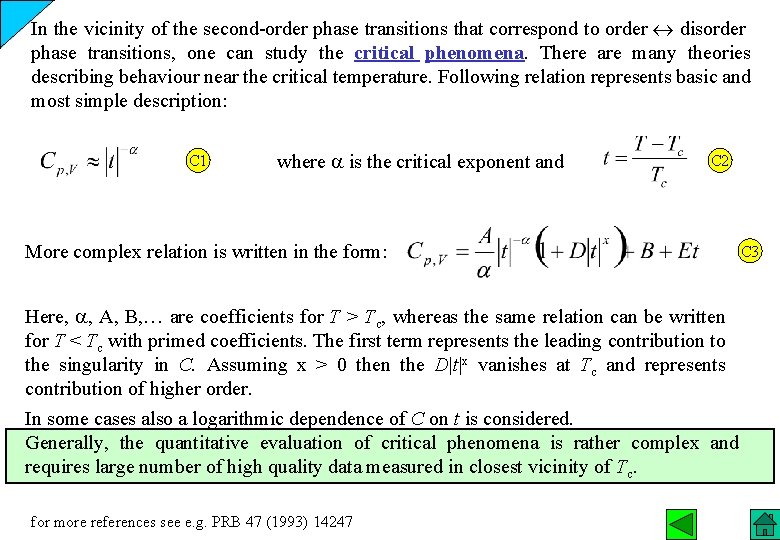
In the vicinity of the second-order phase transitions that correspond to order disorder phase transitions, one can study the critical phenomena. There are many theories describing behaviour near the critical temperature. Following relation represents basic and most simple description: C 1 where is the critical exponent and C 2 More complex relation is written in the form: Here, , A, B, … are coefficients for T > Tc, whereas the same relation can be written for T < Tc with primed coefficients. The first term represents the leading contribution to the singularity in C. Assuming x > 0 then the D t x vanishes at Tc and represents contribution of higher order. In some cases also a logarithmic dependence of C on t is considered. Generally, the quantitative evaluation of critical phenomena is rather complex and requires large number of high quality data measured in closest vicinity of Tc. for more references see e. g. PRB 47 (1993) 14247 C 3
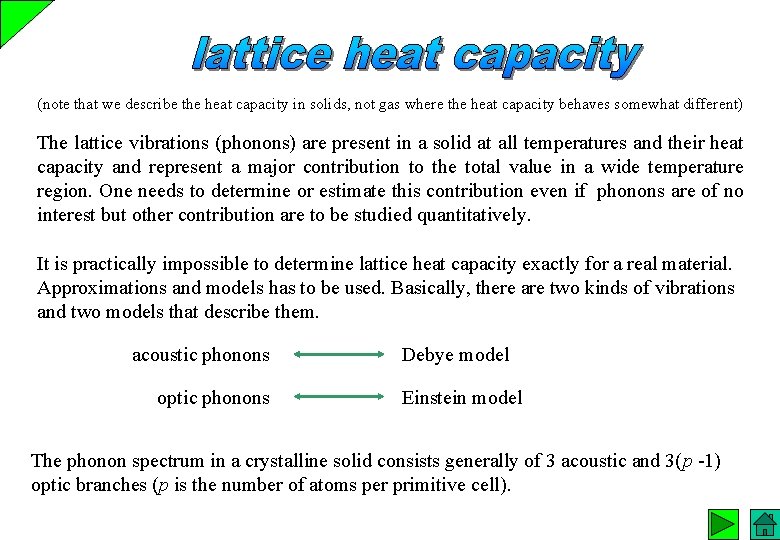
(note that we describe the heat capacity in solids, not gas where the heat capacity behaves somewhat different) The lattice vibrations (phonons) are present in a solid at all temperatures and their heat capacity and represent a major contribution to the total value in a wide temperature region. One needs to determine or estimate this contribution even if phonons are of no interest but other contribution are to be studied quantitatively. It is practically impossible to determine lattice heat capacity exactly for a real material. Approximations and models has to be used. Basically, there are two kinds of vibrations and two models that describe them. acoustic phonons optic phonons Debye model Einstein model The phonon spectrum in a crystalline solid consists generally of 3 acoustic and 3(p -1) optic branches (p is the number of atoms per primitive cell).
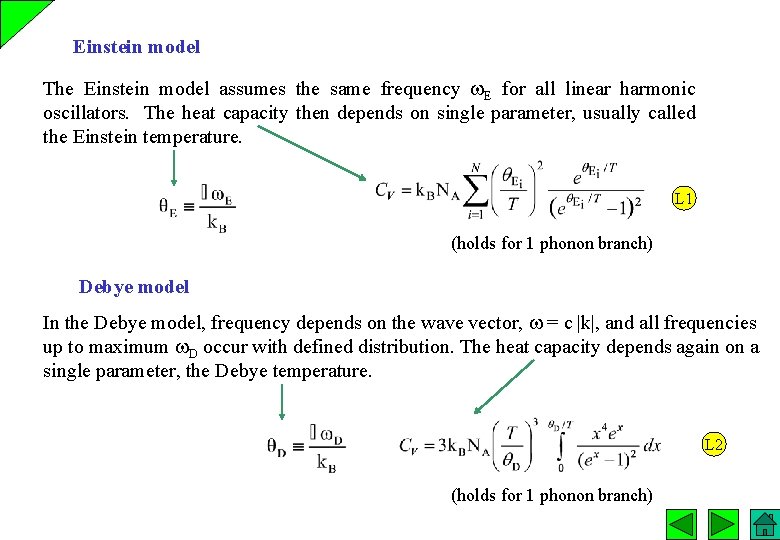
Einstein model The Einstein model assumes the same frequency E for all linear harmonic oscillators. The heat capacity then depends on single parameter, usually called the Einstein temperature. L 1 (holds for 1 phonon branch) Debye model In the Debye model, frequency depends on the wave vector, = c |k|, and all frequencies up to maximum D occur with defined distribution. The heat capacity depends again on a single parameter, the Debye temperature. L 2 (holds for 1 phonon branch)
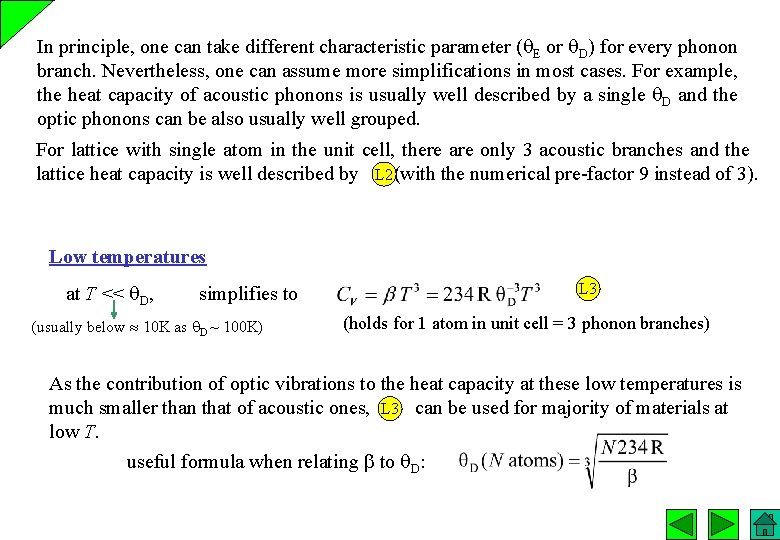
In principle, one can take different characteristic parameter ( E or D) for every phonon branch. Nevertheless, one can assume more simplifications in most cases. For example, the heat capacity of acoustic phonons is usually well described by a single D and the optic phonons can be also usually well grouped. For lattice with single atom in the unit cell, there are only 3 acoustic branches and the lattice heat capacity is well described by L 2 (with the numerical pre-factor 9 instead of 3). Low temperatures at T << D, L 3 simplifies to (usually below 10 K as D ~ 100 K) (holds for 1 atom in unit cell = 3 phonon branches) As the contribution of optic vibrations to the heat capacity at these low temperatures is much smaller than that of acoustic ones, L 3 can be used for majority of materials at low T. useful formula when relating to D:
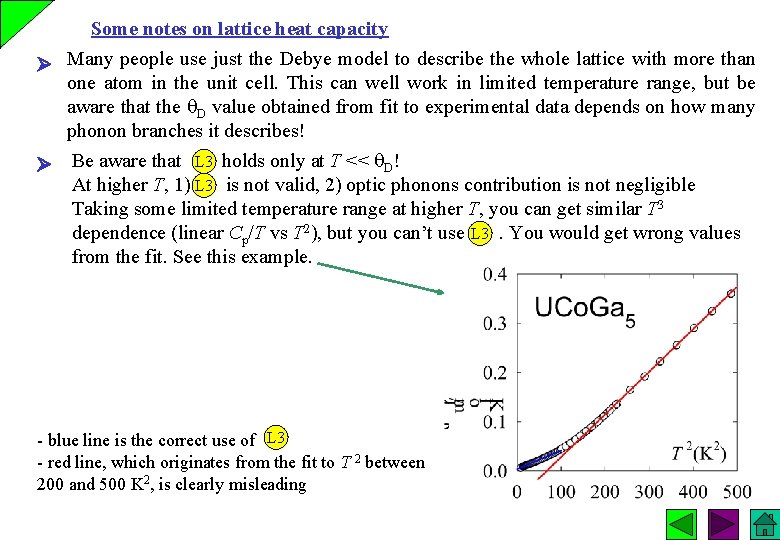
Some notes on lattice heat capacity Many people use just the Debye model to describe the whole lattice with more than one atom in the unit cell. This can well work in limited temperature range, but be aware that the D value obtained from fit to experimental data depends on how many phonon branches it describes! Be aware that L 3 holds only at T << D! At higher T, 1) L 3 is not valid, 2) optic phonons contribution is not negligible Taking some limited temperature range at higher T, you can get similar T 3 dependence (linear Cp/T vs T 2), but you can’t use L 3. You would get wrong values from the fit. See this example. - blue line is the correct use of L 3 - red line, which originates from the fit to T 2 between 200 and 500 K 2, is clearly misleading
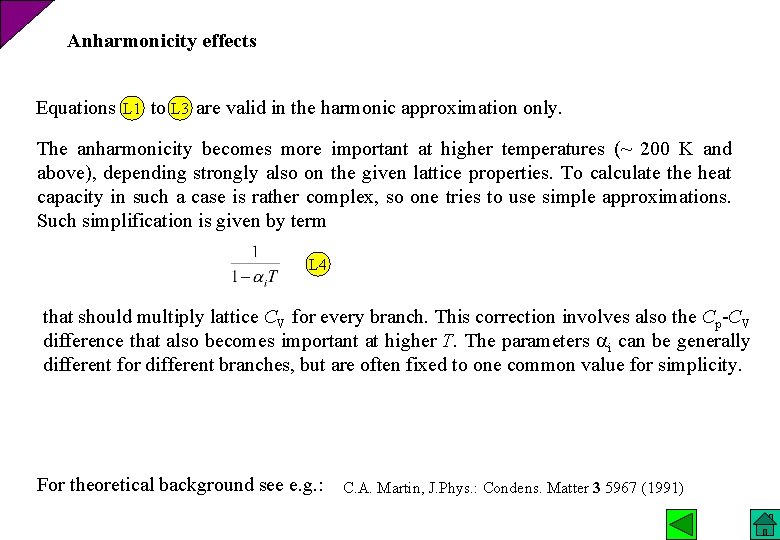
Anharmonicity effects Equations L 1 to L 3 are valid in the harmonic approximation only. The anharmonicity becomes more important at higher temperatures (~ 200 K and above), depending strongly also on the given lattice properties. To calculate the heat capacity in such a case is rather complex, so one tries to use simple approximations. Such simplification is given by term L 4 that should multiply lattice CV for every branch. This correction involves also the Cp-CV difference that also becomes important at higher T. The parameters i can be generally different for different branches, but are often fixed to one common value for simplicity. For theoretical background see e. g. : C. A. Martin, J. Phys. : Condens. Matter 3 5967 (1991)
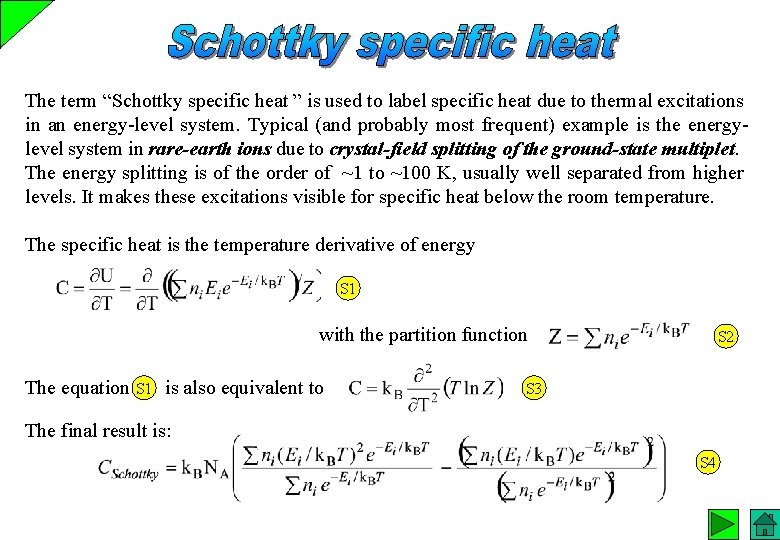
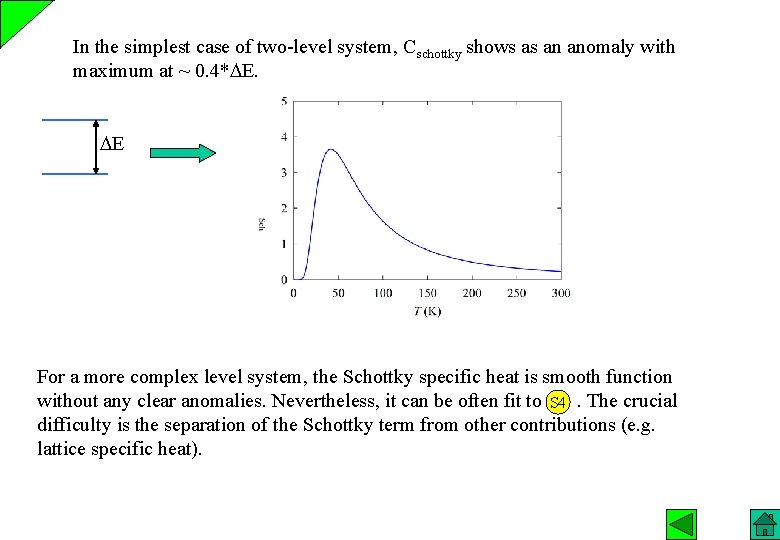
The term “Schottky specific heat ” is used to label specific heat due to thermal excitations in an energy-level system. Typical (and probably most frequent) example is the energylevel system in rare-earth ions due to crystal-field splitting of the ground-state multiplet. The energy splitting is of the order of ~1 to ~100 K, usually well separated from higher levels. It makes these excitations visible for specific heat below the room temperature. The specific heat is the temperature derivative of energy S 1 with the partition function The equation S 1 is also equivalent to S 2 S 3 The final result is: S 4
In the simplest case of two-level system, Cschottky shows as an anomaly with maximum at ~ 0. 4* E. E For a more complex level system, the Schottky specific heat is smooth function without any clear anomalies. Nevertheless, it can be often fit to S 4. The crucial difficulty is the separation of the Schottky term from other contributions (e. g. lattice specific heat).
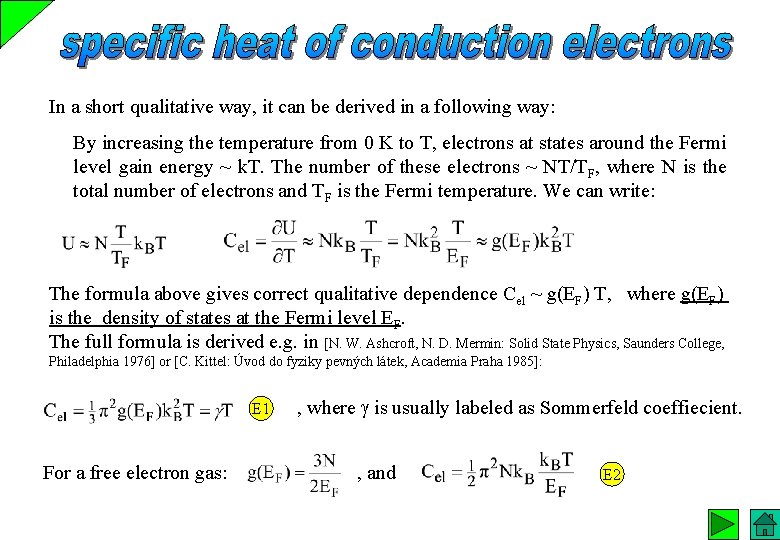
In a short qualitative way, it can be derived in a following way: By increasing the temperature from 0 K to T, electrons at states around the Fermi level gain energy ~ k. T. The number of these electrons ~ NT/TF, where N is the total number of electrons and TF is the Fermi temperature. We can write: The formula above gives correct qualitative dependence Cel ~ g(EF) T, where g(EF) is the density of states at the Fermi level EF. The full formula is derived e. g. in [N. W. Ashcroft, N. D. Mermin: Solid State Physics, Saunders College, Philadelphia 1976] or [C. Kittel: Úvod do fyziky pevných látek, Academia Praha 1985]: E 1 For a free electron gas: , where is usually labeled as Sommerfeld coeffiecient. , and E 2
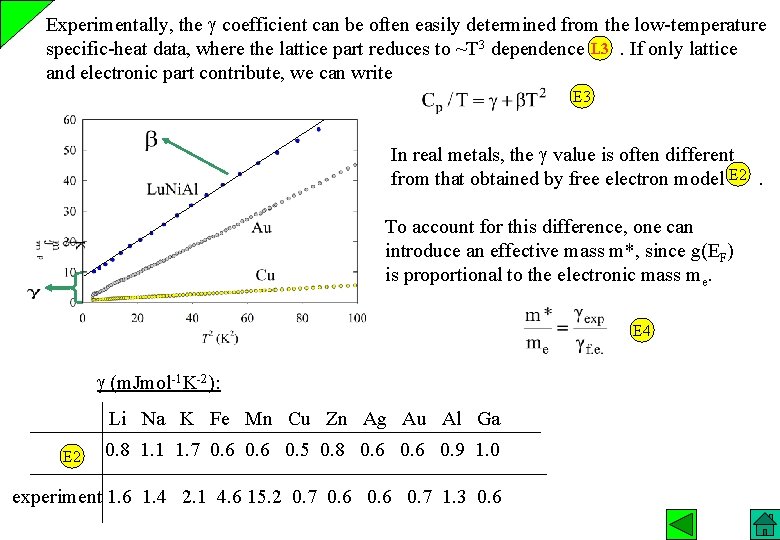
Experimentally, the coefficient can be often easily determined from the low-temperature specific-heat data, where the lattice part reduces to ~T 3 dependence L 3. If only lattice and electronic part contribute, we can write E 3 In real metals, the value is often different from that obtained by free electron model E 2. To account for this difference, one can introduce an effective mass m*, since g(EF) is proportional to the electronic mass me. E 4 (m. Jmol-1 K-2): Li Na K Fe Mn Cu Zn Ag Au Al Ga E 2 0. 8 1. 1 1. 7 0. 6 0. 5 0. 8 0. 6 0. 9 1. 0 experiment 1. 6 1. 4 2. 1 4. 6 15. 2 0. 7 0. 6 0. 7 1. 3 0. 6