
DEFINITIONS Infection The entry and development and multiplication
- Slides: 12
DEFINITIONS • Infection: – The entry and development and multiplication of an infectious agent in the body of humans or animals. The result may be: • inapparent ( asymptomatic) infection, or • manifest (symptomatic) infection. .
DEFINITIONS • pathogenesis: – Production and development of disease. • pathogenicity: – Capability of an infectious agent to cause disease in a susceptible host.
DEFINITIONS • Host: – A person or other living animal which harbours a infectious agent under natural conditions. • Definitive host: – ( primary host) a host in which the parasite passes its sexual stage. • Intermediate host: – (secondary host) a host in which the parasite passes its larval or asexual stages. • carrier: – A person or animal that harbours a specific infectious agent in the absence of discernible clinical disease and serves as a potential source
DEFINITIONS • Symbiosis: – interaction in which one organism lives with, in or on the body of another. • Parasitism: – Symbiosis in which an organism (the parasite) benefits from the association with another organism (the host) whereas the host is harmed inome way. • commensalism: – Kind of symbiosis in which one symbiont, the commensal, is benefited whereas the other symbiont , the host , is neither harmed or helped by the association.
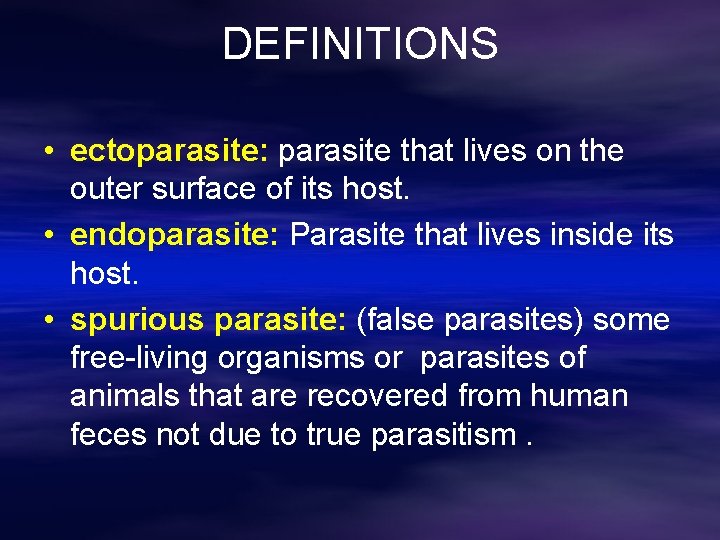
DEFINITIONS • ectoparasite: parasite that lives on the outer surface of its host. • endoparasite: Parasite that lives inside its host. • spurious parasite: (false parasites) some free-living organisms or parasites of animals that are recovered from human feces not due to true parasitism.
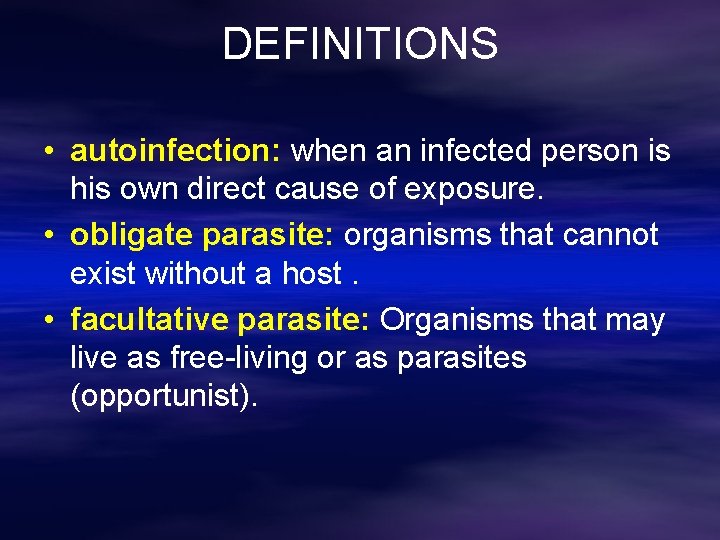
DEFINITIONS • autoinfection: when an infected person is his own direct cause of exposure. • obligate parasite: organisms that cannot exist without a host. • facultative parasite: Organisms that may live as free-living or as parasites (opportunist).
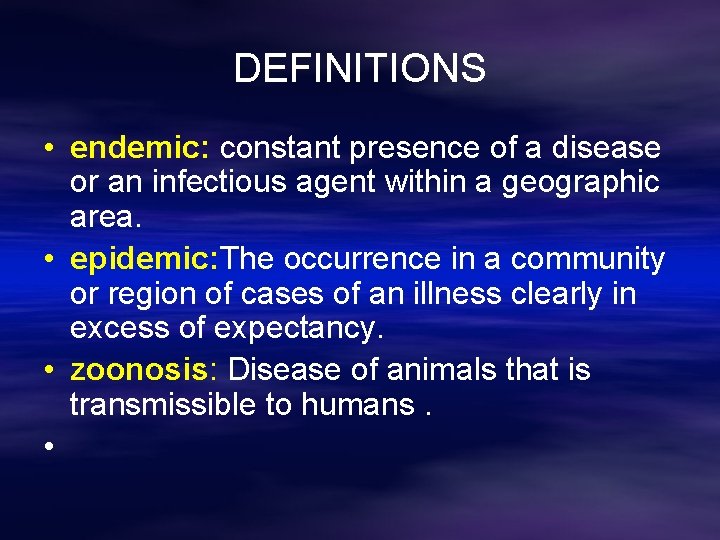
DEFINITIONS • endemic: constant presence of a disease or an infectious agent within a geographic area. • epidemic: The occurrence in a community or region of cases of an illness clearly in excess of expectancy. • zoonosis: Disease of animals that is transmissible to humans. •
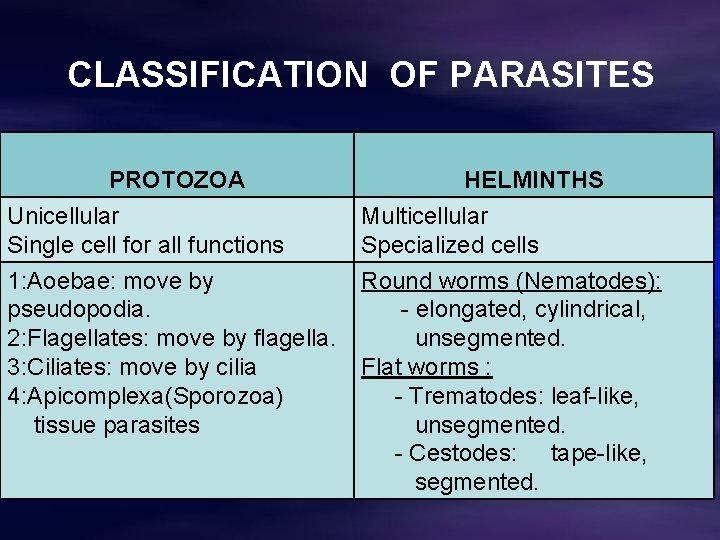
CLASSIFICATION OF PARASITES PROTOZOA Unicellular Single cell for all functions 1: Aoebae: move by pseudopodia. 2: Flagellates: move by flagella. 3: Ciliates: move by cilia 4: Apicomplexa(Sporozoa) tissue parasites HELMINTHS Multicellular Specialized cells Round worms (Nematodes): - elongated, cylindrical, unsegmented. Flat worms : - Trematodes: leaf-like, unsegmented. - Cestodes: tape-like, segmented.
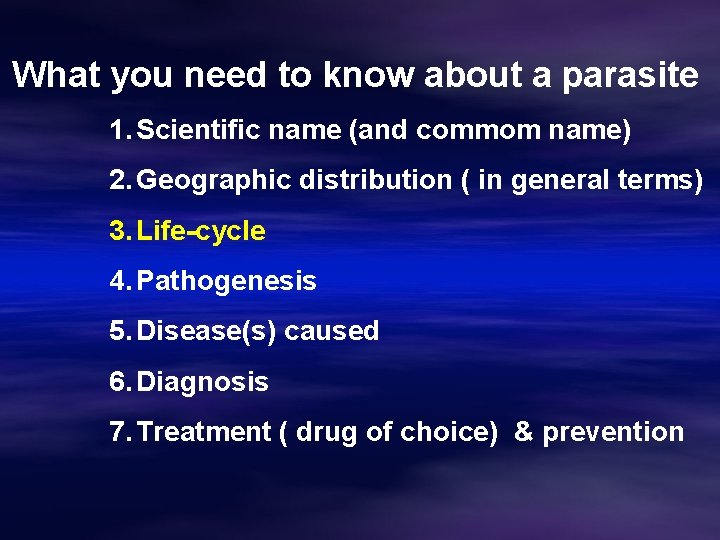
What you need to know about a parasite 1. Scientific name (and commom name) 2. Geographic distribution ( in general terms) 3. Life-cycle 4. Pathogenesis 5. Disease(s) caused 6. Diagnosis 7. Treatment ( drug of choice) & prevention
Resources on Parasitology Centre for Disease Control and Prevention (CDC) : http: //www. dpd. cdc. gov/DPDx/HTML/Para_Health. htm
Resources on Parasitology Centre for Disease Control and Prevention (CDC) : http: //www. dpd. cdc. gov/DPDx/HTML/Para_Health. htm
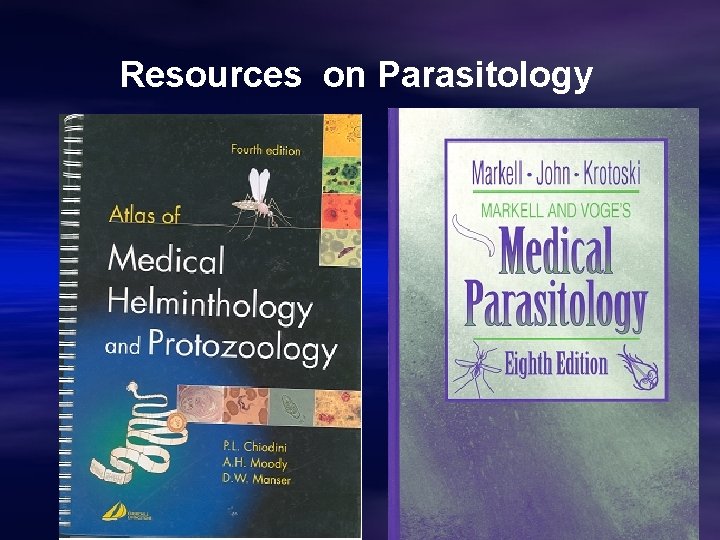
Resources on Parasitology