
Definitions Covered Descriptive Inferential Statistics Simple Random Sample

- Slides: 15
Definitions Covered ● ● ● Descriptive/ Inferential Statistics Simple Random Sample Simulation Sampling With/Without Replacement Sampling/Nonsampling Error
Definitions Covered ● Sampling types ○ Stratified ○ Systematic ○ Cluster ○ Multistage ○ Convenience ● Sampling Frame ● Undercoverage
Definitions
Definitions 1. Census - Measurements or observations from the entire population are used 2. Sample - Measurements or observations from part of the population are used
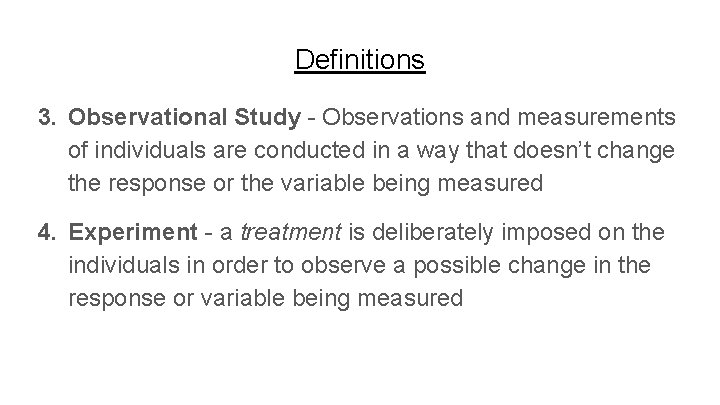
Definitions 3. Observational Study - Observations and measurements of individuals are conducted in a way that doesn’t change the response or the variable being measured 4. Experiment - a treatment is deliberately imposed on the individuals in order to observe a possible change in the response or variable being measured
Definitions 5. Placebo Effect - Occurs when a subject receives no treatment but (incorrectly) believes he or she is, in fact, receiving treatment and responds favorably 6. Completely Randomized Experiment - Experiment in which a random process is used to assign each individual to one of the treatments
Definitions 7. Block - A group of individuals sharing some common features that might affect the treatment 8. Randomized Block Experiment - Individuals are first sorted into blocks, and then a random process is used to assign each individual in the block to one of the treatments
Definitions 9. Control Group - This group receives a dummy treatment, enabling the researchers to control for the placebo effect. In general, a control group is used to account for the influence of other known or unknown variables that might be an underlying cause of a change in response in the experimental group.
Definitions 10. Randomization - used to assign individuals to the two treatment groups a. This helps prevent bias in selecting members for each group 11. Replication - reduces the possibility that the differences for the two groups occurred by chance alone
Definitions 12. Double-Blind - In these experiments neither the individuals in the study nor the observers know which subjects are receiving the treatment
Definitions/ Pitfalls of Surveying 13. Nonresponse - Individuals either cannot be contracted or refuse to participate. Nonresponse can result in significant undercoverage of a population 14. Truthfulness of Response - Respondents may lie intentionally or inadvertently 15. Faulty Recall - Respondents may not accurately remember when or whether an event took place
Definitions/ Pitfalls of Surveying 16. Hidden Bias - The question may be worded in such a way as to elicit a specific response. The order of questions might lead to biased responses. Also, the number of responses on a Likert scale may force responses that do not reflect the respondent’s feelings or experiences
Definitions/ Pitfalls of Surveying 17. Vague Wording - Words such as “often, ” “seldom, ” and “occasionally” mean different things to different people 18. Interviewer Influence - Factors such as tone of voice, body language, dress, gender, authority, and ethnicity of the interviewer might influence responses 19. Voluntary Response - Individuals with strong feelings about a subject are more likely than others to respond.
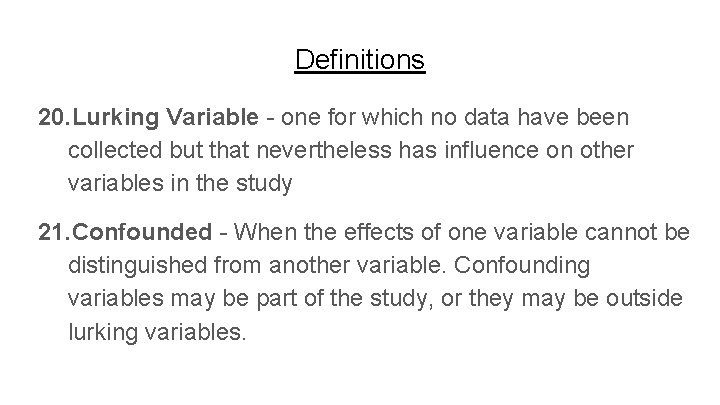
Definitions 20. Lurking Variable - one for which no data have been collected but that nevertheless has influence on other variables in the study 21. Confounded - When the effects of one variable cannot be distinguished from another variable. Confounding variables may be part of the study, or they may be outside lurking variables.
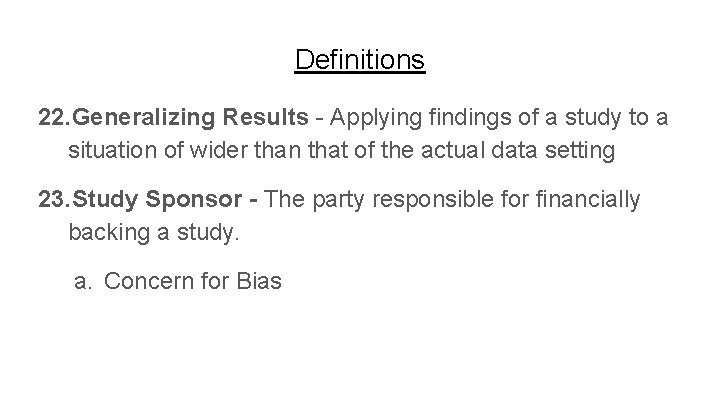
Definitions 22. Generalizing Results - Applying findings of a study to a situation of wider than that of the actual data setting 23. Study Sponsor - The party responsible for financially backing a study. a. Concern for Bias