
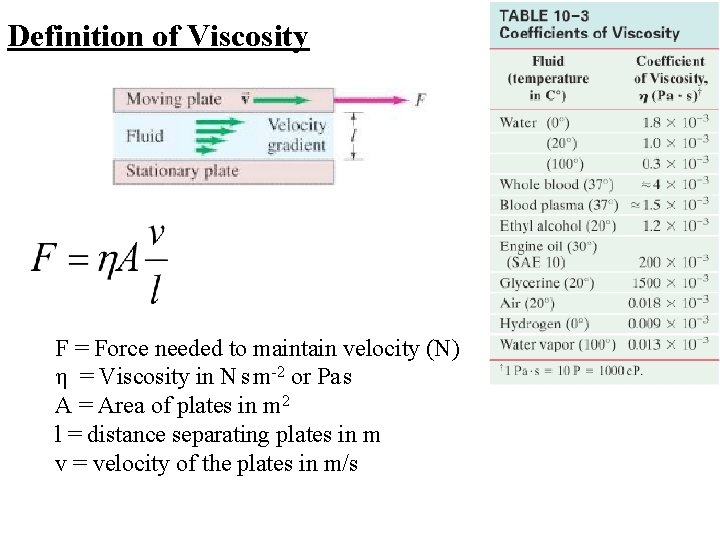
Definition of Viscosity F Force needed to maintain
- Slides: 7
Definition of Viscosity F = Force needed to maintain velocity (N) η = Viscosity in N s m-2 or Pa s A = Area of plates in m 2 l = distance separating plates in m v = velocity of the plates in m/s On what would the force depend?
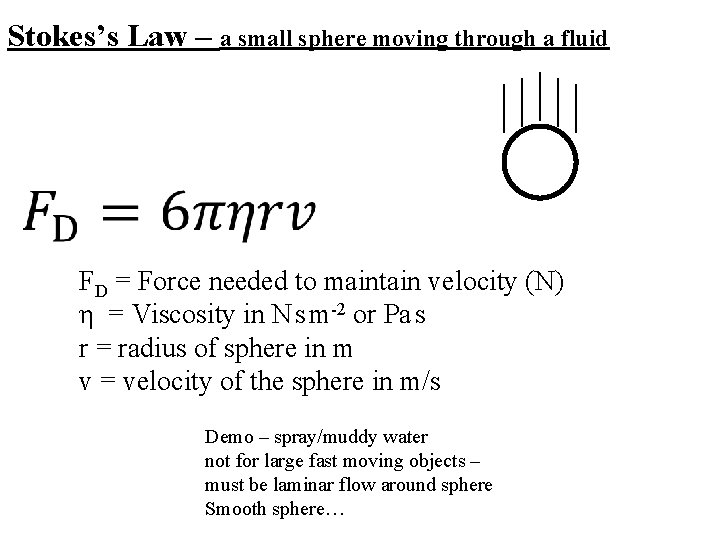
Stokes’s Law – a small sphere moving through a fluid FD = Force needed to maintain velocity (N) η = Viscosity in N s m-2 or Pa s r = radius of sphere in m v = velocity of the sphere in m/s Demo – spray/muddy water not for large fast moving objects – must be laminar flow around sphere Smooth sphere…
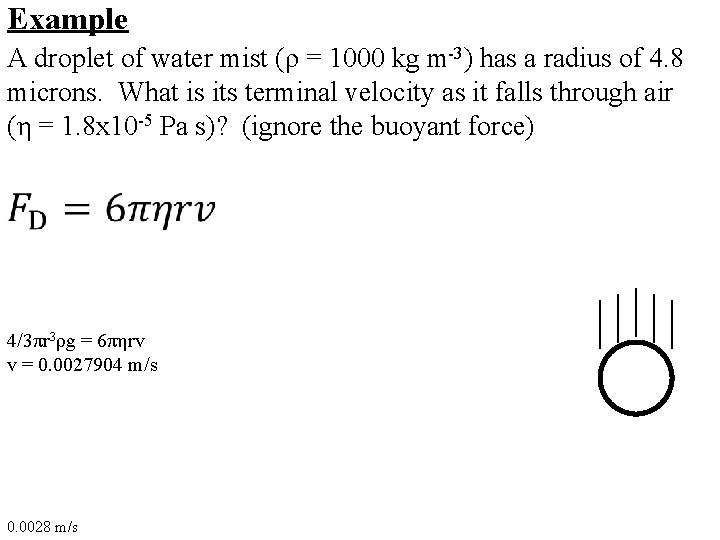
Example A droplet of water mist (ρ = 1000 kg m-3) has a radius of 4. 8 microns. What is its terminal velocity as it falls through air (η = 1. 8 x 10 -5 Pa s)? (ignore the buoyant force) 4/3πr 3ρg = 6πηrv v = 0. 0027904 m/s 0. 0028 m/s
Viscosity 1 -5
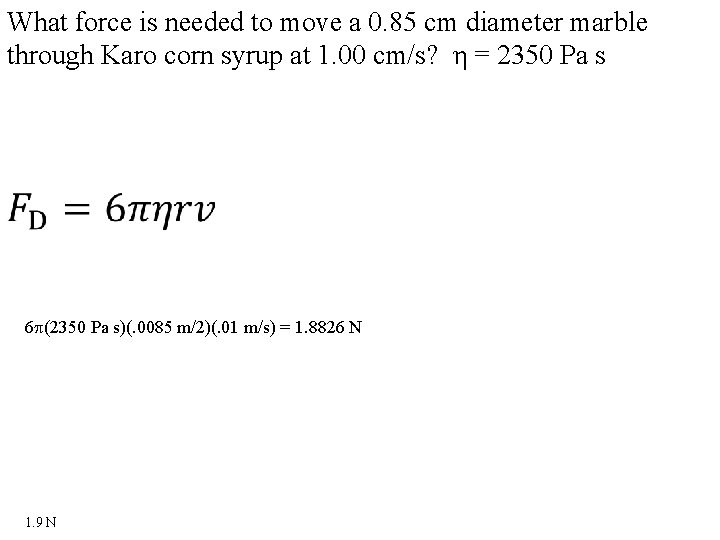
What force is needed to move a 0. 85 cm diameter marble through Karo corn syrup at 1. 00 cm/s? η = 2350 Pa s 6 (2350 Pa s)(. 0085 m/2)(. 01 m/s) = 1. 8826 N 1. 9 N
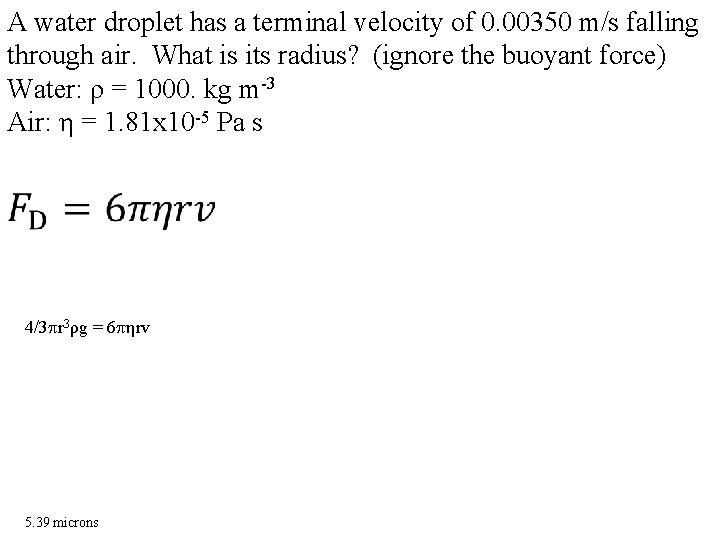
A water droplet has a terminal velocity of 0. 00350 m/s falling through air. What is its radius? (ignore the buoyant force) Water: ρ = 1000. kg m-3 Air: η = 1. 81 x 10 -5 Pa s 4/3 r 3ρg = 6 ηrv 5. 39 microns
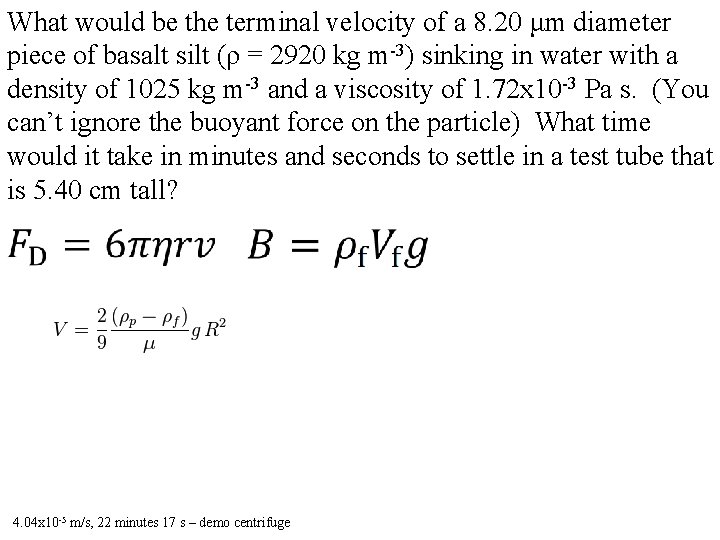
What would be the terminal velocity of a 8. 20 μm diameter piece of basalt silt (ρ = 2920 kg m-3) sinking in water with a density of 1025 kg m-3 and a viscosity of 1. 72 x 10 -3 Pa s. (You can’t ignore the buoyant force on the particle) What time would it take in minutes and seconds to settle in a test tube that is 5. 40 cm tall? 4. 04 x 10 -5 m/s, 22 minutes 17 s – demo centrifuge