
Definition of Threat Assessment Proactive factbased approach to
Definition of Threat Assessment • “Proactive, fact-based approach to identify individuals who pose a threat & to provide interventions before violent act occurs. ” • Inquiry • About people & their behaviors • Posing threat Vs. making threat • Triage & Risk Management
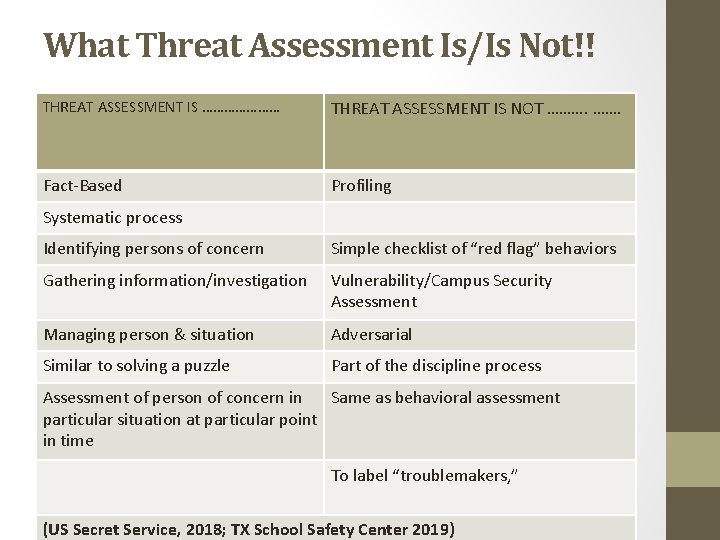
What Threat Assessment Is/Is Not!! THREAT ASSESSMENT IS ………………… THREAT ASSESSMENT IS NOT ………. Fact-Based Profiling Systematic process Identifying persons of concern Simple checklist of “red flag” behaviors Gathering information/investigation Vulnerability/Campus Security Assessment Managing person & situation Adversarial Similar to solving a puzzle Part of the discipline process Assessment of person of concern in Same as behavioral assessment particular situation at particular point in time To label “troublemakers, ” (US Secret Service, 2018; TX School Safety Center 2019)
Why Use School Threat Assessment Teams? (STAT) • TX is one of about 10 states currently legislatively mandating Threat Assessment teams in public schools • Senate Bill 11 & TEC, Chapter 37. 115 require Board of Trustees to: • Establish threat assessment teams (can be one team per district or one at each campus) • Adopt policies & procedures for the STAT that are consistent with model policies & procedures developed by TX School Safety Center • Have each team complete training provided by TX School Safety Center or ESCs
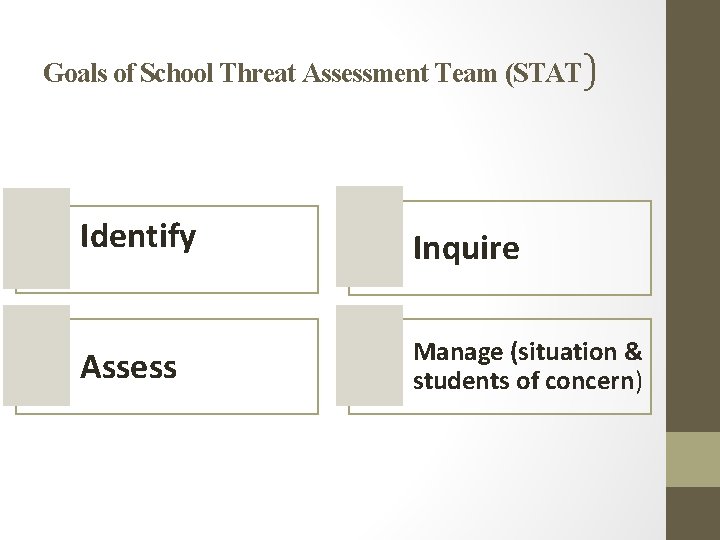
Goals of School Threat Assessment Team (STAT) Identify Inquire Assess Manage (situation & students of concern)
Myth/Fact Activity • School Shooters typically just “snap” & don’t plan out their attacks beforehand • In most cases school shooters tell other people beforehand they are planning a school shooting • Research has identified an accurate profile of a school shooter • Most attackers are already on multiple “radar screens, ” in the school and/or community • School shooters often has a level of desperation about some real/perceived grievance & views violence as only way to solve the problem
Step 1 – Establish Multi-disciplinary Team • Team members should include an administrator, counselor, LSSP/social worker, School Resource Officer/Local Law Enforcement & Ad hoc members as needed • Designate a team leader • Establish team procedures & protocols • Meet on regular basis & as needed
Step 2 – Determine What Behaviors STAT will Address • • Threats of violence Threats to bring weapon to school Threats of suicide Bullying/Harassment
Other Behaviors to Monitor • Attendance (significant increases in absenteeism) • Behavior (increase in office referrals and/or symptoms of mental health issues) • Completion of academic work – sudden, radical change in academic performance • Frequent visits to nurse • Students going to and/or returning from mental health facilities
Step 3 – Establish Central Reporting Mechanism • Determine how threats can be reported by staff and/or students – online form; app; dedicated E-Mail or phone number • Set up & provide training to all staff & students on: • What threats should be reported? • Why it is important to report these threats (not snitching/tattling) • How these threats can be reported • Critical need for timeliness in reporting, the same day, before students leave for day etc.
Step 4 – Threat Report Screening Procedures • Determine who will respond to threat reports in timely, confidential manner (Back-Up people) • Establish threat screening process • Typically administrator will do initial fact gathering interviews/secure written statements etc. , • STAT determines if threat is transient or substantive threat & proceeds accordingly
Tips for Initial Fact-Finding Interviews • Get written statements prior to interviewing students • Need to interview student making threat, potential target of threat & witnesses • Separate students from rest of the school body • Keep student alleged to have made threat with you
11 Investigative Questions (U. S. Secret Service) STAT Considers • See Appendix A • Focus is on: • What threat did the student make? • Do they have a plan to carry out this threat? • Do they have the capacity/means to follow through on threat posed? • Do they have any history of similar behavior?
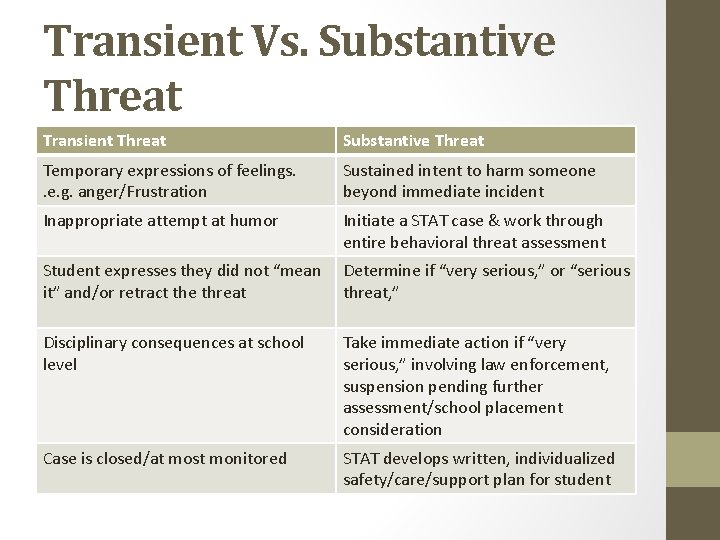
Transient Vs. Substantive Threat Transient Threat Substantive Threat Temporary expressions of feelings. . e. g. anger/Frustration Sustained intent to harm someone beyond immediate incident Inappropriate attempt at humor Initiate a STAT case & work through entire behavioral threat assessment Student expresses they did not “mean it” and/or retract the threat Determine if “very serious, ” or “serious threat, ” Disciplinary consequences at school level Take immediate action if “very serious, ” involving law enforcement, suspension pending further assessment/school placement consideration Case is closed/at most monitored STAT develops written, individualized safety/care/support plan for student
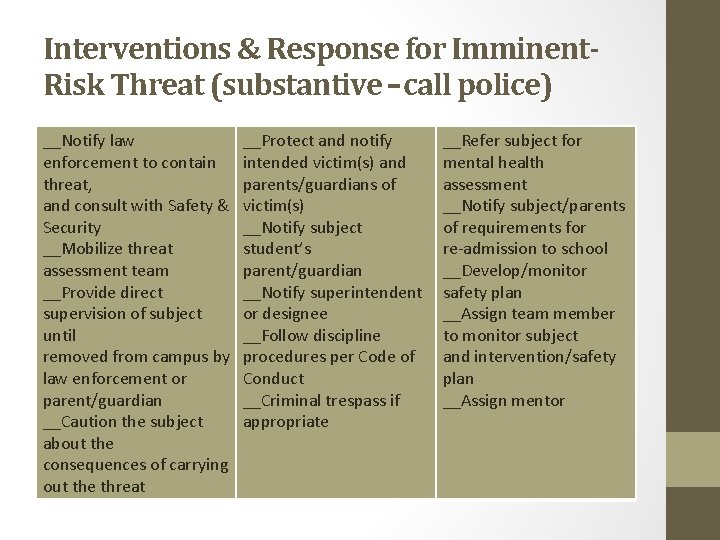
Interventions & Response for Imminent. Risk Threat (substantive – call police) __Notify law enforcement to contain threat, and consult with Safety & Security __Mobilize threat assessment team __Provide direct supervision of subject until removed from campus by law enforcement or parent/guardian __Caution the subject about the consequences of carrying out the threat __Protect and notify intended victim(s) and parents/guardians of victim(s) __Notify subject student’s parent/guardian __Notify superintendent or designee __Follow discipline procedures per Code of Conduct __Criminal trespass if appropriate __Refer subject for mental health assessment __Notify subject/parents of requirements for re-admission to school __Develop/monitor safety plan __Assign team member to monitor subject and intervention/safety plan __Assign mentor
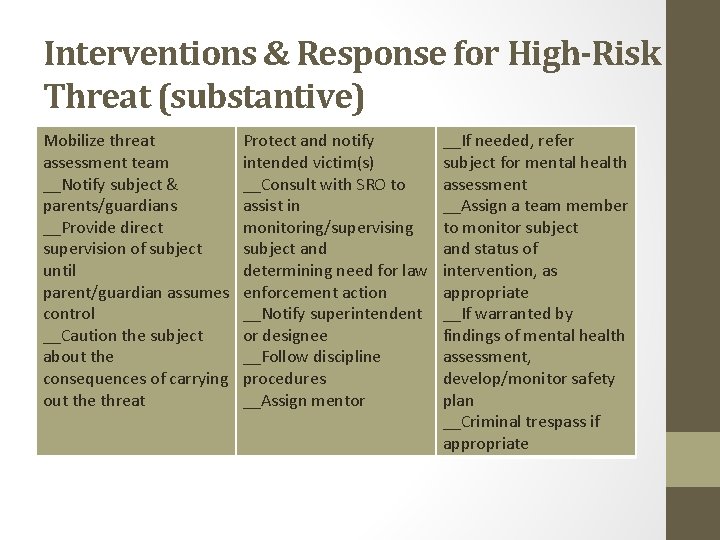
Interventions & Response for High-Risk Threat (substantive) Mobilize threat assessment team __Notify subject & parents/guardians __Provide direct supervision of subject until parent/guardian assumes control __Caution the subject about the consequences of carrying out the threat Protect and notify intended victim(s) __Consult with SRO to assist in monitoring/supervising subject and determining need for law enforcement action __Notify superintendent or designee __Follow discipline procedures __Assign mentor __If needed, refer subject for mental health assessment __Assign a team member to monitor subject and status of intervention, as appropriate __If warranted by findings of mental health assessment, develop/monitor safety plan __Criminal trespass if appropriate
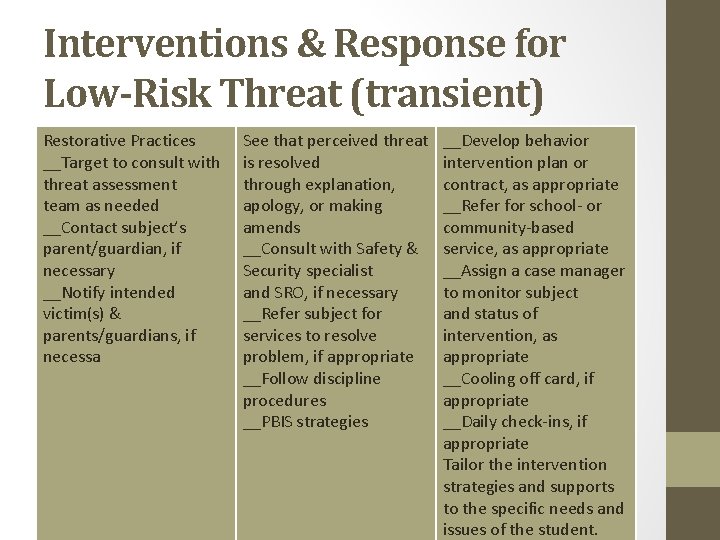
Interventions & Response for Low-Risk Threat (transient) Restorative Practices __Target to consult with threat assessment team as needed __Contact subject’s parent/guardian, if necessary __Notify intended victim(s) & parents/guardians, if necessa See that perceived threat is resolved through explanation, apology, or making amends __Consult with Safety & Security specialist and SRO, if necessary __Refer subject for services to resolve problem, if appropriate __Follow discipline procedures __PBIS strategies __Develop behavior intervention plan or contract, as appropriate __Refer for school- or community-based service, as appropriate __Assign a case manager to monitor subject and status of intervention, as appropriate __Cooling off card, if appropriate __Daily check-ins, if appropriate Tailor the intervention strategies and supports to the specific needs and issues of the student.
Safety Plan Menu of Options • • Behavior contract No-harm contract Stay-away agreement Modifications to class schedule Change in school arrival location and/or time Change in school departure location and/or time Entry check-in/Exit check-out (with whom)
Safety Plan Menu of Options • • • Modified transportation to and from school Check of backpack, pockets, purse, vehicle etc. Increase supervision in certain settings Lunch (changed time, assigned seating, alternate location) Decrease or eleminate passing period of unsupervised time Alert staff and teachers on a need-to-know basis
Safety Plan Menu of Options • Assign adult mentor – “Check & Connect, ” program • Additional in-school counseling services • Consideration of alternative placement (transfer, behavioral program, DAEP, JJAEP) • Anger management/social skills training & support • Consideration of need for initial/additional special education assessment & services (e. g. FBA; behavior support) • Referral information for mental health evaluation • Notify & ongoing communication with probation/parole officer
Additional Resources • Texas School Safety Center • www. txssc. txstate. edu • US Secret Service (2018) National Threat Assessment Center – Operational Guide to prevent school violence • Colorado School Safety Resource Center • Dr. Dewey Cornell – Comprehensive School Threat Assessment Guidelines • Dr. Bernard James – School Safety Law Blog • https: //schoolsafetylawblog. com
- Slides: 20