
DEFINITION OF TERMS EMERGENCY is an event natural
- Slides: 15
DEFINITION OF TERMS EMERGENCY – is an event natural and man-made, sudden or progressive, which impacts with such severity that the affected community has to respond by taking exceptional measures. EMERGENCY RESPONSE – are measures which are taken immediately prior to and following an emergency. Such measures are directed towards saving life, protecting property and dealing with the immediate damage caused by the disaster.
SUPERVISION – means working with and through non-management employees to meet the objective of the organization and the needs of employee. COMMAND – is a process through which the commander conducts overall direction of the flow of operations performed by various emergency services. CONTROL – is a mechanism through which the commander of an organization regulates or guides the operations activities of various emergency services.
COORDINATION – is a process through which actors involved in humanitarian assistance, as a result of emergency, work together in a logical and concerted effort towards an agreed common end, that is to protect the victims, to save life and help resume the normal activities to ensure maximum efficiency with the resources available. EMERGENCY RESPONSE OPERATIONS OBJECTIVES: • To limit casualties • Alleviate hardships and sufferings • Restore essential life support and community systems • Mitigate further damage and loss • To provide foundation for subsequent recovery.
IMPORTANT CHARACTERISTICS OF RESPONSE • Type of disaster • Severity and extent of disaster • Ability to take pre-impact action • Capability for sustained operations • Identification of likely response requirements
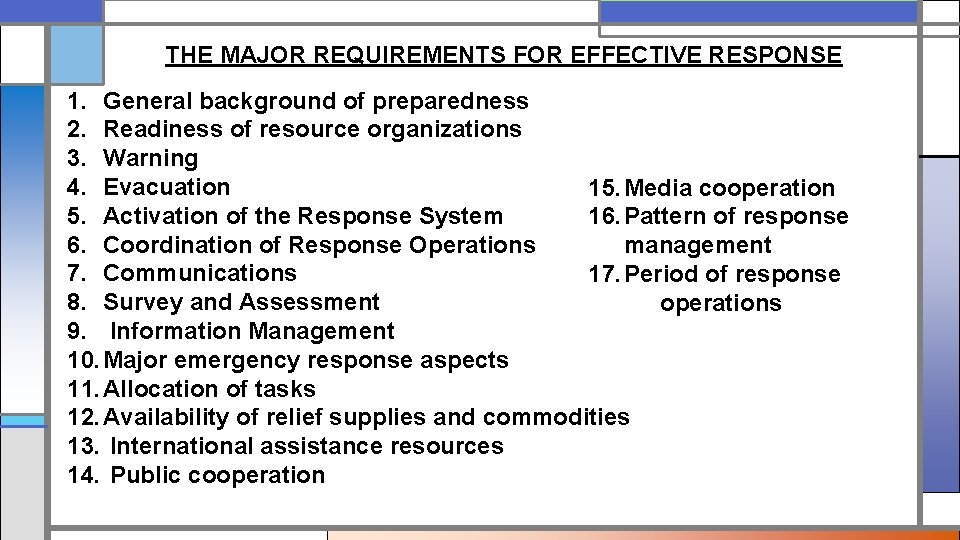
THE MAJOR REQUIREMENTS FOR EFFECTIVE RESPONSE 1. General background of preparedness 2. Readiness of resource organizations 3. Warning 4. Evacuation 15. Media cooperation 5. Activation of the Response System 16. Pattern of response 6. Coordination of Response Operations management 7. Communications 17. Period of response 8. Survey and Assessment operations 9. Information Management 10. Major emergency response aspects 11. Allocation of tasks 12. Availability of relief supplies and commodities 13. International assistance resources 14. Public cooperation
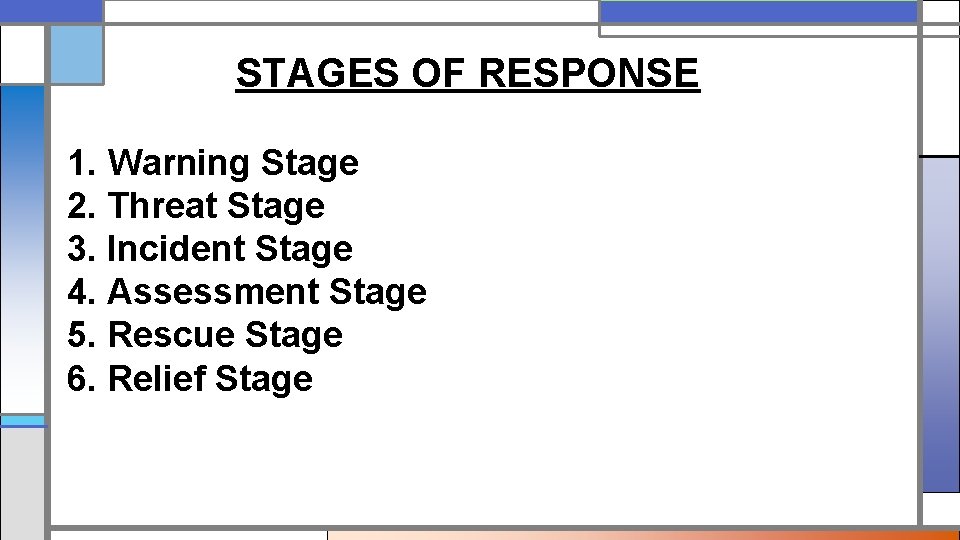
STAGES OF RESPONSE 1. Warning Stage 2. Threat Stage 3. Incident Stage 4. Assessment Stage 5. Rescue Stage 6. Relief Stage
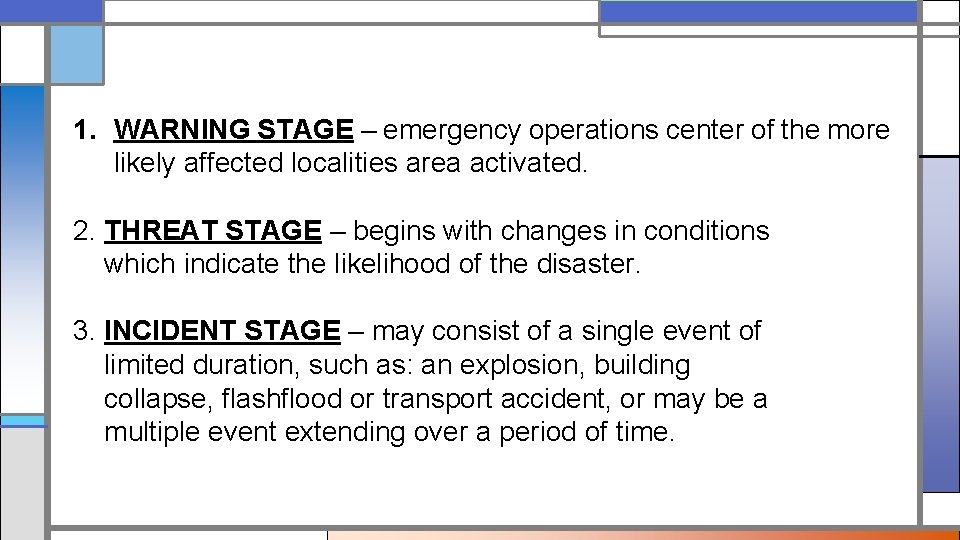
1. WARNING STAGE – emergency operations center of the more likely affected localities area activated. 2. THREAT STAGE – begins with changes in conditions which indicate the likelihood of the disaster. 3. INCIDENT STAGE – may consist of a single event of limited duration, such as: an explosion, building collapse, flashflood or transport accident, or may be a multiple event extending over a period of time.
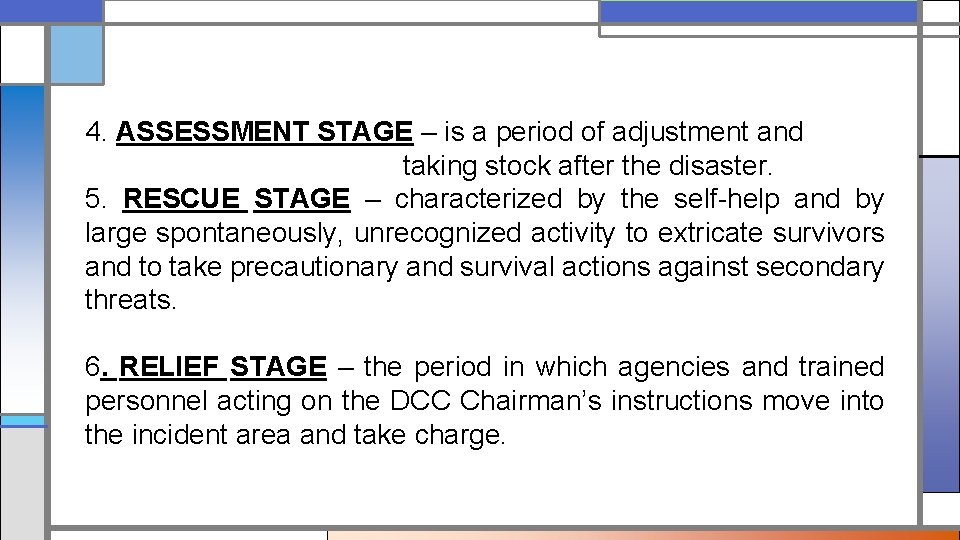
4. ASSESSMENT STAGE – is a period of adjustment and taking stock after the disaster. 5. RESCUE STAGE – characterized by the self-help and by large spontaneously, unrecognized activity to extricate survivors and to take precautionary and survival actions against secondary threats. 6. RELIEF STAGE – the period in which agencies and trained personnel acting on the DCC Chairman’s instructions move into the incident area and take charge.
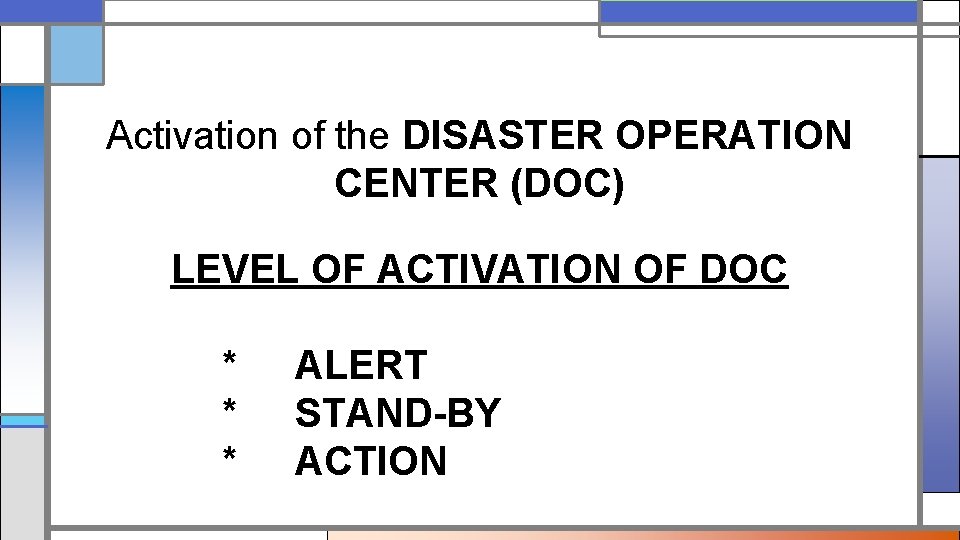
Activation of the DISASTER OPERATION CENTER (DOC) LEVEL OF ACTIVATION OF DOC * * * ALERT STAND-BY ACTION
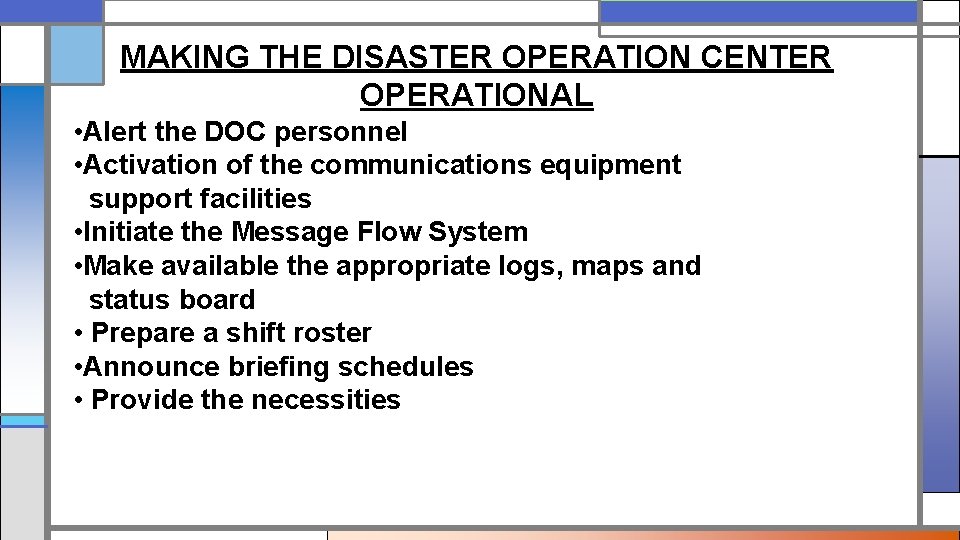
MAKING THE DISASTER OPERATION CENTER OPERATIONAL • Alert the DOC personnel • Activation of the communications equipment support facilities • Initiate the Message Flow System • Make available the appropriate logs, maps and status board • Prepare a shift roster • Announce briefing schedules • Provide the necessities
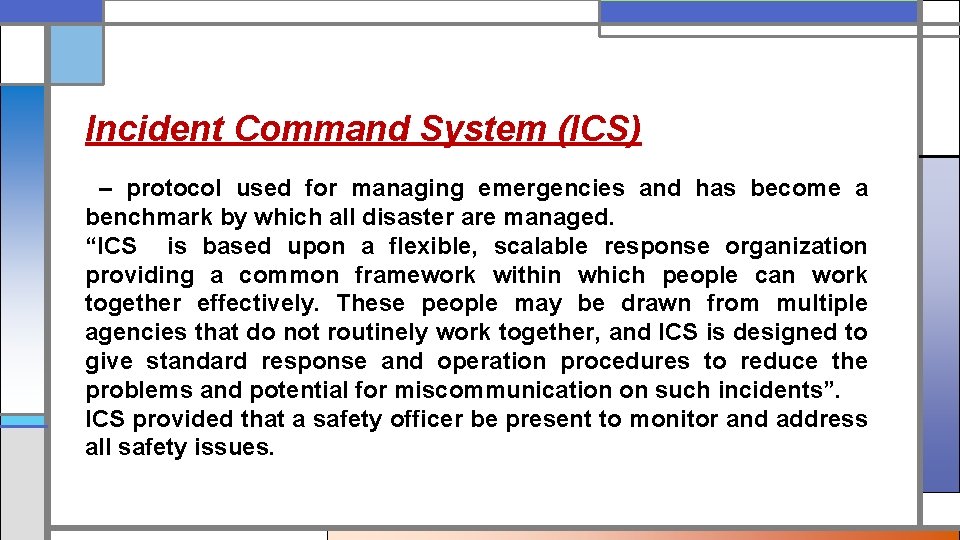
Incident Command System (ICS) – protocol used for managing emergencies and has become a benchmark by which all disaster are managed. “ICS is based upon a flexible, scalable response organization providing a common framework within which people can work together effectively. These people may be drawn from multiple agencies that do not routinely work together, and ICS is designed to give standard response and operation procedures to reduce the problems and potential for miscommunication on such incidents”. ICS provided that a safety officer be present to monitor and address all safety issues.
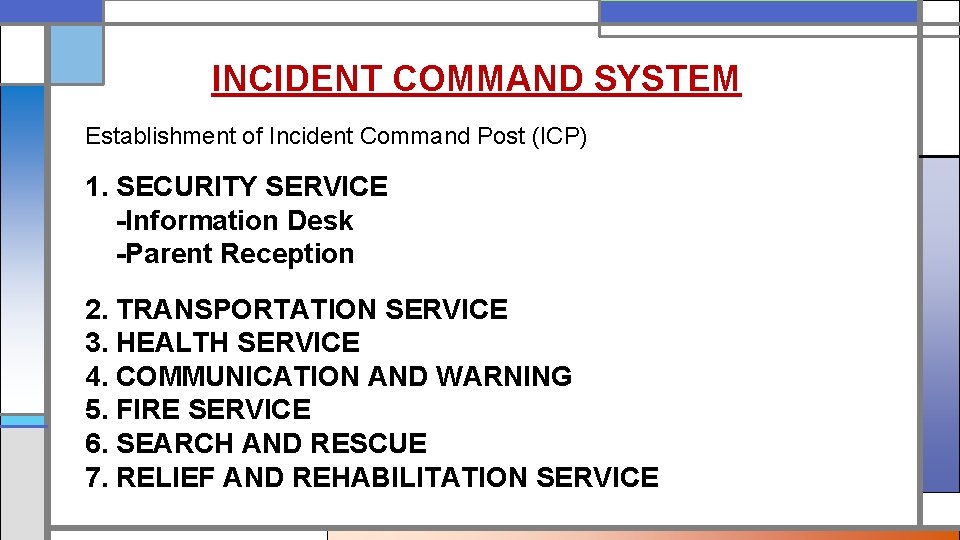
INCIDENT COMMAND SYSTEM Establishment of Incident Command Post (ICP) 1. SECURITY SERVICE -Information Desk -Parent Reception 2. TRANSPORTATION SERVICE 3. HEALTH SERVICE 4. COMMUNICATION AND WARNING 5. FIRE SERVICE 6. SEARCH AND RESCUE 7. RELIEF AND REHABILITATION SERVICE
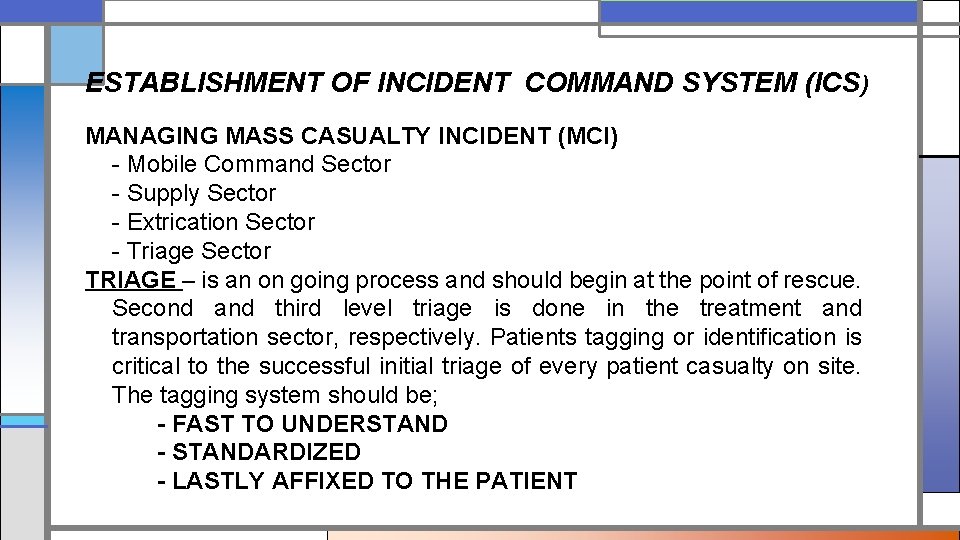
ESTABLISHMENT OF INCIDENT COMMAND SYSTEM (ICS) MANAGING MASS CASUALTY INCIDENT (MCI) - Mobile Command Sector - Supply Sector - Extrication Sector - Triage Sector TRIAGE – is an on going process and should begin at the point of rescue. Second and third level triage is done in the treatment and transportation sector, respectively. Patients tagging or identification is critical to the successful initial triage of every patient casualty on site. The tagging system should be; - FAST TO UNDERSTAND - STANDARDIZED - LASTLY AFFIXED TO THE PATIENT
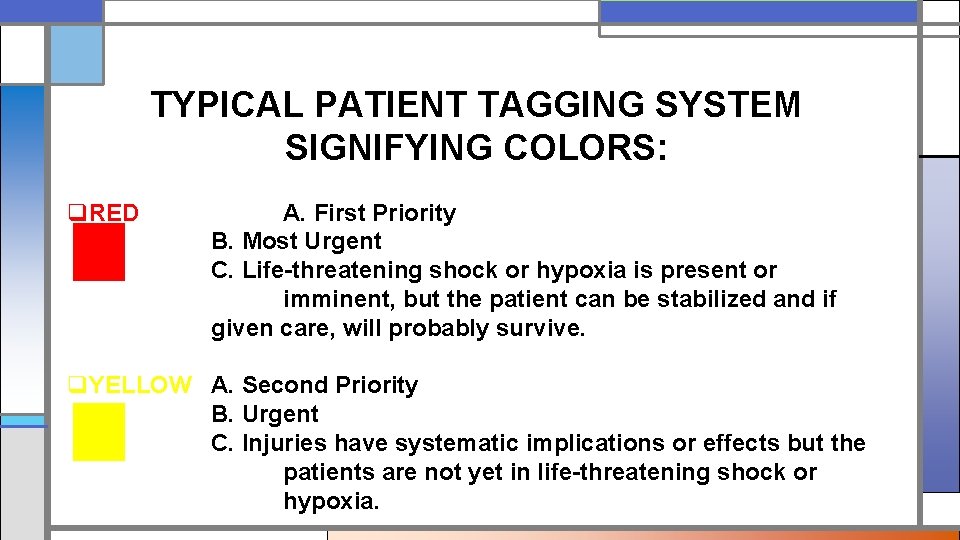
TYPICAL PATIENT TAGGING SYSTEM SIGNIFYING COLORS: q. RED A. First Priority B. Most Urgent C. Life-threatening shock or hypoxia is present or imminent, but the patient can be stabilized and if given care, will probably survive. q. YELLOW A. Second Priority B. Urgent C. Injuries have systematic implications or effects but the patients are not yet in life-threatening shock or hypoxia.
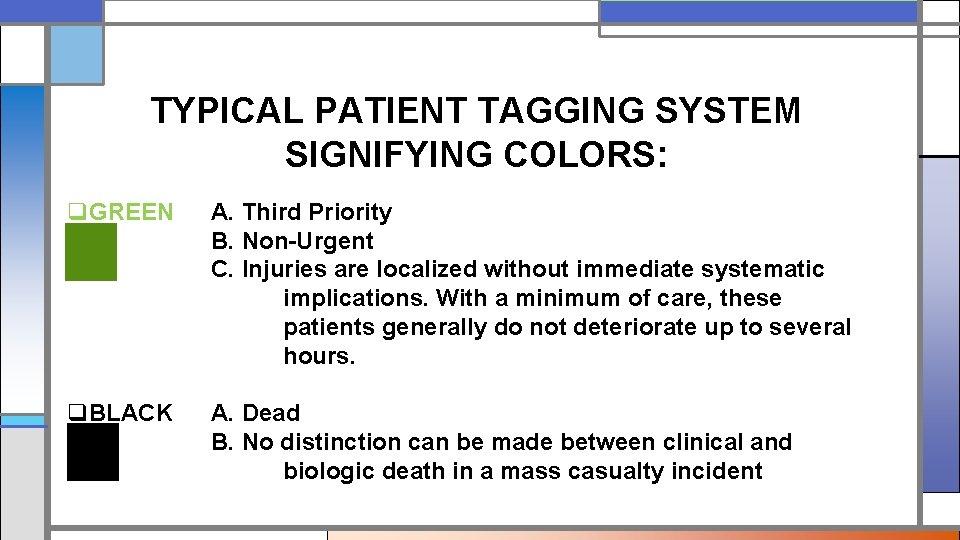
TYPICAL PATIENT TAGGING SYSTEM SIGNIFYING COLORS: q. GREEN A. Third Priority B. Non-Urgent C. Injuries are localized without immediate systematic implications. With a minimum of care, these patients generally do not deteriorate up to several hours. q. BLACK A. Dead B. No distinction can be made between clinical and biologic death in a mass casualty incident