
Definition of statistics It is the science of

- Slides: 24
Definition of statistics: � � � It is the science of numerical and quantitative description of biological, social , economical and all forms of data and different factors, which may influence them. It is the way to get information from data. The branch of mathematical dealing with the collection of probabilities.
Types of statistics: � � a) b) 1 - Social 2 - Economic 3 -Medical statistics deals with medical science. It include: Biostatistics. Demography & population dynamics.
Another classification: � Descriptive statistics It is a statical methods which can be used to summarize or describe a collection of data. Steps in descriptive statistics 1 - Collect data. 2 - Classify data. 3 - Simmarize data. 4 - Present data. 5 -Proceed to inferential statistics if there is enough data to draw a conclusion. �
Inferential Statistics: Process of drawing information from sampled observations of a population and making conclusions about the population. Applied Statistics: Both descriptive and inferential Statistics can be considered part of applied Statistics It is the use of Statistics and Statistical theory in real –life situation s. �
Uses of medical Statistics : 1 - for diagnosis of community health prpblem. 2 - for planning of public health program. 3 - for comparision between health status in countries and within one country allover year. 4 - Evaluation. �
Data in Statistics Data either : 1 - Constant 2 - variable Variable either: 1 - quantitative 2 - qualitative Quantitstive variable: (Which can be numerically measured ) either 1 - Continous Interval between any two variables. 2 - Discrete (No fraction) This variable often represents counts. �
Qualitative variable: This variable which can`t be measured numerically either: a)- Ordinal : denote differences in degree & can be ordered or ranked , has more than 2 categories, exclusive & ordered. E. g. Disease stage : mild, moderate, sever. b) Nominal data: Refer to difference in kind words, mutually exclusive & unordered. E. g. Blood group: A, B, AB, O. c) Dichotomous (Binary): This variable has only 2 possible categories (mutually axclusive). E. g. Result : Success/ failure. Gender: Male/ Female. �
Sources and methods for collection of data: 1 - Registered data: A-Census data ; It gives us data about structure and demographic characteristics of population. B-Health facility: a) Data from records of a health facilities such as: *Vital rate records e. g. Morbidity data Mortality data b) Hospital data ; from hospital records such as: * Out-patients data , In-patients data c) References -Existing published data National or International e. g. Magazine -Text books �
II- Non-registered data(studies): in collection of non -available data we use different statistical methods. � before we start it is better to decide the following: 1) Aim of study * Research study such as Descriptive Analytic And Intervention. �
2) Studied population Either total or sample according to objectives of the study. a) Comprehensive survey: Study the whole population as in: 1 - Tuberculosis survey where we need to know all sick individuals to treat them. 2 -In case of epidemic of cholera and we want to know the carriers to control them. 3 -Census. 4 -Cancer breast. �
Disadvantage: 1 -Expensive, time consuming. 2 -Difficult to control the quality of data. 3 -We may be obliged to use less qualified personnel to cover the heavy load of work. b) Sampling survey: � When we are interest to study some characteristic of population e. g. weight & height of normal children and adults in our population �
Questionnaire : It is the set of questions that prepared by researcher. � Types of questionnaire 1 -Closed ended questionnaire 2 -Open end questionnaires 3 -Likert scale 4 -Bipolar scale �
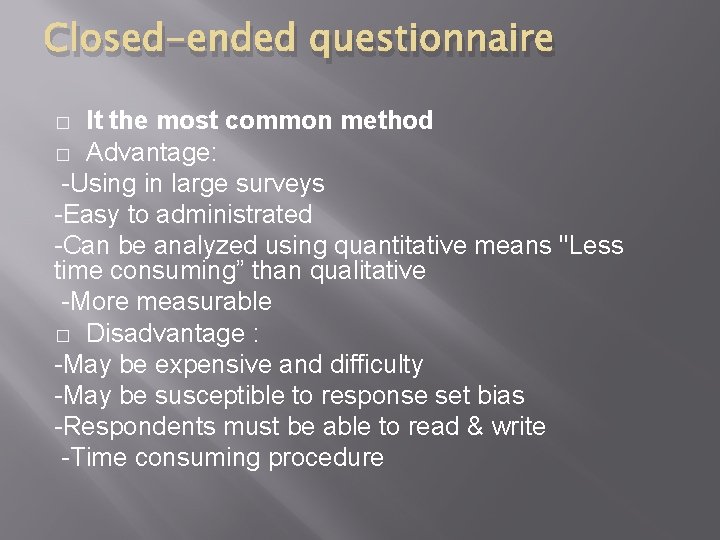
Closed-ended questionnaire It the most common method � Advantage: -Using in large surveys -Easy to administrated -Can be analyzed using quantitative means "Less time consuming” than qualitative -More measurable � Disadvantage : -May be expensive and difficulty -May be susceptible to response set bias -Respondents must be able to read & write -Time consuming procedure �
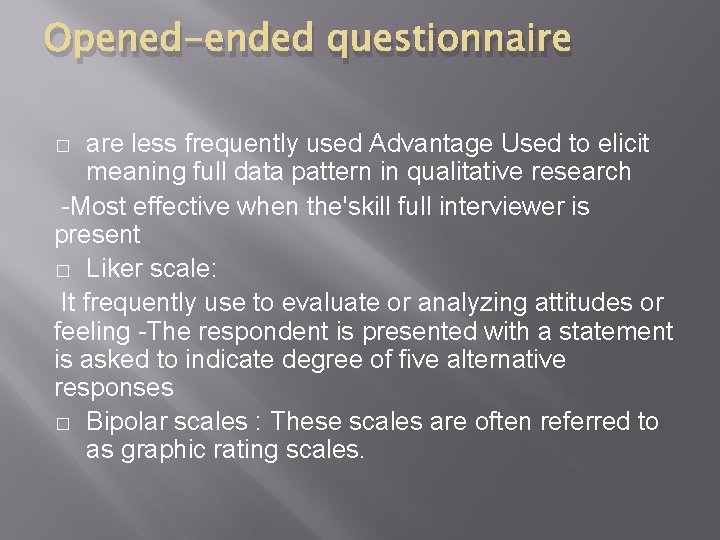
Opened-ended questionnaire are less frequently used Advantage Used to elicit meaning full data pattern in qualitative research -Most effective when the'skill full interviewer is present � Liker scale: It frequently use to evaluate or analyzing attitudes or feeling -The respondent is presented with a statement is asked to indicate degree of five alternative responses � Bipolar scales : These scales are often referred to as graphic rating scales. �
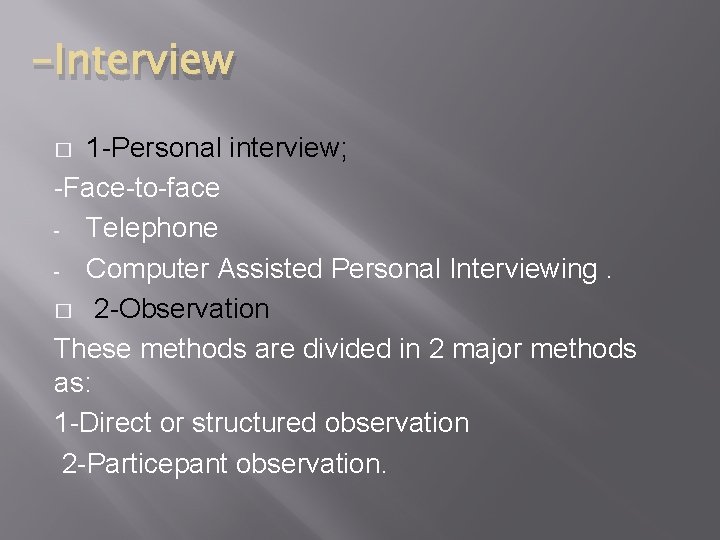
-Interview 1 -Personal interview; -Face-to-face - Telephone - Computer Assisted Personal Interviewing. � 2 -Observation These methods are divided in 2 major methods as: 1 -Direct or structured observation 2 -Particepant observation. �
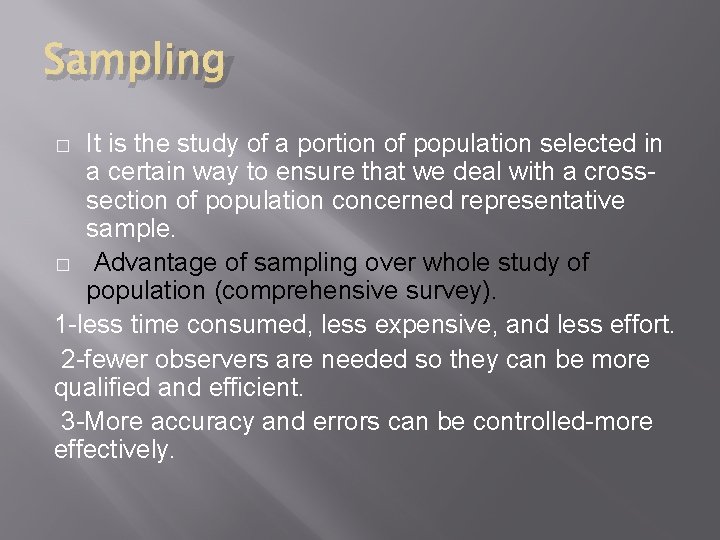
Sampling It is the study of a portion of population selected in a certain way to ensure that we deal with a crosssection of population concerned representative sample. � Advantage of sampling over whole study of population (comprehensive survey). 1 -less time consumed, less expensive, and less effort. 2 -fewer observers are needed so they can be more qualified and efficient. 3 -More accuracy and errors can be controlled-more effectively. �
� � 1. 2. 3. 4. 5. Il-unit of a sample: represents individuals or population groups of the sample. III- size of sample: It is determined by: Homogeneity of the population and more 2 Sampling errors Difficult or obstacles facing us in the collection of data: Problem of non-response if 2 -3% from total sample, it neglected. If more we make sub sample & compare with original sample & see the difference.
Sampling technique & types: � � � 1) Non probability or non random or purposive samples: This is sample chosen according to the person's own judgment so result cannot be generalized to the whole population. II) Probability or random sample: It is a sample which is chosen so that every member of the population is equally likely to be a member of the sample
1 - Simple random sample: This is a sample drawn in such away that every: population has an equal chance of appearing in the sample. Disadvantage: You have to list all the individuals in the original population. Very extreme samples can occur by chance. �
2 - Stratified random sample: Advantage: if the condition under study is not uniformly distributed within different variables, stratification of the target population into homogeneous groups for getting a final representative sample � 3 - Systematic random sample: In this case we choose every Nth individual e. g. every - 5 th, 10'", etc. the first one to be included should be randomly selected. �
Advantage: It is an easy method for field workers to use and in outpatient clinics. � Disadvantage: It can lead to bias if the studied population or some data of them have cyclic or periodic variation. � 4 - Cluster sample In this case the population is divided into clusters or groups as a sample units rather than individuals e. g. households, schools. . . etc. and the sample is selected from these clusters by simple random method. � Advantage: It is preferred in field study such as vaccination coverage �
5 - Sampling by stages: (Multistage). Sometimes a strictly random sample may be very difficult indeed to draw and it is better to take the required sample in a series of stages (this is known as multi-stage sampling) �
Systematic errors 1) Selection bias Occurs when comparisons are made between a differ with respect to the determinants of outcome under study � 2) Measurement bias Occurs when the methods of measurement are dissimilar among groups of patients e. g. recall bias occur wash in one group are more likely to remember past events than in control groups. � 3) Confounding bias Occurs when two factors travel together and the effect of confused or distorted by the other. B) Random Errors: Such errors are determined by heterogeneity of the population and sample size. �