
DEFINITION OF COMMERCE The exchange of goods and
- Slides: 24
DEFINITION OF COMMERCE The exchange of goods and services for money Consists of: Buyers - these are people with money who want to purchase a good or service. Sellers - these are the people who offer goods and services to buyers. 1
ELEMENTS OF COMMERCE You need a Product or service to sell You need a Place from which to sell the products You need to figure out a way to get people to come to your place. You need a way to accept orders. You also need a way to accept money. You need a way to deliver the product or service, often known as fulfillment. Sometimes customers do not like what they buy, so you need a way to accept returns. You need a customer service and technical support department to assist customers with products. 2
WHAT IS E-COMMERCE Distributing, buying, selling and marketing products and services over electronic systems E-business for commercial transactions Involves supply chain management, e-marketing, online marketing, EDI Uses electronic technology such as: - Internet - Extranet/Intranet - Protocols 3
E-COMMERCE TODAY The Internet allows big businesses to act like small ones and small businesses to act big. The challenge to businesses is to make transactions not just cheaper and easier for themselves but also easier and more convenient for customers and suppliers. It’s more than just posting a nice looking Web site with lots of cute animations and expecting customers and suppliers to figure it out Web-based solutions must be easier to use and more convenient than traditional methods if a company hopes to attract and keep customers. 4
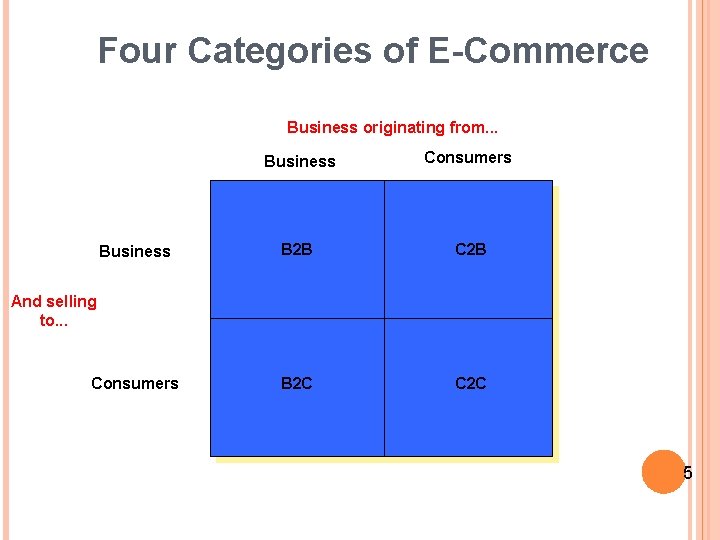
Four Categories of E-Commerce Business originating from. . . Business Consumers Business B 2 B Consumers B 2 C C 2 C And selling to. . . 5
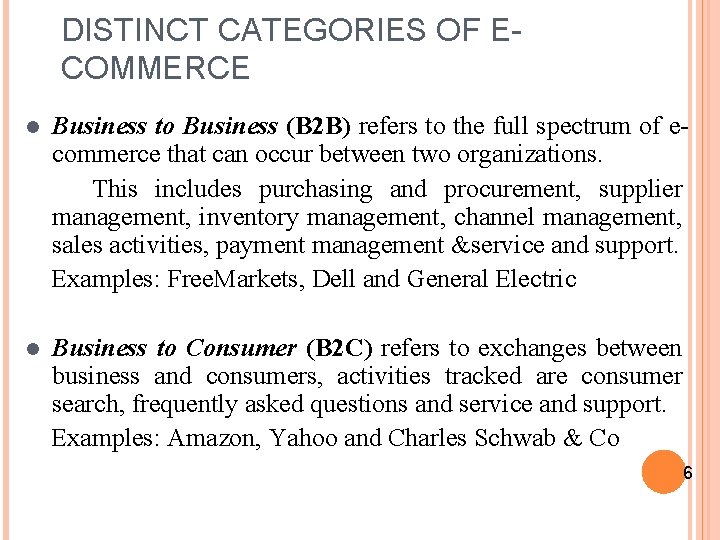
DISTINCT CATEGORIES OF ECOMMERCE l Business to Business (B 2 B) refers to the full spectrum of ecommerce that can occur between two organizations. This includes purchasing and procurement, supplier management, inventory management, channel management, sales activities, payment management &service and support. Examples: Free. Markets, Dell and General Electric l Business to Consumer (B 2 C) refers to exchanges between business and consumers, activities tracked are consumer search, frequently asked questions and service and support. Examples: Amazon, Yahoo and Charles Schwab & Co 6
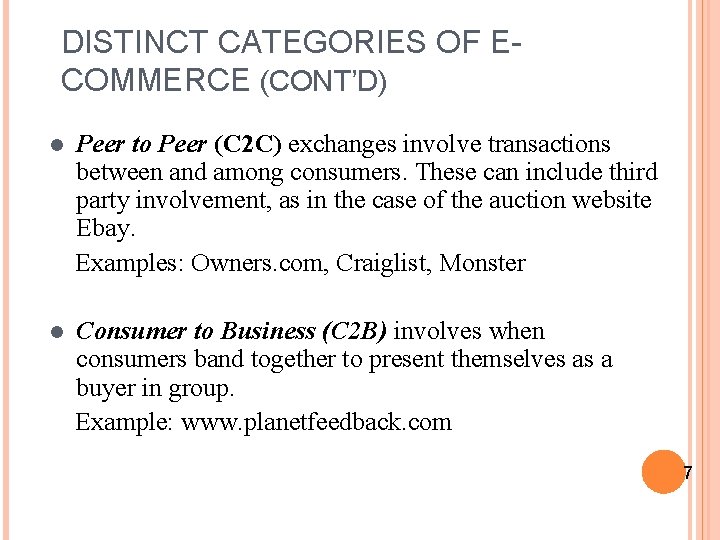
DISTINCT CATEGORIES OF ECOMMERCE (CONT’D) l Peer to Peer (C 2 C) exchanges involve transactions between and among consumers. These can include third party involvement, as in the case of the auction website Ebay. Examples: Owners. com, Craiglist, Monster l Consumer to Business (C 2 B) involves when consumers band together to present themselves as a buyer in group. Example: www. planetfeedback. com 7
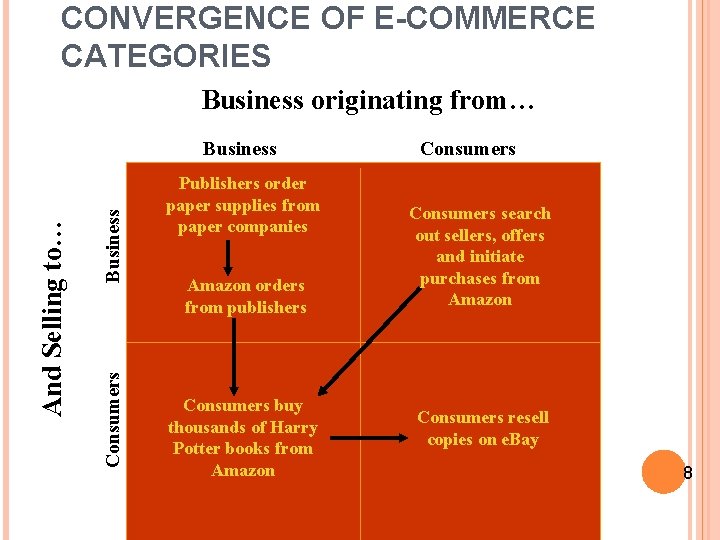
CONVERGENCE OF E-COMMERCE CATEGORIES Business originating from… Business Consumers And Selling to… Business Publishers order paper supplies from paper companies Amazon orders from publishers Consumers buy thousands of Harry Potter books from Amazon Consumers search out sellers, offers and initiate purchases from Amazon Consumers resell copies on e. Bay 8
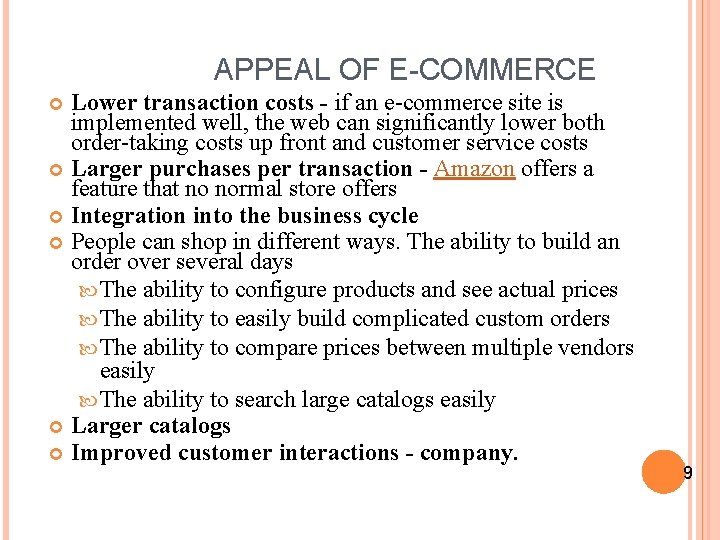
APPEAL OF E-COMMERCE Lower transaction costs - if an e-commerce site is implemented well, the web can significantly lower both order-taking costs up front and customer service costs Larger purchases per transaction - Amazon offers a feature that no normal store offers Integration into the business cycle People can shop in different ways. The ability to build an order over several days The ability to configure products and see actual prices The ability to easily build complicated custom orders The ability to compare prices between multiple vendors easily The ability to search large catalogs easily Larger catalogs Improved customer interactions - company. 9
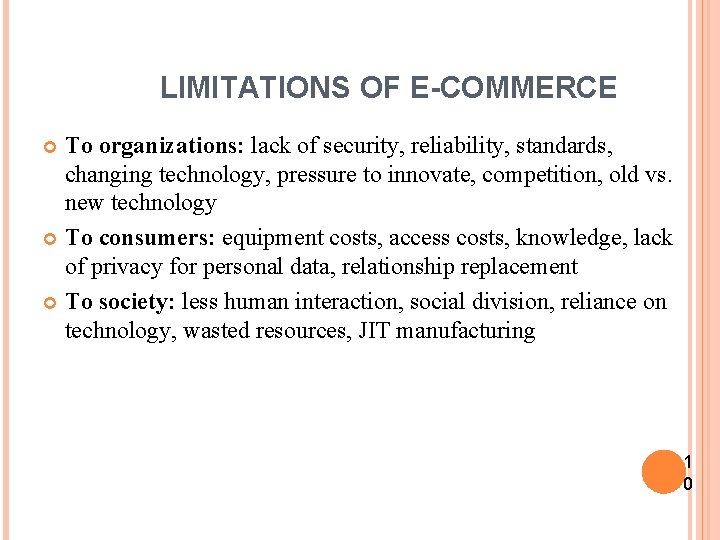
LIMITATIONS OF E-COMMERCE To organizations: lack of security, reliability, standards, changing technology, pressure to innovate, competition, old vs. new technology To consumers: equipment costs, access costs, knowledge, lack of privacy for personal data, relationship replacement To society: less human interaction, social division, reliance on technology, wasted resources, JIT manufacturing 1 0
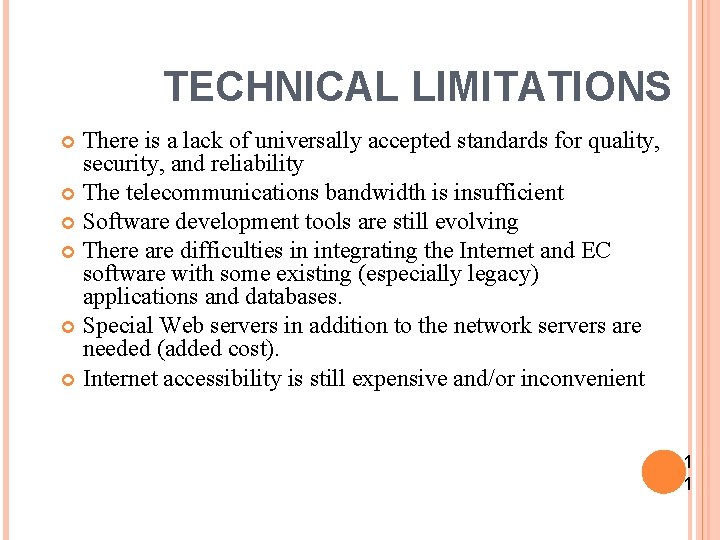
TECHNICAL LIMITATIONS There is a lack of universally accepted standards for quality, security, and reliability The telecommunications bandwidth is insufficient Software development tools are still evolving There are difficulties in integrating the Internet and EC software with some existing (especially legacy) applications and databases. Special Web servers in addition to the network servers are needed (added cost). Internet accessibility is still expensive and/or inconvenient 1 1
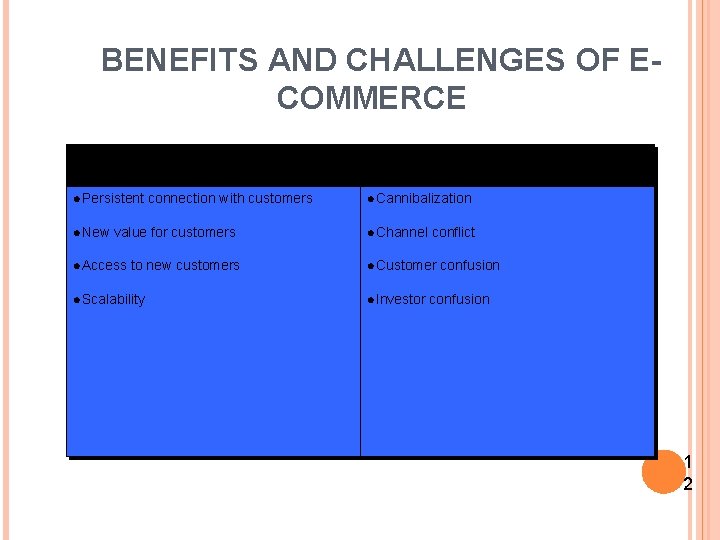
BENEFITS AND CHALLENGES OF ECOMMERCE Benefits l Persistent l New connection with customers value for customers l Access to new customers l Scalability Challenges l Cannibalization l Channel conflict l Customer l Investor confusion 1 2
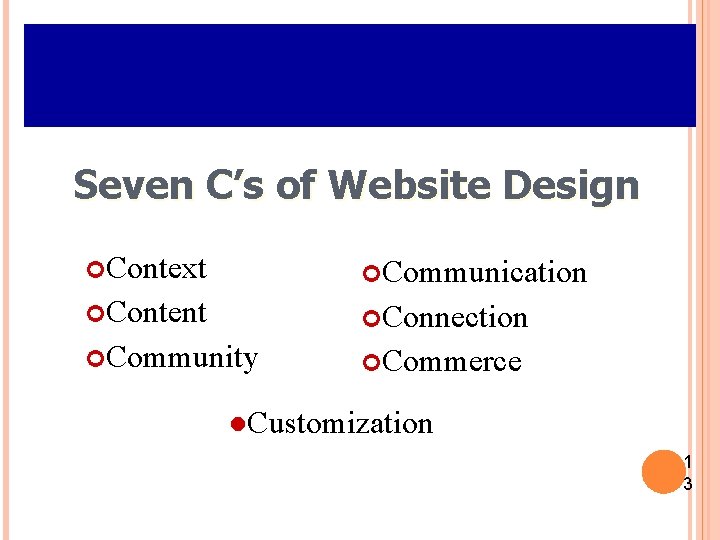
CONDUCTING E-COMMERCE Seven C’s of Website Design Context Communication Content Connection Community Commerce l. Customization 1 3
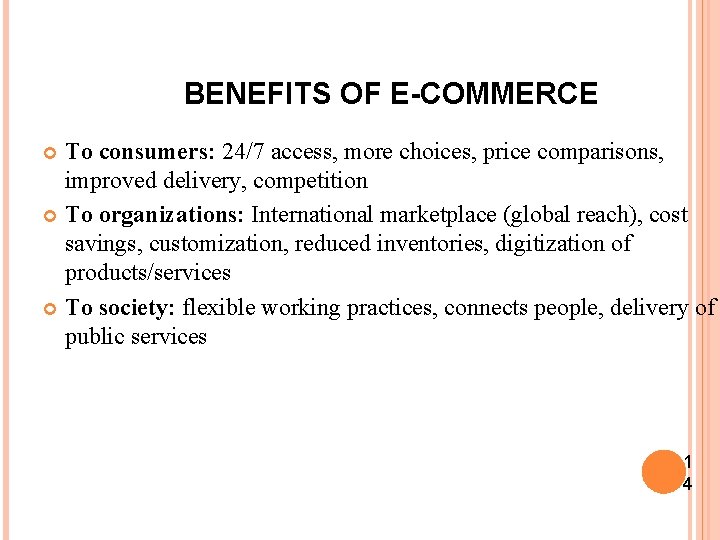
BENEFITS OF E-COMMERCE To consumers: 24/7 access, more choices, price comparisons, improved delivery, competition To organizations: International marketplace (global reach), cost savings, customization, reduced inventories, digitization of products/services To society: flexible working practices, connects people, delivery of public services 1 4
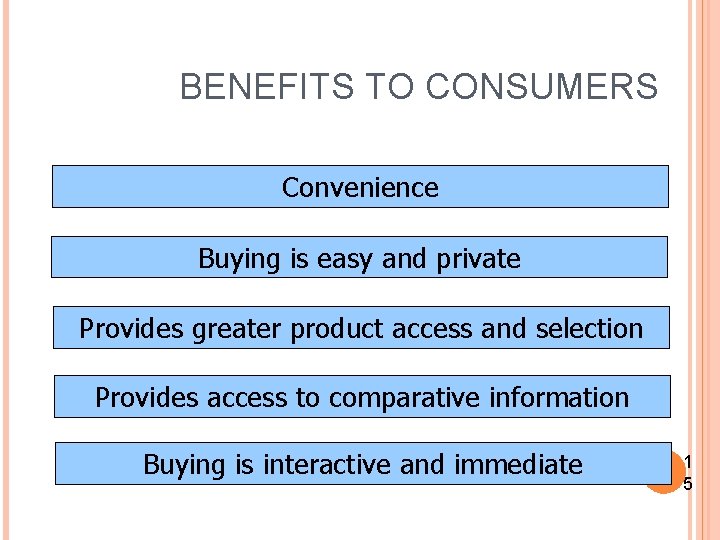
BENEFITS TO CONSUMERS Convenience Buying is easy and private Provides greater product access and selection Provides access to comparative information Buying is interactive and immediate 1 5
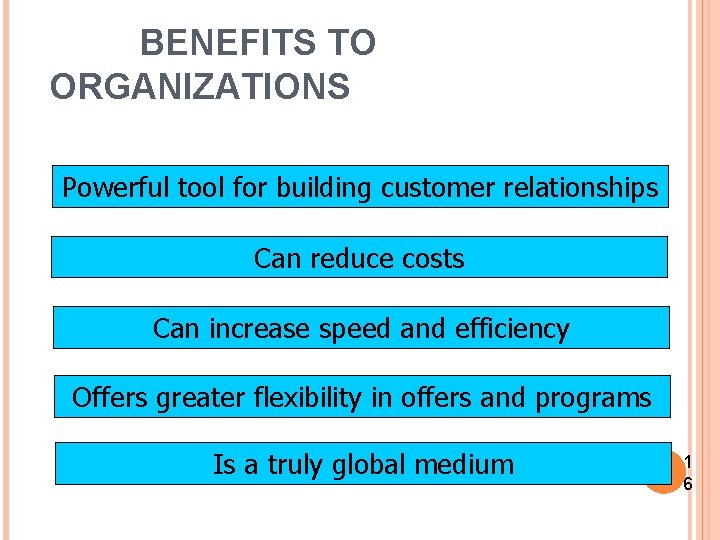
BENEFITS TO ORGANIZATIONS Powerful tool for building customer relationships Can reduce costs Can increase speed and efficiency Offers greater flexibility in offers and programs Is a truly global medium 1 6
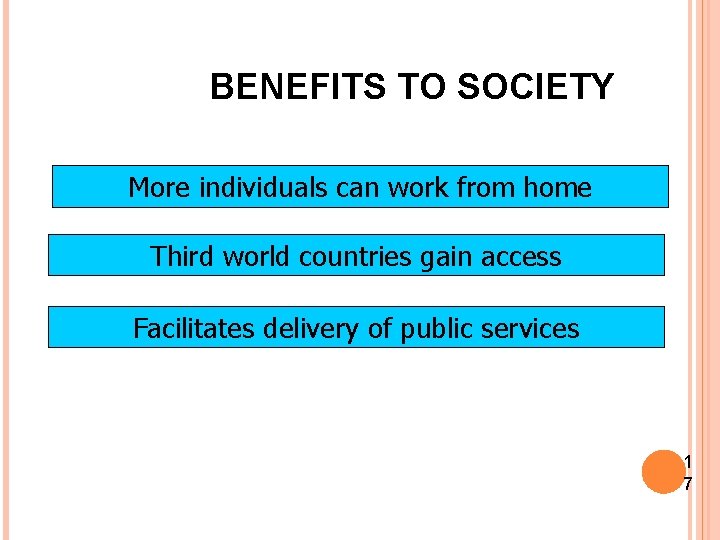
BENEFITS TO SOCIETY More individuals can work from home Third world countries gain access Facilitates delivery of public services 1 7
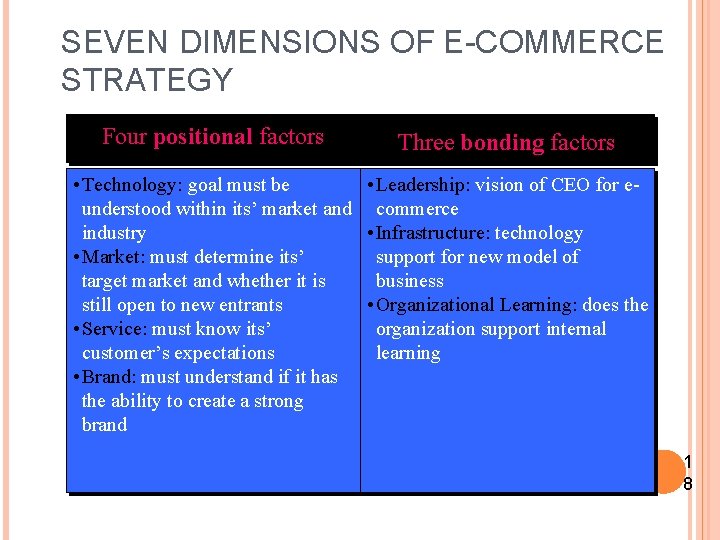
SEVEN DIMENSIONS OF E-COMMERCE STRATEGY Four positional factors Three bonding factors • Technology: goal must be • Leadership: vision of CEO for eunderstood within its’ market and commerce industry • Infrastructure: technology • Market: must determine its’ support for new model of target market and whether it is business still open to new entrants • Organizational Learning: does the • Service: must know its’ organization support internal customer’s expectations learning • Brand: must understand if it has the ability to create a strong brand 1 8
19
20
21
22
23
24