
Definition l Static Nonprogressive disorder of posture and



- Slides: 20
Definition l. Static -Non-progressive disorder of posture and movement due to damage to an immature nervous system 1
Description movement control disturbance l postural disturbance l primitive reflex persistence l failure of normal balance mechanisms l associated multi-system problems l more. . l 2
CEREBRAL • PALSY Occurs in about 2 per 1, 000 births. 3
Causes of cerebral palsy Pre-natal Perinatal Post Natal 4
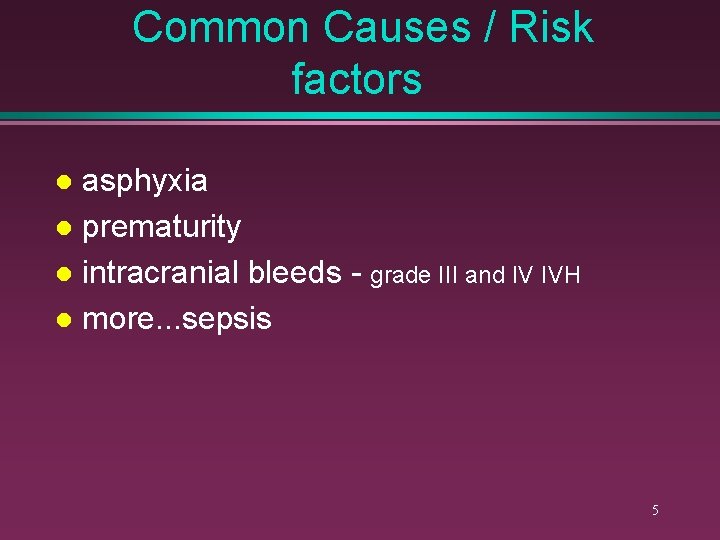
Common Causes / Risk factors asphyxia l prematurity l intracranial bleeds - grade III and IV IVH l more. . . sepsis l 5
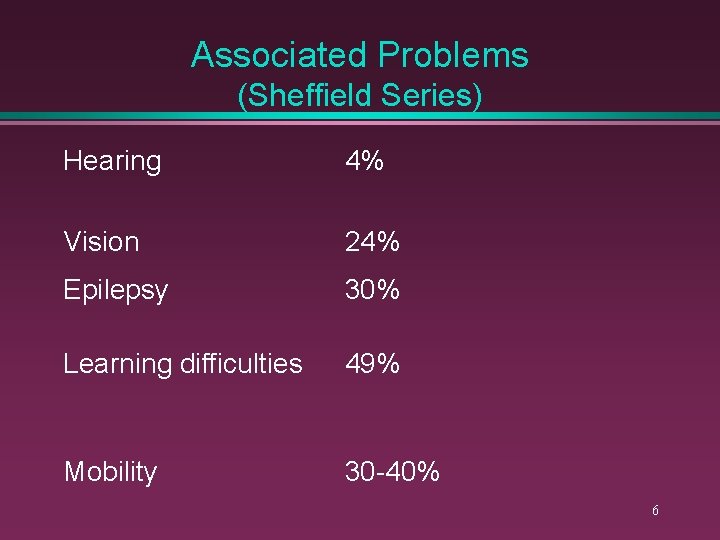
Associated Problems (Sheffield Series) Hearing 4% Vision 24% Epilepsy 30% Learning difficulties 49% Mobility 30 -40% 6
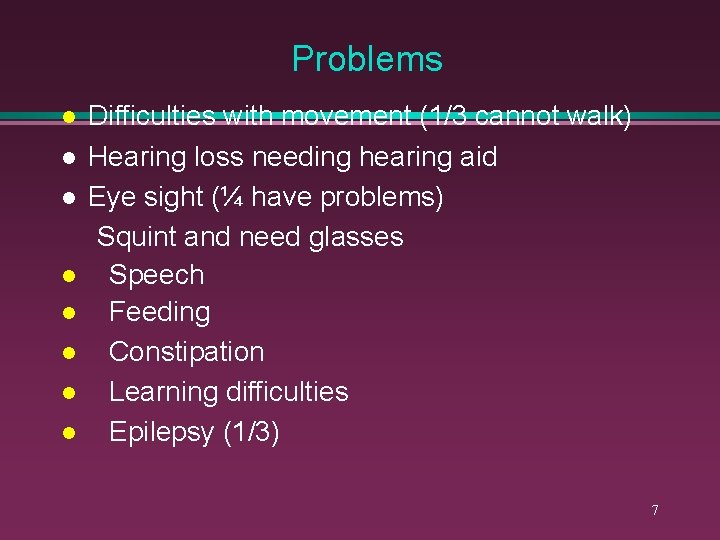
Problems l l l l Difficulties with movement (1/3 cannot walk) Hearing loss needing hearing aid Eye sight (¼ have problems) Squint and need glasses Speech Feeding Constipation Learning difficulties Epilepsy (1/3) 7
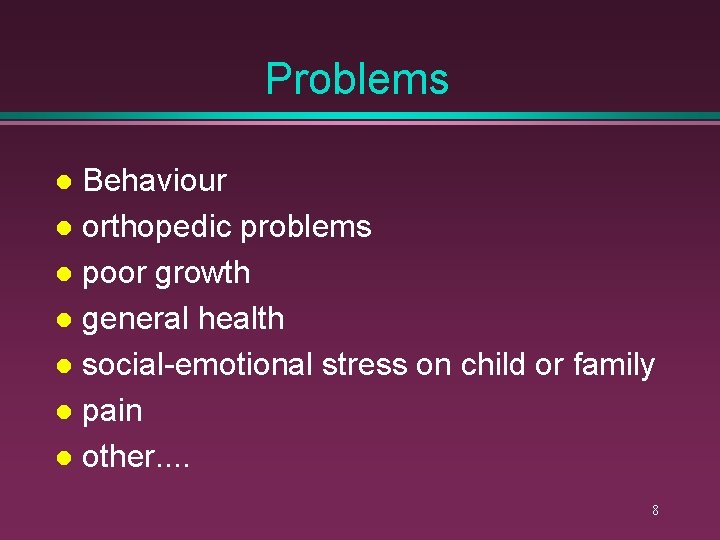
Problems Behaviour l orthopedic problems l poor growth l general health l social-emotional stress on child or family l pain l other. . l 8
Family Implications l social-emotional l financial l time commitment 9
Classification l Type l Distribution 10
Types of cerebral palsy l Spasticity l Hypotonia l Athetosis/Dyskinesia l Mixed 11
Distribution Quadriplegia l Diplegia l Hemiplegia l Triplegia l Paraplegia l Monoplegia l 12
Degree l Mild l Moderate l Severe 13
Perinatal predictors Apgar scores - alone not considered predictive. The majority of infants with low Apgars survive without neurological sequalae l Intracranial hemorrhages and neonatal seizures are the strongest factors discriminating children with neurological impairment from control children. l 14
Intervention l Team management is important 15
Intervention Family Centered l Must consider person’s individuality and their role as an individual in a family, and in a community environment 16
Medical Management l Developmental Medicine l Orthopaedic Surgery - l Neurosurgery l Medication - baclofen (lioresel), 17
Prognosis l Mortality » 87% survival rate for 30 yrs » adverse factors = type of CP (spastic quadriplegia poorest), epilepsy, and severe or profound MR. . . » new developments helpful to survival rate = gastrostomy feeding (nutrition focus in general), improved antibiotic treatment, management of respiratory infections 18
Prognosis l Morbidity » » » ortho problems, hospitalization educational and employment concerns societal isolation pain absence of or loss of function; dependence 19
20