
DEFINITION CLASSIFICATION OF LBP ETHIOLOGY EVOLUTION Pain without
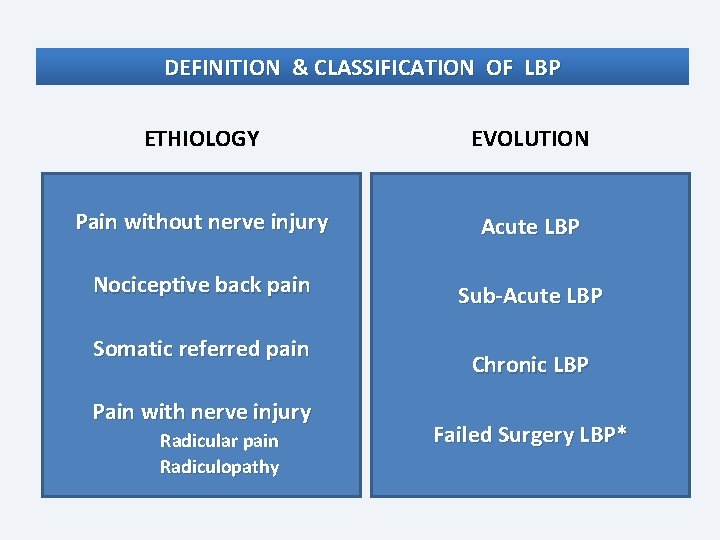
DEFINITION & CLASSIFICATION OF LBP ETHIOLOGY EVOLUTION Pain without nerve injury Acute LBP Nociceptive back pain Sub-Acute LBP Somatic referred pain Pain with nerve injury Radicular pain Radiculopathy Chronic LBP Failed Surgery LBP*
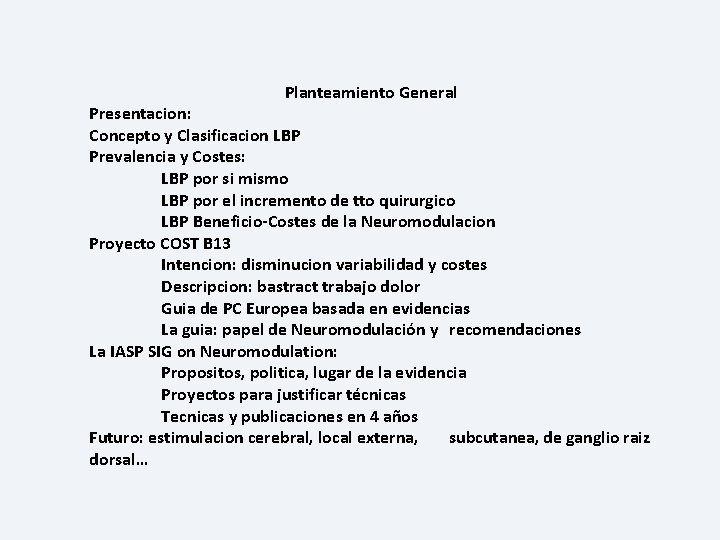
Planteamiento General Presentacion: Concepto y Clasificacion LBP Prevalencia y Costes: LBP por si mismo LBP por el incremento de tto quirurgico LBP Beneficio-Costes de la Neuromodulacion Proyecto COST B 13 Intencion: disminucion variabilidad y costes Descripcion: bastract trabajo dolor Guia de PC Europea basada en evidencias La guia: papel de Neuromodulación y recomendaciones La IASP SIG on Neuromodulation: Propositos, politica, lugar de la evidencia Proyectos para justificar técnicas Tecnicas y publicaciones en 4 años Futuro: estimulacion cerebral, local externa, subcutanea, de ganglio raiz dorsal…
E Latorre Marques, MD SIG on Neuromodulation, Chair of NL Committee The Management of Back Pain Based on Scientific Evidence: The Role of Neuromodulation Techniques Cost-Efectivity and Outcomes International Conference and Exhibition on Pain Medicine June 08 -10, 2015 Chicago
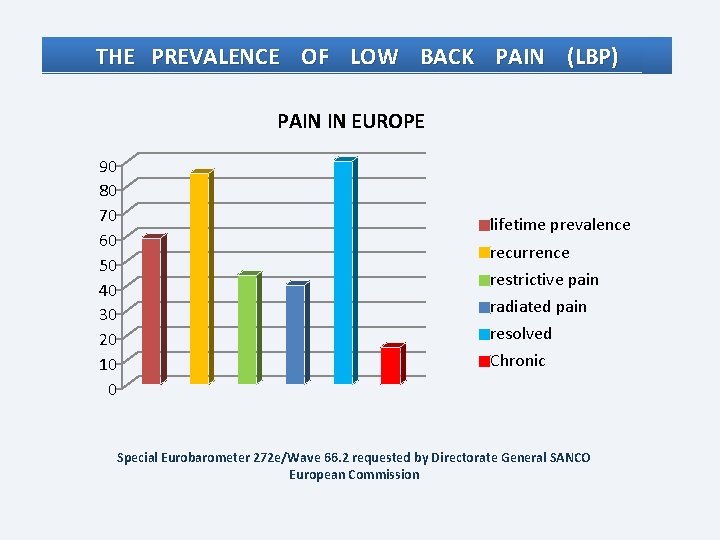
THE PREVALENCE OF LOW BACK PAIN (LBP) PAIN IN EUROPE 90 80 70 60 50 40 30 20 10 0 lifetime prevalence recurrence restrictive pain radiated pain resolved Chronic Special Eurobarometer 272 e/Wave 66. 2 requested by Directorate General SANCO European Commission
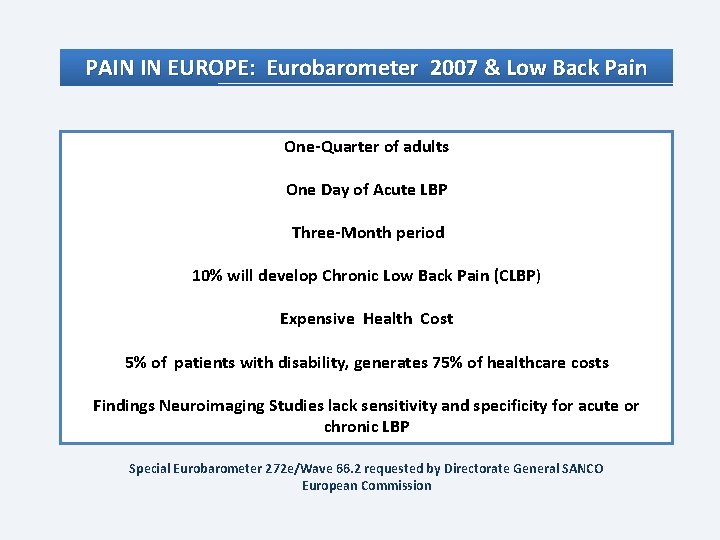
PAIN IN EUROPE: Eurobarometer 2007 & Low Back Pain One-Quarter of adults One Day of Acute LBP Three-Month period 10% will develop Chronic Low Back Pain (CLBP) Expensive Health Cost 5% of patients with disability, generates 75% of healthcare costs Findings Neuroimaging Studies lack sensitivity and specificity for acute or chronic LBP Special Eurobarometer 272 e/Wave 66. 2 requested by Directorate General SANCO European Commission
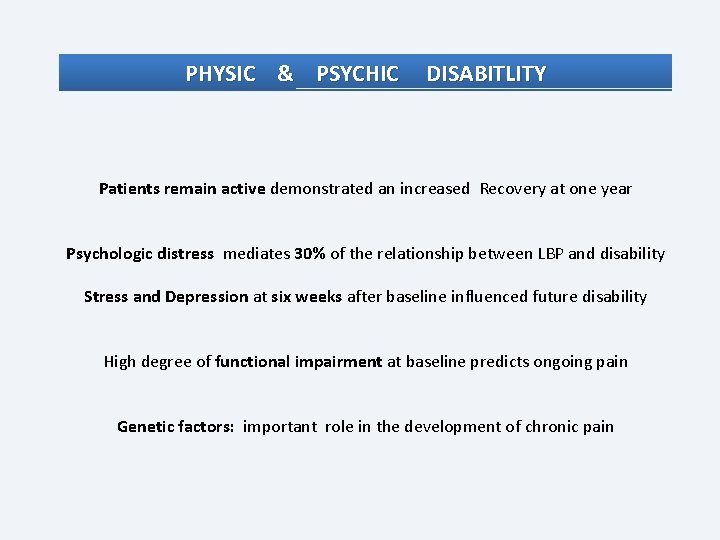
PHYSIC & PSYCHIC DISABITLITY Patients remain active demonstrated an increased Recovery at one year Psychologic distress mediates 30% of the relationship between LBP and disability Stress and Depression at six weeks after baseline influenced future disability High degree of functional impairment at baseline predicts ongoing pain Genetic factors: important role in the development of chronic pain
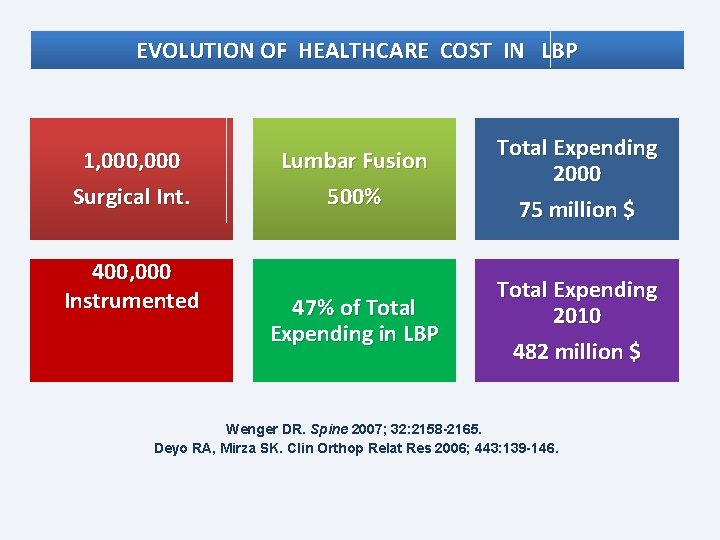
EVOLUTION OF HEALTHCARE COST IN LBP 1, 000 Surgical Int. 400, 000 Instrumented Lumbar Fusion 500% Total Expending 2000 75 million $ 47% of Total Expending in LBP Total Expending 2010 482 million $ Wenger DR. Spine 2007; 32: 2158 -2165. Deyo RA, Mirza SK. Clin Orthop Relat Res 2006; 443: 139 -146.
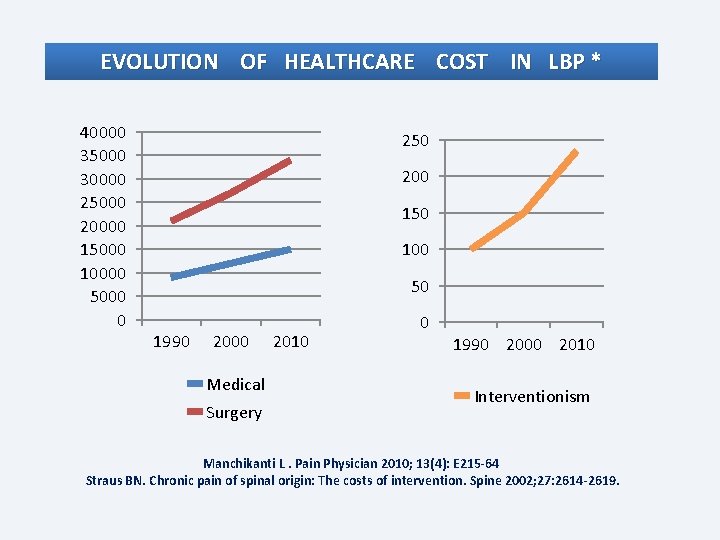
EVOLUTION OF HEALTHCARE COST IN LBP * 40000 35000 30000 25000 20000 15000 10000 5000 0 250 200 150 100 50 1990 2000 Medical Surgery 2010 0 1990 2000 2010 Interventionism Manchikanti L. Pain Physician 2010; 13(4): E 215 -64 Straus BN. Chronic pain of spinal origin: The costs of intervention. Spine 2002; 27: 2614 -2619.

CLINICAL PRACTICE GUIDELINES & MANAGEMENT OF LBP 1987 The Quebec Task force on Spinal Disorders 1994 U. S. Agency for Health Care and Policy Research (AHCPR) management of Acute Low Back Pain 1999 U. S. Guideline by the Veterans Affairs/Department of Defense (VA/Do. D) 1999 Guideline of Royal College of General Practicioners (RCGP) 2005 The European Multinational COST b 13 program (Revised). 2009 American Pain Society (APS) 2010 American Society of Interventional Pain Physicians
COST B 13 Project: The Management of LBP Based on Scientific Evidence Pan-European, multidisciplinary Based on Scientific Evidence Without parcipation of Industry Comprehensive Management & Prevention Acute, Sub-acute & Chronic LBP Technologies Recommended: Type of Patients, Evidence, Efficiency & Safety AGREE Criteria & Conflict Interest Memorandum of Understanding, COST ACTION B 13: “Low back pain : guidelines for its management”. European Commission. Brussels, 1999 - 2005.
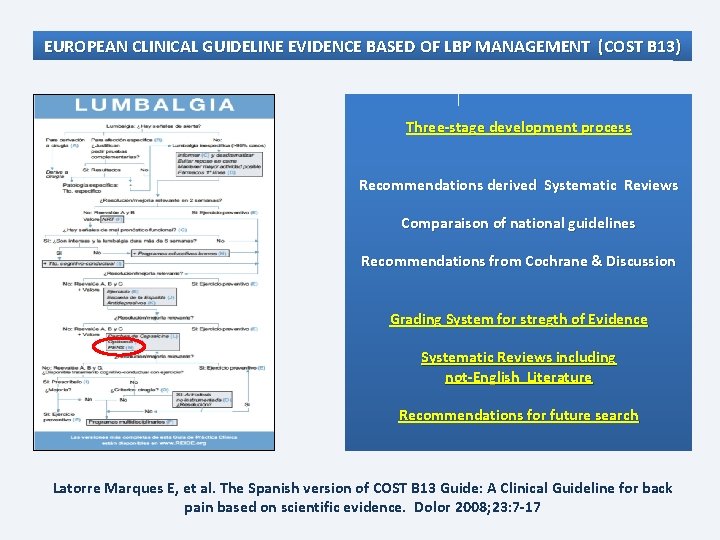
EUROPEAN CLINICAL GUIDELINE EVIDENCE BASED OF LBP MANAGEMENT (COST B 13) Three-stage development process Recommendations derived Systematic Reviews Comparaison of national guidelines Recommendations from Cochrane & Discussion Grading System for stregth of Evidence Systematic Reviews including not-English Literature Recommendations for future search Latorre Marques E, et al. The Spanish version of COST B 13 Guide: A Clinical Guideline for back pain based on scientific evidence. Dolor 2008; 23: 7 -17
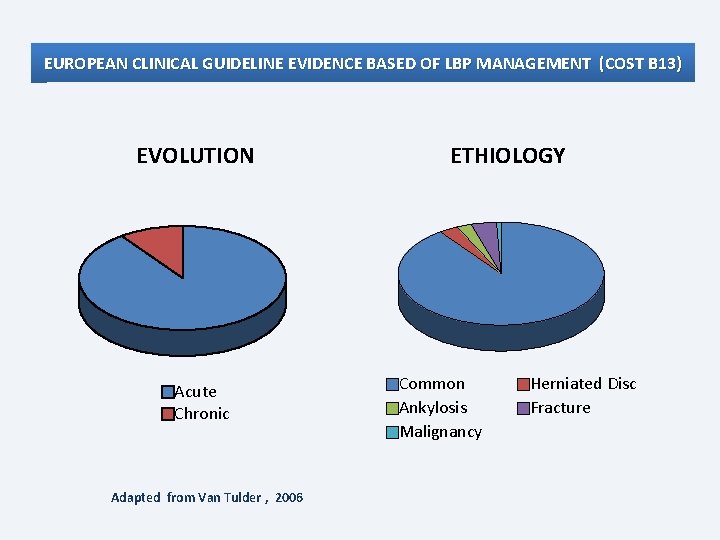
EUROPEAN CLINICAL GUIDELINE EVIDENCE BASED OF LBP MANAGEMENT (COST B 13) EVOLUTION Acute Chronic Adapted from Van Tulder , 2006 ETHIOLOGY Common Ankylosis Malignancy Herniated Disc Fracture

EUROPEAN CLINICAL GUIDELINE EVIDENCE BASED OF LBP MANAGEMENT (COST B 13) Course of LBP Red Flags Acute (< 6 weeks) Systemic disease: Information Rule out red flags No routine Radiology Stay active + Analgesics Muscle relaxants (optional) Aware Yellow Flags Pain < 20 or > 50 age. Thoracic spine pain Deficit Neurologic Deformity, not flexion of 5 th Bad general state, fever Trauma or Neoplasms Use of corticosteroids Addictions Inmunodeficiency, AIDS Subacute (6 -12 weeks) Expectations of patient Regular Re-assessment Active treatments Cognitive behavioral therapy Multidisciplinary Occupational program for workers? Chronic (> 12 weeks) Low disability: simple therapies Severe disability: biopsychosocial Neuromodulation* Yellow Flags Surgery Urgent : Paresis, loss of control of sphincters, "saddle" anesthesia Consultation: 6 Weeks of treatment, limitation of ambulation. Radicular pain > 6 months + image of spinal stenosis Emotional problems Depression, low morale, and social withdrawal Use /Abuse of Psicho-mimetics Inappropriate attitudes and beliefs about pain "pain is harmful or disabling" "passive, rather than active, treatment will be beneficial" Inappropriate pain behavior Fear and reduced activity levels Social & Financial problems Labour disputes Current status and management of LBP and warning signs changed (adapted from Van Tulder & Araksinen)
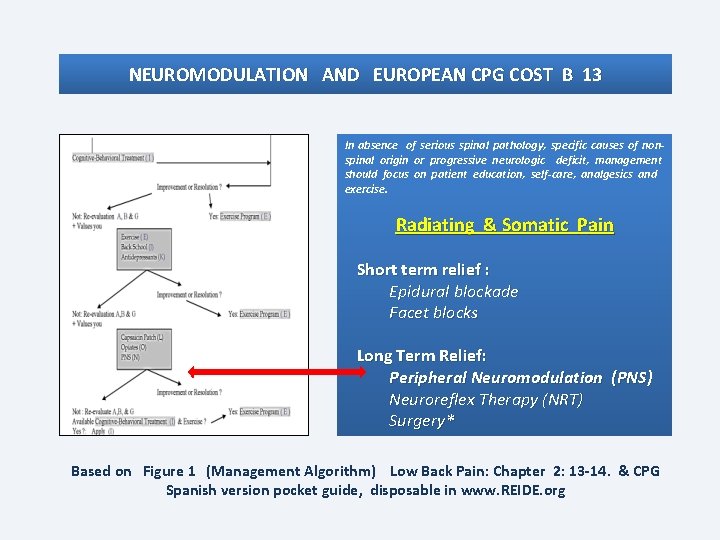
NEUROMODULATION AND EUROPEAN CPG COST B 13 In absence of serious spinal pathology, specific causes of nonspinal origin or progressive neurologic deficit, management should focus on patient education, self-care, analgesics and exercise. Radiating & Somatic Pain Short term relief : Epidural blockade Facet blocks Long Term Relief: Peripheral Neuromodulation (PNS) Neuroreflex Therapy (NRT) Surgery* Based on Figure 1 (Management Algorithm) Low Back Pain: Chapter 2: 13 -14. & CPG Spanish version pocket guide, disposable in www. REIDE. org
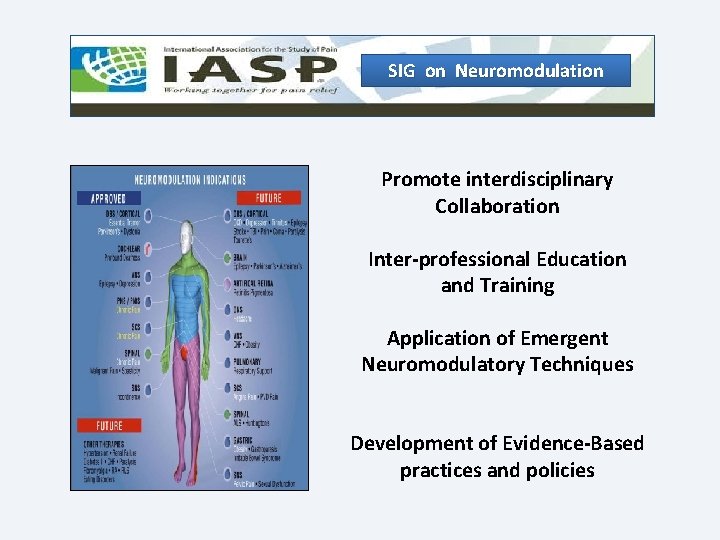
SIG on Neuromodulation Promote interdisciplinary Collaboration Inter-professional Education and Training Application of Emergent Neuromodulatory Techniques Development of Evidence-Based practices and policies
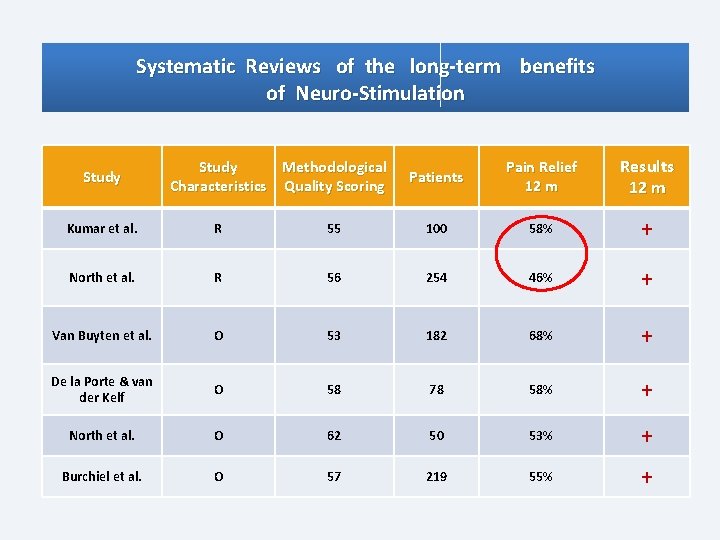
Systematic Reviews of the long-term benefits of Neuro-Stimulation Study Methodological Characteristics Quality Scoring Patients Pain Relief 12 m Results 12 m Kumar et al. R 55 100 58% + North et al. R 56 254 46% + Van Buyten et al. O 53 182 68% + De la Porte & van der Kelf O 58 78 58% + North et al. O 62 50 53% + Burchiel et al. O 57 219 55% +
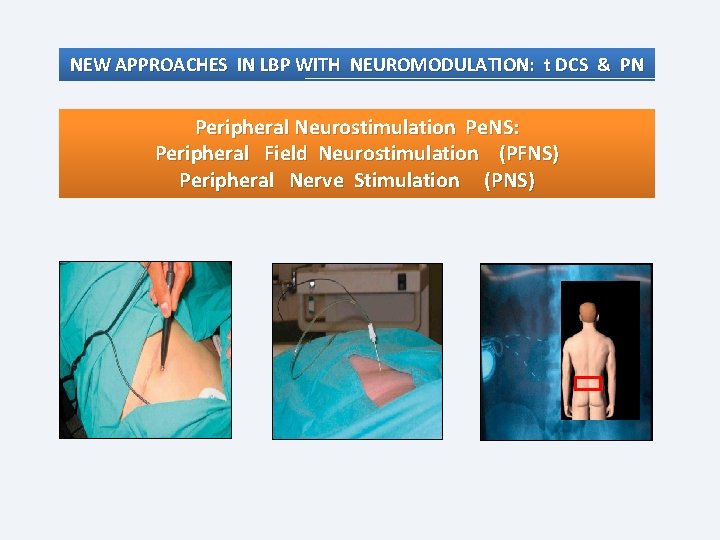
NEW APPROACHES IN LBP WITH NEUROMODULATION: t DCS & PN Peripheral Neurostimulation Pe. NS: Peripheral Field Neurostimulation (PFNS) Peripheral Nerve Stimulation (PNS)
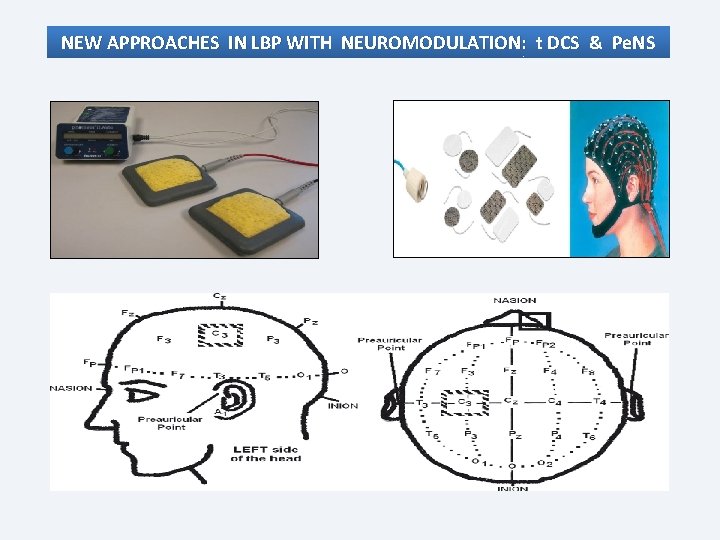
NEW APPROACHES IN LBP WITH NEUROMODULATION: t DCS & Pe. NS
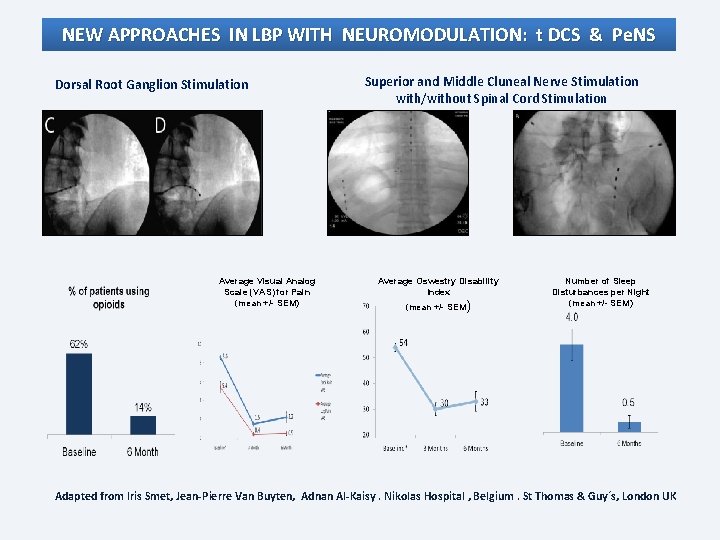
NEW APPROACHES IN LBP WITH NEUROMODULATION: t DCS & Pe. NS Dorsal Root Ganglion Stimulation Average Visual Analog Scale (VAS) for Pain (mean +/- SEM) Superior and Middle Cluneal Nerve Stimulation with/without Spinal Cord Stimulation Average Oswestry Disability Index (mean +/- SEM) Number of Sleep Disturbances per Night (mean +/- SEM) Adapted from Iris Smet, Jean-Pierre Van Buyten, Adnan Al-Kaisy. Nikolas Hospital , Belgium. St Thomas & Guy´s, London UK
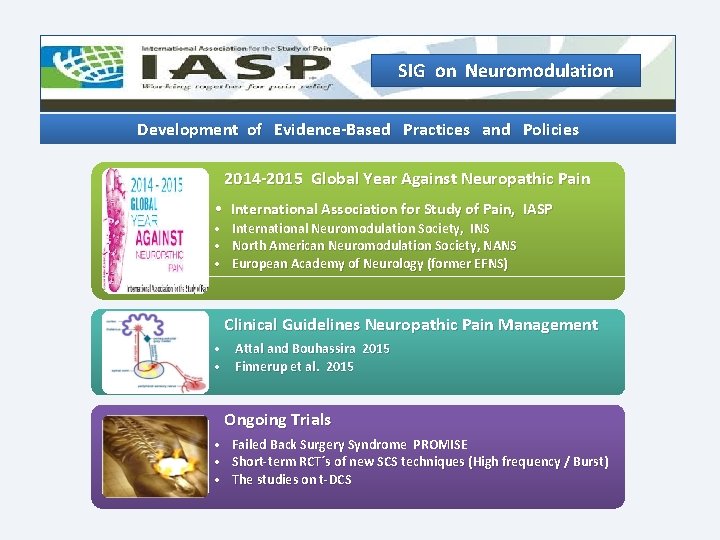
SIG on Neuromodulation Development of Evidence-Based Practices and Policies 2014 -2015 Global Year Against Neuropathic Pain • International Association for Study of Pain, IASP • • • International Neuromodulation Society, INS North American Neuromodulation Society, NANS European Academy of Neurology (former EFNS) Clinical Guidelines Neuropathic Pain Management • Attal and Bouhassira 2015 • Finnerup et al. 2015 Ongoing Trials • • • Failed Back Surgery Syndrome PROMISE Short-term RCT´s of new SCS techniques (High frequency / Burst) The studies on t-DCS
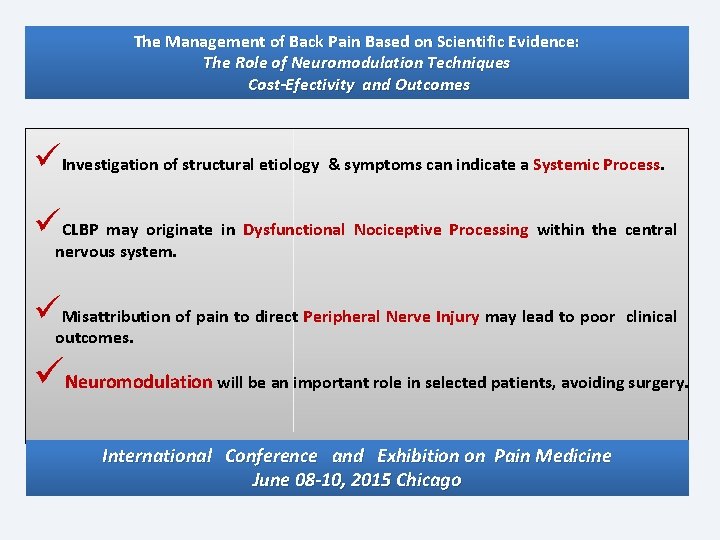
The Management of Back Pain Based on Scientific Evidence: The Role of Neuromodulation Techniques Cost-Efectivity and Outcomes üInvestigation of structural etiology & symptoms can indicate a Systemic Process. üCLBP may originate in Dysfunctional Nociceptive Processing within the central nervous system. üMisattribution of pain to direct Peripheral Nerve Injury may lead to poor clinical outcomes. üNeuromodulation will be an important role in selected patients, avoiding surgery. International Conference and Exhibition on Pain Medicine June 08 -10, 2015 Chicago
Acknowledgements
- Slides: 22