
Definition 2 20 Let R be an equivalence
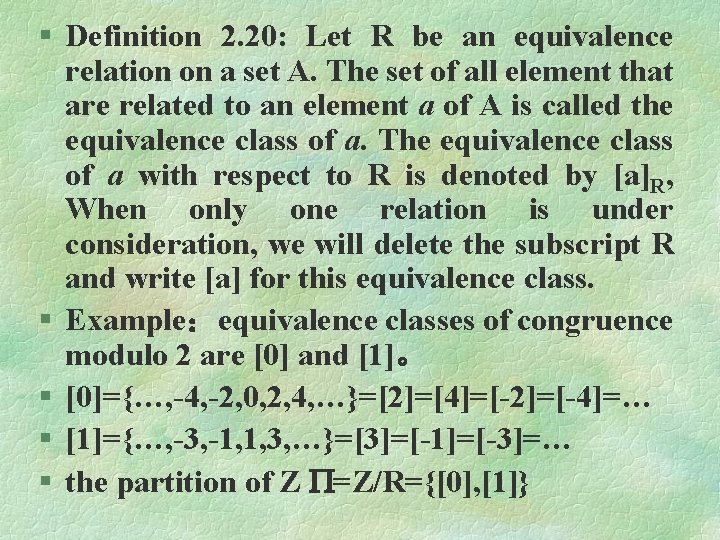
§ Definition 2. 20: Let R be an equivalence relation on a set A. The set of all element that are related to an element a of A is called the equivalence class of a. The equivalence class of a with respect to R is denoted by [a]R, When only one relation is under consideration, we will delete the subscript R and write [a] for this equivalence class. § Example:equivalence classes of congruence modulo 2 are [0] and [1]。 § [0]={…, -4, -2, 0, 2, 4, …}=[2]=[4]=[-2]=[-4]=… § [1]={…, -3, -1, 1, 3, …}=[3]=[-1]=[-3]=… § the partition of Z =Z/R={[0], [1]}
![§ Example: equivalence classes of congruence modulo n are: § [0]={…, -2 n, -n,](http://slidetodoc.com/presentation_image_h2/8e133fd84276f16e79835219c596aad5/image-2.jpg "§ Example: equivalence classes of congruence modulo n are: § [0]={…, -2 n, -n,")
§ Example: equivalence classes of congruence modulo n are: § [0]={…, -2 n, -n, 0, n, 2 n, …} § [1]={…, -2 n+1, -n+1, 1, n+1, 2 n+1, …} §… § [n-1]={…, -n-1, 2 n-1, 3 n-1, …} § A partition or quotient set of Z, § Z/R={[0], [1], …, [n-1]}
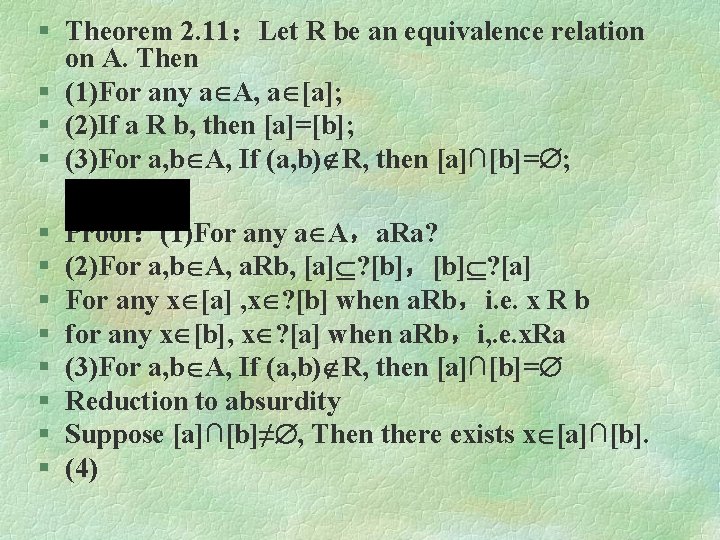
§ Theorem 2. 11:Let R be an equivalence relation on A. Then § (1)For any a A, a [a]; § (2)If a R b, then [a]=[b]; § (3)For a, b A, If (a, b) R, then [a]∩[b]= ; § § § § Proof:(1)For any a A,a. Ra? (2)For a, b A, a. Rb, [a] ? [b],[b] ? [a] For any x [a] , x ? [b] when a. Rb,i. e. x R b for any x [b], x ? [a] when a. Rb,i, . e. x. Ra (3)For a, b A, If (a, b) R, then [a]∩[b]= Reduction to absurdity Suppose [a]∩[b]≠ , Then there exists x [a]∩[b]. (4)
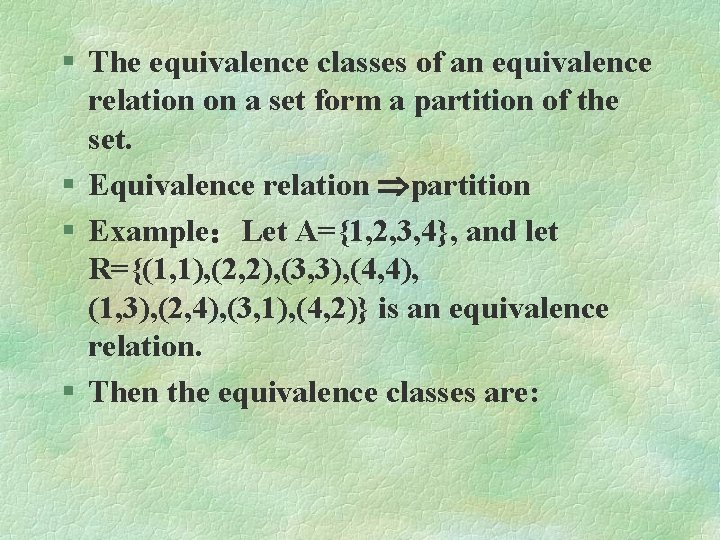
§ The equivalence classes of an equivalence relation on a set form a partition of the set. § Equivalence relation partition § Example:Let A={1, 2, 3, 4}, and let R={(1, 1), (2, 2), (3, 3), (4, 4), (1, 3), (2, 4), (3, 1), (4, 2)} is an equivalence relation. § Then the equivalence classes are:
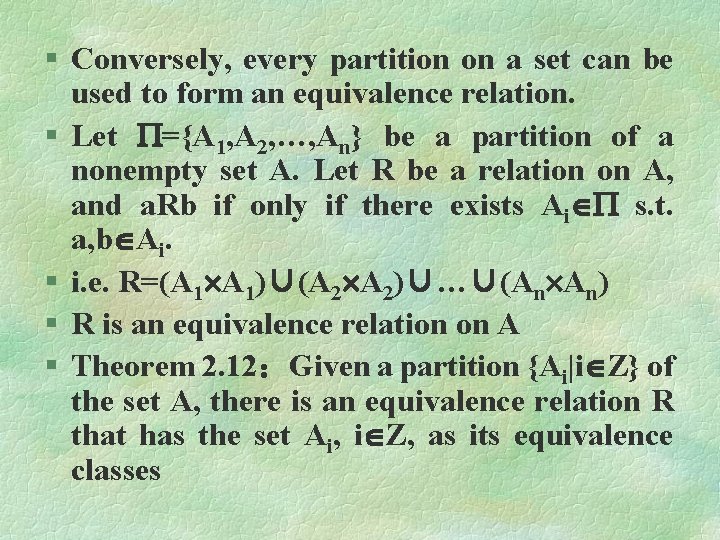
§ Conversely, every partition on a set can be used to form an equivalence relation. § Let ={A 1, A 2, …, An} be a partition of a nonempty set A. Let R be a relation on A, and a. Rb if only if there exists Ai s. t. a, b Ai. § i. e. R=(A 1 A 1)∪(A 2 A 2)∪…∪(An An) § R is an equivalence relation on A § Theorem 2. 12:Given a partition {Ai|i Z} of the set A, there is an equivalence relation R that has the set Ai, i Z, as its equivalence classes
§ Example: Let ={{a, b}, {c}} be a partition of A={a, b, c}. § Equivalence relation R=?
2. 7 Partial order relations § 1. Partially ordered sets § Definition 2. 21: A relation R on a set A is called a partial order if R is reflexive, antisymmetric, and transitive. The set A together with the partial order R is called a partially ordered set, or simply a poset, and we will denote this poset by (A, R). And the notation a≼b denoteds that (a, b) R. Note that the symbol ≼ is used to denote the relation in any poset, not just the “lessthan or equals” relation. The notation a≺b denotes that a≼b but a b.
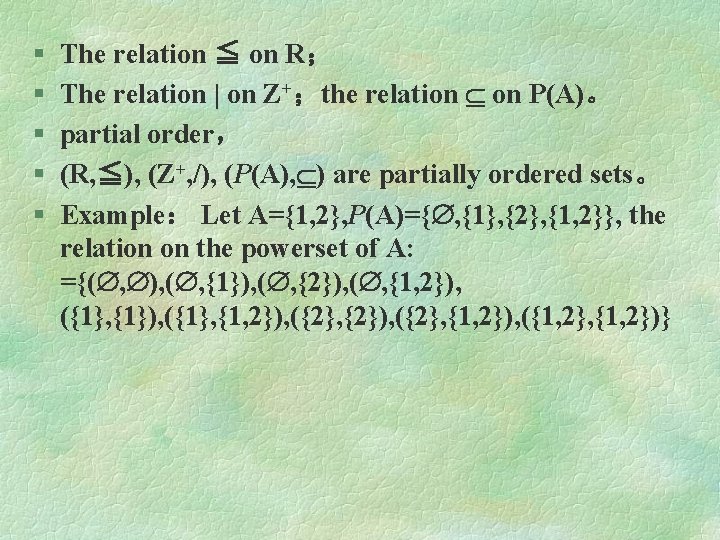
§ § § The relation ≦ on R; The relation | on Z+;the relation on P(A)。 partial order, (R, ≦), (Z+, /), (P(A), ) are partially ordered sets。 Example: Let A={1, 2}, P(A)={ , {1}, {2}, {1, 2}}, the relation on the powerset of A: ={( , ), ( , {1}), ( , {2}), ( , {1, 2}), ({1}, {1, 2}), ({2}, {1, 2}), ({1, 2}, {1, 2})}
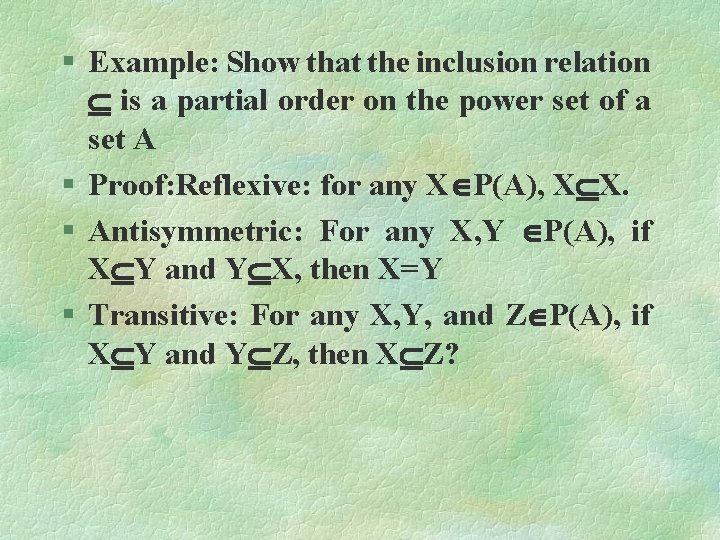
§ Example: Show that the inclusion relation is a partial order on the power set of a set A § Proof: Reflexive: for any X P(A), X X. § Antisymmetric: For any X, Y P(A), if X Y and Y X, then X=Y § Transitive: For any X, Y, and Z P(A), if X Y and Y Z, then X Z?
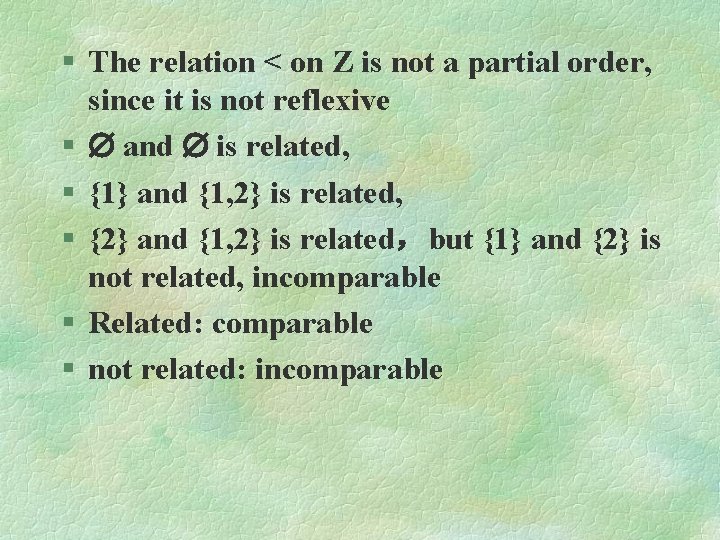
§ The relation < on Z is not a partial order, since it is not reflexive § and is related, § {1} and {1, 2} is related, § {2} and {1, 2} is related,but {1} and {2} is not related, incomparable § Related: comparable § not related: incomparable
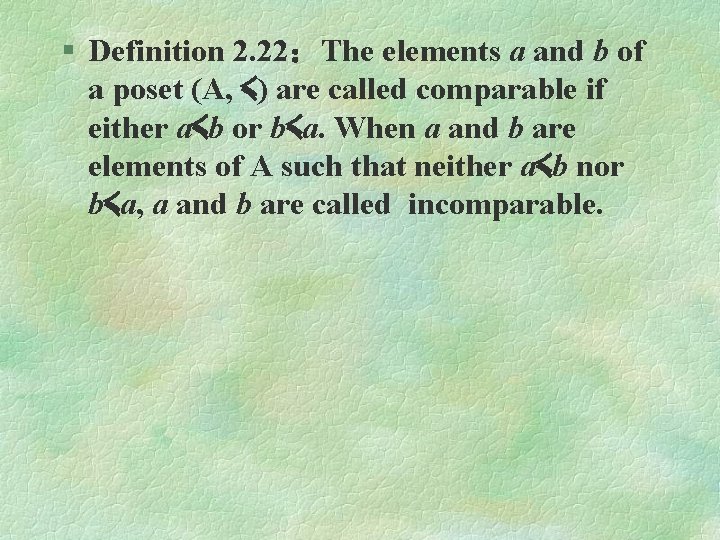
§ Definition 2. 22:The elements a and b of a poset (A, ≼) are called comparable if either a≼b or b≼a. When a and b are elements of A such that neither a≼b nor b≼a, a and b are called incomparable.
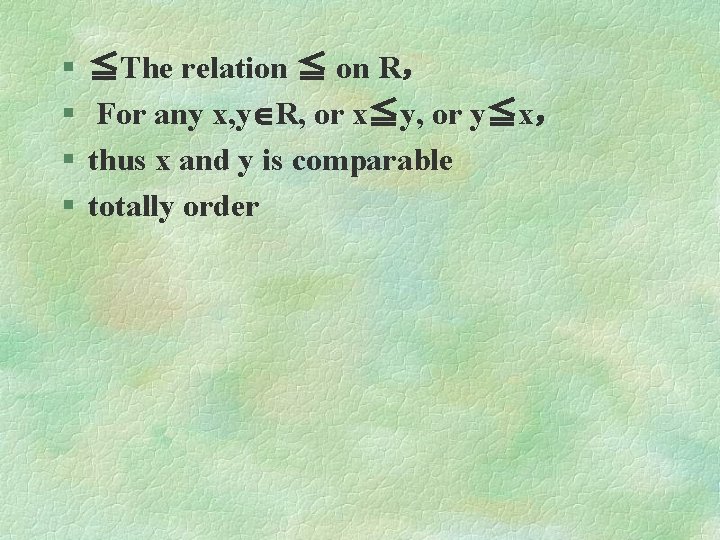
§ § ≦The relation ≦ on R, For any x, y R, or x≦y, or y≦x, thus x and y is comparable totally order
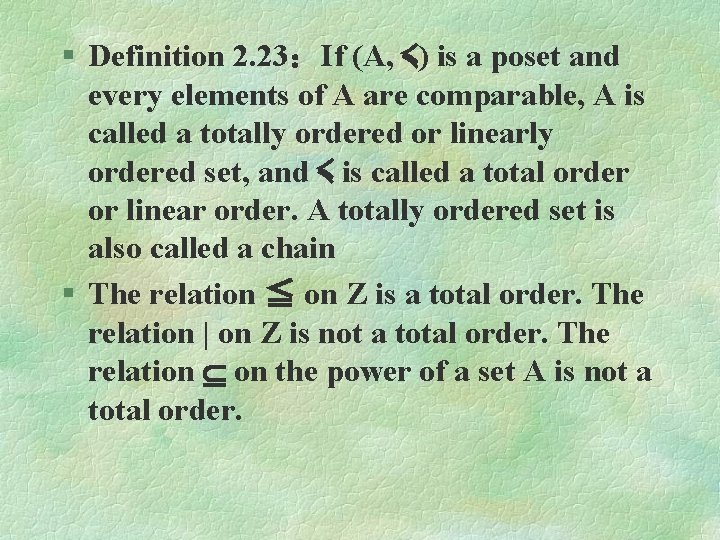
§ Definition 2. 23:If (A, ≼) is a poset and every elements of A are comparable, A is called a totally ordered or linearly ordered set, and ≼ is called a total order or linear order. A totally ordered set is also called a chain § The relation ≦ on Z is a total order. The relation | on Z is not a total order. The relation on the power of a set A is not a total order.
§ § § § 2.Hasse Diagrams Digraph: predigestion (1) partial order is reflexive, a. Ra, We shall delete all loop from the digraph (2) Because a partial order is transitive,We do not have to show those edges that must be present because of transitivity. § (3)If we assume that all edges are pointed “upword”, we do not have to show the directions of the edges. § Hasse Diagrams
§ § The relation on the power of a set A P(A)={ , {1}, {2}, {1, 2}} Example: A={2, 3, 6, 12, 24, 36}, (A, |) A={1, 2, 3, 4, 5, 6}, (A, ≦)
§ 3. Extremal elements of partially ordered sets § Definition 2. 24: Let (A, ≼) is a poset. An elements a A is called a maximal element(极大元 ) of A if there is no elements c in A such that a≺c. An elements b A is called a minimal element (极小元) of A if there is no elements c in A such that c≺b. § Example:A 1={1, 2, 3, 4, 5, 6}, (A 1, ) § 1 is a minimal element of A 1 § 6 is a maximal element of A 1
§ (A 1, |) § 1 is a minimal element of A 1. § As these example shows, a poset can have more than one maximal element and more than one minimal element.
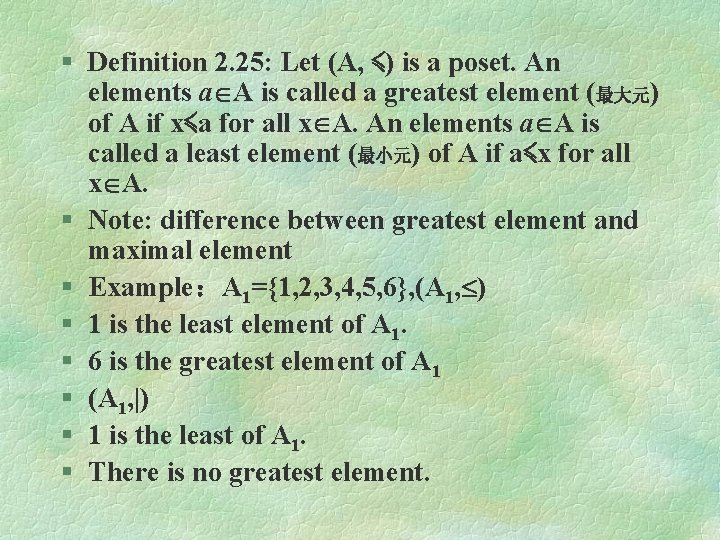
§ Definition 2. 25: Let (A, ≼) is a poset. An elements a A is called a greatest element (最大元) of A if x≼a for all x A. An elements a A is called a least element (最小元) of A if a≼x for all x A. § Note: difference between greatest element and maximal element § Example:A 1={1, 2, 3, 4, 5, 6}, (A 1, ) § 1 is the least element of A 1. § 6 is the greatest element of A 1 § (A 1, |) § 1 is the least of A 1. § There is no greatest element.
§ A 2={2, 3, 6, 12, 24, 36}, (A 2, |) § There is no greatest element. There is no least element.
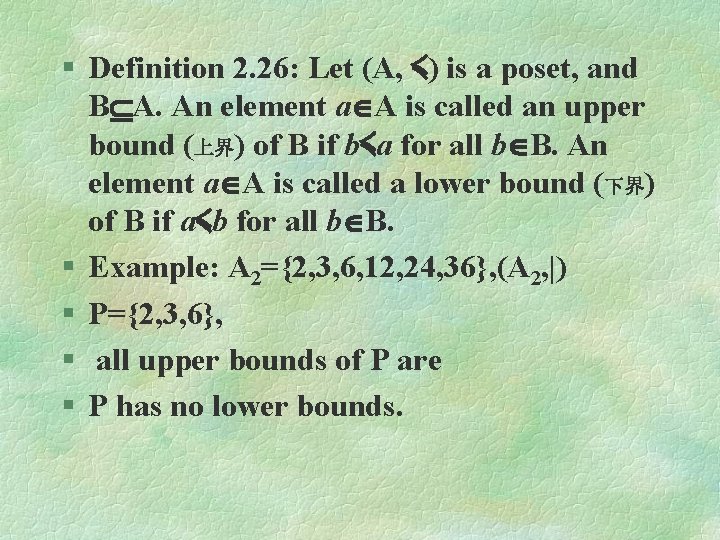
§ Definition 2. 26: Let (A, ≼) is a poset, and B A. An element a A is called an upper bound (上界) of B if b≼a for all b B. An element a A is called a lower bound (下界) of B if a≼b for all b B. § Example: A 2={2, 3, 6, 12, 24, 36}, (A 2, |) § P={2, 3, 6}, § all upper bounds of P are § P has no lower bounds.
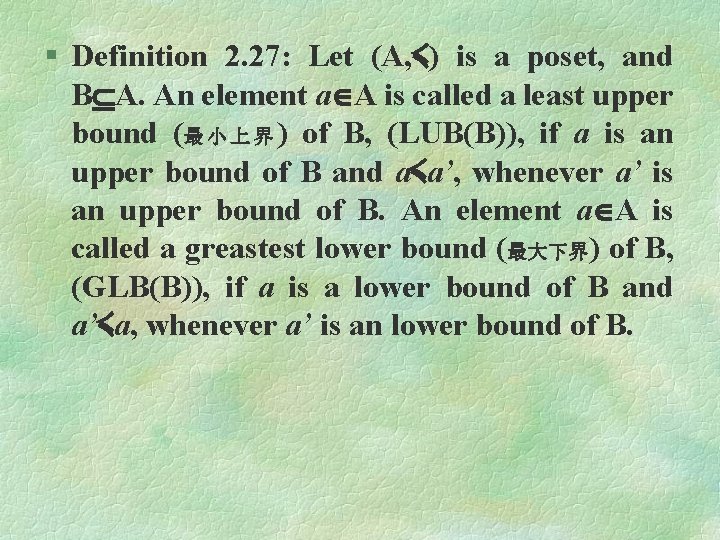
§ Definition 2. 27: Let (A, ≼) is a poset, and B A. An element a A is called a least upper bound (最 小 上 界 ) of B, (LUB(B)), if a is an upper bound of B and a≼a’, whenever a’ is an upper bound of B. An element a A is called a greastest lower bound (最大下界) of B, (GLB(B)), if a is a lower bound of B and a’≼a, whenever a’ is an lower bound of B.
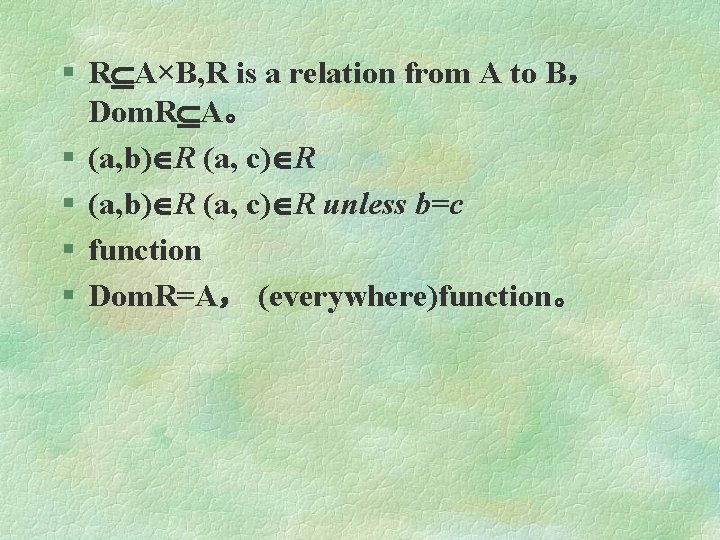
§ R A×B, R is a relation from A to B, Dom. R A。 § (a, b) R (a, c) R unless b=c § function § Dom. R=A, (everywhere)function。
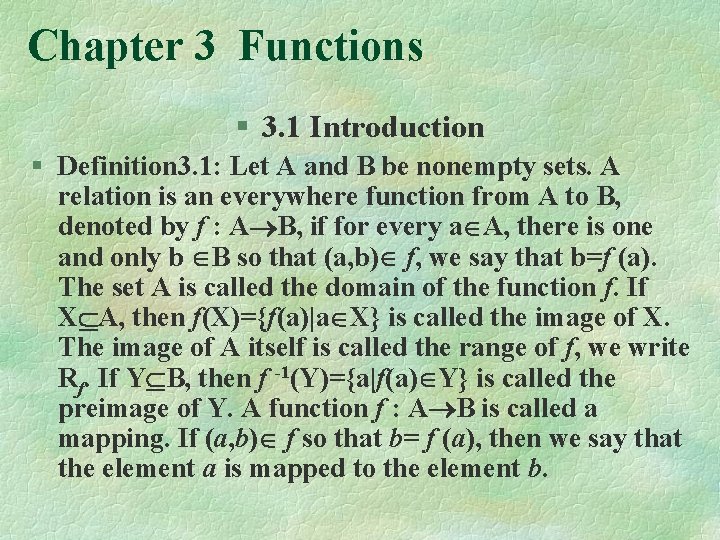
Chapter 3 Functions § 3. 1 Introduction § Definition 3. 1: Let A and B be nonempty sets. A relation is an everywhere function from A to B, denoted by f : A B, if for every a A, there is one and only b B so that (a, b) f, we say that b=f (a). The set A is called the domain of the function f. If X A, then f(X)={f(a)|a X} is called the image of X. The image of A itself is called the range of f, we write Rf. If Y B, then f -1(Y)={a|f(a) Y} is called the preimage of Y. A function f : A B is called a mapping. If (a, b) f so that b= f (a), then we say that the element a is mapped to the element b.
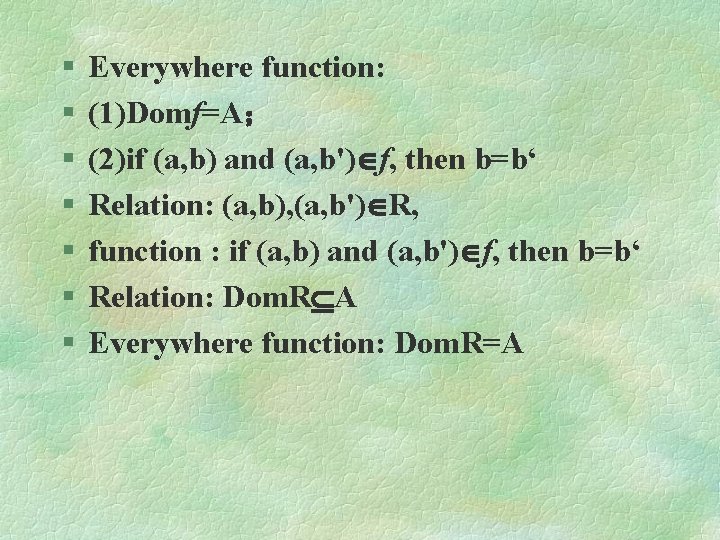
§ § § § Everywhere function: (1)Domf=A; (2)if (a, b) and (a, b') f, then b=b‘ Relation: (a, b), (a, b') R, function : if (a, b) and (a, b') f, then b=b‘ Relation: Dom. R A Everywhere function: Dom. R=A
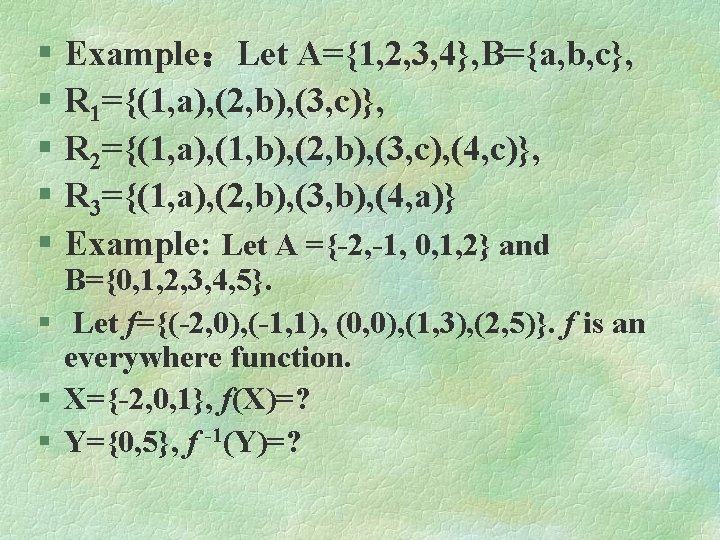
§ Example:Let A={1, 2, 3, 4}, B={a, b, c}, § R 1={(1, a), (2, b), (3, c)}, § R 2={(1, a), (1, b), (2, b), (3, c), (4, c)}, § R 3={(1, a), (2, b), (3, b), (4, a)} § Example: Let A ={-2, -1, 0, 1, 2} and B={0, 1, 2, 3, 4, 5}. § Let f={(-2, 0), (-1, 1), (0, 0), (1, 3), (2, 5)}. f is an everywhere function. § X={-2, 0, 1}, f(X)=? § Y={0, 5}, f -1(Y)=?
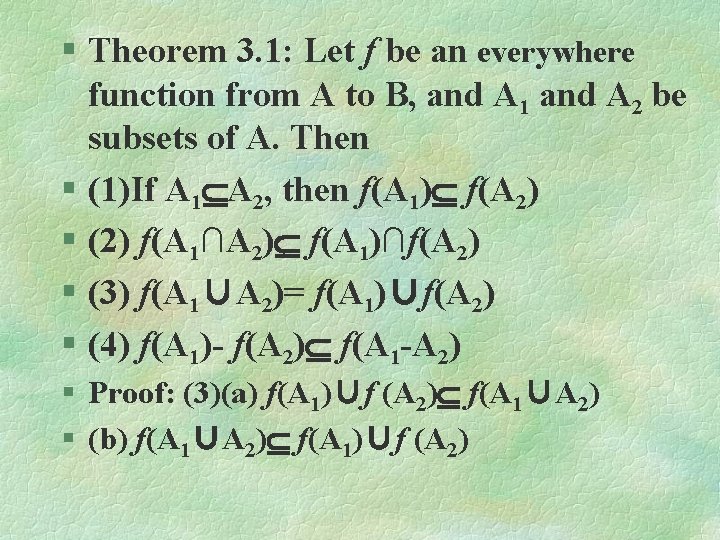
§ Theorem 3. 1: Let f be an everywhere function from A to B, and A 1 and A 2 be subsets of A. Then § (1)If A 1 A 2, then f(A 1) f(A 2) § (2) f(A 1∩A 2) f(A 1)∩f(A 2) § (3) f(A 1∪A 2)= f(A 1)∪f(A 2) § (4) f(A 1)- f(A 2) f(A 1 -A 2) § Proof: (3)(a) f(A 1)∪f (A 2) f(A 1∪A 2) § (b) f(A 1∪A 2) f(A 1)∪f (A 2)
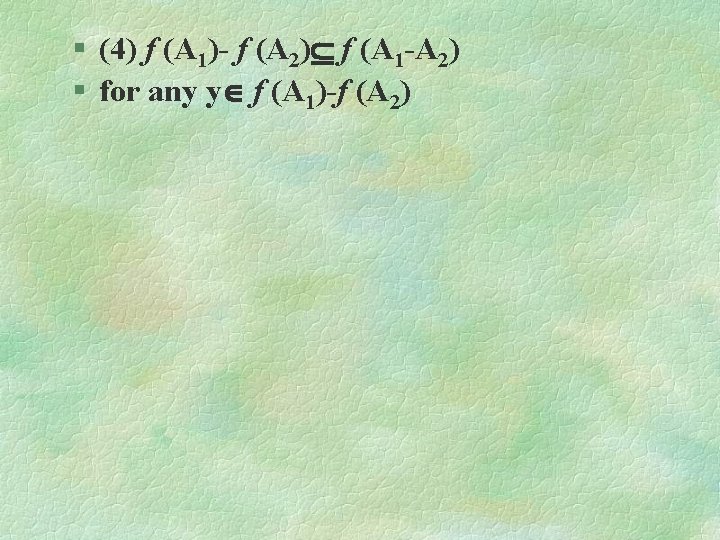
§ (4) f (A 1)- f (A 2) f (A 1 -A 2) § for any y f (A 1)-f (A 2)
§ Exercise: P 226 2, 10, 11, 33 § P 232 17, 19, 23, 26, 27, 28 § P 188 2
- Slides: 28