
Definite Proportions Multiple Proportions and Atomic Theory Law
- Slides: 9
Definite Proportions, Multiple Proportions and Atomic Theory
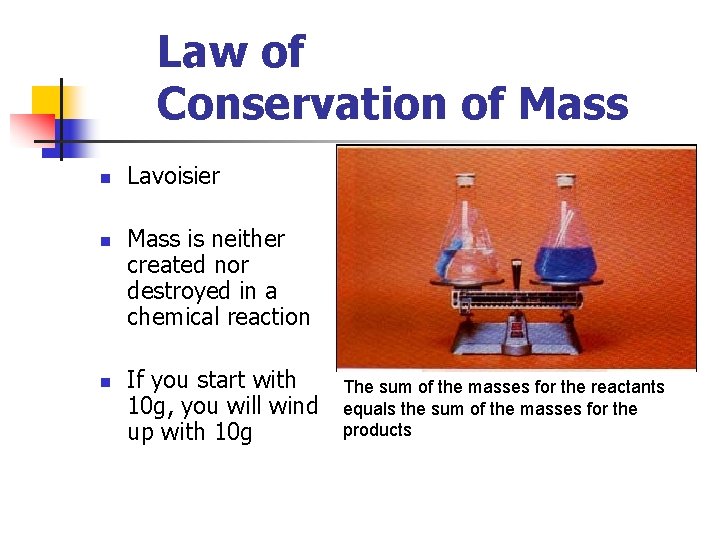
Law of Conservation of Mass n n n Lavoisier Mass is neither created nor destroyed in a chemical reaction If you start with 10 g, you will wind up with 10 g The sum of the masses for the reactants equals the sum of the masses for the products
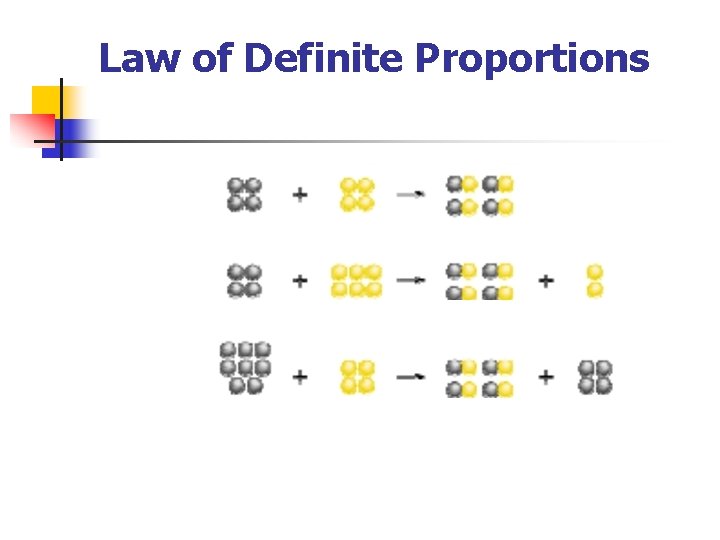
Law of Definite Proportions • Proust • Atoms are neither lost nor gained in a chemical reaction • Chemical compounds have the same mass ratio of elements no matter how formed (e. g. , water always has an O to H ratio of 8. 01: 1. 00) • Evidence for this law: Berzelius’ experiments with lead and sulfur • Constant composition implies constant properties (i. e. , water always boils at 100ºC and freezes at 0ºC)
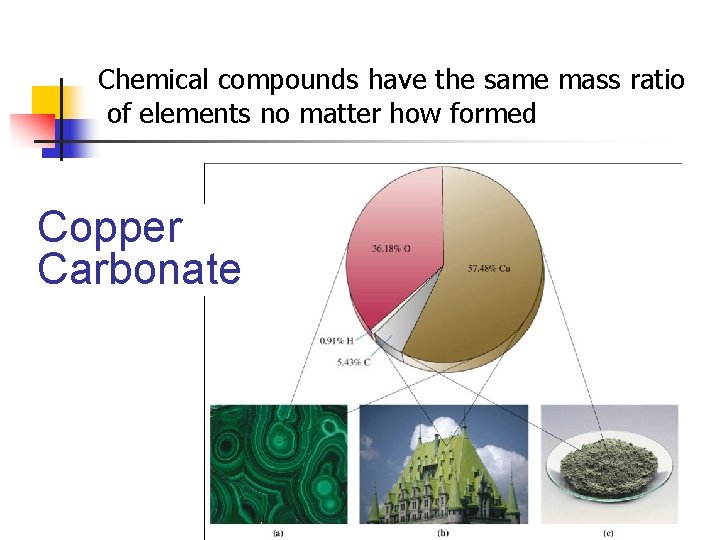
Chemical compounds have the same mass ratio of elements no matter how formed Copper Carbonate
Law of Definite Proportions
Law of Multiple Proportions • Compounds of differing mass ratios of the same elements are found, but they will have different properties • Example: carbon dioxide (CO 2) and carbon monoxide (CO)
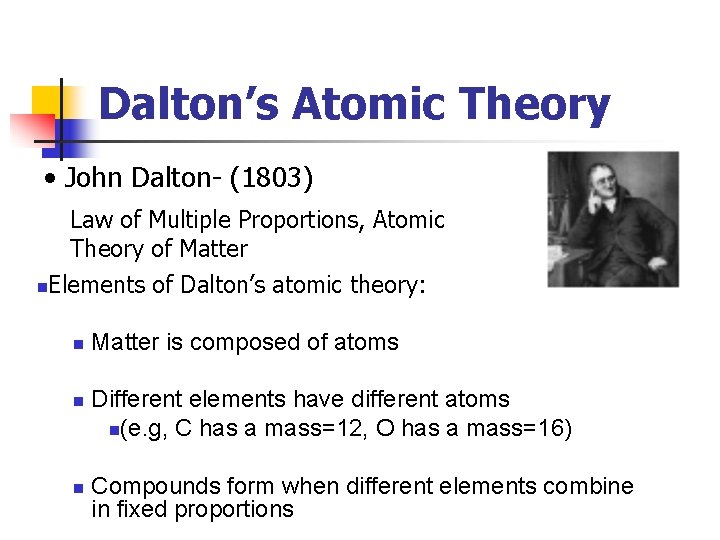
Dalton’s Atomic Theory • John Dalton- (1803) Law of Multiple Proportions, Atomic Theory of Matter n. Elements of Dalton’s atomic theory: n n n Matter is composed of atoms Different elements have different atoms n(e. g, C has a mass=12, O has a mass=16) Compounds form when different elements combine in fixed proportions
Determining the Mass of a Compound n EXAMPLE: n If C has a mass of 12 and O has a mass of 16, what is the mass of: n n a) Carbon monoxide (CO) n 12 + 16 = 28 b) Carbon dioxide (CO 2) n 12 + 2(16) = 44
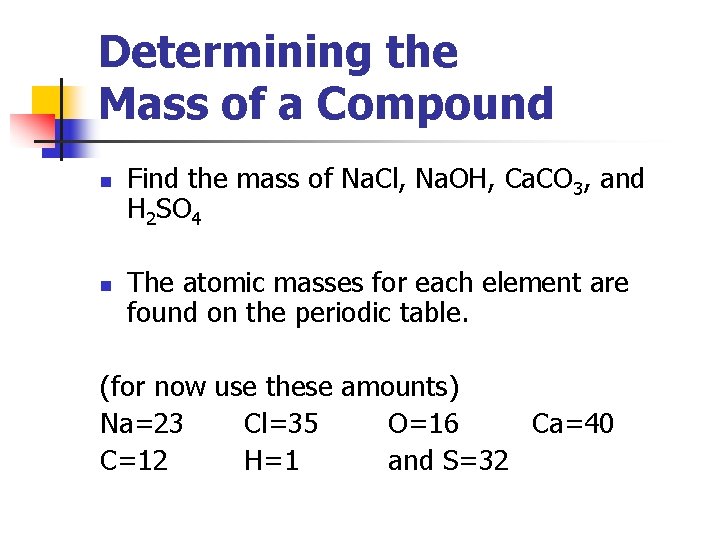
Determining the Mass of a Compound n n Find the mass of Na. Cl, Na. OH, Ca. CO 3, and H 2 SO 4 The atomic masses for each element are found on the periodic table. (for now use these amounts) Na=23 Cl=35 O=16 Ca=40 C=12 H=1 and S=32