
Definite and Indefinite Articles taken from bogglesworldesl com

Definite and Indefinite Articles taken from bogglesworldesl. com
Indefinite Articles: • Singular • a, an • some
Definite Articles: • Singular the • Plural the
Rule 1: • Indefinite articles are used for previously unknown nouns that are being introduced into a dialogue or story and definite articles are used for nouns that have already been introduced (or are already known or are assumed to be known at the point of introduction to the conversation).
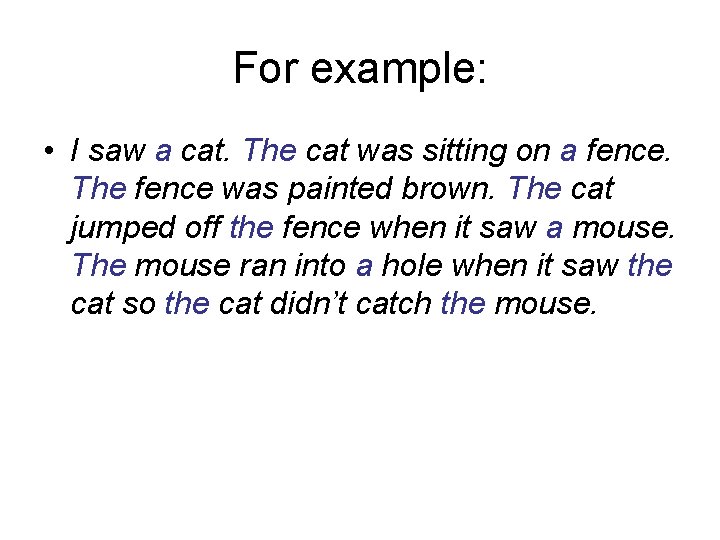
For example: • I saw a cat. The cat was sitting on a fence. The fence was painted brown. The cat jumped off the fence when it saw a mouse. The mouse ran into a hole when it saw the cat so the cat didn’t catch the mouse.
A Knight’s Tale • Fill in the blanks with the articles ‘a’, ‘an’ or ‘the’.
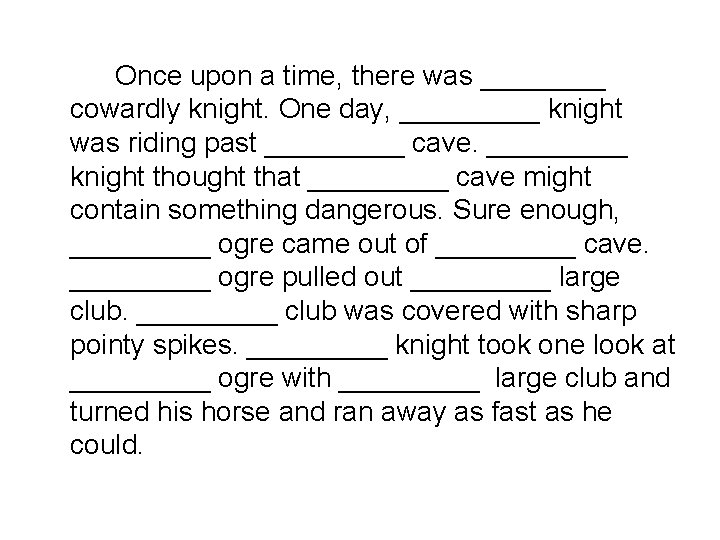
Once upon a time, there was ____ cowardly knight. One day, _____ knight was riding past _____ cave. _____ knight thought that _____ cave might contain something dangerous. Sure enough, _____ ogre came out of _____ cave. _____ ogre pulled out _____ large club. _____ club was covered with sharp pointy spikes. _____ knight took one look at _____ ogre with _____ large club and turned his horse and ran away as fast as he could.
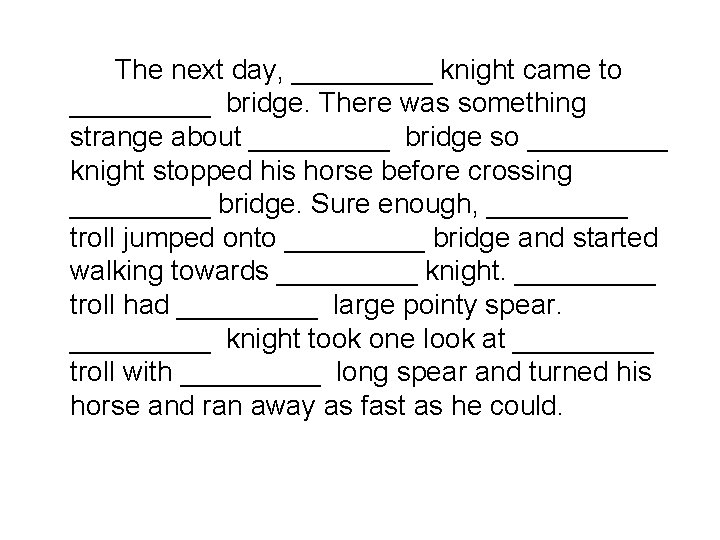
The next day, _____ knight came to _____ bridge. There was something strange about _____ bridge so _____ knight stopped his horse before crossing _____ bridge. Sure enough, _____ troll jumped onto _____ bridge and started walking towards _____ knight. _____ troll had _____ large pointy spear. _____ knight took one look at _____ troll with _____ long spear and turned his horse and ran away as fast as he could.
Some Cats Singing on a Fence • Fill in the blanks with the articles ‘a’, ‘an’ ‘some’ or ‘the’.
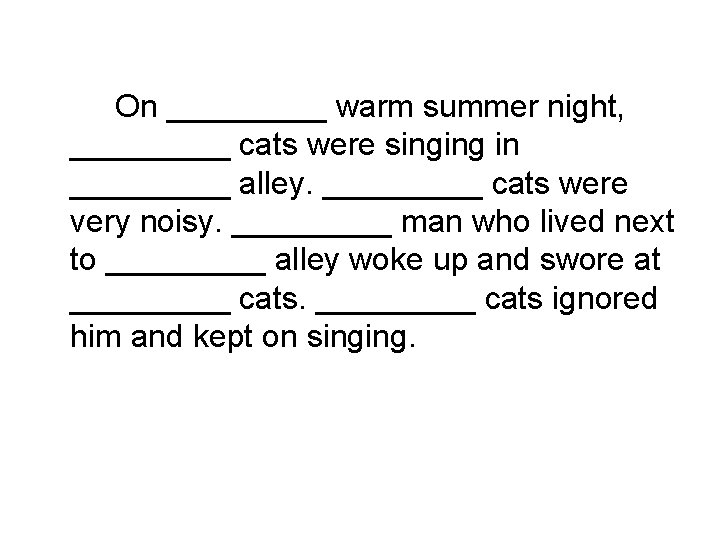
On _____ warm summer night, _____ cats were singing in _____ alley. _____ cats were very noisy. _____ man who lived next to _____ alley woke up and swore at _____ cats ignored him and kept on singing.
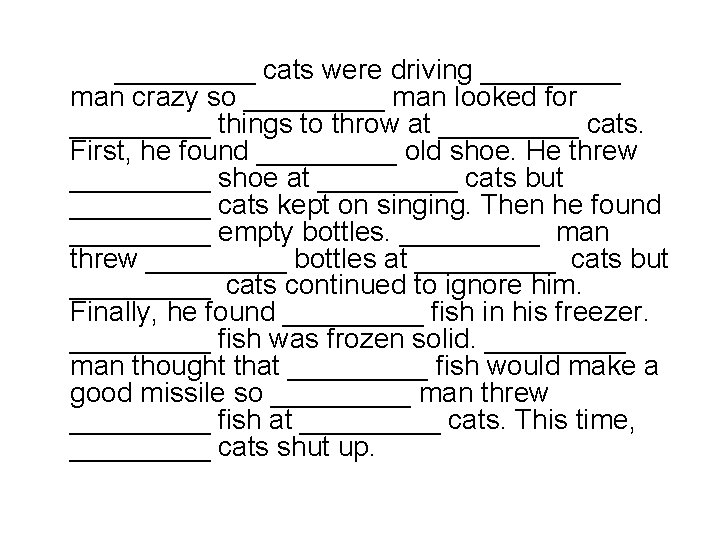
_____ cats were driving _____ man crazy so _____ man looked for _____ things to throw at _____ cats. First, he found _____ old shoe. He threw _____ shoe at _____ cats but _____ cats kept on singing. Then he found _____ empty bottles. _____ man threw _____ bottles at _____ cats but _____ cats continued to ignore him. Finally, he found _____ fish in his freezer. _____ fish was frozen solid. _____ man thought that _____ fish would make a good missile so _____ man threw _____ fish at _____ cats. This time, _____ cats shut up.
Rule 2: • Another important rule is when something is unique* or, in other words, there is only one of that object. In this case, the definite article is used. The sun, the president, the queen of England, the capital city, and the moon are all examples. This is especially true for objects that are well-known by many or most people, but it is true even when the hearer may not know the object:
• A: Who's he? • B: He's the president of Korea. She's the CFO. He's the mayor. • This can be contrasted with: • A: Who's she? • B: She's a member of Congress. She's an accountant. He's an electrician.
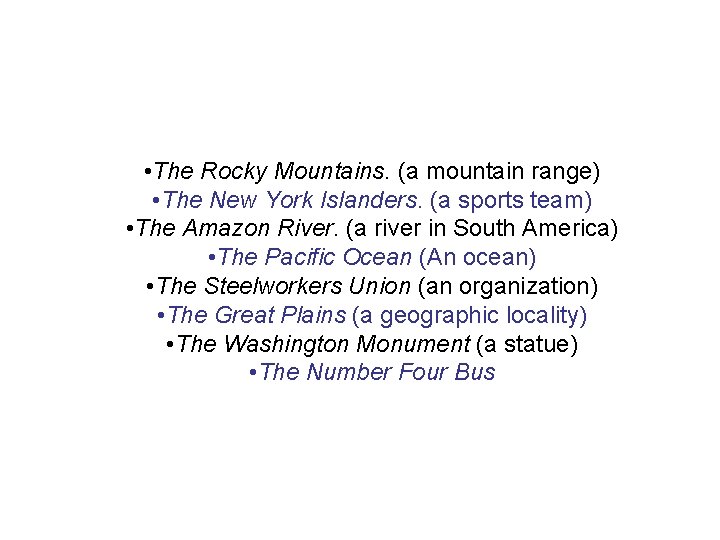
• The Rocky Mountains. (a mountain range) • The New York Islanders. (a sports team) • The Amazon River. (a river in South America) • The Pacific Ocean (An ocean) • The Steelworkers Union (an organization) • The Great Plains (a geographic locality) • The Washington Monument (a statue) • The Number Four Bus
Reporting the News • Read this fictional news report and fill in the blanks with the articles ‘a’, ‘an’ or ‘the’.
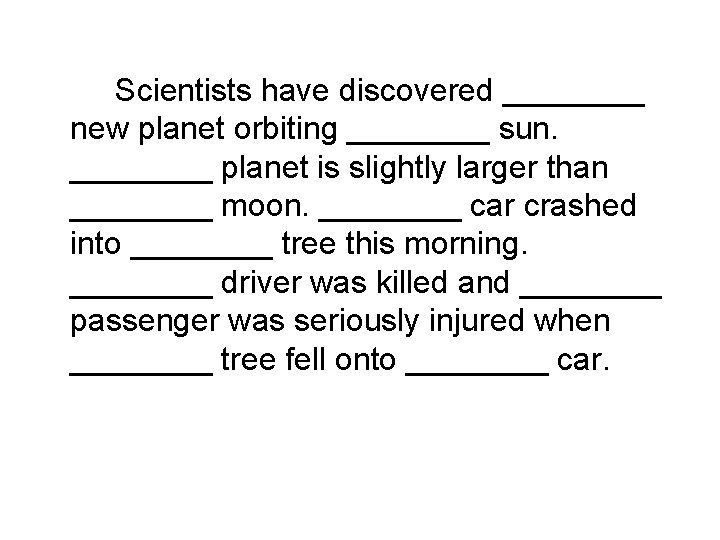
Scientists have discovered ____ new planet orbiting ____ sun. ____ planet is slightly larger than ____ moon. ____ car crashed into ____ tree this morning. ____ driver was killed and ____ passenger was seriously injured when ____ tree fell onto ____ car.
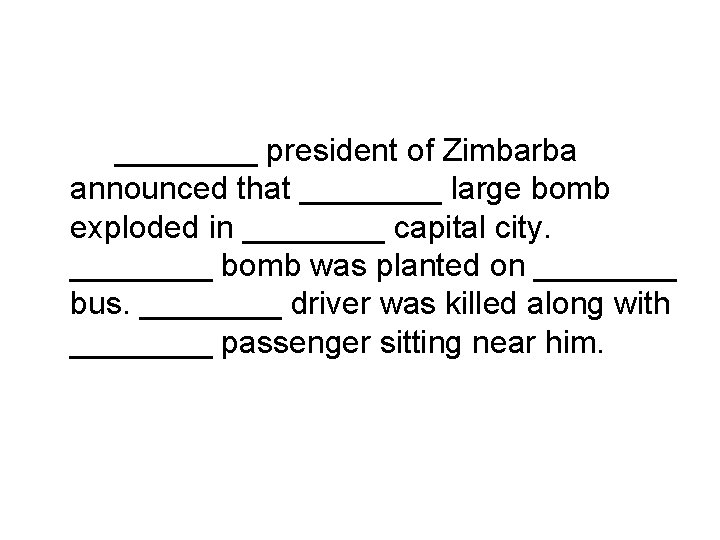
____ president of Zimbarba announced that ____ large bomb exploded in ____ capital city. ____ bomb was planted on ____ bus. ____ driver was killed along with ____ passenger sitting near him.
____ cargo ship ran aground last night. According to ____ crew member, ____ captain had been drinking when he steered ____ ship into ____ shallow reef.
____ airplane has crashed after taking off at 12: 42 this afternoon. ____ pilot sent ____ distress signal shortly before ____ crash. ____ survivor said he saw smoke coming from ____ engine on ____ right side of ____ plane.
____ New York Writers Association has announced ____ competition for ____ best story of the year. ____ winner of ____ competition will receive ____ trip to Europe and $1, 000 in spending money. ____ second place contestant will receive ____ prize of $500.
Three cars collided on Oak Street. ____ driver in one car was hurt along with ____ passenger in another car. ____ driver was taken to the hospital but is in stable condition. ____ passenger was treated at the scene of ____ accident.
• Rule 3: When we are speaking of a noun in general we usually leave the article out and, if it is countable, use the plural form.
• So for example, when we are talking about an actual cookie or cookies that really exist or existed we use an article (definite or indefinite). In the following examples, we are speaking of specific/actual/real cookies. • I ate a cookie. • The cookie was delicious. • The cookies are on the table. • I made some cookies for you.
• However, we can also make general statements about cookies. And when we do speak in general of cookies, we leave the articles out. • I like cookies. • Cookies contain a lot of sugar. • Kids shouldn’t eat cookies everyday. • I enjoy making cookies. • I never eat cookies at night.
• It is possible to either use an article or leave it out, but the meaning will be different in each case: • • I like cookies. (A general statement concerning cookies) I like the cookies. (A statement about some specific cookies that I’ve actually tasted)
• It should be noted that when we do speak in general we commonly use the plural form** of the noun if it is a countable noun (and just the noun if it is not countable). • Cookies are bad for your health. • (Cookie is countable and therefore put into the plural) • Pizza is bad for your health. • (Pizza is uncountable and left as is)
Using Articles: Specific Versus General Nouns • When speaking about specific items we use an article. When speaking about items in general, we leave the article out. Decide whether or not to use an article. Fill in the blank with the article ‘the’ or just leave it blank.
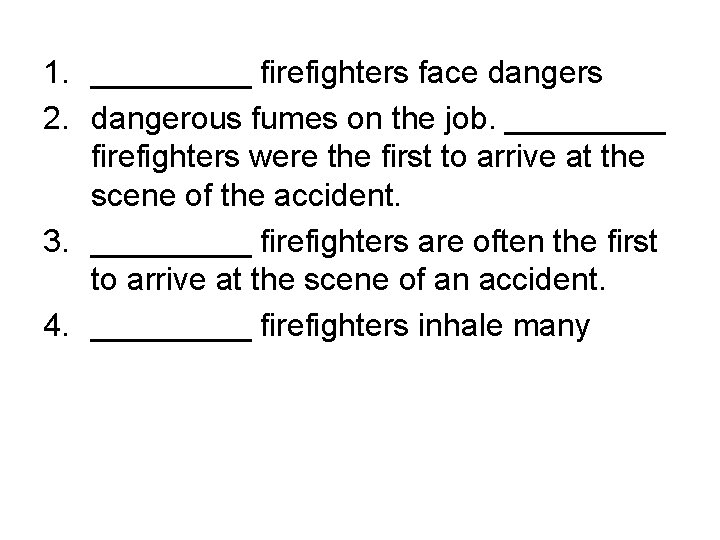
1. _____ firefighters face dangers 2. dangerous fumes on the job. _____ firefighters were the first to arrive at the scene of the accident. 3. _____ firefighters are often the first to arrive at the scene of an accident. 4. _____ firefighters inhale many
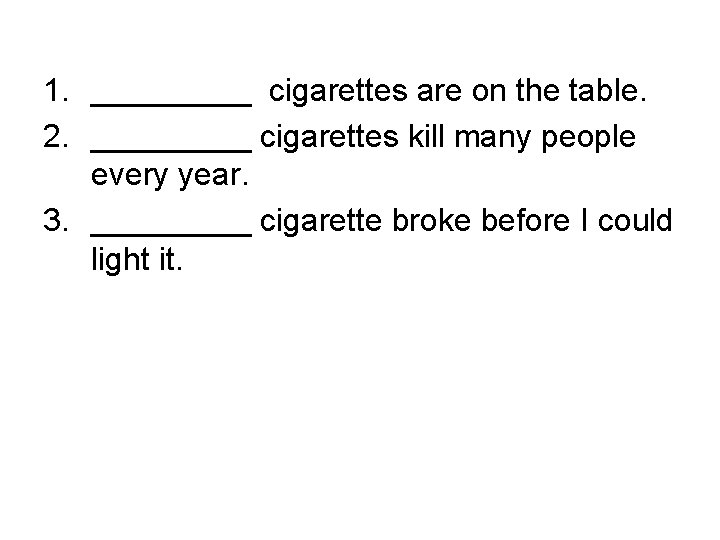
1. _____ cigarettes are on the table. 2. _____ cigarettes kill many people every year. 3. _____ cigarette broke before I could light it.
1. _____ athletes were tired after the game. 2. _____ athletes should drink plenty of liquids.
1. sea turtles are endangered. 2. The fisherman released _____ sea turtles that they caught. 3. _____ sea turtles are protected by the government. 4. The zoo nursed _____ sick sea turtle back to health.
1. _____doctors make a lot of money. 2. _____ doctors who examined the patient couldn’t find anything wrong. 3. _____ doctor said I should exercise more. 4. _____ doctors recommend eating more fish. 5. _____ doctor recommended that I cut down on fats.
1. _____ movies are an important part of modern culture. 2. _____ movie was interesting but a little long. 3. Of all _____ movies I saw last year, it is the only one I remember.
Articles: Speaking in General or about Specific Items • When speaking about specific items we use an article. When speaking about items in general, we leave the article out. Decide whether or not to use an article. Fill in the blank with the article ‘the’ or just leave it blank.
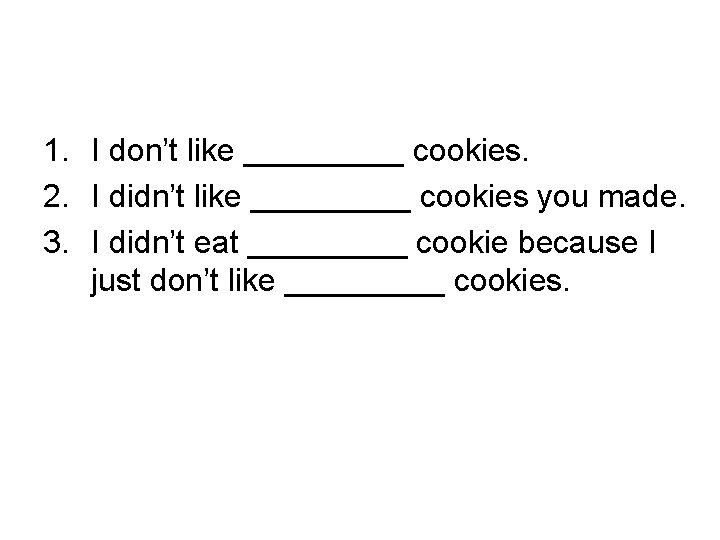
1. I don’t like _____ cookies. 2. I didn’t like _____ cookies you made. 3. I didn’t eat _____ cookie because I just don’t like _____ cookies.
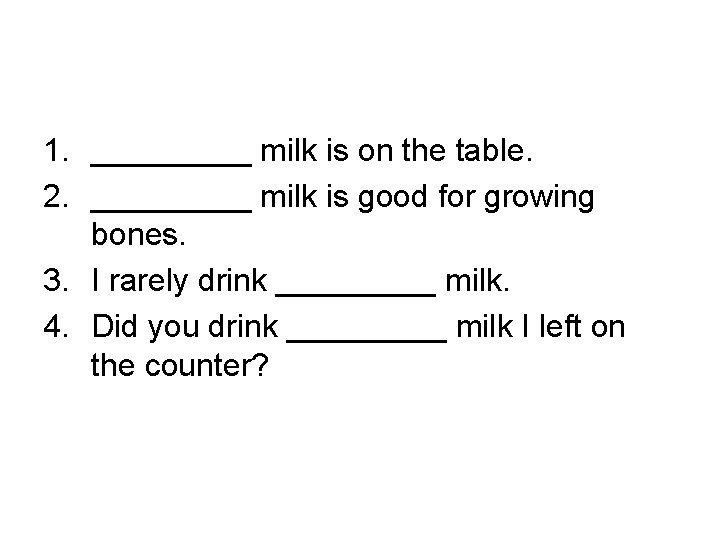
1. _____ milk is on the table. 2. _____ milk is good for growing bones. 3. I rarely drink _____ milk. 4. Did you drink _____ milk I left on the counter?
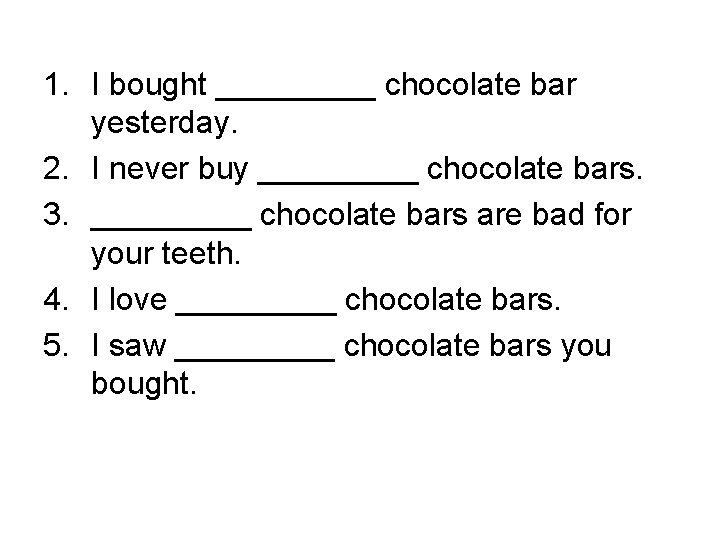
1. I bought _____ chocolate bar yesterday. 2. I never buy _____ chocolate bars. 3. _____ chocolate bars are bad for your teeth. 4. I love _____ chocolate bars. 5. I saw _____ chocolate bars you bought.
1. _____ children need lots of sleep to be healthy. 2. _____ children threw snowballs at their teacher. 3. _____ children should never play with electricity. 4. _____ children ate all of the cookies that I made. 5. _____ children should be in bed before I come back. 6. _____ children shouldn’t eat too much candy.
- Slides: 38