
Defining what the problem is Framing a research
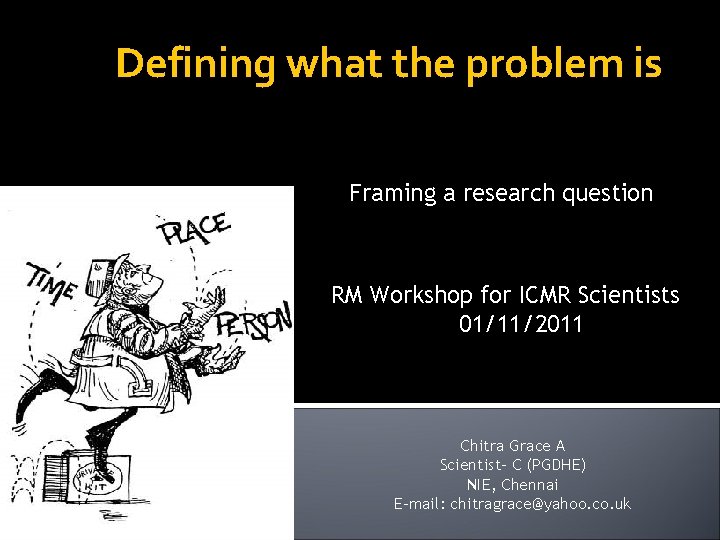
Defining what the problem is Framing a research question RM Workshop for ICMR Scientists 01/11/2011 Chitra Grace A Scientist- C (PGDHE) NIE, Chennai E-mail: chitragrace@yahoo. co. uk
Research questions Personal interest/ experience Published literature New developments Social problems PUBLIC HEALTH PROBLEM
Qualities of a good research question Clear Researchable Connected to published literature Potential for contributing to subject domain Be neither too broad or too narrow
Asking yourself the right question Two ways to deal with a poor or irrelevant research question: Try to answer it ▪ The answer may be of no use of anyone ▪ There may be no answer… Try to reframe it If your research question is wrong: No good hard work will save your work If your research question is right: You have an opportunity to do a good job
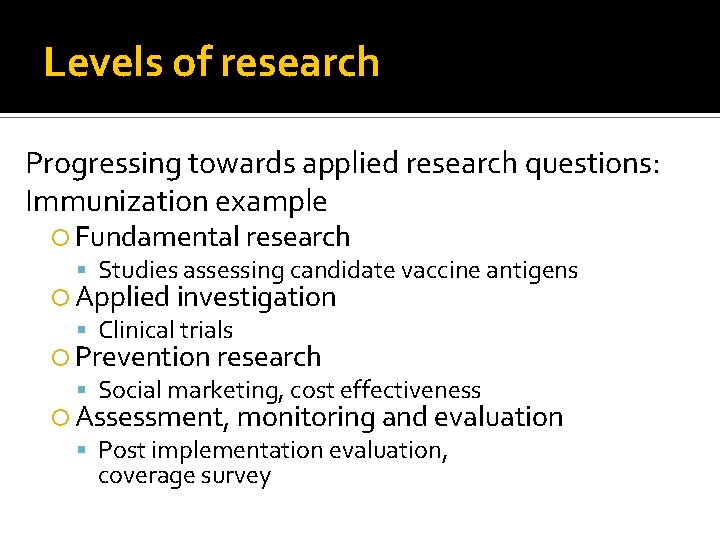
Levels of research Progressing towards applied research questions: Immunization example Fundamental research Studies assessing candidate vaccine antigens Applied investigation Clinical trials Prevention research Social marketing, cost effectiveness Assessment, monitoring and evaluation Post implementation evaluation, coverage survey
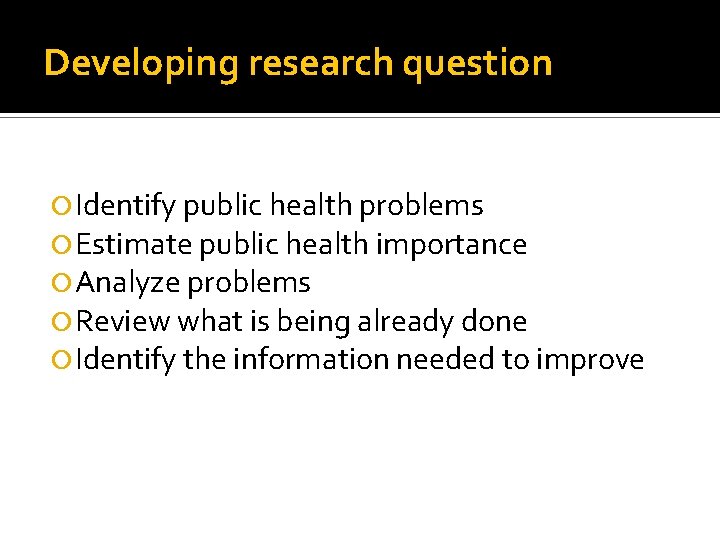
Developing research question Identify public health problems Estimate public health importance Analyze problems Review what is being already done Identify the information needed to improve
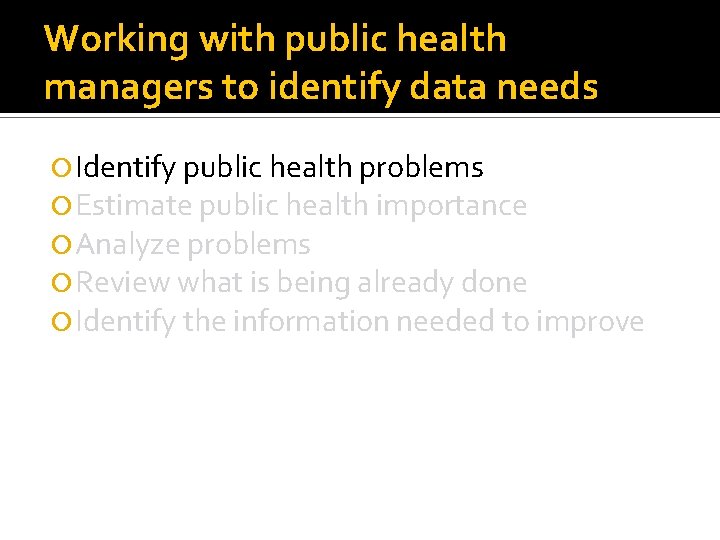
Working with public health managers to identify data needs Identify public health problems Estimate public health importance Analyze problems Review what is being already done Identify the information needed to improve

Identification of a public health problem Any disease, injury, risk factor, environment threat or social condition that can cause death / disability Points that need to be characterized What ▪ Nature / etiology of the condition How much ▪ Magnitude Who ▪ Population at risk Where ▪ Geographic locations When ▪ Time of occurrence / seasonal variations

Health problem statement: Example Diphtheria rates in Hyderabad, AP, India, increased from 11 to 21 per 100, 000 between 2003 and 2006, particularly affecting children 5 to 15 years of age ▪ Specifies: ▪ What ▪ Where ▪ How much ▪ When ▪ Who
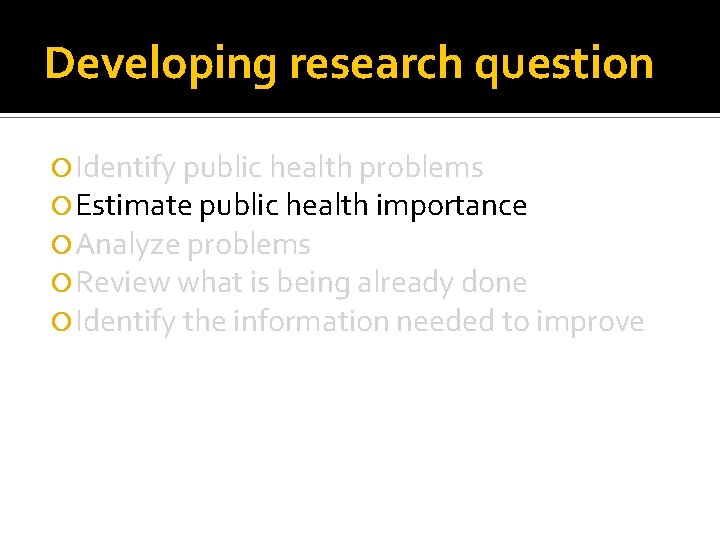
Developing research question Identify public health problems Estimate public health importance Analyze problems Review what is being already done Identify the information needed to improve
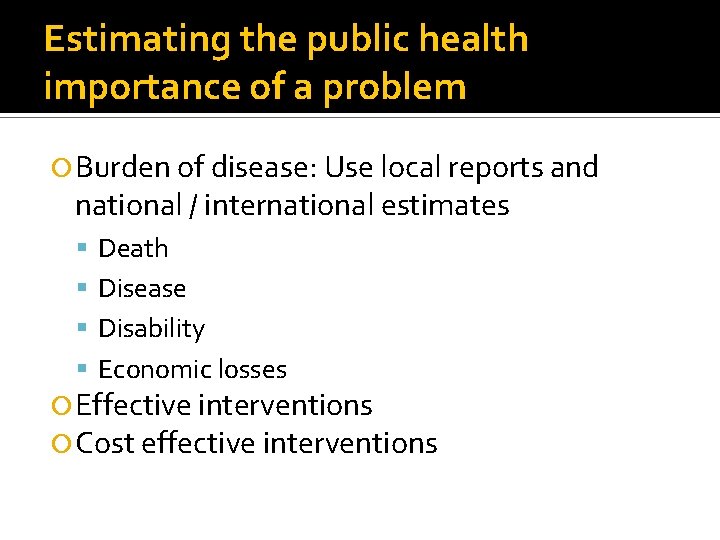
Estimating the public health importance of a problem Burden of disease: Use local reports and national / international estimates Death Disease Disability Economic losses Effective interventions Cost effective interventions
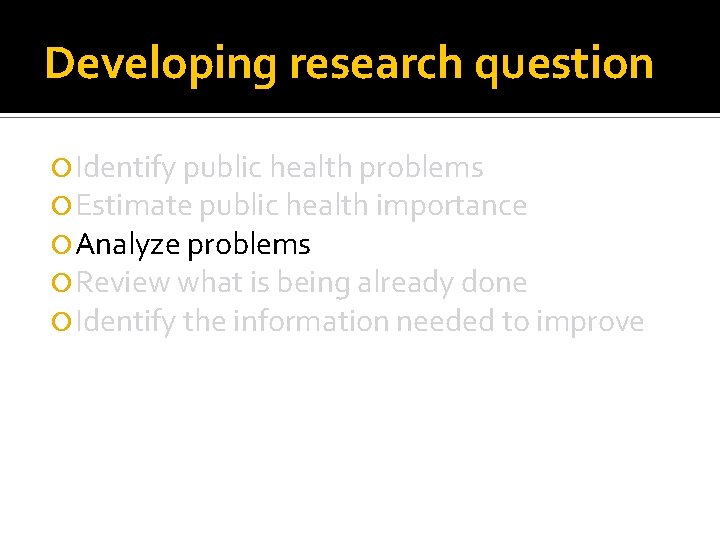
Developing research question Identify public health problems Estimate public health importance Analyze problems Review what is being already done Identify the information needed to improve
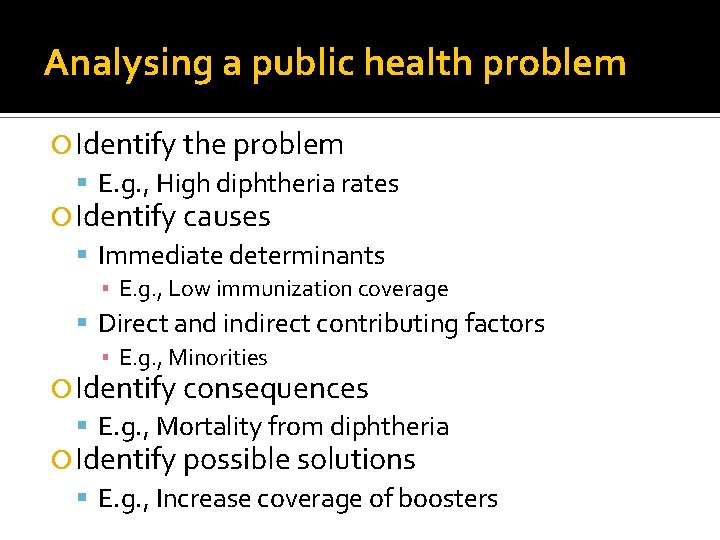
Analysing a public health problem Identify the problem E. g. , High diphtheria rates Identify causes Immediate determinants ▪ E. g. , Low immunization coverage Direct and indirect contributing factors ▪ E. g. , Minorities Identify consequences E. g. , Mortality from diphtheria Identify possible solutions E. g. , Increase coverage of boosters
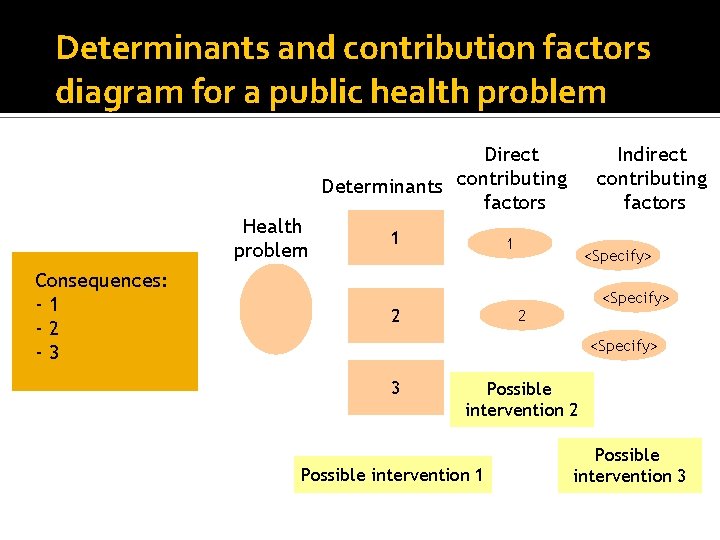
Determinants and contribution factors diagram for a public health problem Indirect Direct Indirect contributing factors Determinants contributing factors Health problem Consequences: -1 -2 -3 1 1 2 <Specify> 3 Possible intervention 2 Possible intervention 1 Possible intervention 3
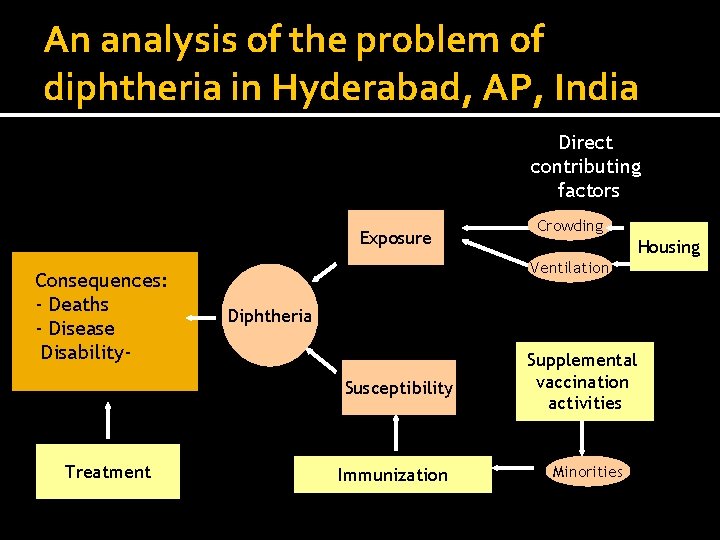
An analysis of the problem of diphtheria in Hyderabad, AP, India Determinants Health problem Consequences: - Deaths - Disease Disability- Exposure Crowding Housing Ventilation Diphtheria Susceptibility Treatment Direct contributing factors Immunization Supplemental vaccination activities Minorities
Developing research question Identify public health problems Estimate public health importance Analyze problems Review what is being already done Identify the information needed to improve
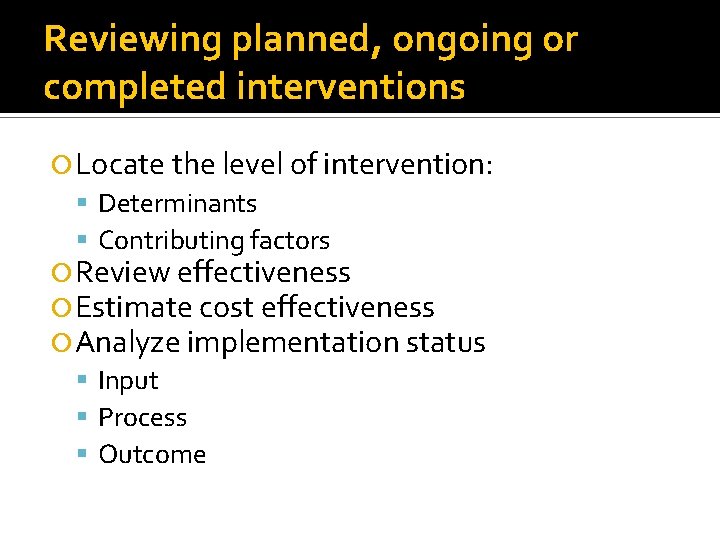
Reviewing planned, ongoing or completed interventions Locate the level of intervention: Determinants Contributing factors Review effectiveness Estimate cost effectiveness Analyze implementation status Input Process Outcome
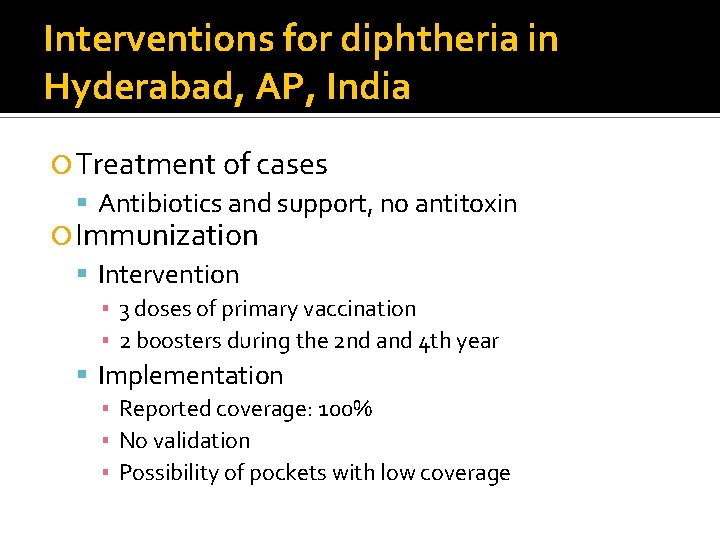
Interventions for diphtheria in Hyderabad, AP, India Treatment of cases Antibiotics and support, no antitoxin Immunization Intervention ▪ 3 doses of primary vaccination ▪ 2 boosters during the 2 nd and 4 th year Implementation ▪ Reported coverage: 100% ▪ No validation ▪ Possibility of pockets with low coverage
Developing research question Identify public health problems Estimate public health importance Analyze problems Review what is being already done Identify the information needed to improve
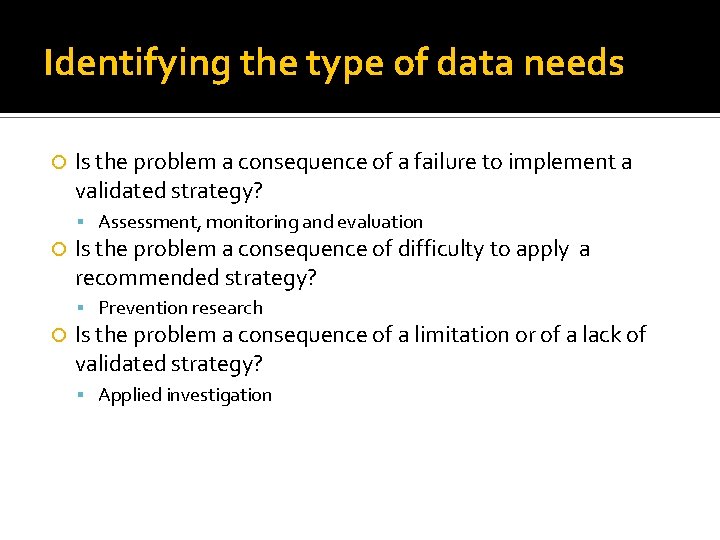
Identifying the type of data needs Is the problem a consequence of a failure to implement a validated strategy? Assessment, monitoring and evaluation Is the problem a consequence of difficulty to apply a recommended strategy? Prevention research Is the problem a consequence of a limitation or of a lack of validated strategy? Applied investigation
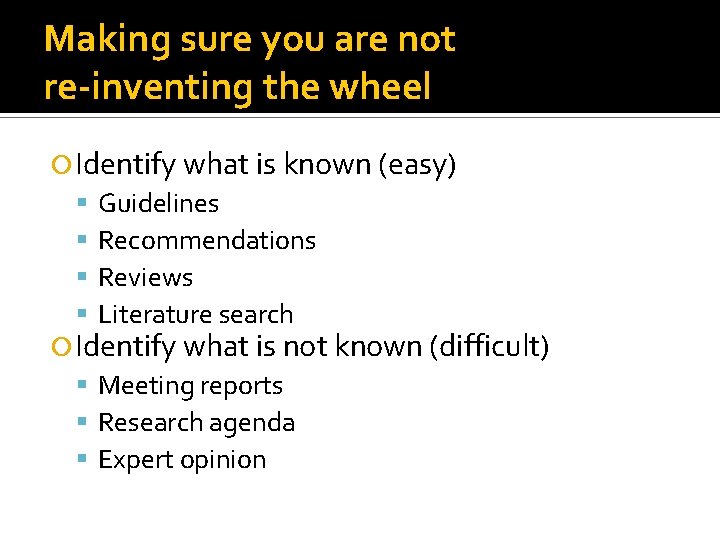
Making sure you are not re-inventing the wheel Identify what is known (easy) Guidelines Recommendations Reviews Literature search Identify what is not known (difficult) Meeting reports Research agenda Expert opinion
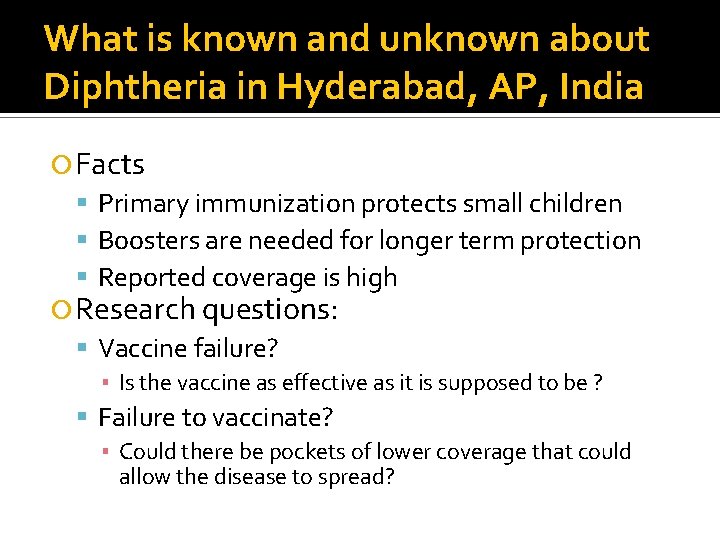
What is known and unknown about Diphtheria in Hyderabad, AP, India Facts Primary immunization protects small children Boosters are needed for longer term protection Reported coverage is high Research questions: Vaccine failure? ▪ Is the vaccine as effective as it is supposed to be ? Failure to vaccinate? ▪ Could there be pockets of lower coverage that could allow the disease to spread?
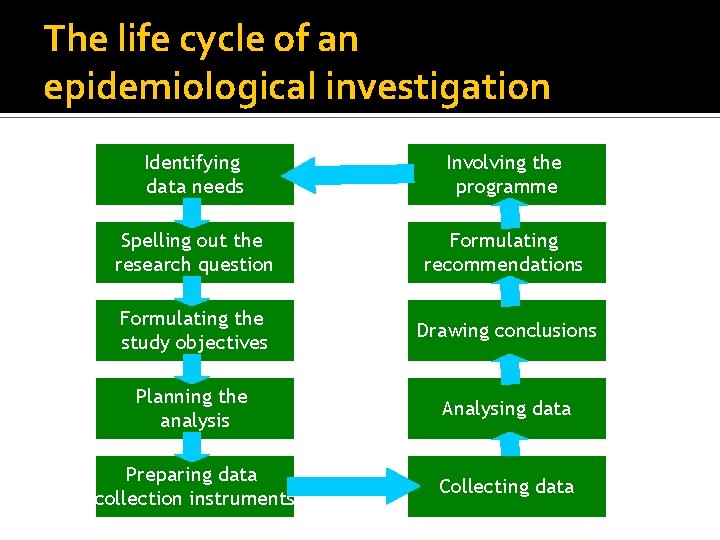
The life cycle of an epidemiological investigation Identifying data needs Involving the programme Spelling out the research question Formulating recommendations Formulating the study objectives Drawing conclusions Planning the analysis Analysing data Preparing data collection instruments Collecting data
Anticipating what will be done with the information that will be delivered by an applied research project Anticipate the various possible results of the study Imagine scenarios of various possible answers to the research question Identify the kind of public health action that could be realistically taken for each case scenario
Expected benefit of a diphtheria study in Hyderabad, AP, India If the vaccine efficacy is low: Programme evaluation could identify where the problem is If there are pockets of lower coverage: Supplemental immunization activities could increase population immunity
Evolving public health concepts are like onions being peeled Sound answers to good research question bring new questions These questions should be framed with the same careful methods Addressing consecutive public health questions is: Useful Gratifying
Possible future next step for the diphtheria study in Hyderabad, AP, India Conclusions Booster is key for protection among children > 5 years Booster coverage drops among selected minorities Possible next question What is the best strategy to use to increase the coverage of booster among minorities?
Recap Local problem to be identified What? When? Where? Who? How? Problem statement Specified, quantified Causal web Problem, consequences, determinants, contributing factors and possible interventions Review evidence available What is known and What is unknown? Research question Specific; with a question mark

Thank you
- Slides: 29