
Defining types and causes of injuries of the

- Slides: 20
Defining types and causes of injuries of the foot and lower leg in runners: A scoping review M Hancock – 2018 MOS Student
• Running is one of the most popular physical activities worldwide and has become increasingly popular over the last four decades (Saragiotto BT et al, 2014 ; Mann R et al, 2016) • Up to 50% of regular runners report more than one injury per year (Tschopp M et al, 2017) • A large literature base regarding incidence rates, risk factors and research on individual running injuries currently exist • Due to the multifactorial nature of running injuries, the studies cover diverse methodologies, definitions, epidemiologies, anatomical, biomechanical and training risk factors • It is a broad and extensive field of information crossing multiple modalities providing little amalgamation of its knowledge for clinical practitioners.
Research question • What are the types and causes, both intrinsic and extrinsic, of injuries of the foot and lower leg in runners? Aim • To explore and map the current published peer-reviewed literature involving foot and lower leg injuries to runners, to identify and categorise the types and causes of those injuries.
Objectives • To execute a scoping review of published peer-reviewed studies relating to the definitions, incidence rates, causes and types of injuries of the foot and lower leg, sustained by runners. • To critically review the range, themes and extent of current research investigating foot and lower leg injuries in runners. • To establish patterns within the current research investigating foot and lower leg injuries in runners. • To identify and define key themes or categories of foot and lower leg injuries for use in future research.
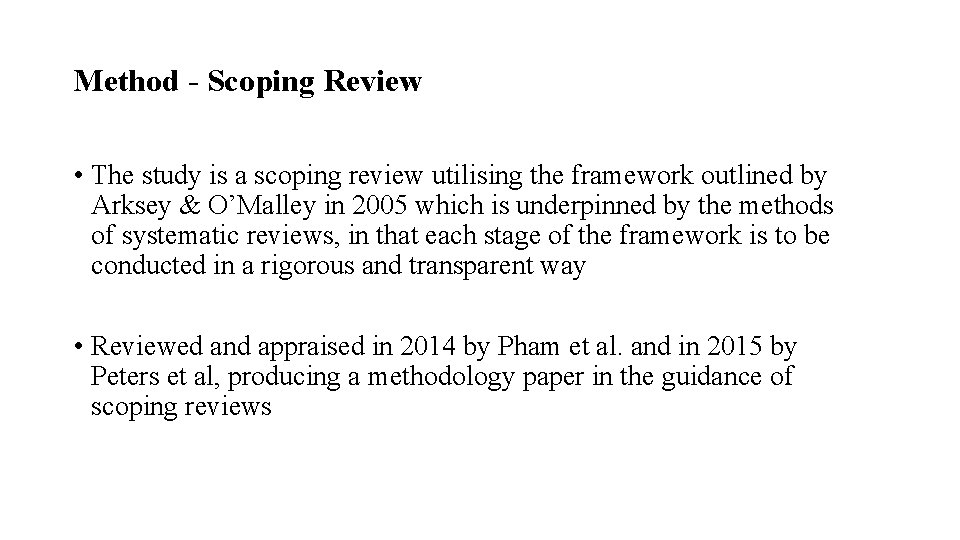
Method - Scoping Review • The study is a scoping review utilising the framework outlined by Arksey & O’Malley in 2005 which is underpinned by the methods of systematic reviews, in that each stage of the framework is to be conducted in a rigorous and transparent way • Reviewed and appraised in 2014 by Pham et al. and in 2015 by Peters et al, producing a methodology paper in the guidance of scoping reviews
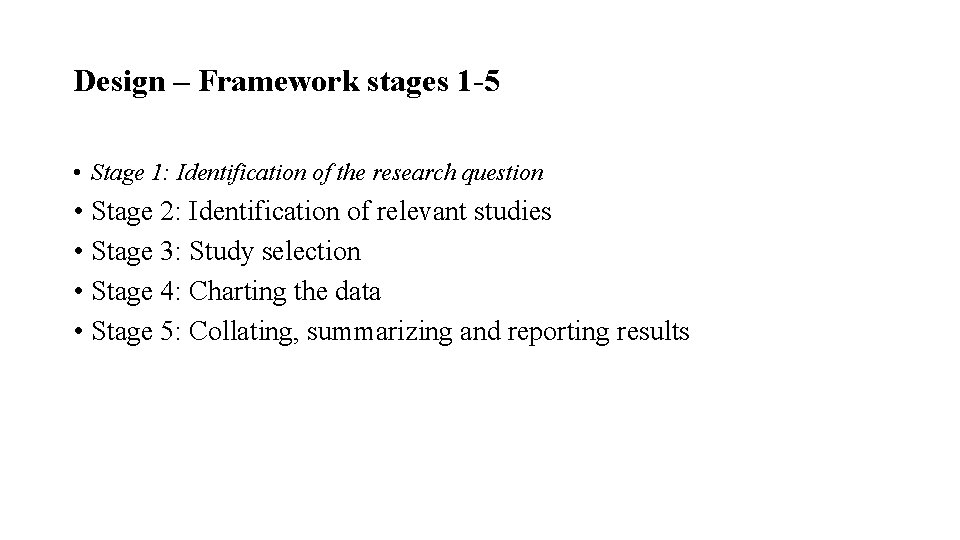
Design – Framework stages 1 -5 • Stage 1: Identification of the research question • Stage 2: Identification of relevant studies • Stage 3: Study selection • Stage 4: Charting the data • Stage 5: Collating, summarizing and reporting results
Search Methods • Searches will be conducted using: Science. Direct (Elsevier), Ebsco health databases, SPORTDiscus, Pub. Med, Google Scholar, and the Cochrane Library; specifically, the database of systematic reviews. • The reference lists of studies selected for inclusion will also be disseminated for additional studies to include until saturation is reached.
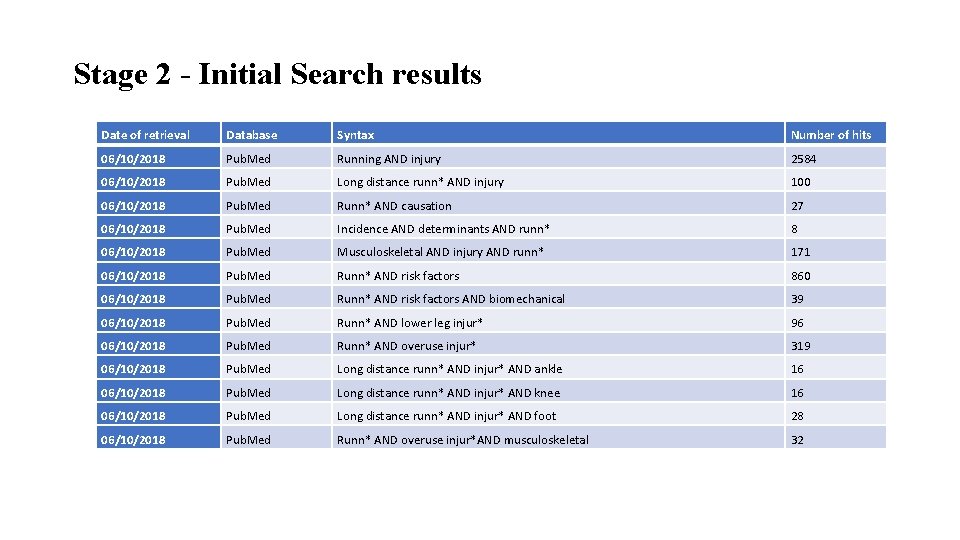
Stage 2 - Initial Search results Date of retrieval Database Syntax Number of hits 06/10/2018 Pub. Med Running AND injury 2584 06/10/2018 Pub. Med Long distance runn* AND injury 100 06/10/2018 Pub. Med Runn* AND causation 27 06/10/2018 Pub. Med Incidence AND determinants AND runn* 8 06/10/2018 Pub. Med Musculoskeletal AND injury AND runn* 171 06/10/2018 Pub. Med Runn* AND risk factors 860 06/10/2018 Pub. Med Runn* AND risk factors AND biomechanical 39 06/10/2018 Pub. Med Runn* AND lower leg injur* 96 06/10/2018 Pub. Med Runn* AND overuse injur* 319 06/10/2018 Pub. Med Long distance runn* AND injur* AND ankle 16 06/10/2018 Pub. Med Long distance runn* AND injur* AND knee 16 06/10/2018 Pub. Med Long distance runn* AND injur* AND foot 28 06/10/2018 Pub. Med Runn* AND overuse injur*AND musculoskeletal 32
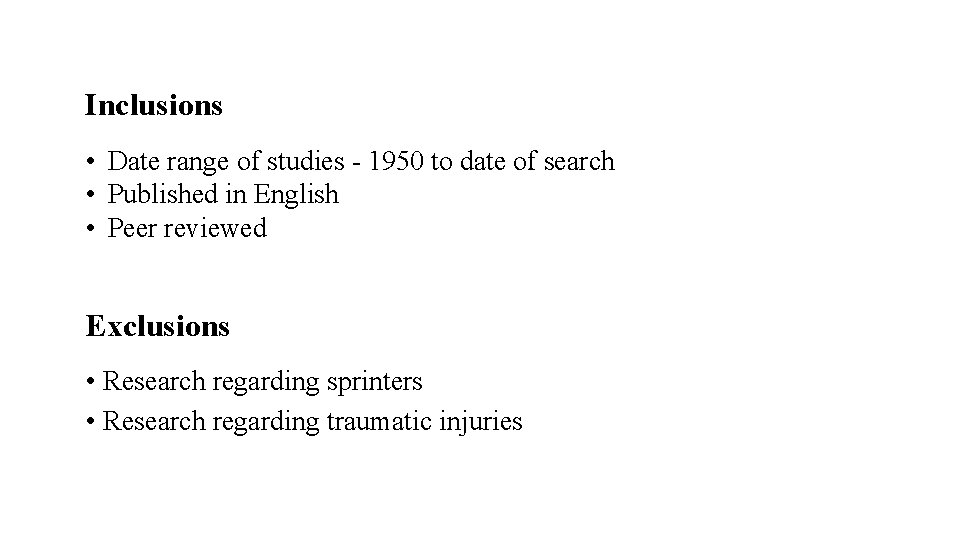
Inclusions • Date range of studies - 1950 to date of search • Published in English • Peer reviewed Exclusions • Research regarding sprinters • Research regarding traumatic injuries
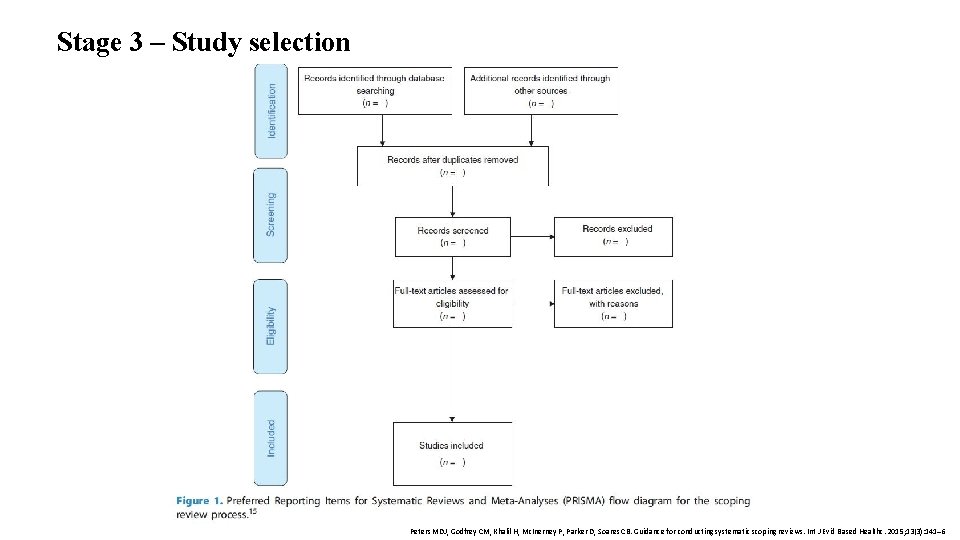
Stage 3 – Study selection Peters MDJ, Godfrey CM, Khalil H, Mc. Inerney P, Parker D, Soares CB. Guidance for conducting systematic scoping reviews. Int J Evid Based Healthc. 2015; 13(3): 141– 6
Stage 4 – Charting results • Inductive content analysis will be used in order to identify implicit and explicit concepts within the data • Involves establishing patterns within the data through examination of data without a priori frameworks. • Enables the researcher to identify key themes in the area of interest by reducing the material to a set of themes or categories
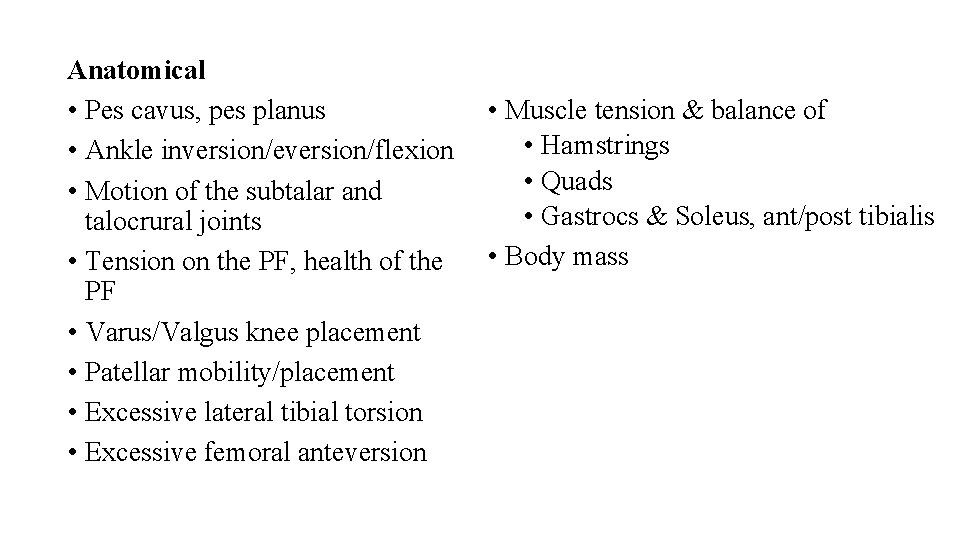
Anatomical • Pes cavus, pes planus • Ankle inversion/eversion/flexion • Motion of the subtalar and talocrural joints • Tension on the PF, health of the PF • Varus/Valgus knee placement • Patellar mobility/placement • Excessive lateral tibial torsion • Excessive femoral anteversion • Muscle tension & balance of • Hamstrings • Quads • Gastrocs & Soleus, ant/post tibialis • Body mass
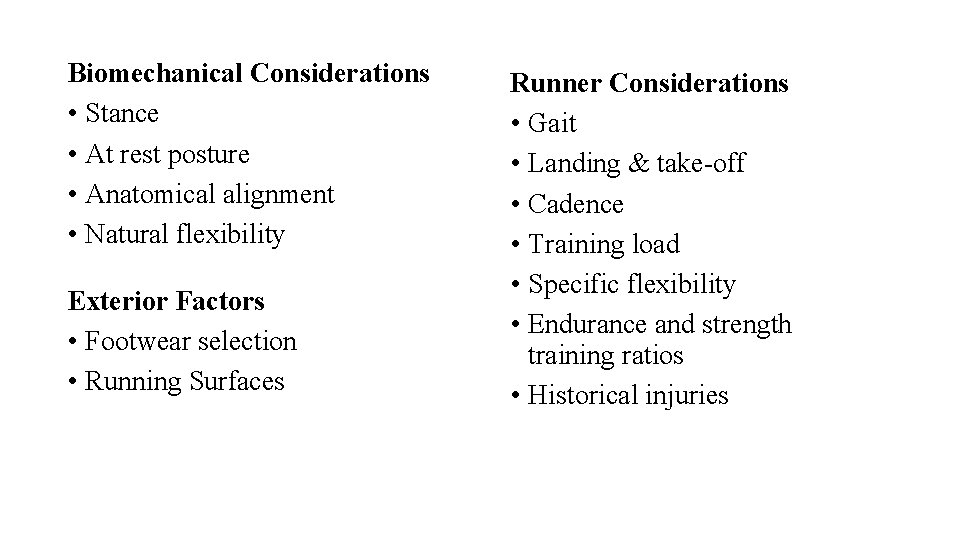
Biomechanical Considerations • Stance • At rest posture • Anatomical alignment • Natural flexibility Exterior Factors • Footwear selection • Running Surfaces Runner Considerations • Gait • Landing & take-off • Cadence • Training load • Specific flexibility • Endurance and strength training ratios • Historical injuries
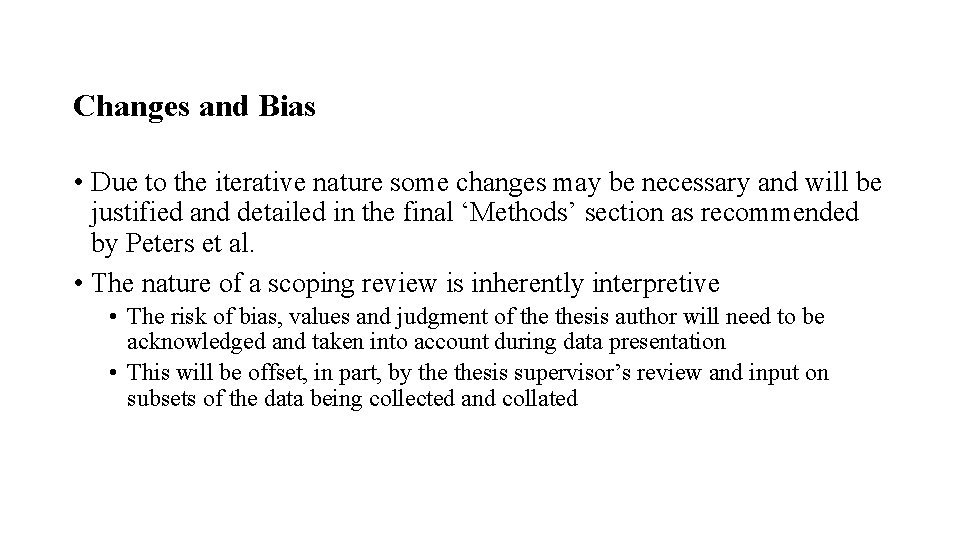
Changes and Bias • Due to the iterative nature some changes may be necessary and will be justified and detailed in the final ‘Methods’ section as recommended by Peters et al. • The nature of a scoping review is inherently interpretive • The risk of bias, values and judgment of thesis author will need to be acknowledged and taken into account during data presentation • This will be offset, in part, by thesis supervisor’s review and input on subsets of the data being collected and collated
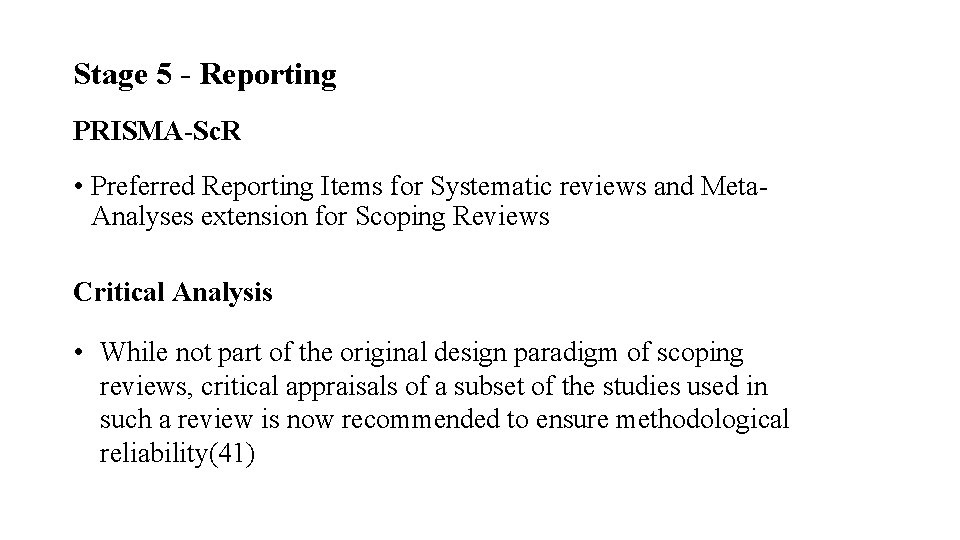
Stage 5 - Reporting PRISMA-Sc. R • Preferred Reporting Items for Systematic reviews and Meta. Analyses extension for Scoping Reviews Critical Analysis • While not part of the original design paradigm of scoping reviews, critical appraisals of a subset of the studies used in such a review is now recommended to ensure methodological reliability(41)
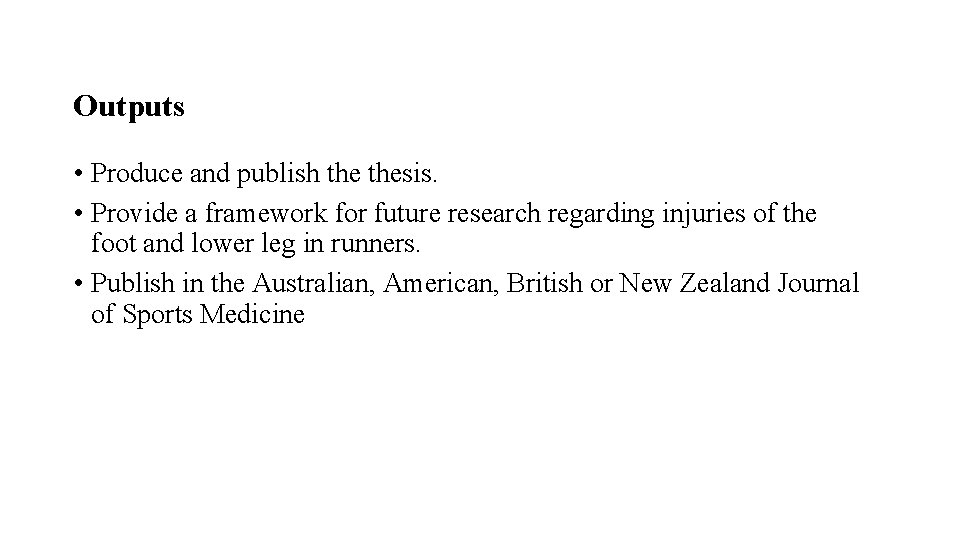
Outputs • Produce and publish thesis. • Provide a framework for future research regarding injuries of the foot and lower leg in runners. • Publish in the Australian, American, British or New Zealand Journal of Sports Medicine
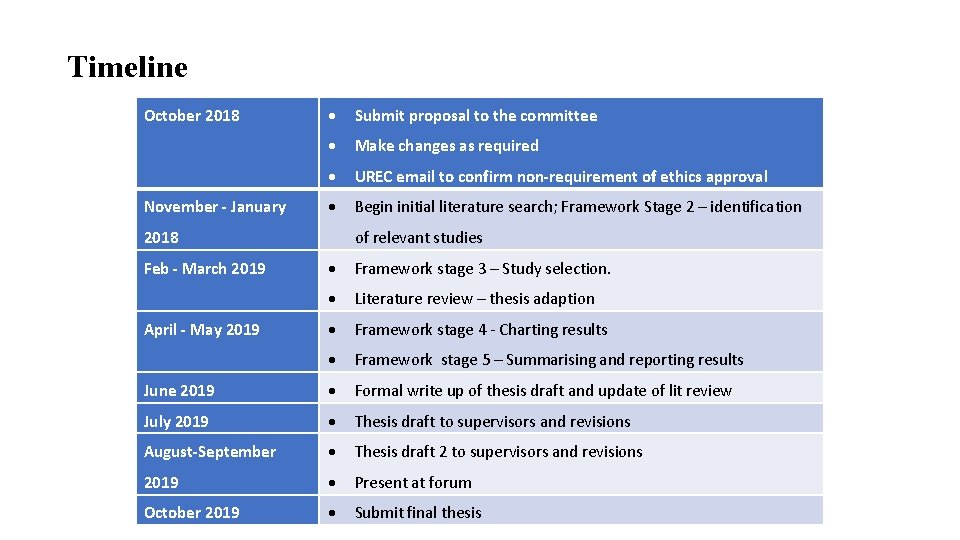
Timeline October 2018 November - January Submit proposal to the committee Make changes as required UREC email to confirm non-requirement of ethics approval Begin initial literature search; Framework Stage 2 – identification 2018 of relevant studies Framework stage 3 – Study selection. Literature review – thesis adaption Framework stage 4 - Charting results Framework stage 5 – Summarising and reporting results June 2019 Formal write up of thesis draft and update of lit review July 2019 Thesis draft to supervisors and revisions August-September Thesis draft 2 to supervisors and revisions 2019 Present at forum October 2019 Submit final thesis Feb - March 2019 April - May 2019
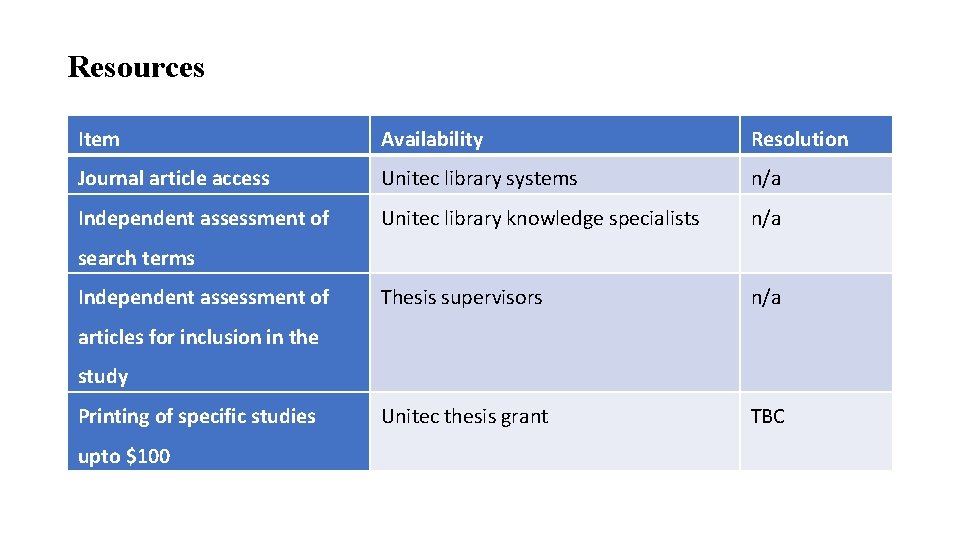
Resources Item Availability Resolution Journal article access Unitec library systems n/a Independent assessment of Unitec library knowledge specialists n/a Thesis supervisors n/a Unitec thesis grant TBC search terms Independent assessment of articles for inclusion in the study Printing of specific studies upto $100
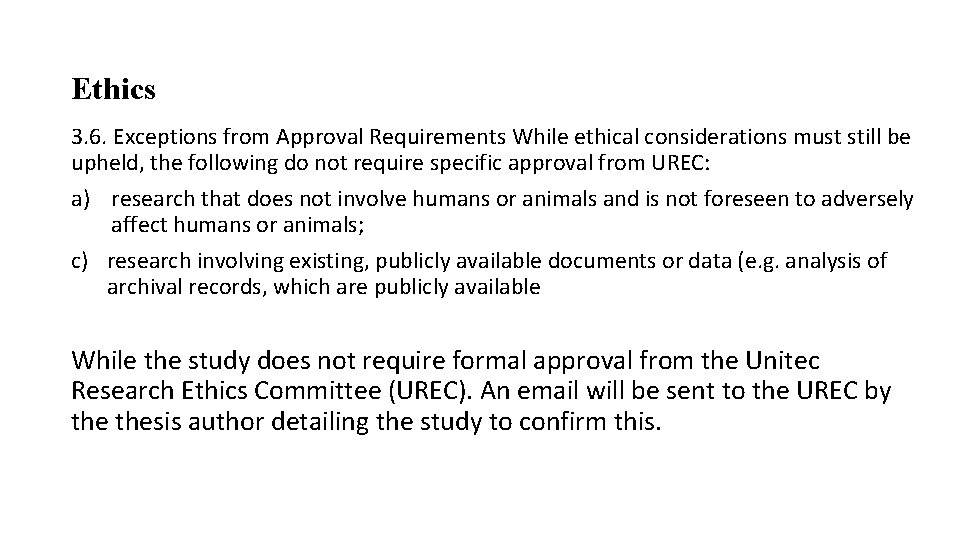
Ethics 3. 6. Exceptions from Approval Requirements While ethical considerations must still be upheld, the following do not require specific approval from UREC: a) research that does not involve humans or animals and is not foreseen to adversely affect humans or animals; c) research involving existing, publicly available documents or data (e. g. analysis of archival records, which are publicly available While the study does not require formal approval from the Unitec Research Ethics Committee (UREC). An email will be sent to the UREC by thesis author detailing the study to confirm this.
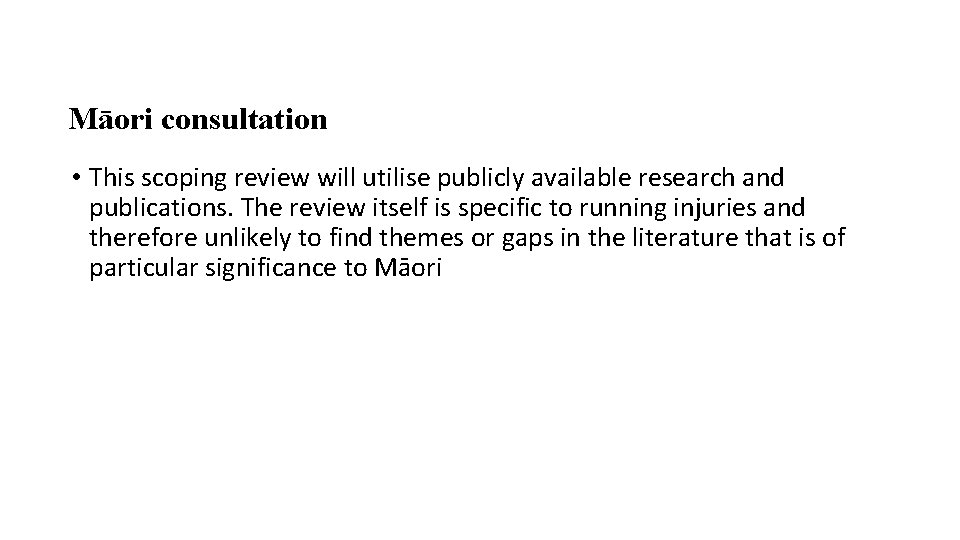
Māori consultation • This scoping review will utilise publicly available research and publications. The review itself is specific to running injuries and therefore unlikely to find themes or gaps in the literature that is of particular significance to Māori