
Defining the future of NHS commissioning across Nottingham
- Slides: 31
Defining the future of NHS commissioning across Nottingham & Nottinghamshire FINDINGS REPORT Stakeholder consultation regarding the future of NHS commissioning across Nottingham and Nottinghamshire
i FOREWORD: Actions for Governing Body members 1. Defining the future of NHS commissioning across Nottingham & Nottinghamshire The Governing Body is asked to: • Review and reflect upon the views shared by stakeholders • Carefully consider this feedback when making decisions relating to the future of commissioning arrangements across Nottingham and Nottinghamshire 2. Agree a formal response to feedback, which will be published by 19 July 2019 together with this report 3. Note that a case for change, required to support any merger application, would need to include a specific response from CCGs to comments raised by: - Local Authorities - Healthwatch - GP members
Defining the future of NHS commissioning across Nottingham & Nottinghamshire Table of contents Page Foreword: Actions for Governing Body Members i Executive Summary………………………………………… 1 Introduction……………. . . . 2 Consultation scope……………………………. . 3 Stakeholders targeted…. . . . 4 Consultation questions ………………………… 5 Methodology…………………. . ………………………. 6 Data cleansing……………. . …………………. . 7 Consultation results…………………. . . . 8 Essential organisational responses. . . 22 Organisations and groups represented …………………. . 28
1 Executive Summary Defining the future of NHS commissioning across Nottingham & Nottinghamshire This report relates to the 2019 consultation regarding the future arrangements of NHS commissioning across Nottingham and Nottinghamshire. Two options were proposed: 1) to merge the six CCG organisations and create a single, strategic commissioner; and 2) no change, i. e. for CCG organisations to stay as they are with no further structural change. Led by the six CCGs across Nottingham and Nottinghamshire, the consultation attracted a total of 192 responses from stakeholders such as GP members, local authorities, Healthwatch, healthcare providers, local residents and patient groups. Overall, there was strong support for the proposed merger; and notably more so than support for the alternative option of staying the same (‘no change’). Significantly, the proposal to merge was supported by Healthwatch, local authority representatives and the majority of GPs, residents and patient groups. However, a caveat accompanied expressions of support from many groups, stipulating the need for CCGs to provide assurances regarding a number of matters. Most notably, this related to an ongoing focus on the needs of localities and communities as well as the need to engage with local people and clinicians to inform commissioning activities. As part of the stakeholder consultation many local people and patient representative groups responded requesting to be involved in the development of commissioning plans and activities going forward. They also asked for more information about the emerging arrangements across the region with regard to the Integrated Care System (ICS), Integrated Care Providers (ICPs) and, in particular, the Primary Care Networks (PCNs). It is essential that CCG leaders take into account the feedback received during the consultation and use it to inform their decisions regarding future commissioning arrangements. Furthermore, key departments and leads would benefit from noting specific comments received as they may inform and help improve commissioning activities.
2 Introduction Defining the future of NHS commissioning across Nottingham & Nottinghamshire The CCGs commissioned an independent consultant, Jo Yeaman of MIH Solutions, to carry out analysis of the consultation with the support of the CCG’s Business Information Team to produce this detailed report on the results. This report sets out the key findings following a consultation with stakeholders regarding the future possible arrangements for NHS commissioning across Nottingham and Nottinghamshire. It is presented to the joint Governing Body for the purposes of informing a decision about whether to pursue a formal merger of the six CCGs, or to keep current arrangements as they are with no further structural change. CCGs have committed to respond formally to these findings, and a response will be published following Governing Body discussions on 4 July 2019. This report will also be made available to stakeholders and published on CCG websites.
3 Consultation scope Defining the future of NHS commissioning across Nottingham & Nottinghamshire The consultation was jointly led by the six NHS Clinical Commissioning Groups (CCGs) across Nottingham and Nottinghamshire. It ran for 31 days from 17 May to 17 June 2019. The commissioning proposals subject to consultation were specifically about how the six CCGs might be structured in future. As proposals did not relate to patient services commissioned, this was deemed a stakeholder consultation and not a public one. Outside of scope Bassetlaw in the north of Nottinghamshire was not considered within this consultation, as it will continue to remain part of the South Yorkshire and Bassetlaw healthcare system. The University of Nottingham is also conducting research on behalf of the CCGs, interviewing 15 GPs in each of the three localities (45 in total). This relates to wider considerations outside of the consultation, including strengthening clinical involvement and leadership, and ensuring an ongoing focus on local health needs. This work will inform commissioning strategy and activities, and is subject to a separate report. The consultation attracted a number of comments relevant to matters beyond the subject of the consultation itself, e. g. personal experiences of NHS services. These will be shared with the appropriate departments and individuals for the purposes of continuing to improve commissioning activities. These comments are not considered within this report.
4 Stakeholders targeted Defining the future of NHS commissioning across Nottingham & Nottinghamshire The following stakeholder groups were targeted: • GPs and member GP Practices • Healthwatch and other patient representative groups • Local authorities (Nottingham City and Nottinghamshire County) • CCG Staff • Voluntary, community sector and social care • Local clinicians and other healthcare partners • Local decision makers and other influencers, e. g. MPs, councillors, overview and scrutiny committees Whilst members of the public were not targeted, some patient representative groups and individuals wished to participate. The CCGs made provision for this eventuality in the consultation and welcomed views from local people. The comments shared by local people have been fully considered within this report.
5 Consultation questions Defining the future of NHS commissioning across Nottingham & Nottinghamshire Respondents were asked the following: 1. In which group they categorise themselves 2. Whether views are their own or shared on behalf of others 3. Which group or organisation they represent (if applicable) 4. The extent to which they support ‘a full merger’ of the six CCGs 5. The extent to which they support ‘no further change’ to CCGs 6. An opportunity to explain their views for both options 7. Whether they have other considerations for CCGs Respondents were able to select which questions they answered, and some chose not to answer them all
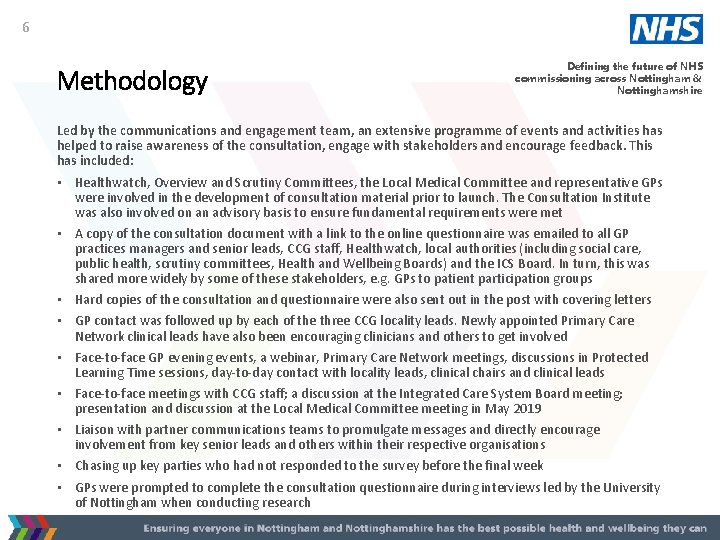
6 Methodology Defining the future of NHS commissioning across Nottingham & Nottinghamshire Led by the communications and engagement team, an extensive programme of events and activities has helped to raise awareness of the consultation, engage with stakeholders and encourage feedback. This has included: • Healthwatch, Overview and Scrutiny Committees, the Local Medical Committee and representative GPs were involved in the development of consultation material prior to launch. The Consultation Institute was also involved on an advisory basis to ensure fundamental requirements were met • A copy of the consultation document with a link to the online questionnaire was emailed to all GP practices managers and senior leads, CCG staff, Healthwatch, local authorities (including social care, public health, scrutiny committees, Health and Wellbeing Boards) and the ICS Board. In turn, this was shared more widely by some of these stakeholders, e. g. GPs to patient participation groups • Hard copies of the consultation and questionnaire were also sent out in the post with covering letters • GP contact was followed up by each of the three CCG locality leads. Newly appointed Primary Care Network clinical leads have also been encouraging clinicians and others to get involved • Face-to-face GP evening events, a webinar, Primary Care Network meetings, discussions in Protected Learning Time sessions, day-to-day contact with locality leads, clinical chairs and clinical leads • Face-to-face meetings with CCG staff; a discussion at the Integrated Care System Board meeting; presentation and discussion at the Local Medical Committee meeting in May 2019 • Liaison with partner communications teams to promulgate messages and directly encourage involvement from key senior leads and others within their respective organisations • Chasing up key parties who had not responded to the survey before the final week • GPs were prompted to complete the consultation questionnaire during interviews led by the University of Nottingham when conducting research
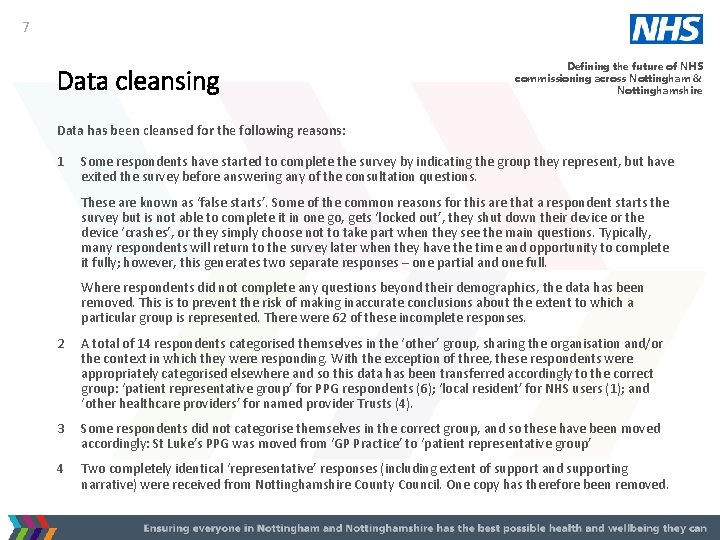
7 Data cleansing Defining the future of NHS commissioning across Nottingham & Nottinghamshire Data has been cleansed for the following reasons: 1 Some respondents have started to complete the survey by indicating the group they represent, but have exited the survey before answering any of the consultation questions. These are known as ‘false starts’. Some of the common reasons for this are that a respondent starts the survey but is not able to complete it in one go, gets ‘locked out’, they shut down their device or the device ‘crashes’, or they simply choose not to take part when they see the main questions. Typically, many respondents will return to the survey later when they have the time and opportunity to complete it fully; however, this generates two separate responses – one partial and one full. Where respondents did not complete any questions beyond their demographics, the data has been removed. This is to prevent the risk of making inaccurate conclusions about the extent to which a particular group is represented. There were 62 of these incomplete responses. 2 A total of 14 respondents categorised themselves in the ‘other’ group, sharing the organisation and/or the context in which they were responding. With the exception of three, these respondents were appropriately categorised elsewhere and so this data has been transferred accordingly to the correct group: ‘patient representative group’ for PPG respondents (6); ‘local resident’ for NHS users (1); and ‘other healthcare providers’ for named provider Trusts (4). 3 Some respondents did not categorise themselves in the correct group, and so these have been moved accordingly: St Luke’s PPG was moved from ‘GP Practice’ to ‘patient representative group’ 4 Two completely identical ‘representative’ responses (including extent of support and supporting narrative) were received from Nottinghamshire County Council. One copy has therefore been removed.
8 Defining the future of NHS commissioning across Nottingham & Nottinghamshire CONSULTATION RESULTS
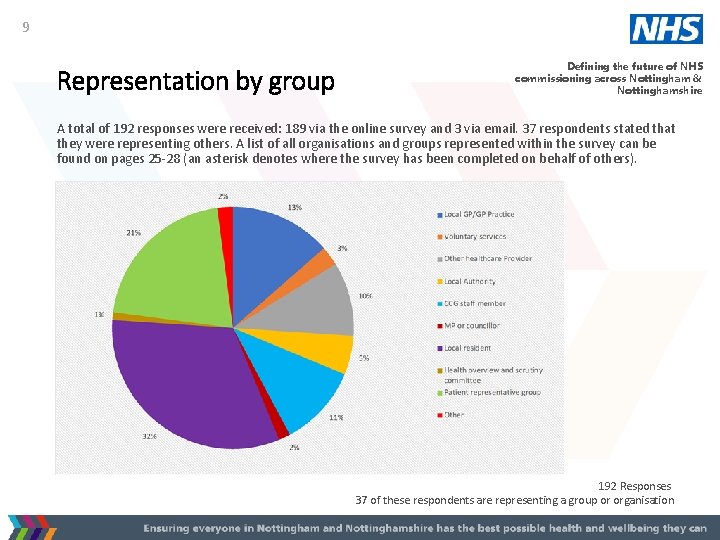
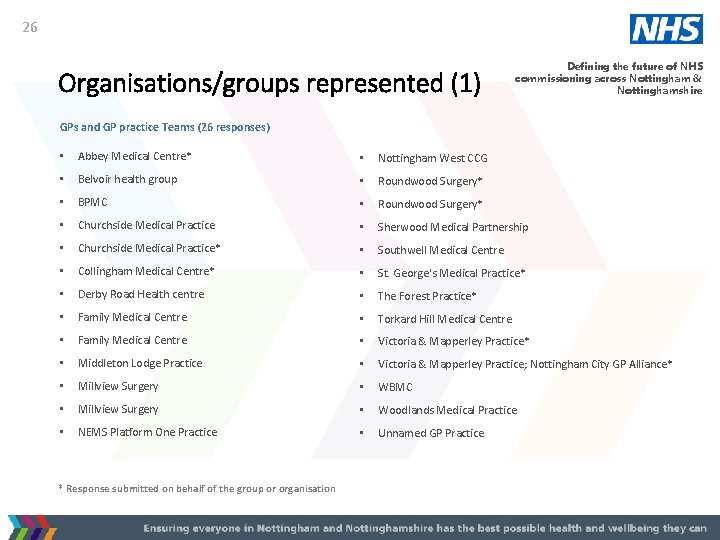
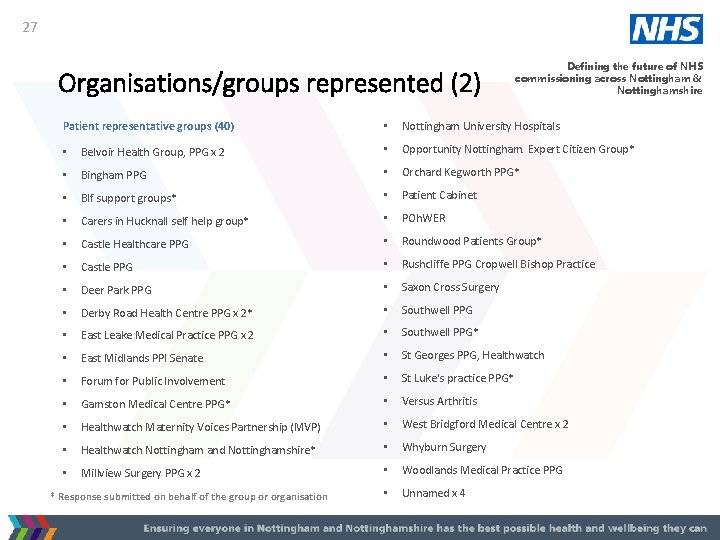
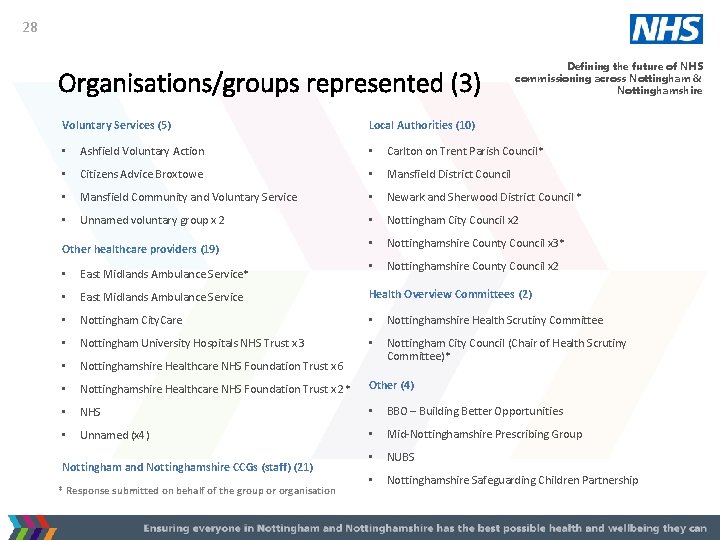
9 Representation by group Defining the future of NHS commissioning across Nottingham & Nottinghamshire A total of 192 responses were received: 189 via the online survey and 3 via email. 37 respondents stated that they were representing others. A list of all organisations and groups represented within the survey can be found on pages 25 -28 (an asterisk denotes where the survey has been completed on behalf of others). 192 Responses 37 of these respondents are representing a group or organisation
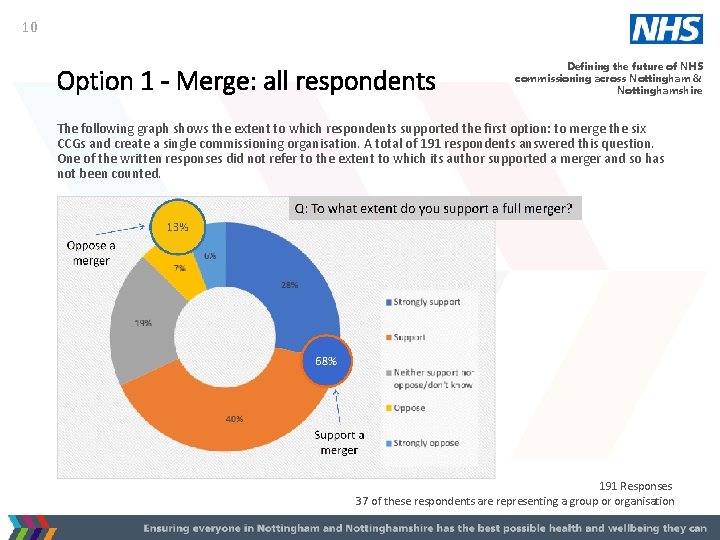
10 Option 1 - Merge: all respondents Defining the future of NHS commissioning across Nottingham & Nottinghamshire The following graph shows the extent to which respondents supported the first option: to merge the six CCGs and create a single commissioning organisation. A total of 191 respondents answered this question. One of the written responses did not refer to the extent to which its author supported a merger and so has not been counted. 191 Responses 37 of these respondents are representing a group or organisation
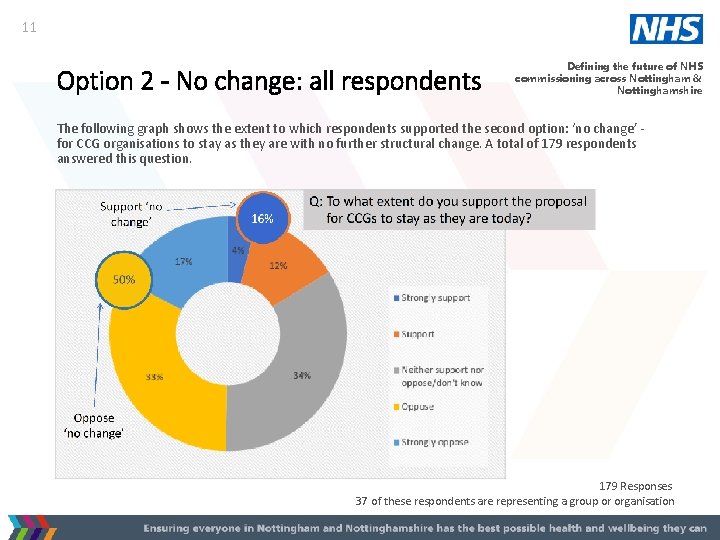
11 Option 2 - No change: all respondents Defining the future of NHS commissioning across Nottingham & Nottinghamshire The following graph shows the extent to which respondents supported the second option: ‘no change’ for CCG organisations to stay as they are with no further structural change. A total of 179 respondents answered this question. 179 Responses 37 of these respondents are representing a group or organisation
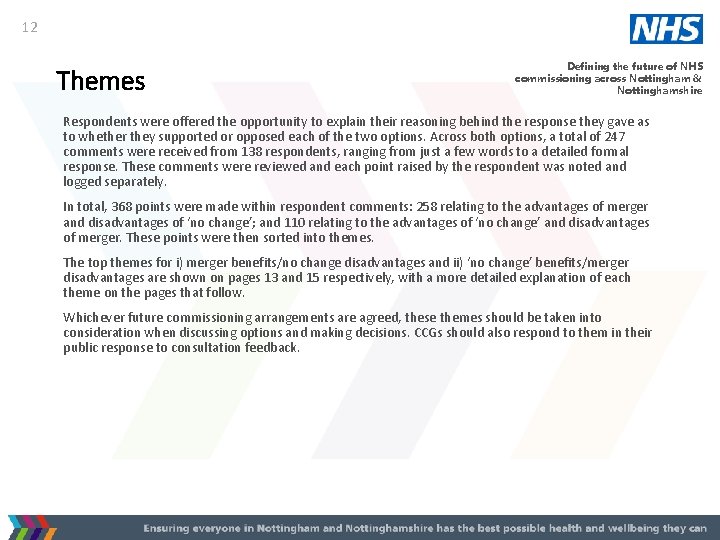
12 Themes Defining the future of NHS commissioning across Nottingham & Nottinghamshire Respondents were offered the opportunity to explain their reasoning behind the response they gave as to whether they supported or opposed each of the two options. Across both options, a total of 247 comments were received from 138 respondents, ranging from just a few words to a detailed formal response. These comments were reviewed and each point raised by the respondent was noted and logged separately. In total, 368 points were made within respondent comments: 258 relating to the advantages of merger and disadvantages of ‘no change’; and 110 relating to the advantages of ‘no change’ and disadvantages of merger. These points were then sorted into themes. The top themes for i) merger benefits/no change disadvantages and ii) ‘no change’ benefits/merger disadvantages are shown on pages 13 and 15 respectively, with a more detailed explanation of each theme on the pages that follow. Whichever future commissioning arrangements are agreed, these themes should be taken into consideration when discussing options and making decisions. CCGs should also respond to them in their public response to consultation feedback.
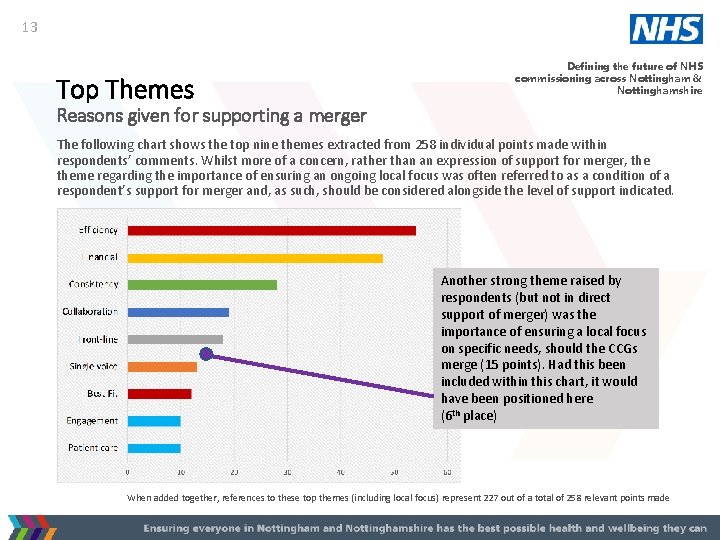
13 Top Themes Defining the future of NHS commissioning across Nottingham & Nottinghamshire Reasons given for supporting a merger The following chart shows the top nine themes extracted from 258 individual points made within respondents’ comments. Whilst more of a concern, rather than an expression of support for merger, theme regarding the importance of ensuring an ongoing local focus was often referred to as a condition of a respondent’s support for merger and, as such, should be considered alongside the level of support indicated. Another strong theme raised by respondents (but not in direct support of merger) was the importance of ensuring a local focus on specific needs, should the CCGs merge (15 points). Had this been included within this chart, it would have been positioned here (6 th place) When added together, references to these top themes (including local focus) represent 227 out of a total of 258 relevant points made
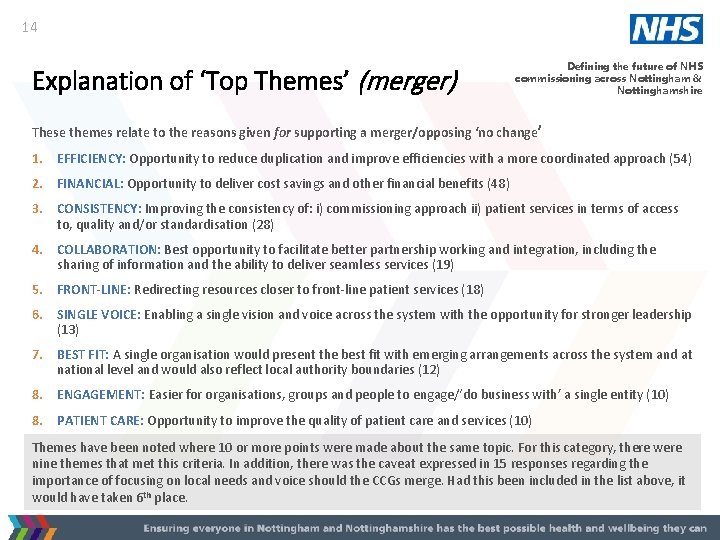
14 Explanation of ‘Top Themes’ (merger) Defining the future of NHS commissioning across Nottingham & Nottinghamshire These themes relate to the reasons given for supporting a merger/opposing ‘no change’ 1. EFFICIENCY: Opportunity to reduce duplication and improve efficiencies with a more coordinated approach (54) 2. FINANCIAL: Opportunity to deliver cost savings and other financial benefits (48) 3. CONSISTENCY: Improving the consistency of: i) commissioning approach ii) patient services in terms of access to, quality and/or standardisation (28) 4. COLLABORATION: Best opportunity to facilitate better partnership working and integration, including the sharing of information and the ability to deliver seamless services (19) 5. FRONT-LINE: Redirecting resources closer to front-line patient services (18) 6. SINGLE VOICE: Enabling a single vision and voice across the system with the opportunity for stronger leadership (13) 7. BEST FIT: A single organisation would present the best fit with emerging arrangements across the system and at national level and would also reflect local authority boundaries (12) 8. ENGAGEMENT: Easier for organisations, groups and people to engage/‘do business with’ a single entity (10) 8. PATIENT CARE: Opportunity to improve the quality of patient care and services (10) Themes have been noted where 10 or more points were made about the same topic. For this category, there were nine themes that met this criteria. In addition, there was the caveat expressed in 15 responses regarding the importance of focusing on local needs and voice should the CCGs merge. Had this been included in the list above, it would have taken 6 th place.
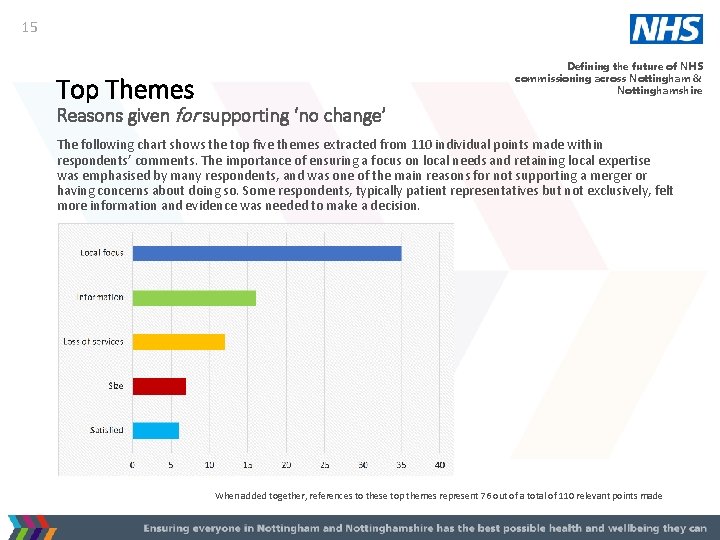
15 Top Themes Defining the future of NHS commissioning across Nottingham & Nottinghamshire Reasons given for supporting ‘no change’ The following chart shows the top five themes extracted from 110 individual points made within respondents’ comments. The importance of ensuring a focus on local needs and retaining local expertise was emphasised by many respondents, and was one of the main reasons for not supporting a merger or having concerns about doing so. Some respondents, typically patient representatives but not exclusively, felt more information and evidence was needed to make a decision. When added together, references to these top themes represent 76 out of a total of 110 relevant points made
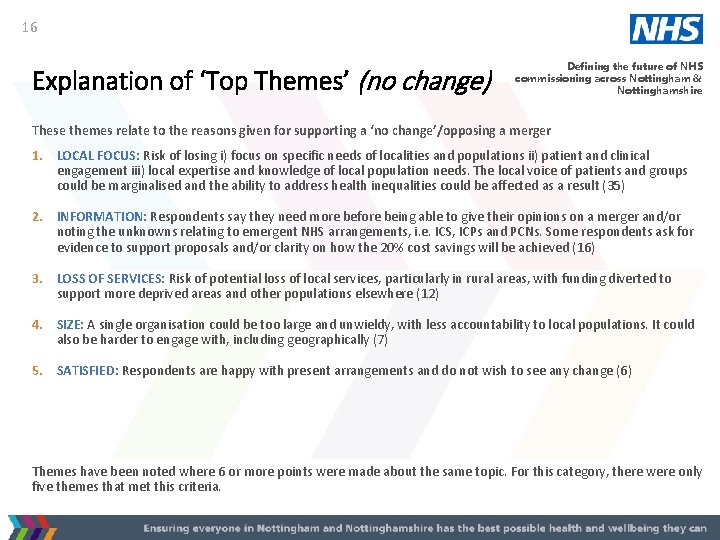
16 Explanation of ‘Top Themes’ (no change) Defining the future of NHS commissioning across Nottingham & Nottinghamshire These themes relate to the reasons given for supporting a ‘no change’/opposing a merger 1. LOCAL FOCUS: Risk of losing i) focus on specific needs of localities and populations ii) patient and clinical engagement iii) local expertise and knowledge of local population needs. The local voice of patients and groups could be marginalised and the ability to address health inequalities could be affected as a result (35) 2. INFORMATION: Respondents say they need more before being able to give their opinions on a merger and/or noting the unknowns relating to emergent NHS arrangements, i. e. ICS, ICPs and PCNs. Some respondents ask for evidence to support proposals and/or clarity on how the 20% cost savings will be achieved (16) 3. LOSS OF SERVICES: Risk of potential loss of local services, particularly in rural areas, with funding diverted to support more deprived areas and other populations elsewhere (12) 4. SIZE: A single organisation could be too large and unwieldy, with less accountability to local populations. It could also be harder to engage with, including geographically (7) 5. SATISFIED: Respondents are happy with present arrangements and do not wish to see any change (6) Themes have been noted where 6 or more points were made about the same topic. For this category, there were only five themes that met this criteria.
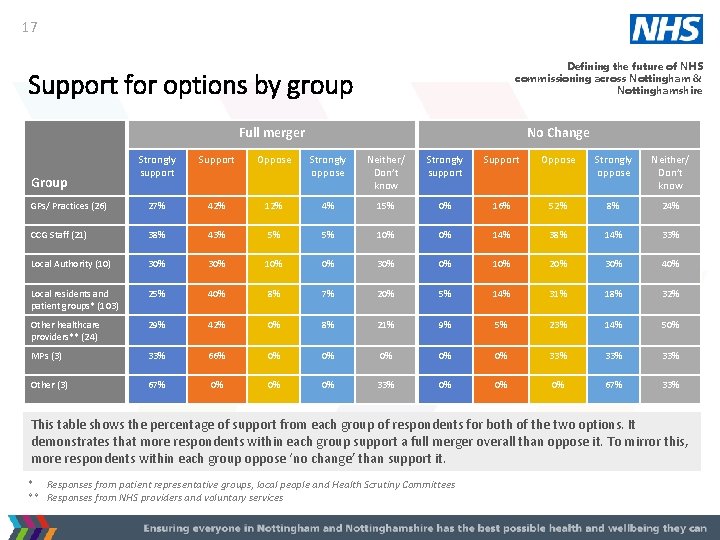
17 Defining the future of NHS commissioning across Nottingham & Nottinghamshire Support for options by group Full merger No Change Strongly support Support Oppose Strongly oppose Neither/ Don’t know GPs/ Practices (26) 27% 42% 12% 4% 15% 0% 16% 52% 8% 24% CCG Staff (21) 38% 43% 5% 5% 10% 0% 14% 38% 14% 33% Local Authority (10) 30% 10% 0% 30% 0% 10% 20% 30% 40% Local residents and patient groups* (103) 25% 40% 8% 7% 20% 5% 14% 31% 18% 32% Other healthcare providers** (24) 29% 42% 0% 8% 21% 9% 5% 23% 14% 50% MPs (3) 33% 66% 0% 0% 0% 33% 33% Other (3) 67% 0% 0% 0% 33% 0% 0% 0% 67% 33% Group This table shows the percentage of support from each group of respondents for both of the two options. It demonstrates that more respondents within each group support a full merger overall than oppose it. To mirror this, more respondents within each group oppose ‘no change’ than support it. * Responses from patient representative groups, local people and Health Scrutiny Committees ** Responses from NHS providers and voluntary services
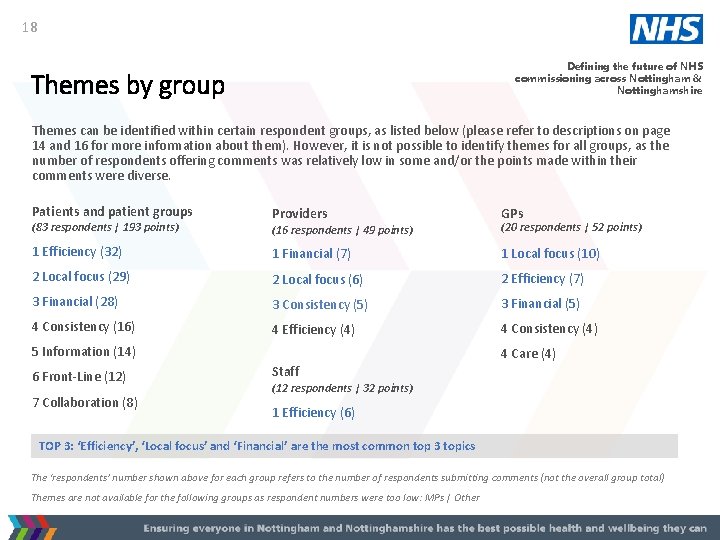
18 Defining the future of NHS commissioning across Nottingham & Nottinghamshire Themes by group Themes can be identified within certain respondent groups, as listed below (please refer to descriptions on page 14 and 16 for more information about them). However, it is not possible to identify themes for all groups, as the number of respondents offering comments was relatively low in some and/or the points made within their comments were diverse. Patients and patient groups Providers GPs (16 respondents | 49 points) (20 respondents | 52 points) 1 Efficiency (32) 1 Financial (7) 1 Local focus (10) 2 Local focus (29) 2 Local focus (6) 2 Efficiency (7) 3 Financial (28) 3 Consistency (5) 3 Financial (5) 4 Consistency (16) 4 Efficiency (4) 4 Consistency (4) (83 respondents | 193 points) 5 Information (14) 6 Front-Line (12) 7 Collaboration (8) 4 Care (4) Staff (12 respondents | 32 points) 1 Efficiency (6) TOP 3: ‘Efficiency’, ‘Local focus’ and ‘Financial’ are the most common top 3 topics The ‘respondents’ number shown above for each group refers to the number of respondents submitting comments (not the overall group total) Themes are not available for the following groups as respondent numbers were too low: MPs | Other
19 Defining the future of NHS commissioning across Nottingham & Nottinghamshire ESSENTIAL ORGANISATIONAL RESPONSES Healthwatch Local Authorities
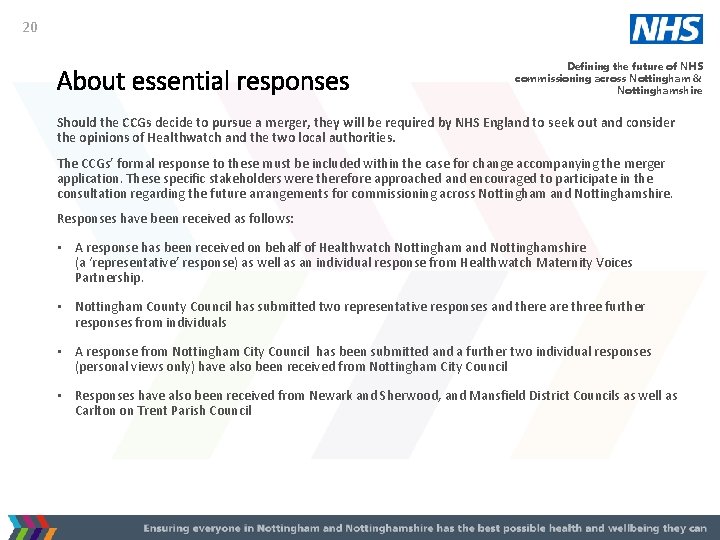
20 About essential responses Defining the future of NHS commissioning across Nottingham & Nottinghamshire Should the CCGs decide to pursue a merger, they will be required by NHS England to seek out and consider the opinions of Healthwatch and the two local authorities. The CCGs’ formal response to these must be included within the case for change accompanying the merger application. These specific stakeholders were therefore approached and encouraged to participate in the consultation regarding the future arrangements for commissioning across Nottingham and Nottinghamshire. Responses have been received as follows: • A response has been received on behalf of Healthwatch Nottingham and Nottinghamshire (a ‘representative’ response) as well as an individual response from Healthwatch Maternity Voices Partnership. • Nottingham County Council has submitted two representative responses and there are three further responses from individuals • A response from Nottingham City Council has been submitted and a further two individual responses (personal views only) have also been received from Nottingham City Council • Responses have also been received from Newark and Sherwood, and Mansfield District Councils as well as Carlton on Trent Parish Council
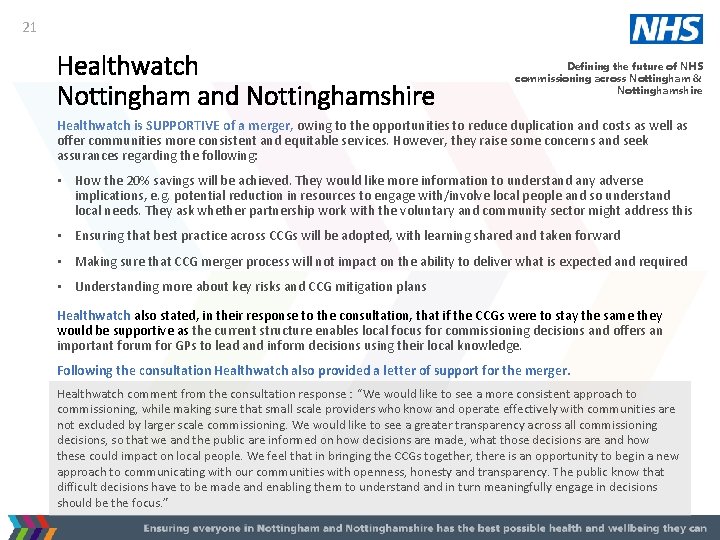
21 Healthwatch Nottingham and Nottinghamshire Defining the future of NHS commissioning across Nottingham & Nottinghamshire Healthwatch is SUPPORTIVE of a merger, owing to the opportunities to reduce duplication and costs as well as offer communities more consistent and equitable services. However, they raise some concerns and seek assurances regarding the following: • How the 20% savings will be achieved. They would like more information to understand any adverse implications, e. g. potential reduction in resources to engage with/involve local people and so understand local needs. They ask whether partnership work with the voluntary and community sector might address this • Ensuring that best practice across CCGs will be adopted, with learning shared and taken forward • Making sure that CCG merger process will not impact on the ability to deliver what is expected and required • Understanding more about key risks and CCG mitigation plans Healthwatch also stated, in their response to the consultation, that if the CCGs were to stay the same they would be supportive as the current structure enables local focus for commissioning decisions and offers an important forum for GPs to lead and inform decisions using their local knowledge. Following the consultation Healthwatch also provided a letter of support for the merger. Healthwatch comment from the consultation response : “We would like to see a more consistent approach to commissioning, while making sure that small scale providers who know and operate effectively with communities are not excluded by larger scale commissioning. We would like to see a greater transparency across all commissioning decisions, so that we and the public are informed on how decisions are made, what those decisions are and how these could impact on local people. We feel that in bringing the CCGs together, there is an opportunity to begin a new approach to communicating with our communities with openness, honesty and transparency. The public know that difficult decisions have to be made and enabling them to understand in turn meaningfully engage in decisions should be the focus. ”
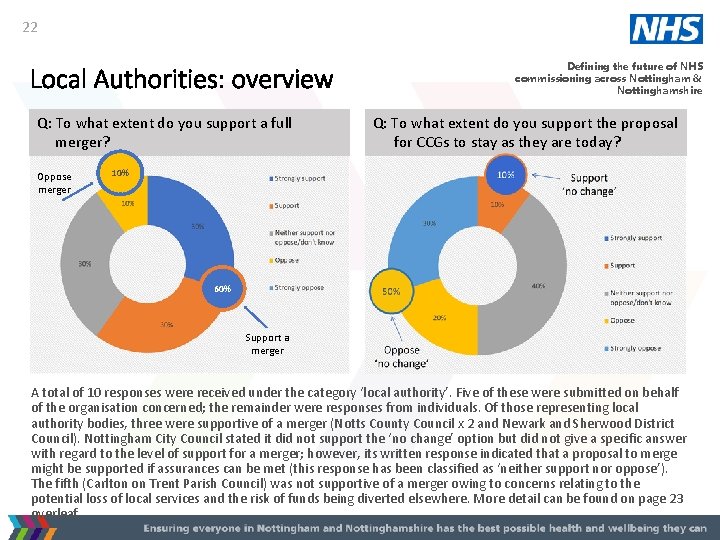
22 Local Authorities: overview Q: To what extent do you support a full merger? Oppose merger Defining the future of NHS commissioning across Nottingham & Nottinghamshire Q: To what extent do you support the proposal for CCGs to stay as they are today? 10% 60% Support a merger A total of 10 responses were received under the category ‘local authority’. Five of these were submitted on behalf of the organisation concerned; the remainder were responses from individuals. Of those representing local authority bodies, three were supportive of a merger (Notts County Council x 2 and Newark and Sherwood District Council). Nottingham City Council stated it did not support the ‘no change’ option but did not give a specific answer with regard to the level of support for a merger; however, its written response indicated that a proposal to merge might be supported if assurances can be met (this response has been classified as ‘neither support nor oppose’). The fifth (Carlton on Trent Parish Council) was not supportive of a merger owing to concerns relating to the potential loss of local services and the risk of funds being diverted elsewhere. More detail can be found on page 23 overleaf.
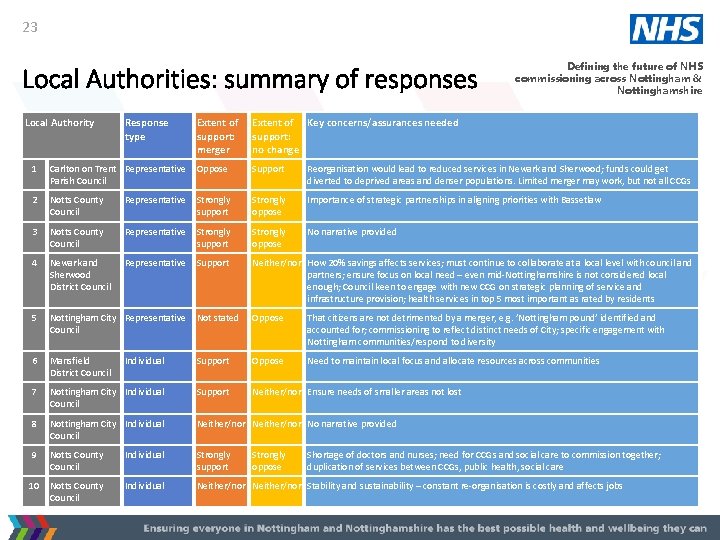
23 Local Authorities: summary of responses Local Authority Response type Extent of support: merger Extent of Key concerns/assurances needed support: no change Defining the future of NHS commissioning across Nottingham & Nottinghamshire 1 Carlton on Trent Representative Parish Council Oppose Support Reorganisation would lead to reduced services in Newark and Sherwood; funds could get diverted to deprived areas and denser populations. Limited merger may work, but not all CCGs 2 Notts County Council Representative Strongly support Strongly oppose Importance of strategic partnerships in aligning priorities with Bassetlaw 3 Notts County Council Representative Strongly support Strongly oppose No narrative provided 4 Newark and Sherwood District Council Representative Support Neither/nor How 20% savings affects services; must continue to collaborate at a local level with council and partners; ensure focus on local need – even mid-Nottinghamshire is not considered local enough; Council keen to engage with new CCG on strategic planning of service and infrastructure provision; health services in top 5 most important as rated by residents 5 Nottingham City Representative Council Not stated Oppose That citizens are not detrimented by a merger, e. g. ’Nottingham pound’ identified and accounted for; commissioning to reflect distinct needs of City; specific engagement with Nottingham communities/respond to diversity 6 Mansfield District Council Individual Support Oppose Need to maintain local focus and allocate resources across communities 7 Nottingham City Individual Council Support Neither/nor Ensure needs of smaller areas not lost 8 Nottingham City Individual Council Neither/nor No narrative provided 9 Notts County Council Individual Strongly support 10 Notts County Council Individual Neither/nor Stability and sustainability – constant re-organisation is costly and affects jobs Strongly oppose Shortage of doctors and nurses; need for CCGs and social care to commission together; duplication of services between CCGs, public health, social care
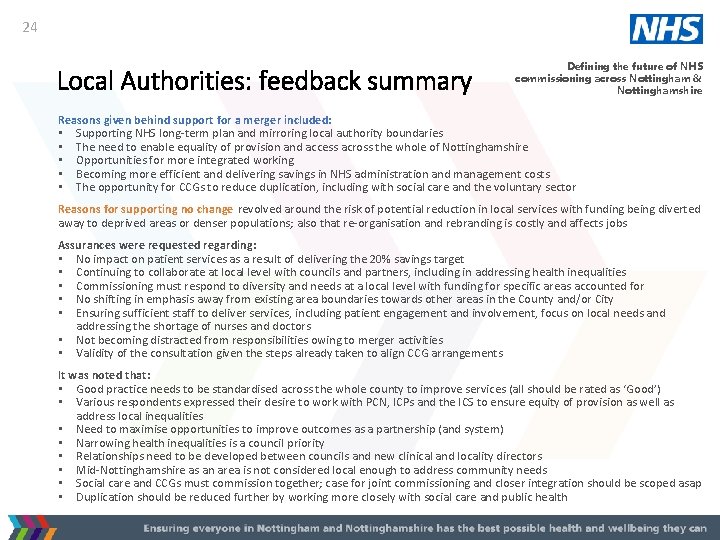
24 Local Authorities: feedback summary Defining the future of NHS commissioning across Nottingham & Nottinghamshire Reasons given behind support for a merger included: • Supporting NHS long-term plan and mirroring local authority boundaries • The need to enable equality of provision and access across the whole of Nottinghamshire • Opportunities for more integrated working • Becoming more efficient and delivering savings in NHS administration and management costs • The opportunity for CCGs to reduce duplication, including with social care and the voluntary sector Reasons for supporting no change revolved around the risk of potential reduction in local services with funding being diverted away to deprived areas or denser populations; also that re-organisation and rebranding is costly and affects jobs Assurances were requested regarding: • No impact on patient services as a result of delivering the 20% savings target • Continuing to collaborate at local level with councils and partners, including in addressing health inequalities • Commissioning must respond to diversity and needs at a local level with funding for specific areas accounted for • No shifting in emphasis away from existing area boundaries towards other areas in the County and/or City • Ensuring sufficient staff to deliver services, including patient engagement and involvement, focus on local needs and addressing the shortage of nurses and doctors • Not becoming distracted from responsibilities owing to merger activities • Validity of the consultation given the steps already taken to align CCG arrangements It was noted that: • Good practice needs to be standardised across the whole county to improve services (all should be rated as ‘Good’) • Various respondents expressed their desire to work with PCN, ICPs and the ICS to ensure equity of provision as well as address local inequalities • Need to maximise opportunities to improve outcomes as a partnership (and system) • Narrowing health inequalities is a council priority • Relationships need to be developed between councils and new clinical and locality directors • Mid-Nottinghamshire as an area is not considered local enough to address community needs • Social care and CCGs must commission together; case for joint commissioning and closer integration should be scoped asap • Duplication should be reduced further by working more closely with social care and public health
25 Defining the future of NHS commissioning across Nottingham & Nottinghamshire ORGANISATIONS AND GROUPS REPRESENTED
26 Organisations/groups represented (1) Defining the future of NHS commissioning across Nottingham & Nottinghamshire GPs and GP practice Teams (26 responses) • Abbey Medical Centre* • Nottingham West CCG • Belvoir health group • Roundwood Surgery* • BPMC • Roundwood Surgery* • Churchside Medical Practice • Sherwood Medical Partnership • Churchside Medical Practice* • Southwell Medical Centre • Collingham Medical Centre* • St. George's Medical Practice* • Derby Road Health centre • The Forest Practice* • Family Medical Centre • Torkard Hill Medical Centre • Family Medical Centre • Victoria & Mapperley Practice* • Middleton Lodge Practice • Victoria & Mapperley Practice; Nottingham City GP Alliance* • Millview Surgery • WBMC • Millview Surgery • Woodlands Medical Practice • NEMS Platform One Practice • Unnamed GP Practice * Response submitted on behalf of the group or organisation
27 Organisations/groups represented (2) Patient representative groups (40) Defining the future of NHS commissioning across Nottingham & Nottinghamshire • Nottingham University Hospitals • Belvoir Health Group, PPG x 2 • Opportunity Nottingham. Expert Citizen Group* • Bingham PPG • Orchard Kegworth PPG* • Blf support groups* • Patient Cabinet • Carers in Hucknall self help group* • POh. WER • Castle Healthcare PPG • Roundwood Patients Group* • Castle PPG • Rushcliffe PPG Cropwell Bishop Practice • Deer Park PPG • Saxon Cross Surgery • Derby Road Health Centre PPG x 2* • Southwell PPG • East Leake Medical Practice PPG x 2 • Southwell PPG* • East Midlands PPI Senate • St Georges PPG, Healthwatch • Forum for Public Involvement • St Luke's practice PPG* • Gamston Medical Centre PPG* • Versus Arthritis • Healthwatch Maternity Voices Partnership (MVP) • West Bridgford Medical Centre x 2 • Healthwatch Nottingham and Nottinghamshire* • Whyburn Surgery • Millview Surgery PPG x 2 • Woodlands Medical Practice PPG • Unnamed x 4 * Response submitted on behalf of the group or organisation
28 Organisations/groups represented (3) Voluntary Services (5) Defining the future of NHS commissioning across Nottingham & Nottinghamshire Local Authorities (10) • Ashfield Voluntary Action • Carlton on Trent Parish Council* • Citizens Advice Broxtowe • Mansfield District Council • Mansfield Community and Voluntary Service • Newark and Sherwood District Council * • Unnamed voluntary group x 2 • Nottingham City Council x 2 • Nottinghamshire County Council x 3* • Nottinghamshire County Council x 2 Other healthcare providers (19) • East Midlands Ambulance Service* • East Midlands Ambulance Service Health Overview Committees (2) • Nottingham City. Care • Nottinghamshire Health Scrutiny Committee • Nottingham University Hospitals NHS Trust x 3 • • Nottinghamshire Healthcare NHS Foundation Trust x 6 Nottingham City Council (Chair of Health Scrutiny Committee)* • Nottinghamshire Healthcare NHS Foundation Trust x 2* Other (4) • NHS • BBO – Building Better Opportunities • Unnamed (x 4) • Mid-Nottinghamshire Prescribing Group • NUBS • Nottinghamshire Safeguarding Children Partnership Nottingham and Nottinghamshire CCGs (staff) (21) * Response submitted on behalf of the group or organisation