
Defining the Boundaries of Addiction A Biological Perspective
Defining the Boundaries of Addiction: A Biological Perspective Marc N. Potenza, M. D. , Ph. D. Associate Professor of Psychiatry Director, Problem Gambling Clinic Director, Women and Addictions Core, Women’s Health Research at Yale Director of Neuroimaging, VA VISN 1 MIRECC, West Haven VA Hospital Yale University School of Medicine 3 rd Mind & World Conference, May 4, 2007
Overview • Explore the Boundaries of Addiction - Are Pathological Gambling (PG) and Other Impulse Control Disorders (ICDs) “Behavioral Addictions”? • Examine the Relationship Between PG, Substance Use Disorders (SUDs) and Other Mental Health Disorders • Describe the Clinical Implications (Prevention, Treatment) of Conceptualizing PG and Other ICDs as Behavioral Addictions 3 rd Mind & World Conference, May 4, 2007
What is Addiction? • Addict (verb) - “to devote or give (oneself) habitually or compulsively”; from Latin addicere - bound to or enslaved • Historical Shifts in Usage of Term • Core Components of Addiction (Shaffer, 1999) - Continued Behavior Despite Adverse Consequences - Diminished or Lost Control / Compulsive Engagement - Craving or Urge State Component 3 rd Mind & World Conference, May 4, 2007
What is Gambling? • Gambling Is Placing Something of Value at Risk in Hopes of Achieving Something of Greater Value (Potenza et al, JAMA, 2001) • Perception Influenced by the Relative Amounts of Risk and Reward - Mutual Funds Vs. Day Trading 3 rd Mind & World Conference, May 4, 2007
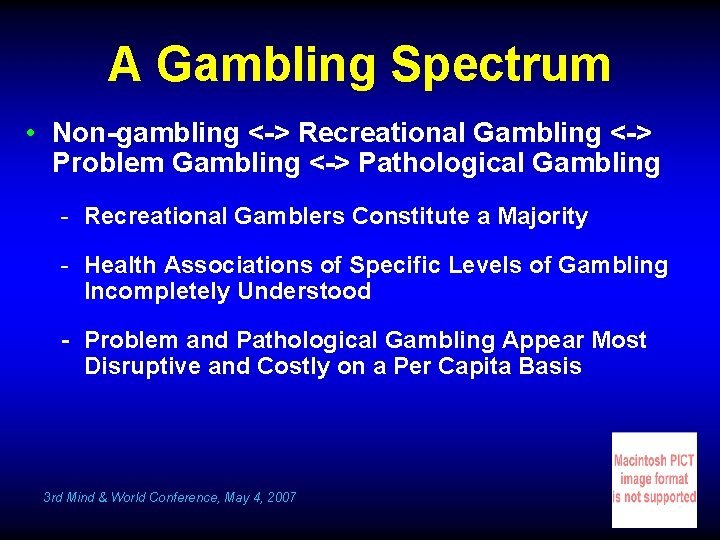
A Gambling Spectrum • Non-gambling <-> Recreational Gambling <-> Problem Gambling <-> Pathological Gambling - Recreational Gamblers Constitute a Majority - Health Associations of Specific Levels of Gambling Incompletely Understood - Problem and Pathological Gambling Appear Most Disruptive and Costly on a Per Capita Basis 3 rd Mind & World Conference, May 4, 2007
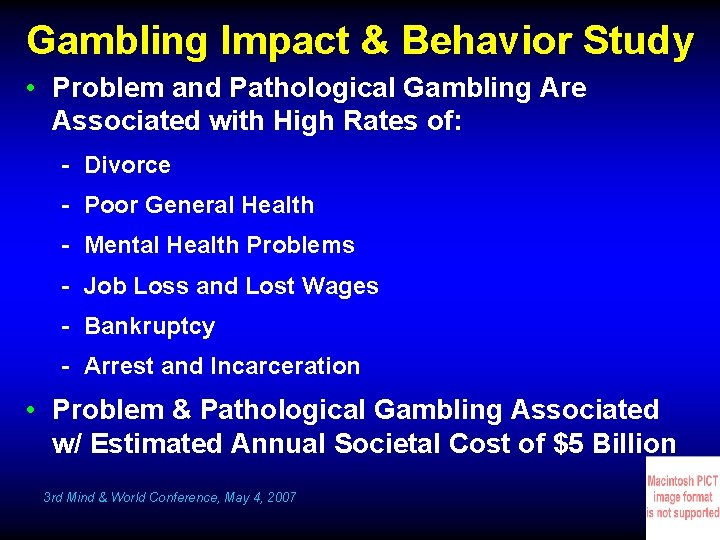
Gambling Impact & Behavior Study • Problem and Pathological Gambling Are Associated with High Rates of: - Divorce - Poor General Health - Mental Health Problems - Job Loss and Lost Wages - Bankruptcy - Arrest and Incarceration • Problem & Pathological Gambling Associated w/ Estimated Annual Societal Cost of $5 Billion 3 rd Mind & World Conference, May 4, 2007
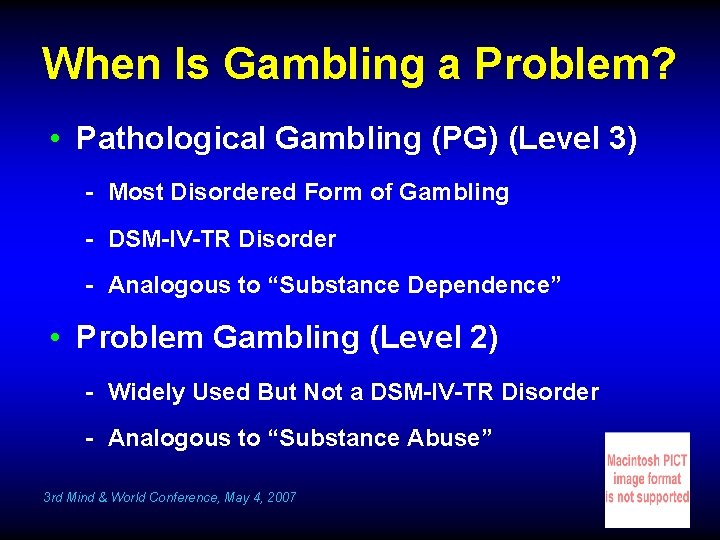
When Is Gambling a Problem? • Pathological Gambling (PG) (Level 3) - Most Disordered Form of Gambling - DSM-IV-TR Disorder - Analogous to “Substance Dependence” • Problem Gambling (Level 2) - Widely Used But Not a DSM-IV-TR Disorder - Analogous to “Substance Abuse” 3 rd Mind & World Conference, May 4, 2007
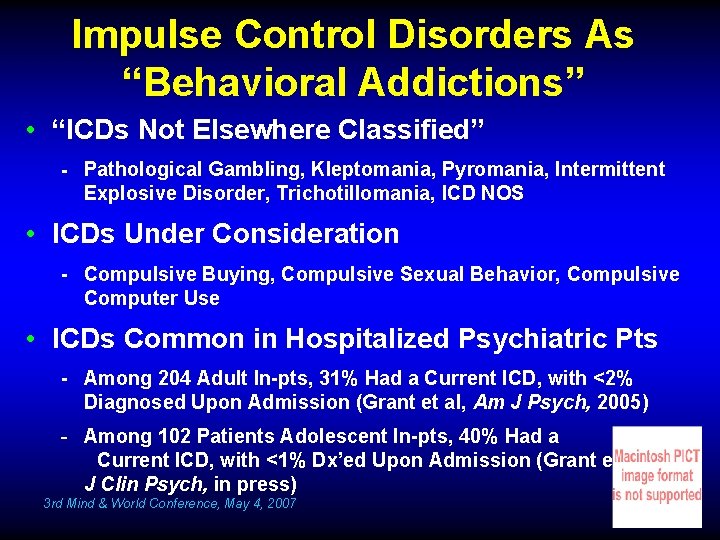
Impulse Control Disorders As “Behavioral Addictions” • “ICDs Not Elsewhere Classified” - Pathological Gambling, Kleptomania, Pyromania, Intermittent Explosive Disorder, Trichotillomania, ICD NOS • ICDs Under Consideration - Compulsive Buying, Compulsive Sexual Behavior, Compulsive Computer Use • ICDs Common in Hospitalized Psychiatric Pts - Among 204 Adult In-pts, 31% Had a Current ICD, with <2% Diagnosed Upon Admission (Grant et al, Am J Psych, 2005) - Among 102 Patients Adolescent In-pts, 40% Had a Current ICD, with <1% Dx’ed Upon Admission (Grant et J Clin Psych, in press) 3 rd Mind & World Conference, May 4, 2007 al,
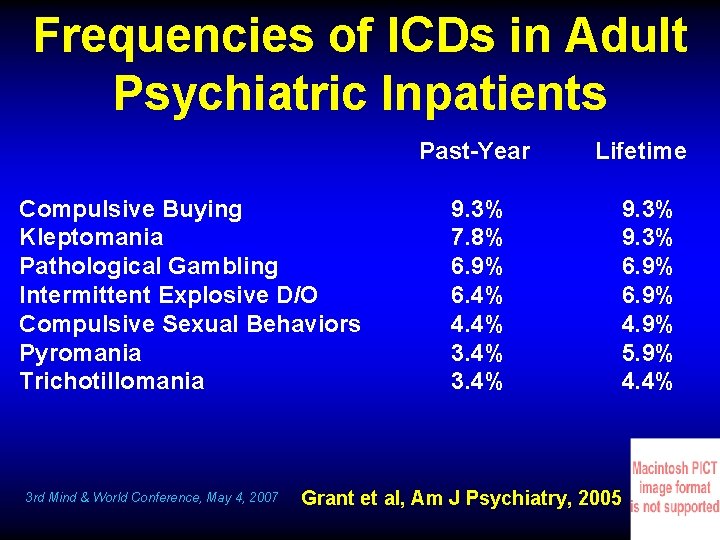
Frequencies of ICDs in Adult Psychiatric Inpatients Past-Year Compulsive Buying Kleptomania Pathological Gambling Intermittent Explosive D/O Compulsive Sexual Behaviors Pyromania Trichotillomania 3 rd Mind & World Conference, May 4, 2007 9. 3% 7. 8% 6. 9% 6. 4% 4. 4% 3. 4% Lifetime 9. 3% 6. 9% 4. 9% 5. 9% 4. 4% Grant et al, Am J Psychiatry, 2005
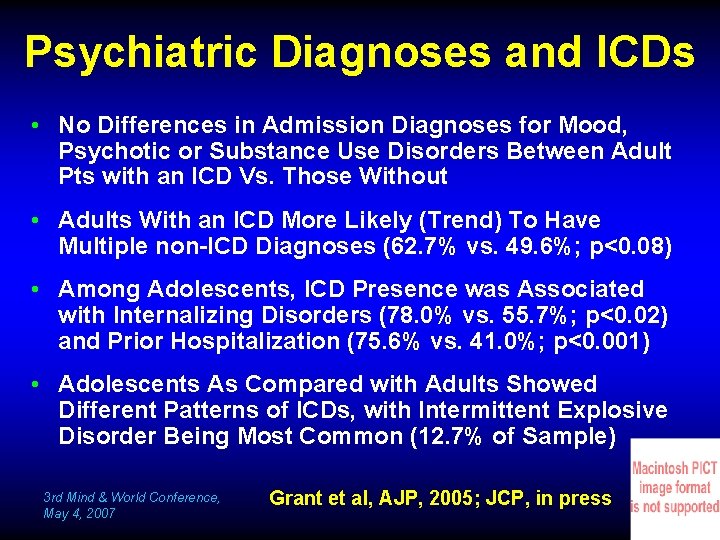
Psychiatric Diagnoses and ICDs • No Differences in Admission Diagnoses for Mood, Psychotic or Substance Use Disorders Between Adult Pts with an ICD Vs. Those Without • Adults With an ICD More Likely (Trend) To Have Multiple non-ICD Diagnoses (62. 7% vs. 49. 6%; p<0. 08) • Among Adolescents, ICD Presence was Associated with Internalizing Disorders (78. 0% vs. 55. 7%; p<0. 02) and Prior Hospitalization (75. 6% vs. 41. 0%; p<0. 001) • Adolescents As Compared with Adults Showed Different Patterns of ICDs, with Intermittent Explosive Disorder Being Most Common (12. 7% of Sample) 3 rd Mind & World Conference, May 4, 2007 Grant et al, AJP, 2005; JCP, in press
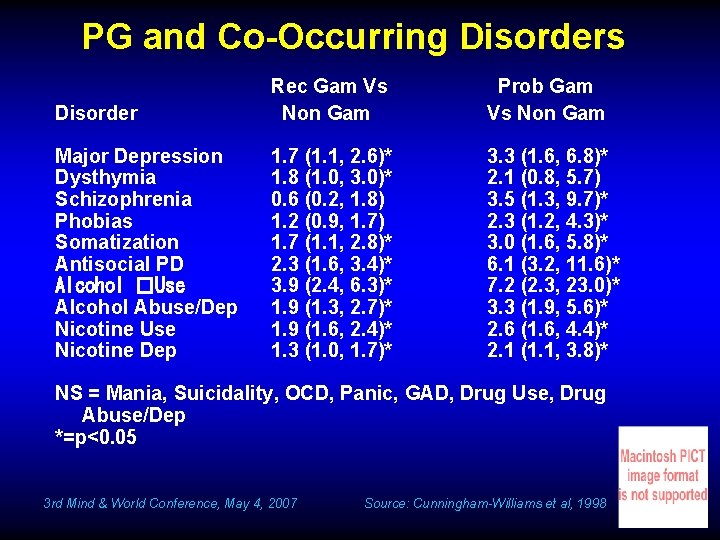
PG and Co-Occurring Disorders Disorder Rec Gam Vs Non Gam Prob Gam Vs Non Gam Major Depression Dysthymia Schizophrenia Phobias Somatization Antisocial PD Alcohol �Use Alcohol Abuse/Dep Nicotine Use Nicotine Dep 1. 7 (1. 1, 2. 6)* 1. 8 (1. 0, 3. 0)* 0. 6 (0. 2, 1. 8) 1. 2 (0. 9, 1. 7) 1. 7 (1. 1, 2. 8)* 2. 3 (1. 6, 3. 4)* 3. 9 (2. 4, 6. 3)* 1. 9 (1. 3, 2. 7)* 1. 9 (1. 6, 2. 4)* 1. 3 (1. 0, 1. 7)* 3. 3 (1. 6, 6. 8)* 2. 1 (0. 8, 5. 7) 3. 5 (1. 3, 9. 7)* 2. 3 (1. 2, 4. 3)* 3. 0 (1. 6, 5. 8)* 6. 1 (3. 2, 11. 6)* 7. 2 (2. 3, 23. 0)* 3. 3 (1. 9, 5. 6)* 2. 6 (1. 6, 4. 4)* 2. 1 (1. 1, 3. 8)* NS = Mania, Suicidality, OCD, Panic, GAD, Drug Use, Drug Abuse/Dep *=p<0. 05 3 rd Mind & World Conference, May 4, 2007 Source: Cunningham-Williams et al, 1998
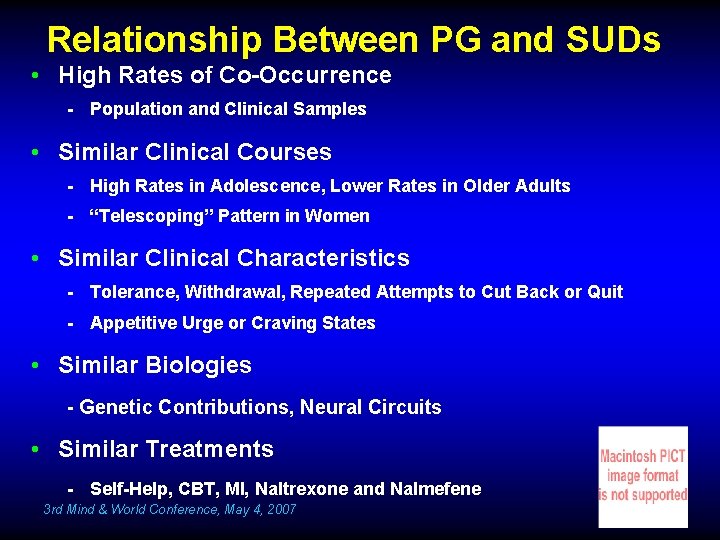
Relationship Between PG and SUDs • High Rates of Co-Occurrence - Population and Clinical Samples • Similar Clinical Courses - High Rates in Adolescence, Lower Rates in Older Adults - “Telescoping” Pattern in Women • Similar Clinical Characteristics - Tolerance, Withdrawal, Repeated Attempts to Cut Back or Quit - Appetitive Urge or Craving States • Similar Biologies - Genetic Contributions, Neural Circuits • Similar Treatments - Self-Help, CBT, MI, Naltrexone and Nalmefene 3 rd Mind & World Conference, May 4, 2007
Clinical Relevance of PG & SUDs • Individuals with Co-Occurring PG and SUDs Experience More Severe Symptoms Than Those With SUDs Alone (Kaplan & Davis, 1997) - Increased Rates of Admission for Detoxification (> Two-Fold Rate) - Increased Rates of Admission for Psychiatric Stabilization (> 50% Increased Rate) - More Suicidality (Federman et al, 1998) 3 rd Mind & World Conference, May 4, 2007
Impulsivity as an Endophenotype • Defining Impulsivity (Moeller et al, 2001) - “A Predisposition Toward Rapid, Unplanned Reactions to Internal or External Stimuli [With Diminished] Regard to the Negative Consequences of These Reactions to the Impulsive Individual or to Others” • Impulsivity Across Psychiatric Groups - ICDs, SUDs, Bipolar D/O, ADHD, ASPD, BPD, Suicidality, SIB • Behavioral Measures of Impulsivity - Risk/Reward Assessment & Decision-Making Paradigms (Monetary Reward/Punishment, Discounting, Gambling Tasks) - Response Disinhibition/Attentional Paradigms (Go/No-Go, Stroop) 3 rd Mind & World Conference, May 4, 2007
Neural Systems and Addiction • Mesocorticolimbic Dopamine System (“Overactive Motor”) - Ventral Tegmental Area, Nucleus Accumbens • Frontal Serotonin Systems (“Bad Brakes”) - Frontal/Prefrontal Cortical Function • Role for Neurotransmitter Systems Modulating DA, 5 HT Function - GABA, Glutamate, Opioids, . . . 3 rd Mind & World Conference, May 4, 2007
Roles for Neurotransmitters Neurotransmitter Role in Impulse Control Norepinephrine (NE) Arousal, Excitement Serotonin (5 HT) Behavior Initiation/Cessation Dopamine (DA) Reward, Reinforcement Opioids Pleasure, Urges 3 rd Mind & World Conference, May 4, 2007 Potenza and Hollander, 2002
5 -HT & Impulse Control • Low CSF 5 -HIAA Associated w/ Impaired Impulse Control (Potenza and Hollander, 2002) • Altered Biochemical and Behavioral Responses to m-CPP (5 HT 1 R and 5 HT 2 R Partial Agonist) (De. Caria et al, 1998) • Blunted 5 HT Response in vm. PFC in Impulsive Aggression (Siever et al, 1999; New et al, 2002) 3 rd Mind & World Conference, May 4, 2007
Impulsivity and Addiction • Serotonergic Drugs (e. g. , SSRIs) Have Shown Mixed Results in the Tx of PG (Grant et al, 2003) • SSRI Tx May Be Particularly Effective for Particular Groups of Individuals with PG - Individuals with PG and Co-Occurring Affective Disorders (Grant and Potenza, 2006 a) 3 rd Mind & World Conference, May 4, 2007
Decision-Making, Reward Processing and Addiction • Individuals with PG or SUDs Perform Disadvantageously or Impulsively on Gambling Tasks, and Performance Correlates with Real-Life Measures (Petry et al, 2001; Bechara, 2003) • Individuals with PG or SUDs Discount Rewards Rapidly Over Time (Bickel et al, 1999; Petry et al, 2001) • Behavioral Measures of Reward Discounting Are Associated with SUD Tx Outcome (Krishnan-Sarin et al, 2007) 3 rd Mind & World Conference, May 4, 2007
Reward Processing in Addiction • Adults w/ AD vs Those w/o AD Show Less Activation of NAc in Anticipation of Working for Monetary Reward (Hommer et al, 2004) • Similar Findings in Adolescents and Adults FH+ Vs. FH- for AD (Hommer et al, 2004) • Extends Across Addictions - Less Activation of NAc in PG vs. Control During Monetary Wins vs. Losses (Reuter et al, 2005) 3 rd Mind & World Conference, May 4, 2007
Dopamine and ICDs in PD • PG and Other ICDs Reported in Association with Parkinson’s Disease (Dodd et al, 2005) • Association Linked to Dopamine Agonist Treatment (Weintraub & Potenza, 2006) • Prior ICD and FH of Et. OHism Associated with ICD Presence in PD (Weintraub et al, 2006; Voon et al, 2006) • Need to Identify Neurobiological Factors Underlying Vulnerability to ICDs in PD 3 rd Mind & World Conference, May 4, 2007
Genetics of PG, AD and AAB • Shared Genetic Contributions to PG and AD - 12%-20% of Genetic Variation in the Risk for PG Accounted for by the Risk for AD (Slutske et al, 2000) • Shared Genetic Contributions to PG and AAB - 16%-22% of Genetic Variation in the Risk for PG Accounted for by the Risk for Anti-Social Behaviors (Slutske et al, 2001) • Shared Risks Suggest Shared Genetic Contributions to Risk for Impulsiveness 3 rd Mind & World Conference, May 4, 2007
Pharmacological Treatment of AD • FDA-Approved Drugs for AD (None for PG) - Disulfiram, Naltrexone, Acamprosate • Naltrexone and Other Opioid Antagonists Indirectly Modulate Dopamine Neurotransmission in VTA-NAc Pathway • Might Naltrexone or Other Mu-Opioid Receptor Antagonists Be Effective in Treating PG? 3 rd Mind & World Conference, May 4, 2007
Opioid Antagonists • High-Dose Naltrexone (Avg Dose: 188 mg/day) Effective in Targeting PG Sxs (Kim et al, 2001) • High Rates of Drop-Out & LFT Abnormalities • Greater Drug-Related Improvement in Subjects with High Initial Gambling Urge Measures - Similar to Naltrexone & Cravings in AD • Encouraging Findings with Opioid Antagonist Nalmefene (Grant et al, 2006) 3 rd Mind & World Conference, May 4, 2007
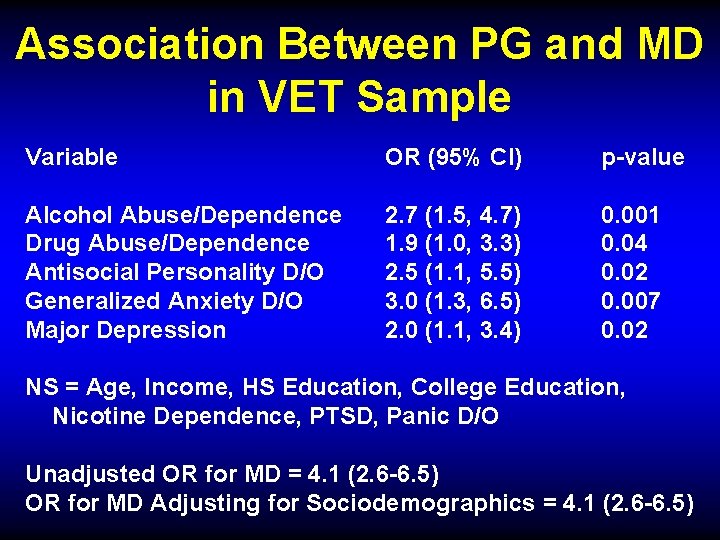
Association Between PG and MD in VET Sample Variable OR (95% CI) p-value Alcohol Abuse/Dependence Drug Abuse/Dependence Antisocial Personality D/O Generalized Anxiety D/O Major Depression 2. 7 (1. 5, 4. 7) 1. 9 (1. 0, 3. 3) 2. 5 (1. 1, 5. 5) 3. 0 (1. 3, 6. 5) 2. 0 (1. 1, 3. 4) 0. 001 0. 04 0. 02 0. 007 0. 02 NS = Age, Income, HS Education, College Education, Nicotine Dependence, PTSD, Panic D/O Unadjusted OR for MD = 4. 1 (2. 6 -6. 5) OR for MD Adjusting for Sociodemographics = 4. 1 (2. 6 -6. 5)
Bivariate Biometric Model for PG & MD Potenza et al, 2005, Arch Gen Psychiatry
Overall Conclusions • PG and Other ICDs Are Common, Particularly Among Psychiatric Pts • There Exist Multiple Shared Features Between ICDs and SUDs • Characterizing Biological Mechanisms of ICDs Has Implications for Categorizing Disorders and Tx Development • Identification of PG and Other ICDs Critical For Optimizing Clinical Care 3 rd Mind & World Conference, May 4, 2007

The International Society for Research on Impulsivity and Impulse Control Disorders (ISRI) www. impulsivity. org (or contact marc. potenza@yale. edu)
- Slides: 28