
Defining Success Strategies for Assessing Collaborative Group Projects
Defining Success Strategies for Assessing Collaborative Group Projects Keeta Holmes and Margaret Cohen Center for Teaching and Learning University of Missouri - St. Louis Peggy_Cohen@umsl. edu and Holmeskm@umsl. edu
Today’s Objectives ¡Promote student success in group projects ¡Consider how learning-centered practices include group learning ¡Identify strategies to focus successfully on collaboration ¡Consider strategies to assess contribution of groups and individuals to a collaborative project
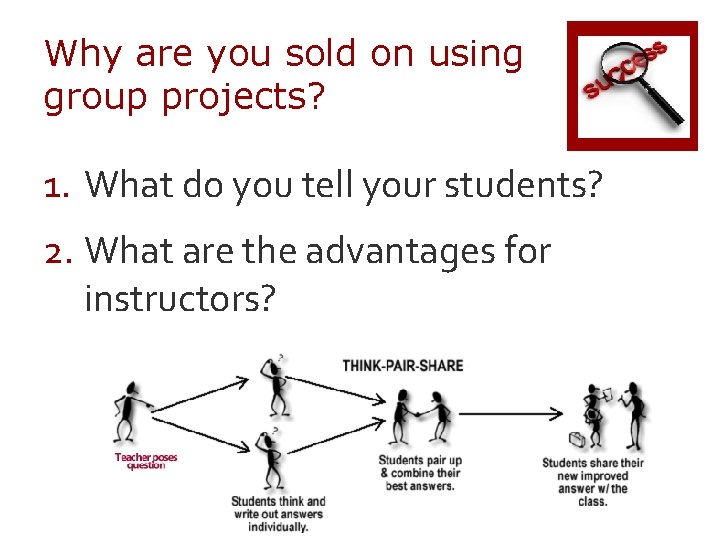
Why are you sold on using group projects? 1. What do you tell your students? 2. What are the advantages for instructors?
Messages to students ¡This will be a good experience ¡You’ll learn to work as a team ¡You don’t want to do this complicated project solo ¡You’ll have a chance to assess others’ contributions ¡The workplace seeks those who know how to work well on teams
Advantages from the faculty perspective § Opportunity for students to use and apply course content § Students gaining skills to use in upper level courses § Students learning to manage nuances of interpersonal work § Getting to know my students more individually § Increased efficiency: Fewer projects to grade means more time for more thorough feedback

Research confirms
Why learning-centered? Why collaborative learning? ¡Learner-Centered Teaching (Weimer, 2002) ¡Principles for Good Practice in Undergraduate Education (Chickering & Gamson, 1987) ¡Implementing the Seven Principles: Technology as a lever (Chickering & Ehrmann, 1996) ¡How College Affects Students (Pascarella & Terenzini, 1991; 2005) ¡National Survey of Student Engagement (Kuh, 1998 - present)
Learning-centered teaching focuses on: o what students are learning and o how they are learning
What supports are available to you?
Build a Framework 1. Course and project objectives 2. Instruction in effective group work 3. Teaching students to monitor group meetings 4. Guiding students to self assess contributions to a group 5. Guiding students to assess group members’ contributions 6. Consider grading options
Avoiding Conflict Instructor’s Role Students’ Role 1. Set clear goals 1. Establish meeting times 2. Make expectations for team members explicit 2. Encourage frequent interaction 3. Assign roles 3. Rotate roles @ each mtg. (e. g. devil’s advocate, visionary, leader) 4. Manage group size and makeup 5. Stay close, check-in often 4. Decide by consensus how to resolve conflicts: • • Lack of participation Poor contributions Take turns talking Be open to persuasion
Integrate a focus on how ¡Make a plan. ¡Be systematic. ¡Plan small increments. ¡ Increase time on task ¡ Add interpersonal skills ¡ Teach project management skills ¡Be prepared to assess and fine-tune. ¡Expect to be successful. ¡Keep trying. cf. Weimer’s (2002) chapter 9: Making learner-centered teaching work
1. Objectives for course and projects ¡Integrate your existing course/project objectives into the assignment ¡Consider building process objectives into your course: ¡Demonstrate effective leadership skills ¡Learn to be a productive team member ¡Practice offering feedback to peers ¡Learn objective ways to assess a peer
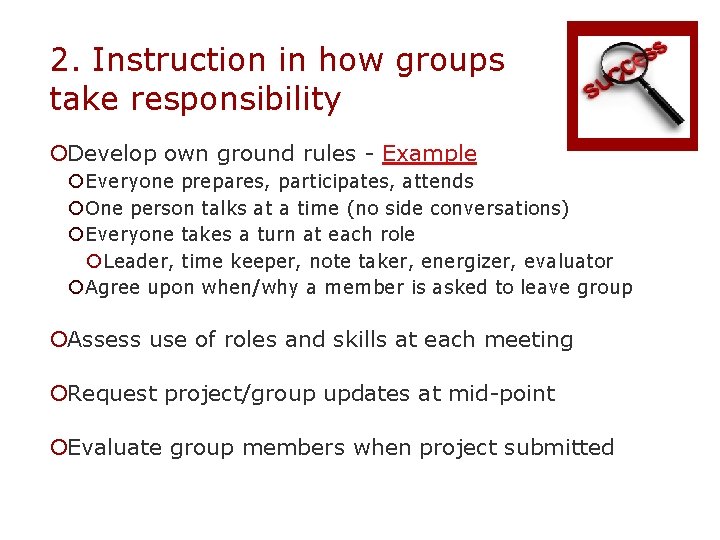
2. Instruction in how groups take responsibility ¡Develop own ground rules - Example ¡ Everyone prepares, participates, attends ¡ One person talks at a time (no side conversations) ¡ Everyone takes a turn at each role ¡ Leader, time keeper, note taker, energizer, evaluator ¡ Agree upon when/why a member is asked to leave group ¡Assess use of roles and skills at each meeting ¡Request project/group updates at mid-point ¡Evaluate group members when project submitted
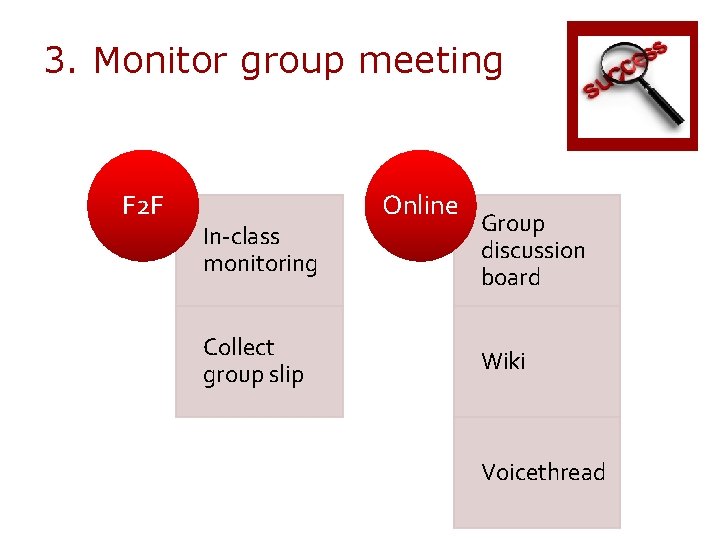
3. Monitor group meeting F 2 F In-class monitoring Collect group slip Online Group discussion board Wiki Voicethread
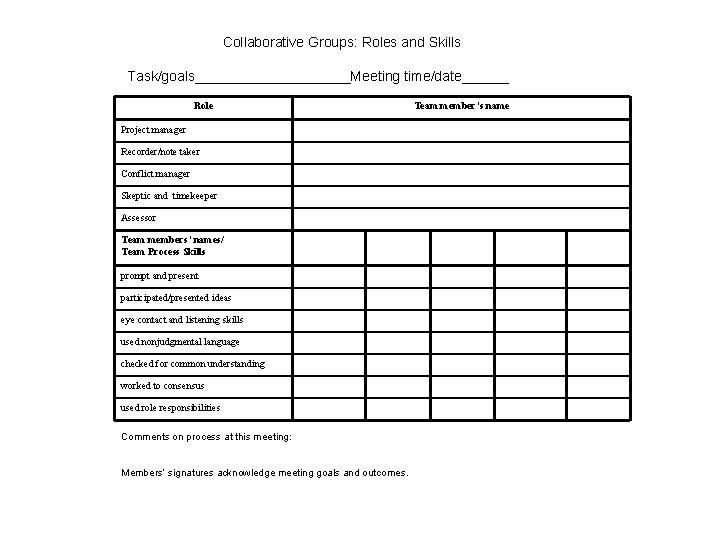
Collaborative Groups: Roles and Skills Task/goals__________Meeting time/date______ Role Project manager Recorder/note taker Conflict manager Skeptic and timekeeper Assessor Team members’ names/ Team Process Skills prompt and present participated/presented ideas eye contact and listening skills used nonjudgmental language checked for common understanding worked to consensus used role responsibilities Comments on process at this meeting: Members’ signatures acknowledge meeting goals and outcomes. Team member’s name
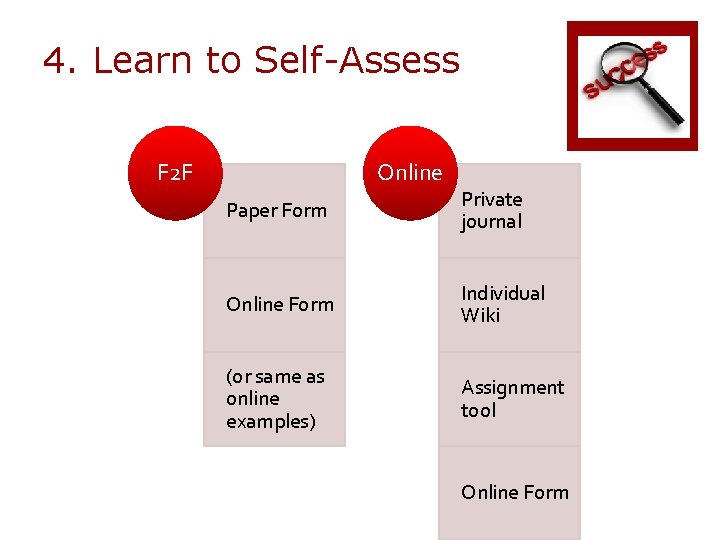
4. Learn to Self-Assess F 2 F Online Paper Form Private journal Online Form Individual Wiki (or same as online examples) Assignment tool Online Form
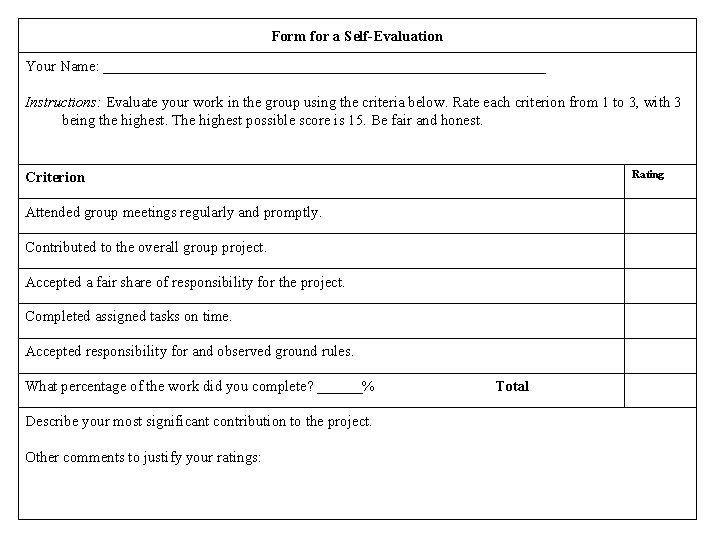
Form for a Self-Evaluation Your Name: ______________________________ Instructions: Evaluate your work in the group using the criteria below. Rate each criterion from 1 to 3, with 3 being the highest. The highest possible score is 15. Be fair and honest. Criterion Rating Attended group meetings regularly and promptly. Contributed to the overall group project. Accepted a fair share of responsibility for the project. Completed assigned tasks on time. Accepted responsibility for and observed ground rules. What percentage of the work did you complete? ______% Total Describe your most significant contribution to the project. Other comments to justify your ratings:
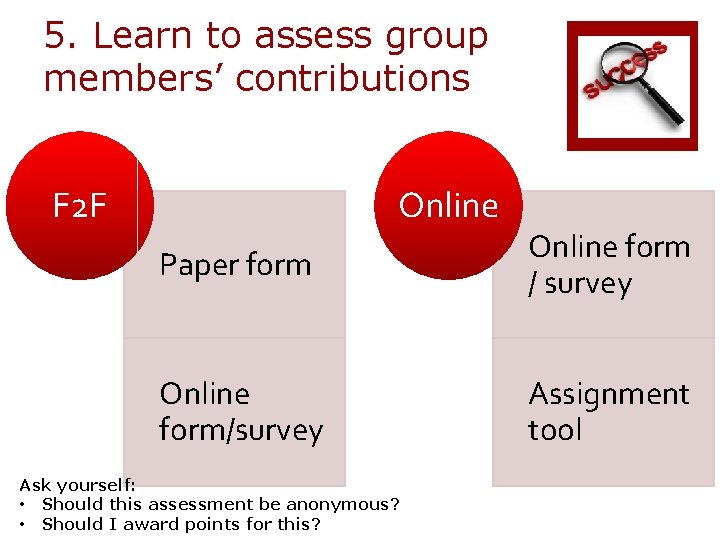
5. Learn to assess group members’ contributions F 2 F Online Paper form Online form / survey Online form/survey Assignment tool Ask yourself: • Should this assessment be anonymous? • Should I award points for this?
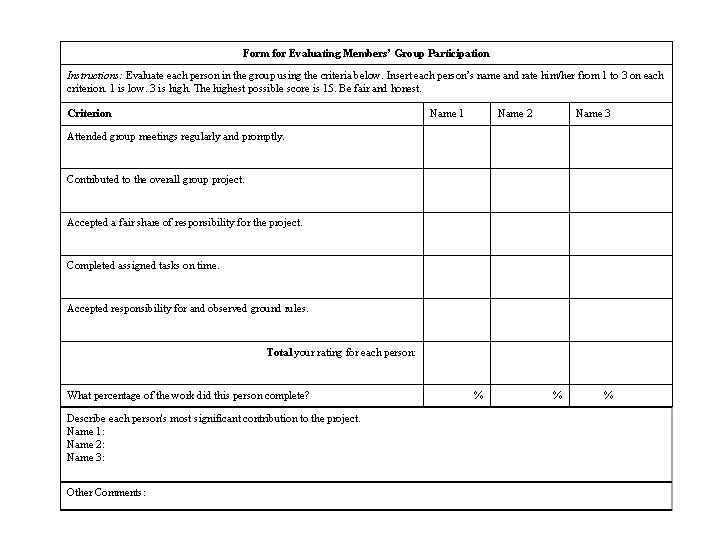
Form for Evaluating Members’ Group Participation Instructions: Evaluate each person in the group using the criteria below. Insert each person’s name and rate him/her from 1 to 3 on each criterion. 1 is low. 3 is high. The highest possible score is 15. Be fair and honest. Criterion Name 1 Name 2 Name 3 Attended group meetings regularly and promptly. Contributed to the overall group project. Accepted a fair share of responsibility for the project. Completed assigned tasks on time. Accepted responsibility for and observed ground rules. Total your rating for each person: What percentage of the work did this person complete? Describe each person's most significant contribution to the project. Name 1: Name 2: Name 3: Other Comments: % % %
6. Grading group projects § Each group member submits self-evaluation and evaluation of those in group AND § Your choice of these options: § § Shared Student Grade Group Average Grade Individual Grade Allocated Task Individual Grade Individual Report
Example 1: Online International Marketing ¡Undergraduate course with 120 students ¡Before the redesign: ¡ Instructor doing too much of the work ¡ All assessments were exams ¡ Class met in virtual meeting room; no asynchronous activities ¡Prompts for redesign: ¡ Students requesting more asynchronous activities ¡ Desire to improve DFW rates ¡ Wanted students to process more
Solution: Asynchronous Activities for Groups ¡ 5 Case studies ¡ 3 Current Issue Research Papers Logistics: ¡Groups of 4 -5 ¡Adaptive Release used to control access ¡Training in virtual session and embedded in the assignment ¡Strict Interim deadlines ¡Tools: Wikis, Voicethread
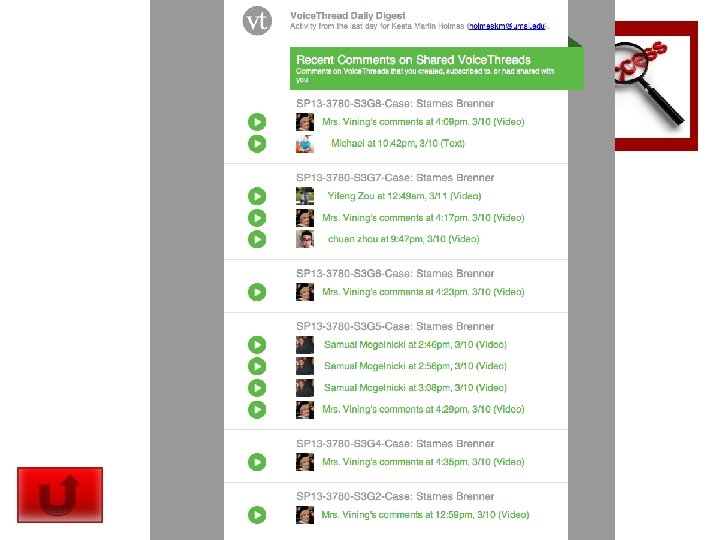
Solution: Asynchronous Activities for Groups Monitoring Student Participation ¡Wiki Revision History ¡Voicethread daily digests ¡Participation tracking spreadsheet Assessment ¡Shared group grade with deductions for students who didn’t participate
Example 2: Probation and Parole ¡Undergraduate course with 50 students ¡Prompts for redesign: ¡Desire to improve engagement; students complained about discussion boards ¡Desire to improve writing skills ¡Instructor spent too much time editing drafts and grading papers; didn’t have time for discussions
Solution: Critical Friends and Group Work ¡Case Studies ¡Video discussions ¡Response papers Logistics: ¡Groups of 2, then 4 (start small then grow) ¡Preparing students to be “critical friends” ¡Tools: Group tools, Voicethread, Wikis, Assignment Tool ¡Strict interim deadlines
6. Considering Options for Grading group projects § Each group member submits self-evaluation and evaluation of those in group AND § Your choice of these options: § § Shared Student Grade Group Average Grade Individual Grade Allocated Task Individual Grade Individual Report
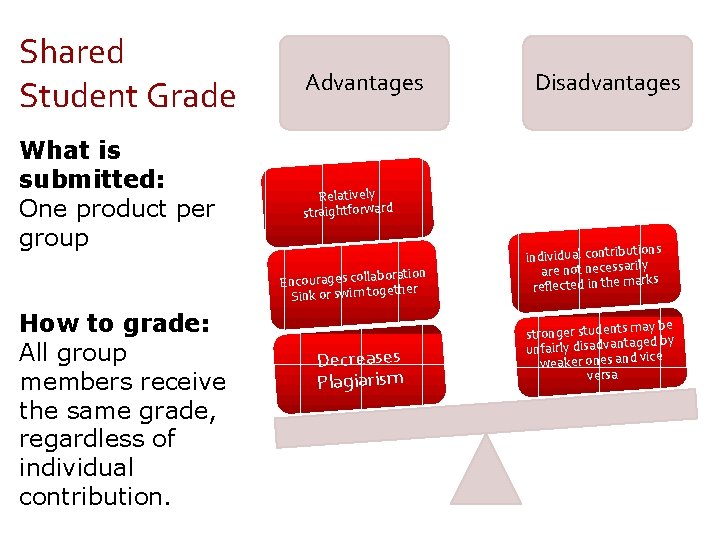
Shared Student Grade What is submitted: One product per group Advantages Relatively straightforward oration Encourages collab her Sink or swim toget How to grade: All group members receive the same grade, regardless of individual contribution. Disadvantages Decreases Plagiarism tions individual contribu are not necessarily arks reflected in the m may be stronger students ed by g unfairly disadvanta ce weaker ones and vi versa
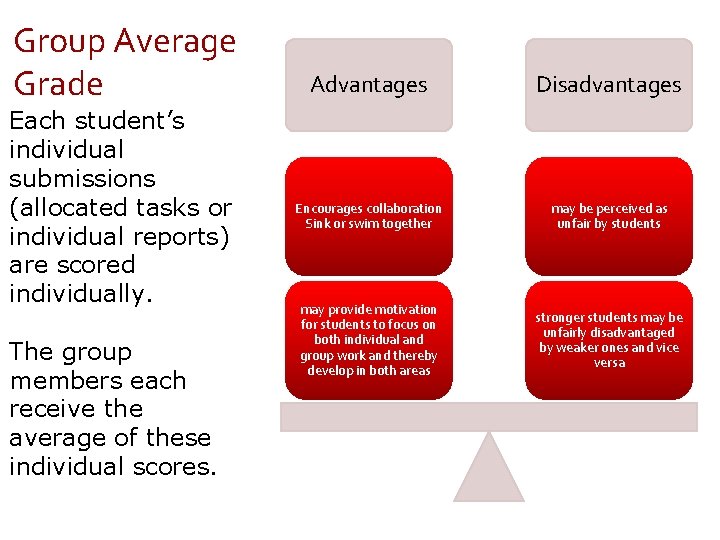
Group Average Grade Each student’s individual submissions (allocated tasks or individual reports) are scored individually. The group members each receive the average of these individual scores. Advantages Disadvantages Encourages collaboration Sink or swim together may be perceived as unfair by students may provide motivation for students to focus on both individual and group work and thereby develop in both areas stronger students may be unfairly disadvantaged by weaker ones and vice versa
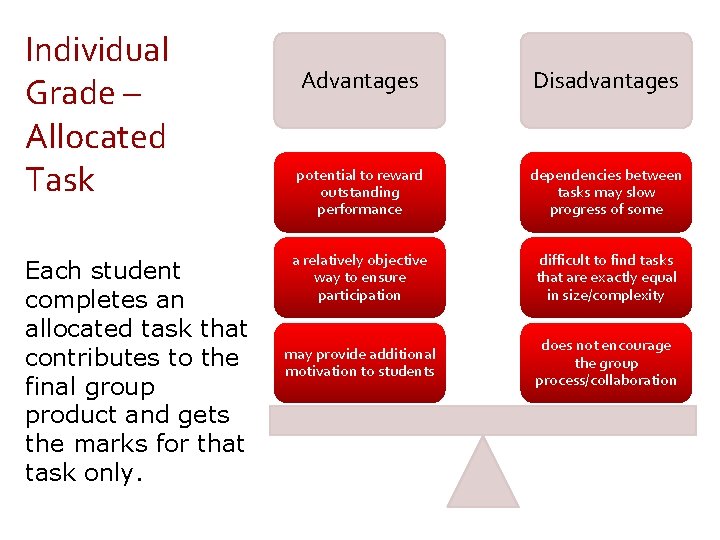
Individual Grade – Allocated Task Each student completes an allocated task that contributes to the final group product and gets the marks for that task only. Advantages Disadvantages potential to reward outstanding performance dependencies between tasks may slow progress of some a relatively objective way to ensure participation difficult to find tasks that are exactly equal in size/complexity may provide additional motivation to students does not encourage the group process/collaboration
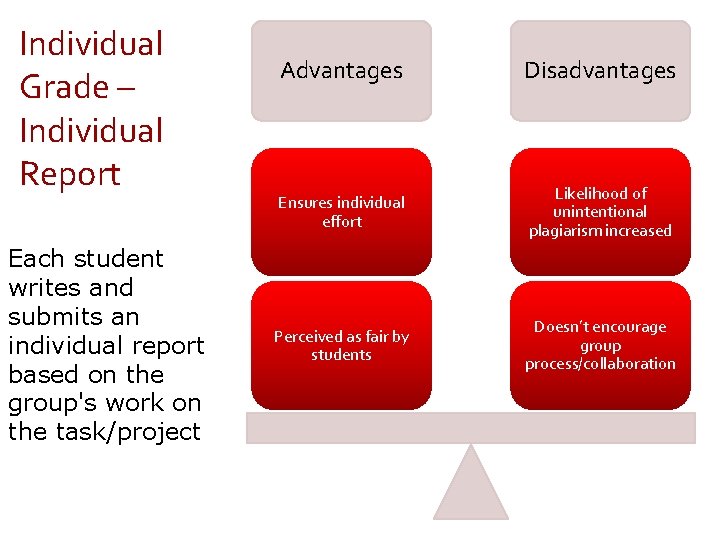
Individual Grade – Individual Report Each student writes and submits an individual report based on the group's work on the task/project Advantages Disadvantages Ensures individual effort Likelihood of unintentional plagiarism increased Perceived as fair by students Doesn’t encourage group process/collaboration
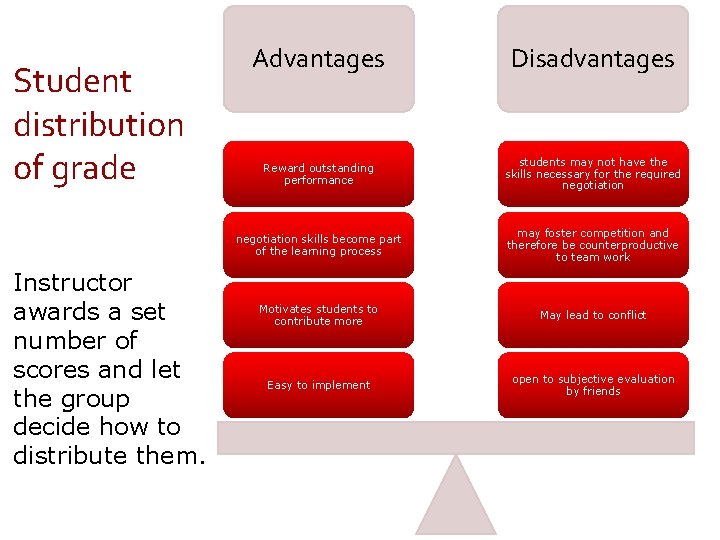
Student distribution of grade Instructor awards a set number of scores and let the group decide how to distribute them. Advantages Disadvantages Reward outstanding performance students may not have the skills necessary for the required negotiation skills become part of the learning process may foster competition and therefore be counterproductive to team work Motivates students to contribute more May lead to conflict Easy to implement open to subjective evaluation by friends
In summary ¡“If you think you understand something …apply it …teach it to a peer” ¡Learn group skills as learn course content ¡Include as course & project objectives ¡Emphasize learning for learning (not credits) ¡Explain relevance of learning collaborative behaviors for profession ¡Role of teamwork in program and profession ¡Alert colleagues, chair to innovation pilots
References Banta, T. & Kuh, G. (March/April 1998). A missing link in assessment: collaboration between academic affairs and student affairs professionals, Change, 40 -46. Chickering, A. W. & Gamson, Z. F. (1987). Seven principles for good practice in undergraduate education. AAHE Bulletin, 39(7), 3 -7. Chickering, A. W. & Ehrmann, S. C. (1996) Implementing the seven principles: Technology as lever. AAHE Bulletin, 49(2), 3 -7 Millis, B. J. (2010). Cooperative learning in higher education: Across the disciplines, across the academy. Sterling, VA: Stylus. National Survey of Student Engagement: http: //nsse. iub. edu/index. cfm Pascarella, E. T. & Terenzini, P. T. (2005) How College Affects Students: A Third Decade of Research. San Francisco: Jossey. Bass. Pascarella, E. T. & Terenzini, P. T. (1991) How College Affects Students: Findings and Insights from Twenty Years of Research. San Francisco: Jossey-Bass. Weimer, Maryellen. (2002) Learner-Centered Teaching. San Francisco: Jossey-Bass. Winchester-Seeto, T. (April, 2002). Assessment of collaborative work – collaboration versus assessment. Invited paper presented at the Annual Uniserve Science Symposium, The University of Sydney.


Thank you We’re happy to send these copies electronically. Send request to holmeskm@umsl. edu
- Slides: 37