
Defining Program Syntax bisonized by Jeffery Chapter Two

Defining Program Syntax bisonized by Jeffery Chapter Two Modern Programming Languages, 2 nd ed. 1
Lexical, Syntax and Semantics Lexical analysis: words and punctuation notation: regular expressions Syntax: “look”, form/structure notation: context free grammar Semantics: what programs do, their behavior and meaning Chapter Two no easy notation—more on this in Chapter 23 Modern Programming Languages, 2 nd ed. 2
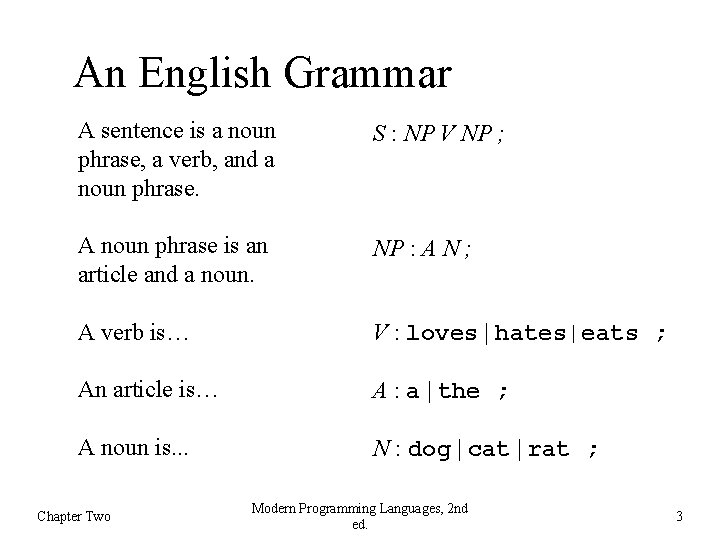
An English Grammar A sentence is a noun phrase, a verb, and a noun phrase. S : NP V NP ; A noun phrase is an article and a noun. NP : A N ; A verb is… V : loves | hates|eats ; An article is… A : a | the ; A noun is. . . N : dog | cat | rat ; Chapter Two Modern Programming Languages, 2 nd ed. 3
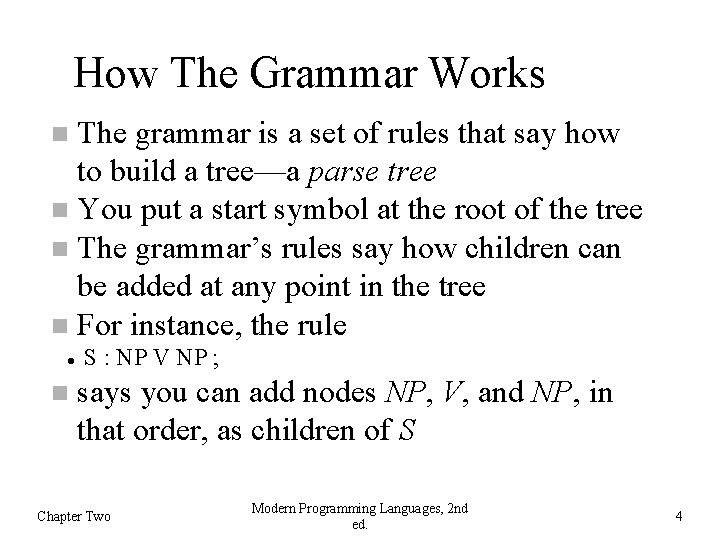
How The Grammar Works The grammar is a set of rules that say how to build a tree—a parse tree You put a start symbol at the root of the tree The grammar’s rules say how children can be added at any point in the tree For instance, the rule S : NP V NP ; says you can add nodes NP, V, and NP, in that order, as children of S Chapter Two Modern Programming Languages, 2 nd ed. 4
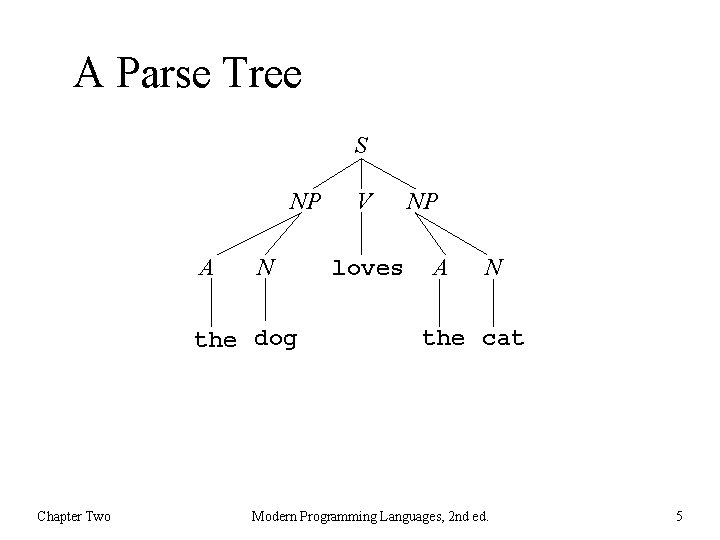
A Parse Tree S NP A N the dog Chapter Two V loves NP A N the cat Modern Programming Languages, 2 nd ed. 5
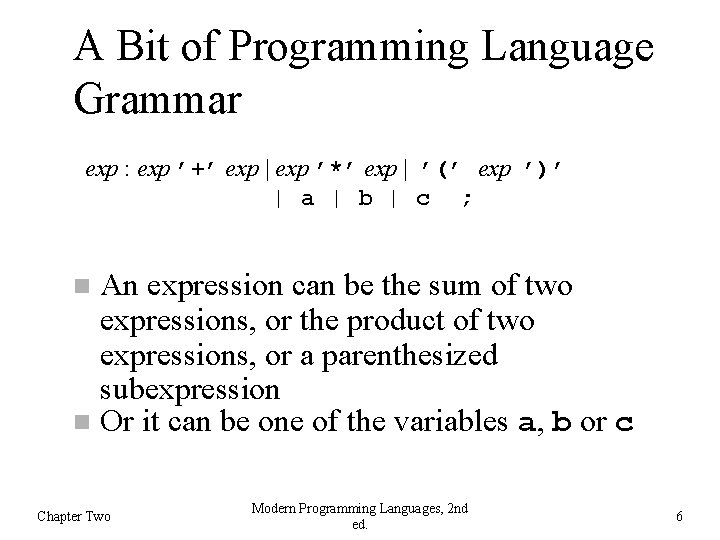
A Bit of Programming Language Grammar exp : exp ’+’ exp | exp ’*’ exp | ’(’ exp ’)’ | a | b | c ; An expression can be the sum of two expressions, or the product of two expressions, or a parenthesized subexpression Or it can be one of the variables a, b or c Chapter Two Modern Programming Languages, 2 nd ed. 6
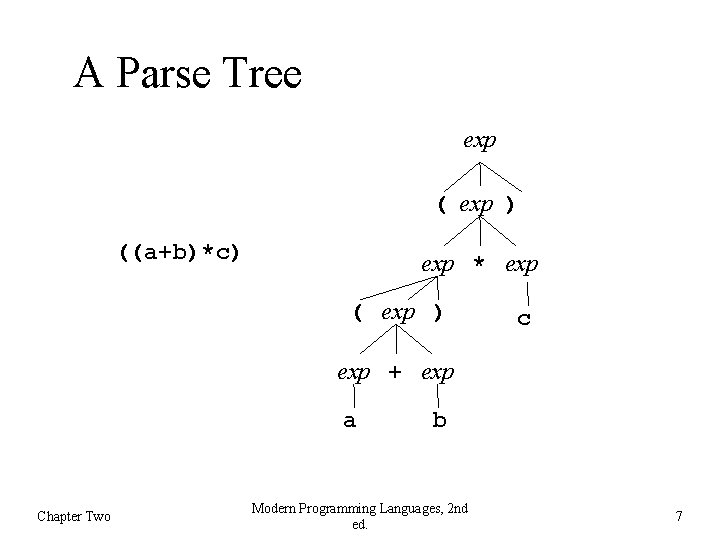
A Parse Tree exp ( exp ) ((a+b)*c) exp * exp ( exp ) c exp + exp a Chapter Two b Modern Programming Languages, 2 nd ed. 7
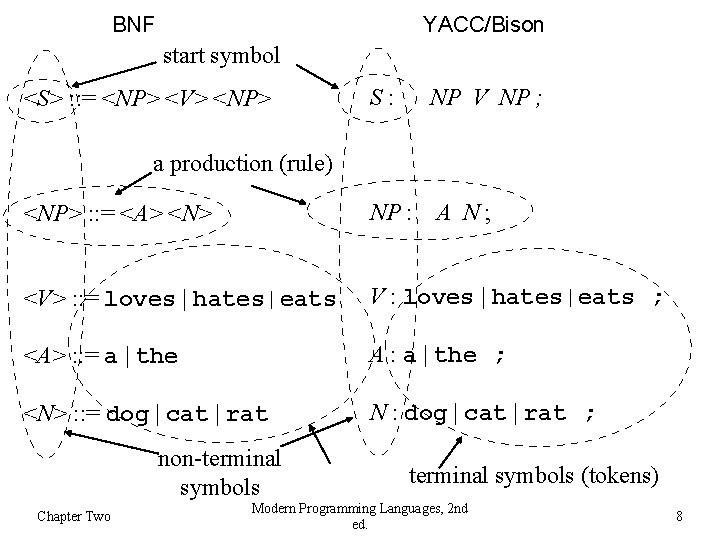
BNF YACC/Bison start symbol <S> : : = <NP> <V> <NP> S: NP V NP ; a production (rule) <NP> : : = <A> <N> NP : A N ; <V> : : = loves | hates|eats V : loves | hates|eats ; <A> : : = a | the A : a | the ; <N> : : = dog | cat | rat N : dog | cat | rat ; non-terminal symbols Chapter Two terminal symbols (tokens) Modern Programming Languages, 2 nd ed. 8
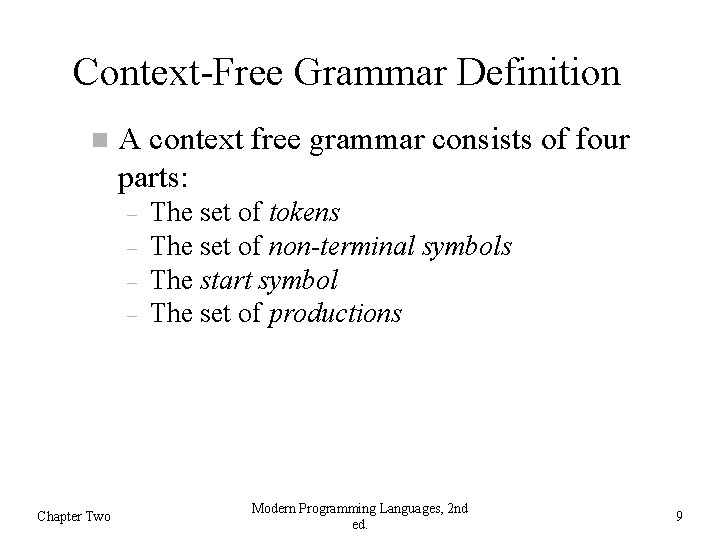
Context-Free Grammar Definition A context free grammar consists of four parts: Chapter Two The set of tokens The set of non-terminal symbols The start symbol The set of productions Modern Programming Languages, 2 nd ed. 9
Definition, Continued The tokens are the smallest units of syntax The non-terminal symbols stand for larger pieces of syntax Strings of one or more characters of program text They are atomic: not treated as being composed from smaller parts They are strings enclosed in angle brackets, as in <NP> They are not strings that occur literally in program text The grammar says how they can be expanded into strings of tokens The start symbol is the particular non-terminal that forms the root of any parse tree for the grammar Chapter Two Modern Programming Languages, 2 nd ed. 10
Definition, Continued The productions are the tree-building rules Each one has a left-hand side, the separator : , and a right-hand side The left-hand side is a single non-terminal The right-hand side is a sequence of zero or more things, each of which can be either a token or a nonterminal A production permits the non-terminal symbol on the left-hand side to have things on the righthand side, in order, as its children in a parse tree Chapter Two Modern Programming Languages, 2 nd ed. 11
Alternatives When there is more than one production with the same left-hand side, an abbreviated form can be used The grammar can give the left-hand side, the separator : , and then a list of possible righthand sides separated by the special symbol | Chapter Two Modern Programming Languages, 2 nd ed. 12
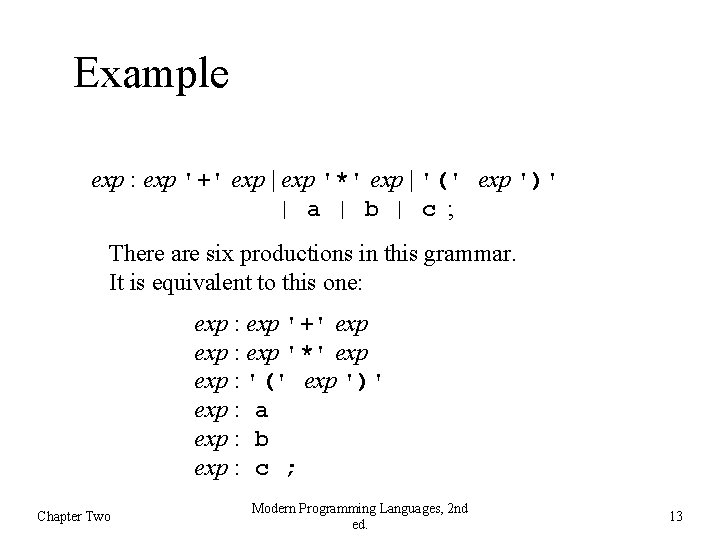
Example exp : exp '+' exp | exp '*' exp | '(' exp ')' | a | b | c ; There are six productions in this grammar. It is equivalent to this one: exp '+' exp : exp '*' exp : '(' exp ')' exp : a exp : b exp : c ; Chapter Two Modern Programming Languages, 2 nd ed. 13
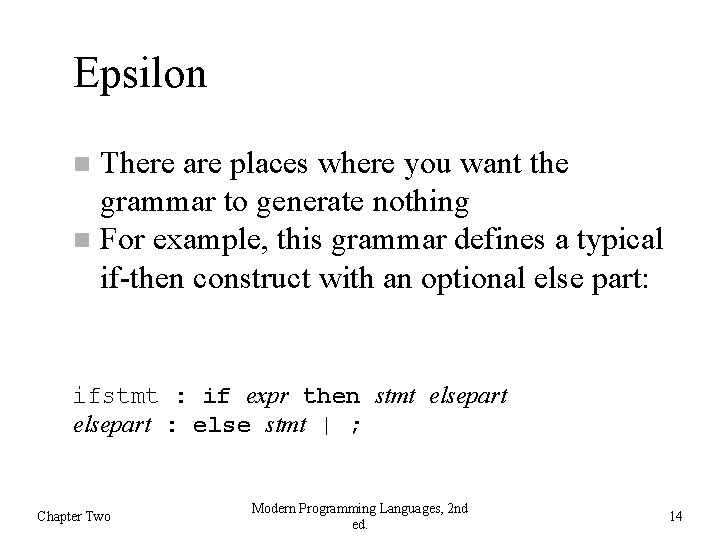
Epsilon There are places where you want the grammar to generate nothing For example, this grammar defines a typical if-then construct with an optional else part: ifstmt : if expr then stmt elsepart : else stmt | ; Chapter Two Modern Programming Languages, 2 nd ed. 14
Parse Trees To build a parse tree, put the start symbol at the root Add children to every non-terminal, following any one of the productions for that non-terminal in the grammar Done when all the leaves are tokens Read off leaves from left to right—that is the string derived by the tree Chapter Two Modern Programming Languages, 2 nd ed. 15
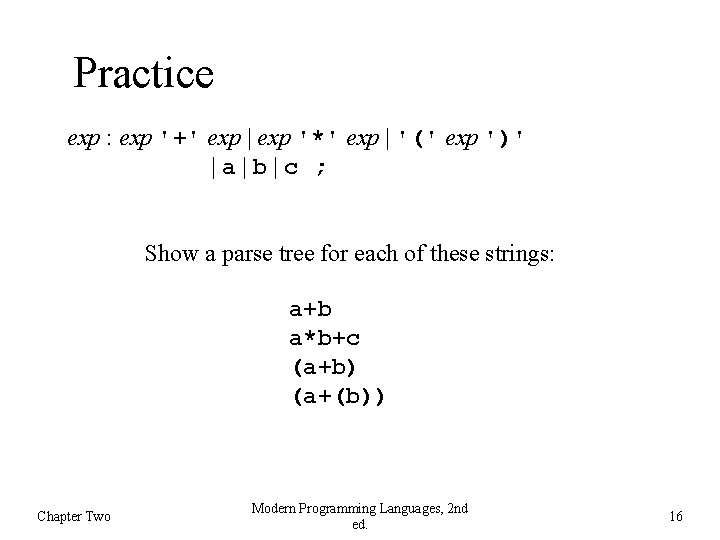
Practice exp : exp '+' exp | exp '*' exp | '(' exp ')' |a|b|c ; Show a parse tree for each of these strings: a+b a*b+c (a+b) (a+(b)) Chapter Two Modern Programming Languages, 2 nd ed. 16
Compiler Note What we just did is parsing: trying to find a parse tree for a given string That’s what compilers do for every program you try to compile: try to build a parse tree for your program, using the grammar for whatever language you used Take a course in compiler construction to learn about algorithms for doing this efficiently Chapter Two Modern Programming Languages, 2 nd ed. 17
Language Definition We use grammars to define the syntax of programming languages The language defined by a grammar is the set of all strings that can be derived by some parse tree for the grammar As in the previous example, that set is often infinite (though grammars are finite) Constructing grammars is a little like programming. . . Chapter Two Modern Programming Languages, 2 nd ed. 18
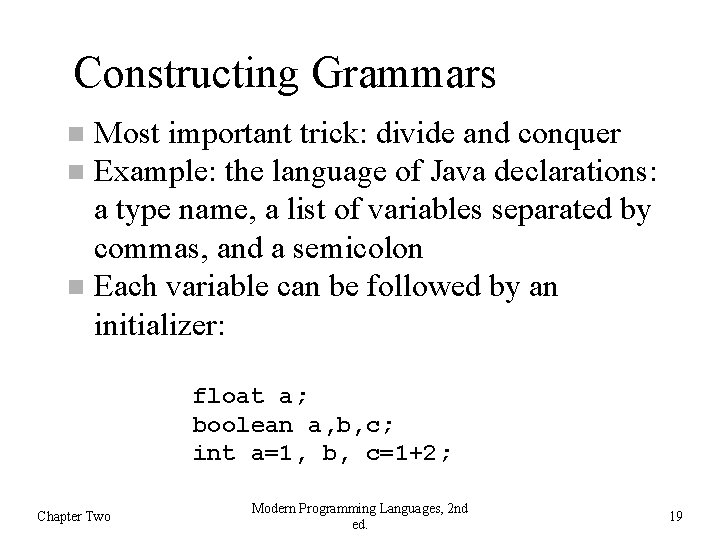
Constructing Grammars Most important trick: divide and conquer Example: the language of Java declarations: a type name, a list of variables separated by commas, and a semicolon Each variable can be followed by an initializer: float a; boolean a, b, c; int a=1, b, c=1+2; Chapter Two Modern Programming Languages, 2 nd ed. 19
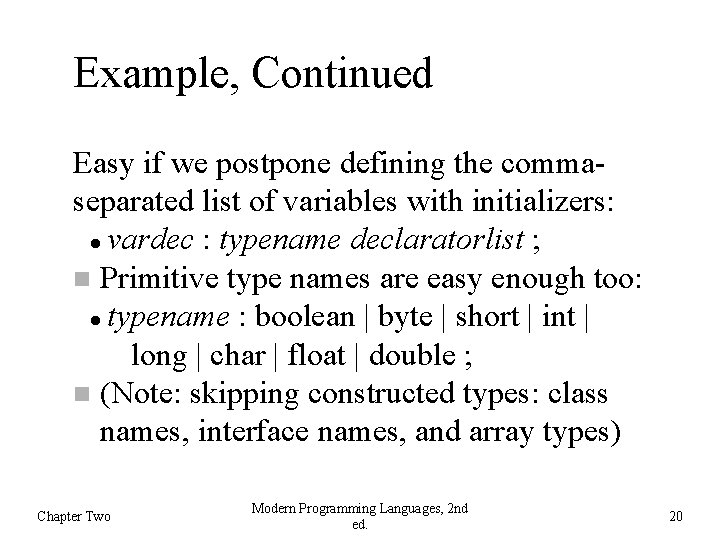
Example, Continued Easy if we postpone defining the commaseparated list of variables with initializers: vardec : typename declaratorlist ; Primitive type names are easy enough too: typename : boolean | byte | short | int | long | char | float | double ; (Note: skipping constructed types: class names, interface names, and array types) Chapter Two Modern Programming Languages, 2 nd ed. 20
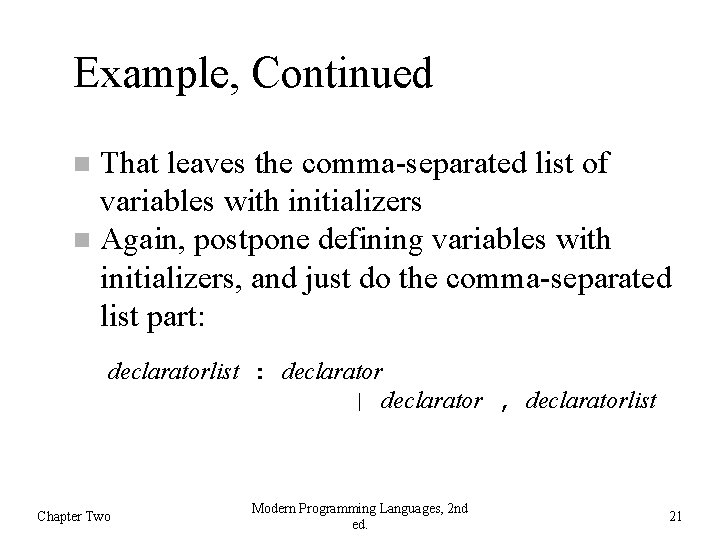
Example, Continued That leaves the comma-separated list of variables with initializers Again, postpone defining variables with initializers, and just do the comma-separated list part: declaratorlist : declarator | declarator , declaratorlist Chapter Two Modern Programming Languages, 2 nd ed. 21
Example, Continued That leaves the variables with initializers: declarator : variablename | variablename '=' expr ; For full Java, we would need to allow pairs of square brackets after the variable name There is also a syntax for array initializers And definitions for variablename and expr Chapter Two Modern Programming Languages, 2 nd ed. 22
Where Do Tokens Come From? Tokens are pieces of program text that we do not wish to think of as being built from smaller pieces Identifiers (count), keywords (if), operators (==), constants (123. 4), etc. Programs stored in files are just sequences of characters How is such a file divided into a sequence of tokens? Chapter Two Modern Programming Languages, 2 nd ed. 23
Lexical Structure And Phrase Structure Grammars so far have defined phrase structure: how a program is built from a sequence of tokens We also need to define lexical structure: how a text file is divided into tokens Chapter Two Modern Programming Languages, 2 nd ed. 24
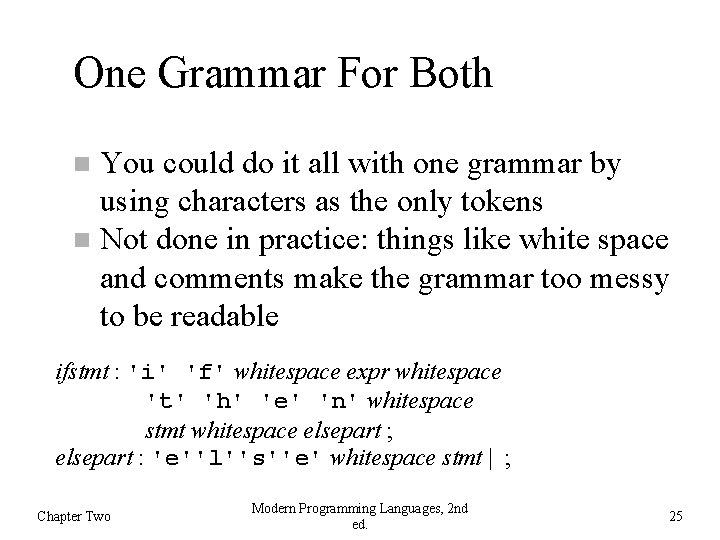
One Grammar For Both You could do it all with one grammar by using characters as the only tokens Not done in practice: things like white space and comments make the grammar too messy to be readable ifstmt : 'i' 'f' whitespace expr whitespace 't' 'h' 'e' 'n' whitespace stmt whitespace elsepart ; elsepart : 'e''l''s''e' whitespace stmt | ; Chapter Two Modern Programming Languages, 2 nd ed. 25
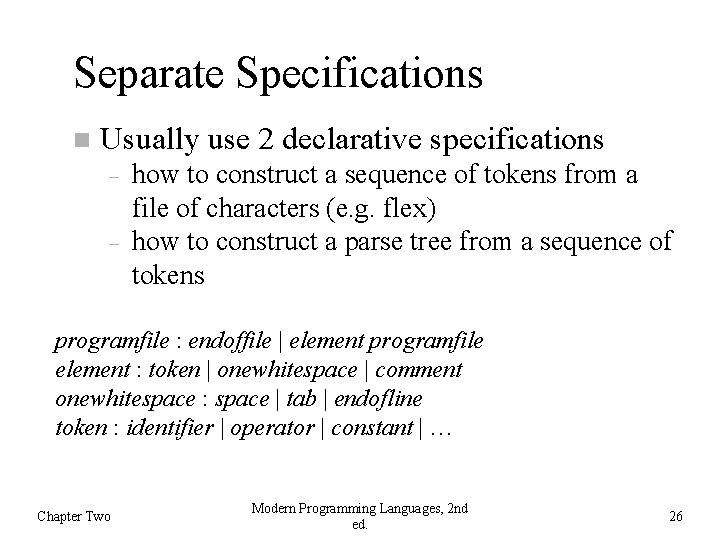
Separate Specifications Usually use 2 declarative specifications how to construct a sequence of tokens from a file of characters (e. g. flex) how to construct a parse tree from a sequence of tokens programfile : endoffile | element programfile element : token | onewhitespace | comment onewhitespace : space | tab | endofline token : identifier | operator | constant | … Chapter Two Modern Programming Languages, 2 nd ed. 26
Separate Compiler Phases The scanner reads the input file and divides it into tokens The scanner discards white space and comments The parser constructs a parse tree from the token stream according to the grammar Chapter Two Modern Programming Languages, 2 nd ed. 27
Historical Note #1 Early languages sometimes did not separate lexical structure from phrase structure Early Fortran and Algol dialects allowed spaces anywhere, even in the middle of a keyword Other languages like PL/I allow keywords to be used as identifiers This makes them harder to scan and parse It also reduces readability Chapter Two Modern Programming Languages, 2 nd ed. 28
Historical Note #2 Some languages have a fixed-format lexical structure—column positions are significant One statement per line (i. e. per card) First few columns for statement label, etc. Ancient Fortran, Cobol, Basic; Python Most modern languages are free-format: column positions are ignored Chapter Two Modern Programming Languages, 2 nd ed. 29
Other Grammar Notations We saw BNF and Yacc notation There also more BNF variations EBNF Syntax diagrams Chapter Two Modern Programming Languages, 2 nd ed. 30
BNF Variations Some use or = instead of : : = Some leave out the angle brackets and use a distinct typeface for tokens Some allow single quotes around tokens, for example to distinguish ‘|’ as a token from | as a meta-symbol Chapter Two Modern Programming Languages, 2 nd ed. 31
EBNF Variations Additional syntax to simplify some grammar chores: Chapter Two {x} to mean zero or more repetitions of x [x] to mean x is optional (i. e. x | <empty>) () for grouping | anywhere to mean a choice among alternatives Quotes around tokens, if necessary, to distinguish from all these meta-symbols Modern Programming Languages, 2 nd ed. 32
![EBNF Examples <if-stmt> : : = if <expr> then <stmt> [else <stmt>] <stmt-list> :](http://slidetodoc.com/presentation_image/26cd56fbbaca24a160e0c4410d22c451/image-33.jpg "EBNF Examples <if-stmt> : : = if <expr> then <stmt> [else <stmt>] <stmt-list> :")
EBNF Examples <if-stmt> : : = if <expr> then <stmt> [else <stmt>] <stmt-list> : : = {<stmt> ; } <thing-list> : : = { (<stmt> | <declaration>) ; } <mystery 1> : : = a[1] <mystery 2> : : = ‘a[1]’ Anything that extends BNF this way is called an Extended BNF: EBNF There are many variations Chapter Two Modern Programming Languages, 2 nd ed. 33
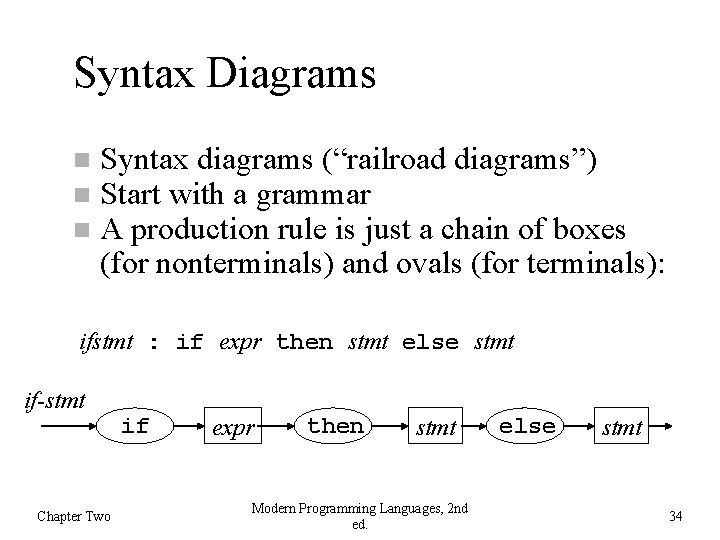
Syntax Diagrams Syntax diagrams (“railroad diagrams”) Start with a grammar A production rule is just a chain of boxes (for nonterminals) and ovals (for terminals): ifstmt : if expr then stmt else stmt if-stmt Chapter Two if expr then stmt Modern Programming Languages, 2 nd ed. else stmt 34
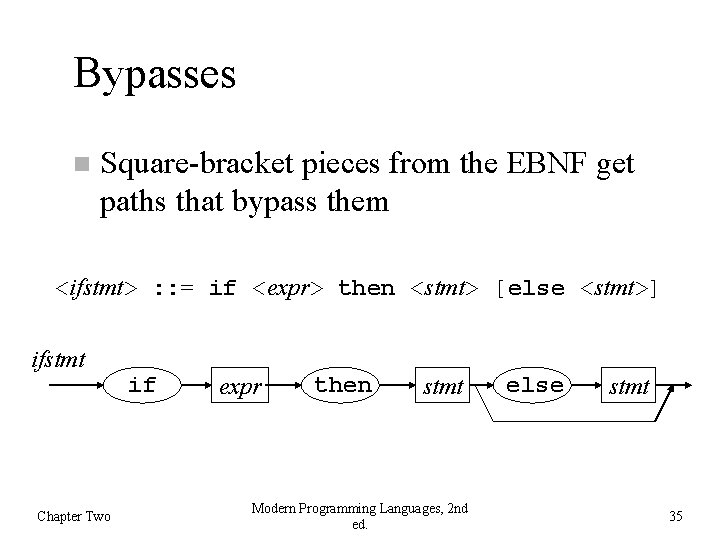
Bypasses Square-bracket pieces from the EBNF get paths that bypass them <ifstmt> : : = if <expr> then <stmt> [else <stmt>] ifstmt Chapter Two if expr then stmt Modern Programming Languages, 2 nd ed. else stmt 35
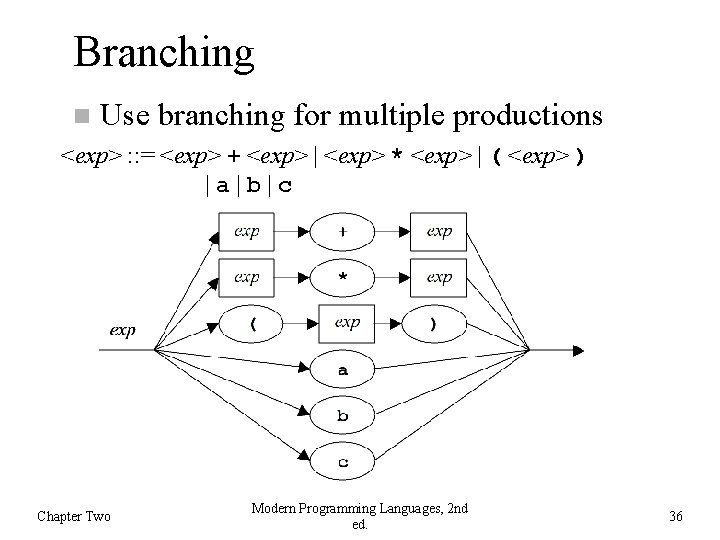
Branching Use branching for multiple productions <exp> : : = <exp> + <exp> | <exp> * <exp> | ( <exp> ) |a|b|c Chapter Two Modern Programming Languages, 2 nd ed. 36
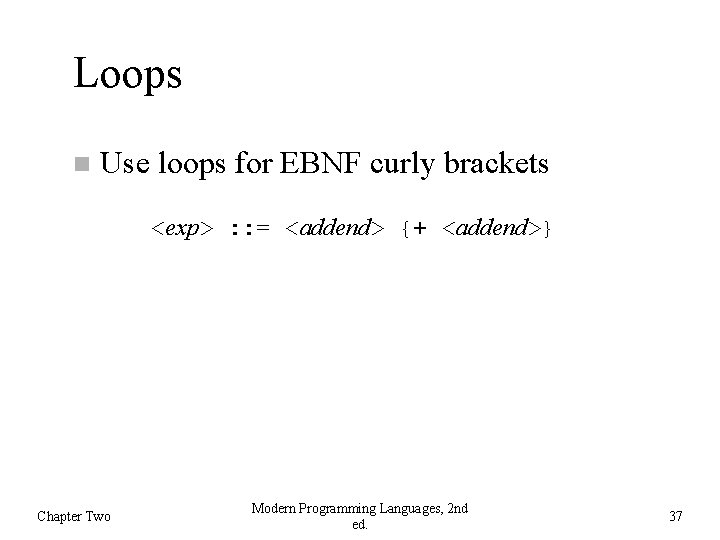
Loops Use loops for EBNF curly brackets <exp> : : = <addend> {+ <addend>} Chapter Two Modern Programming Languages, 2 nd ed. 37
Syntax Diagrams, Pro and Con Easy to read casually Harder to read precisely: what will the parse tree look like? Harder to make machine readable (for automatic parser-generators) Chapter Two Modern Programming Languages, 2 nd ed. 38
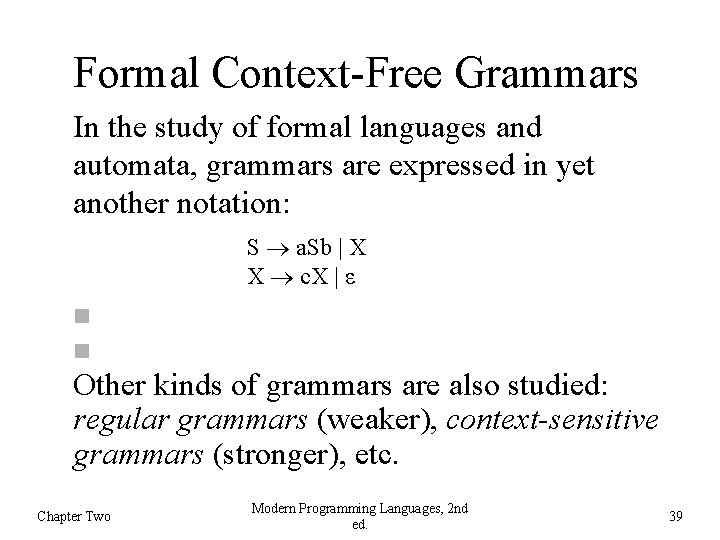
Formal Context-Free Grammars In the study of formal languages and automata, grammars are expressed in yet another notation: S a. Sb | X X c. X | ε Other kinds of grammars are also studied: regular grammars (weaker), context-sensitive grammars (stronger), etc. Chapter Two Modern Programming Languages, 2 nd ed. 39
Many Other Variations BNF and EBNF ideas are widely used Exact notation differs, in spite of occasional efforts to get uniformity But as long as you understand the ideas, differences in notation are easy to pick up Chapter Two Modern Programming Languages, 2 nd ed. 40
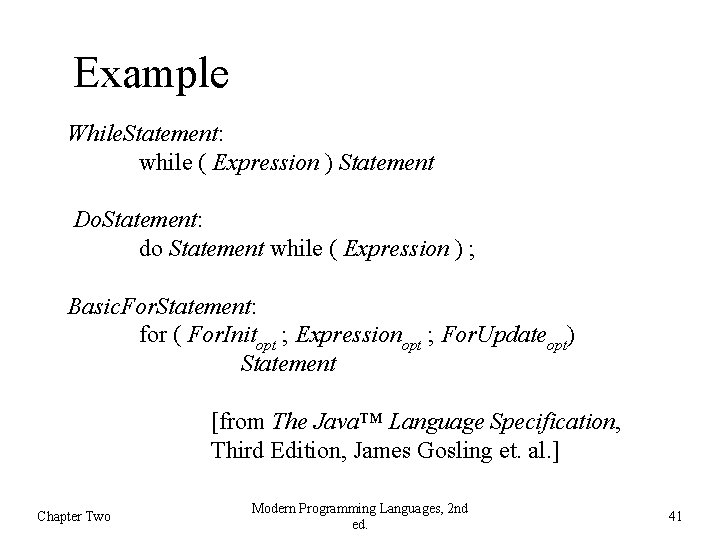
Example While. Statement: while ( Expression ) Statement Do. Statement: do Statement while ( Expression ) ; Basic. For. Statement: for ( For. Initopt ; Expressionopt ; For. Updateopt) Statement [from The Java™ Language Specification, Third Edition, James Gosling et. al. ] Chapter Two Modern Programming Languages, 2 nd ed. 41
Conclusion We use grammars to define programming language syntax, both lexical structure and phrase structure Connection between theory and practice Chapter Two grammars, two compiler passes Parser-generators can write code for those two passes automatically from grammars Modern Programming Languages, 2 nd ed. 42
Conclusion, Continued Multiple audiences for a grammar Chapter Two Novices want to find out what legal programs look like Experts want an exact, detailed definition Tools—parser and scanner generators—require an exact, detailed definition in a particular, machine-readable form Modern Programming Languages, 2 nd ed. 43
- Slides: 43