
Defining Measuring the Middle Class Steven Pressman Monmouth




- Slides: 18
Defining & Measuring the Middle Class Steven Pressman Monmouth University and Colorado State University pressman@monmouth. edu
2
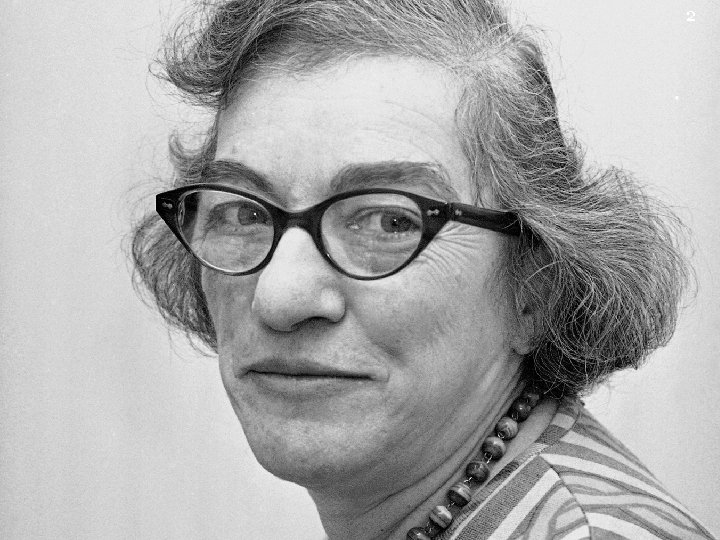
3 MOLLIE ORSHANSKY • B. A. , Hunter College, 1935, in math & statistics; graduate work at American University in economics & statistics • 1939, research assistant at US Children’s Bureau, worked on children’s health & nutrition • 1942, statistician for NYC Department of Health • 1945, U. S. Department of Agriculture, working on family consumption & living standards. She soon became their Senior Food Economist, collecting & analyzing data on food consumption • 1958, Social Security Administration expert on income adequacy • Dec. 1962, President Kennedy asked Walter Heller, chair of CEA to get poverty statistics. • 1963, developed US definition of poverty • 1965, OEO adopted her measure • 1969, Bureau of Budget directed all Federal agencies to use this measure to determine eligibility for federal programs
4 SOME APPROACHES TO DEFINING THE MIDDLE CLASS • Percentage around median income • Middle Three Income Quintiles- look at what % of total income they get • Robert Putnam, Our Kids- households where no parent has a college degree but some education beyond high school • Thomas Piketty, Capital in the Twenty-First Century—look at wealth distribution • Ask people if they are middle class & use average income of those who say they are middle class (Pew)
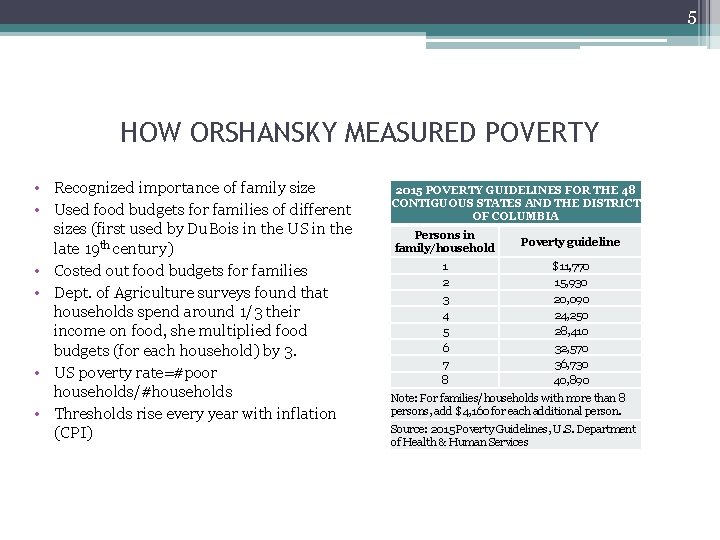
5 HOW ORSHANSKY MEASURED POVERTY • Recognized importance of family size • Used food budgets for families of different sizes (first used by Du. Bois in the US in the late 19 th century) • Costed out food budgets for families • Dept. of Agriculture surveys found that households spend around 1/3 their income on food, she multiplied food budgets (for each household) by 3. • US poverty rate=#poor households/#households • Thresholds rise every year with inflation (CPI) 2015 POVERTY GUIDELINES FOR THE 48 CONTIGUOUS STATES AND THE DISTRICT OF COLUMBIA Persons in family/household Poverty guideline 1 2 3 4 5 6 7 8 $11, 770 15, 930 20, 090 24, 250 28, 410 32, 570 36, 730 40, 890 Note: For families/households with more than 8 persons, add $4, 160 for each additional person. Source: 2015 Poverty Guidelines, U. S. Department of Health & Human Services
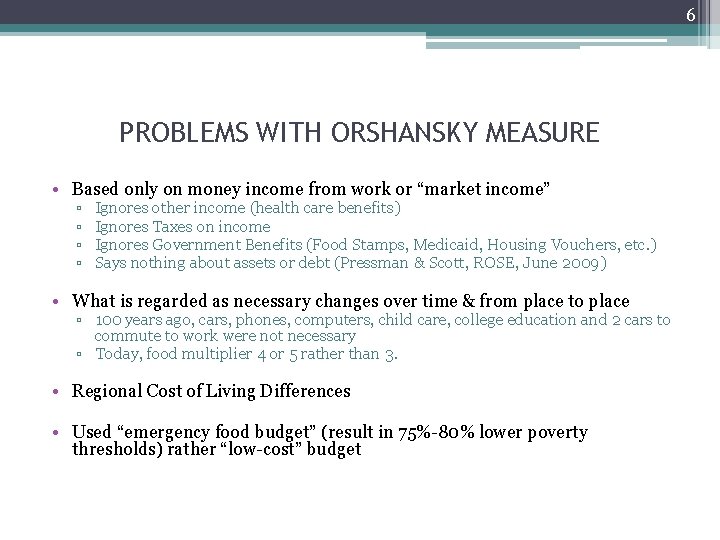
6 PROBLEMS WITH ORSHANSKY MEASURE • Based only on money income from work or “market income” ▫ ▫ Ignores other income (health care benefits) Ignores Taxes on income Ignores Government Benefits (Food Stamps, Medicaid, Housing Vouchers, etc. ) Says nothing about assets or debt (Pressman & Scott, ROSE, June 2009) • What is regarded as necessary changes over time & from place to place ▫ 100 years ago, cars, phones, computers, child care, college education and 2 cars to commute to work were not necessary ▫ Today, food multiplier 4 or 5 rather than 3. • Regional Cost of Living Differences • Used “emergency food budget” (result in 75%-80% lower poverty thresholds) rather “low-cost” budget
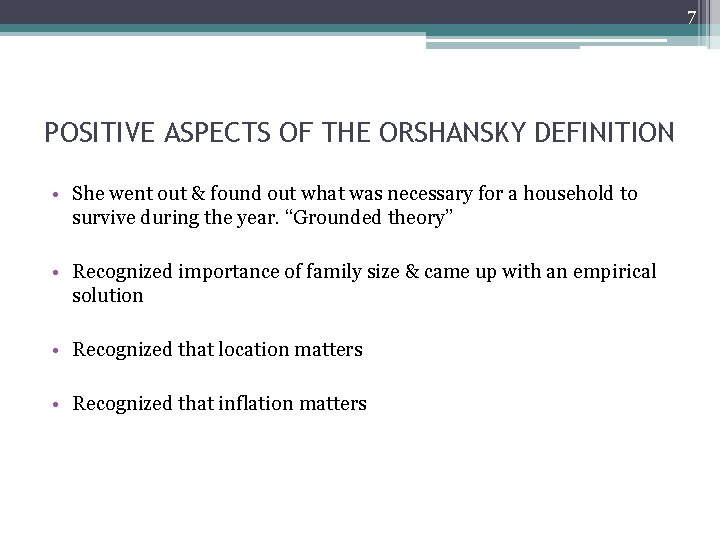
7 POSITIVE ASPECTS OF THE ORSHANSKY DEFINITION • She went out & found out what was necessary for a household to survive during the year. “Grounded theory” • Recognized importance of family size & came up with an empirical solution • Recognized that location matters • Recognized that inflation matters
8 WHY THE MIDDLE CLASS MATTERS • ECONOMIC REASONS ▫ Their income & spending are main determinants of economic growth ▫ Productivity growth suffers • POLITICAL REASONS ▫ Voting increases ▫ Aristotle (Politics, Book IV) noted that communities with a large middle class would be dominated by neither the rich nor the poor & will be better run as a result ▫ Lipset (1959) Hypothesis- a large middle class penalizes extremists & sustains democracy • PSYCHOLOGICAL or HEALTH REASONS ▫ Inequality leads to stress and to health problems (Wilkinson & Pickett, 2011)
9 WHO IS MIDDLE CLASS- A 5 STEP PROGRAM • Take median household income for a family of 4 (surveys and estimates of household wealth in 2010 found a middle-class income for a family of four was $68, 000+, close to the median for a family of four • Find median household disposable income • Middle class those 4 -member households with disposable income between 67% & 200% of the median (Pew Research Center) • For households of other sizes, use the Orshansky adjustments & repeat. • % middle class = % all households that are middle class
10 AN ADDITIONAL PROBLEM • DOWNWARD MOBILITY During the Great Recession median household income fell. Households may still be counted as middle class, even after experiencing a 5% drop in disposable income, because the median also dropped.
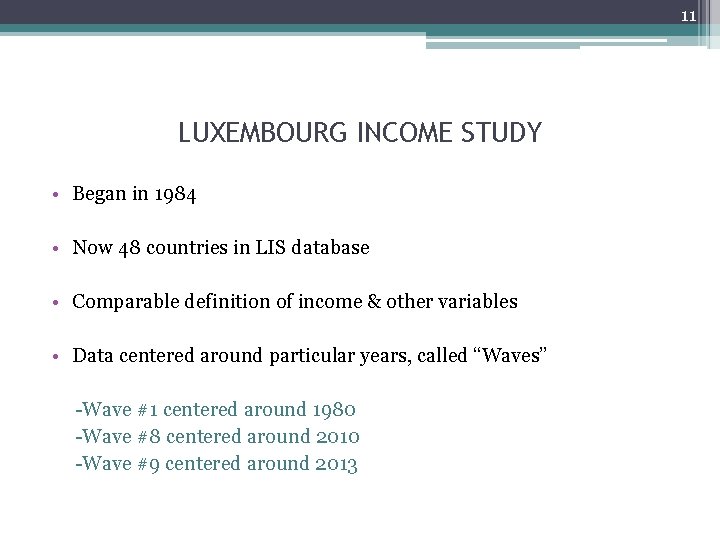
11 LUXEMBOURG INCOME STUDY • Began in 1984 • Now 48 countries in LIS database • Comparable definition of income & other variables • Data centered around particular years, called “Waves” -Wave #1 centered around 1980 -Wave #8 centered around 2010 -Wave #9 centered around 2013
12 MIDDLE-CLASS INCOME LEVELS (US 2013) HOUSEHOLD SIZE INCOME RANGE (Household Income) 1 $28, 569 -$85, 281 2 $37, 140 -$110, 865 3 $45, 710 -$136, 449 4 $54, 281 -$162, 033 5 $62, 852 -$187, 617 6 $71, 422 -$213, 201 7 $79, 993 -$238, 786 8 $88, 564 -$264, 370 9+ $97, 135 -$289, 954 Source: Luxembourg Income Study Database
13 US MIDDLE CLASS OVER TIME % Middle Class 59% 57% 55% 2004, 53. 5% 53. 1% 2010, 52. 2% 2013, 51. 1% 51. 0% 50. 0% 49% 47% 45% 1970 1975 1980 1985 Adjusted 1990 1995 Unadjusted 2000 2005 2010 2015
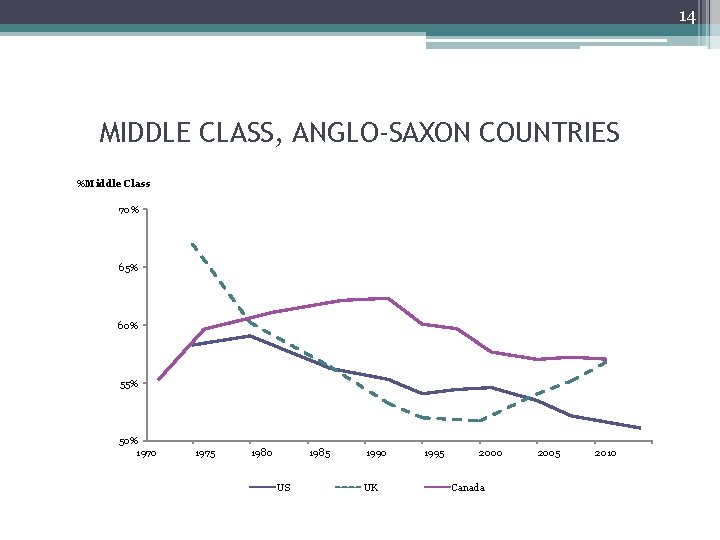
14 MIDDLE CLASS, ANGLO-SAXON COUNTRIES %Middle Class 70% 65% 60% 55% 50% 1970 1975 1980 1985 US 1990 UK 1995 2000 Canada 2005 2010
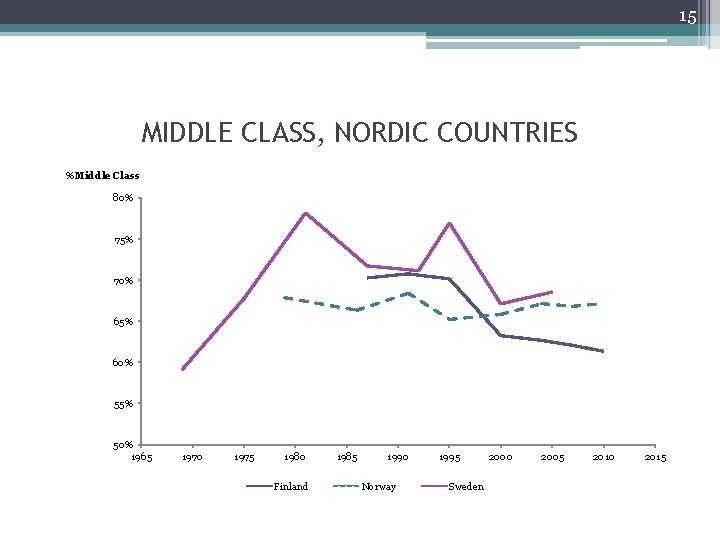
15 MIDDLE CLASS, NORDIC COUNTRIES %Middle Class 80% 75% 70% 65% 60% 55% 50% 1965 1970 1975 1980 Finland 1985 1990 Norway 1995 Sweden 2000 2005 2010 2015
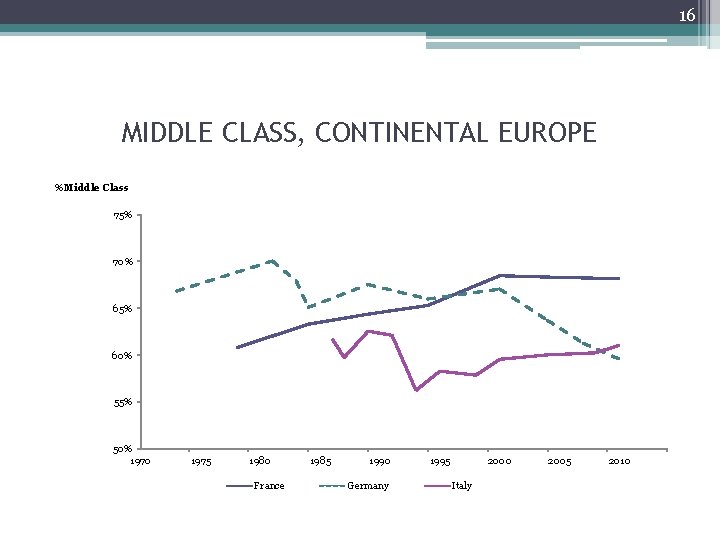
16 MIDDLE CLASS, CONTINENTAL EUROPE %Middle Class 75% 70% 65% 60% 55% 50% 1970 1975 1980 France 1985 1990 Germany 1995 2000 Italy 2005 2010
17 MOVING FORWARD • We need to control for regional difference in cost of living & expand the number of countries with measures of the middle class. • We need to begin to test theories find out what it is that has caused the middle class to shrink in the US & other developed nations. • Standard economic explanations (robots and trade) seem to lack empirical support. We need to understand why the middle class did not shrink in some countries (Canada, Italy and Norway) & increased in a few (France). • A paper of mine on the case of Italy identifies demographics and the lack of financialization as two key factors.
Thank you for paying attention and putting up with me!!