
Defining Liveness by Bowen Alpern and Fred B
Defining Liveness by Bowen Alpern and Fred B. Schneider Presented by Joe Melnyk
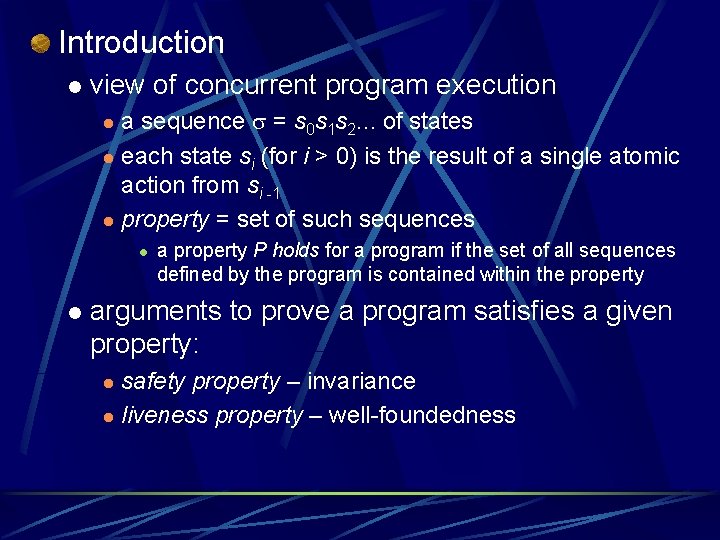
Introduction l view of concurrent program execution a sequence = s 0 s 1 s 2. . . of states l each state si (for i > 0) is the result of a single atomic action from si -1 l property = set of such sequences l l l a property P holds for a program if the set of all sequences defined by the program is contained within the property arguments to prove a program satisfies a given property: safety property – invariance l liveness property – well-foundedness l
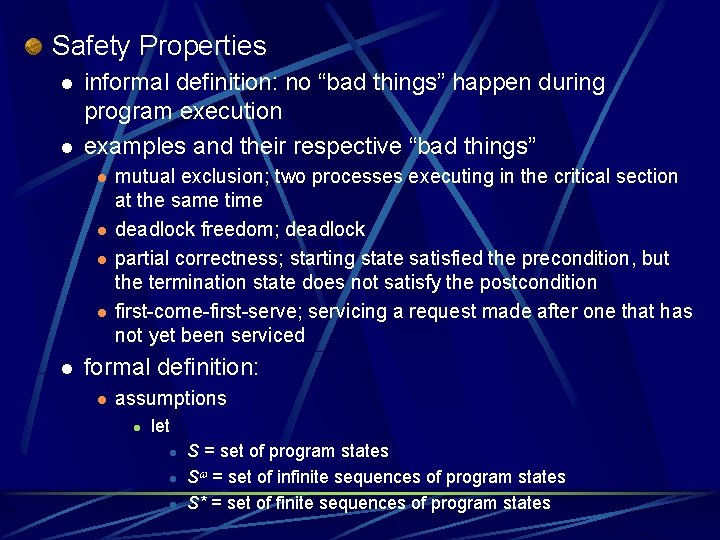
Safety Properties l l informal definition: no “bad things” happen during program execution examples and their respective “bad things” l l l mutual exclusion; two processes executing in the critical section at the same time deadlock freedom; deadlock partial correctness; starting state satisfied the precondition, but the termination state does not satisfy the postcondition first-come-first-serve; servicing a request made after one that has not yet been serviced formal definition: l assumptions l let l l l S = set of program states S = set of infinite sequences of program states S* = set of finite sequences of program states

l l l execution of a program can be modeled as a member of S elements of S = executions elements of S* = partial executions |= P if is in property P let i = partial execution consisting of the first i states in order for P to be a safety property, if P doesn’t hold for an execution then a “bad thing” must happen at some point l the “bad thing” is irremediable since a safety property states that “bad things” never happen during execution l therefore, P is a safety property if and only if l l l ( : S : | P ( i : 0 i: ( : S : i | P))) by the definition, a safety property unconditionally prohibits a “bad thing” from occurring; if it does occur, there is an identifiable point at which this can be recognized

Liveness Properties informal definition: a “good thing” happens during program execution l examples and their respective “good things” l starvation freedom; making progress l termination; completion of the final instruction l guaranteed service; receiving service l l defining characteristic of liveness no partial execution is irremediable; a “good thing” can always occur in the future l note: if a partial execution were irremediable, it would be a “bad thing” and liveness properties cannot reject “bad things”, only ensure “good things” l
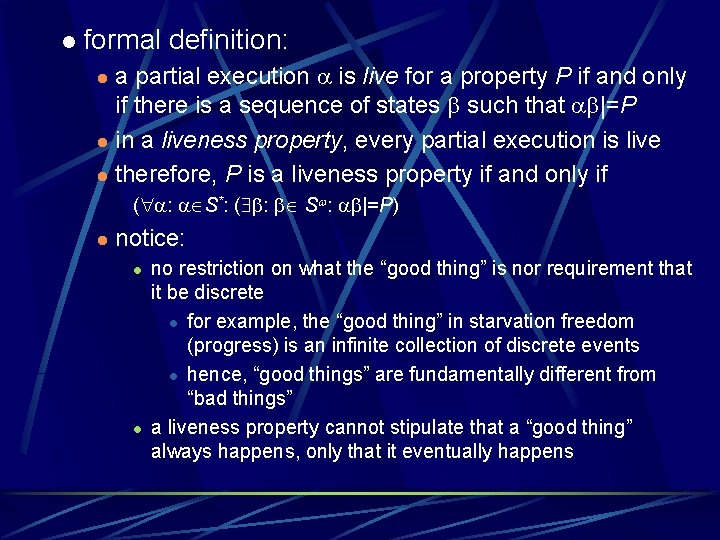
l formal definition: a partial execution is live for a property P if and only if there is a sequence of states such that |=P l in a liveness property, every partial execution is live l therefore, P is a liveness property if and only if l ( : S*: ( : S : |=P) l notice: l l no restriction on what the “good thing” is nor requirement that it be discrete l for example, the “good thing” in starvation freedom (progress) is an infinite collection of discrete events l hence, “good things” are fundamentally different from “bad things” a liveness property cannot stipulate that a “good thing” always happens, only that it eventually happens
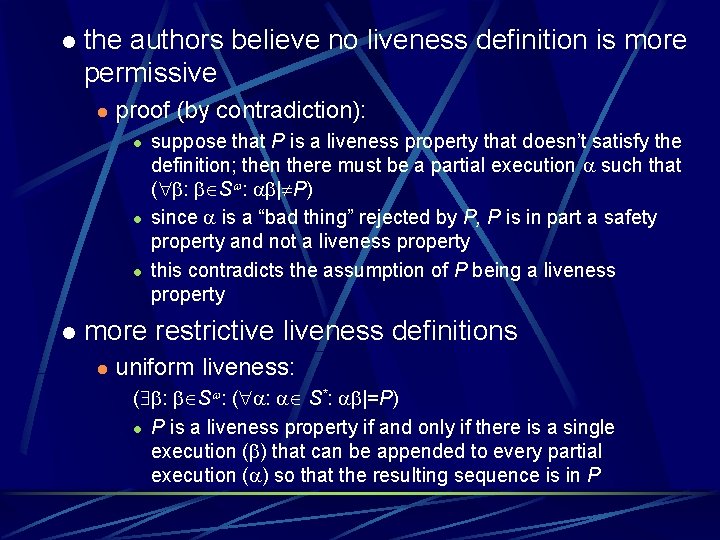
l the authors believe no liveness definition is more permissive l proof (by contradiction): l l suppose that P is a liveness property that doesn’t satisfy the definition; then there must be a partial execution such that ( : S : | P) since is a “bad thing” rejected by P, P is in part a safety property and not a liveness property this contradicts the assumption of P being a liveness property more restrictive liveness definitions l uniform liveness: ( : S : ( : S*: |=P) l P is a liveness property if and only if there is a single execution ( ) that can be appended to every partial execution ( ) so that the resulting sequence is in P

l absolute liveness ( : S : |=P) ( : S : |=P ( : S*: |=P)) l P is an absolute-liveness property if and only if it is nonempty and any execution ( ) in P can be appended to any partial execution ( ) to obtain a sequence in P l contrast of definitions liveness: if any partial execution can be extended by some execution so that is in L (choice of may depend on ), then L is a liveness property l uniform-liveness: if there is a single execution that extends all partial execution such that is in U, then U is a uniform-livness property l absolute liveness: if A is non-empty and any execution in A can be used to extend all partial executions , then A is an absolute-liveness property l any absolute-liveness property is also a uniformliveness property and any uniform-liveness property is also a liveness property l
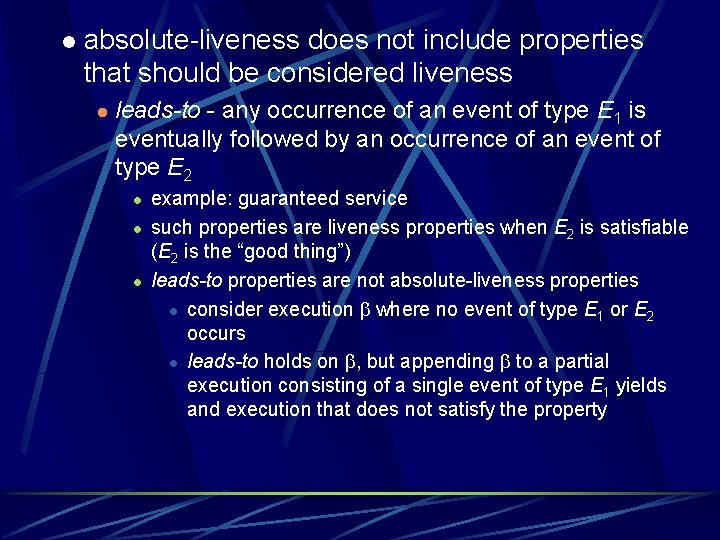
l absolute-liveness does not include properties that should be considered liveness l leads-to - any occurrence of an event of type E 1 is eventually followed by an occurrence of an event of type E 2 l l l example: guaranteed service such properties are liveness properties when E 2 is satisfiable (E 2 is the “good thing”) leads-to properties are not absolute-liveness properties l consider execution where no event of type E 1 or E 2 occurs l leads-to holds on , but appending to a partial execution consisting of a single event of type E 1 yields and execution that does not satisfy the property
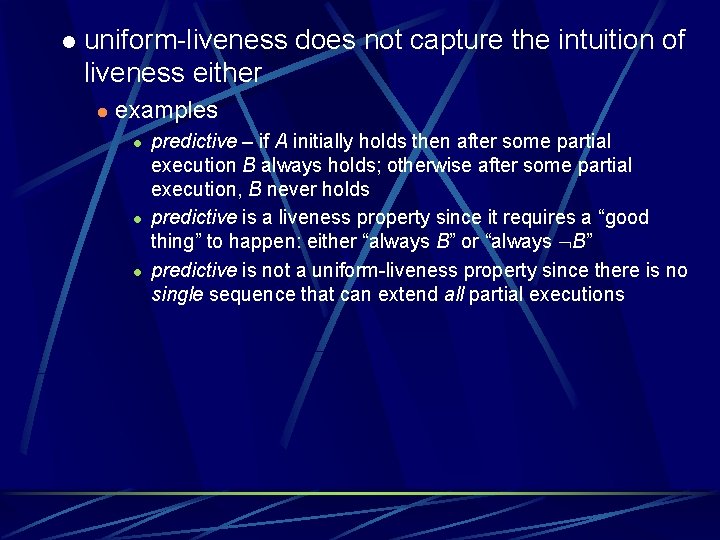
l uniform-liveness does not capture the intuition of liveness either l examples l l l predictive – if A initially holds then after some partial execution B always holds; otherwise after some partial execution, B never holds predictive is a liveness property since it requires a “good thing” to happen: either “always B” or “always B” predictive is not a uniform-liveness property since there is no single sequence that can extend all partial executions
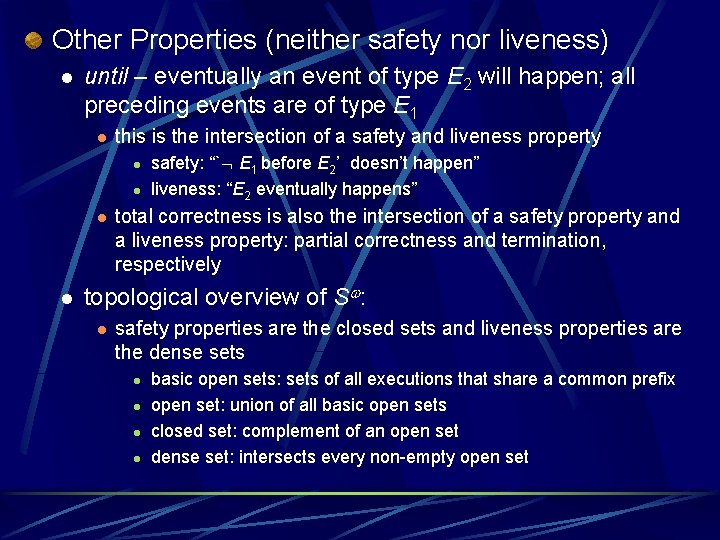
Other Properties (neither safety nor liveness) l until – eventually an event of type E 2 will happen; all preceding events are of type E 1 l this is the intersection of a safety and liveness property l l safety: “` E 1 before E 2’ doesn’t happen” liveness: “E 2 eventually happens” total correctness is also the intersection of a safety property and a liveness property: partial correctness and termination, respectively topological overview of S : l safety properties are the closed sets and liveness properties are the dense sets l l basic open sets: sets of all executions that share a common prefix open set: union of all basic open sets closed set: complement of an open set dense set: intersects every non-empty open set
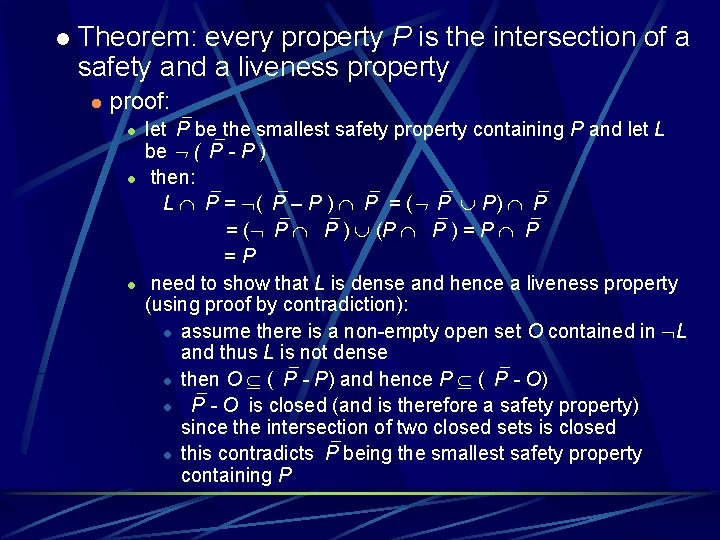
l Theorem: every property P is the intersection of a safety and a liveness property l proof: l let P be the smallest safety property containing P and let L be ( P - P ) then: L P = ( P – P ) P = ( P P ) (P P ) = P P =P need to show that L is dense and hence a liveness property (using proof by contradiction): l assume there is a non-empty open set O contained in L and thus L is not dense l then O ( P - P) and hence P ( P - O) l P - O is closed (and is therefore a safety property) since the intersection of two closed sets is closed l this contradicts P being the smallest safety property containing P
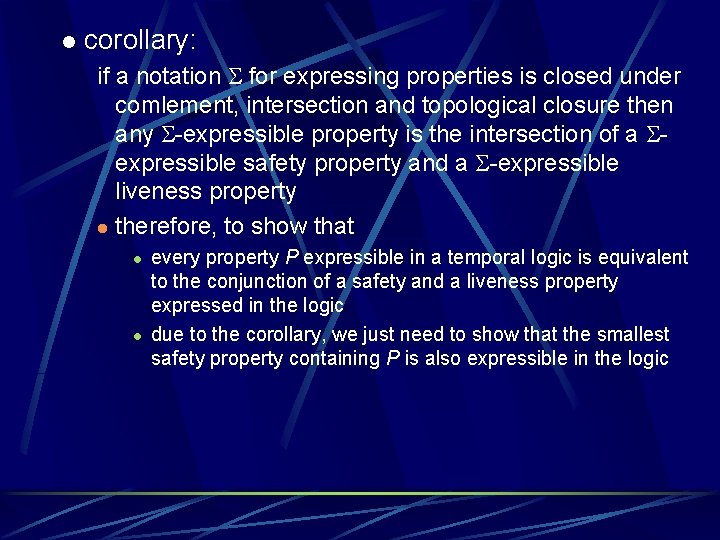
l corollary: if a notation for expressing properties is closed under comlement, intersection and topological closure then any -expressible property is the intersection of a expressible safety property and a -expressible liveness property l therefore, to show that l l every property P expressible in a temporal logic is equivalent to the conjunction of a safety and a liveness property expressed in the logic due to the corollary, we just need to show that the smallest safety property containing P is also expressible in the logic
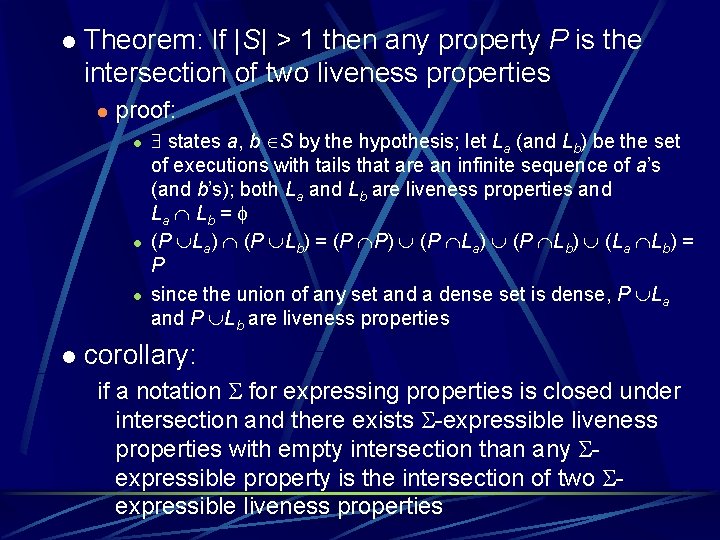
l Theorem: If |S| > 1 then any property P is the intersection of two liveness properties l proof: l l states a, b S by the hypothesis; let La (and Lb) be the set of executions with tails that are an infinite sequence of a’s (and b’s); both La and Lb are liveness properties and La Lb = (P La) (P Lb) = (P P) (P La) (P Lb) (La Lb) = P since the union of any set and a dense set is dense, P La and P Lb are liveness properties corollary: if a notation for expressing properties is closed under intersection and there exists -expressible liveness properties with empty intersection than any expressible property is the intersection of two expressible liveness properties
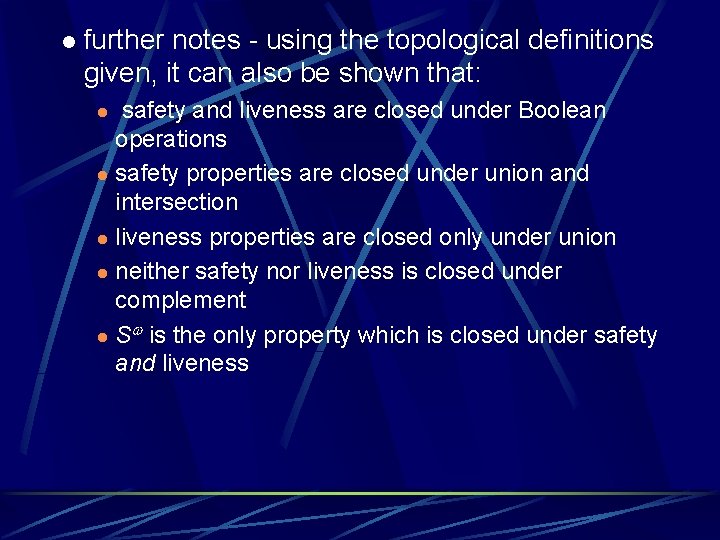
l further notes - using the topological definitions given, it can also be shown that: safety and liveness are closed under Boolean operations l safety properties are closed under union and intersection l liveness properties are closed only under union l neither safety nor liveness is closed under complement l S is the only property which is closed under safety and liveness l
- Slides: 15