
Defining Death in a Pluralistic Culture Karen Gervais
- Slides: 19
Defining Death in a Pluralistic Culture
Karen Gervais, Ph. D gervais@mnhealthethics. org September 7, 2016
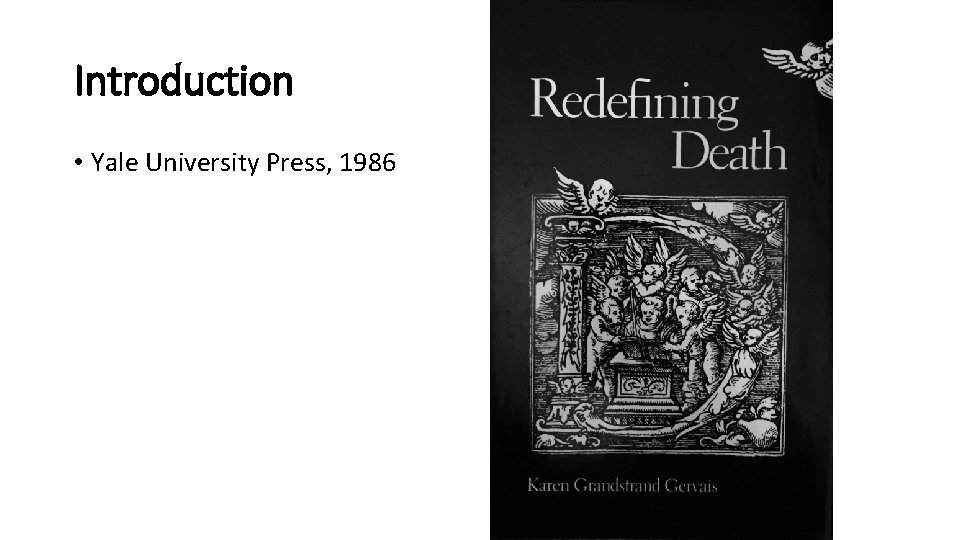
Introduction • Yale University Press, 1986
Redefining Death: Key Claims • “Decisions of significance” • Biological events do not self-identify their significance. • “What is human death? ” will not be settled by continuing to refine our biological knowledge. • Any criterion for determining death rests on a “decision of significance” that a specific biological situation should be called human death.
Redefining Death: Key Claims • Intellectual grid • I use Veatch’s grid [formal definition-concept-criterion-tests] • Formal def’n: “Death means a complete change in the status of a living entity characterized by the irreversible loss of those characteristics that are essentially significant to it. ” - Robert Veatch • Formal definitions require content: The essentially significant characteristic(s) chosen convey a specific concept of death. • Every criterion for declaring death rests on a concept of death that is based on a “decision of significance” concerning what is so essential to human life that its irreversible loss should be considered human death.
Redefining Death: Key Claims • Cardiopulmonary Death Criterion: CPDC • Societal consensus supports the CPDC (cardiopulmonary death criterion) and its underlying concept. • Its underlying concept is the irreversible loss of integrated functioning of the organism as a whole. • “CPD is death” is not a fact, it is a normative or value statement deriving from beliefs and values characteristic of most societies. • It views the human as organism • It considers integrated functioning essentially significant • It is a social construct.
Redefining Death: Key Claims • Brain Death Criterion: Harvard Committee Report 1968 • What is the decision of significance underlying, “Brain death is death”? • What beliefs and values re the human, death, moral obligations, medical knowledge, etc. , does it rest on? • INCOMPLETENESS: 48 years of argument • Defenders: the CPDC and the BDC rest on same concept • disagreed on whether the concept was organism-centric or person-centric • disagreed on the type of analysis needed to demonstrate what that concept is (biological, moral, ontological) • didn’t see that technology forces a fundamental normative question before a decision of significance and specific concept can be decided upon • Which aspect of human (organism or person) should be the basis of the decision of significance?
What decisions of significance and concept of death underlie CPDC and BDC? (Gervais’ answers) • CPDC: integrated function of the organism as a whole • BDC: (implicitly) irreversible loss of capacity for consciousness • technological source of organism’s functioning irrelevant • integrated functioning of the organism as a whole continues • only the irreversible loss of capacity for consciousness differentiates BD pt from other brain damaged pts • BDC implicitly focuses on characteristics of the human as person
Social Constructs without Public Input • Nearly all of us agree CPDC and BDC rest on different concepts of death • They hold different normative perspectives on the human (as organism or person) • Accordingly, they differ on the medical criteria/tests used to diagnose death. • Since decisions of significance underlie the formation of these concepts of death and justify the drawing of biological lines, • “BD is D” and “CPD is D” are not facts • They are 2 social constructs built on the presumed authority of medicine to say what death is and how to diagnose it, and on the power of law to codify and enforce medical authority • Unfortunately, the public has never had a chance to react to the phenomenon of BD as an informed public – only one patient/family at a time, responding to entrenched medical practice and legal authority
Plurality of definitions of death • Individuals also make decisions of significance concerning what death is • Their decisions of significance reflect fundamentally different views of the human • They differ in their concepts of death • The plurality of their individual concepts of death means some may reject our medically operationalized societal concepts and criteria • This argues for a policy of accommodation for those who would refuse the BDC on the basis of deeply held beliefs and values
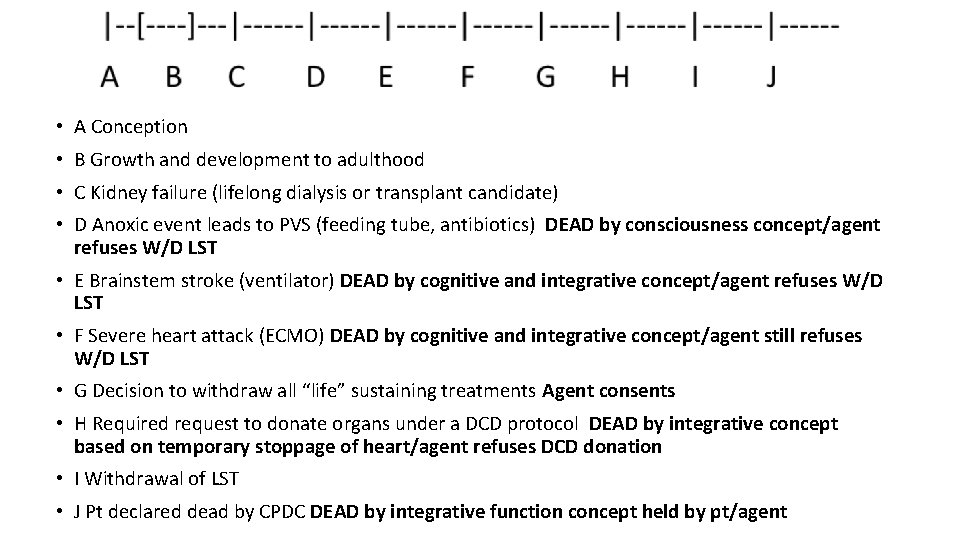
Plurality of definitions of death • To demonstrate the plurality of definitions, consider a hypothetical biological lifeline of a very unfortunate patient • 4 different concepts of death could be used to diagnose the patient dead at different points • Organ donation could have been requested at 3 different points • In this case, healthcare agent’s decision of significance/concept of death is organism-centric and requires irreversible cessation of the integrated functioning of the organism as a whole
• A Conception • B Growth and development to adulthood • C Kidney failure (lifelong dialysis or transplant candidate) • D Anoxic event leads to PVS (feeding tube, antibiotics) DEAD by consciousness concept/agent refuses W/D LST • E Brainstem stroke (ventilator) DEAD by cognitive and integrative concept/agent refuses W/D LST • F Severe heart attack (ECMO) DEAD by cognitive and integrative concept/agent still refuses W/D LST • G Decision to withdraw all “life” sustaining treatments Agent consents • H Required request to donate organs under a DCD protocol DEAD by integrative concept based on temporary stoppage of heart/agent refuses DCD donation • I Withdrawal of LST • J Pt declared dead by CPDC DEAD by integrative function concept held by pt/agent
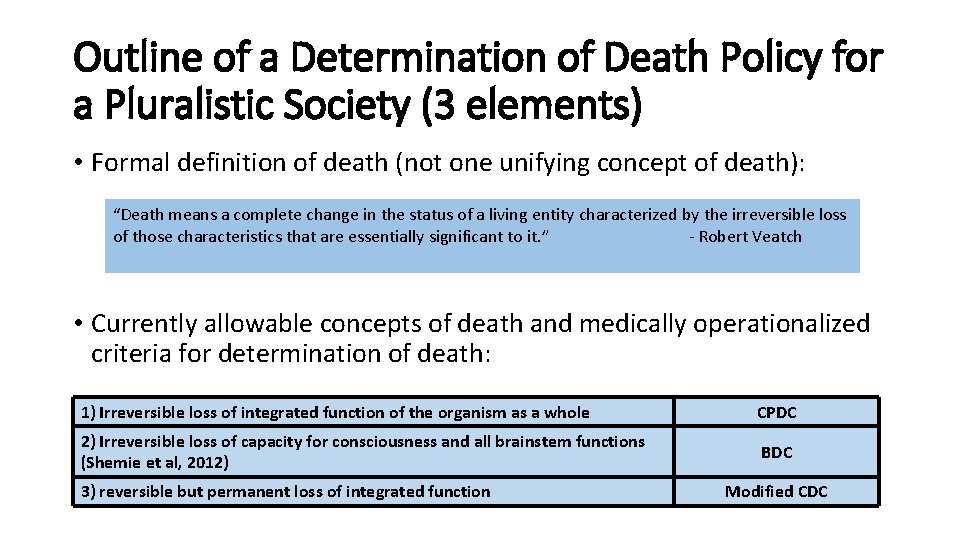
Outline of a Determination of Death Policy for a Pluralistic Society (3 elements) • Formal definition of death (not one unifying concept of death): “Death means a complete change in the status of a living entity characterized by the irreversible loss of those characteristics that are essentially significant to it. ” - Robert Veatch • Currently allowable concepts of death and medically operationalized criteria for determination of death: 1) Irreversible loss of integrated function of the organism as a whole CPDC 2) Irreversible loss of capacity for consciousness and all brainstem functions (Shemie et al, 2012) BDC 3) reversible but permanent loss of integrated function Modified CDC
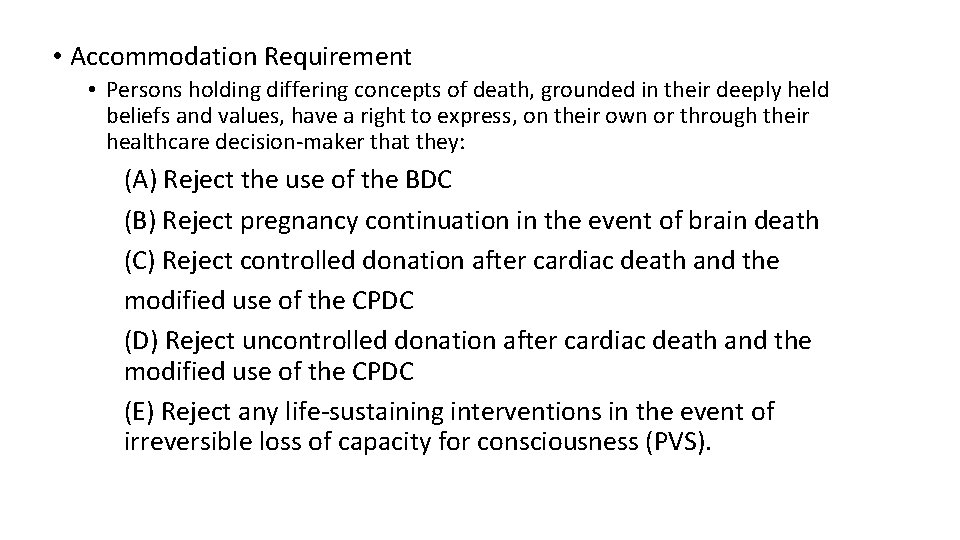
• Accommodation Requirement • Persons holding differing concepts of death, grounded in their deeply held beliefs and values, have a right to express, on their own or through their healthcare decision-maker that they: (A) Reject the use of the BDC (B) Reject pregnancy continuation in the event of brain death (C) Reject controlled donation after cardiac death and the modified use of the CPDC (D) Reject uncontrolled donation after cardiac death and the modified use of the CPDC (E) Reject any life-sustaining interventions in the event of irreversible loss of capacity for consciousness (PVS).
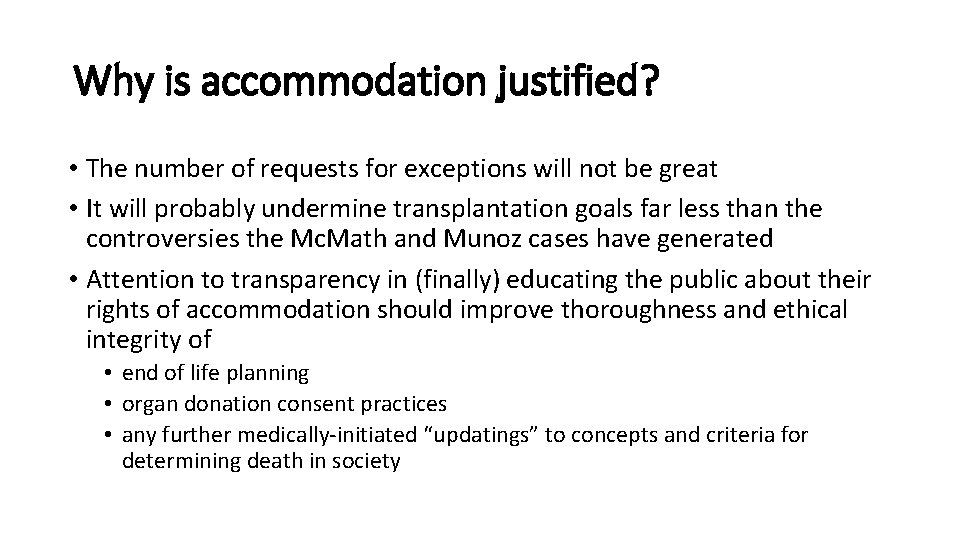
Why is accommodation justified? • The number of requests for exceptions will not be great • It will probably undermine transplantation goals far less than the controversies the Mc. Math and Munoz cases have generated • Attention to transparency in (finally) educating the public about their rights of accommodation should improve thoroughness and ethical integrity of • end of life planning • organ donation consent practices • any further medically-initiated “updatings” to concepts and criteria for determining death in society
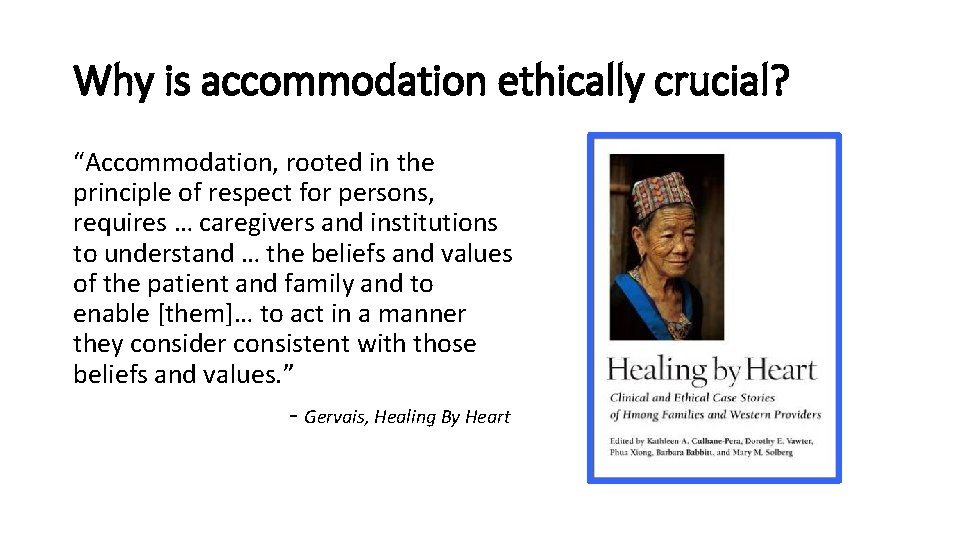
Why is accommodation ethically crucial? “Accommodation, rooted in the principle of respect for persons, requires … caregivers and institutions to understand … the beliefs and values of the patient and family and to enable [them]… to act in a manner they consider consistent with those beliefs and values. ” - Gervais, Healing By Heart
“Why should HCPs aspire to the accommodationist approach? Acts of accommodation enable [patients and families]…to address tragedy in terms of their most deeply help spiritual beliefs and moral values, empowering them in the clinical situation and after to interpret and integrate this experience and loss into their lives in healing ways. The metaphysical and moral beliefs and values [they hold]…are the tools with which they make sense of life, attribute meaning to their experiences, and determine their own and others’ ethical responsibilities. ” - Gervais, Healing By Heart
“The healing and deathbed acts and practices that express these assumptions, beliefs and values allow them to interpret events, to define personal and collective responsibilities, to sustain and strengthen relationships, to remain situated, and to retain a sense of control—even in the face of the dying and death of a family or clan member. ” “The healthcare environment – which is unfamiliar, often frightening, and usually disempowering to patients and their families – requires HCPs to facilitate, not simply to tolerate, the expression of cultural beliefs and values. When providers and institutions fail to empower patients and families to act in accordance with their world views, they risk disassociating them from their sources of meeting, belonging, and strength. ” - Gervais, Healing By Heart
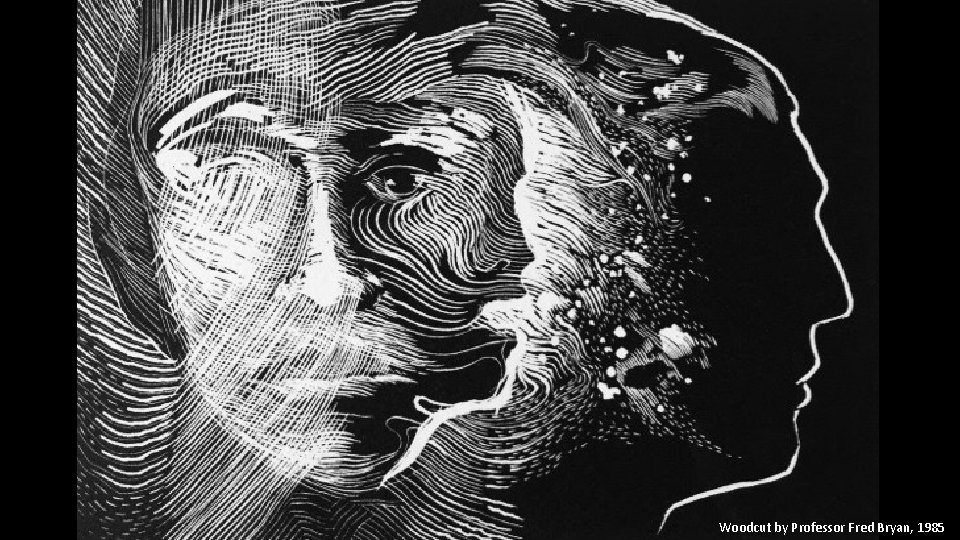
Woodcut by Professor Fred Bryan, 1985