
Defining Dataintensive computing B Ramamurthy 2152022 1 Dataintensive
Defining Data-intensive computing B. Ramamurthy 2/15/2022 1
Data-intensive computing � What is it? ◦ Volume, velocity, variety, veracity (uncertainty) (Gartner, IBM) � How is it addressed? � Why now? � What do you expect to extract by processing this large data? ◦ Intelligence for decision making � What is different now? ◦ Storage models, processing models ◦ Big Data, analytics and cloud infrastructures � Summary 2/15/2022 2
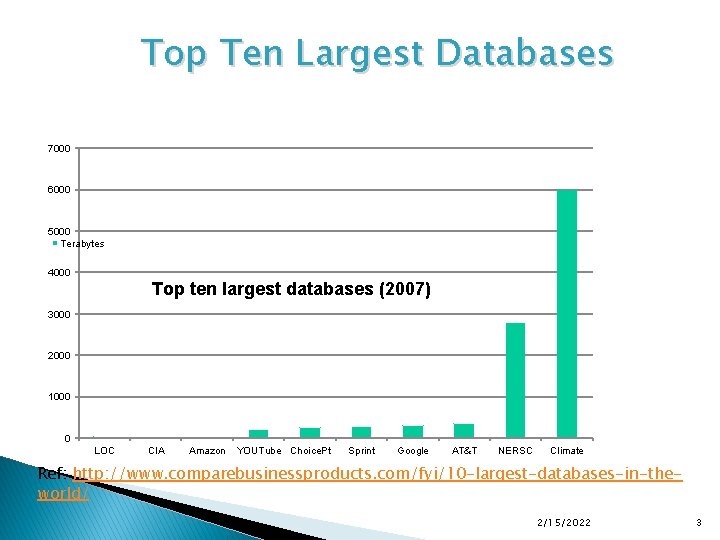
Top Ten Largest Databases 7000 6000 5000 Terabytes 4000 Top ten largest databases (2007) 3000 2000 1000 0 LOC CIA Amazon YOUTube Choice. Pt Sprint Google AT&T NERSC Climate Ref: http: //www. comparebusinessproducts. com/fyi/10 -largest-databases-in-theworld/ 2/15/2022 3
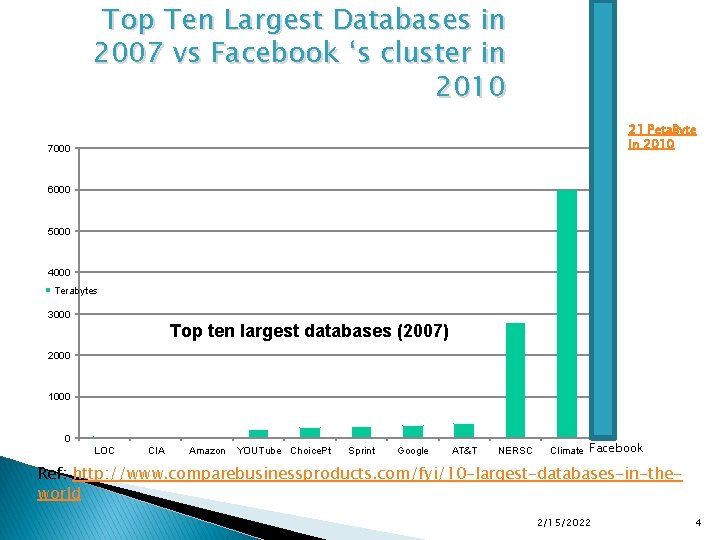
Top Ten Largest Databases in 2007 vs Facebook ‘s cluster in 2010 21 Peta. Byte In 2010 7000 6000 5000 4000 Terabytes 3000 Top ten largest databases (2007) 2000 1000 0 LOC CIA Amazon YOUTube Choice. Pt Sprint Google AT&T NERSC Climate Facebook Ref: http: //www. comparebusinessproducts. com/fyi/10 -largest-databases-in-theworld 2/15/2022 4
Big-data Problem Solving Approaches � Algorithmic: after all we have working towards this for ever: scalable/tracktable � High Performance computing (HPC: multi-core) CCR has machines that are: 16 CPU , 32 core machine with 128 GB RAM: openmp, MPI, etc. � GPGPU programming: general purpose graphics processor (NVIDIA) � Statistical packages like R running on parallel threads on powerful machines � Machine learning algorithms on super computers � Hadoop Map. Reduce like parallel processing.
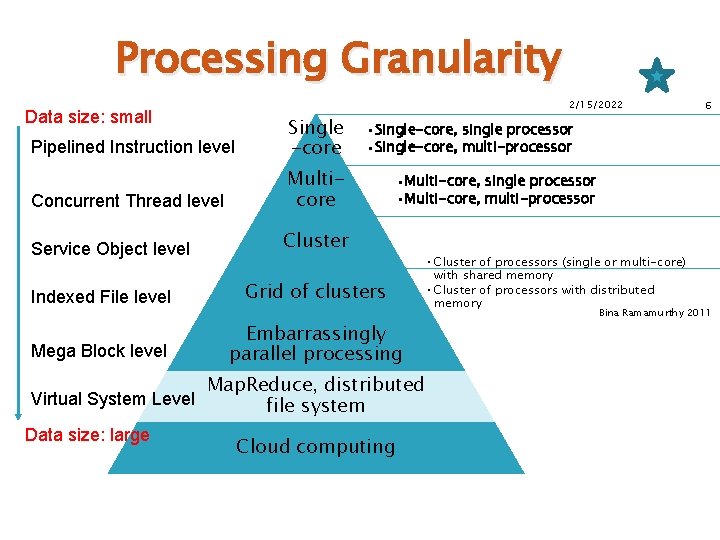
Processing Granularity 2/15/2022 Data size: small Pipelined Instruction level Single -core Concurrent Thread level Multicore Service Object level Cluster • Single-core, single processor • Single-core, multi-processor • Multi-core, single processor • Multi-core, multi-processor Indexed File level Grid of clusters Mega Block level Embarrassingly parallel processing Map. Reduce, distributed Virtual System Level file system Data size: large 6 Cloud computing • Cluster of processors (single or multi-core) with shared memory • Cluster of processors with distributed memory Bina Ramamurthy 2011
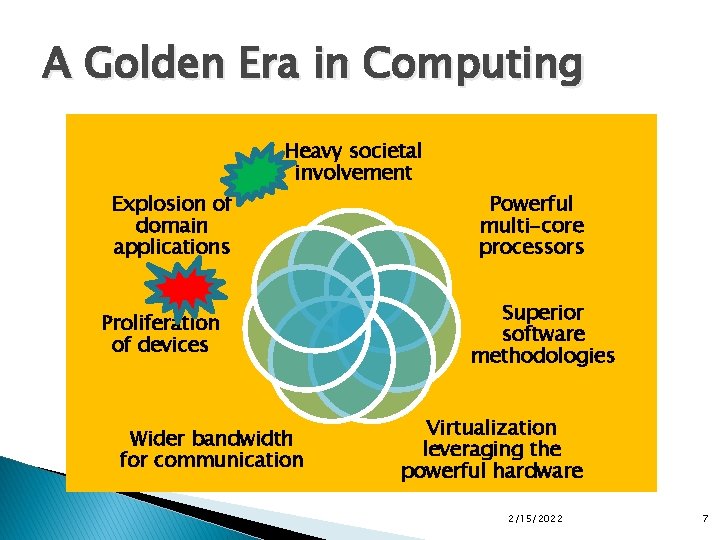
A Golden Era in Computing Heavy societal involvement Explosion of domain applications Proliferation of devices Wider bandwidth for communication Powerful multi-core processors Superior software methodologies Virtualization leveraging the powerful hardware 2/15/2022 7
Data Deluge: smallest to largest � Bioinformatics data: from about 3. 3 billion base pairs in a human genome to huge number of sequences of proteins and the analysis of their behaviors � The internet: web logs, facebook, twitter, maps, blogs, etc. : Analytics … � Financial applications: that analyze volumes of data for trends and other deeper knowledge � Health Care: huge amount of patient data, drug and treatment data � The universe: The Hubble ultra deep telescope shows 100 s of galaxies each with billions of stars: Sloan Digital Sky Survey: http: //www. sdss. org/ 2/15/2022 8
Intelligence and Scale of Data Intelligence is a set of discoveries made by federating/processing information collected from diverse sources. � Information is a cleansed form of raw data. � For statistically significant information we need reasonable amount of data. � For gathering good intelligence we need large amount of information. � As pointed out by Jim Grey in the Fourth Paradigm book enormous amount of data is generated by the millions of experiments and applications. � Thus intelligence applications are invariably data-heavy, data-driven and data-intensive. � Data is gathered from the web (public or private, covert or overt), generated by large number of domain applications. � 2/15/2022 9
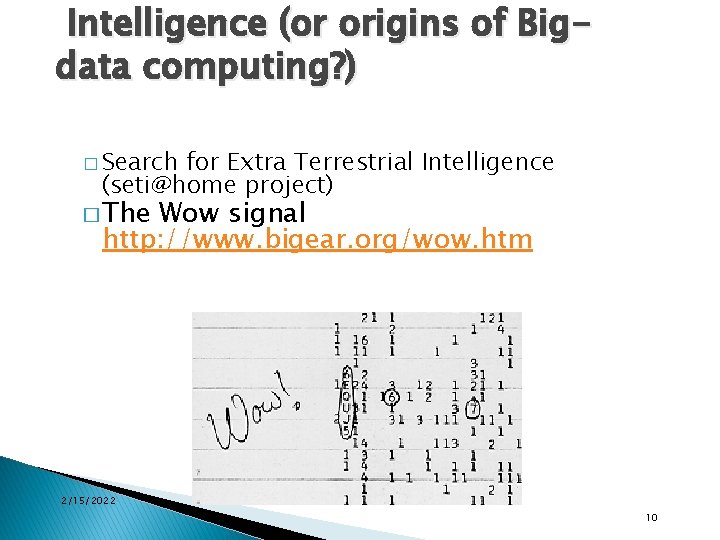
Intelligence (or origins of Bigdata computing? ) � Search for Extra Terrestrial Intelligence (seti@home project) � The Wow signal http: //www. bigear. org/wow. htm 2/15/2022 10
Characteristics of intelligent applications � � � Google search: How is different from regular search in existence before it? ◦ It took advantage of the fact the hyperlinks within web pages form an underlying structure that can be mined to determine the importance of various pages. Restaurant and Menu suggestions: instead of “Where would you like to go? ” “Would you like to go to City. Grille”? ◦ Learning capacity from previous data of habits, profiles, and other information gathered over time. Collaborative and interconnected world inference capable: facebook friend suggestion Large scale data requiring indexing …Do you know amazon is going to ship things before you order? Here 2/15/2022 11
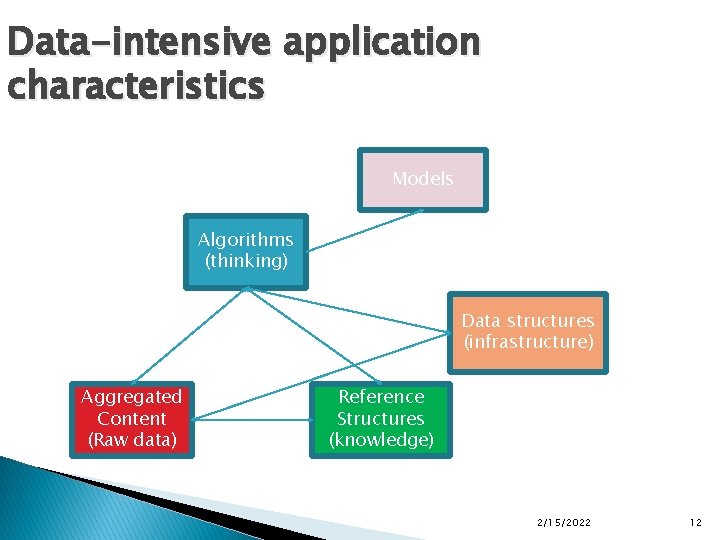
Data-intensive application characteristics Models Algorithms (thinking) Data structures (infrastructure) Aggregated Content (Raw data) Reference Structures (knowledge) 2/15/2022 12
Basic Elements � Aggregated content: large amount of data pertinent to the specific application; each piece of information is typically connected to many other pieces. Ex: DBs � Reference structures: Structures that provide one or more structural and semantic interpretations of the content. Reference structure about specific domain of knowledge come in three flavors: dictionaries, knowledge bases, and ontologies � Algorithms: modules that allows the application to harness the information which is hidden in the data. Applied on aggregated content and some times require reference structure Ex: Map. Reduce � Data Structures: newer data structures to leverage the scale and the WORM characteristics; ex: MS Azure, Apache Hadoop, Google Big. Table 2/15/2022 13
Examples of data-intensive applications � Search engines � Recommendation systems: ◦ Cine. Match of Netflix Inc. movie recommendations ◦ Amazon. com: book/product recommendations � Biological systems: high throughput sequences (HTS) ◦ Analysis: disease-gene match ◦ Query/search for gene sequences � Space exploration � Financial analysis 2/15/2022 14
More intelligent data-intensive applications � Social networking sites � Mashups : applications that draw upon content retrieved from external sources to create entirely new innovative services. � Portals � Wikis: content aggregators; linked data; excellent data and fertile ground for applying concepts discussed in the text � Media-sharing sites � Online gaming � Biological analysis � Space exploration 2/15/2022 15
Algorithms � Statistical inference � Machine learning is the capability of the software system to generalize based on past experience and the use of these generalization to provide answers to questions related old, new and future data. � Data mining � Soft computing � We also need algorithms that are specially designed for the emerging storage models and data characteristics. 2/15/2022 16
Different Type of Storage Internet introduced a new challenge in the form web logs, web crawler’s data: large scale “peta scale” • But observe that this type of data has an uniquely different characteristic than your transactional or the “customer order” data, or “bank account data” : • The data type is “write once read many (WORM)” ; • Privacy protected healthcare and patient information; • Historical financial data; • Other historical data � Relational file system and tables are insufficient. • Large <key, value> stores (files) and storage management system. • Built-in features for fault-tolerance, load balancing, data-transfer and aggregation, … • Clusters of distributed nodes for storage and computing. • Computing is inherently parallel • 2/15/2022 17
Big-data Concepts Originated from the Google File System (GFS) is the special <key, value> store � Hadoop Distributed file system (HDFS) is the open source version of this. (Currently an Apache project) � Parallel processing of the data using Map. Reduce (MR) programming model � Apache Spark Eco system � Challenges � � Formulation of algorithms � Proper use of the features of infrastructure (Ex: sort) � Best practices in parallel processing � An extensive ecosystem consisting of other components such as column-based store (Hbase, Big. Table), big data warehousing (Hive), workflow languages, etc. 2/15/2022 18
Data & Analytics � We have witnessed explosion in algorithmic solutions. � “In pioneer days they used oxen for heavy pulling, when one couldn’t budge a log they didn’t try to grow a larger ox. We shouldn’t be trying for bigger computers, but for more systems of computers. ” Grace Hopper � What you cannot achieve by an algorithm can be achieved by more data. � Big data if analyzed right gives you better answers: Center for disease control prediction of flu vs. prediction of flu through “search” data 2 full weeks before the onset of flu season! http: //www. google. org/flutrends/ 2/15/2022 19
Cloud Computing � Cloud is a facilitator for Big Data computing and is an indispensable in this context � Cloud provides processor, software, operating systems, storage, monitoring, load balancing, clusters and other requirements as a service � Cloud offers accessibility to Big Data computing � Cloud computing models: ◦ ◦ platform (Paa. S), Microsoft Azure software (Saa. S), Google App Engine (GAE) infrastructure (Iaa. S), Amazon web services (AWS) Services-based application programming interface (API) 2/15/2022 20
Data � We are entering a watershed moment in the internet era. � This involves in its core and center, big data analytics and tools that provide intelligence in a timely manner to support decision making. � Newer storage models, processing models, and approaches have emerged. � UB does have a Data-intensive Computing Certificate Program. � https: //catalog. buffalo. edu/academicprogra ms/data-intensive_computing_cert. html 2/15/2022 21
Data Intensive Computing Certificate � Pre-reqs: � CSE 250 CSE 115, CSE 116 � CSE 486 : Distributed Systems � CSE 487: Data-intensive Computing � XYZ course in any major (including CSE) � Capstone research: 1 -3 credits ◦ Example 1: BIO 419, CSE 495 (1 credit) Research in genomics ◦ Example 2: Math 337, MTH 495 Research in Math ◦ Example 3: CSE 442, CSE 453 If you are interested please fill this short survey so that I can guide you: https: //goo. gl/forms/0 Kkx 6 c 2 w. T 43 IF 4 g 32 2/15/2022 22
- Slides: 22