
Defining Abnormality Rhianna Conway Statistical Infrequency q Under
Defining Abnormality Rhianna Conway
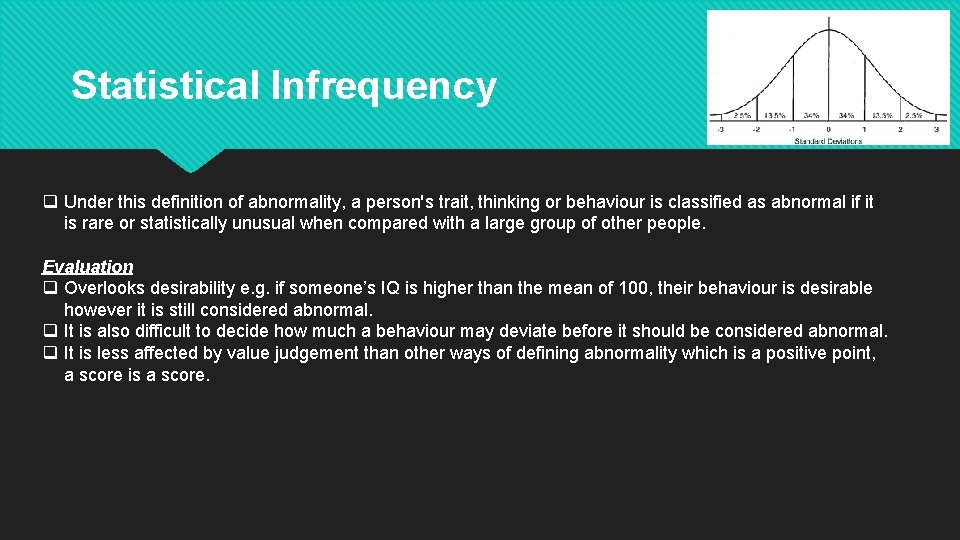
Statistical Infrequency q Under this definition of abnormality, a person's trait, thinking or behaviour is classified as abnormal if it is rare or statistically unusual when compared with a large group of other people. Evaluation q Overlooks desirability e. g. if someone’s IQ is higher than the mean of 100, their behaviour is desirable however it is still considered abnormal. q It is also difficult to decide how much a behaviour may deviate before it should be considered abnormal. q It is less affected by value judgement than other ways of defining abnormality which is a positive point, a score is a score.
Deviation from social norms q Under this definition, a persons thinking or behaviour is classified as abnormal if it violates the unwritten rules about what is expected or acceptable behaviour in a particular social group e. g. Simon (evil people) – a boy with acute schizophrenia. Evaluation q The concept of social deviancy is related to moral codes or standards subjectively defined by society however these can vary. For example until the late part of the 20 th century it was regarded unacceptable for an unmarried women to have a child. q Social deviance is defined by the context in which a certain behaviour occurs e. g. wearing few clothes on a beach is acceptable but not on a high street. q Social deviance is not always a bad thing, some people are socially deviant because they’ve chosen a nonconformist lifestyle e. g. think about the ‘deviants’ who spoke out against the atrocities committed in Nazi Germany.
- Slides: 3