
DEFINE the use of the LINE IV Therapy

- Slides: 12
“DEFINE the use of the LINE” IV Therapy January Tip of The Month Peripheral IV PICC Short Term Access Greater than 5 day access � Non vesicant medications Primarily IV Fluid Commonly used Vesicants: Vancomycin, Flagyl, KCL > 40 Meq…. . � Highly Irritating: Nafcillin, Cipro, Gentamycin …… � Great veins, minimal blood draws. Difficult IV Access with overly used phlebotic � veins. Admission diagnosis i. e. pancreatitis, ulcerative � colitis, liver failure, joint infections, cellulitis.
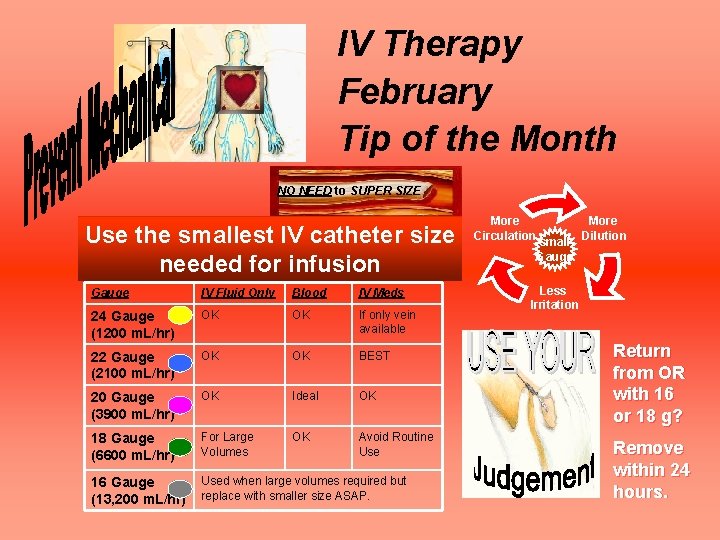
IV Therapy February Tip of the Month NO NEED to SUPER SIZE Use the smallest IV catheter size needed for infusion Gauge IV Fluid Only Blood IV Meds 24 Gauge (1200 m. L/hr) OK OK If only vein available 22 Gauge (2100 m. L/hr) OK OK BEST 20 Gauge (3900 m. L/hr) OK Ideal OK 18 Gauge (6600 m. L/hr) For Large Volumes OK Avoid Routine Use 16 Gauge (13, 200 m. L/hr) Used when large volumes required but replace with smaller size ASAP. More Circulation small Gauge More Dilution Less Irritation Return from OR with 16 or 18 g? Remove within 24 hours.
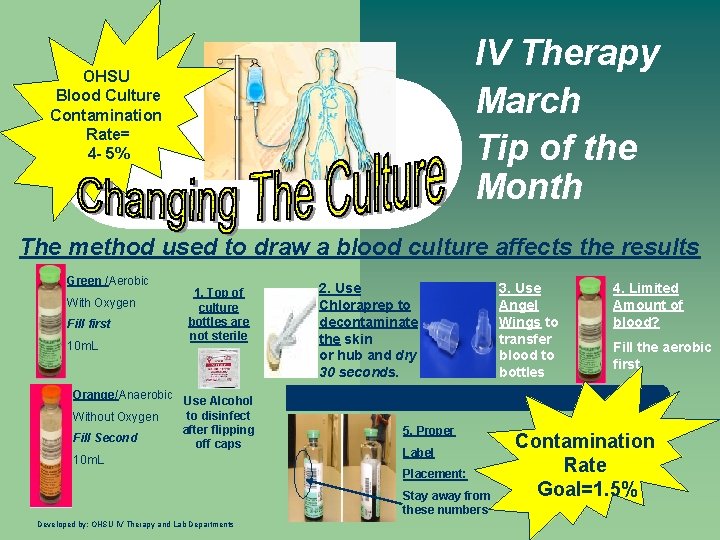
IV Therapy March Tip of the Month OHSU Blood Culture Contamination Rate= 4 - 5% The method used to draw a blood culture affects the results Green /Aerobic With Oxygen Fill first 10 m. L 1. Top of culture bottles are not sterile Orange/Anaerobic Use Alcohol to disinfect Without Oxygen after flipping Fill Second off caps 10 m. L 2. Use Chloraprep to decontaminate the skin or hub and dry 30 seconds. 5. Proper Label Placement: Stay away from these numbers Developed by: OHSU IV Therapy and Lab Departments 3. Use Angel Wings to transfer blood to bottles 4. Limited Amount of blood? Fill the aerobic first Contamination Rate Goal=1. 5%
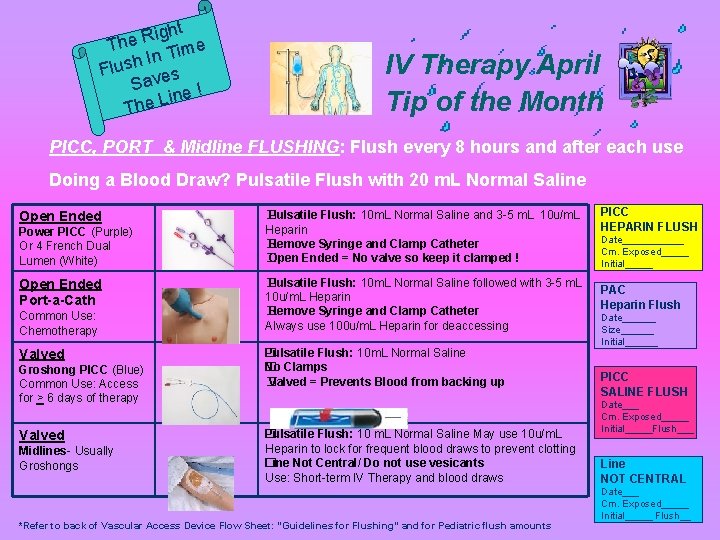
ight R e Th Time n I h Flus s Save ! ine The L IV Therapy April Tip of the Month PICC, PORT & Midline FLUSHING: Flush every 8 hours and after each use Doing a Blood Draw? Pulsatile Flush with 20 m. L Normal Saline Open Ended Power PICC (Purple) Or 4 French Dual Lumen (White) Open Ended Port-a-Cath Common Use: Chemotherapy Valved Groshong PICC (Blue) Common Use: Access for > 6 days of therapy Valved Midlines- Usually Groshongs � Pulsatile Flush: 10 m. L Normal Saline and 3 -5 m. L 10 u/m. L Heparin Remove Syringe and Clamp Catheter � Open Ended = No valve so keep it clamped ! � � Pulsatile Flush: 10 m. L Normal Saline followed with 3 -5 m. L 10 u/m. L Heparin Remove Syringe and Clamp Catheter � Always use 100 u/m. L Heparin for deaccessing �ulsatile Flush: 10 m. L Normal Saline P No Clamps � Valved = Prevents Blood from backing up � �ulsatile Flush: 10 m. L Normal Saline May use 10 u/m. L P Heparin to lock for frequent blood draws to prevent clotting Line Not Central/ Do not use vesicants � Use: Short-term IV Therapy and blood draws *Refer to back of Vascular Access Device Flow Sheet: “Guidelines for Flushing” and for Pediatric flush amounts PICC HEPARIN FLUSH Date______ Cm. Exposed_____ Initial_____ PAC Heparin Flush Date______ Size______ Initial______ PICC SALINE FLUSH Date___ Cm. Exposed_____ Initial_____Flush___ Line NOT CENTRAL Date___ Cm. Exposed_____ Initial_____ Flush__
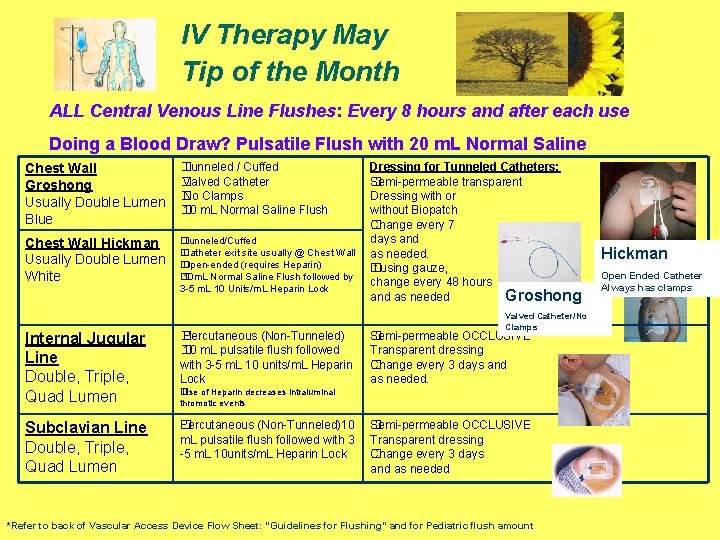
IV Therapy May Tip of the Month ALL Central Venous Line Flushes: Every 8 hours and after each use Doing a Blood Draw? Pulsatile Flush with 20 m. L Normal Saline Chest Wall Groshong Usually Double Lumen Blue � Tunneled / Cuffed � Valved Catheter � No Clamps � 10 m. L Normal Saline Flush Chest Wall Hickman Usually Double Lumen White � Tunneled/Cuffed � Catheter exit site usually @ Chest Wall � Open-ended (requires Heparin) � 10 m. L Normal Saline Flush followed by 3 -5 m. L 10 Units/m. L Heparin Lock Internal Jugular Line Double, Triple, Quad Lumen � Percutaneous (Non-Tunneled) � 10 m. L pulsatile flush followed with 3 -5 m. L 10 units/m. L Heparin Lock Subclavian Line Double, Triple, Quad Lumen �ercutaneous (Non-Tunneled)10 P m. L pulsatile flush followed with 3 -5 m. L 10 units/m. L Heparin Lock Dressing for Tunneled Catheters: Semi-permeable transparent � Dressing with or without Biopatch Change every 7 � days and as needed. If using gauze, � change every 48 hours and as needed Groshong Valved Catheter/No Clamps �emi-permeable OCCLUSIVE S Transparent dressing Change every 3 days and � as needed. � Use of Heparin decreases intraluminal thromotic events �emi-permeable OCCLUSIVE S Transparent dressing Change every 3 days � and as needed *Refer to back of Vascular Access Device Flow Sheet: “Guidelines for Flushing” and for Pediatric flush amount Hickman Open Ended Catheter Always has clamps
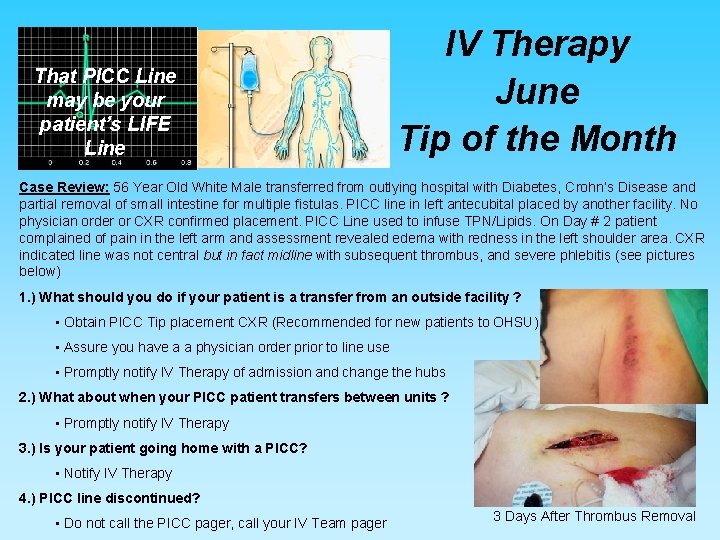
That PICC Line may be your patient’s LIFE Line IV Therapy June Tip of the Month Case Review: 56 Year Old White Male transferred from outlying hospital with Diabetes, Crohn’s Disease and partial removal of small intestine for multiple fistulas. PICC line in left antecubital placed by another facility. No physician order or CXR confirmed placement. PICC Line used to infuse TPN/Lipids. On Day # 2 patient complained of pain in the left arm and assessment revealed edema with redness in the left shoulder area. CXR indicated line was not central but in fact midline with subsequent thrombus, and severe phlebitis (see pictures below) 1. ) What should you do if your patient is a transfer from an outside facility ? • Obtain PICC Tip placement CXR (Recommended for new patients to OHSU) • Assure you have a a physician order prior to line use • Promptly notify IV Therapy of admission and change the hubs 2. ) What about when your PICC patient transfers between units ? • Promptly notify IV Therapy 3. ) Is your patient going home with a PICC? • Notify IV Therapy 4. ) PICC line discontinued? • Do not call the PICC pager, call your IV Team pager 3 Days After Thrombus Removal
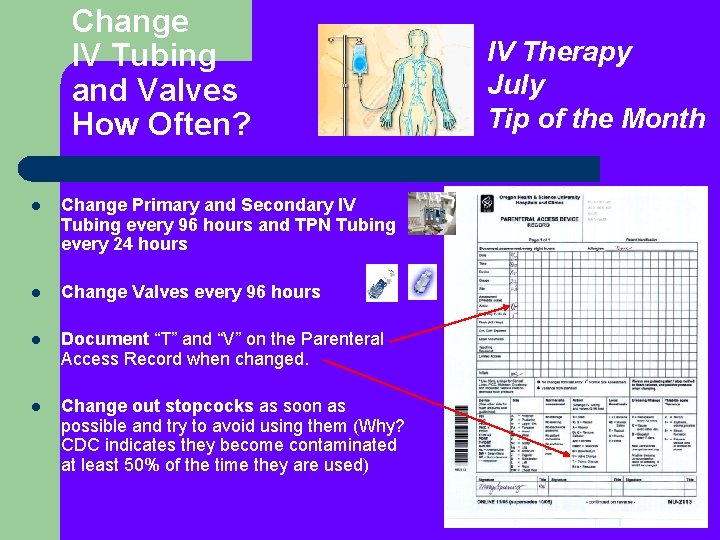
Change IV Tubing and Valves How Often? l Change Primary and Secondary IV Tubing every 96 hours and TPN Tubing every 24 hours l Change Valves every 96 hours l Document “T” and “V” on the Parenteral Access Record when changed. l Change out stopcocks as soon as possible and try to avoid using them (Why? CDC indicates they become contaminated at least 50% of the time they are used) IV Therapy July Tip of the Month
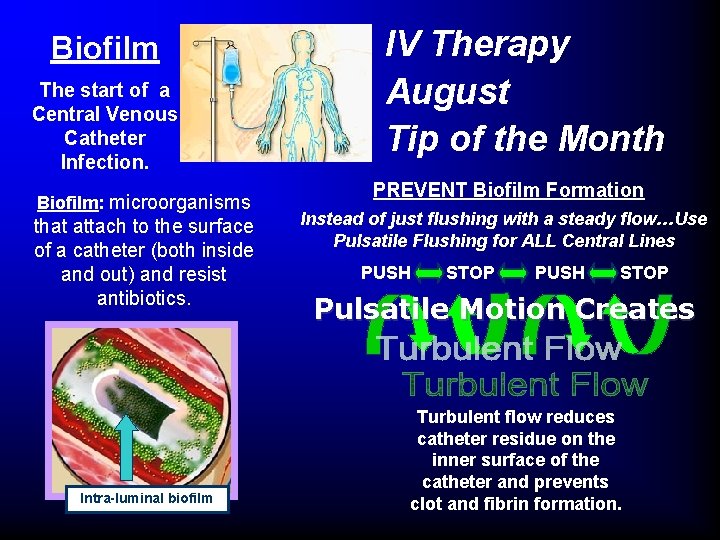
Biofilm The start of a Central Venous Catheter Infection. Biofilm: microorganisms that attach to the surface of a catheter (both inside and out) and resist antibiotics. Intra-luminal biofilm IV Therapy August Tip of the Month PREVENT Biofilm Formation Instead of just flushing with a steady flow…Use Pulsatile Flushing for ALL Central Lines PUSH STOP Pulsatile Motion Creates Turbulent flow reduces catheter residue on the inner surface of the catheter and prevents clot and fibrin formation.
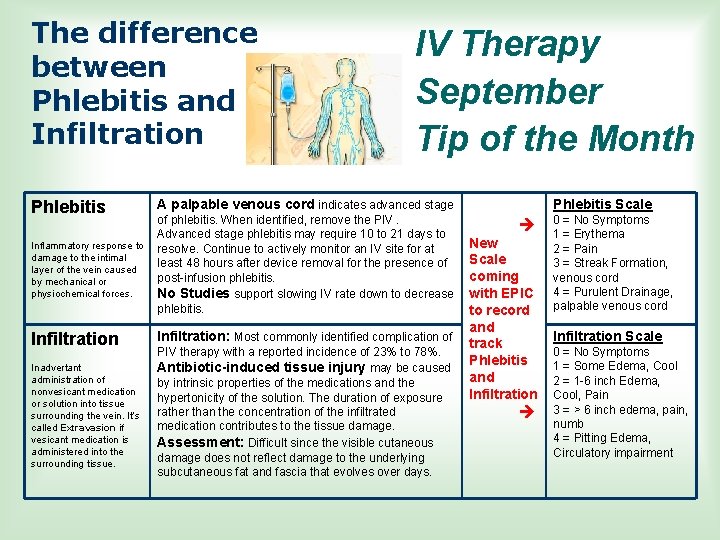
The difference between Phlebitis and Infiltration Phlebitis IV Therapy September Tip of the Month A palpable venous cord indicates advanced stage Inflammatory response to damage to the intimal layer of the vein caused by mechanical or physiochemical forces. of phlebitis. When identified, remove the PIV. Advanced stage phlebitis may require 10 to 21 days to resolve. Continue to actively monitor an IV site for at least 48 hours after device removal for the presence of post-infusion phlebitis. No Studies support slowing IV rate down to decrease phlebitis. Infiltration: Most commonly identified complication of Inadvertant administration of nonvesicant medication or solution into tissue surrounding the vein. It’s called Extravasion if vesicant medication is administered into the surrounding tissue. PIV therapy with a reported incidence of 23% to 78%. Antibiotic-induced tissue injury may be caused by intrinsic properties of the medications and the hypertonicity of the solution. The duration of exposure rather than the concentration of the infiltrated medication contributes to the tissue damage. Assessment: Difficult since the visible cutaneous damage does not reflect damage to the underlying subcutaneous fat and fascia that evolves over days. Phlebitis Scale New Scale coming with EPIC to record and track Phlebitis and Infiltration 0 = No Symptoms 1 = Erythema 2 = Pain 3 = Streak Formation, venous cord 4 = Purulent Drainage, palpable venous cord Infiltration Scale 0 = No Symptoms 1 = Some Edema, Cool 2 = 1 -6 inch Edema, Cool, Pain 3 = > 6 inch edema, pain, numb 4 = Pitting Edema, Circulatory impairment
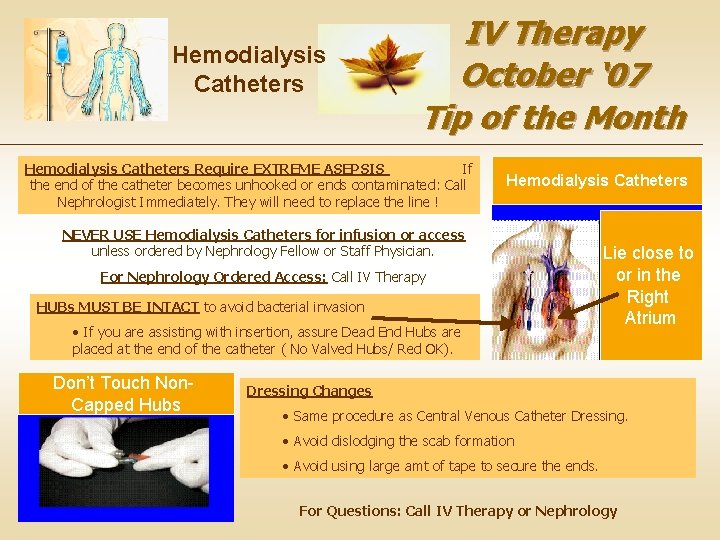
Hemodialysis Catheters IV Therapy October ‘ 07 Tip of the Month Hemodialysis Catheters Require EXTREME ASEPSIS If the end of the catheter becomes unhooked or ends contaminated: Call Nephrologist Immediately. They will need to replace the line ! Hemodialysis Catheters NEVER USE Hemodialysis Catheters for infusion or access unless ordered by Nephrology Fellow or Staff Physician. For Nephrology Ordered Access: Call IV Therapy HUBs MUST BE INTACT to avoid bacterial invasion • If you are assisting with insertion, assure Dead End Hubs are placed at the end of the catheter ( No Valved Hubs/ Red OK). Don’t Touch Non. Capped Hubs Lie close to or in the Right Atrium Dressing Changes • Same procedure as Central Venous Catheter Dressing. • Avoid dislodging the scab formation • Avoid using large amt of tape to secure the ends. For Questions: Call IV Therapy or Nephrology
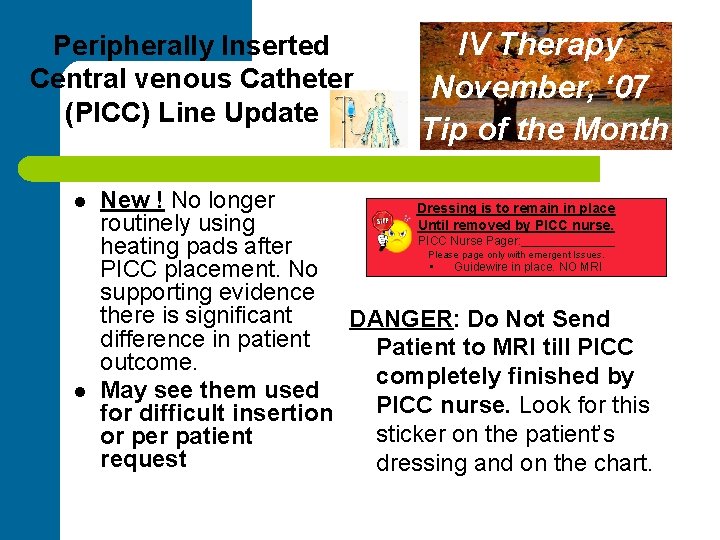
Peripherally Inserted Central venous Catheter (PICC) Line Update l l IV Therapy November, ‘ 07 Tip of the Month New ! No longer Dressing is to remain in place Until removed by PICC nurse. routinely using PICC Nurse Pager: _______ heating pads after Please page only with emergent Issues. • Guidewire in place. NO MRI PICC placement. No supporting evidence there is significant DANGER: Do Not Send difference in patient Patient to MRI till PICC outcome. completely finished by May see them used PICC nurse. Look for this for difficult insertion sticker on the patient’s or per patient request dressing and on the chart.
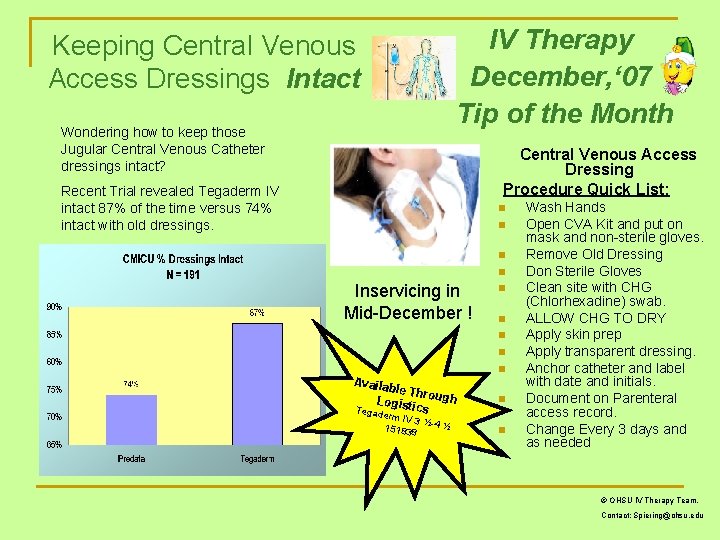
IV Therapy December, ‘ 07 Tip of the Month Keeping Central Venous Access Dressings Intact Wondering how to keep those Jugular Central Venous Catheter dressings intact? Central Venous Access Dressing Procedure Quick List: Recent Trial revealed Tegaderm IV intact 87% of the time versus 74% intact with old dressings. n n Inservicing in Mid-December ! n n Availa ble Th r Logist ough ics Tegade rm IV 3 ½ 151838 -4 ½ n n n Wash Hands Open CVA Kit and put on mask and non-sterile gloves. Remove Old Dressing Don Sterile Gloves Clean site with CHG (Chlorhexadine) swab. ALLOW CHG TO DRY Apply skin prep Apply transparent dressing. Anchor catheter and label with date and initials. Document on Parenteral access record. Change Every 3 days and as needed © OHSU IV Therapy Team. Contact: Spiering@ohsu. edu