
Define and Deploy an Enterprise PMO Transform your
- Slides: 23
Define and Deploy an Enterprise PMO Transform your disconnected silos into an interdependent portfolio network. Info-Tech Research Group, Inc. is a global leader in providing IT research and advice. Info-Tech’s products and services combine actionable insight and relevant advice with ready-to-use tools and templates that cover the full spectrum of IT concerns. © 1997 -2015 Info-Tech Research Group Inc. Info-Tech Research Group 1
Our understanding of the problem This Research is Is Designed For: This Research Will Help You: üIT or business leaders who have been tasked üClarify your needs to ensure your EPMO with instituting, evolving, or interacting with an enterprise PMO. creates greater stakeholder satisfaction across the organization. üDefine an EPMO framework that helps foster success on large, strategic initiatives. üDevelop an EPMO that is sustainable for the long run and doesn’t contribute to the high failure rate that plagues most new PMOs. This Research Will Also Assist: This Research Will Help You: Them: üPMO directors (or equivalent) who are üImplement tactical enterprise PPM practices required to take on more enterprise level responsibility for large, strategic initiatives. and solutions into existing processes to help foster better communication and collaboration across departments. Info-Tech Research Group 2
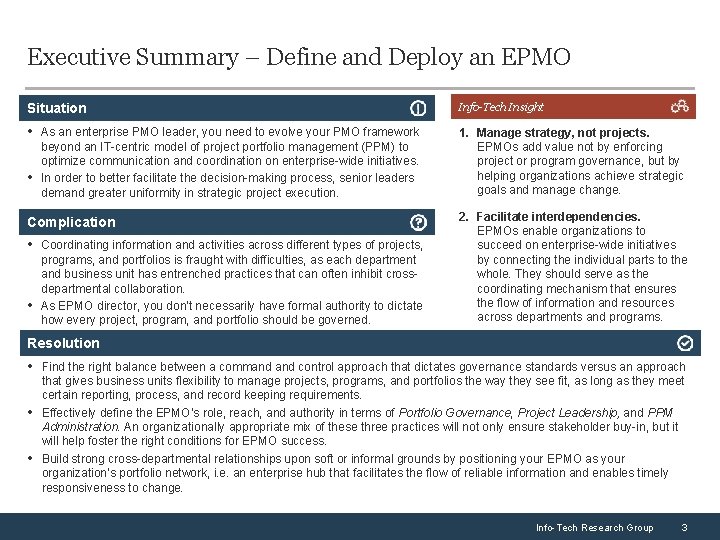
Executive Summary – Define and Deploy an EPMO Situation Info-Tech Insight • As an enterprise PMO leader, you need to evolve your PMO framework 1. Manage strategy, not projects. EPMOs add value not by enforcing project or program governance, but by helping organizations achieve strategic goals and manage change. • beyond an IT-centric model of project portfolio management (PPM) to optimize communication and coordination on enterprise-wide initiatives. In order to better facilitate the decision-making process, senior leaders demand greater uniformity in strategic project execution. Complication • Coordinating information and activities across different types of projects, • programs, and portfolios is fraught with difficulties, as each department and business unit has entrenched practices that can often inhibit crossdepartmental collaboration. As EPMO director, you don’t necessarily have formal authority to dictate how every project, program, and portfolio should be governed. 2. Facilitate interdependencies. EPMOs enable organizations to succeed on enterprise-wide initiatives by connecting the individual parts to the whole. They should serve as the coordinating mechanism that ensures the flow of information and resources across departments and programs. Resolution • Find the right balance between a command control approach that dictates governance standards versus an approach • • that gives business units flexibility to manage projects, programs, and portfolios the way they see fit, as long as they meet certain reporting, process, and record keeping requirements. Effectively define the EPMO’s role, reach, and authority in terms of Portfolio Governance, Project Leadership, and PPM Administration. An organizationally appropriate mix of these three practices will not only ensure stakeholder buy-in, but it will help foster the right conditions for EPMO success. Build strong cross-departmental relationships upon soft or informal grounds by positioning your EPMO as your organization’s portfolio network, i. e. an enterprise hub that facilitates the flow of reliable information and enables timely responsiveness to change. Info-Tech Research Group 3
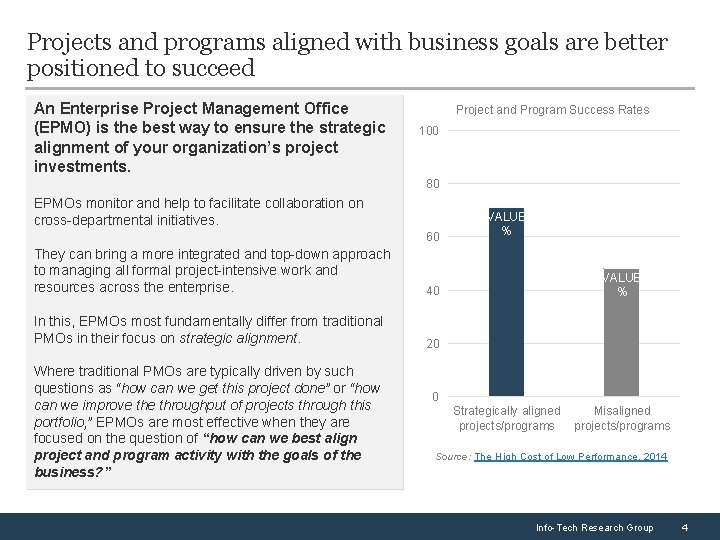
Projects and programs aligned with business goals are better positioned to succeed An Enterprise Project Management Office (EPMO) is the best way to ensure the strategic alignment of your organization’s project investments. Project and Program Success Rates 100 80 EPMOs monitor and help to facilitate collaboration on cross-departmental initiatives. 60 They can bring a more integrated and top-down approach to managing all formal project-intensive work and resources across the enterprise. 40 In this, EPMOs most fundamentally differ from traditional PMOs in their focus on strategic alignment. 20 Where traditional PMOs are typically driven by such questions as “how can we get this project done” or “how can we improve throughput of projects through this portfolio, ” EPMOs are most effective when they are focused on the question of “how can we best align project and program activity with the goals of the business? ” [VALUE] % 0 Strategically aligned projects/programs Misaligned projects/programs Source: The High Cost of Low Performance, 2014 Info-Tech Research Group 4
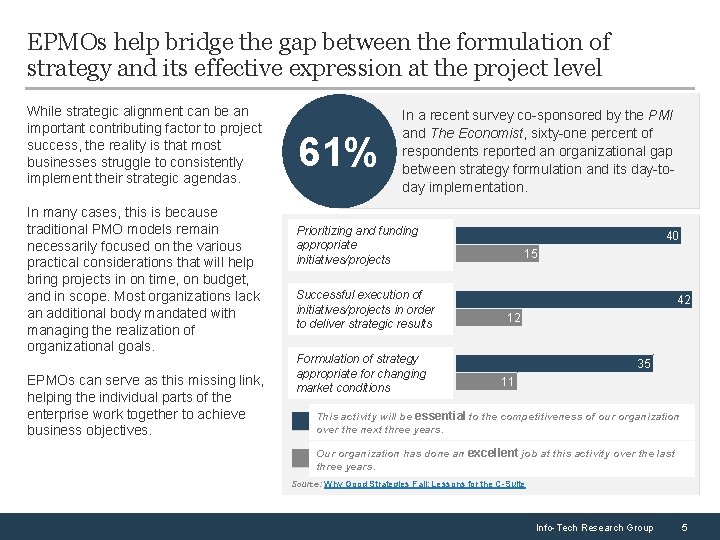
EPMOs help bridge the gap between the formulation of strategy and its effective expression at the project level While strategic alignment can be an important contributing factor to project success, the reality is that most businesses struggle to consistently implement their strategic agendas. In many cases, this is because traditional PMO models remain necessarily focused on the various practical considerations that will help bring projects in on time, on budget, and in scope. Most organizations lack an additional body mandated with managing the realization of organizational goals. EPMOs can serve as this missing link, helping the individual parts of the enterprise work together to achieve business objectives. 61% In a recent survey co-sponsored by the PMI and The Economist, sixty-one percent of respondents reported an organizational gap between strategy formulation and its day-today implementation. Prioritizing and funding appropriate initiatives/projects Successful execution of initiatives/projects in order to deliver strategic results Formulation of strategy appropriate for changing market conditions 40 15 42 12 35 11 This activity will be essential to the competitiveness of our organization over the next three years. Our organization has done an excellent job at this activity over the last three years. Source: Why Good Strategies Fail: Lessons for the C-Suite Info-Tech Research Group 5
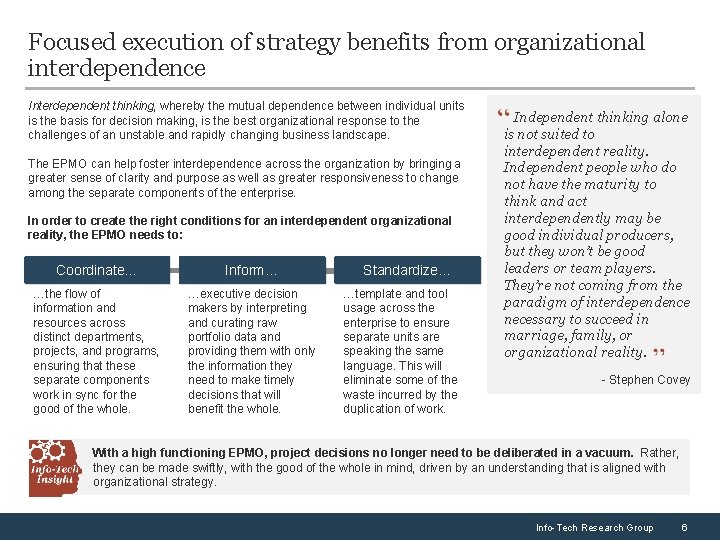
Focused execution of strategy benefits from organizational interdependence Interdependent thinking, whereby the mutual dependence between individual units is the basis for decision making, is the best organizational response to the challenges of an unstable and rapidly changing business landscape. The EPMO can help foster interdependence across the organization by bringing a greater sense of clarity and purpose as well as greater responsiveness to change among the separate components of the enterprise. In order to create the right conditions for an interdependent organizational reality, the EPMO needs to: Coordinate… Inform… …the flow of information and resources across distinct departments, projects, and programs, ensuring that these separate components work in sync for the good of the whole. …executive decision makers by interpreting and curating raw portfolio data and providing them with only the information they need to make timely decisions that will benefit the whole. Standardize… …template and tool usage across the enterprise to ensure separate units are speaking the same language. This will eliminate some of the waste incurred by the duplication of work. Independent thinking alone is not suited to interdependent reality. Independent people who do not have the maturity to think and act interdependently may be good individual producers, but they won’t be good leaders or team players. They’re not coming from the paradigm of interdependence necessary to succeed in marriage, family, or organizational reality. - Stephen Covey With a high functioning EPMO, project decisions no longer need to be deliberated in a vacuum. Rather, they can be made swiftly, with the good of the whole in mind, driven by an understanding that is aligned with organizational strategy. Info-Tech Research Group 6
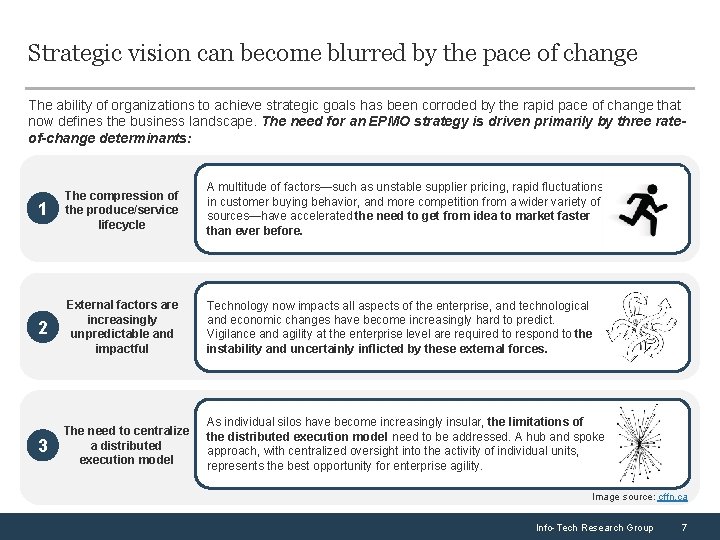
Strategic vision can become blurred by the pace of change The ability of organizations to achieve strategic goals has been corroded by the rapid pace of change that now defines the business landscape. The need for an EPMO strategy is driven primarily by three rateof-change determinants: 1 The compression of the produce/service lifecycle A multitude of factors—such as unstable supplier pricing, rapid fluctuations in customer buying behavior, and more competition from a wider variety of sources—have accelerated the need to get from idea to market faster than ever before. 2 External factors are increasingly unpredictable and impactful Technology now impacts all aspects of the enterprise, and technological and economic changes have become increasingly hard to predict. Vigilance and agility at the enterprise level are required to respond to the instability and uncertainly inflicted by these external forces. 3 The need to centralize a distributed execution model As individual silos have become increasingly insular, the limitations of the distributed execution model need to be addressed. A hub and spoke approach, with centralized oversight into the activity of individual units, represents the best opportunity for enterprise agility. Image source: cffn. ca Info-Tech Research Group 7
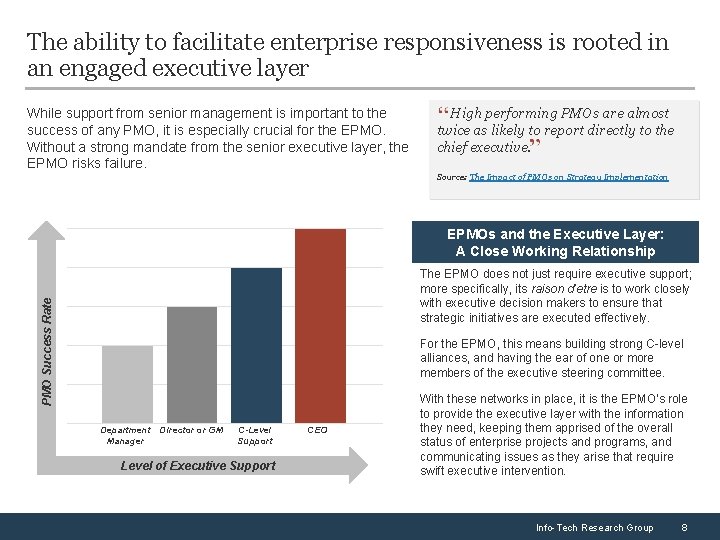
The ability to facilitate enterprise responsiveness is rooted in an engaged executive layer While support from senior management is important to the success of any PMO, it is especially crucial for the EPMO. Without a strong mandate from the senior executive layer, the EPMO risks failure. High performing PMOs are almost twice as likely to report directly to the chief executive. Source: The Impact of PMOs on Strategy Implementation EPMOs and the Executive Layer: A Close Working Relationship PMO Success Rate The EPMO does not just require executive support; more specifically, its raison d’etre is to work closely with executive decision makers to ensure that strategic initiatives are executed effectively. For the EPMO, this means building strong C-level alliances, and having the ear of one or more members of the executive steering committee. Department Manager Director or GM C-Level Support Level of Executive Support CEO With these networks in place, it is the EPMO’s role to provide the executive layer with the information they need, keeping them apprised of the overall status of enterprise projects and programs, and communicating issues as they arise that require swift executive intervention. Info-Tech Research Group 8
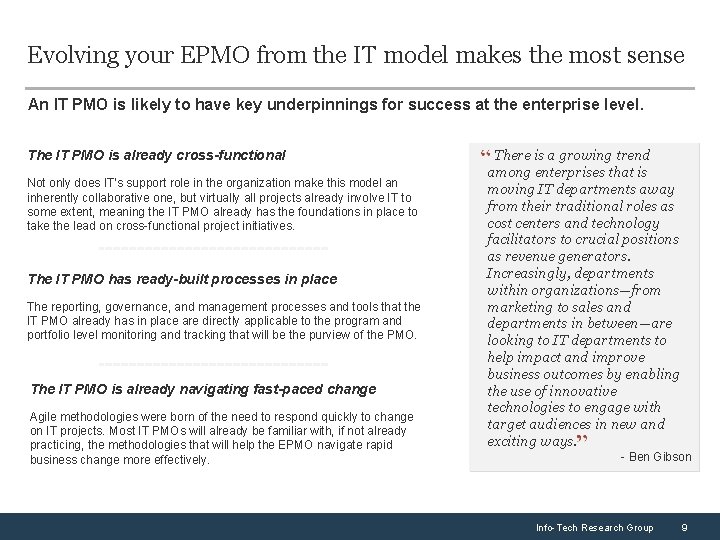
Evolving your EPMO from the IT model makes the most sense An IT PMO is likely to have key underpinnings for success at the enterprise level. The IT PMO is already cross-functional Not only does IT’s support role in the organization make this model an inherently collaborative one, but virtually all projects already involve IT to some extent, meaning the IT PMO already has the foundations in place to take the lead on cross-functional project initiatives. The IT PMO has ready-built processes in place The reporting, governance, and management processes and tools that the IT PMO already has in place are directly applicable to the program and portfolio level monitoring and tracking that will be the purview of the PMO. The IT PMO is already navigating fast-paced change Agile methodologies were born of the need to respond quickly to change on IT projects. Most IT PMOs will already be familiar with, if not already practicing, the methodologies that will help the EPMO navigate rapid business change more effectively. There is a growing trend among enterprises that is moving IT departments away from their traditional roles as cost centers and technology facilitators to crucial positions as revenue generators. Increasingly, departments within organizations—from marketing to sales and departments in between—are looking to IT departments to help impact and improve business outcomes by enabling the use of innovative technologies to engage with target audiences in new and exciting ways. - Ben Gibson Info-Tech Research Group 9
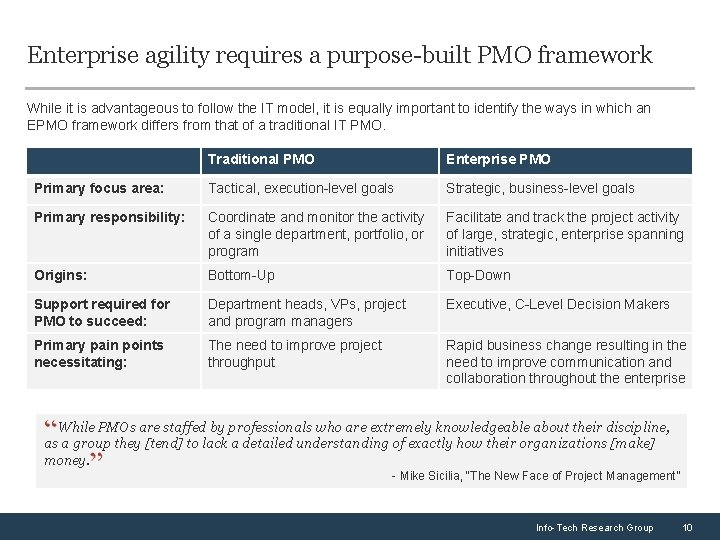
Enterprise agility requires a purpose-built PMO framework While it is advantageous to follow the IT model, it is equally important to identify the ways in which an EPMO framework differs from that of a traditional IT PMO. Traditional PMO Enterprise PMO Primary focus area: Tactical, execution-level goals Strategic, business-level goals Primary responsibility: Coordinate and monitor the activity of a single department, portfolio, or program Facilitate and track the project activity of large, strategic, enterprise spanning initiatives Origins: Bottom-Up Top-Down Support required for PMO to succeed: Department heads, VPs, project and program managers Executive, C-Level Decision Makers Primary pain points necessitating: The need to improve project throughput Rapid business change resulting in the need to improve communication and collaboration throughout the enterprise While PMOs are staffed by professionals who are extremely knowledgeable about their discipline, as a group they [tend] to lack a detailed understanding of exactly how their organizations [make] money. - Mike Sicilia, “The New Face of Project Management” Info-Tech Research Group 10
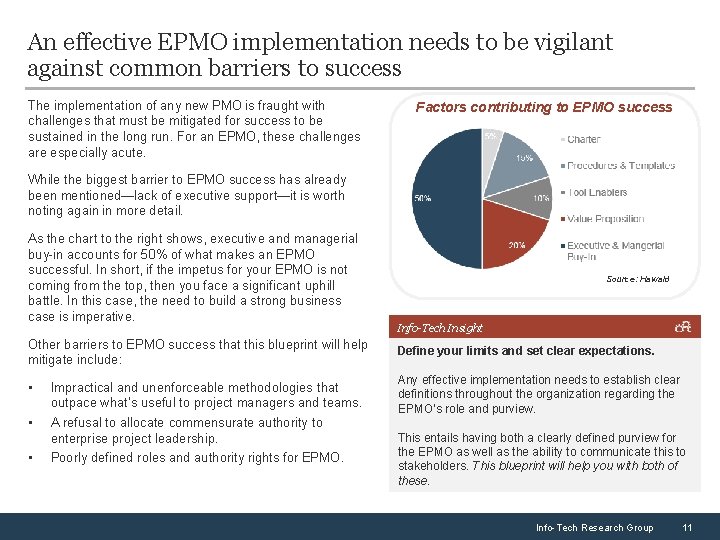
An effective EPMO implementation needs to be vigilant against common barriers to success The implementation of any new PMO is fraught with challenges that must be mitigated for success to be sustained in the long run. For an EPMO, these challenges are especially acute. Factors contributing to EPMO success While the biggest barrier to EPMO success has already been mentioned—lack of executive support—it is worth noting again in more detail. As the chart to the right shows, executive and managerial buy-in accounts for 50% of what makes an EPMO successful. In short, if the impetus for your EPMO is not coming from the top, then you face a significant uphill battle. In this case, the need to build a strong business case is imperative. Other barriers to EPMO success that this blueprint will help mitigate include: • Impractical and unenforceable methodologies that outpace what’s useful to project managers and teams. • A refusal to allocate commensurate authority to enterprise project leadership. • Poorly defined roles and authority rights for EPMO. Source: Hawald Info-Tech Insight Define your limits and set clear expectations. Any effective implementation needs to establish clear definitions throughout the organization regarding the EPMO’s role and purview. This entails having both a clearly defined purview for the EPMO as well as the ability to communicate this to stakeholders. This blueprint will help you with both of these. Info-Tech Research Group 11
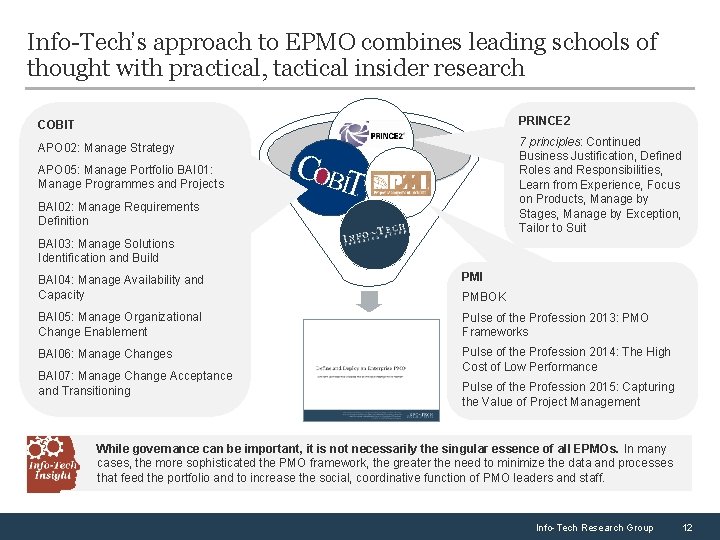
Info-Tech’s approach to EPMO combines leading schools of thought with practical, tactical insider research PRINCE 2 COBIT 7 principles: Continued Business Justification, Defined Roles and Responsibilities, Learn from Experience, Focus on Products, Manage by Stages, Manage by Exception, Tailor to Suit APO 02: Manage Strategy APO 05: Manage Portfolio BAI 01: Manage Programmes and Projects BAI 02: Manage Requirements Definition BAI 03: Manage Solutions Identification and Build BAI 04: Manage Availability and Capacity PMI BAI 05: Manage Organizational Change Enablement Pulse of the Profession 2013: PMO Frameworks BAI 06: Manage Changes Pulse of the Profession 2014: The High Cost of Low Performance BAI 07: Manage Change Acceptance and Transitioning PMBOK Pulse of the Profession 2015: Capturing the Value of Project Management While governance can be important, it is not necessarily the singular essence of all EPMOs. In many cases, the more sophisticated the PMO framework, the greater the need to minimize the data and processes that feed the portfolio and to increase the social, coordinative function of PMO leaders and staff. Info-Tech Research Group 12
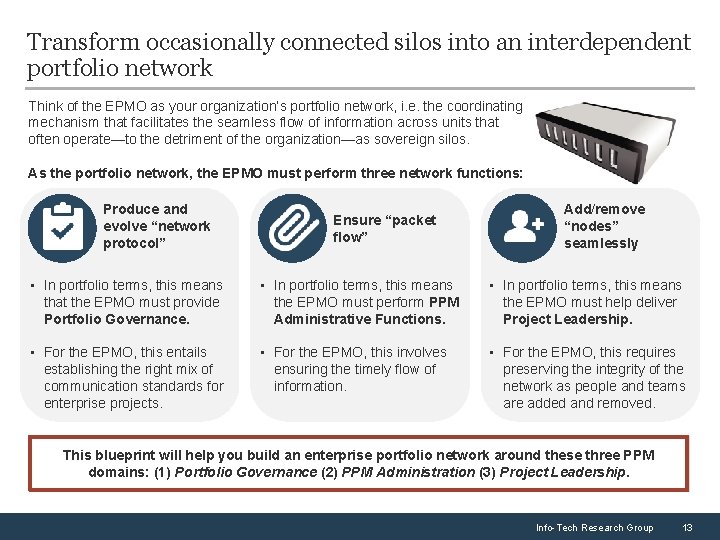
Transform occasionally connected silos into an interdependent portfolio network Think of the EPMO as your organization’s portfolio network, i. e. the coordinating mechanism that facilitates the seamless flow of information across units that often operate—to the detriment of the organization—as sovereign silos. As the portfolio network, the EPMO must perform three network functions: Produce and evolve “network protocol” Ensure “packet flow” Add/remove “nodes” seamlessly • In portfolio terms, this means that the EPMO must provide Portfolio Governance. • In portfolio terms, this means the EPMO must perform PPM Administrative Functions. • In portfolio terms, this means the EPMO must help deliver Project Leadership. • For the EPMO, this entails establishing the right mix of communication standards for enterprise projects. • For the EPMO, this involves ensuring the timely flow of information. • For the EPMO, this requires preserving the integrity of the network as people and teams are added and removed. This blueprint will help you build an enterprise portfolio network around these three PPM domains: (1) Portfolio Governance (2) PPM Administration (3) Project Leadership. Info-Tech Research Group 13
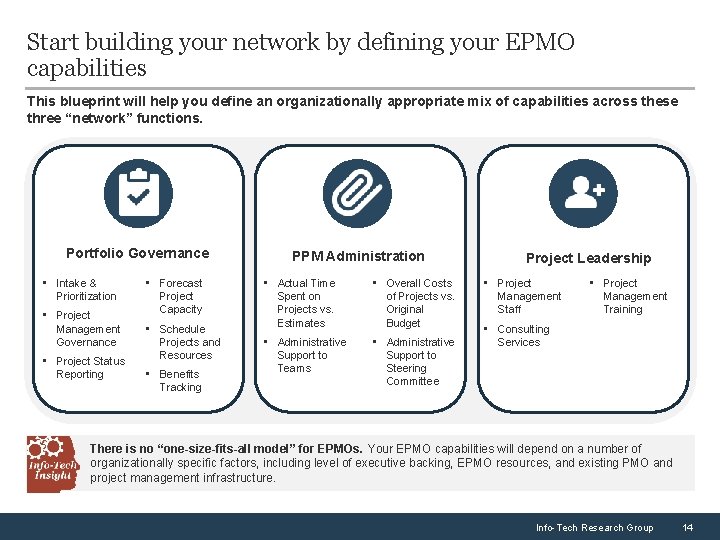
Start building your network by defining your EPMO capabilities This blueprint will help you define an organizationally appropriate mix of capabilities across these three “network” functions. Portfolio Governance • Intake & Prioritization • Project Management Governance • Project Status Reporting • Forecast Project Capacity • Schedule Projects and Resources • Benefits Tracking PPM Administration • Actual Time Spent on Projects vs. Estimates • Overall Costs of Projects vs. Original Budget • Administrative Support to Teams • Administrative Support to Steering Committee Project Leadership • Project Management Staff • Project Management Training • Consulting Services There is no “one-size-fits-all model” for EPMOs. Your EPMO capabilities will depend on a number of organizationally specific factors, including level of executive backing, EPMO resources, and existing PMO and project management infrastructure. Info-Tech Research Group 14
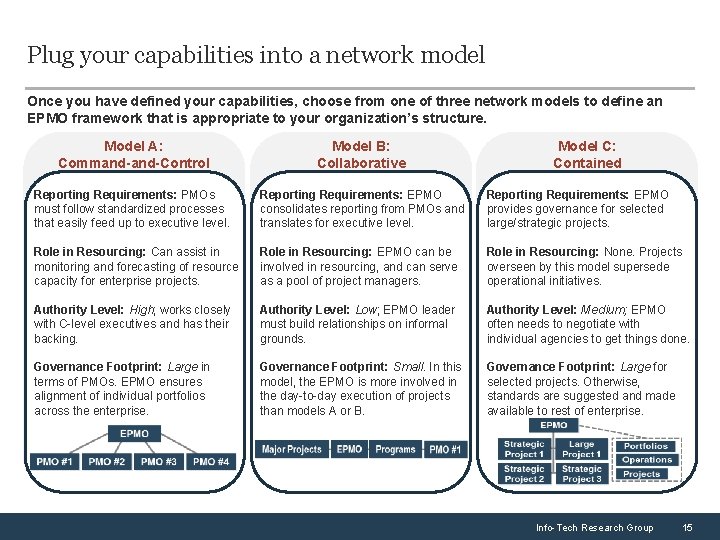
Plug your capabilities into a network model Once you have defined your capabilities, choose from one of three network models to define an EPMO framework that is appropriate to your organization’s structure. Model A: Command-Control Model B: Collaborative Model C: Contained Reporting Requirements: PMOs must follow standardized processes that easily feed up to executive level. Reporting Requirements: EPMO consolidates reporting from PMOs and translates for executive level. Reporting Requirements: EPMO provides governance for selected large/strategic projects. Role in Resourcing: Can assist in monitoring and forecasting of resource capacity for enterprise projects. Role in Resourcing: EPMO can be involved in resourcing, and can serve as a pool of project managers. Role in Resourcing: None. Projects overseen by this model supersede operational initiatives. Authority Level: High; works closely with C-level executives and has their backing. Authority Level: Low; EPMO leader must build relationships on informal grounds. Authority Level: Medium; EPMO often needs to negotiate with individual agencies to get things done. Governance Footprint: Large in terms of PMOs. EPMO ensures alignment of individual portfolios across the enterprise. Governance Footprint: Small. In this model, the EPMO is more involved in the day-to-day execution of projects than models A or B. Governance Footprint: Large for selected projects. Otherwise, standards are suggested and made available to rest of enterprise. Info-Tech Research Group 15
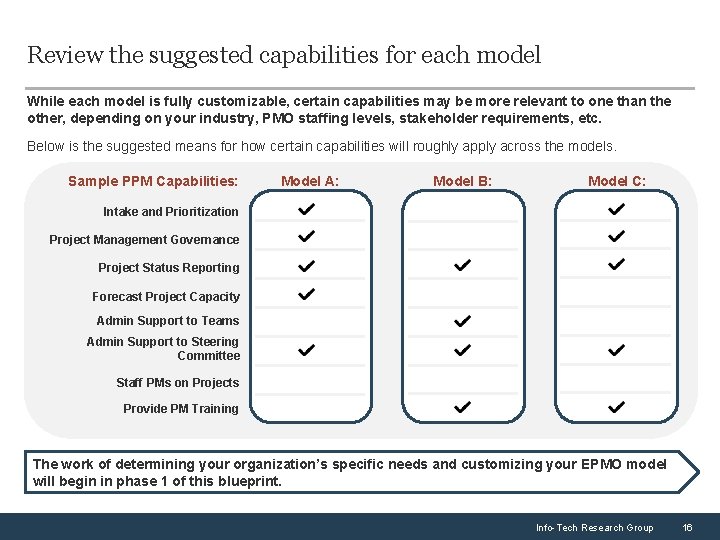
Review the suggested capabilities for each model While each model is fully customizable, certain capabilities may be more relevant to one than the other, depending on your industry, PMO staffing levels, stakeholder requirements, etc. Below is the suggested means for how certain capabilities will roughly apply across the models. Sample PPM Capabilities: Model A: Model B: Model C: Intake and Prioritization Project Management Governance Project Status Reporting Forecast Project Capacity Admin Support to Teams Admin Support to Steering Committee Staff PMs on Projects Provide PM Training The work of determining your organization’s specific needs and customizing your EPMO model will begin in phase 1 of this blueprint. Info-Tech Research Group 16
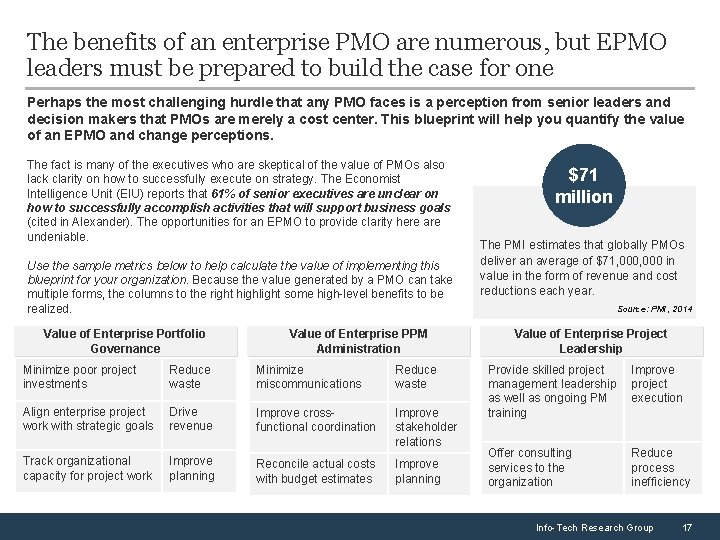
The benefits of an enterprise PMO are numerous, but EPMO leaders must be prepared to build the case for one Perhaps the most challenging hurdle that any PMO faces is a perception from senior leaders and decision makers that PMOs are merely a cost center. This blueprint will help you quantify the value of an EPMO and change perceptions. The fact is many of the executives who are skeptical of the value of PMOs also lack clarity on how to successfully execute on strategy. The Economist Intelligence Unit (EIU) reports that 61% of senior executives are unclear on how to successfully accomplish activities that will support business goals (cited in Alexander). The opportunities for an EPMO to provide clarity here are undeniable. Use the sample metrics below to help calculate the value of implementing this blueprint for your organization. Because the value generated by a PMO can take multiple forms, the columns to the right highlight some high-level benefits to be realized. Value of Enterprise Portfolio Governance Value of Enterprise PPM Administration Minimize poor project investments Reduce waste Minimize miscommunications Reduce waste Align enterprise project work with strategic goals Drive revenue Improve crossfunctional coordination Improve stakeholder relations Track organizational capacity for project work Improve planning Reconcile actual costs with budget estimates Improve planning $71 million The PMI estimates that globally PMOs deliver an average of $71, 000 in value in the form of revenue and cost reductions each year. Source: PMI, 2014 Value of Enterprise Project Leadership Provide skilled project management leadership as well as ongoing PM training Improve project execution Offer consulting services to the organization Reduce process inefficiency Info-Tech Research Group 17
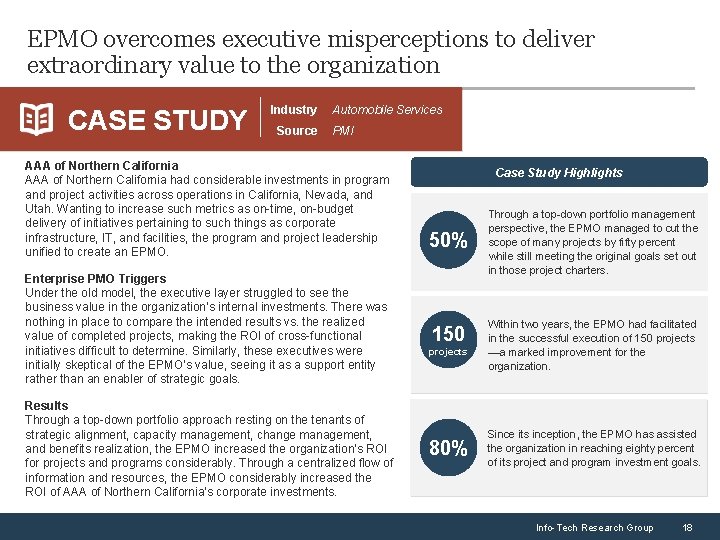
EPMO overcomes executive misperceptions to deliver extraordinary value to the organization CASE STUDY Industry Source Automobile Services PMI AAA of Northern California had considerable investments in program and project activities across operations in California, Nevada, and Utah. Wanting to increase such metrics as on-time, on-budget delivery of initiatives pertaining to such things as corporate infrastructure, IT, and facilities, the program and project leadership unified to create an EPMO. Enterprise PMO Triggers Under the old model, the executive layer struggled to see the business value in the organization’s internal investments. There was nothing in place to compare the intended results vs. the realized value of completed projects, making the ROI of cross-functional initiatives difficult to determine. Similarly, these executives were initially skeptical of the EPMO’s value, seeing it as a support entity rather than an enabler of strategic goals. Results Through a top-down portfolio approach resting on the tenants of strategic alignment, capacity management, change management, and benefits realization, the EPMO increased the organization’s ROI for projects and programs considerably. Through a centralized flow of information and resources, the EPMO considerably increased the ROI of AAA of Northern California’s corporate investments. Case Study Highlights 50% 150 projects 80% Through a top-down portfolio management perspective, the EPMO managed to cut the scope of many projects by fifty percent while still meeting the original goals set out in those project charters. Within two years, the EPMO had facilitated in the successful execution of 150 projects —a marked improvement for the organization. Since its inception, the EPMO has assisted the organization in reaching eighty percent of its project and program investment goals. Info-Tech Research Group 18
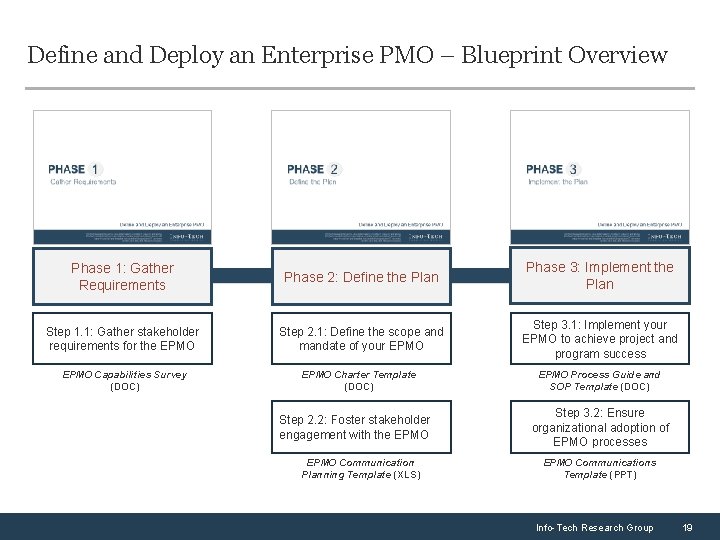
Define and Deploy an Enterprise PMO – Blueprint Overview Phase 1: Gather Requirements Phase 2: Define the Plan Phase 3: Implement the Plan Step 1. 1: Gather stakeholder requirements for the EPMO Step 2. 1: Define the scope and mandate of your EPMO Step 3. 1: Implement your EPMO to achieve project and program success EPMO Capabilities Survey (DOC) EPMO Charter Template (DOC) EPMO Process Guide and SOP Template (DOC) Step 2. 2: Foster stakeholder engagement with the EPMO Communication Planning Template (XLS) Step 3. 2: Ensure organizational adoption of EPMO processes EPMO Communications Template (PPT) Info-Tech Research Group 19
Use these icons to help direct you as you navigate this research Use these icons to help guide you through each step of the blueprint and direct you to content related to the recommended activities. This icon denotes a slide where a supporting Info-Tech tool or template will help you perform the activity or step associated with the slide. Refer to the supporting tool or template to get the best results and proceed to the next step of the project. This icon denotes a slide with an associated activity. The activity can be performed either as part of your project or with the support of Info-Tech team members who will come onsite to facilitate a workshop for your organization. Info-Tech Research Group 20
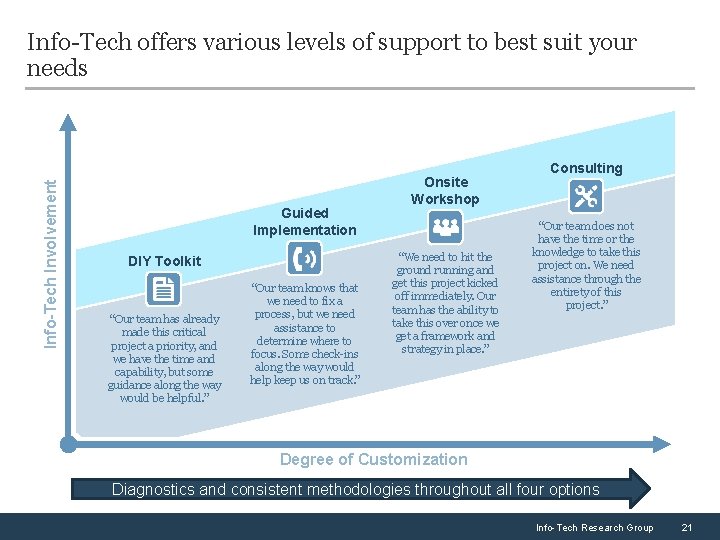
Info-Tech Involvement Info-Tech offers various levels of support to best suit your needs Guided Implementation DIY Toolkit “Our team has already made this critical project a priority, and we have the time and capability, but some guidance along the way would be helpful. ” “Our team knows that we need to fix a process, but we need assistance to determine where to focus. Some check-ins along the way would help keep us on track. ” Onsite Workshop “We need to hit the ground running and get this project kicked off immediately. Our team has the ability to take this over once we get a framework and strategy in place. ” Consulting “Our team does not have the time or the knowledge to take this project on. We need assistance through the entirety of this project. ” Degree of Customization Diagnostics and consistent methodologies throughout all four options Info-Tech Research Group 21
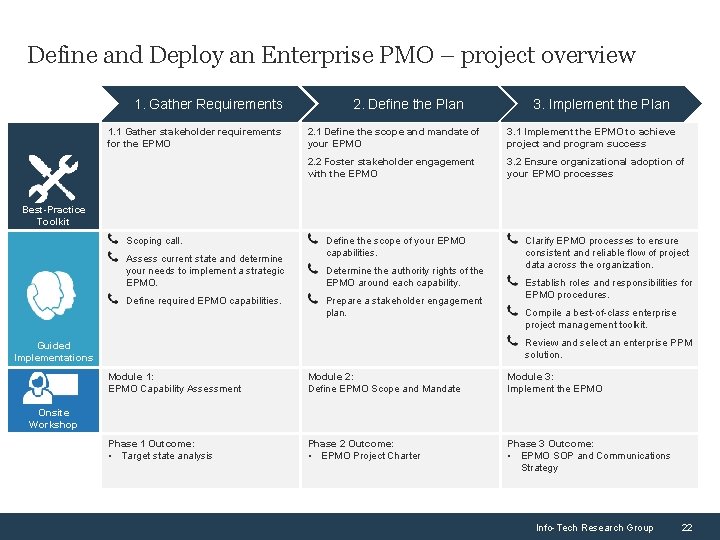
Define and Deploy an Enterprise PMO – project overview 1. Gather Requirements 1. 1 Gather stakeholder requirements for the EPMO 2. Define the Plan 3. Implement the Plan 2. 1 Define the scope and mandate of your EPMO 3. 1 Implement the EPMO to achieve project and program success 2. 2 Foster stakeholder engagement with the EPMO 3. 2 Ensure organizational adoption of your EPMO processes Best-Practice Toolkit Scoping call. Assess current state and determine your needs to implement a strategic EPMO. Define required EPMO capabilities. Define the scope of your EPMO capabilities. Determine the authority rights of the EPMO around each capability. Prepare a stakeholder engagement plan. Clarify EPMO processes to ensure consistent and reliable flow of project data across the organization. Establish roles and responsibilities for EPMO procedures. Compile a best-of-class enterprise project management toolkit. Review and select an enterprise PPM solution. Guided Implementations Module 1: EPMO Capability Assessment Module 2: Define EPMO Scope and Mandate Module 3: Implement the EPMO Phase 1 Outcome: • Target state analysis Phase 2 Outcome: • EPMO Project Charter Phase 3 Outcome: • EPMO SOP and Communications Strategy Onsite Workshop Info-Tech Research Group 22
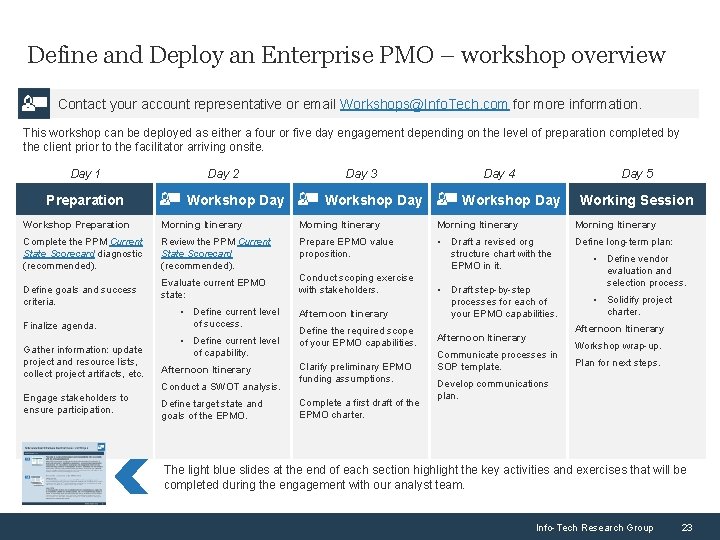
Define and Deploy an Enterprise PMO – workshop overview Contact your account representative or email Workshops@Info. Tech. com for more information. This workshop can be deployed as either a four or five day engagement depending on the level of preparation completed by the client prior to the facilitator arriving onsite. Day 1 Preparation Day 2 Workshop Day 3 Workshop Day 4 Day 5 Workshop Day Working Session Workshop Preparation Morning Itinerary Complete the PPM Current State Scorecard diagnostic (recommended). Review the PPM Current State Scorecard (recommended). Prepare EPMO value proposition. • Draft a revised org structure chart with the EPMO in it. Define long-term plan: Evaluate current EPMO state: Conduct scoping exercise with stakeholders. Define goals and success criteria. Finalize agenda. Gather information: update project and resource lists, collect project artifacts, etc. Engage stakeholders to ensure participation. • Define current level of success. • Define current level of capability. Afternoon Itinerary Conduct a SWOT analysis. Define target state and goals of the EPMO. Afternoon Itinerary • Draft step-by-step processes for each of your EPMO capabilities. Define the required scope of your EPMO capabilities. Afternoon Itinerary Clarify preliminary EPMO funding assumptions. Complete a first draft of the EPMO charter. • Define vendor evaluation and selection process. • Solidify project charter. Afternoon Itinerary Communicate processes in SOP template. Workshop wrap-up. Plan for next steps. Develop communications plan. The light blue slides at the end of each section highlight the key activities and exercises that will be completed during the engagement with our analyst team. Info-Tech Research Group 23