
Defibrillator q principles of operation function use scientific
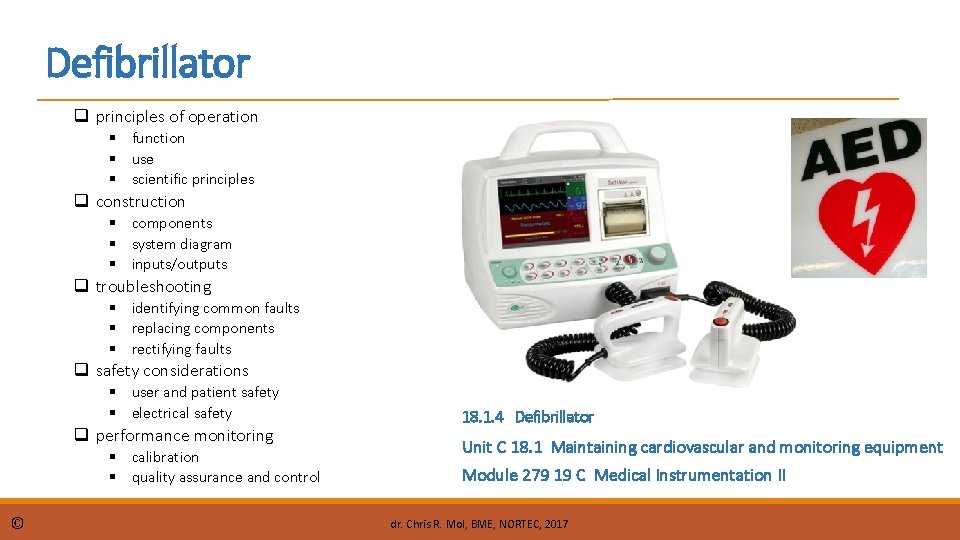
Defibrillator q principles of operation § function § use § scientific principles q construction § components § system diagram § inputs/outputs q troubleshooting § identifying common faults § replacing components § rectifying faults q safety considerations § user and patient safety § electrical safety q performance monitoring § calibration § quality assurance and control © 18. 1. 4 Defibrillator Unit C 18. 1 Maintaining cardiovascular and monitoring equipment Module 279 19 C Medical Instrumentation II dr. Chris R. Mol, BME, NORTEC, 2017
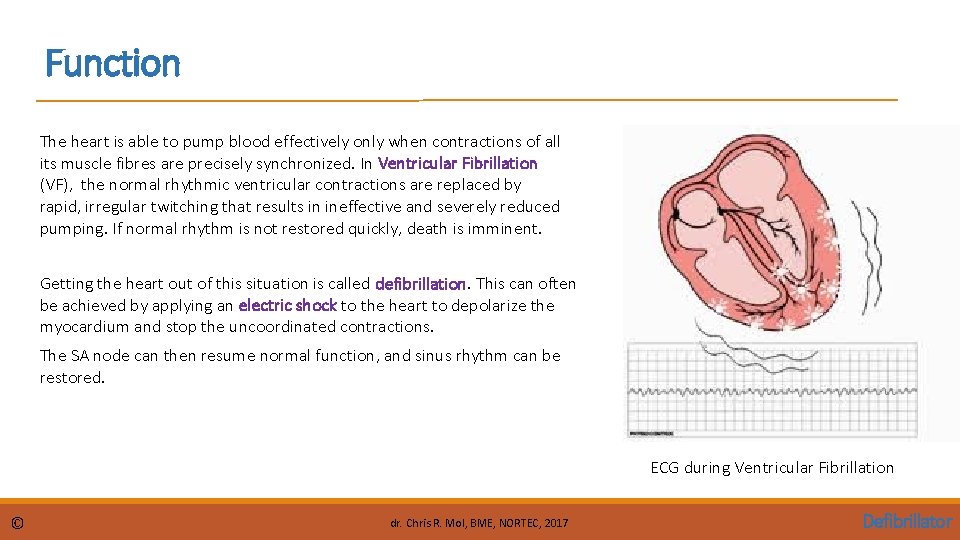
Function The heart is able to pump blood effectively only when contractions of all its muscle fibres are precisely synchronized. In Ventricular Fibrillation (VF), the normal rhythmic ventricular contractions are replaced by rapid, irregular twitching that results in ineffective and severely reduced pumping. If normal rhythm is not restored quickly, death is imminent. Getting the heart out of this situation is called defibrillation. This can often be achieved by applying an electric shock to the heart to depolarize the myocardium and stop the uncoordinated contractions. The SA node can then resume normal function, and sinus rhythm can be restored. ECG during Ventricular Fibrillation © dr. Chris R. Mol, BME, NORTEC, 2017 Defibrillator
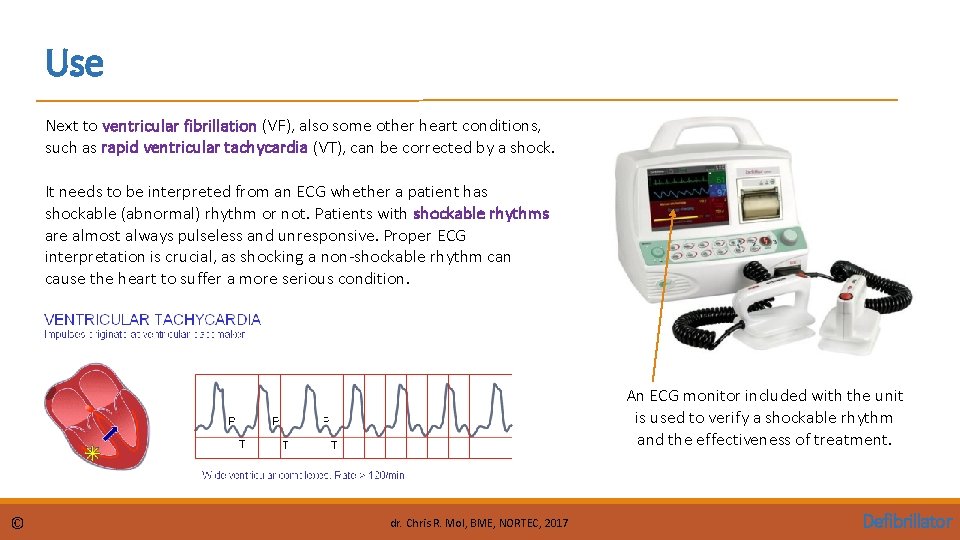
Use Next to ventricular fibrillation (VF), also some other heart conditions, such as rapid ventricular tachycardia (VT), can be corrected by a shock. It needs to be interpreted from an ECG whether a patient has shockable (abnormal) rhythm or not. Patients with shockable rhythms are almost always pulseless and unresponsive. Proper ECG interpretation is crucial, as shocking a non-shockable rhythm can cause the heart to suffer a more serious condition. An ECG monitor included with the unit is used to verify a shockable rhythm and the effectiveness of treatment. © dr. Chris R. Mol, BME, NORTEC, 2017 Defibrillator
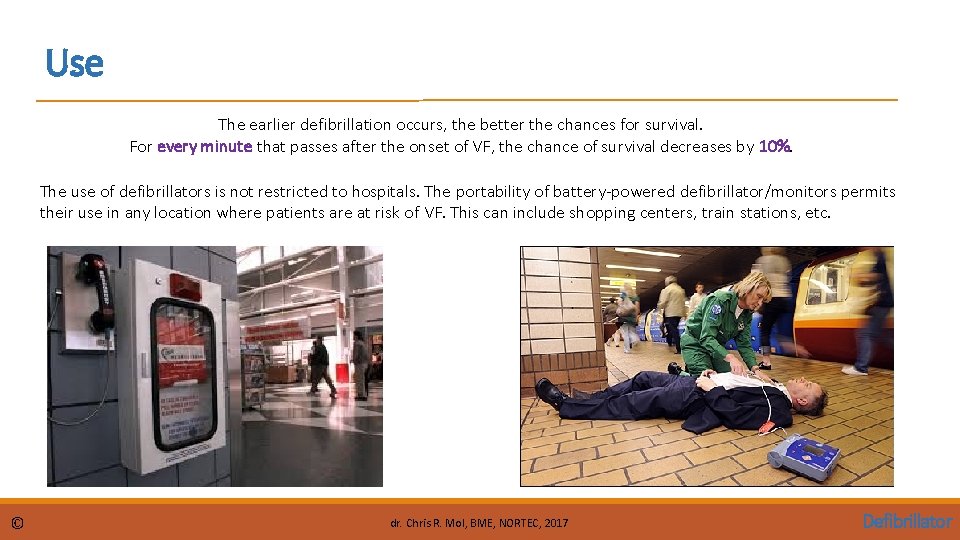
Use The earlier defibrillation occurs, the better the chances for survival. For every minute that passes after the onset of VF, the chance of survival decreases by 10%. The use of defibrillators is not restricted to hospitals. The portability of battery-powered defibrillator/monitors permits their use in any location where patients are at risk of VF. This can include shopping centers, train stations, etc. © dr. Chris R. Mol, BME, NORTEC, 2017 Defibrillator
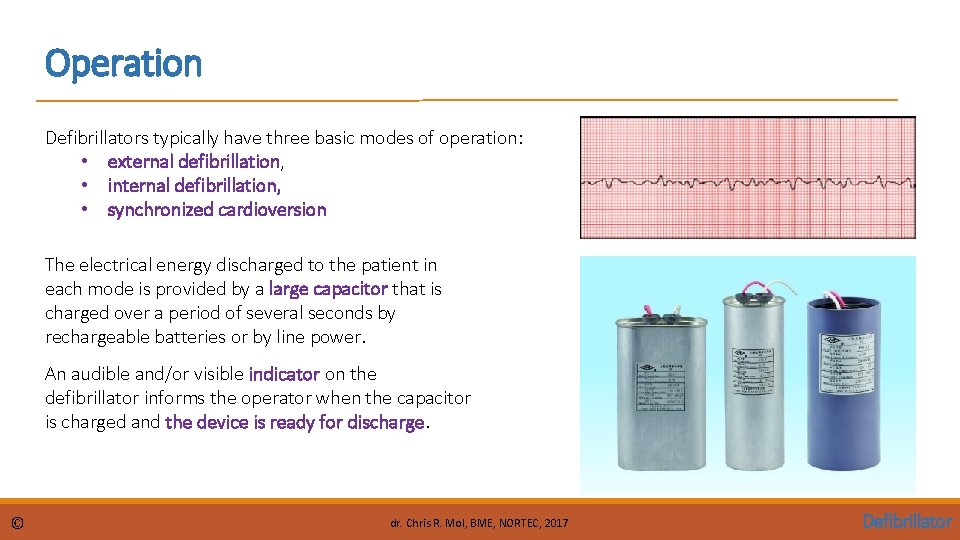
Operation Defibrillators typically have three basic modes of operation: • external defibrillation, • internal defibrillation, • synchronized cardioversion The electrical energy discharged to the patient in each mode is provided by a large capacitor that is charged over a period of several seconds by rechargeable batteries or by line power. An audible and/or visible indicator on the defibrillator informs the operator when the capacitor is charged and the device is ready for discharge. © dr. Chris R. Mol, BME, NORTEC, 2017 Defibrillator
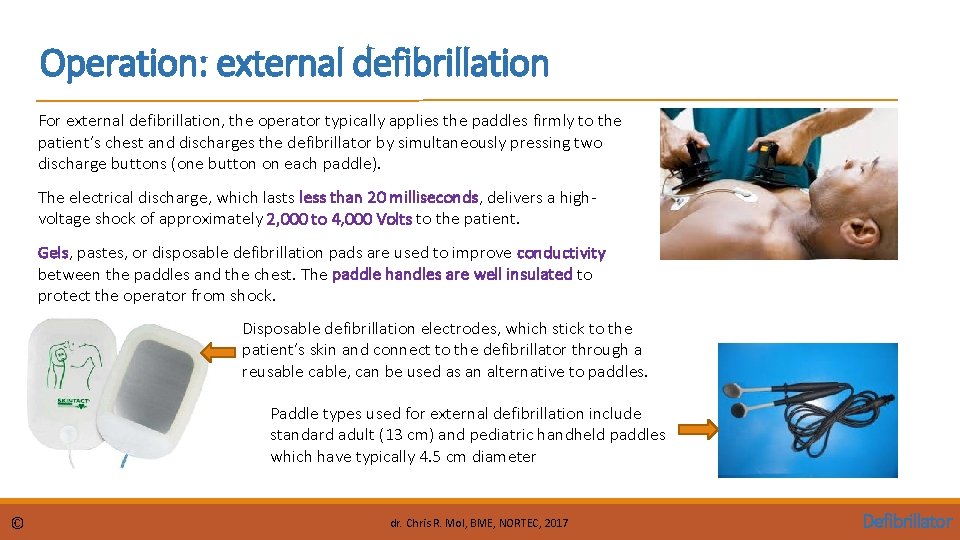
Operation: external defibrillation For external defibrillation, the operator typically applies the paddles firmly to the patient’s chest and discharges the defibrillator by simultaneously pressing two discharge buttons (one button on each paddle). The electrical discharge, which lasts less than 20 milliseconds, delivers a highvoltage shock of approximately 2, 000 to 4, 000 Volts to the patient. Gels, pastes, or disposable defibrillation pads are used to improve conductivity between the paddles and the chest. The paddle handles are well insulated to protect the operator from shock. Disposable defibrillation electrodes, which stick to the patient’s skin and connect to the defibrillator through a reusable cable, can be used as an alternative to paddles. Paddle types used for external defibrillation include standard adult (13 cm) and pediatric handheld paddles which have typically 4. 5 cm diameter © dr. Chris R. Mol, BME, NORTEC, 2017 Defibrillator
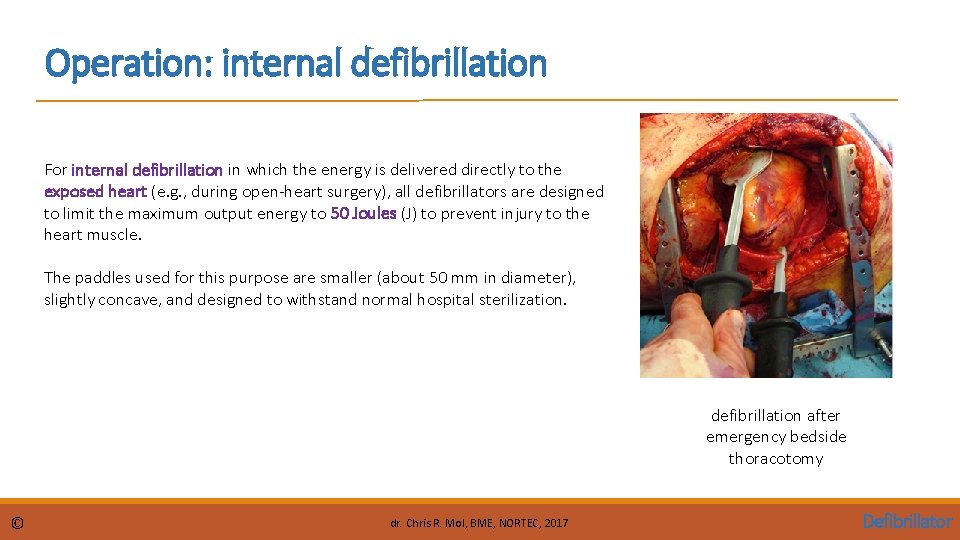
Operation: internal defibrillation For internal defibrillation in which the energy is delivered directly to the exposed heart (e. g. , during open-heart surgery), all defibrillators are designed to limit the maximum output energy to 50 Joules (J) to prevent injury to the heart muscle. The paddles used for this purpose are smaller (about 50 mm in diameter), slightly concave, and designed to withstand normal hospital sterilization. defibrillation after emergency bedside thoracotomy © dr. Chris R. Mol, BME, NORTEC, 2017 Defibrillator
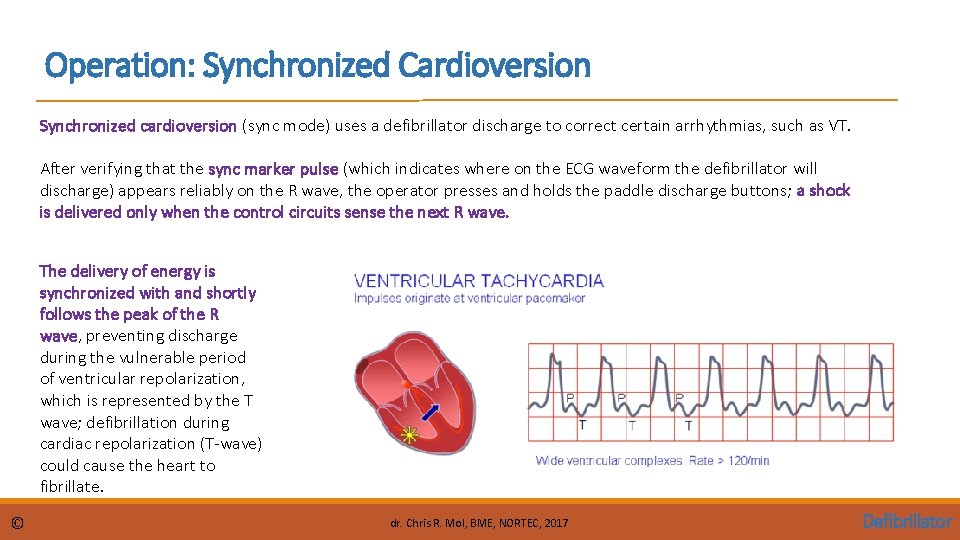
Operation: Synchronized Cardioversion Synchronized cardioversion (sync mode) uses a defibrillator discharge to correct certain arrhythmias, such as VT. After verifying that the sync marker pulse (which indicates where on the ECG waveform the defibrillator will discharge) appears reliably on the R wave, the operator presses and holds the paddle discharge buttons; a shock is delivered only when the control circuits sense the next R wave. The delivery of energy is synchronized with and shortly follows the peak of the R wave, preventing discharge during the vulnerable period of ventricular repolarization, which is represented by the T wave; defibrillation during cardiac repolarization (T-wave) could cause the heart to fibrillate. © dr. Chris R. Mol, BME, NORTEC, 2017 Defibrillator
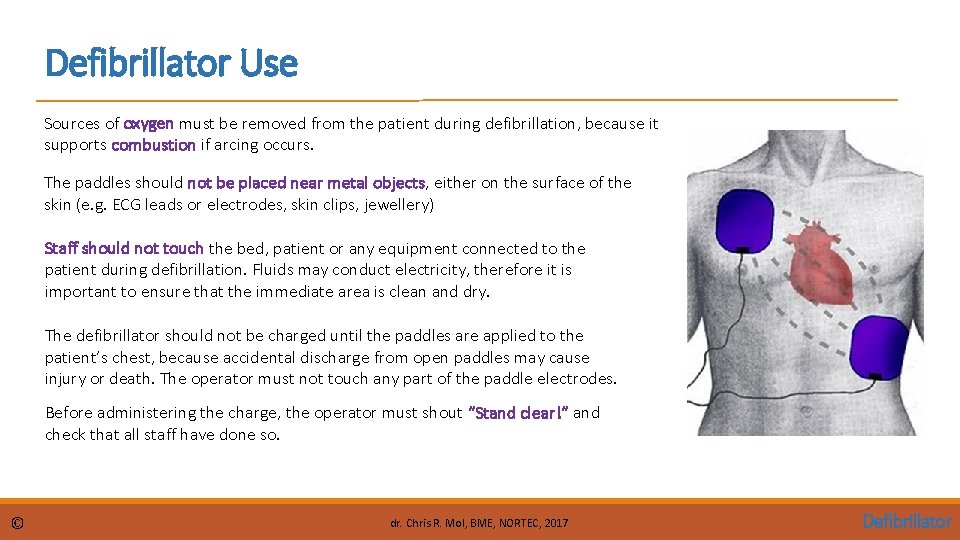
Defibrillator Use Sources of oxygen must be removed from the patient during defibrillation, because it supports combustion if arcing occurs. The paddles should not be placed near metal objects, either on the surface of the skin (e. g. ECG leads or electrodes, skin clips, jewellery) Staff should not touch the bed, patient or any equipment connected to the patient during defibrillation. Fluids may conduct electricity, therefore it is important to ensure that the immediate area is clean and dry. The defibrillator should not be charged until the paddles are applied to the patient’s chest, because accidental discharge from open paddles may cause injury or death. The operator must not touch any part of the paddle electrodes. Before administering the charge, the operator must shout “Stand clear!” and check that all staff have done so. © dr. Chris R. Mol, BME, NORTEC, 2017 Defibrillator
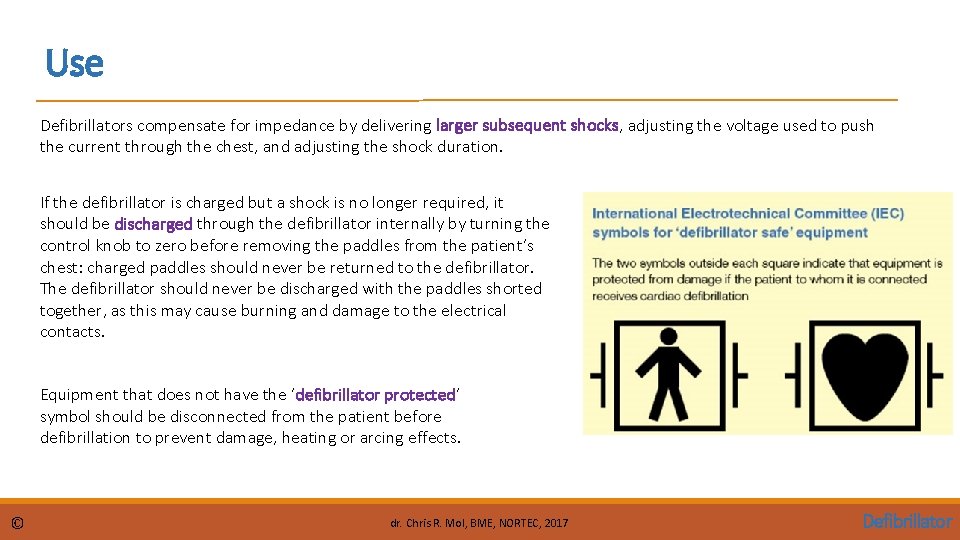
Use Defibrillators compensate for impedance by delivering larger subsequent shocks, adjusting the voltage used to push the current through the chest, and adjusting the shock duration. If the defibrillator is charged but a shock is no longer required, it should be discharged through the defibrillator internally by turning the control knob to zero before removing the paddles from the patient’s chest: charged paddles should never be returned to the defibrillator. The defibrillator should never be discharged with the paddles shorted together, as this may cause burning and damage to the electrical contacts. Equipment that does not have the ‘defibrillator protected’ symbol should be disconnected from the patient before defibrillation to prevent damage, heating or arcing effects. © dr. Chris R. Mol, BME, NORTEC, 2017 Defibrillator
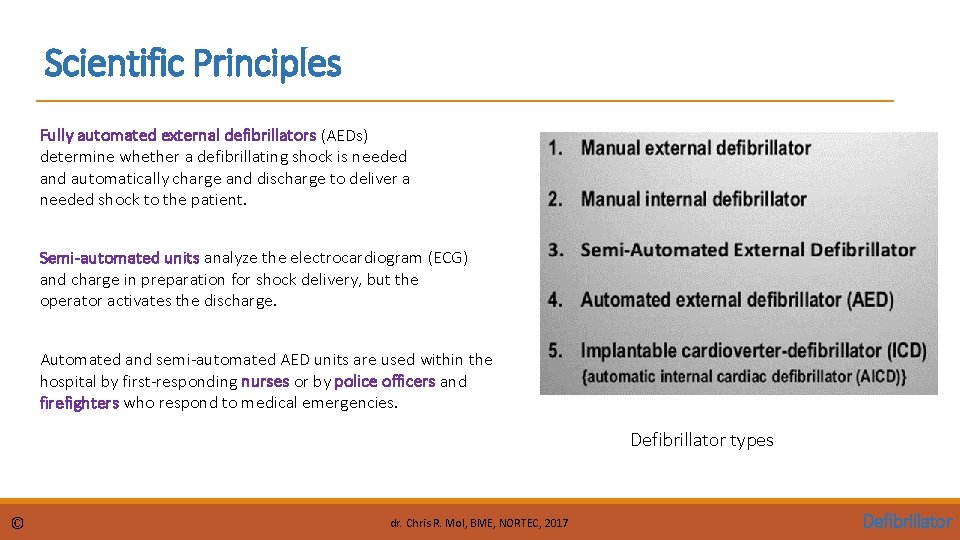
Scientific Principles Fully automated external defibrillators (AEDs) determine whether a defibrillating shock is needed and automatically charge and discharge to deliver a needed shock to the patient. Semi-automated units analyze the electrocardiogram (ECG) and charge in preparation for shock delivery, but the operator activates the discharge. Automated and semi-automated AED units are used within the hospital by first-responding nurses or by police officers and firefighters who respond to medical emergencies. Defibrillator types © dr. Chris R. Mol, BME, NORTEC, 2017 Defibrillator
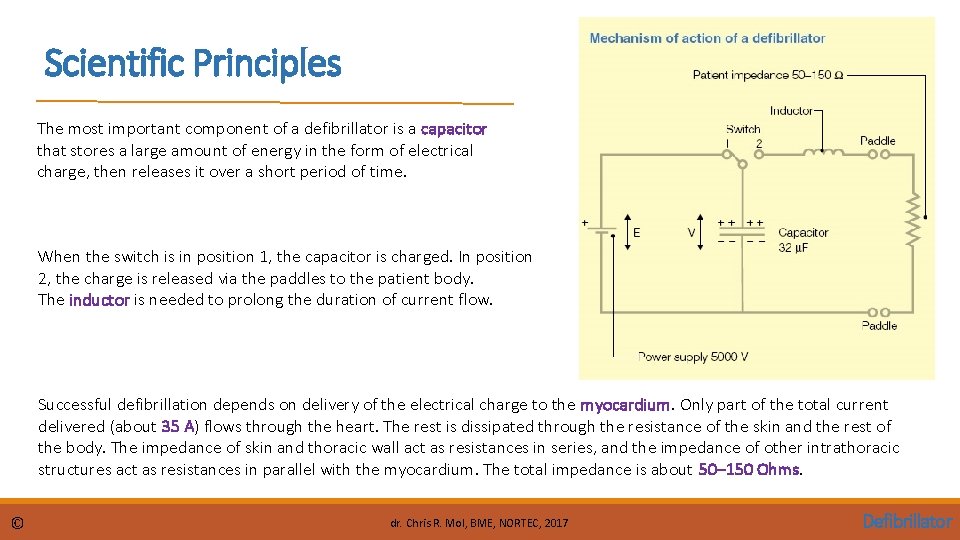
Scientific Principles The most important component of a defibrillator is a capacitor that stores a large amount of energy in the form of electrical charge, then releases it over a short period of time. When the switch is in position 1, the capacitor is charged. In position 2, the charge is released via the paddles to the patient body. The inductor is needed to prolong the duration of current flow. Successful defibrillation depends on delivery of the electrical charge to the myocardium. Only part of the total current delivered (about 35 A) flows through the heart. The rest is dissipated through the resistance of the skin and the rest of the body. The impedance of skin and thoracic wall act as resistances in series, and the impedance of other intrathoracic structures act as resistances in parallel with the myocardium. The total impedance is about 50– 150 Ohms. © dr. Chris R. Mol, BME, NORTEC, 2017 Defibrillator
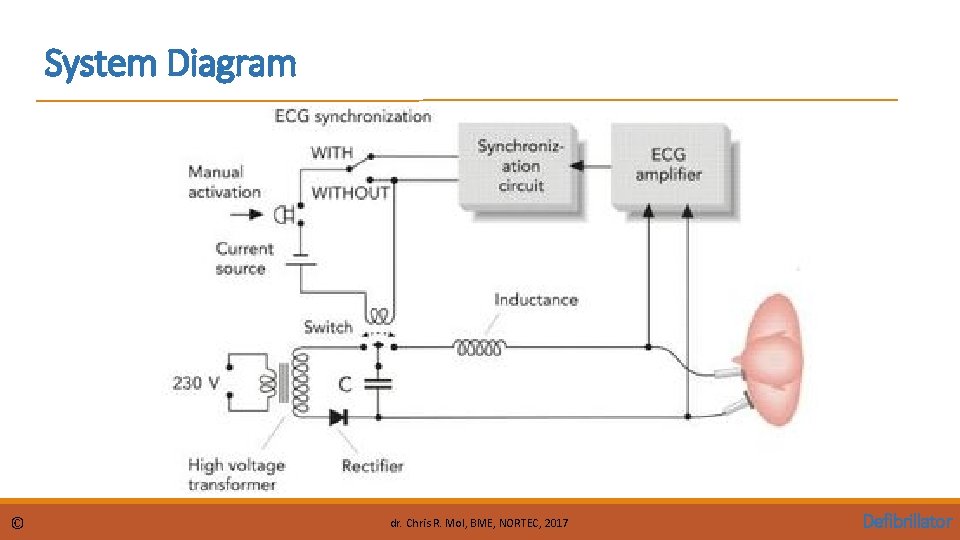
System Diagram © dr. Chris R. Mol, BME, NORTEC, 2017 Defibrillator
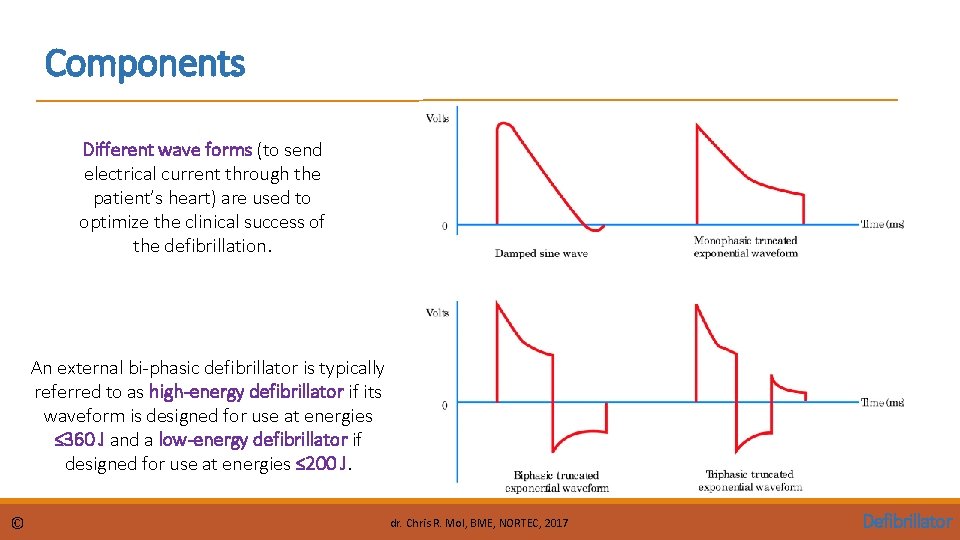
Components Different wave forms (to send electrical current through the patient’s heart) are used to optimize the clinical success of the defibrillation. An external bi-phasic defibrillator is typically referred to as high-energy defibrillator if its waveform is designed for use at energies ≤ 360 J and a low-energy defibrillator if designed for use at energies ≤ 200 J. © dr. Chris R. Mol, BME, NORTEC, 2017 Defibrillator
Troubleshooting: identifying common faults Failure to defibrillate a patient can be caused by • defibrillator malfunction, • poor electrode application, • inappropriate energy selection, • a cardiac physiologic state not conducive to defibrillation. Device problems are frequently related to problems with the rechargeable battery; therefore, careful attention should be paid to battery maintenance. Nickel-cadmium (Ni-Cd) batteries should be periodically deep discharged to help prevent premature battery failure. Nevertheless, whether used infrequently or every day, rechargeable batteries have a limited life and must be replaced every one to two years. The problems that commonly cause the defibrillator not to discharge are: • Device is set in “sync” mode • Only one discharge button is depressed. © dr. Chris R. Mol, BME, NORTEC, 2017 Defibrillator
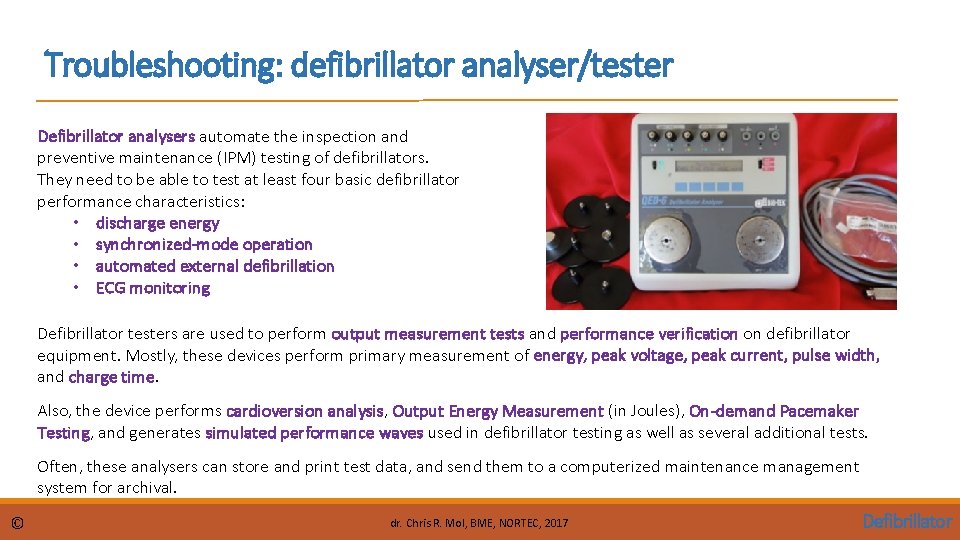
Troubleshooting: defibrillator analyser/tester Defibrillator analysers automate the inspection and preventive maintenance (IPM) testing of defibrillators. They need to be able to test at least four basic defibrillator performance characteristics: • discharge energy • synchronized-mode operation • automated external defibrillation • ECG monitoring Defibrillator testers are used to perform output measurement tests and performance verification on defibrillator equipment. Mostly, these devices perform primary measurement of energy, peak voltage, peak current, pulse width, and charge time. Also, the device performs cardioversion analysis, Output Energy Measurement (in Joules), On-demand Pacemaker Testing, and generates simulated performance waves used in defibrillator testing as well as several additional tests. Often, these analysers can store and print test data, and send them to a computerized maintenance management system for archival. © dr. Chris R. Mol, BME, NORTEC, 2017 Defibrillator
Troubleshooting: Performance Checks • Batteries • • • Output Pacing Paddles for pits ECG Leads Chassis for cracks Power and Paddle Cords (e. g. ensure no fissures, cuts, or broken wires) Date and Time Paper installed correctly Outdated supplies (e. g. gel pad electrodes) Knobs etc. Most of the defibrillators provide an automated self-test function. Check in the user manual !! © dr. Chris R. Mol, BME, NORTEC, 2017 Defibrillator
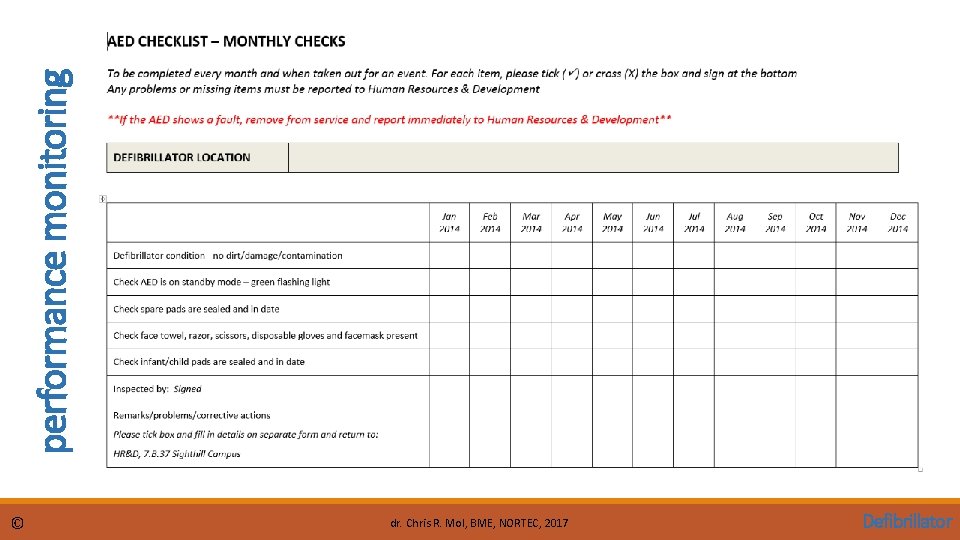
performance monitoring © dr. Chris R. Mol, BME, NORTEC, 2017 Defibrillator
Safety considerations One problem associated with defibrillation and cardioversion is skin burns at the paddle or electrode sites. First- and second-degree burns are especially likely to occur during repeated defibrillation attempts, which require successively higher energies. Burns are usually caused by a high current flow through a small area (e. g. , the edge of defibrillator paddles) and/or increased resistance (e. g. , due to dried gel). Paddles must be pressed firmly against the skin during defibrillation (25 lb of force); when administering repeated shocks, users should check paddles for adequate amounts of gel before each defibrillation attempt. In addition to increasing the risk of burns, poor application technique may also reduce the energy delivered to the patient’s heart. When using disposable electrodes, users should check the expiration date on the package and the integrity of the package (do not use if the package has been opened). It is not the task of the hospital technician to conduct user training for defibrillators. But the technician can assist and can give technical information e. g. about how to conduct a self-test or charging the internal batteries. However the technician should know how the equipment is used correctly. © dr. Chris R. Mol, BME, NORTEC, 2017 Defibrillator

END The creation of this presentation was supported by a grant from THET: see https: //www. thet. org/
- Slides: 20