
Defibrillation pad vector change in prehospital refractory Vfib
Defibrillation pad vector change in prehospital refractory V-fib Davis, M. , Loosley, J. , Schappert, A. , Van. Aarsen, K. , Mc. Leod, S. , Cheskes, S. SWORBHP Prehospital and Transport Medicine Research Day
Defibrillation Pad Vector Change • No external financial support or other conflicts to declare
Introduction



Background
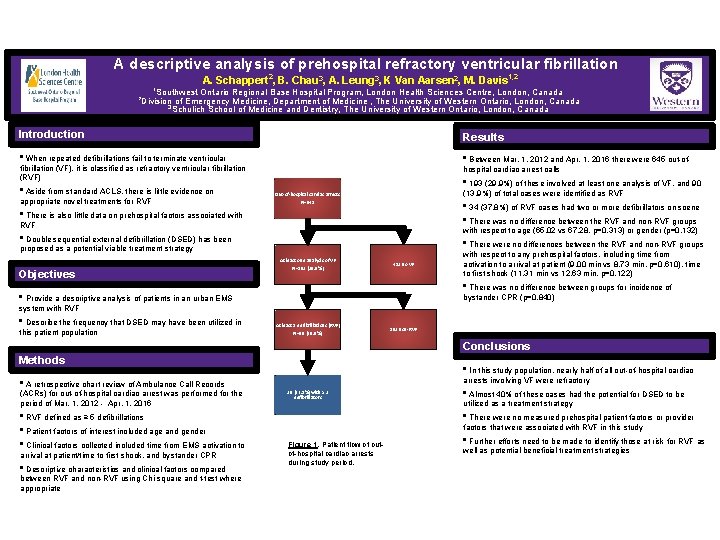
A descriptive analysis of prehospital refractory ventricular fibrillation 2 A. Schappert , B. Chau 3, A. Leung 3, K Van Aarsen 2, M. Davis 1, 2 Southwest Ontario Regional Base Hospital Program, London Health Sciences Centre, London, Canada Division of Emergency Medicine, Department of Medicine , The University of Western Ontario, London, Canada 3 Schulich School of Medicine and Dentistry, The University of Western Ontario, London, Canada 1 2 Introduction Results • When repeated defibrillations fail to terminate ventricular • Between Mar. 1, 2012 and Apr. 1, 2016 there were 645 out-of- fibrillation (VF), it is classified as refractory ventricular fibrillation (RVF) • Aside from standard ACLS, there is little evidence on appropriate novel treatments for RVF hospital cardiac arrest calls • 193 (29. 9%) of these involved at least one analysis of VF, and 90 (13. 9%) of total cases were identified as RVF Out-of-hospital cardiac arrests N=645 • 34 (37. 8%) of RVF cases had two or more defibrillators on scene • There was no difference between the RVF and non-RVF groups • There is also little data on prehospital factors associated with RVF with respect to age (65. 02 vs 67. 28, p=0. 313) or gender (p=0. 132) • Double sequential external defibrillation (DSED) has been • There were no differences between the RVF and non-RVF groups proposed as a potential viable treatment strategy Objectives At least one analysis of VF N=193 (29. 9%) 452 no VF with respect to any prehospital factors, including time from activation to arrival at patient (9. 00 min vs 8. 73 min, p=0. 610), time to first shock (11. 31 min vs 12. 63 min, p=0. 122) • There was no difference between groups for incidence of • Provide a descriptive analysis of patients in an urban EMS bystander CPR (p=0. 840) system with RVF • Describe the frequency that DSED may have been utilized in this patient population At least 5 defibrillations (RVF) N=90 (46. 6%) 103 non-RVF Conclusions Methods • In this study population, nearly half of all out-of-hospital cardiac arrests involving VF were refractory • A retrospective chart review of Ambulance Call Records (ACRs) for out-of-hospital cardiac arrest was performed for the period of Mar. 1, 2012 - Apr. 1, 2016 • RVF defined as ≥ 5 defibrillations • Patient factors of interest included age and gender • Clinical factors collected included time from EMS activation to arrival at patient/time to first shock, and bystander CPR • Descriptive characteristics and clinical factors compared between RVF and non-RVF using Chi-square and t-test where appropriate 30 (37. 8%) with ≥ 2 defibrillators • Almost 40% of these cases had the potential for DSED to be utilized as a treatment strategy • There were no measured prehospital patient factors or provider factors that were associated with RVF in this study Figure 1. Patient flow of outof-hospital cardiac arrests during study period. • Further efforts need to be made to identify those at risk for RVF as well as potential beneficial treatment strategies
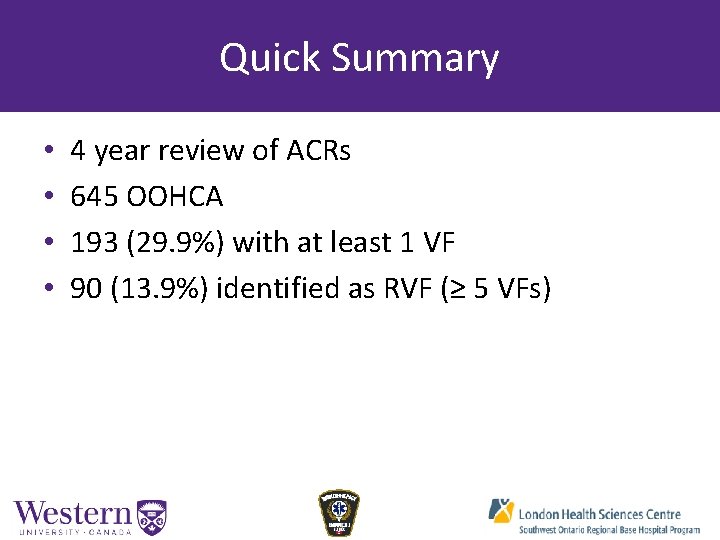
Quick Summary • • 4 year review of ACRs 645 OOHCA 193 (29. 9%) with at least 1 VF 90 (13. 9%) identified as RVF (≥ 5 VFs)
Next question What happens to this group during transport?
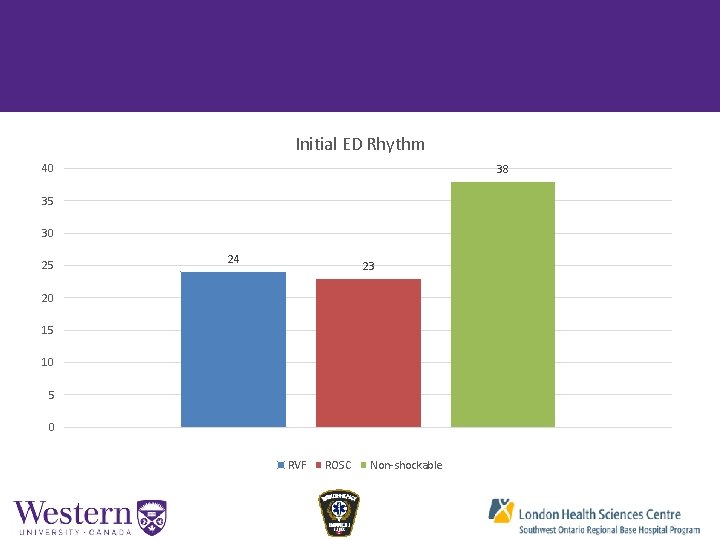
Initial ED Rhythm 40 38 35 30 25 24 23 20 15 10 5 0 RVF ROSC Non-shockable
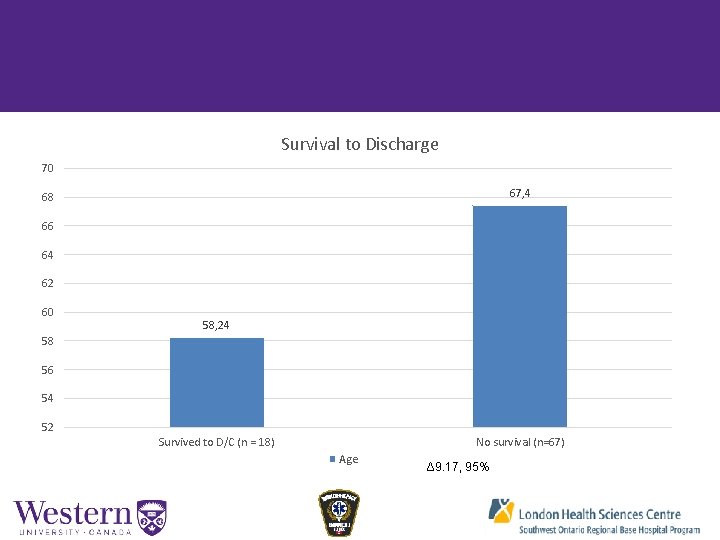
Survival to Discharge 70 67, 4 68 66 64 62 60 58, 24 58 56 54 52 Survived to D/C (n = 18) No survival (n=67) Age Δ 9. 17, 95% CI 1. 82 to 16. 52, p = 0. 015
What can we do prehospitally? • High incidence of refractory VF (up to 30%) • Double Sequential Electrical Defibrillation? • Multiple energy vectors increases shocked myocardium? • Shock timing? • Change in vector?
Methods • Ambulance Call Records (ACRs) between Mar. 2016 and Feb. 2017 • Included patients presenting in RVF (defined as ≥ 5 consecutive VF analyses) • Treatment was pad vector change (change from AA to AP after 3 consecutive defibrillations) • Compared VF termination and ROSC between vector change and no vector change groups
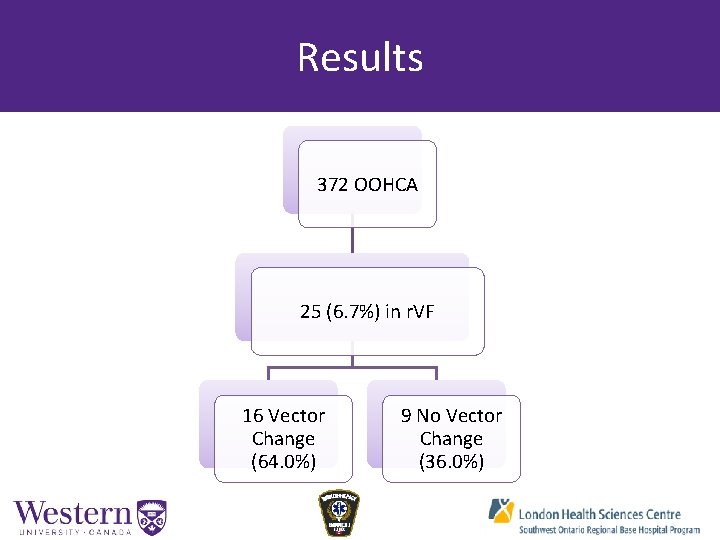
Results 372 OOHCA 25 (6. 7%) in r. VF 16 Vector Change (64. 0%) 9 No Vector Change (36. 0%)
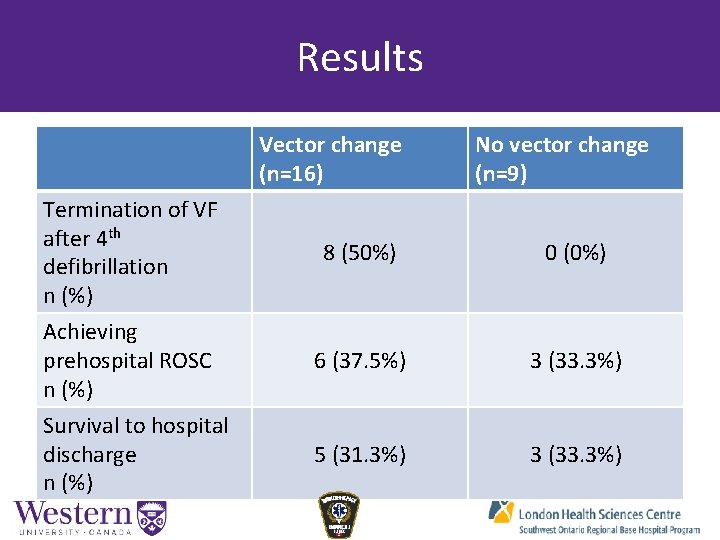
Results Vector change (n=16) Termination of VF after 4 th defibrillation n (%) Achieving prehospital ROSC n (%) Survival to hospital discharge n (%) No vector change (n=9) 8 (50%) 0 (0%) 6 (37. 5%) 3 (33. 3%) 5 (31. 3%) 3 (33. 3%)

Conclusions
Limitations and Future Directions • Small sample size
- Slides: 18