
Defensive SelfEsteem and Working Memory Following Ego Threat
- Slides: 1
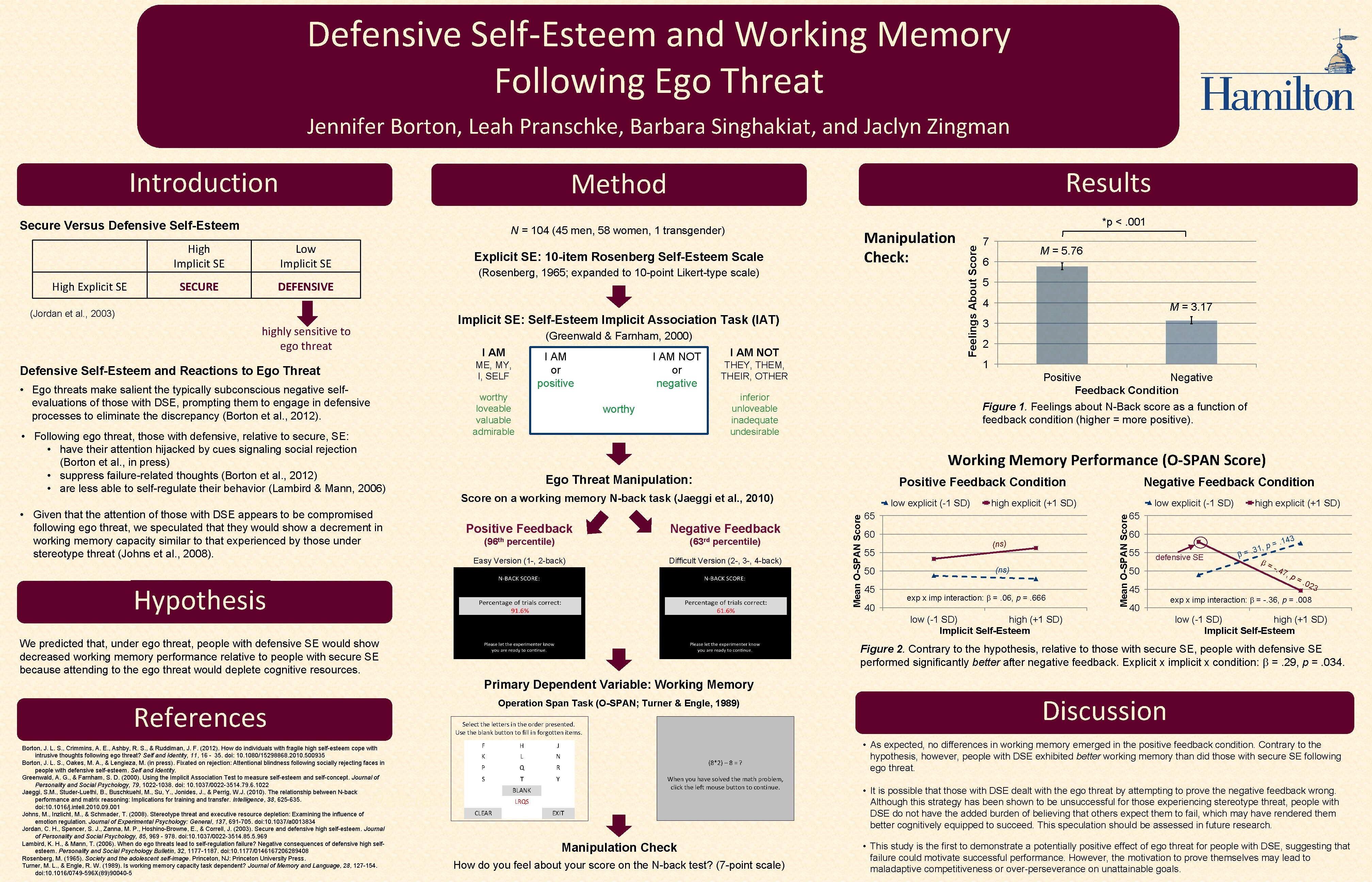
Defensive Self-Esteem and Working Memory Following Ego Threat Jennifer Borton, Leah Pranschke, Barbara Singhakiat, and Jaclyn Zingman Introduction N = 104 (45 men, 58 women, 1 transgender) SECURE DEFENSIVE Explicit SE: 10 -item Rosenberg Self-Esteem Scale (Rosenberg, 1965; expanded to 10 -point Likert-type scale) (Jordan et al. , 2003) Implicit SE: Self-Esteem Implicit Association Task (IAT) highly sensitive to ego threat (Greenwald & Farnham, 2000) I AM or positive ME, MY, I, SELF Defensive Self-Esteem and Reactions to Ego Threat • Ego threats make salient the typically subconscious negative selfevaluations of those with DSE, prompting them to engage in defensive processes to eliminate the discrepancy (Borton et al. , 2012). • Following ego threat, those with defensive, relative to secure, SE: • have their attention hijacked by cues signaling social rejection (Borton et al. , in press) • suppress failure-related thoughts (Borton et al. , 2012) • are less able to self-regulate their behavior (Lambird & Mann, 2006) • Given that the attention of those with DSE appears to be compromised following ego threat, we speculated that they would show a decrement in working memory capacity similar to that experienced by those under stereotype threat (Johns et al. , 2008). worthy loveable valuable admirable I AM NOT or negative I AM NOT M = 5. 76 6 5 4 M = 3. 17 3 2 1 THEY, THEM, THEIR, OTHER Positive Negative Feedback Condition Figure 1. Feelings about N-Back score as a function of feedback condition (higher = more positive). inferior unloveable inadequate undesirable worthy 7 Working Memory Performance (O-SPAN Score) Ego Threat Manipulation: Positive Feedback Condition Score on a working memory N-back task (Jaeggi et al. , 2010) Positive Feedback Negative Feedback (96 th percentile) (63 rd percentile) Easy Version (1 -, 2 -back) Difficult Version (2 -, 3 -, 4 -back) Hypothesis low explicit (-1 SD) high explicit (+1 SD) 65 60 55 50 45 Negative Feedback Condition low explicit (-1 SD) 60 (ns) 55 (ns) 3 4 1. p= defensive SE 50 exp x imp interaction: b =. 06, p =. 666 40 45 40 low (-1 SD) high (+1 SD) Implicit Self-Esteem We predicted that, under ego threat, people with defensive SE would show decreased working memory performance relative to people with secure SE because attending to the ego threat would deplete cognitive resources. high explicit (+1 SD) 65 Mean O-SPAN Score Low Implicit SE Mean O-SPAN Score High Implicit SE Manipulation Check: *p <. 001 Feelings About Score Secure Versus Defensive Self-Esteem High Explicit SE Results Method , 1 3. b= b= -. 4 7, p =. 023 exp x imp interaction: b = -. 36, p =. 008 low (-1 SD) high (+1 SD) Implicit Self-Esteem Figure 2. Contrary to the hypothesis, relative to those with secure SE, people with defensive SE performed significantly better after negative feedback. Explicit x implicit x condition: b =. 29, p =. 034. Primary Dependent Variable: Working Memory Operation Span Task (O-SPAN; Turner & Engle, 1989) References Select the letters in the order presented. Use the blank button to fill in forgotten items. Borton, J. L. S. , Crimmins, A. E. , Ashby, R. S. , & Ruddiman, J. F. (2012). How do individuals with fragile high self-esteem cope with intrusive thoughts following ego threat? Self and Identity, 11, 16 - 35. doi: 10. 1080/15298868. 2010. 500935 Borton, J. L. S. , Oakes, M. A. , & Lengieza, M. (in press). Fixated on rejection: Attentional blindness following socially rejecting faces in people with defensive self-esteem. Self and Identity. Greenwald, A. G. , & Farnham, S. D. (2000). Using the Implicit Association Test to measure self-esteem and self-concept. Journal of Personality and Social Psychology, 79, 1022 -1038. doi: 10. 1037/0022 -3514. 79. 6. 1022 Jaeggi, S. M. , Studer-Luethi, B. , Buschkuehl, M. , Su, Y. , Jonides, J. , & Perrig, W. J. (2010). The relationship between N-back performance and matrix reasoning: Implications for training and transfer. Intelligence, 38, 625 -635. doi: 10. 1016/j. intell. 2010. 09. 001 Johns, M. , Inzlicht, M. , & Schmader, T. (2008). Stereotype threat and executive resource depletion: Examining the influence of emotion regulation. Journal of Experimental Psychology: General, 137, 691 -705. doi: 10. 1037/a 0013834 Jordan, C. H. , Spencer, S. J. , Zanna, M. P. , Hoshino-Browne, E. , & Correll, J. (2003). Secure and defensive high self-esteem. Journal of Personality and Social Psychology, 85, 969 - 978. doi: 10. 1037/0022 -3514. 85. 5. 969 Lambird, K. H. , & Mann, T. (2006). When do ego threats lead to self-regulation failure? Negative consequences of defensive high selfesteem. Personality and Social Psychology Bulletin, 32, 1177 -1187. doi: 10. 1177/0146167206289408 Rosenberg, M. (1965). Society and the adolescent self-image. Princeton, NJ: Princeton University Press. Turner, M. L. , & Engle, R. W. (1989). Is working memory capacity task dependent? Journal of Memory and Language, 28, 127 -154. doi: 10. 1016/0749 -596 X(89)90040 -5 References F H J K L N P Q R S T Y CLEAR (8*2) – 8 = ? When you have solved the math problem, click the left mouse button to continue. BLANK LRQS EXIT Manipulation Check How do you feel about your score on the N-back test? (7 -point scale) Discussion • As expected, no differences in working memory emerged in the positive feedback condition. Contrary to the hypothesis, however, people with DSE exhibited better working memory than did those with secure SE following ego threat. • It is possible that those with DSE dealt with the ego threat by attempting to prove the negative feedback wrong. Although this strategy has been shown to be unsuccessful for those experiencing stereotype threat, people with DSE do not have the added burden of believing that others expect them to fail, which may have rendered them better cognitively equipped to succeed. This speculation should be assessed in future research. • This study is the first to demonstrate a potentially positive effect of ego threat for people with DSE, suggesting that failure could motivate successful performance. However, the motivation to prove themselves may lead to maladaptive competitiveness or over-perseverance on unattainable goals.