
Defensive Driving Techniques Your Ticket to Safety Introduction
- Slides: 48
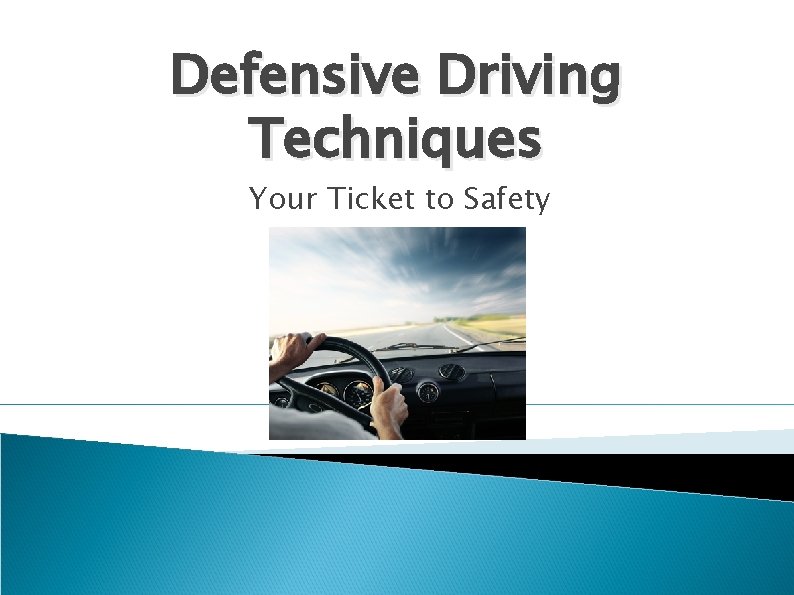
Defensive Driving Techniques Your Ticket to Safety
Introduction You know how to drive right? Of course you do. You drove here today. I’m not here to teach you that. You know how to drive safely as well right? Of course you do, everybody does. Traffic Laws … pedestrians … following distances; the list goes on and on.
Introduction Obviously, not everybody knows how to drive safely, or maybe they know how and choose not to. Which category do you fall into?
Introduction We know you know how to drive safe … but do you? I mean, I know the speed limit’s 65, but if I go 100 anyway, what does that knowledge get me? When you get right down to it, it’s not really a matter of knowledge at all. . . but a matter of responsibility. You have a responsibility to yourself, your family, the company, other motorists, and their families to operate your vehicle in a manner that doesn’t put you, them, or anybody else at risk.
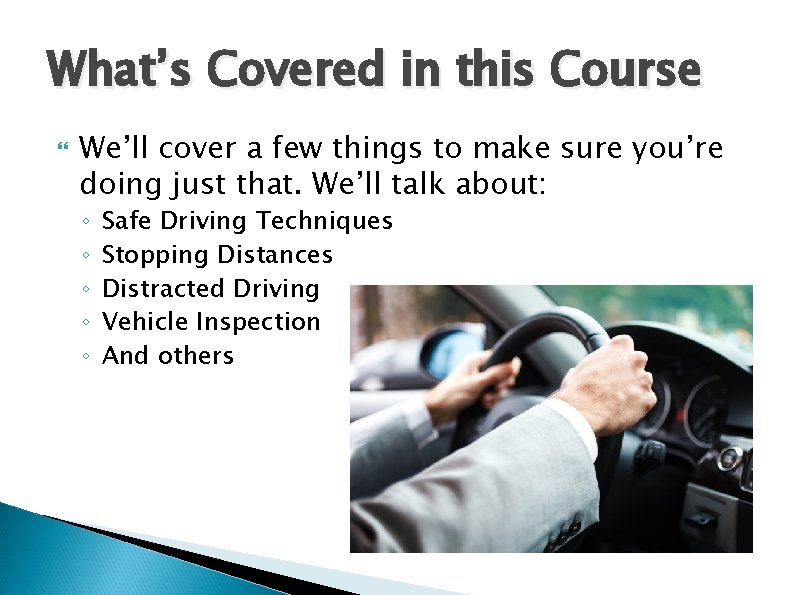
What’s Covered in this Course We’ll cover a few things to make sure you’re doing just that. We’ll talk about: ◦ ◦ ◦ Safe Driving Techniques Stopping Distances Distracted Driving Vehicle Inspection And others
Minimizing Your Risk Motor Vehicle accidents are the leading cause of death of the American worker. The leading causes of collisions are: ◦ Improper speed, ◦ Following too close, ◦ Driving While Intoxicated or Driving Under the Influence of Drugs or Alcohol, and ◦ Failure to obey traffic signals
Minimizing Your Risk Speeding results in 12, 000 traffic deaths per year. For every 10 miles per hour over 50 mph you drive, the risk of death is doubled. ◦ By following traffic safety laws, being aware, and using common sense, you can minimize your risk.
The Pre-Trip Inspection Anytime you are going to drive a vehicle, you need to start by performing a pre-trip inspection. Prior to getting in the vehicle, take a look around the vehicle. Note any damage to the vehicle or fluid leaks.
The Pre-Trip Inspection One of the most critical parts of the inspection is the inflation, tread depth and general condition of the tires. Tread depth can be easily measured by observing treadwear bars or using a penny to measure the remaining tread. If a part of Lincoln’s head is covered there is the minimum 2/32” remaining. But remember, that’s the bare minimum. Steer tires must have 4/32” tread remaining.
The Pre-Trip Inspection When starting the vehicle, note warning lights and gauges. Check and adjust mirrors and headrest prior to moving the vehicle. Make sure the windows are completely clear of snow, ice, and fog before starting to drive.
Safe Driving—Seatbelts First things first, always wear your seatbelt. Wearing a seatbelt is the single most important thing you can do to protect yourself in the event of a crash.
Safe Driving—Speed Limits Next, obey all posted speed limits at all times. If the sign says 55, how fast should you be traveling? Obvious … right? Not necessarily. In inclement weather such as rain, snow or fog, the posted speed limit may not be safe. Slow down in inclement weather and when the sun’s out, do the speed limit.
Safe Driving—Following Distance It may take your vehicle longer to stop than you may think. For this reason, we recommend a minimum of a 3 -second following distance in dry conditions. To determine this distance, watch the rear bumper of the vehicle just ahead as it passes a stationary marker, such as a sign post, or telephone pole, and count "one thousand one, one thousand two, one thousand three. “ As you say "three, " your front bumper should reach that marker. If you reach it before that point, reduce your speed by a few miles per hour and then recheck your distance.
Safe Driving—Following Distance Increase the following distance 1 second for each of the following conditions: ◦ ◦ ◦ Adverse weather conditions Heavy traffic Following a truck Night driving or poor visibility Being tailgated Driving while stressed or fatigued Plain and simple. Leave more cushion and slow down.
Safe Driving—Blind Spots Remember, your vehicle has areas called “blind spots. ” You cannot see without properly adjusted mirrors. Adjust your mirrors before you start your car and be aware of your blind spot at all times.
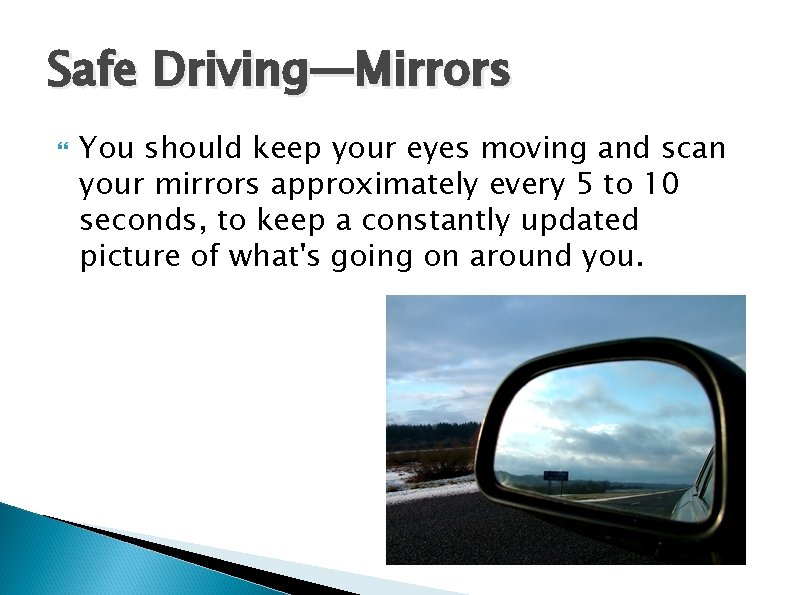
Safe Driving—Mirrors You should keep your eyes moving and scan your mirrors approximately every 5 to 10 seconds, to keep a constantly updated picture of what's going on around you.
Safe Driving—Intersections Intersections are responsible for over 50% of all accidents. When approaching intersections, scan to the left, then to the right, and back to the left, for vehicles that may run a stop sign or light or for pedestrians and bicyclists. Remember, always leave yourself an out. Anticipate what mistakes others may make and assume that they will make them!
Safe Driving—Intersections If there is a stop sign, make sure you come to a complete stop and let other vehicles with the right of way proceed. Don’t force the issue. If the intersection is lighted, be aware of “stale” green lights. This means that if the light has been green for some time, be ready for it to change to yellow and adjust your speed accordingly.
Safe Driving—Stopping at an Intersection When stopping at an intersection stop so you can see the rear tires of the vehicle in front of you. This will allow extra space in front of you in case the vehicle behind you bumps into you. Also, if the vehicle in front stalls, you will have room to maneuver around it.
Safe Driving—Starting After a Stop When traffic starts, delay your start for 2 seconds after the vehicle in front of you starts to move. This will give you time to react if the vehicle in front of you suddenly stops. Your should also check for traffic from your left and right sides to insure that no one has run a red light.
Passing On a 2 -lane road, you should only pass another vehicle when absolutely necessary. Never pass when there is limited visibility, in no-passing zones, school zones, at railroad crossings, intersections, on bridges, or in tunnels.
Passing When passing: ◦ Observe 3 -second following rule before passing in order to give visibility around the vehicle being passed. ◦ Wait for clear space of oncoming traffic and when it is legal to pass. ◦ Signal your intention. ◦ Check your rear view mirror and blind spots to make sure the vehicle behind you is not trying to pass at the same time.
Passing When passing: ◦ Pull out into the oncoming lane and quickly accelerate, but do not exceed the speed limit. ◦ Pull back into the lane when you can see the vehicle you just passed in your rear view mirror. ◦ When passing a truck, increase the distance before pulling back into your lane so that you can see in your rear view mirror the pavement between you and the truck.
Driving Defensively The point of driving defensively is to be ready to make good driving decisions yourself and be ready to make up for the mistakes of other drivers. It doesn’t matter whose fault an accident is if you or your family is seriously injured or killed. It is your responsibility to drive defensively to avoid an accident even if another driver makes a mistake.
Adverse Weather Driving Do not drive in adverse weather unless absolutely necessary. If you have to drive, keep windows clear of ice, snow, and fog. Use the “What If” strategy: always have a way out. Remember, shaded road areas may be icy and bridges and overpasses ice first in winter —proceed over these with caution.
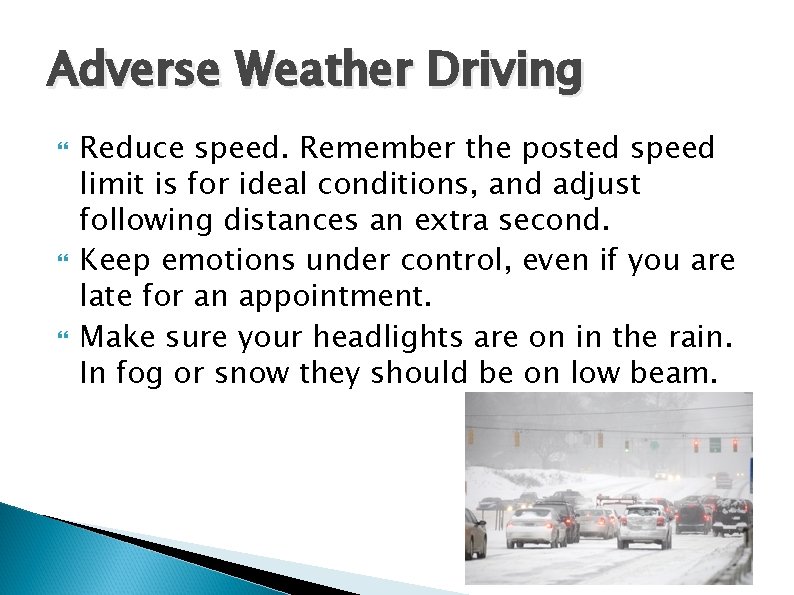
Adverse Weather Driving Reduce speed. Remember the posted speed limit is for ideal conditions, and adjust following distances an extra second. Keep emotions under control, even if you are late for an appointment. Make sure your headlights are on in the rain. In fog or snow they should be on low beam.
Adverse Weather Driving If your vehicle starts to skid: ◦ Ease off the accelerator. ◦ Turn the steering wheel in the direction you want the vehicle to go. ◦ If the vehicle has an ABS brake system, keep your foot firmly on the brake. You may hear a popping sound or feel vibration on the foot pedal—that is OK. ◦ If you have non-ABS brakes, pump the brake pedal.
Adverse Weather Driving Hydroplaning or aquaplaning occurs when a layer of water builds between the tires of a vehicle and the road surface, leading to the loss of traction, preventing the vehicle from responding to control inputs such as steering, braking or accelerating. In rain, if your car begins to hydroplane: ◦ Release accelerator. ◦ Do not brake. ◦ Steer in the direction you want the car to go.
Distracted Driving So now, we've established you need to use your eyes while you drive. But, what are you using your eyes for? Looking at the scenery. . . not good. Checking your e-mail or looking at your laptop. . . a really bad idea. Texting your significant other. . . not good either. Do you want to wake up in the middle of the night in a panic thinking about how your texting resulted in loss of life?
Distracted Driving Scenery, e-mail, laptops, friends, spouses. . . these are all good things, great things. . . just not while you're driving. Why? Easy. Distracted driving results in 1. 4 million crashes a year and it is against company policy.
Distracted Driving: E-mail and Laptops Let's start with the e-mail and laptops. Of course, you shouldn't be checking your email, reading your e-mail, playing solitaire or anything else on a computer while you drive. If you're the type of person who just can't resist, keep your computer closed and in the case. No more temptation and one less potential crash.
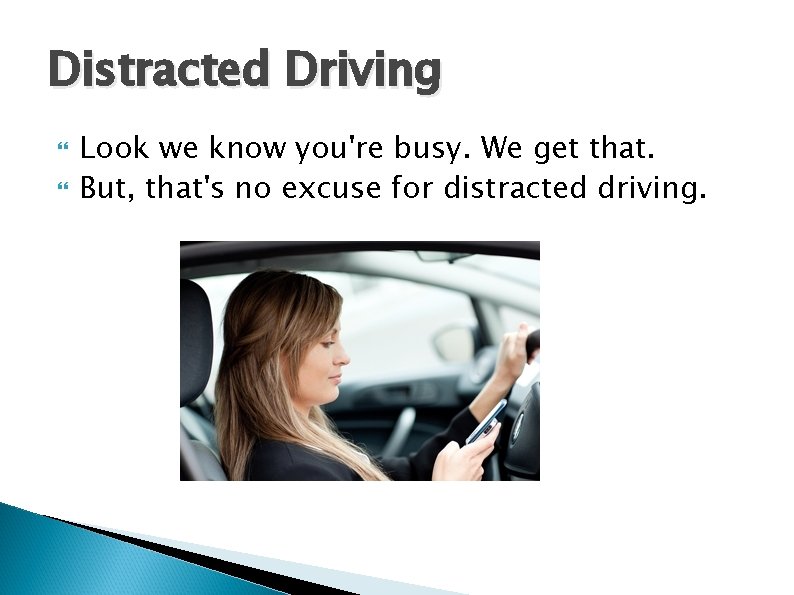
Distracted Driving Look we know you're busy. We get that. But, that's no excuse for distracted driving.
Distracted Driving—Cell Phones Cell phones. Can't get by today without one. But, did you know drivers who use cell phones are four times as likely to get into crashes serious enough to injure themselves or others? Four times! These odds are not in your favor. Simply reaching for the phone to make or receive a call or dialing numbers takes drivers' eyes off the road. This distraction might only last a second, but at only 35 miles an hour, in one second they've lost more than 50 feet of stopping distance.
Distracted Driving—Cell Phones Being on the phone is distracting. But … you've got a Bluetooth and that makes you safe right? Well, actually no. It does allow you to keep both hands on the wheel. But, studies have shown there is absolutely no difference. Even with a hands-free device, cell phone use reduces the amount of brain activity associated with driving by 37%.
Distracted Driving—Cell Phones If you need to talk to someone, pull over to a safe area, stop your car and talk. That way you take care of business but you don't put yourself or others at risk. The caller will appreciate it since you can now devote your full attention to them.
Distracted Driving—Cell Phones But, I’m not texting! This is a Blackberry! Doesn’t matter. Using a keyboard or reading the screen of wireless communication devices such as a Blackberry is prohibited. Just like regular cell phones, the only time these devices may be used is if the vehicle has been pulled safely off to the side of the road. Most states now have laws prohibiting texting while driving.
Distracted Driving—Other Distractions Cell phones are not the only thing in a car that get our attention and take our eyes off the road. Changing radio stations, inserting CDs in the player, looking for things in the glove box, programming the GPS, doing personal grooming, and smoking are common distracted driving hazards. Avoid these activities unless parked.
Distracted Driving—Driving Tired National Highway Traffic Safety Administration data indicates that in recent years, there have been about 56, 000 crashes annually in which driver drowsiness or fatigue was cited by police. Annual averages of roughly 40, 000 non-fatal injuries and 1, 550 fatalities result from these crashes. These statistics are probably a little conservative.
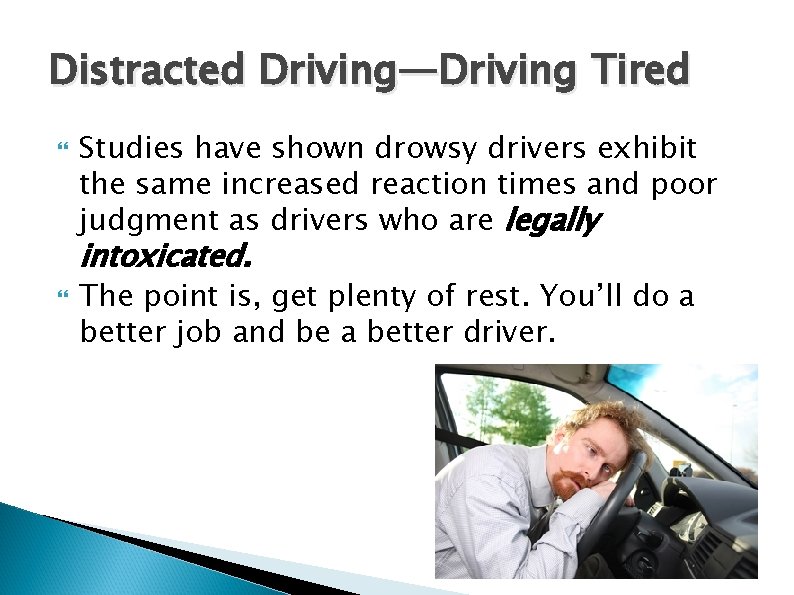
Distracted Driving—Driving Tired Studies have shown drowsy drivers exhibit the same increased reaction times and poor judgment as drivers who are legally intoxicated. The point is, get plenty of rest. You’ll do a better job and be a better driver.
Distracted Driving—Driving Tired If you are tired or drowsy, pull off the road at a safe, well lit location, and get some rest, or get out and walk around the car if on a long trip. You should stop about every two hours or less.
Safe Backing You can avoid unnecessary backing by pulling through a parking space so you do not have to back out. If you must back, it is better to back in when you approach your destination instead of backing out when leaving. But if you must back up, before getting into the vehicle, walk around the vehicle to make sure there is nothing in the way before backing. Back slowly and carefully.
Accident Procedures If you are involved in a vehicle accident: Never leave the scene. Call emergency personnel if necessary. Do not attempt to move an injured person unless there is a life threatening situation such as a fire and the occupant is unable to get out. Do not admit guilt or discuss whose fault the accident was.
Accident Procedures If your company has an accident reporting kit, make sure you use it. Take photos of the accident scene showing vehicle locations, direction of travel, vehicle and other property damage, location of traffic control devices, the license plate of vehicles involved, etc.
Accident Procedures Depending on state law, move your vehicle to the side of the road if there are no injuries and minor damage. Obtain names and phone numbers of all involved parties and witnesses. Have witnesses write out what they saw. Obtain insurance information of all parties involved (insurance company name, policy number, telephone number, expiration date, name of insured on the policy).
Accident Procedures If police are on the scene, obtain police officers’ names, badge numbers, and the police report file number, and a police phone number. Once you have gathered the required information, contact your supervisor.
Review Remember, every driver and passenger on the road is part of someone’s family. You are in control of your vehicle. Don’t give up control to your emotions or to other drivers. Control your actions and how you deal with traffic, weather, and emotions. The average driver will be involved in 6 collisions in a lifetime—don’t be average!
Conclusion Have we covered every possible situation you may face on the road? Of course not. That’s why it’s so important to use your common sense and good judgment at all times.
Seven Habits of Defensive Driving Always wear your seatbelt. Continuously evaluate driving conditions. Scan ahead and use the “What If” strategy. Maintain personal control—even if other drivers don’t. Observe the 3 -second following distance rule. Recognize hazards, understand the defensive measures, and act. Be patient with other drivers—courtesy, respect, dignity.