
Defensive Design Defensive Coding Erik Poll Digital Security


- Slides: 53
Defensive Design & Defensive Coding Erik Poll Digital Security
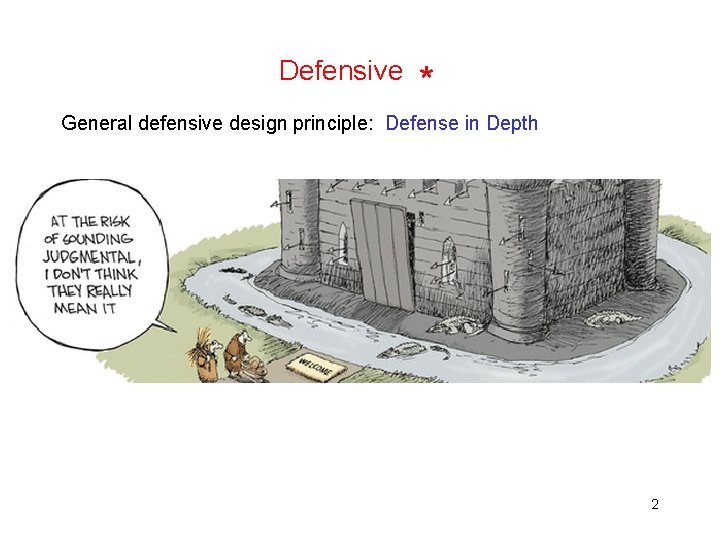
Defensive * General defensive design principle: Defense in Depth 2
Detection & Reaction Important example of Defense in Depth: Don’t just try to prevent security problems, also try to detect them & react to them 3
Detection & Reaction Important example of Defense in Depth: Don’t just try to prevent security problems, also try to detect them & react to them There may be different goals with security cameras & other forms of monitoring a) b) detection & response as it happens investigation after the fact 4
What if … ? Any design involves trust assumptions (e. g. a TCB) Useful question to ask for defensive design: What if these assumptions are broken? Eg: What if • key material of card, terminal, or back-end leaks? • card is cloned? • terminal is compromised? • issuance process is compromised? • there’s an insider attacker with insider in role X? 5
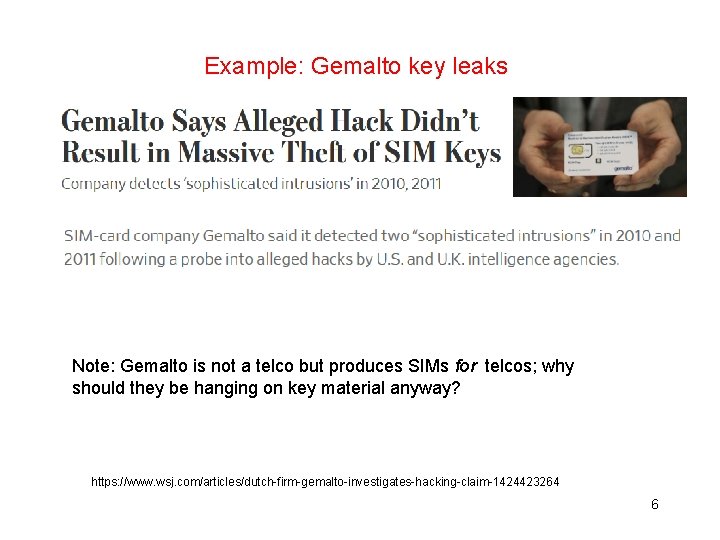
Example: Gemalto key leaks Note: Gemalto is not a telco but produces SIMs for telcos; why should they be hanging on key material anyway? ; https: //www. wsj. com/articles/dutch-firm-gemalto-investigates-hacking-claim-1424423264 6
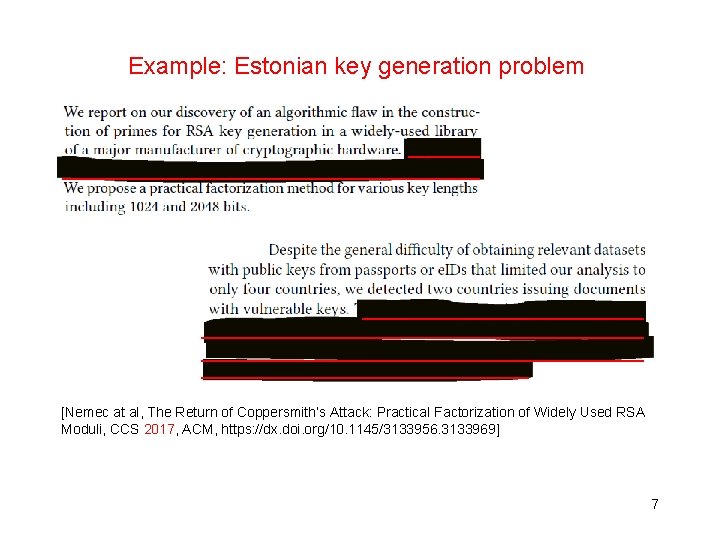
Example: Estonian key generation problem [Nemec at al, The Return of Coppersmith’s Attack: Practical Factorization of Widely Used RSA Moduli, CCS 2017, ACM, https: //dx. doi. org/10. 1145/3133956. 3133969] 7
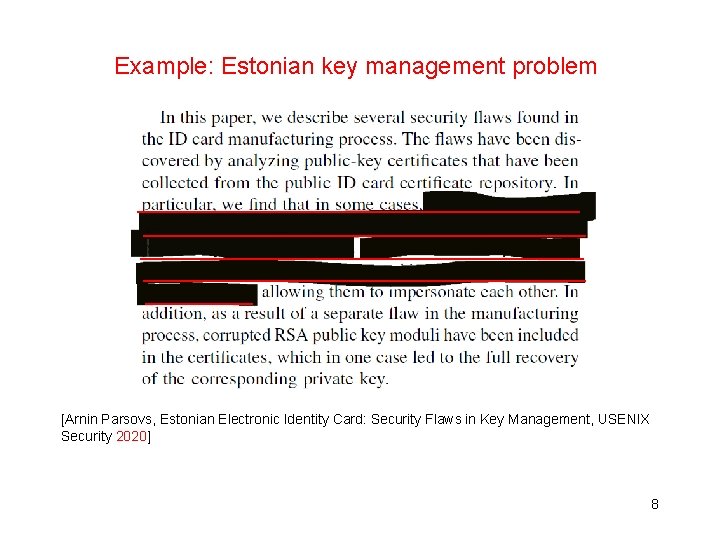
Example: Estonian key management problem [Arnin Parsovs, Estonian Electronic Identity Card: Security Flaws in Key Management, USENIX Security 2020] 8
Some defensive design tricks • Having both parties provide nonces always makes attack harder – even if one of these parties has to be ‘trusted’ for some security guarantee 9
Some defensive design tricks • Having both parties provide nonces always makes attack harder – even if one of these parties has to be ‘trusted’ for some security guarantee • Including more info in (hash used to construct) MAC or signature always makes attacks harder – eg card or terminal IDs, sequence no, time stamp, … 10
Some defensive design tricks • Having both parties provide nonces always makes attack harder – even if one of these parties has to be ‘trusted’ for some security guarantee • Including more info in (hash used to construct) MAC or signature always makes attacks harder – eg card or terminal IDs, sequence no, time stamp, … • Advantages of counters over nonces: – avoids risk of crappy RNGs – makes checking for repeated of nonces in backend easier – may make other forms of compromise detectable • Eg, if card includes a counter in the receipts it signs, then existence of cloned cards is detectable in back-end 11
Moral of the story it’s good to be paranoid! “Just because you're paranoid doesn't mean they aren't after you. ” -- Joseph Heller, Catch 22 12
Defensive Coding against side channel attacks
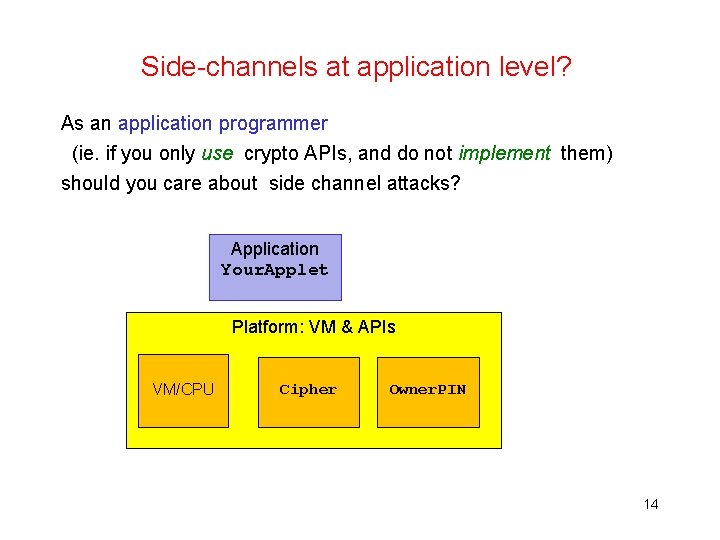
Side-channels at application level? As an application programmer (ie. if you only use crypto APIs, and do not implement them) should you care about side channel attacks? Application Your. Applet Platform: VM & APIs VM/CPU Cipher Owner. PIN 14
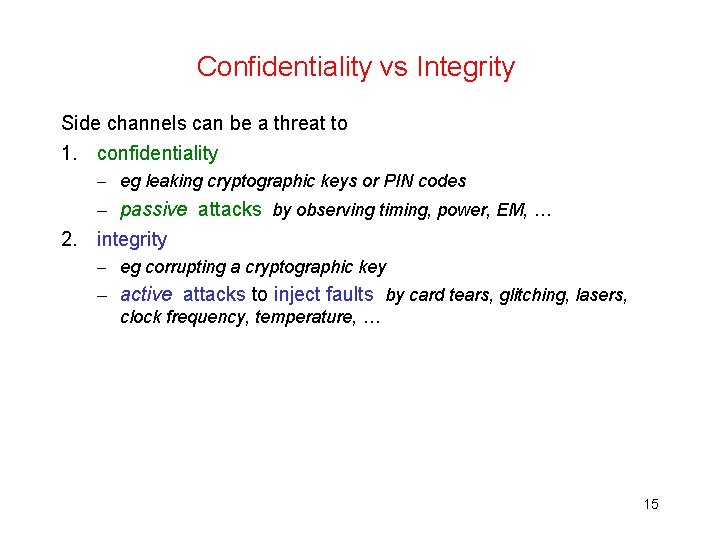
Confidentiality vs Integrity Side channels can be a threat to 1. confidentiality – eg leaking cryptographic keys or PIN codes – passive attacks by observing timing, power, EM, … 2. integrity – eg corrupting a cryptographic key – active attacks to inject faults by card tears, glitching, lasers, clock frequency, temperature, … 15
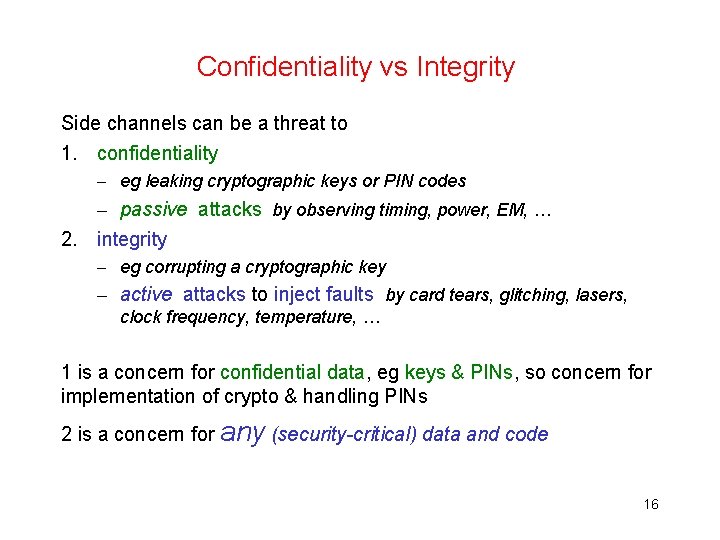
Confidentiality vs Integrity Side channels can be a threat to 1. confidentiality – eg leaking cryptographic keys or PIN codes – passive attacks by observing timing, power, EM, … 2. integrity – eg corrupting a cryptographic key – active attacks to inject faults by card tears, glitching, lasers, clock frequency, temperature, … 1 is a concern for confidential data, eg keys & PINs, so concern for implementation of crypto & handling PINs 2 is a concern for any (security-critical) data and code 16
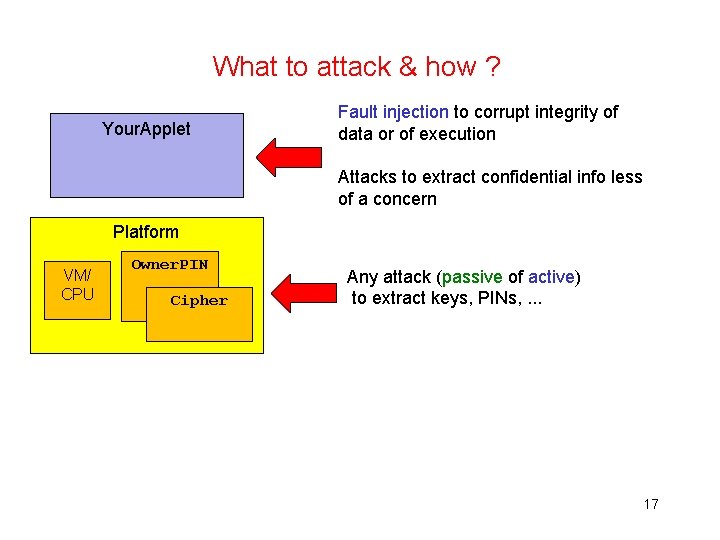
What to attack & how ? Your. Applet Fault injection to corrupt integrity of data or of execution Attacks to extract confidential info less of a concern Platform VM/ CPU Owner. PIN Cipher Any attack (passive of active) to extract keys, PINs, . . . 17
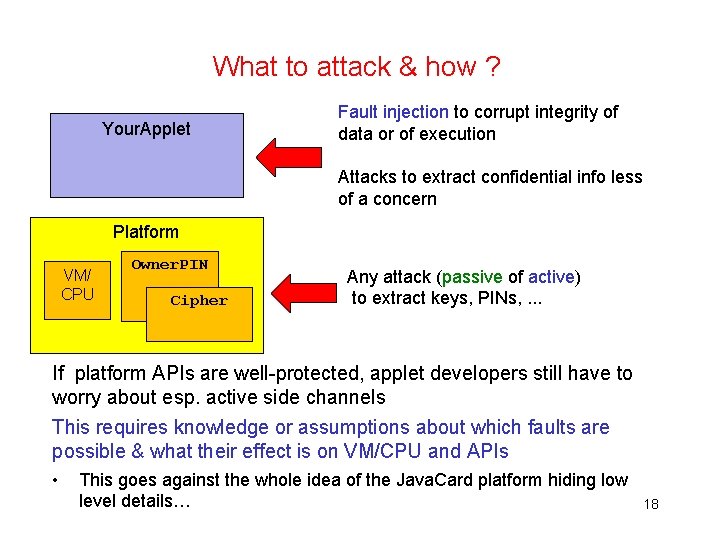
What to attack & how ? Your. Applet Fault injection to corrupt integrity of data or of execution Attacks to extract confidential info less of a concern Platform VM/ CPU Owner. PIN Cipher Any attack (passive of active) to extract keys, PINs, . . . If platform APIs are well-protected, applet developers still have to worry about esp. active side channels This requires knowledge or assumptions about which faults are possible & what their effect is on VM/CPU and APIs • This goes against the whole idea of the Java. Card platform hiding low level details… 18
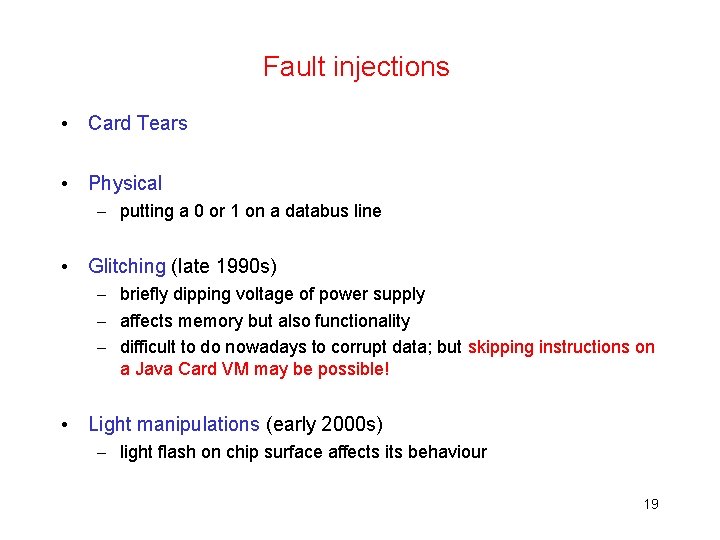
Fault injections • Card Tears • Physical – putting a 0 or 1 on a databus line • Glitching (late 1990 s) – briefly dipping voltage of power supply – affects memory but also functionality – difficult to do nowadays to corrupt data; but skipping instructions on a Java Card VM may be possible! • Light manipulations (early 2000 s) – light flash on chip surface affects its behaviour 19
Fault injections: practical complications Many parameters for the attacker to play with - when to do a card tear - when to glitch; how far to dip the voltage; for how long - when & where (x and y dimension) to shoot a laser; how long; how strong; and which colour? - Multiple faults? for Multiple glitches are possible, multiple laser attacks harder This can make fault attacks a hit-and-miss process for the attacker (and security evaluator) 20
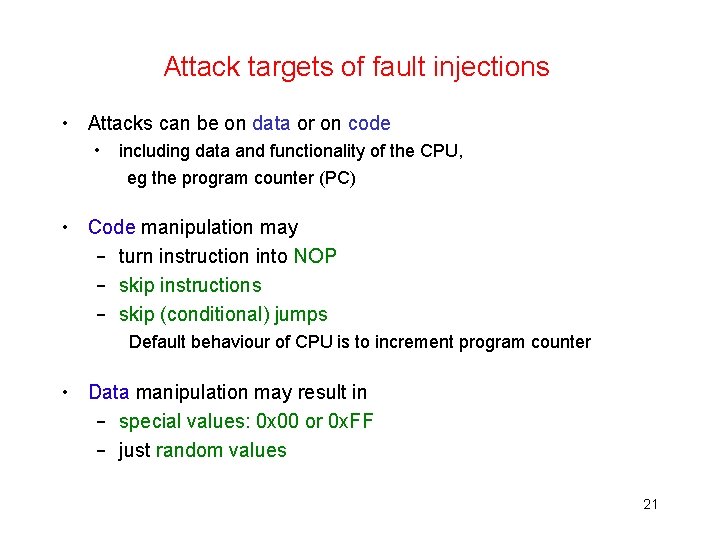
Attack targets of fault injections • Attacks can be on data or on code • including data and functionality of the CPU, eg the program counter (PC) • Code manipulation may – turn instruction into NOP – skip instructions – skip (conditional) jumps Default behaviour of CPU is to increment program counter • Data manipulation may result in – special values: 0 x 00 or 0 x. FF – just random values 21
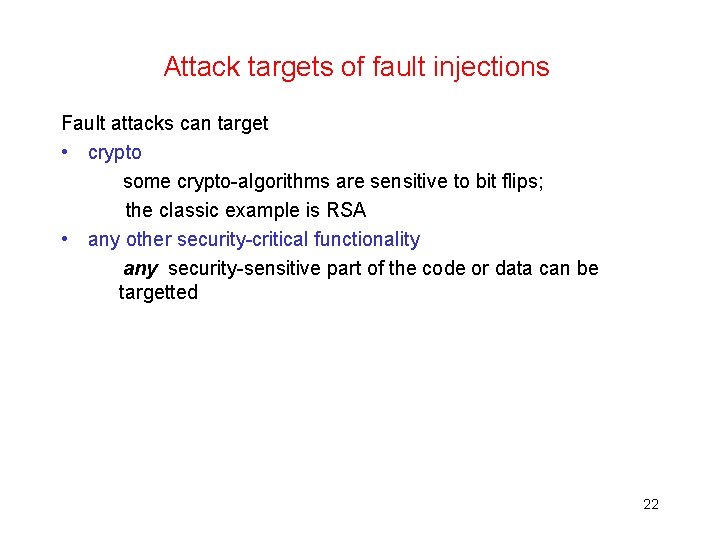
Attack targets of fault injections Fault attacks can target • crypto some crypto-algorithms are sensitive to bit flips; the classic example is RSA • any other security-critical functionality any security-sensitive part of the code or data can be targetted 22
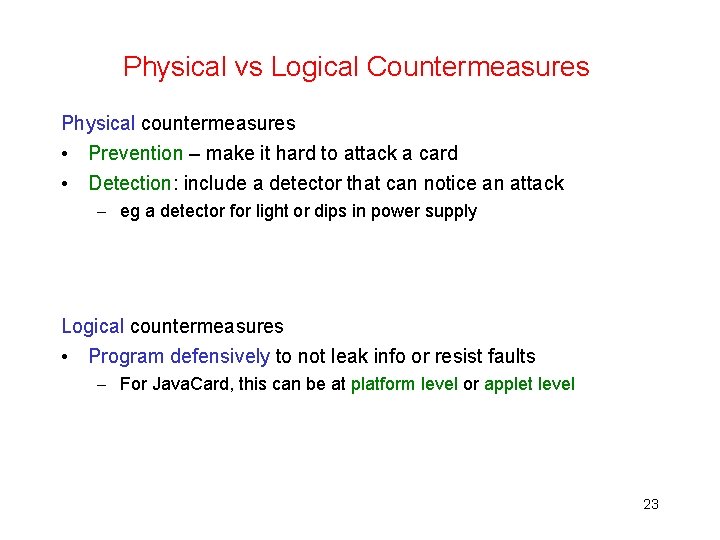
Physical vs Logical Countermeasures Physical countermeasures • Prevention – make it hard to attack a card • Detection: include a detector that can notice an attack – eg a detector for light or dips in power supply Logical countermeasures • Program defensively to not leak info or resist faults – For Java. Card, this can be at platform level or applet level 23
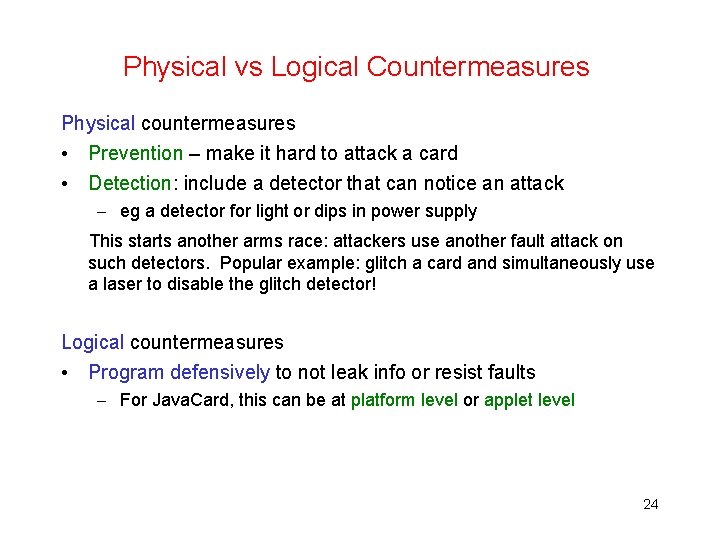
Physical vs Logical Countermeasures Physical countermeasures • Prevention – make it hard to attack a card • Detection: include a detector that can notice an attack – eg a detector for light or dips in power supply This starts another arms race: attackers use another fault attack on such detectors. Popular example: glitch a card and simultaneously use a laser to disable the glitch detector! Logical countermeasures • Program defensively to not leak info or resist faults – For Java. Card, this can be at platform level or applet level 24
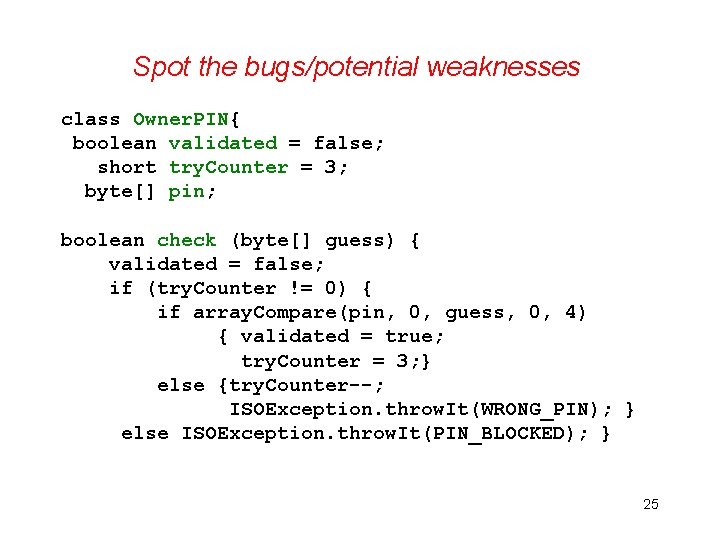
Spot the bugs/potential weaknesses class Owner. PIN{ boolean validated = false; short try. Counter = 3; byte[] pin; boolean check (byte[] guess) { validated = false; if (try. Counter != 0) { if array. Compare(pin, 0, guess, 0, 4) { validated = true; try. Counter = 3; } else {try. Counter--; ISOException. throw. It(WRONG_PIN); } else ISOException. throw. It(PIN_BLOCKED); } 25
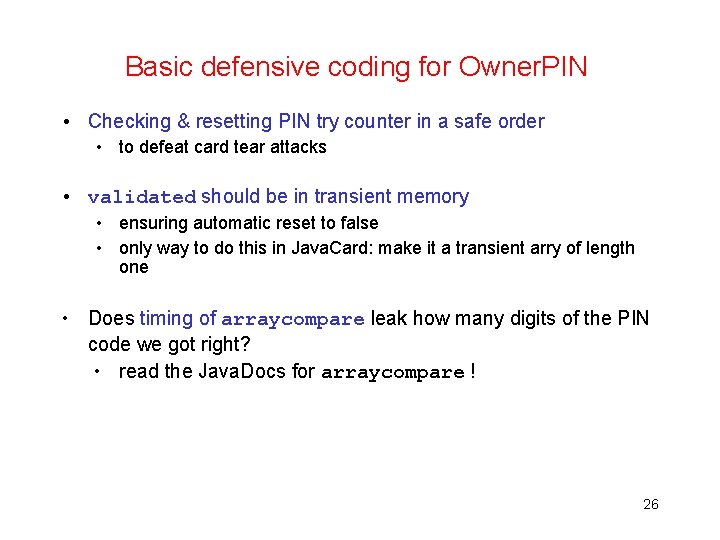
Basic defensive coding for Owner. PIN • Checking & resetting PIN try counter in a safe order • to defeat card tear attacks • validated should be in transient memory • ensuring automatic reset to false • only way to do this in Java. Card: make it a transient arry of length one • Does timing of arraycompare leak how many digits of the PIN code we got right? • read the Java. Docs for arraycompare ! 26
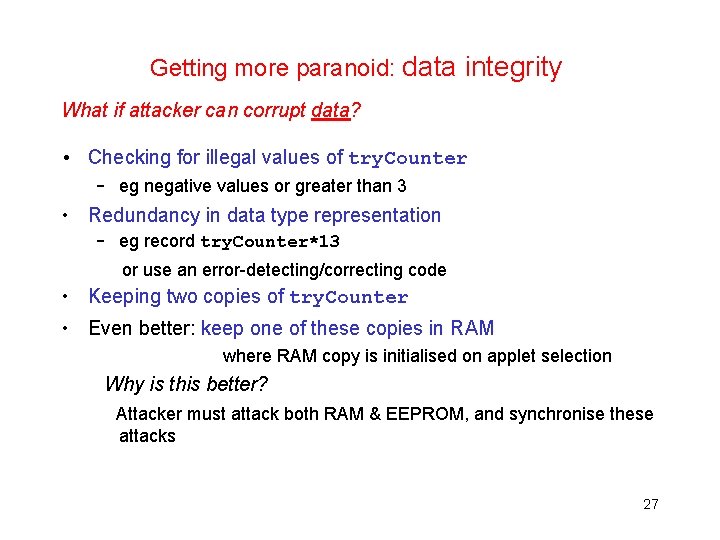
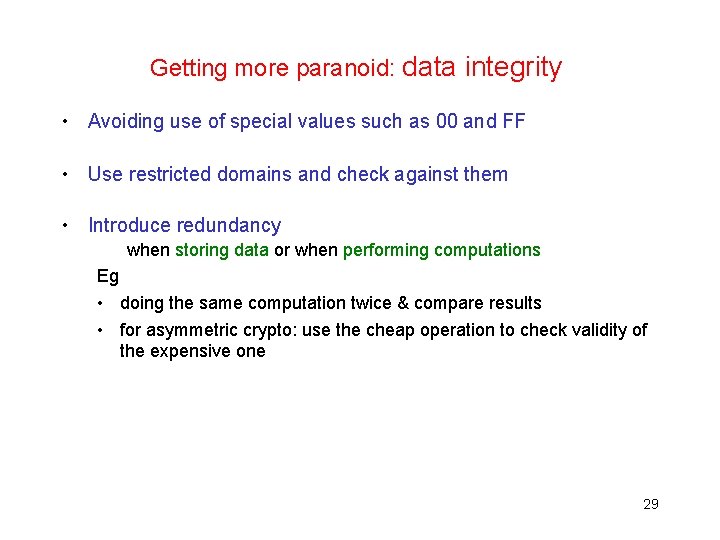
Getting more paranoid: data integrity What if attacker can corrupt data? • Checking for illegal values of try. Counter – eg negative values or greater than 3 • Redundancy in data type representation – eg record try. Counter*13 or use an error-detecting/correcting code • Keeping two copies of try. Counter • Even better: keep one of these copies in RAM where RAM copy is initialised on applet selection Why is this better? Attacker must attack both RAM & EEPROM, and synchronise these attacks 27
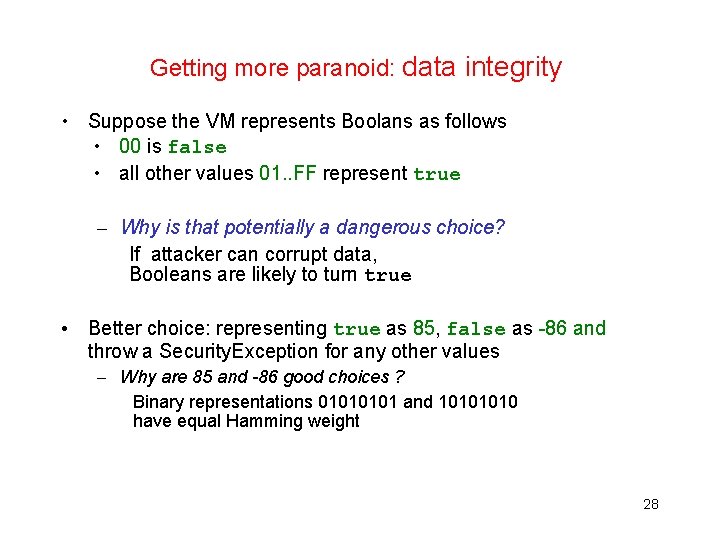
Getting more paranoid: data integrity • Suppose the VM represents Boolans as follows • 00 is false • all other values 01. . FF represent true – Why is that potentially a dangerous choice? If attacker can corrupt data, Booleans are likely to turn true • Better choice: representing true as 85, false as -86 and throw a Security. Exception for any other values – Why are 85 and -86 good choices ? Binary representations 0101 and 1010 have equal Hamming weight 28
Getting more paranoid: data integrity • Avoiding use of special values such as 00 and FF • Use restricted domains and check against them • Introduce redundancy when storing data or when performing computations Eg • doing the same computation twice & compare results • for asymmetric crypto: use the cheap operation to check validity of the expensive one 29
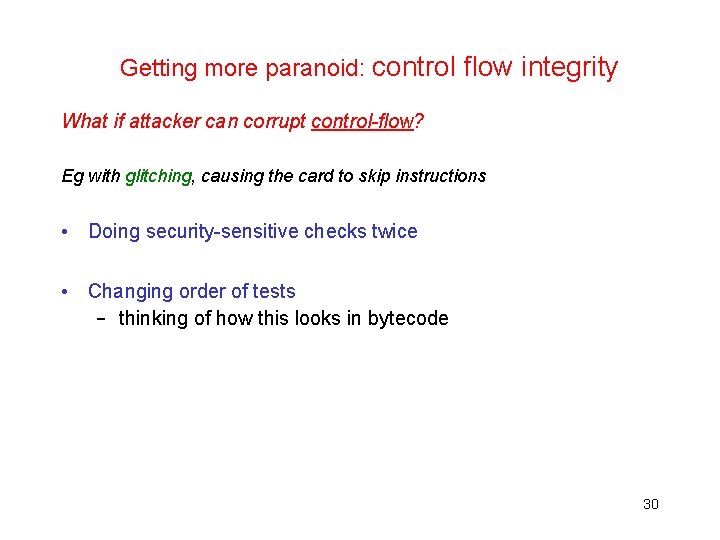
Getting more paranoid: control flow integrity What if attacker can corrupt control-flow? Eg with glitching, causing the card to skip instructions • Doing security-sensitive checks twice • Changing order of tests – thinking of how this looks in bytecode 30
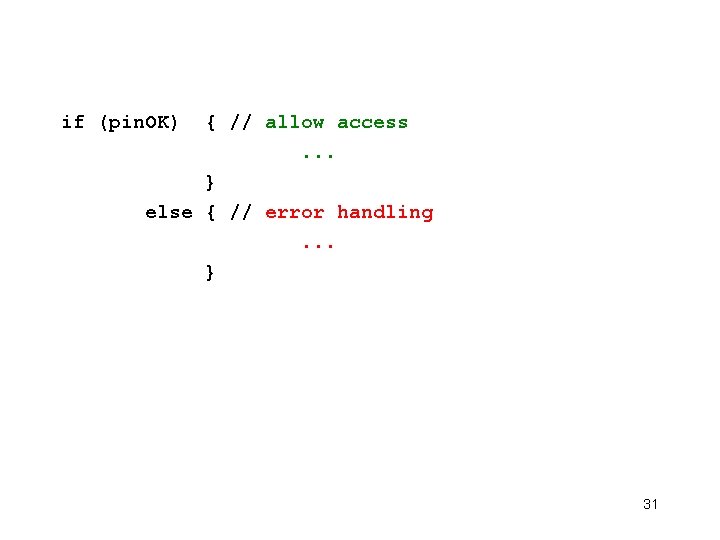
if (pin. OK) { // allow access. . . } else { // error handling. . . } 31
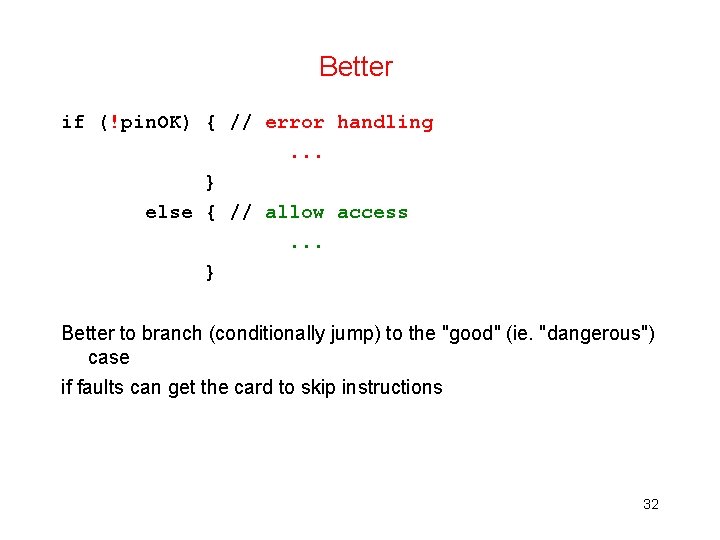
Better if (!pin. OK) { // error handling. . . } else { // allow access. . . } Better to branch (conditionally jump) to the "good" (ie. "dangerous") case if faults can get the card to skip instructions 32
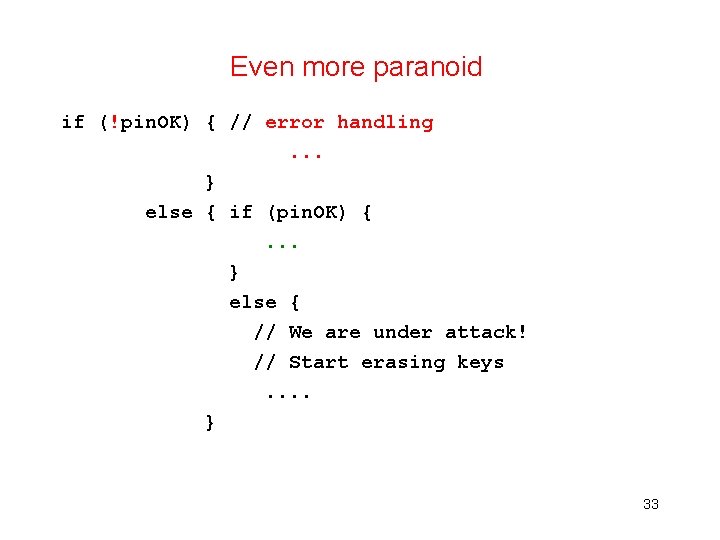
Even more paranoid if (!pin. OK) { // error handling. . . } else { if (pin. OK) {. . . } else { // We are under attack! // Start erasing keys. . } 33
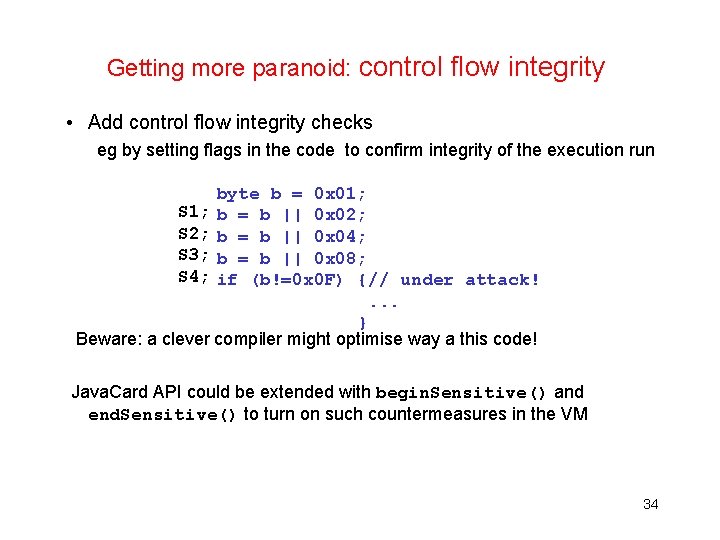
Getting more paranoid: control flow integrity • Add control flow integrity checks eg by setting flags in the code to confirm integrity of the execution run byte b = 0 x 01; S 1; b = b || 0 x 02; S 2; b = b || 0 x 04; S 3; b = b || 0 x 08; S 4; if (b!=0 x 0 F) {// under attack!. . . } Beware: a clever compiler might optimise way a this code! Java. Card API could be extended with begin. Sensitive() and end. Sensitive() to turn on such countermeasures in the VM 34
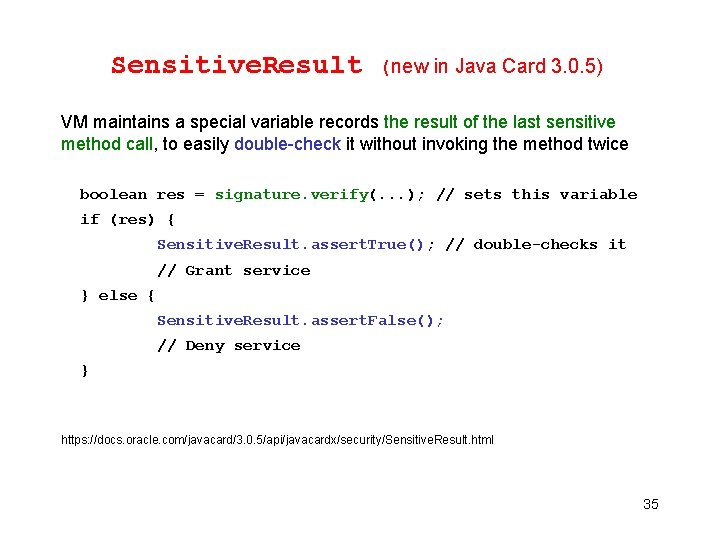
try { boolean res = signature. verify(. . . ); if (res) { Sensitive. Result. assert. True(); // Grant service } else { Sensitive. Result. assert. False(); // Deny service } } finally { Sensitive. Result (new in Java Card 3. 0. 5) VM maintains a special variable records the result of the last sensitive method call, to easily double-check it without invoking the method twice boolean res = signature. verify(. . . ); // sets this variable if (res) { Sensitive. Result. assert. True(); // double-checks it // Grant service } else { Sensitive. Result. assert. False(); // Deny service } https: //docs. oracle. com/javacard/3. 0. 5/api/javacardx/security/Sensitive. Result. html 35
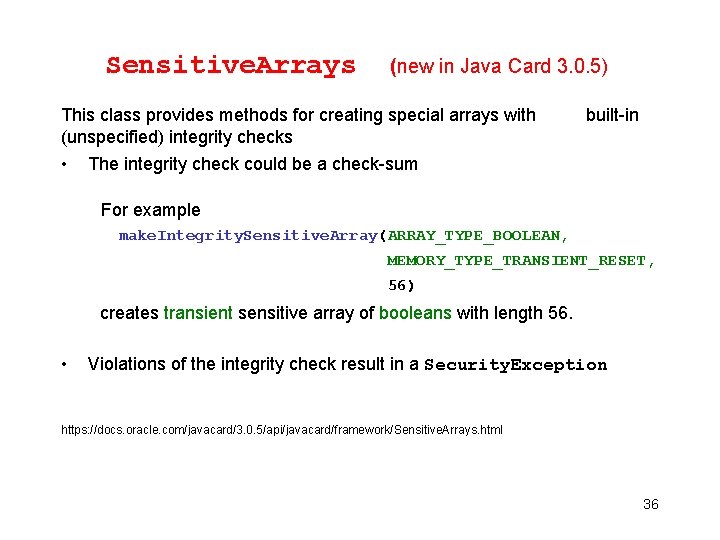
try { boolean res = signature. verify(. . . ); if (res) { Sensitive. Result. assert. True(); // Grant service } else { Sensitive. Result. assert. False(); // Deny service } } finally { Sensitive. Arrays (new in Java Card 3. 0. 5) This class provides methods for creating special arrays with (unspecified) integrity checks • built-in The integrity check could be a check-sum For example make. Integrity. Sensitive. Array(ARRAY_TYPE_BOOLEAN, MEMORY_TYPE_TRANSIENT_RESET, 56) creates transient sensitive array of booleans with length 56. • Violations of the integrity check result in a Security. Exception https: //docs. oracle. com/javacard/3. 0. 5/api/javacard/framework/Sensitive. Arrays. html 36
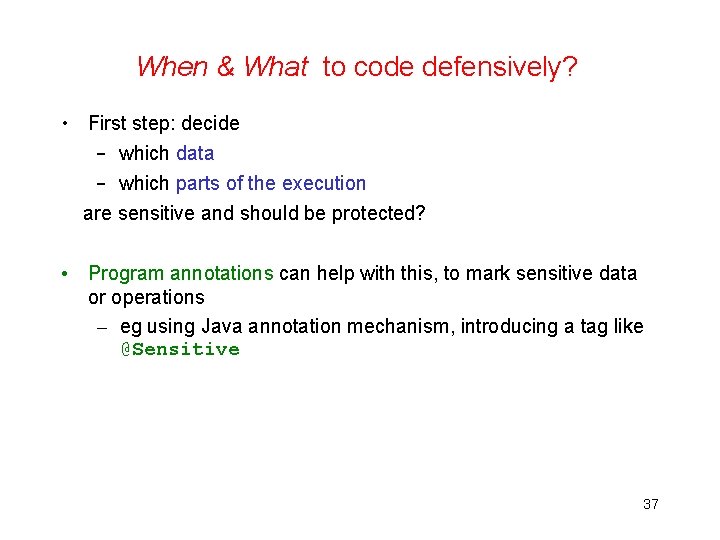
When & What to code defensively? • First step: decide – which data – which parts of the execution are sensitive and should be protected? • Program annotations can help with this, to mark sensitive data or operations – eg using Java annotation mechanism, introducing a tag like @Sensitive 37
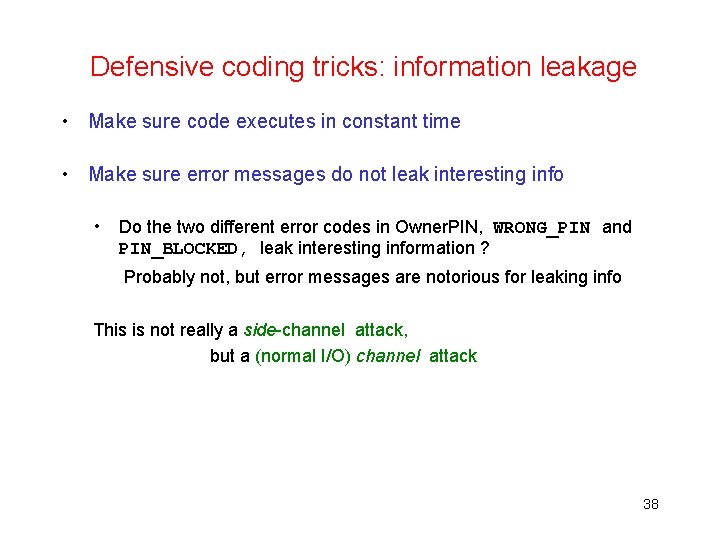
Defensive coding tricks: information leakage • Make sure code executes in constant time • Make sure error messages do not leak interesting info • Do the two different error codes in Owner. PIN, WRONG_PIN and PIN_BLOCKED, leak interesting information ? Probably not, but error messages are notorious for leaking info This is not really a side-channel attack, but a (normal I/O) channel attack 38
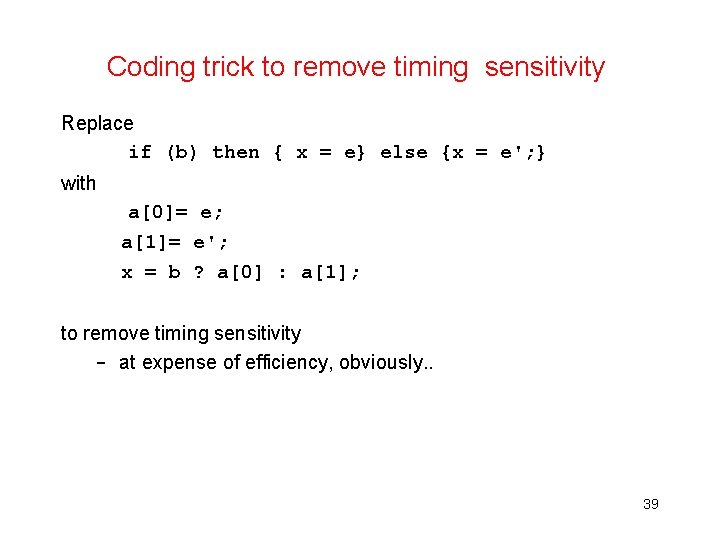
Coding trick to remove timing sensitivity Replace if (b) then { x = e} else {x = e'; } with a[0]= e; a[1]= e'; x = b ? a[0] : a[1]; to remove timing sensitivity – at expense of efficiency, obviously. . 39
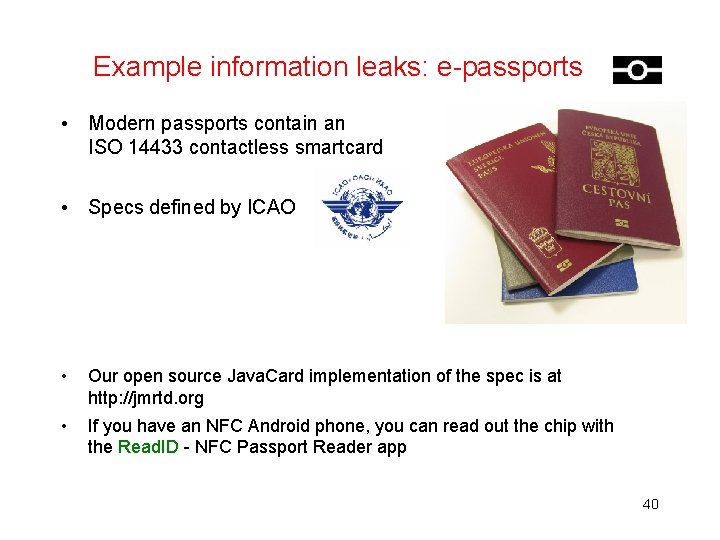
Example information leaks: e-passports • Modern passports contain an ISO 14433 contactless smartcard • Specs defined by ICAO • Our open source Java. Card implementation of the spec is at http: //jmrtd. org • If you have an NFC Android phone, you can read out the chip with the Read. ID - NFC Passport Reader app 40
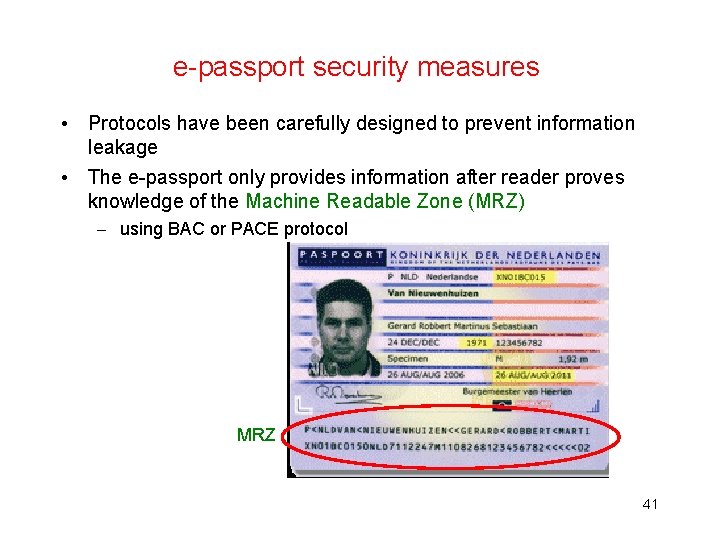
e-passport security measures • Protocols have been carefully designed to prevent information leakage • The e-passport only provides information after reader proves knowledge of the Machine Readable Zone (MRZ) – using BAC or PACE protocol MRZ 41
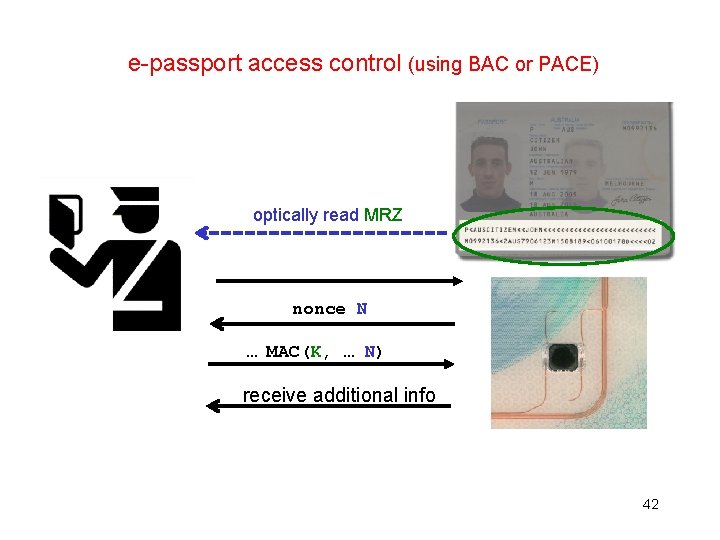
e-passport access control (using BAC or PACE) optically read MRZ nonce N … MAC(K, … N) receive additional info 42
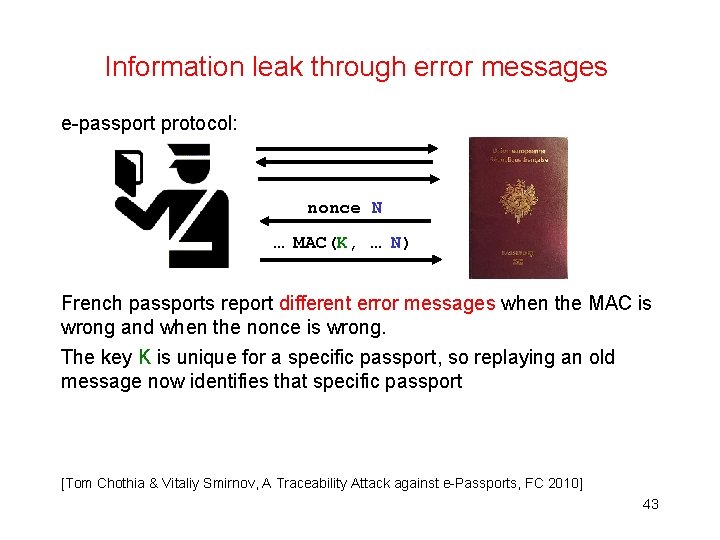
Information leak through error messages e-passport protocol: nonce N … MAC(K, … N) French passports report different error messages when the MAC is wrong and when the nonce is wrong. The key K is unique for a specific passport, so replaying an old message now identifies that specific passport [Tom Chothia & Vitaliy Smirnov, A Traceability Attack against e-Passports, FC 2010] 43
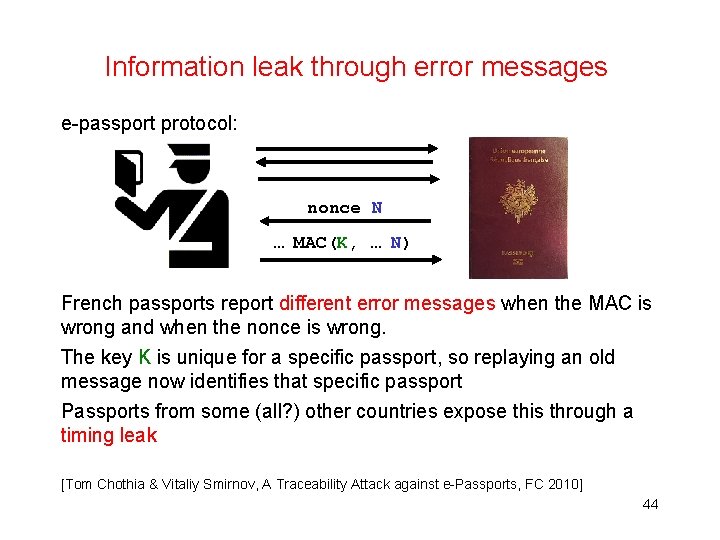
Information leak through error messages e-passport protocol: nonce N … MAC(K, … N) French passports report different error messages when the MAC is wrong and when the nonce is wrong. The key K is unique for a specific passport, so replaying an old message now identifies that specific passport Passports from some (all? ) other countries expose this through a timing leak [Tom Chothia & Vitaliy Smirnov, A Traceability Attack against e-Passports, FC 2010] 44
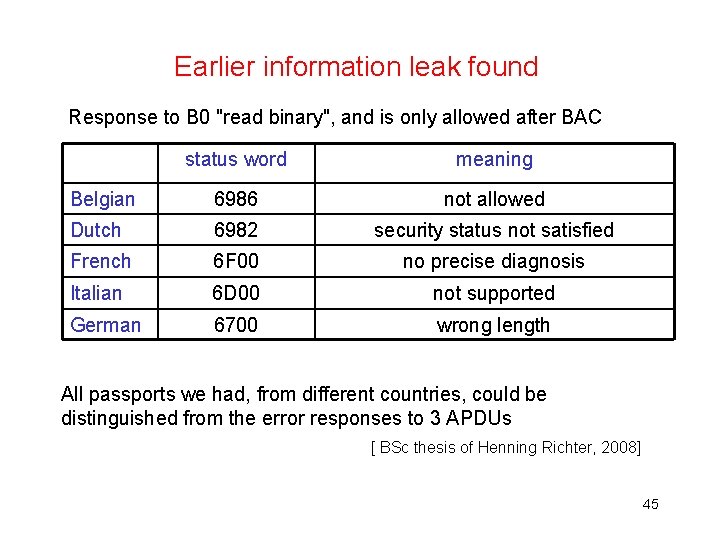
Earlier information leak found Response to B 0 "read binary", and is only allowed after BAC status word meaning Belgian 6986 not allowed Dutch 6982 security status not satisfied French 6 F 00 no precise diagnosis Italian 6 D 00 not supported German 6700 wrong length All passports we had, from different countries, could be distinguished from the error responses to 3 APDUs [ BSc thesis of Henning Richter, 2008] 45
46
Passport bombs? http: //www. youtube. com/watch? v=-XXaqra. F 7 p. I
Your project code • For your projects, you do not have to do program defensively to withstand faults – except that you have to resist card tears • So you do not have to add your own integrity checks on data stored on the card; for this you may simply trust the card 48
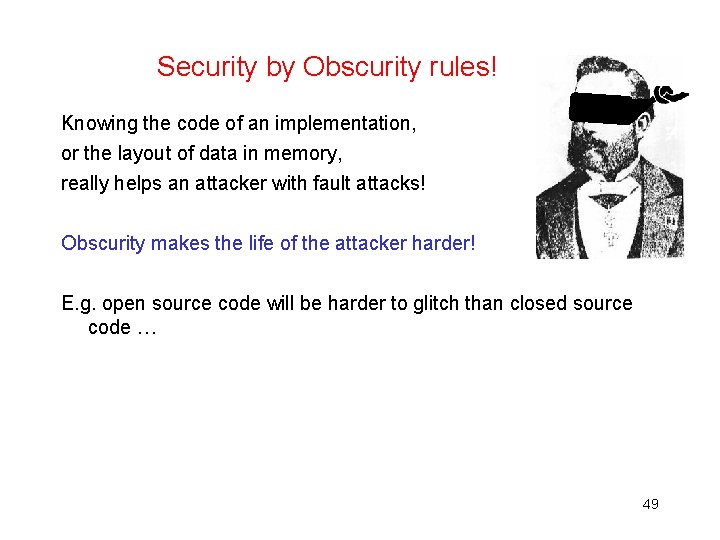
Security by Obscurity rules! Knowing the code of an implementation, or the layout of data in memory, really helps an attacker with fault attacks! Obscurity makes the life of the attacker harder! E. g. open source code will be harder to glitch than closed source code … 49
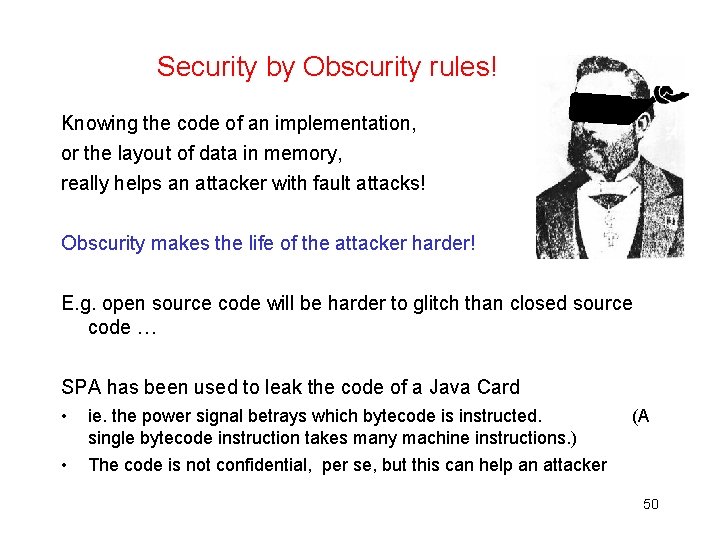
Security by Obscurity rules! Knowing the code of an implementation, or the layout of data in memory, really helps an attacker with fault attacks! Obscurity makes the life of the attacker harder! E. g. open source code will be harder to glitch than closed source code … SPA has been used to leak the code of a Java Card • ie. the power signal betrays which bytecode is instructed. single bytecode instruction takes many machine instructions. ) • The code is not confidential, per se, but this can help an attacker (A 50
Side channels going mainstream Side channel attacks used to be the concern for embedded security, esp. smartcards – where attacker has physical access to do side-channel attacks on confidentiality (eg DPA) or integrity (eg glitching & light attacks) 51
Side channels going mainstream Side channel attacks used to be the concern for embedded security, esp. smartcards – where attacker has physical access to do side-channel attacks on confidentiality (eg DPA) or integrity (eg glitching & light attacks) However, in the last decade this went mainstream due to – micro-architectural attacks Spectre & Meltdown on confidentiality – Row. Hammering as fault injection attack to comprise integrity 52
Side channels going mainstream Side channel attacks used to be the concern for embedded security, esp. smartcards – where attacker has physical access to do side-channel attacks on confidentiality (eg DPA) or integrity (eg glitching & light attacks) However, in the last decade this went mainstream due to – micro-architectural attacks Spectre & Meltdown on confidentiality – Row. Hammering as fault injection attack to comprise integrity The attacker model is different here: not a physical attacker, but a malicious execution thread 53