
Defense Trade Advisory Group DTAG Public Plenary May
Defense Trade Advisory Group (DTAG) Public Plenary May 10, 2018
Agenda 1: 00 – 1: 30 pm - Welcome and Introductory Remarks • DTAG Chair, Bill Wade • State Dept. DAS, Defense Trade Control, Michael Miller 1: 30 – 2: 30 PM - Working Group – Defense Services Break: 1: 45 – 3: 00 PM - Working Group – 3: 00 – 3: 15 PM - Break 3: 15 – 4: 00 PM - Working Group – PPE 4: 30 – 4: 45 PM - Wrap Up/Closing Remarks 2
DTAG Charter (2016) • Objectives and Scope of Activities – “The purpose of the DTAG is to provide a formal channel for regular consultation and coordination with U. S. private sector defense exporters and defense trade specialists on issues involving U. S. laws, policies, and regulations for exports of defense articles, services, and related technical data. The DTAG serves the Department in a solely advisory capacity. ” • Description of Duties – “The DTAG will advise the Department on its support for and regulation of defense trade to help ensure that the foreign policy and national security interests of the United States continue to be protected and advanced while helping to reduce unnecessary impediments to legitimate exports in order to support the defense requirements of 3 U. S. friends and allies. ”
Housekeeping • • • Cell Phones, Electronic Devices • Mute, Stun, Vibrate… • Enable the Cloaking Device No recording devices No photos Restrooms • Out the door to the left Q&A • Hold your questions until the end of each presentation 4
Defense Trade Advisory Group DAS Michael Miller Plenary Session February 1, 2018
Defense Trade Advisory Group ONE-FORM ELECTRONIC FILING WORKING GROUP Plenary Session February 1, 2018
DRAFT Defense Trade Advisory Group ONE-FORM ELECTRONIC FILING WORKING GROUP Plenary Session May 10, 2018
Agenda • • • Working Group Members Task Description- Updated! Recap Survey Results Recommendations Questions 8
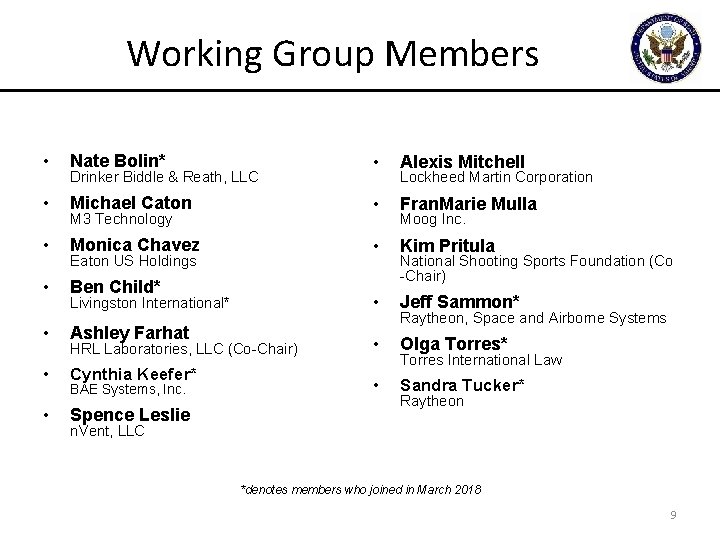
Working Group Members • Nate Bolin* • Alexis Mitchell • Michael Caton • Fran. Marie Mulla • Monica Chavez • Kim Pritula • Ben Child* • Jeff Sammon* • Olga Torres* • Sandra Tucker* • • • Drinker Biddle & Reath, LLC M 3 Technology Eaton US Holdings Livingston International* Ashley Farhat HRL Laboratories, LLC (Co-Chair) Cynthia Keefer* BAE Systems, Inc. Spence Leslie Lockheed Martin Corporation Moog Inc. National Shooting Sports Foundation (Co -Chair) Raytheon, Space and Airborne Systems Torres International Law Raytheon n. Vent, LLC *denotes members who joined in March 2018 9
Kudos DDTC A special thank you to Karen Wrege and her team for providing guidance and continual support throughout the process 10
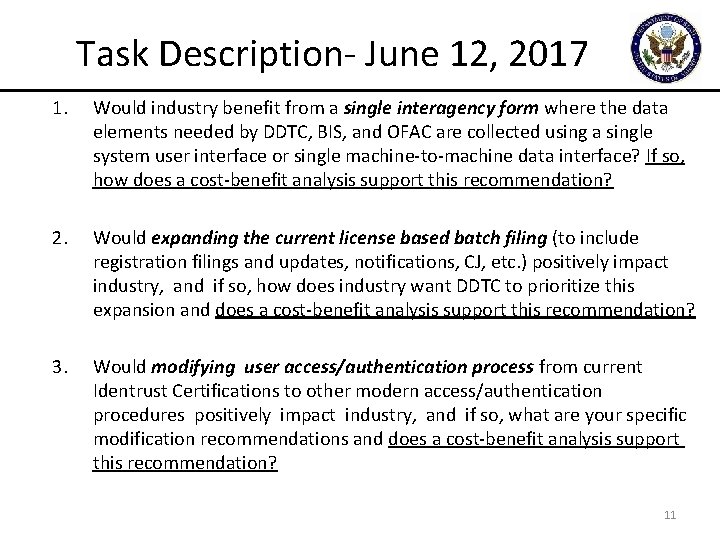
Task Description- June 12, 2017 1. Would industry benefit from a single interagency form where the data elements needed by DDTC, BIS, and OFAC are collected using a single system user interface or single machine-to-machine data interface? If so, how does a cost-benefit analysis support this recommendation? 2. Would expanding the current license based batch filing (to include registration filings and updates, notifications, CJ, etc. ) positively impact industry, and if so, how does industry want DDTC to prioritize this expansion and does a cost-benefit analysis support this recommendation? 3. Would modifying user access/authentication process from current Identrust Certifications to other modern access/authentication procedures positively impact industry, and if so, what are your specific modification recommendations and does a cost-benefit analysis support this recommendation? 11
Task Description- June 12, 2017 1. Would industry benefit from a single interagency form where the data elements needed by DDTC, BIS, and OFAC are collected using a single system user interface or single machine-to-machine data interface? If so, how does a cost-benefit analysis support this recommendation? 2. Would expanding the current license based batch filing (to include registration filings and updates, notifications, CJ, etc. ) positively impact industry, and if so, how does industry want DDTC to prioritize this expansion and does a cost-benefit analysis support this recommendation? 3. Would modifying user access/authentication process from current Identrust Certifications to other modern access/authentication procedures positively impact industry, and if so, what are your specific modification recommendations and does a cost-benefit analysis support this recommendation? 12
Updates to June 2017 Tasking • Deployment of the survey brought on several challenges that WG 1 had to work through – Paperwork Reduction Act – Federal Advisory Committee Act – Freedom of Information Act – Obtain OMB approval – OMB concerned that cost related questions could be considered a direct influence to the Agency’s decision making – Cost related questions were omitted from the deployed survey • Cost related questions will go through another OMB approval and will be administered to the DTAG for response • Plan is to present the results of the cost data in the next Plenary 13
Current Tasking- March 13, 2018 • From the tasking letter: “The current DTAG charter period closes in mid-May 2018. We have tentatively scheduled a final plenary for this DTAG charter on May 10 th. After the February 1 plenary, there remained one task not yet briefed as final by the IT working group. Please take action to close out that task at the May 10 plenary and pass on remaining work by way of recommendations for further study so we can reassign that work to the next DTAG charter group. ” 14
Recap • WG 1 reported that the data from the Section 4 - Authentication were inconclusive • Addendum survey was sent out to DTAG members only • 39 DTAG members responded to the addendum survey 15
One-Form Electronic Filing: Authentication TASK: Would modifying user access/authentication process from current Identrust Certifications to other modern access/authentication procedures positively impact industry, and if so, what are your specific modification recommendations? 16
One-Form Electronic Filing: Authentication Q 1: What is the upper limit for cost that your company is able to pay, without significant impact, for annual authentication tokens person? Responses ranged from $100 -$500 USD person 17
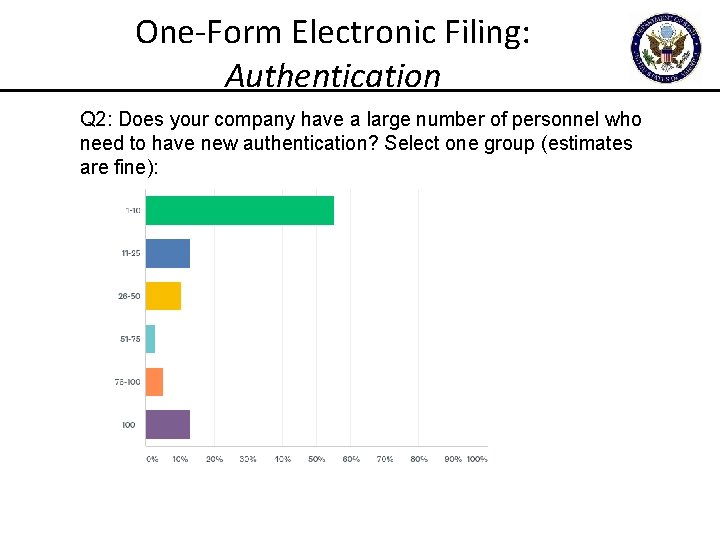
One-Form Electronic Filing: Authentication Q 2: Does your company have a large number of personnel who need to have new authentication? Select one group (estimates are fine):
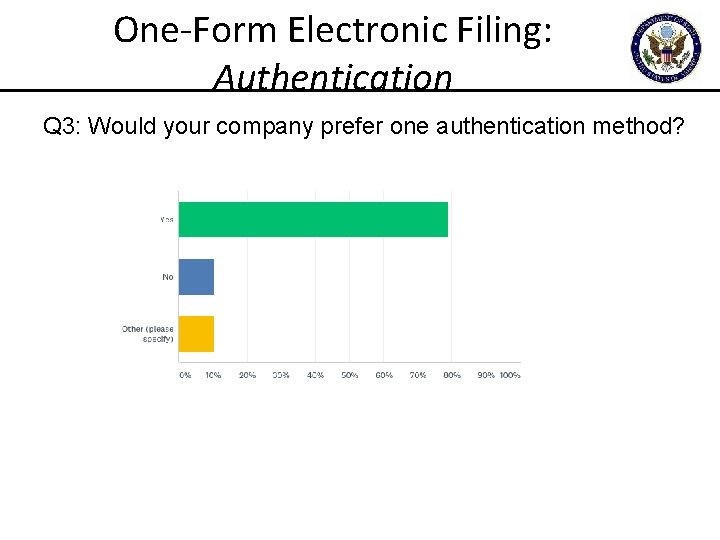
One-Form Electronic Filing: Authentication Q 3: Would your company prefer one authentication method?
One-Form Electronic Filing: Authentication Q 4: Would your company want a solution that allows for a number of role(s)(i. e. , super users vs users) or individual(s) (i. e. third-party counsel/consultant vs company designated Empowered Officials) accessing DECCS on behalf of your company? Overwhelming majority of responses were “Yes” 20
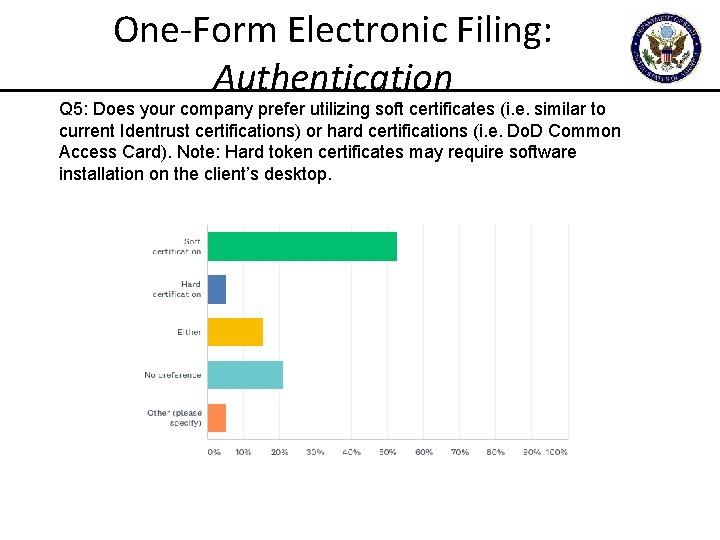
One-Form Electronic Filing: Authentication Q 5: Does your company prefer utilizing soft certificates (i. e. similar to current Identrust certifications) or hard certifications (i. e. Do. D Common Access Card). Note: Hard token certificates may require software installation on the client’s desktop.
One-Form Electronic Filing: Authentication Recommendation • • • Cost for Authentication must be reasonable Soft Certification is recommended One authentication method is preferred Include IT professionals into DTAG charter Continued partnership and collaboration between industry and government 22
Questions? Thank you 23
Defense Trade Advisory Group Defense Service Task Plenary Session May 10 th, 2018
Agenda • • Working Group Members Tasking Combat Operations EAR 600 -series “Use of Technical Data” Public Domain/Fundamental Research ITAR 126. 11 and 22 CFR 3 a Questions and Discussion 25
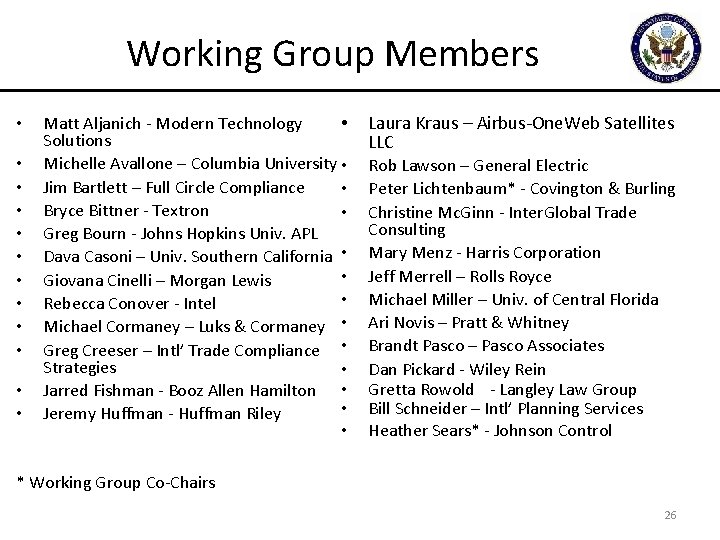
Working Group Members • • • Laura Kraus – Airbus-One. Web Satellites LLC Matt Aljanich - Modern Technology • Solutions Michelle Avallone – Columbia University • Jim Bartlett – Full Circle Compliance • Bryce Bittner - Textron • Greg Bourn - Johns Hopkins Univ. APL Dava Casoni – Univ. Southern California • • Giovana Cinelli – Morgan Lewis • Rebecca Conover - Intel Michael Cormaney – Luks & Cormaney • Greg Creeser – Intl’ Trade Compliance • Strategies • Jarred Fishman - Booz Allen Hamilton • • Jeremy Huffman - Huffman Riley • Rob Lawson – General Electric Peter Lichtenbaum* - Covington & Burling Christine Mc. Ginn - Inter. Global Trade Consulting Mary Menz - Harris Corporation Jeff Merrell – Rolls Royce Michael Miller – Univ. of Central Florida Ari Novis – Pratt & Whitney Brandt Pasco – Pasco Associates Dan Pickard - Wiley Rein Gretta Rowold - Langley Law Group Bill Schneider – Intl’ Planning Services Heather Sears* - Johnson Control * Working Group Co-Chairs 26
Tasking • “At the February 1, 2018 plenary, the Defense Services Working Group provided a final white paper on their findings. In that white paper they had a number of recommendations for future definitional work in Section VI, specifically identifying five (5) topics for further study/development. Given the limited time between this tasking and the May 10 plenary, DDTC is requesting information from the DTAG on any of those 5 topics. ” 27
120. 9(a) - “Catch” (a) Defense service means where a U. S. person does any of the following: (1) Assisting or training a foreign person (see § 120. 16) in the development, production, assembly, testing, intermediate- or depot-level maintenance (see § 120. 38), modification, employment, integration, repair, overhaul or refurbishing of a defense article (see § 120. 6), using traceable U. S. -origin technical data (see § 120. 10) or foreign-origin technical data that has been produced or manufactured from U. S. -origin technical data (see § 124. 8(5)). (2) Participating in, providing training in, or directing combat operations for a foreign government, except as a member of the regular military forces of a foreign nation by a U. S. person who has been drafted into such forces. See § 120. 54. See also § 126. 11 and 22 CFR Part 3 a (performance of services on behalf of foreign governments by former U. S. military personnel). (3) Assisting or training a foreign person (see § 120. 16) of a country listed in § 126. 1(d)(1) of this subchapter in the development, production, assembly, testing, maintenance, modification, employment, integration, installation, repair, overhaul, or refurbishing of a defense article. 28
120. 9(b) – “Release” (b) Release: The following are not covered by paragraphs (a)(1) or (a)(2): 1. Assisting a foreign person using technical data subject to the ITAR that was separately authorized by the U. S. government for export to the same foreign person. 2. Assisting or training regarding the organizational-level (basic-level) maintenance of a defense article, or regarding the basic operation of a defense article authorized by the U. S. government for export to the same recipient; 3. The installation of any parts, components, attachments or accessories into a defense article, or the installation of a defense article into an end-item or system. 4. Providing law enforcement, physical security, or personal protective services (including training and advice) to or for a foreign person; 5. Providing medical, logistical (other than maintenance), translation, financial, costing and budgeting, legal, scheduling, or administrative services; 6. Furnishing assistance by a foreign government to a foreign person in the United States, pursuant to an arrangement with the Department of Defense; and 7. Instruction in general principles, including general scientific, mathematical, or engineering principles commonly taught in schools, colleges, and universities or associated teaching or research laboratories of academic institutions 29
Issue 1: Combat Operations “Defense Services” means …. (2) [Knowingly] Participating in, providing training in, or directing combat operations for a foreign government, except as a member of the regular military forces of a foreign nation by a U. S. person who has been drafted into such forces. • Subsection 120. 9(a)(2) covers assistance in combat operations even where technical data is not used, given the national security sensitivity of such operations. PROPOSED DEFINITION FOR SECTION 120. 54: “Combat Operations” means planning or conducting offensive or defensive actions taken to (i) defeat an adversary’s military or other hostile forces or (ii) execute an attack on the United States. Combat Operations include strategic, tactical, or operational actions, whether related to military, paramilitary, terrorist, law enforcement, intelligence, cyberwarfare or electronic warfare operations. 30
Definitions – Standard Dictionary • Logistics: detailed coordination of a complex operation involving many people, facilities, or supplies. • Strategic: relating to the identification of long-term or overall aims and interests and the means of achieving them. • Tactical: relating to or constituting actions carefully planned to gain a specific military end. • Operational: engaged in or relating to active operations of the armed forces, police, or emergency services. • Cyberwarfare: the use of computer technology to attack information systems for strategic or military purposes. • Electronic warfare: the military use of electronics to prevent or reduce an enemy’s effective use and to protect friendly use of electromagnetic radiation equipment. 31
Definitions – Do. D Dictionary • Logistics: Planning and executing the movement and support of forces. • Tactical level of warfare: The level of warfare at which battles and engagements are planned and executed to achieve military objectives assigned to tactical units or task forces. • Strategic level of warfare: The level of warfare at which a nation, often as a member of a group of nations, determines national or multinational (alliance or coalition) strategic security objectives and guidance, then develops and uses national resources to achieve those objectives. • Operational level of warfare: The level of warfare at which campaigns and major operations are planned, conducted, and sustained to achieve strategic objectives within theaters or other operational areas. • Cyberwarfare: [not defined in the Do. D dictionary] • Electronic warfare: Military action involving the use of electromagnetic and directed energy to control the electromagnetic spectrum or to attack the enemy. 32
Issue 2: EAR 600 -Series [for DTAG only] • To alleviate USG concerns during the previous tasking, DTAG proposed that “defense services” apply more stringently to § 126. 1(d)(1) countries. • In DTAG’s proposed§ 120. 9(a)(3), a broader set of activities qualify as “defense services” when provided to foreign persons of these countries. • DTAG considered extending (a)(3) to cover activities related to EAR 600 series items in§ 126. 1(d)(1) countries, even when no ITAR defense articles or technical data are at issue. 33
EAR 600 -Series: Legal Aspect • DDTC has expressed concern that they lack statutory authority to regulate activities that do not relate to ITAR defense articles. • DTAG’s view is that DDTC has the statutory authority to designate activities relating to 600 -series items as “defense services”. • AECA Section 2778(a)(1) gives the President (i. e. , DDTC) broad authority to identify defense services on the USML. 34
EAR 600 -Series: Policy Aspect • Controlling activities only related to 600 -series items as “defense services” would undo a major component of ECR and require DSPs/TAAs for solely EAR-related activities. • Activities only related to 600 -series items should only be controlled as “defense services” if DDTC articulates a strong national security rationale. • Based on consultations with DDTC and BIS staff, we understand they do not support controlling activities only related to 600 -series items as defense services. • DTAG WG consensus does not support control. 35
Issue 3: “Use of Technical Data” Definition as proposed by DTAG in February: “Assisting or training a foreign person…in the development, production…of a defense article … , using [identifiable] U. S. -origin technical data. ” Issues: • Absent limitation, “use” of technical data is broad • Could require companies to control employees simply based on their knowledge, rather than what they actually do with the foreign person • Could be burdensome for companies, limit ability to involve engineers in important work, and foster misunderstandings between industry and U. S. enforcement agencies 36
“Use of Technical Data” Recommendation is to ADD the following: • The word “traceable” to the proposed definition of defense services. “Assisting or training a foreign person (see § 120. 16) in the development, production … of a defense article (see § 120. 6), using traceable U. S. -origin technical data …” • (b)(3) release: “Assisting or training a foreign person based solely on knowledge, training, education or work experience that cannot be traced to U. S. -origin technical data. ”; • Note 3: The term “traceable” requires that the use of U. S-origin technical data be established based on specific evidence. 37
Issue 4: Public Domain / Fundamental Research • DTAG’s Feb. 1, 2018 “defense service” definition helps clarify the interplay between defense service controls and public domain/fundamental research – Eliminates unnecessary confusion by removing current 120. 9(a)(2) – Ties “defense service” to ITAR technical data for non-126. 1(d)(1) countries – Acknowledges further clarification is needed regarding if/when public domain information can be captured under defense services for 126. 1(d)(1) countries • DTAG encourages DDTC to move forward with the process it started in 2015 to revise the definitions of “public domain” and “fundamental research” – DTAG should update its May 9 th, 2013 proposed definition of “fundamental research” 38
Public Domain/Fundamental Research [for DTAG only] • When considering revisions to “public domain” and “fundamental research”, DTAG urges DDTC to – retain its 2015 proposed change to move “fundamental research” into its own stand-alone category (2015 proposed rule 120. 49) – harmonize ITAR’s definition of “fundamental research” with EAR 734. 8, to the extent possible – differentiate between publication delays resulting from government access/dissemination controls on research data vs. reviews to protect proprietary data/ patent rights – refrain from imposing a prior approval requirement on “public domain” information similar to that in 2015 proposed rule 120. 11(b) – solicit early feedback from DTAG on new proposed definitions 39
Issue 5: ITAR 126. 11 and 22 CFR 3 a • Constitutional restrictions that preclude retired uniformed services personnel from accepting compensated positions with foreign governments: US Constitution, Article I, § 9, Clause 8 [the “Emoluments Clause”] • The Constitution does not limit the services that can be provided but focuses on the prohibition of compensated positions and Congress has indicated that uniformed services personnel may accept such positions with the approval of the Secretary of State • ITAR 126. 11 identifies two requirements: – The performance of defense services provided by retired military personnel on behalf of foreign governments requires ITAR authorizations; and – The same performance of defense services also requires consent under 22 CFR Part 3 A 40
ITAR 126. 11 and 22 CFR 3 a • 22 CFR Part 3 A: Acceptance of Employment from Foreign Governments by Members of the Uniformed Services – Applies to any retired member of the uniformed services who accepts civil employment (and compensation) from a foreign government, 22 CFR 3 a. 1 – Does not require the performance of a specific type of service – i. e. , a defense service or technical service – The Secretary of State may approve the employment, 22 CFR 3 a. 2 – The Secretary has designated the Director of the Bureau of Political. Military Affairs to approve or disapprove any such employment and this authority can be further delegated within P/M, 22 CFR 3 a. 3 – Applications for employment will be reviewed to determine whether the proposed employment “would adversely affect the foreign relations of the United States, in light of the applicant’s official status as a retiree or reservist. ” 22 CFR 3 a. 6 41
ITAR 126. 11 and 22 CFR 3 a • 22 CFR 126. 11 indicates that retired uniformed services personnel who perform defense services must satisfy the requirements of the: – ITAR; and – Part 3 a • The question is whether this provision should be included as in the definition of defense services as another type of service that requires authorization or addressed as a separate definition • Given the focused situation that 126. 11 and Part 3 a are designed to address, the general consensus was that this activity should be addressed in a separate definition and not within the proposed defense services definition 42
Defense Trade Advisory Group Working Group 1 Potential Expansion of the Personal Protective Equipment Exemption May 10, 2018
Working Group Members • Fred Alvarado • Candace Goforth Consultant Goforth Trade Advisors • Steve Casazza General Atomics Aeronautical Systems • Sandra Cross untington Ingalls Industries, Inc. • Tom Donovan Northrop Grumman • Larry Fink* Leidos, Inc. *Co-Leaders • Greg Hill Leonardo DRS • Angela Noll Consultant • Johanna Reeves F. A. I. R. Trade Group • Dale Rill Honeywell • Debbie Shaffer* L 3 Technologies DTAG ONLY - Do not distribute 44
Task 1. Potential Expansion of the PPE Exemption Over the years since this exemption was put in place, DDTC has been made aware of situations where the personnel claiming the exemption for PPE have also been in possession of other not PPE defense articles covered by the USML. This is not optimal as it makes the exit/entry subject to licensing requirements when for the not PPE. DTAG ONLY - Do not distribute 45
Task 1. Potential Expansion of the PPE Exemption Tasking: DDTC is requesting information from the DTAG on recommended changes to ITAR 123. 17 exemption that would cover other commonly carried Government Furnished Equipment (GFE), such as chemical-biological equipment, routinely issued through CONUS Replacement Center. DTAG ONLY - Do not distribute 46
Approach • Reviewed exemption § 123. 17(f) • Discussed and identified issues and complexities involving use of the exemption • Reviewed current guidance available on the subject of PPE • Reviewed past DTAG recommendations on the subject • Reviewed other ITAR exemptions DTAG ONLY - Do not distribute 47
PPE Exemption, 123. 17(f) • Permitted items – One set of personal ballistic protective gear and chemical agent protective gear – One additional filter canister • Exemption may be used for travel to§ 126. 1 countries provided travel is for official USG business or work under a USG contract • Individuals are not required to be registered with the Department of State DTAG ONLY - Do not distribute 48
PPE Exemption, 123. 17(f) • Export must be hand-carried or in checked luggage • Export via U. S. mail or freight forwarders is not permitted • Traveler presents Internal Transaction Number (ITN) to CBP officer and items for CBP inspection upon each departure • If ITN is not available, follow CBP instructions DTAG ONLY - Do not distribute 49
Concerns • Scope of the exemption does not currently cover all of the protective equipment currently issued to contractors by the USG for work in high-risk locations – Decontamination Kit – Detection paper • Exemption does not account for changes to USG issued protective equipment – CRC-required equipment can change based on changing threats – Specific equipment authorized by the exemption may be updated or replaced by the CRC DTAG ONLY - Do not distribute 50
Concerns • Export and import rules set forth in the current exemption are too restrictive given the demanding environment and conditions of deploying to support USG contracts – Presenting equipment to CBP for inspection prior to departure is difficult or impossible to accomplish and is not required for other ITAR hardware exemptions – Contractor personnel may be required by the USG contract to transit from one country to another requiring a separate retransfer/reexport authorization – Contractor personnel may be required to carry protective equipment in accordance with a USG contract that is not Government Furnished Equipment (GFE) – Contractor personnel may be required to mail GFE due to logistical concerns with hand-carrying (i. e. foreign customs, etc. ) • Current exemption places compliance responsibilities and action on individual travelers rather than the registrant DTAG ONLY - Do not distribute 51
Recommended Changes • Allow for temporary export of defense articles authorized by the USG • Recommend listing USML categories/subcategories rather than specific defense articles to allow for changes to USG/CONUS Replacement Center (CRC) equipment list or specific contract needs • Permit use of freight forwarders to handle shipments – Provides flexibility to address requirements beyond the company’s control – Avoids risk of seizure or detainment by local customs DTAG ONLY - Do not distribute 52
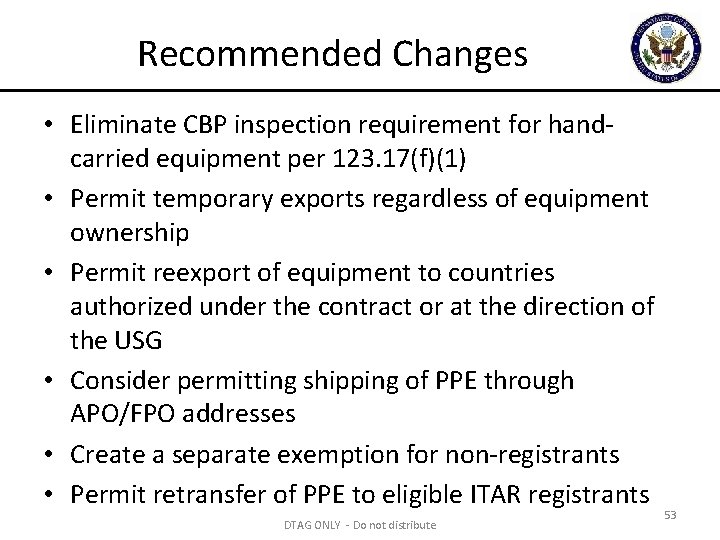
Recommended Changes • Eliminate CBP inspection requirement for handcarried equipment per 123. 17(f)(1) • Permit temporary exports regardless of equipment ownership • Permit reexport of equipment to countries authorized under the contract or at the direction of the USG • Consider permitting shipping of PPE through APO/FPO addresses • Create a separate exemption for non-registrants • Permit retransfer of PPE to eligible ITAR registrants DTAG ONLY - Do not distribute 53
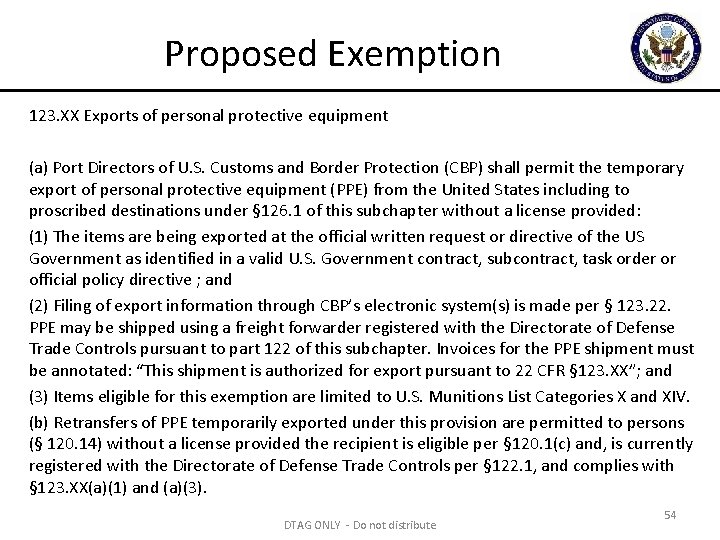
Proposed Exemption 123. XX Exports of personal protective equipment (a) Port Directors of U. S. Customs and Border Protection (CBP) shall permit the temporary export of personal protective equipment (PPE) from the United States including to proscribed destinations under § 126. 1 of this subchapter without a license provided: (1) The items are being exported at the official written request or directive of the US Government as identified in a valid U. S. Government contract, subcontract, task order or official policy directive ; and (2) Filing of export information through CBP’s electronic system(s) is made per § 123. 22. PPE may be shipped using a freight forwarder registered with the Directorate of Defense Trade Controls pursuant to part 122 of this subchapter. Invoices for the PPE shipment must be annotated: “This shipment is authorized for export pursuant to 22 CFR § 123. XX”; and (3) Items eligible for this exemption are limited to U. S. Munitions List Categories X and XIV. (b) Retransfers of PPE temporarily exported under this provision are permitted to persons (§ 120. 14) without a license provided the recipient is eligible per § 120. 1(c) and, is currently registered with the Directorate of Defense Trade Controls per § 122. 1, and complies with § 123. XX(a)(1) and (a)(3). DTAG ONLY - Do not distribute 54
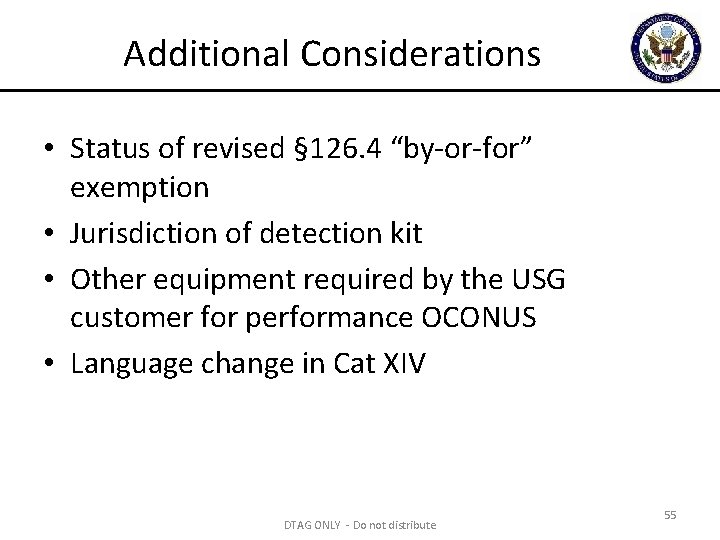
Additional Considerations • Status of revised § 126. 4 “by-or-for” exemption • Jurisdiction of detection kit • Other equipment required by the USG customer for performance OCONUS • Language change in Cat XIV DTAG ONLY - Do not distribute 55
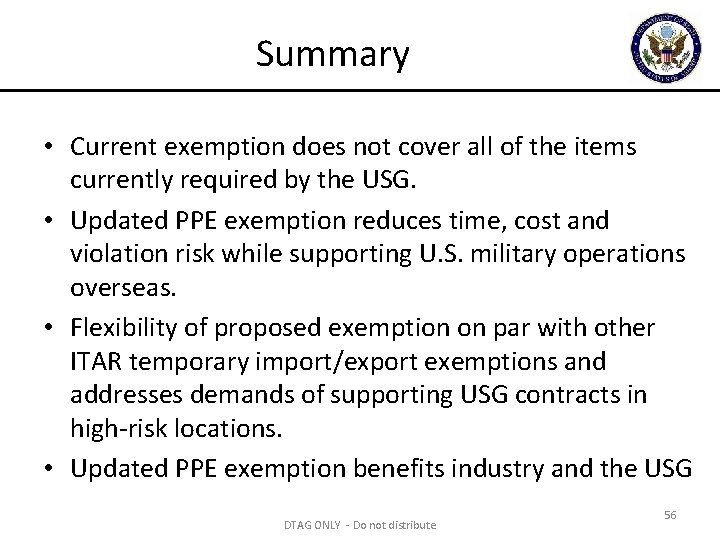
Summary • Current exemption does not cover all of the items currently required by the USG. • Updated PPE exemption reduces time, cost and violation risk while supporting U. S. military operations overseas. • Flexibility of proposed exemption on par with other ITAR temporary import/export exemptions and addresses demands of supporting USG contracts in high-risk locations. • Updated PPE exemption benefits industry and the USG DTAG ONLY - Do not distribute 56
- Slides: 56