
Defending the frequency spectrum Protecting the frequency spectrum
- Slides: 21
Defending the frequency spectrum Protecting the frequency spectrum for existing and future EO missions Richard Bantges Imperial College London & NCEO
Overview • What do I mean by the “frequency spectrum”? • Ofcom’s Spectrum Strategy • Why do we (NERC/NCEO) care – what are we “defending”? • How is frequency spectrum allocated? • Ofcom CFI’s / consultations • Ongoing activities – what can we all do?
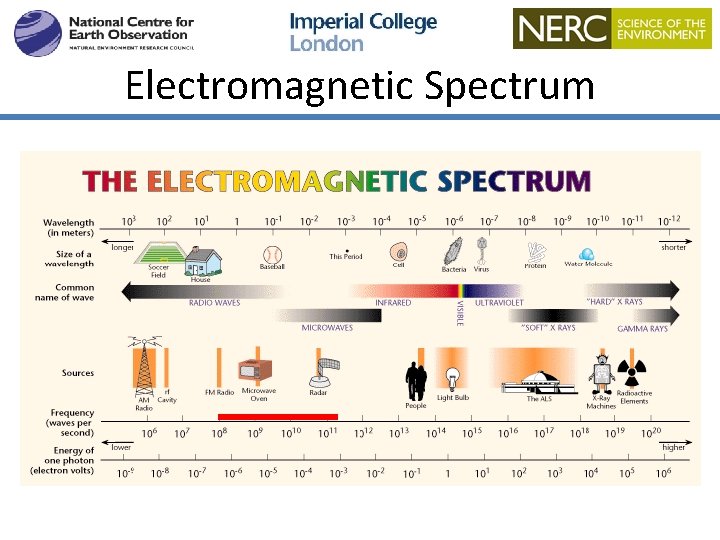
Electromagnetic Spectrum
Ofcom • • Ofcom is the communications regulator in the UK. We regulate the TV, radio and video-on-demand sectors, fixed-line telecoms, mobiles and postal services, plus the airwaves over which wireless devices operate. We make sure that people in the UK get the best from their communications services and are protected from scams and sharp practices, while ensuring that competition can thrive. Ofcom operates under a number of Acts of Parliament, including in particular the Communications Act 2003. Ofcom must act within the powers and duties set for it by Parliament in legislation. The Communications Act says that Ofcom’s principal duty is to further the interests of citizens and of consumers, where appropriate by promoting competition. Meeting this duty is at the heart of everything we do. Accountable to Parliament, we set and enforce regulatory rules for the sectors for which we have responsibility. We also have powers to enforce competition law in those sectors, alongside the Competition and Markets Authority. Ofcom is funded by fees from industry for regulating broadcasting and communications networks, and grant-in-aid from the Government.
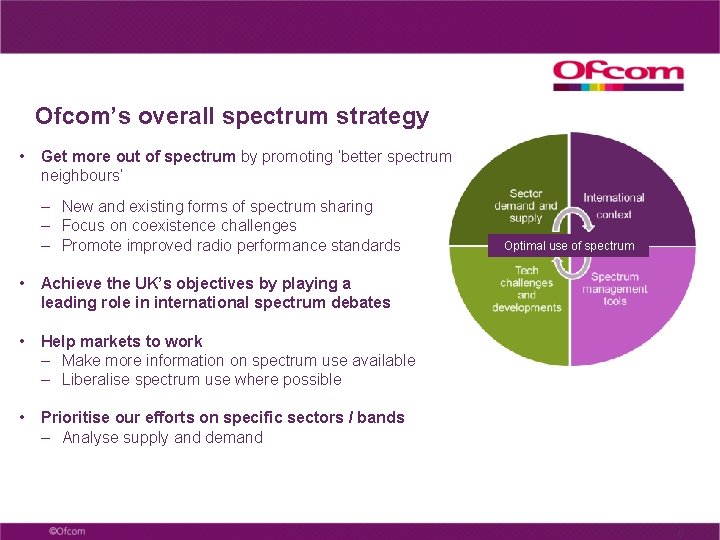
Ofcom’s overall spectrum strategy • Get more out of spectrum by promoting ‘better spectrum neighbours’ – New and existing forms of spectrum sharing – Focus on coexistence challenges – Promote improved radio performance standards Optimal use of spectrum • Achieve the UK’s objectives by playing a leading role in international spectrum debates • Help markets to work – Make more information on spectrum use available – Liberalise spectrum use where possible • Prioritise our efforts on specific sectors / bands – Analyse supply and demand 5
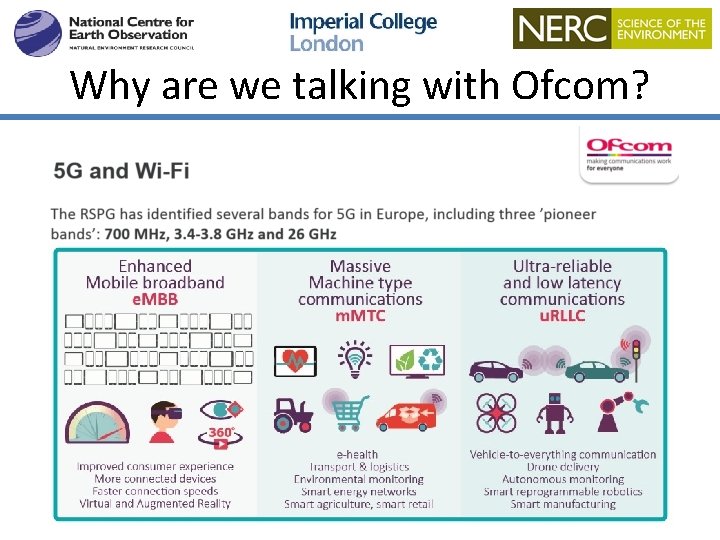
Why are we talking with Ofcom?
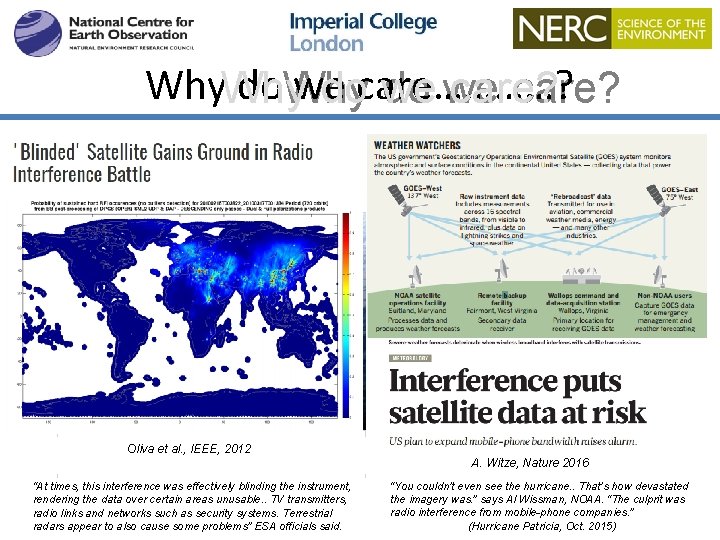
Why. Why do. Why we docare…………? we care? do we care? Oliva et al. , IEEE, 2012 A. Witze, Nature 2016 “At times, this interference was effectively blinding the instrument, rendering the data over certain areas unusable. . TV transmitters, radio links and networks such as security systems. Terrestrial radars appear to also cause some problems" ESA officials said. “You couldn’t even see the hurricane. . That’s how devastated the imagery was. ” says Al Wissman, NOAA. “The culprit was radio interference from mobile-phone companies. ” (Hurricane Patricia, Oct. 2015)
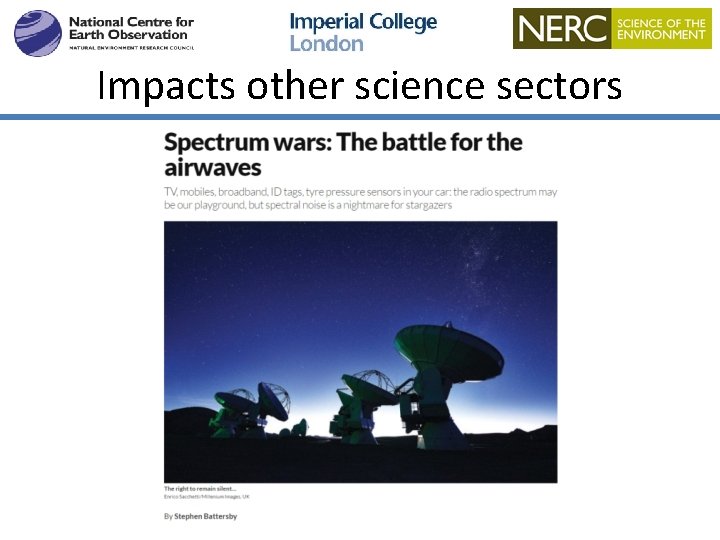
Impacts other science sectors
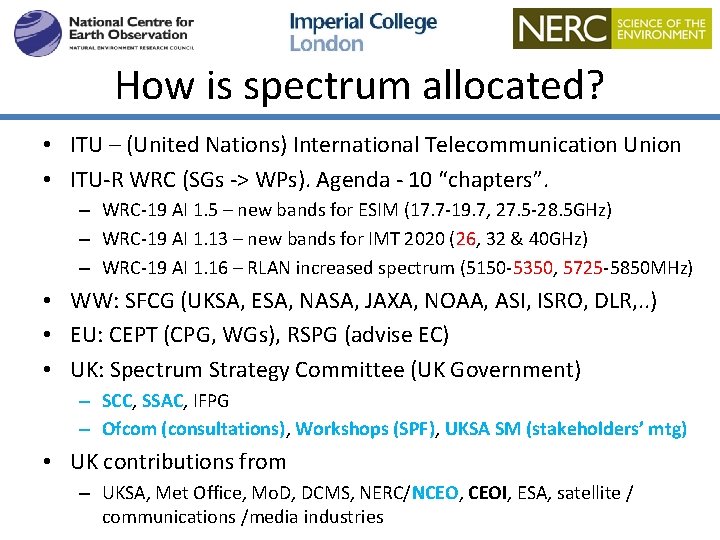
How is spectrum allocated? • ITU – (United Nations) International Telecommunication Union • ITU-R WRC (SGs -> WPs). Agenda - 10 “chapters”. – WRC-19 AI 1. 5 – new bands for ESIM (17. 7 -19. 7, 27. 5 -28. 5 GHz) – WRC-19 AI 1. 13 – new bands for IMT 2020 (26, 32 & 40 GHz) – WRC-19 AI 1. 16 – RLAN increased spectrum (5150 -5350, 5725 -5850 MHz) • WW: SFCG (UKSA, ESA, NASA, JAXA, NOAA, ASI, ISRO, DLR, . . ) • EU: CEPT (CPG, WGs), RSPG (advise EC) • UK: Spectrum Strategy Committee (UK Government) – SCC, SSAC, IFPG – Ofcom (consultations), Workshops (SPF), UKSA SM (stakeholders’ mtg) • UK contributions from – UKSA, Met Office, Mo. D, DCMS, NERC/NCEO, CEOI, ESA, satellite / communications /media industries
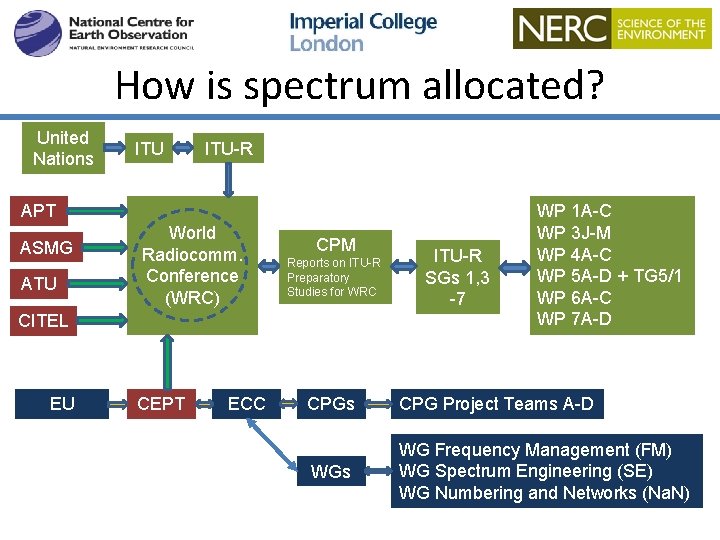
How is spectrum allocated? United Nations ITU-R APT ASMG ATU World Radiocomm. Conference (WRC) CPM Reports on ITU-R Preparatory Studies for WRC CITEL EU CEPT ECC ITU-R SGs 1, 3 -7 WP 1 A-C WP 3 J-M WP 4 A-C WP 5 A-D + TG 5/1 WP 6 A-C WP 7 A-D CPGs CPG Project Teams A-D WGs WG Frequency Management (FM) WG Spectrum Engineering (SE) WG Numbering and Networks (Na. N)
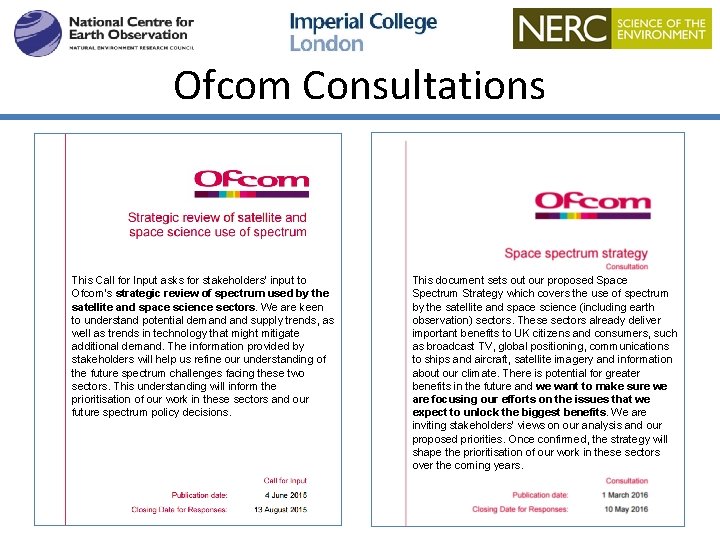
Ofcom Consultations This Call for Input asks for stakeholders’ input to Ofcom’s strategic review of spectrum used by the satellite and space science sectors. We are keen to understand potential demand supply trends, as well as trends in technology that might mitigate additional demand. The information provided by stakeholders will help us refine our understanding of the future spectrum challenges facing these two sectors. This understanding will inform the prioritisation of our work in these sectors and our future spectrum policy decisions. This document sets out our proposed Space Spectrum Strategy which covers the use of spectrum by the satellite and space science (including earth observation) sectors. These sectors already deliver important benefits to UK citizens and consumers, such as broadcast TV, global positioning, communications to ships and aircraft, satellite imagery and information about our climate. There is potential for greater benefits in the future and we want to make sure we are focusing our efforts on the issues that we expect to unlock the biggest benefits. We are inviting stakeholders’ views on our analysis and our proposed priorities. Once confirmed, the strategy will shape the prioritisation of our work in these sectors over the coming years.
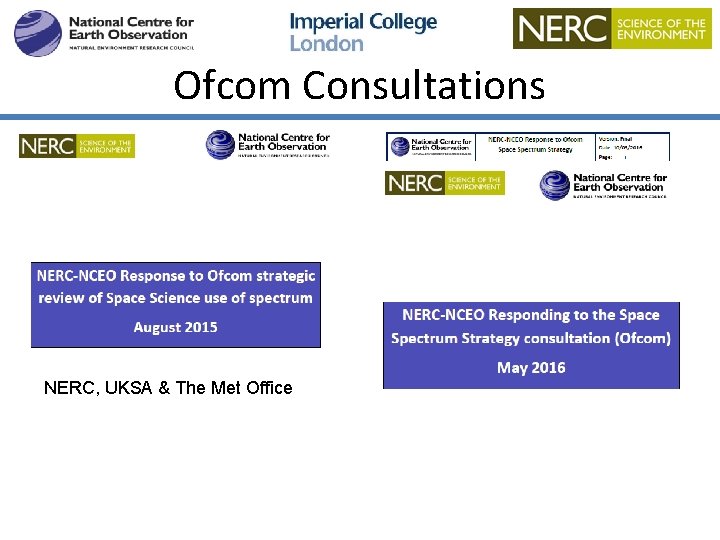
Ofcom Consultations NERC, UKSA & The Met Office
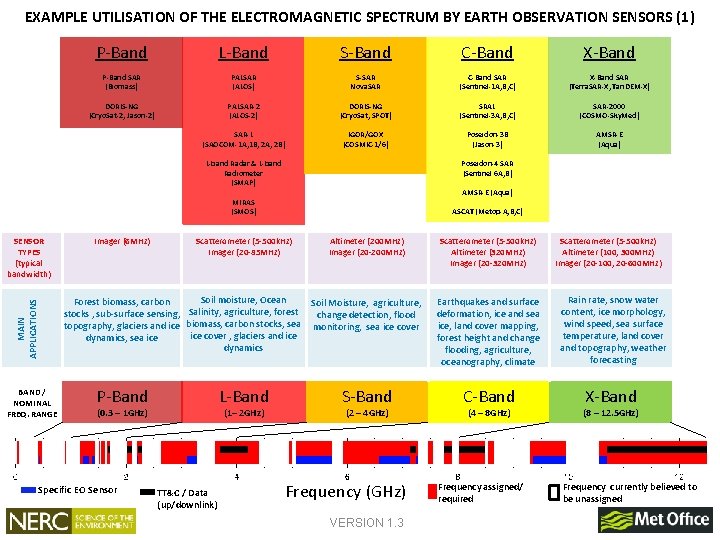
EXAMPLE UTILISATION OF THE ELECTROMAGNETIC SPECTRUM BY EARTH OBSERVATION SENSORS (1) P-Band L-Band S-Band C-Band X-Band P-Band SAR (Biomass) PALSAR (ALOS) S-SAR Nova. SAR C-Band SAR (Sentinel-1 A, B, C) X-Band SAR (Terra. SAR-X, Tan. DEM-X) DORIS-NG (Cryo. Sat-2, Jason-2) PALSAR-2 (ALOS-2) DORIS-NG (Cryo. Sat, SPOT) SRAL (Sentinel-3 A, B, C) SAR-2000 (COSMO-Sky. Med) SAR-L (SAOCOM-1 A, 1 B, 2 A, 2 B) IGOR/GOX (COSMIC-1/6) Poseidon-3 B (Jason-3) AMSR-E (Aqua) L-band Radar & L-band Radiometer (SMAP) Poseidon-4 SAR (Sentinel 6 A, B) AMSR-E (Aqua) MIRAS (SMOS) MAIN APPLICATIONS SENSOR TYPES (typical bandwidth) BAND / NOMINAL FREQ. RANGE Imager (6 MHz) ASCAT (Metop-A, B, C) Scatterometer (5 -500 k. Hz) Imager (20 -85 MHz) Soil moisture, Ocean Forest biomass, carbon Salinity, agriculture, forest stocks , sub-surface sensing, biomass, carbon stocks, sea topography, glaciers and ice cover , glaciers and ice dynamics, sea ice dynamics P-Band L-Band (0. 3 – 1 GHz) Specific EO Sensor (1– 2 GHz) TT&C / Data (up/downlink) Altimeter (200 MHz) Imager (20 -200 MHz) Scatterometer (5 -500 k. Hz) Altimeter (320 MHz) Imager (20 -320 MHz) Soil Moisture, agriculture, change detection, flood monitoring, sea ice cover Earthquakes and surface deformation, ice and sea ice, land cover mapping, forest height and change flooding, agriculture, oceanography, climate S-Band C-Band (2 – 4 GHz) Frequency (GHz) VERSION 1. 3 (4 – 8 GHz) Frequency assigned/ required Scatterometer (5 -500 k. Hz) Altimeter (100, 300 MHz) Imager (20 -100, 20 -600 MHz) Rain rate, snow water content, ice morphology, wind speed, sea surface temperature, land cover and topography, weather forecasting X-Band (8 – 12. 5 GHz) Frequency currently believed to be unassigned
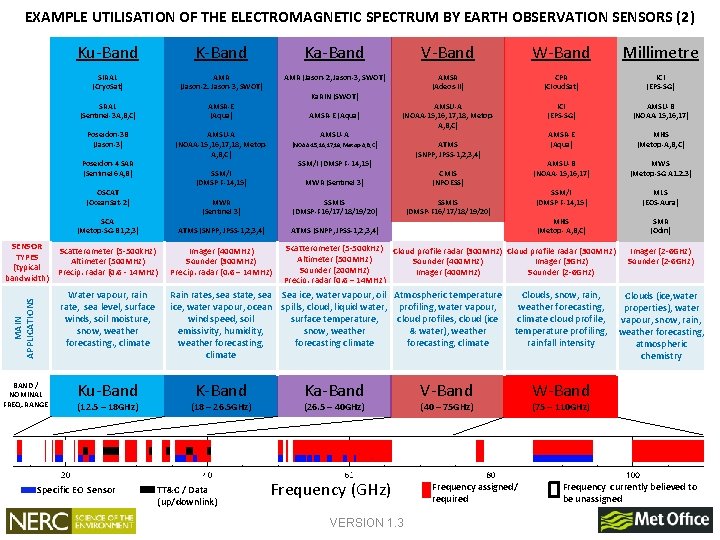
EXAMPLE UTILISATION OF THE ELECTROMAGNETIC SPECTRUM BY EARTH OBSERVATION SENSORS (2) Ku-Band Ka-Band V-Band W-Band Millimetre SIRAL (Cryo. Sat) AMR (Jason-2. Jason-3, SWOT) AMR (Jason-2, Jason-3, SWOT) AMSR (Adeos-II) CPR (Cloud. Sat) ICI (EPS-SG) SRAL (Sentinel-3 A, B, C) AMSR-E (Aqua) ICI (EPS-SG) AMSU-B (NOAA-15, 16, 17) Poseidon-3 B (Jason-3) AMSU-A (NOAA-15, 16, 17, 18, Metop. A, B, C) AMSR-E (Aqua) MHS (Metop-A, B, C) AMSU-B (NOAA-15, 16, 17) MWS (Metop-SG A 1. 2. 3) SSM/I (DMSP F-14, 15) MLS (EOS-Aura) MHS (Metop- A, B, C) SMR (Odin) Poseidon-4 SAR (Sentinel 6 A, B) MAIN APPLICATIONS BAND / NOMINAL FREQ. RANGE AMSR-E (Aqua) AMSU-A (NOAA-15, 16, 17, 18, Metop-A, B, C) SSM/I (DMSP F-14, 15) ATMS (SNPP, JPSS-1, 2, 3, 4) MWR (Sentinel 3) CMIS (NPOESS) SCA (Metop-SG-B 1, 2, 3) MWR (Sentinel 3) SSMIS (DMSP-F 16/17/18/19/20) ATMS (SNPP, JPSS-1, 2, 3, 4) Scatterometer (5 -500 k. Hz) Altimeter (500 MHz) Precip. radar (0. 6 - 14 MHz) Imager (400 MHz) Sounder (300 MHz) Precip. radar (0. 6 – 14 MHz) Water vapour, rain rate, sea level, surface winds, soil moisture, snow, weather forecasting. , climate Rain rates, sea state, sea Sea ice, water vapour, oil Atmospheric temperature ice, water vapour, ocean spills, cloud, liquid water, profiling, water vapour, wind speed, soil surface temperature, cloud profiles, cloud (ice emissivity, humidity, snow, weather & water), weather forecasting, forecasting climate forecasting, climate OSCAT (Ocean. Sat-2) SENSOR TYPES (typical bandwidth) Ka. RIN (SWOT) Ku-Band (12. 5 – 18 GHz) Specific EO Sensor K-Band (18 – 26. 5 GHz) TT&C / Data (up/downlink) Scatterometer (5 -500 k. Hz) Cloud profile radar (300 MHz) Altimeter (500 MHz) Sounder (400 MHz) Imager (3 GHz) Sounder (200 MHz) Imager (400 MHz) Sounder (2 -6 GHz) Precip. radar (0. 6 – 14 MHz) Ka-Band (26. 5 – 40 GHz) Frequency (GHz) VERSION 1. 3 Clouds, snow, rain, weather forecasting, climate cloud profile, temperature profiling, rainfall intensity V-Band (40 – 75 GHz) Frequency assigned/ required Imager (2 -6 GHz) Sounder (2 -6 GHz) Clouds (ice, water properties), water vapour, snow, rain, weather forecasting, atmospheric chemistry W-Band (75 – 110 GHz) Frequency currently believed to be unassigned
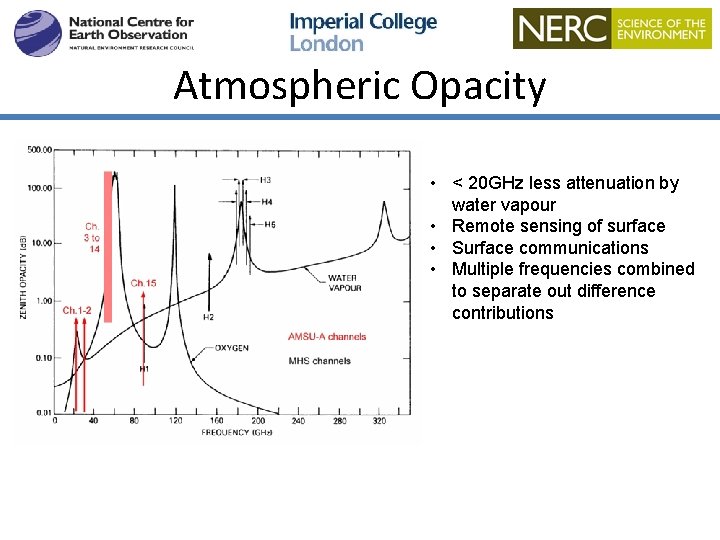
Atmospheric Opacity • < 20 GHz less attenuation by water vapour • Remote sensing of surface • Surface communications • Multiple frequencies combined to separate out difference contributions
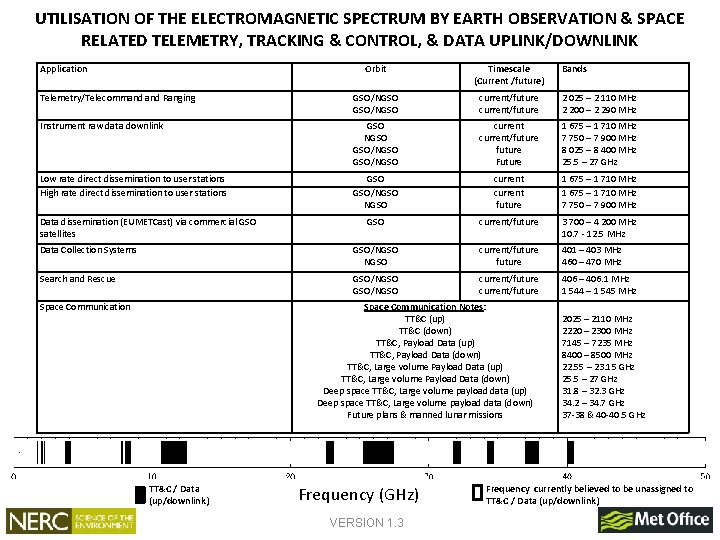
UTILISATION OF THE ELECTROMAGNETIC SPECTRUM BY EARTH OBSERVATION & SPACE RELATED TELEMETRY, TRACKING & CONTROL, & DATA UPLINK/DOWNLINK Application Orbit Timescale (Current /future) Telemetry/Telecommand Ranging GSO/NGSO current/future 2 025 – 2 110 MHz 2 200 – 2 290 MHz Instrument raw data downlink GSO NGSO GSO/NGSO current/future Future 1 675 – 1 710 MHz 7 750 – 7 900 MHz 8 025 – 8 400 MHz 25. 5 – 27 GHz Low rate direct dissemination to user stations High rate direct dissemination to user stations GSO/NGSO current future 1 675 – 1 710 MHz 7 750 – 7 900 MHz GSO current/future 3 700 – 4 200 MHz 10. 7 - 12. 5 MHz Data Collection Systems GSO/NGSO current/future 401 – 403 MHz 460 – 470 MHz Search and Rescue GSO/NGSO current/future 406 – 406. 1 MHz 1 544 – 1 545 MHz Data dissemination (EUMETCast) via commercial GSO satellites Space Communication Notes: TT&C (up) TT&C (down) TT&C, Payload Data (up) TT&C, Payload Data (down) TT&C, Large volume Payload Data (up) TT&C, Large volume Payload Data (down) Deep space TT&C, Large volume payload data (up) Deep space TT&C, Large volume payload data (down) Future plans & manned lunar missions TT&C / Data (up/downlink) Frequency (GHz) VERSION 1. 3 Bands 2025 – 2110 MHz 2220 – 2300 MHz 7145 – 7235 MHz 8400 – 8500 MHz 22. 55 – 23. 15 GHz 25. 5 – 27 GHz 31. 8 – 32. 3 GHz 34. 2 – 34. 7 GHz 37 -38 & 40 -40. 5 GHz Frequency currently believed to be unassigned to TT&C / Data (up/downlink)
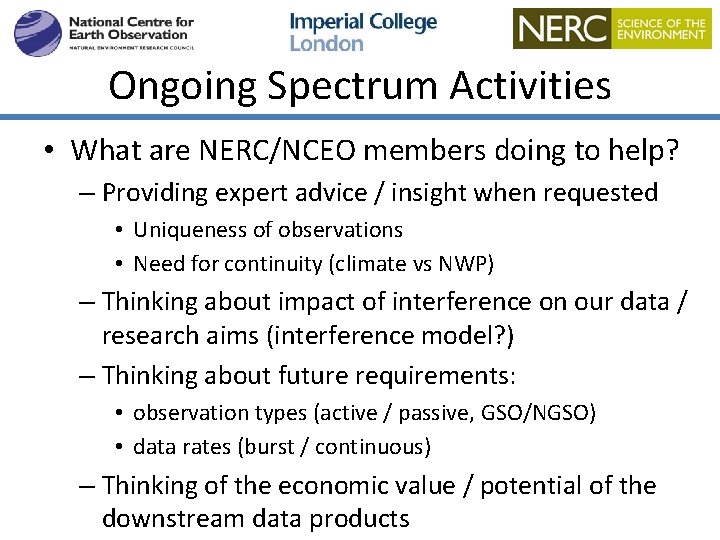
Ongoing Spectrum Activities • What are NERC/NCEO members doing to help? – Providing expert advice / insight when requested • Uniqueness of observations • Need for continuity (climate vs NWP) – Thinking about impact of interference on our data / research aims (interference model? ) – Thinking about future requirements: • observation types (active / passive, GSO/NGSO) • data rates (burst / continuous) – Thinking of the economic value / potential of the downstream data products
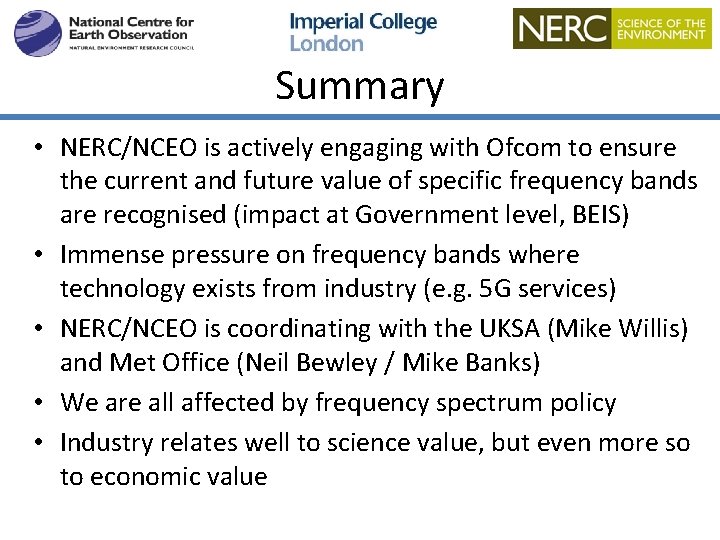
Summary • NERC/NCEO is actively engaging with Ofcom to ensure the current and future value of specific frequency bands are recognised (impact at Government level, BEIS) • Immense pressure on frequency bands where technology exists from industry (e. g. 5 G services) • NERC/NCEO is coordinating with the UKSA (Mike Willis) and Met Office (Neil Bewley / Mike Banks) • We are all affected by frequency spectrum policy • Industry relates well to science value, but even more so to economic value
Extras
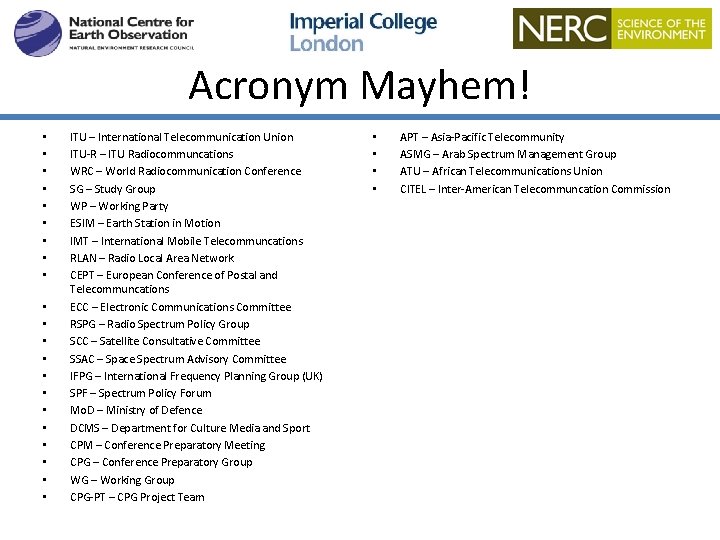
Acronym Mayhem! • • • • • • ITU – International Telecommunication Union ITU-R – ITU Radiocommuncations WRC – World Radiocommunication Conference SG – Study Group WP – Working Party ESIM – Earth Station in Motion IMT – International Mobile Telecommuncations RLAN – Radio Local Area Network CEPT – European Conference of Postal and Telecommuncations ECC – Electronic Communications Committee RSPG – Radio Spectrum Policy Group SCC – Satellite Consultative Committee SSAC – Space Spectrum Advisory Committee IFPG – International Frequency Planning Group (UK) SPF – Spectrum Policy Forum Mo. D – Ministry of Defence DCMS – Department for Culture Media and Sport CPM – Conference Preparatory Meeting CPG – Conference Preparatory Group WG – Working Group CPG-PT – CPG Project Team • • APT – Asia-Pacific Telecommunity ASMG – Arab Spectrum Management Group ATU – African Telecommunications Union CITEL – Inter-American Telecommuncation Commission
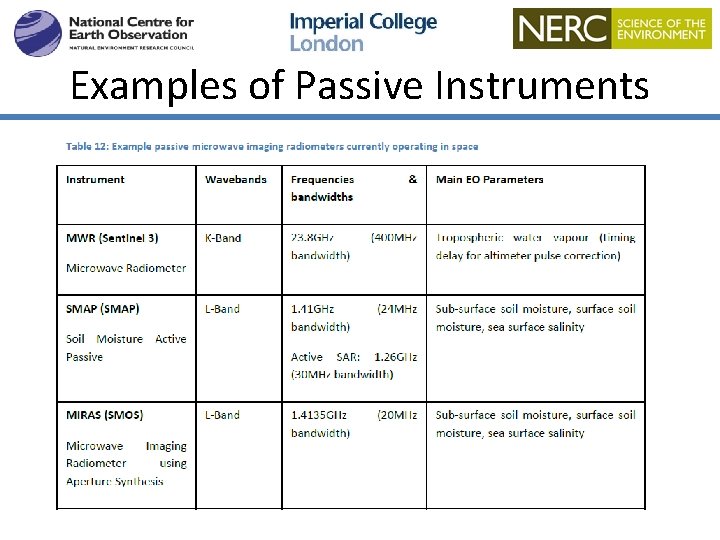
Examples of Passive Instruments