
Defending Students Facing Suspension Expulsion November 20 2015
Defending Students Facing Suspension & Expulsion November 20, 2015 Zabrina Aleguire, Education Project Director Legal Services for Children 1254 Market Street, 3 rd Floor San Francisco, CA 94102 (415) 863 -3762 ext. 312 This presentation is for informational purposes only. It is not legal advice, does not create an attorneyclient relationship, and should not replace an individualized legal assessment of a particular case

VIDEO 1 https: //youtu. be/29 NHx. Re. Lv. AY
Suspension + Expulsion = Harm l l l Suspensions do not improve student behavior and, in fact, often exacerbate it. Students lose valuable instructional time. They’re more likely to repeat a grade; More likely to be suspended again; More likely to drop out; More likely to enter the juvenile delinquency system. (“School to Prison pipeline”)
Negative Mental Health Consequences l l l l Labeling Lower self-esteem Shame Isolation from positive peers Alienation from school community Separation from positive adult mentors Lack of resolution or closure after conflict
Statement by US Dept. of Educ. l “Widespread overuse of suspension & expulsion has tremendous costs. ” – – Students unsupervised during the day Fails to help students develop skills needed to improve their behavior & avoid future problems Higher suspension rates associated with lower schoolwide academic achievement & standardized test scores. Higher drop out rates = higher taxpayer costs.
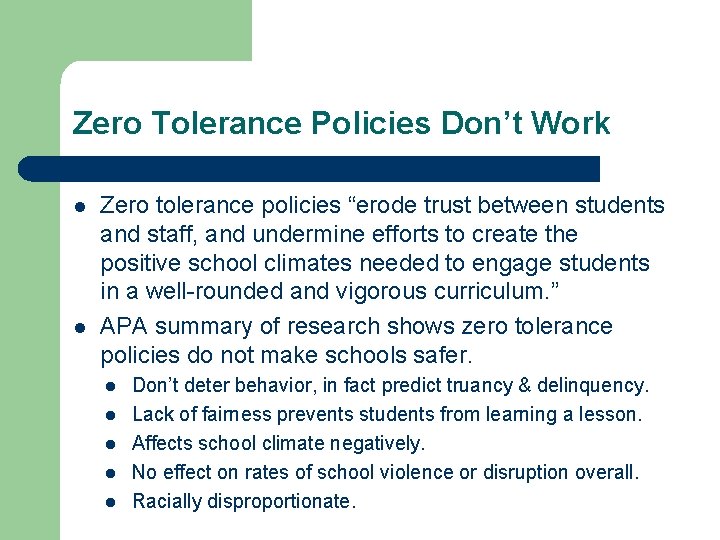
Zero Tolerance Policies Don’t Work l l Zero tolerance policies “erode trust between students and staff, and undermine efforts to create the positive school climates needed to engage students in a well-rounded and vigorous curriculum. ” APA summary of research shows zero tolerance policies do not make schools safer. l l l Don’t deter behavior, in fact predict truancy & delinquency. Lack of fairness prevents students from learning a lesson. Affects school climate negatively. No effect on rates of school violence or disruption overall. Racially disproportionate.
Discipline Data From Bay Area School Districts, 2013 – 2014
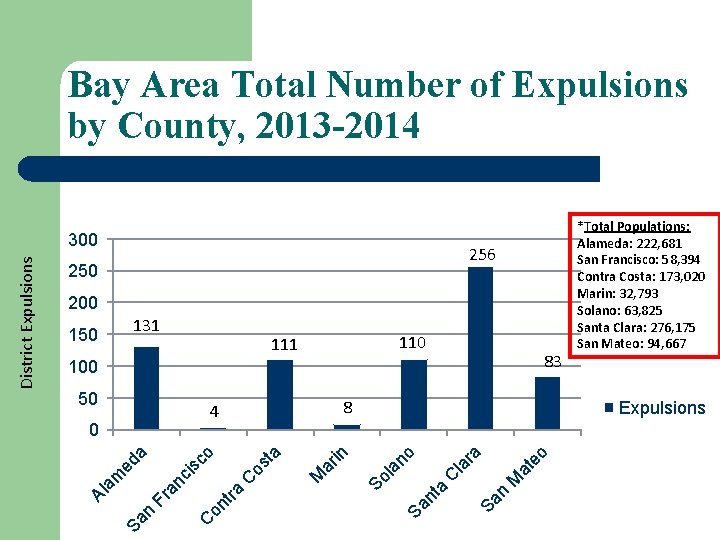
Bay Area Total Number of Expulsions by County, 2013 -2014 256 250 200 131 150 111 83 100 8 o at e M Sa n a C la ra an o in ar Expulsions Sa nt on tra M sc o nc i C Sa n Fr a m ed a 0 C os ta 4 So l 50 Al a District Expulsions 300 *Total Populations: Alameda: 222, 681 San Francisco: 58, 394 Contra Costa: 173, 020 Marin: 32, 793 Solano: 63, 825 Santa Clara: 276, 175 San Mateo: 94, 667
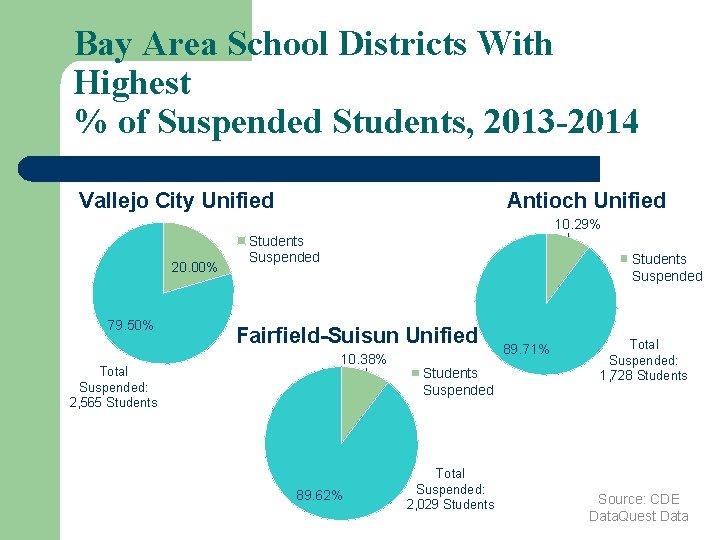
Bay Area School Districts With Highest % of Suspended Students, 2013 -2014 Vallejo City Unified Antioch Unified 10. 29% 20. 00% 79. 50% Total Suspended: 2, 565 Students Suspended Fairfield-Suisun Unified 10. 38% 89. 62% Students Suspended Total Suspended: 2, 029 Students 89. 71% Total Suspended: 1, 728 Students Source: CDE Data. Quest Data
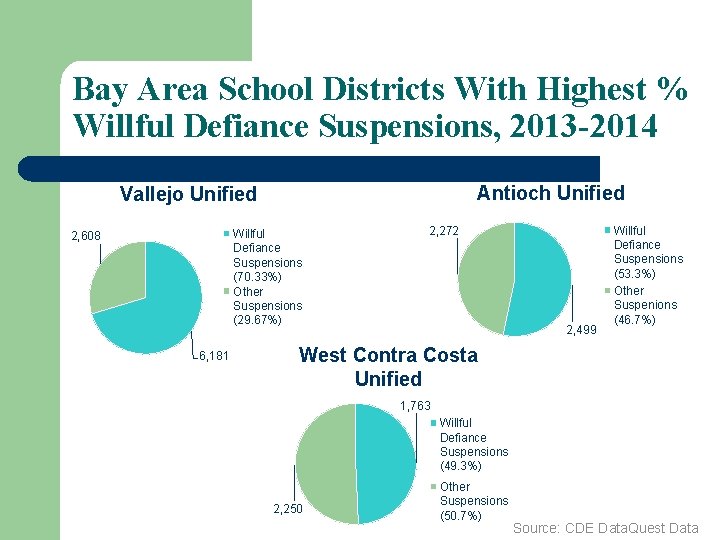
Bay Area School Districts With Highest % Willful Defiance Suspensions, 2013 -2014 Antioch Unified Vallejo Unified Willful Defiance Suspensions (70. 33%) Other Suspensions (29. 67%) 2, 608 6, 181 2, 272 2, 499 Willful Defiance Suspensions (53. 3%) Other Suspenions (46. 7%) West Contra Costa Unified 1, 763 Willful Defiance Suspensions (49. 3%) 2, 250 Other Suspensions (50. 7%) Source: CDE Data. Quest Data
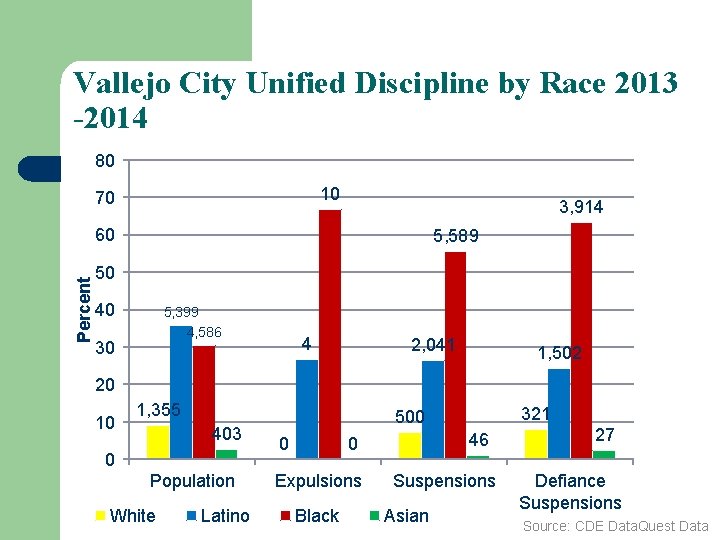
Vallejo City Unified Discipline by Race 2013 -2014 80 10 70 3, 914 Percent 60 5, 589 50 40 5, 399 4, 586 30 4 2, 041 1, 502 20 10 1, 355 403 0 Population White Latino 321 500 0 46 0 Expulsions Black Suspensions Asian 27 Defiance Suspensions Source: CDE Data. Quest Data
Racial Disproportionality l It is not that Blacks are misbehaving more; l Studies show that when poverty factors are controlled for, higher percentages of White students were disciplined on more serious grounds, such as possessing drugs or carrying a weapon; l Black students are receiving harsher punishments when it comes to misbehavior that requires a more subjective evaluation. (Implicit Bias)
Trauma & School Discipline l l l Success in school requires “attention, organization, comprehension, memory, engagement in learning, and trust. ” Complex Trauma’s effect on children’s brains (fight or flight response, dissociation) impairs these areas of functioning. Complex trauma also induces aggression, reactivity, impulsivity, distractibility, or withdrawal and avoidance.
Children with > 3 ACE’s are: l l Two-and-half times more likely to repeat a grade; Five times more likely to have severe attendance issues; Six times more likely to experience behavioral problems; and More than twice as likely to be suspended from school.
5 Minute Stretch Break




Representing Students Who is your client? 1. 2. 3. 4. Explain Role Duty of Loyalty Confidentiality Parent/Ed Rights holder decides Who holds Ed Rights? 1. 2. 3. 4. Parent Guardian Appointed Ed Rights Holder Or Student > 18
Three Basic Principles About California School Discipline l Students have a fundamental right to public education, even if they misbehave in school. California Constitution Article IX, section 1; Serrano v. Priest, 5 Cal. 3 d 584, 608 -10 (1971). l Students have the right to challenge punishment and tell their side of the story before removal. Goss v. Lopez, 419 U. S. 565 (1975) l Students have procedural rights to fair notice, a “prompt” hearing before an impartial arbiter, etc. Charles S. v. San Francisco Unified School District, 20 Cal. App. 3 d 83 (1971).
School Disciplinary Spectrum General Discipline: All forms of “punishment” other than suspension and expulsion – includes detention, behavior contracts, loss of privileges, etc. Suspension: Temporary removal of a student for incident listed under Cal. Educ. Code (EC) §§ 48900 et seq. Requires meeting, but NO hearing. EC §§ 48910 -48911 Extended Suspension: Suspension of a student pending an expulsion hearing, if student determined to cause danger to persons/property or disruption. EC § 48911(g) Expulsion: Removal of a student from all comprehensive District schools by the Governing Board for a term no longer than one calendar year.
Suspension l l l l Limit of 5 consecutive school days Limit of 20 days total per school year Only when “other means of correction” have failed to bring about proper conduct Immediate notice to parent/guardian Cannot be extended due to parent/guardian no show Opportunity to be heard before suspension, unless “emergency situation” EC § 48911 No right to education during suspension!
AB 1909 – Notice to Attorneys l Any student who is subject of petition filed under W&I Code §§ 300 or 602 - As defined in EC § 48853. 5 l Notice required* to Attorney & CWW of: – – – Extension of suspension meeting (EC § 48911) Manifestation determination meeting (EC § 48853. 5) Expulsion hearing (10 days notice – by email or phone is fine) (EC § 48918. 1(a)) (* Exception for mandatory expulsion recommendation)
Extension of Suspension l “New suspension” requiring its own meeting. – l Only permitted if: – – l Montoya v. Sanger Unified School District, 502 F. Supp. 209 (C. D. Cal. 1980) District is recommending expulsion, and “presence of the pupil would cause a danger to persons or property or a threat of disrupting the instructional process. ” No right to educational instruction outside of IEP services.
Who Has Authority to Expel? l Principal only recommends expulsion – – l l Discretionary offenses Mandatory recommendation to expel for “Zero tolerance” offenses Pupil Services department in school district coordinates expulsion hearing process School Board makes the ultimate decision – – Conducting hearing directly, or Consider recommendation by hearing panel.
Procedural & Time Requirements 1. Right to a Timely Hearing – within 30 schooldays (Garcia v. Los Angeles County Board of Ed. ) 2. 3. 4. 5. 6. 7. Right to a Postponement by student/parent Right to Timely Notice of the Hearing (10 days) Right to Translated Docs & Interpretation at Hearing Right to an Impartial Decision-Maker Right to Representation at the Hearing Right to Inspect and Present Evidence - EC § 48918(a)-(d)

It’s not just activities at school…. A student may only be suspended or expelled for acts that are related to a school activity or school attendance and which occur (as per § 48900(s)): A. ON SCHOOL GROUNDS B. WHILE GOING TO OR COMING FROM SCHOOL C. DURING LUNCH PERIOD (ON OR OFF CAMPUS) D. DURING, OR WHILE GOING TO OR COMING FROM, A SCHOOLSPONSORED ACTIVITY *THIS ALSO APPLIES TO CYBER-BULLYING (48900(R)(1))

Levels of Expulsion l Discretionary Offenses l Medium-Discretion Offenses l Mandatory Expulsion / “Zero Tolerance”
Offenses for Which a School Has Full Discretion to Suspend or Expel Principal may impose alternatives “that are ageappropriate and designed to address and correct the pupil’s [specified] misbehavior. ” 48900(v). • • Possession of tobacco • • Stealing • • Damage to property Vulgarity “Willful defiance”* Possession of an Imitation Firearm
Medium-Discretion Offenses A principal generally must recommend expulsion for the following: 1. Serious physical injury except in self defense 2. Possession of a knife or other dangerous object of no reasonable use 3. Unlawful possession of any controlled substance (except first marijuana offense under once ounce) 4. Robbery or extortion 5. Assault or battery on any school employee …unless the principal determines that expulsion is inappropriate under the circumstances or that alternative means of correction would address the conduct.

Mandatory Expulsion Principal must immediately suspend & recommend expulsion for the following offenses: 1. 2. 3. 4. 5. Possessing, selling or furnishing a firearm Brandishing a knife at another person Selling a controlled substance Committing or attempting sexual assault or battery Possession of an explosive
What must the school prove? For Mandatory Expulsion offenses, the SCHOOL must merely prove the following: 1. All procedural and time requirements have been met 2. That the student actually committed the offense charged, by SUBSTANTIAL EVIDENCE. And that there was a sufficient relation between the act and school attendance or activity 3. (NO SECONDARY FINDINGS) Expulsion for a mandatory offense can last as long as one calendar year from date of offense, while regular expulsions may only last to end of next semester.

For all other offenses, what must the school prove? For DISCRETIONARY and MEDIUM DISCRETION offenses, the SCHOOL has the burden of proving the following elements: 1. All procedural and time requirements have been met. 2. That the student actually committed the offense charged, by SUBSTANTIAL EVIDENCE. And that there was a sufficient relation between the act and school attendance or activity. 3. “SECONDARY FINDINGS” That EITHER (1) due to the nature of the act, the presence of the pupil causes a continuing danger to the physical safety of the pupil or others OR (2) other means of correction have failed in the past to correct the student’s behavior.
Secondary Findings & Advocacy Opportunities Remember, Secondary Findings Standard: 1) 2) Due to the nature of the act, the presence of the pupil causes a continuing danger to the physical safety of the pupil or others. OR Other means of correction are not feasible or have repeatedly failed bring about the proper conduct; Advocacy Tip: Even if it’s totally clear your client committed an expellable offense, you can still argue expulsion is inappropriate (and win) if secondary findings cannot be made.
Malik Brings Box Cutter to School Pattern of bullying by Arman against Malik. l “Hurry the F* up” when they’re on trash duty together l Pushes him against the wall during a basketball game l Points his middle finger close to Malik’s eye, “Are you scared? ” On May 4, Arman smacks Malik on back of his neck at end of recess l Malik tells anger management teacher, who gives him ice pack l He and Arman sent back to class without discussion l Tells teacher and mother who ignore him On May 5, Malik brings box cutter to school in his backpack l Shows it to his friends l Taken to principal’s office where backpack searched & box cutter confiscated
Developing a Defense Strategy 1. 2. 3. Is the principal correct that she had no discretion in this situation? (I. e. , is it a zero tolerance offense? ) If not, what are your arguments against expulsion? This incident occurred on May 5 th, and the hearing is scheduled for June 5 th. Is it timely?
Other Means of Correction l l l Referrals to school counselor or social worker for case management and counseling School team (including student and parent) that develops an individualized plan to address the behavior Referral for a comprehensive psychosocial or psychoeducational assessment for IEP or 504 Plan Participation in an anger management or similar program Participation in a restorative justice program After-school programs that address specific behavioral issues or expose pupils to positive activities and behaviors
Restorative Practices & PBIS Restorative Justice in Oakland video, available at https: //youtu. be/Ztdo. Wo 1 D 3 s. Y l
5 Minute Stretch Break
Malik’s Undiagnosed Disability Malik’s mother is having him tested for ADHD through his pediatrician’s office. Two weeks before his suspension, his teacher Ms. Moosewood raised concerns that Malik was very distracted in class and often failed to complete timed assignments during class. Moosewood said she would talk to the special education coordinator at school about testing Malik, but recommended that his mother should go ahead and have Malik tested through their family physician since ADHD is a medical diagnosis.
Special Education & School Discipline Students with disabilities must not be expelled, put on extended suspension or subjected to “patterns of removal” because of behavior that is a manifestation of the student’s disability. 20 U. S. C. § 1415(k). Prohibits student’s removal from school for more than 10 consecutive school days. 20 U. S. C. § 1415(k)(1)(B); 34 C. F. R. § 300. 536. “Pattern of Removal? ” 34 C. F. R. § 300. 536(a)(2). Case-by-case determination based on: - total number of days of removal, - length of each removal and frequency, - substantial similarity among the incidents resulting in removal.
Manifestation Determination No removal from school if either: 1) Student’s behavior was caused by, or had a “direct and substantial relationship” to, the student’s disability. OR 2) Student’s behavior was a direct result of the district’s failure to implement the student’s IEP. If either are true, the IEP team must conduct a “functional behavioral assessment” and implement a behavior intervention plan to specifically address the behavior that led to the discipline referral. 20 U. S. C. § 1415(k)(1)(F).
Manifestation Determination (cont. ) A manifestation determination review (MDR) must be held within 10 days of the school’s decision to seek a change in the student’s placement. Zero Tolerance Exception: Immediate removal & placement in “interim alternative education setting” for up to 45 days, regardless of whether the behavior is a manifestation of the student’s disability. If student: (1) carried or possessed a weapon (as defined in 18 U. S. C. § 930(g)); (2) knowingly possessed, used, sold, or solicited the sale of illegal drugs; or (3) inflicted serious bodily injury on another person. 20 U. S. C. § 1415(k)(1)(G).
IEP or 504 Plan l These procedural safeguards against school exclusion apply to: 1. Students with IEPs (Individualized Education Plan based on meeting IDEA special education criteria) 2. Students with 504 Plans (Accommodations as provided for in the Americans with Disabilities Act in school) 3. Students with “unidentified special needs” where the school knew or should have known of a possible disability.
Unidentified Sp. Ed Needs? The IDEA’s disciplinary protections will apply if the school “has knowledge” of the student’s disability prior to the behavior leading to the disciplinary referral. 20 U. S. C. § 1415(k)(5)(A). “Knowledge” may be based on: a) Expressed concern in writing to school; b) Initiation of assessment for special education needs, but no evaluation was completed; or c) Teacher or other school personnel expressed specific concern to the school’s special education director or to other supervisory personnel about a pattern of behavior. 34 C. F. R. § 300. 534(b)

Unidentified Sp. Ed Needs (cont. ) The school will not be deemed to have knowledge if: a) parent has not allowed the student to be assessed for special education; b) parent has refused special education services; or c) evaluation was conducted, and the school district determined that the child did not qualify for services under the IDEA. 20 U. S. C. § 1415(k)(5)(C).
Hypothetical #3 – SPED/Discipline 1. 2. 3. Is Malik entitled to procedural safeguards before he is expelled? On what basis? Is this a special circumstance in which a student may be removed from school regardless of whether the behavior is a manifestation of his disability? What are your arguments at the Manifestation Determination Review?
The Expulsion Packet How will I know what the school says about the incident? Request the “Expulsion Packet” – school discipline version of discovery. l l l Witness statements (“This is what happened!”) Notices (letters, forms, etc. ) Discipline history Attendance and grade history Pictures! Any other relevant (or irrelevant) information
Expulsion Hearings: Who Are the Players? l School Board or Administrative Panel: three certificated administrative employees (usually principals, vice-principals, deans) who are NOT from the school that the student attends or where the incident took place l Hearing Administrator: some districts have an administrator who oversees expulsion hearings and will “lead” the hearing l Representative from School: usually a dean, principal or VP who will present the case for the school l Witnesses: for the school and for the student l Student & Parent or Other Support Persons
Expulsion Hearing Format General Introductions & Instructions: • Explanation of hearing, charges presented, names for the record, etc. Opening Statements: • School first, then student (note that the school may not have a formal opening statement – it may just blend into the presentation of the case) School Presents Case: • Summary of alleged event • Witnesses Called (and may be sworn in) and then Direct Examination • Cross Examination of School’s Witnesses by Student • Questions of Witnesses by Panel Student Presents Case: • Witnesses Called (again, may be sworn) and then Direct Examination • Cross Examination of Student’s Witnesses by School • Questions of Witnesses by Panel Closing Statements
Presentation of Evidence What evidence can the student present? • • Written or other physical evidence Witnesses What rules apply? • • Technical Rules of Evidence (CA and federal) DO NOT apply Relevant evidence will be admitted if it’s the kind of evidence upon which reasonable persons are accustomed to rely in the conduct of serious affairs Hearsay IS ADMISSABLE, BUT a decision to expel cannot be made on hearsay alone Subpoenas may be issued to require the attendance of a witness
Evidence Practice Tips l l If the student has NOT made a statement about the incident thus far, and the school has only hearsay evidence to present, the student SHOULD NOT make any statements in the hearing (his or her statement alone would be direct evidence, which means the district would then have enough non-hearsay evidence to expel). Advise that kid to keep quiet! If the student was arrested for the offense at school and has a pending delinquency case, the District Attorney can subpoena the tape of the expulsion proceeding and use it as evidence against the student at the delinquency proceeding. The student SHOULD NOT make any statements at the hearing!
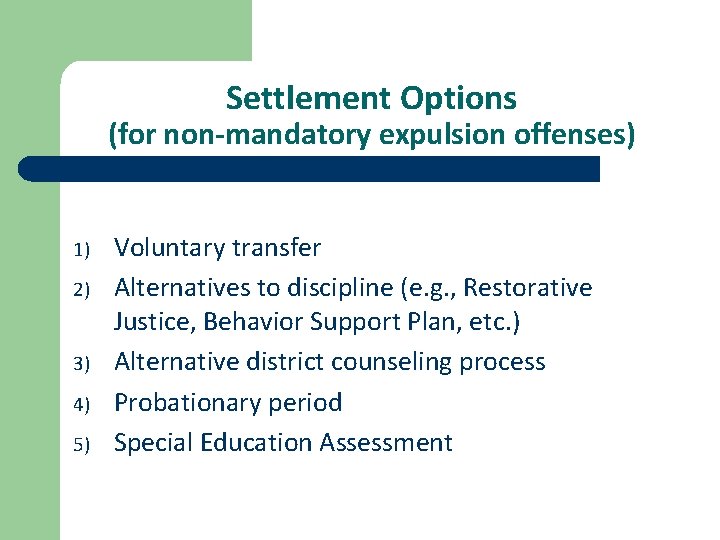
Settlement Options (for non-mandatory expulsion offenses) 1) 2) 3) 4) 5) Voluntary transfer Alternatives to discipline (e. g. , Restorative Justice, Behavior Support Plan, etc. ) Alternative district counseling process Probationary period Special Education Assessment
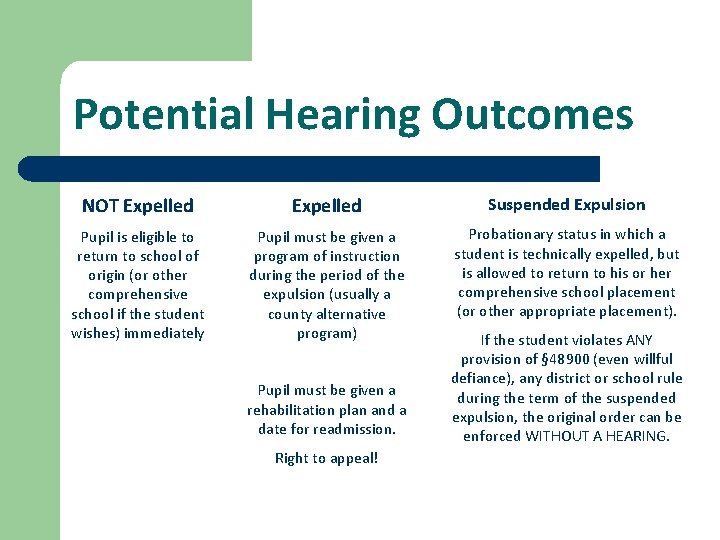
Potential Hearing Outcomes NOT Expelled Suspended Expulsion Pupil is eligible to return to school of origin (or other comprehensive school if the student wishes) immediately Pupil must be given a program of instruction during the period of the expulsion (usually a county alternative program) Probationary status in which a student is technically expelled, but is allowed to return to his or her comprehensive school placement (or other appropriate placement). Pupil must be given a rehabilitation plan and a date for readmission. Right to appeal! If the student violates ANY provision of § 48900 (even willful defiance), any district or school rule during the term of the suspended expulsion, the original order can be enforced WITHOUT A HEARING.
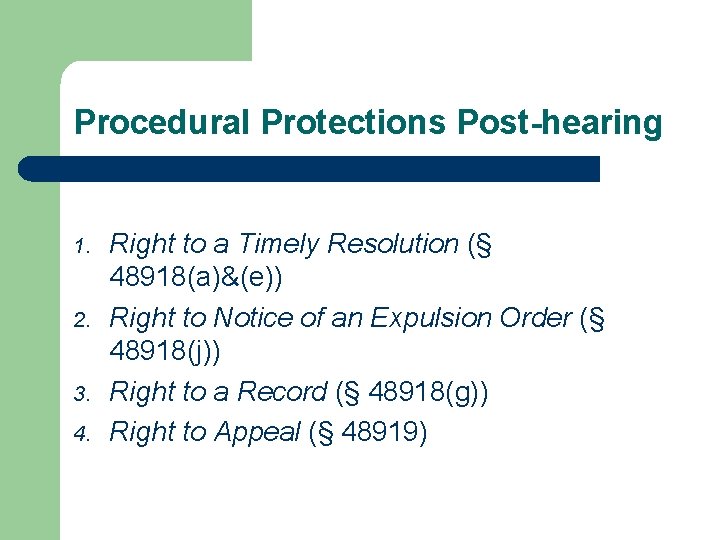
Procedural Protections Post-hearing 1. 2. 3. 4. Right to a Timely Resolution (§ 48918(a)&(e)) Right to Notice of an Expulsion Order (§ 48918(j)) Right to a Record (§ 48918(g)) Right to Appeal (§ 48919)
45 Minute Lunch Break






































- Slides: 105