
Defects in crystals Nonstoichiometry Point defects Vacancy Point





- Slides: 11
Defects in crystals, Non-stoichiometry
Point defects Vacancy
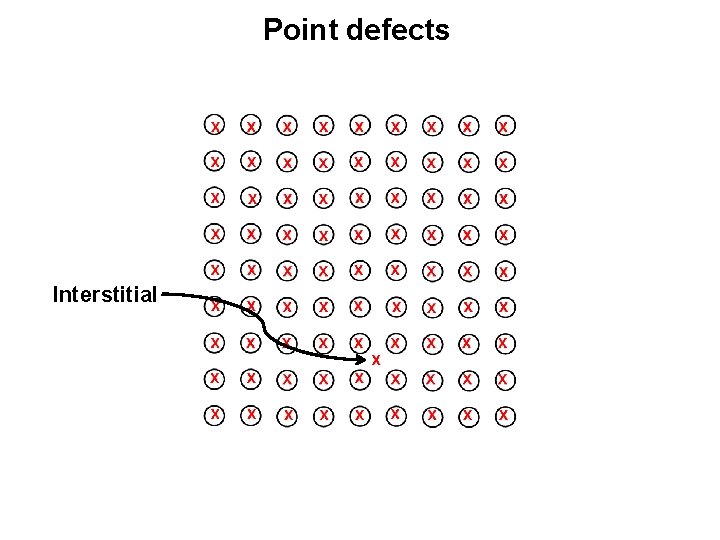
Point defects Interstitial
Point defects Substitutional impurity
Point defects Schottky pair
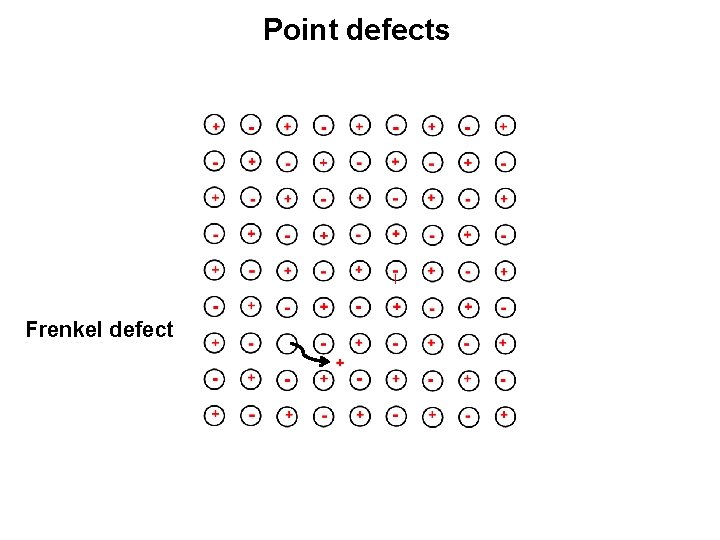
Point defects Frenkel defect
Other defects Line defects • Edge dislocation • Screw dislocation Plane defects • Stacking fault • Small angle grain boundaries
Non-stoichiometry Example: Fe. O Stoichiometric case: Fe 2+ : O 2 - = 1: 1 Usually: partial oxidation of Fe 2+ occurs non-stoichiometric composition: Fe 1 -x. O Say for example: Fe 3+/Fe 2+ = 0. 05 Let: [Fe 2+] = b [Fe 3+] = a ; a/b = 0. 05 charge balance : 3 a + 2 b = 2 Solving : a = 0. 05; b = 0. 93 Therefore the non-stoichiometric composition = Fe 0. 98 O
Effect of defects on properties Frenkel defects • Ag. Br, Ag. Cl • ionic conduction, photography Substitutional impurities • Extrinsic semiconductors • n-type: P doped Si • p-type: B doped Si
Relevance of non-stoichiometry • • electrical conductivity corrosion electrode surface activity catalysis Examples of non-stoichiometric materials • Tungsten bronzes: Nax. WO 3 colored materials • 123 oxides: YBa 2 Cu 3 O 7 -x high Tc superconductors
Problem Set 1. The average energy required to create a vacancy in a monatomic solid is 1. 1515 e. V/mol. Compute the ratio of vacancies at 1000 K and 500 K. 2. How are the density of crystals affected by the presence of Schottky and Frenkel defects ? 3. Addition of Ca 2+ increases the conductivity of KCl crystal. However, it is found that the conductivity is still due to the motion of K+ ions rather than the doped Ca 2+ ions. Discuss the mechanism for the enhanced conductivity. 4. If the ratio of A 3+ to A 2+ in a nonstoichiometric sample of an ionic crystal AO is 0. 15, what is the nature of the defect ? Derive the correct formula for AO. 5. Discuss the nature of nonstoichiometry in (a) copper sulfide, (b) zinc oxide, (c) praseodymium oxide. What are the different structures in the case of (c). 6. Ni. Te exhibits nonstoichiometry. Draw schematic diagrams to illustrate the crystal structures of the two extreme formulations.