
Defect testing l Testing programs to establish the
Defect testing l Testing programs to establish the presence of system defects ©Ian Sommerville 2000 Software Engineering, 6 th edition. Chapter 20 Slide 1
The testing process l l Component testing Integration testing • l Includes integration of subsystems, of systems, acceptance testing In OO development, boundary is less clear ©Ian Sommerville 2000 Software Engineering, 6 th edition. Chapter 20 Slide 4
20. 1 Defect testing l l l The goal of defect testing is to discover defects in programs A successful defect test is a test which causes a program to behave in an anomalous way Tests show the presence not the absence of defects ©Ian Sommerville 2000 Software Engineering, 6 th edition. Chapter 20 Slide 6
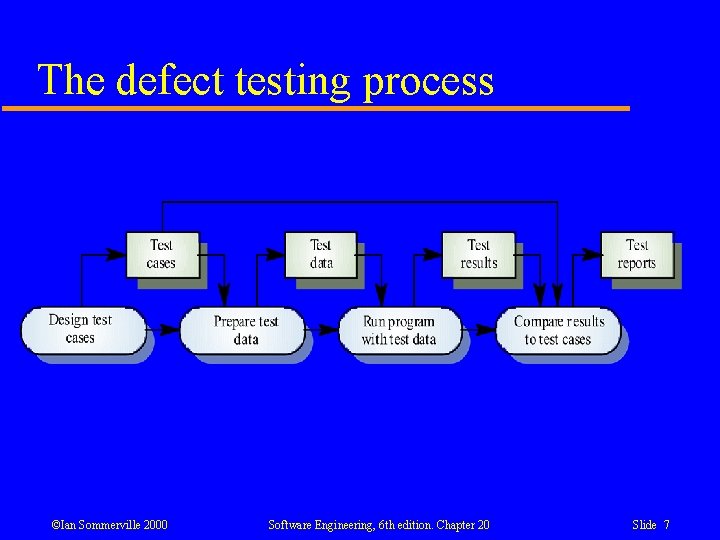
The defect testing process ©Ian Sommerville 2000 Software Engineering, 6 th edition. Chapter 20 Slide 7
Black-box testing l l l An approach to testing where the program is considered as a ‘black-box’ The program test cases are based on the system specification Test planning (developing test cases) can begin early in the software process ©Ian Sommerville 2000 Software Engineering, 6 th edition. Chapter 20 Slide 10
Equivalence partitioning l l l Input data and output results often fall into different classes where all members of a class are related Each of these classes is an equivalence partition where the program behaves in an equivalent way for each class member Test cases should be chosen from each partition ©Ian Sommerville 2000 Software Engineering, 6 th edition. Chapter 20 Slide 12
E. g. Equivalence partitioning l Partition system inputs and outputs into ‘equivalence sets’ • l If input is a 5 -digit integer between 10, 000 and 99, 999, equivalence partitions are <10, 000, 10, 000 -99, 999 and > 100, 000 Choose test cases around the midpoint of partitions and at the boundary of these sets • • 5000, 50000, 1500000, 09999, 10000, 99999, 100000 ©Ian Sommerville 2000 Software Engineering, 6 th edition. Chapter 20 Slide 14
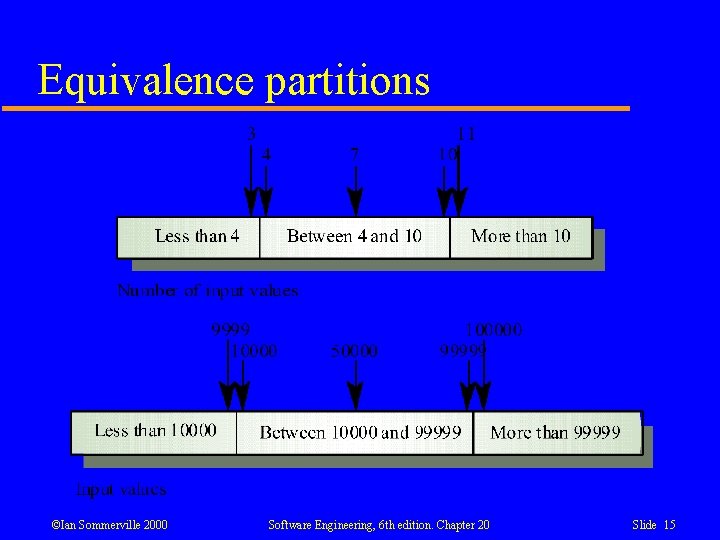
Equivalence partitions ©Ian Sommerville 2000 Software Engineering, 6 th edition. Chapter 20 Slide 15
Search routine - input partitions l l Inputs which conform to the pre-conditions Inputs where a pre-condition does not hold Inputs where the key element is a member of the array Inputs where the key element is not a member of the array ©Ian Sommerville 2000 Software Engineering, 6 th edition. Chapter 20 Slide 17
Other Testing guidelines (sequences) l l Test software with sequences which have only a single value Use sequences of different sizes in different tests Derive tests so that the first, middle and last elements of the sequence are accessed Spec doesn’t say that the sequence is ordered, so don’t assume that it is ©Ian Sommerville 2000 Software Engineering, 6 th edition. Chapter 20 Slide 18
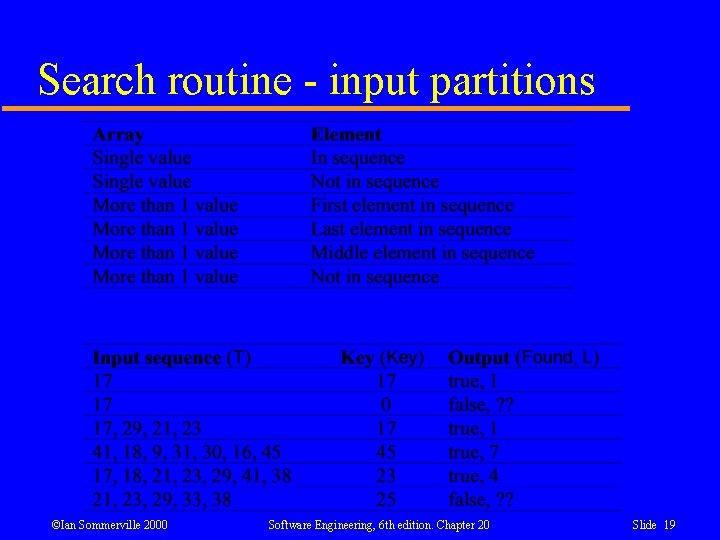
Search routine - input partitions ©Ian Sommerville 2000 Software Engineering, 6 th edition. Chapter 20 Slide 19
Structural testing l l l Sometime called white-box testing Derivation of test cases according to program structure. Knowledge of the program is used to identify additional test cases Objective is to exercise all program statements (not all path combinations) ©Ian Sommerville 2000 Software Engineering, 6 th edition. Chapter 20 Slide 20
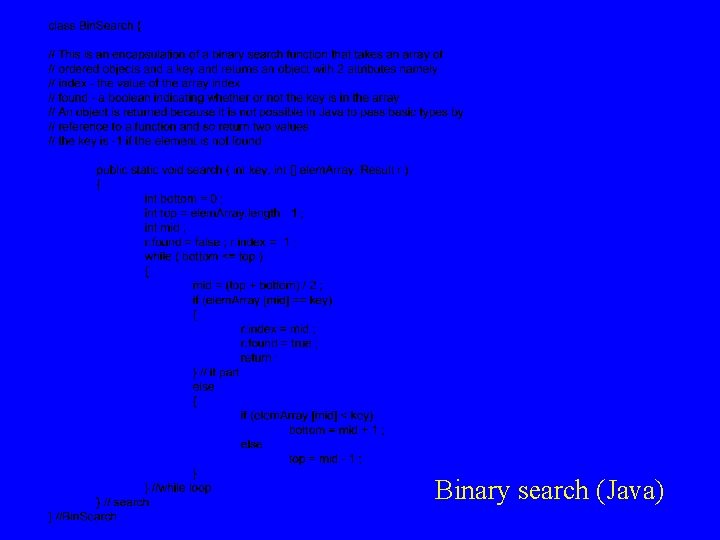
Binary search (Java)
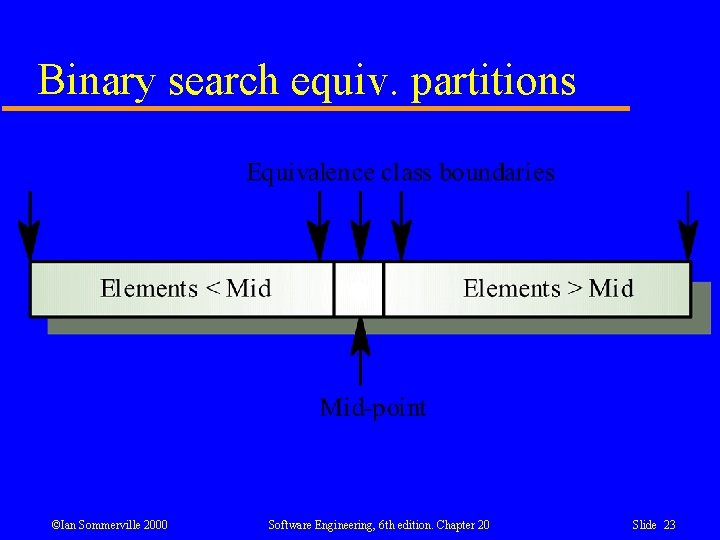
Binary search equiv. partitions ©Ian Sommerville 2000 Software Engineering, 6 th edition. Chapter 20 Slide 23
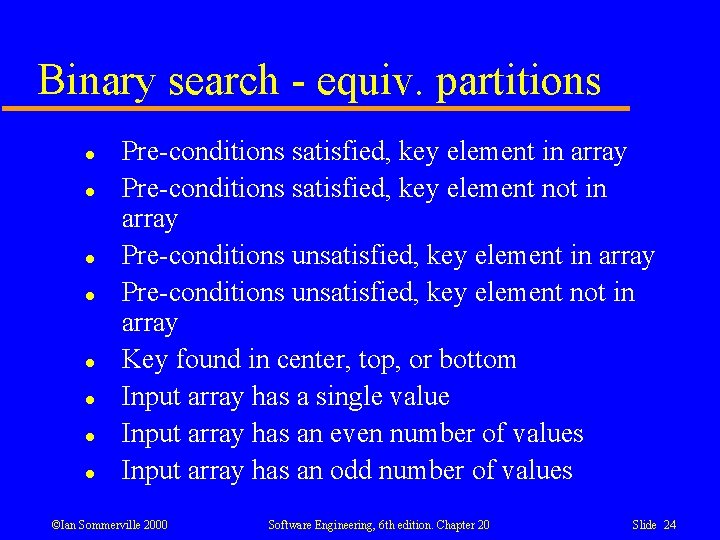
Binary search - equiv. partitions l l l l Pre-conditions satisfied, key element in array Pre-conditions satisfied, key element not in array Pre-conditions unsatisfied, key element not in array Key found in center, top, or bottom Input array has a single value Input array has an even number of values Input array has an odd number of values ©Ian Sommerville 2000 Software Engineering, 6 th edition. Chapter 20 Slide 24
Binary search - test cases ©Ian Sommerville 2000 Software Engineering, 6 th edition. Chapter 20 Slide 25
Path testing l l l The objective of path testing is to ensure that the set of test cases is such that each path through the program is executed at least once The starting point for path testing is a program flow graph that shows nodes representing program decisions and arcs representing the flow of control Statements with conditions are therefore nodes in the flow graph ©Ian Sommerville 2000 Software Engineering, 6 th edition. Chapter 20 Slide 26
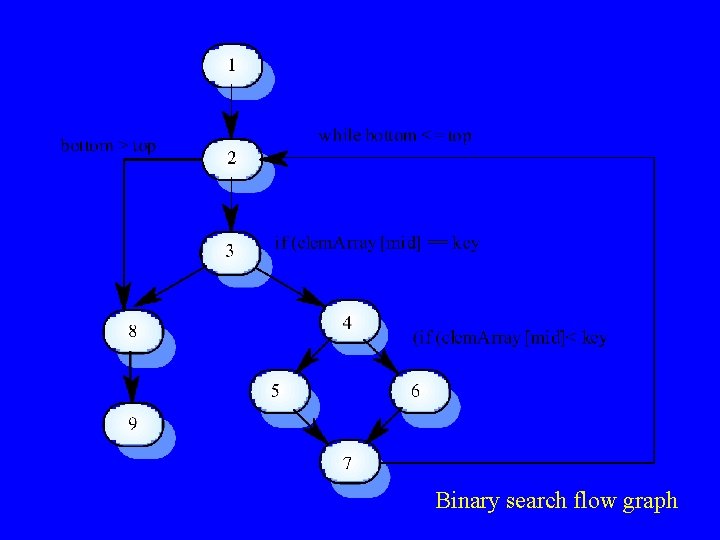
Binary search flow graph
Cyclomatic complexity l l The number of tests to test all control statements equals the cyclomatic complexity Cyclomatic complexity equals number of conditions in a program + 1 Useful if used with care. Does not imply adequacy of testing. Although all paths are executed, all combinations of paths are not executed ©Ian Sommerville 2000 Software Engineering, 6 th edition. Chapter 20 Slide 29
Independent paths l l l Test cases should be derived so that all of these paths are executed 1, 2, 3, 8, 9 1, 2, 3, 4, 6, 7, 2, 8, 9 1, 2, 3, 4, 5, 7, 2, 8, 9 A dynamic program analyser may be used to check that paths have been executed ©Ian Sommerville 2000 Software Engineering, 6 th edition. Chapter 20 Slide 30
Integration testing l l Tests complete systems or subsystems composed of integrated components Integration testing should be black-box testing with tests derived from the specification Main difficulty is localizing errors Incremental integration testing reduces this problem ©Ian Sommerville 2000 Software Engineering, 6 th edition. Chapter 20 Slide 31
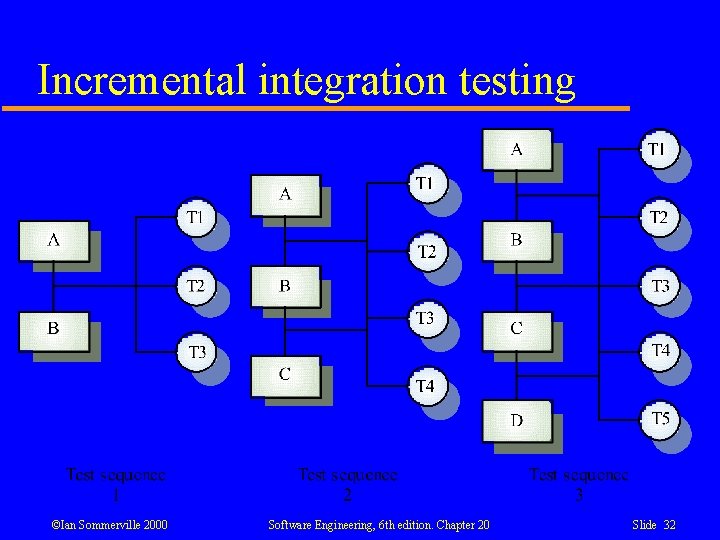
Incremental integration testing ©Ian Sommerville 2000 Software Engineering, 6 th edition. Chapter 20 Slide 32
Approaches to integration testing l l l Top-down testing Bottom-up testing In practice, most integration involves a combination of these strategies ©Ian Sommerville 2000 Software Engineering, 6 th edition. Chapter 20 Slide 33
Top-down testing ©Ian Sommerville 2000 Software Engineering, 6 th edition. Chapter 20 Slide 34
Bottom-up testing ©Ian Sommerville 2000 Software Engineering, 6 th edition. Chapter 20 Slide 35
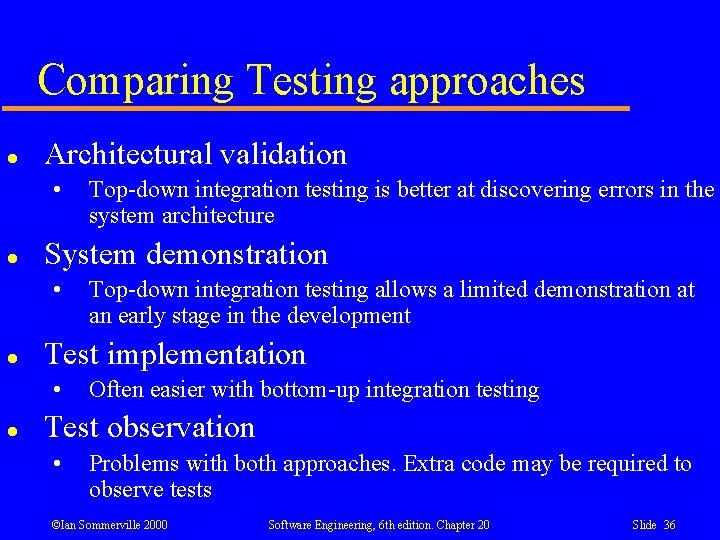
Comparing Testing approaches l Architectural validation • l System demonstration • l Top-down integration testing allows a limited demonstration at an early stage in the development Test implementation • l Top-down integration testing is better at discovering errors in the system architecture Often easier with bottom-up integration testing Test observation • Problems with both approaches. Extra code may be required to observe tests ©Ian Sommerville 2000 Software Engineering, 6 th edition. Chapter 20 Slide 36
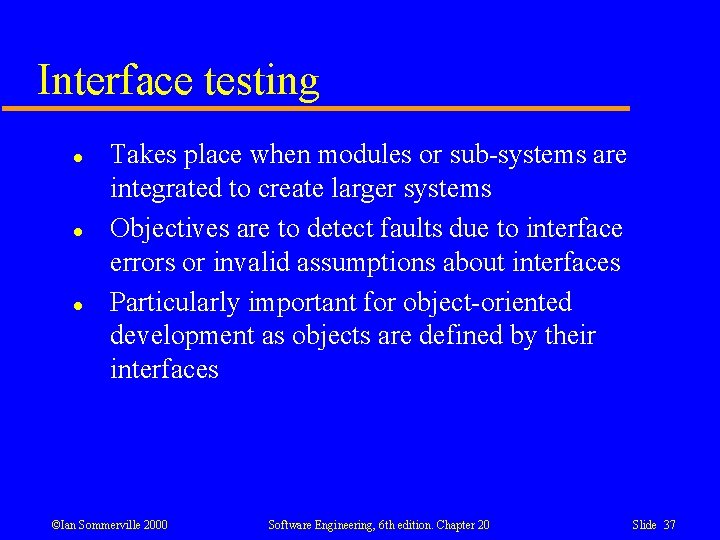
Interface testing l l l Takes place when modules or sub-systems are integrated to create larger systems Objectives are to detect faults due to interface errors or invalid assumptions about interfaces Particularly important for object-oriented development as objects are defined by their interfaces ©Ian Sommerville 2000 Software Engineering, 6 th edition. Chapter 20 Slide 37
Interface testing ©Ian Sommerville 2000 Software Engineering, 6 th edition. Chapter 20 Slide 38
Common Interface errors l l l Interface misuse Interface misunderstanding Timing errors ©Ian Sommerville 2000 Software Engineering, 6 th edition. Chapter 20 Slide 40
Stress testing l l Exercises the system up to and beyond its maximum design load. Stressing the system often causes defects to come to light Stressing the system test failure behaviour. Systems should not fail catastrophically. Stress testing checks for unacceptable loss of service or data Particularly relevant to distributed systems which can exhibit severe degradation as a network becomes overloaded ©Ian Sommerville 2000 Software Engineering, 6 th edition. Chapter 20 Slide 42
20. 3 Object-oriented testing l l l The components to be tested are object classes that are instantiated as objects Larger grain than individual functions No obvious ‘top’ to the system for top-down integration and testing ©Ian Sommerville 2000 Software Engineering, 6 th edition. Chapter 20 Slide 43
Testing levels l l Testing operations associated with objects Testing object classes Testing clusters of cooperating objects Testing the complete OO system ©Ian Sommerville 2000 Software Engineering, 6 th edition. Chapter 20 Slide 44
Object class testing l Complete test coverage of a class involves • • • l Testing all operations associated with an object Setting and interrogating all object attributes Exercising the object in all possible states Inheritance makes it more difficult to design object class tests as the information to be tested is not localized ©Ian Sommerville 2000 Software Engineering, 6 th edition. Chapter 20 Slide 45
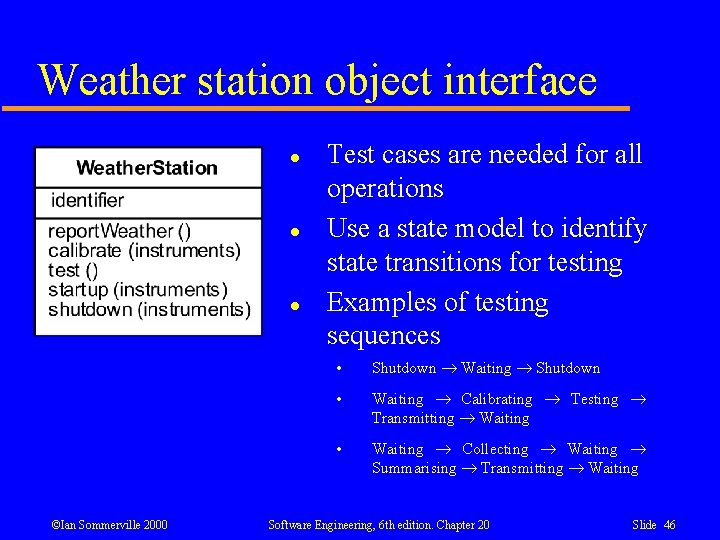
Weather station object interface l l l ©Ian Sommerville 2000 Test cases are needed for all operations Use a state model to identify state transitions for testing Examples of testing sequences • Shutdown ® Waiting ® Shutdown • Waiting ® Calibrating ® Testing ® Transmitting ® Waiting • Waiting ® Collecting ® Waiting ® Summarising ® Transmitting ® Waiting Software Engineering, 6 th edition. Chapter 20 Slide 46
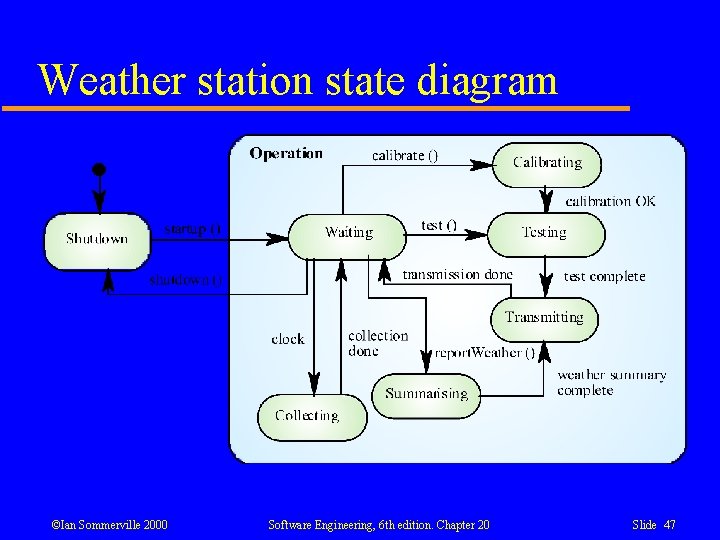
Weather station state diagram ©Ian Sommerville 2000 Software Engineering, 6 th edition. Chapter 20 Slide 47
Object integration l l l Levels of integration are less distinct in objectoriented systems Cluster testing is concerned with integrating and testing clusters of cooperating objects Identify clusters using knowledge of the operation of objects and the system features that are implemented by these clusters ©Ian Sommerville 2000 Software Engineering, 6 th edition. Chapter 20 Slide 48
Approaches to cluster testing l l l Use-case or scenario testing Thread testing Object interaction testing ©Ian Sommerville 2000 Software Engineering, 6 th edition. Chapter 20 Slide 49
Scenario-based testing l l Identify scenarios from use-cases and supplement these with interaction (sequence) diagrams that show the objects involved in the scenario Consider the scenario in the weather station system where a report is generated … ©Ian Sommerville 2000 Software Engineering, 6 th edition. Chapter 20 Slide 50
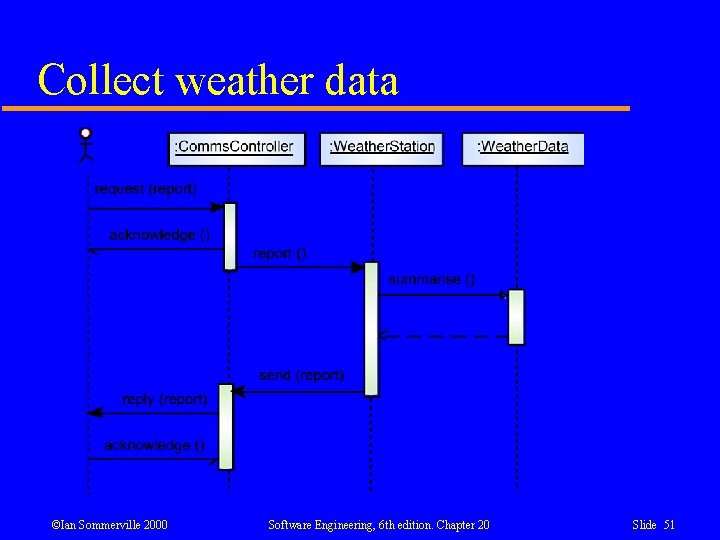
Collect weather data ©Ian Sommerville 2000 Software Engineering, 6 th edition. Chapter 20 Slide 51
20. 4 Testing workbenches l l l Testing is an expensive process phase. Testing workbenches provide a range of tools to reduce the time required and total testing costs Most testing workbenches are open systems because testing needs are organization-specific – need tools to be adaptable to your organization and project Difficult to integrate your project with closed design and analysis workbenches ©Ian Sommerville 2000 Software Engineering, 6 th edition. Chapter 20 Slide 53
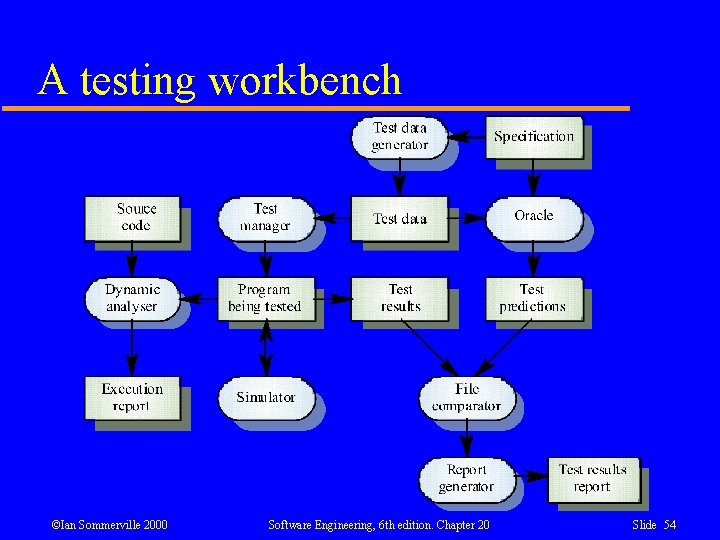
A testing workbench ©Ian Sommerville 2000 Software Engineering, 6 th edition. Chapter 20 Slide 54
- Slides: 41