
Defect Structure Mechanical Behaviour of Nanomaterials Defect structure
Defect Structure & Mechanical Behaviour of Nanomaterials

Defect structure in nanomaterials q The defect structure in nanomaterials can be altered with respect to their bulk counterparts. q This in turn can lead to profound differences in the mechanical behavior of nanomaterials as compared to bulk materials.

Vacancies q Vacancies are equilibrium thermodynamic defects and at a temperature T (in K) there exists an equilibrium concentration of vacancies (nv) in bulk crystals. n. V the number of vacancies, N number of sites in the lattice (for n. V/N << 1) Interaction between vacancies can be ignored ( Hformation (n vacancies) = n. Hformation (1 vacancy) Hf enthalpy of formation of a vacancy T (ºC) n/N 500 1 x 10 10 1000 1 x 10 5 1500 5 x 10 4 2000 3 x 10 3 Hf = 1 e. V/vacancy = 0. 16 x 10 18 J/vacancy q. Close to the melting point in FCC metals Au, Ag, Cu the fraction of vacancies is about 10 4 (i. e. one in 10, 000 lattice sites are vacant)
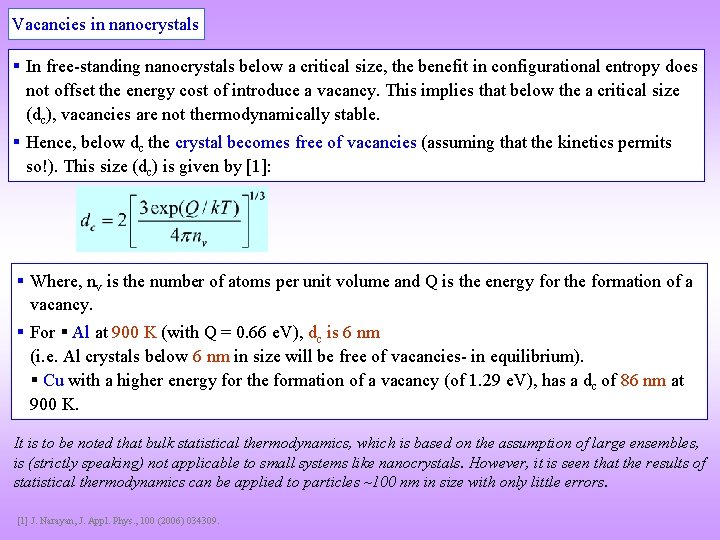
Vacancies in nanocrystals In free-standing nanocrystals below a critical size, the benefit in configurational entropy does not offset the energy cost of introduce a vacancy. This implies that below the a critical size (dc), vacancies are not thermodynamically stable. Hence, below dc the crystal becomes free of vacancies (assuming that the kinetics permits so!). This size (dc) is given by [1]: Where, nv is the number of atoms per unit volume and Q is the energy for the formation of a vacancy. For Al at 900 K (with Q = 0. 66 e. V), dc is 6 nm (i. e. Al crystals below 6 nm in size will be free of vacancies- in equilibrium). Cu with a higher energy for the formation of a vacancy (of 1. 29 e. V), has a dc of 86 nm at 900 K. It is to be noted that bulk statistical thermodynamics, which is based on the assumption of large ensembles, is (strictly speaking) not applicable to small systems like nanocrystals. However, it is seen that the results of statistical thermodynamics can be applied to particles ~100 nm in size with only little errors. [1] J. Narayan, J. Appl. Phys. , 100 (2006) 034309.

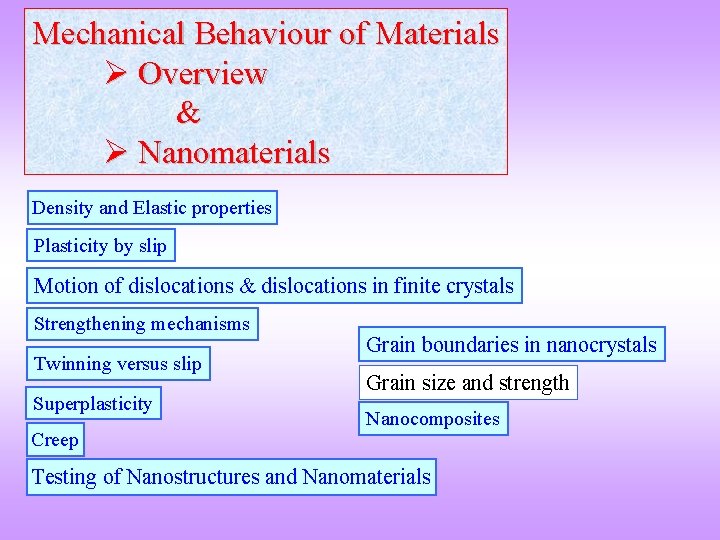
Mechanical Behaviour of Materials Overview & Nanomaterials Density and Elastic properties Plasticity by slip Motion of dislocations & dislocations in finite crystals Strengthening mechanisms Twinning versus slip Superplasticity Creep Grain boundaries in nanocrystals Grain size and strength Nanocomposites Testing of Nanostructures and Nanomaterials

Mechanisms / Methods by which a Material can FAIL Elastic deformation Slip Fracture Fatigue Creep Chemical / Electro-chemical degradation Microstructural changes Twinning Phase transformations Grain growth Particle coarsening Failure can be considered as deterioration in desired performancewhich could involve changes in properties and/or shape Physical degradation Wear Erosion
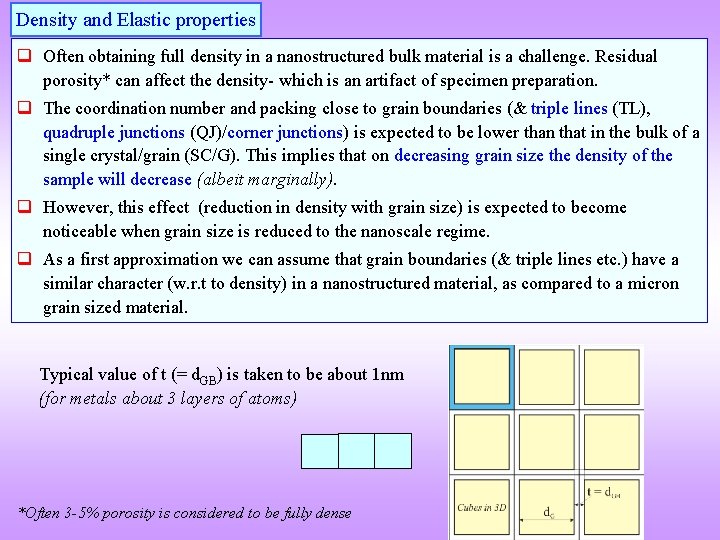
Density and Elastic properties q Often obtaining full density in a nanostructured bulk material is a challenge. Residual porosity* can affect the density- which is an artifact of specimen preparation. q The coordination number and packing close to grain boundaries (& triple lines (TL), quadruple junctions (QJ)/corner junctions) is expected to be lower than that in the bulk of a single crystal/grain (SC/G). This implies that on decreasing grain size the density of the sample will decrease (albeit marginally). q However, this effect (reduction in density with grain size) is expected to become noticeable when grain size is reduced to the nanoscale regime. q As a first approximation we can assume that grain boundaries (& triple lines etc. ) have a similar character (w. r. t to density) in a nanostructured material, as compared to a micron grain sized material. Typical value of t (= d. GB) is taken to be about 1 nm (for metals about 3 layers of atoms) *Often 3 -5% porosity is considered to be fully dense
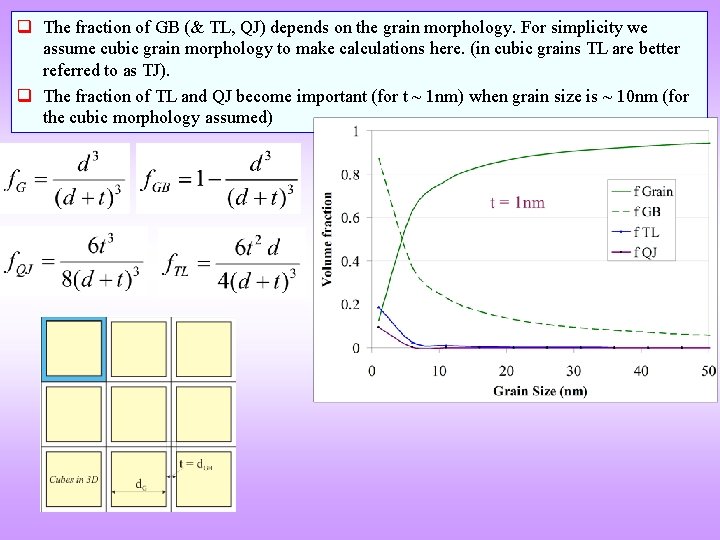
q The fraction of GB (& TL, QJ) depends on the grain morphology. For simplicity we assume cubic grain morphology to make calculations here. (in cubic grains TL are better referred to as TJ). q The fraction of TL and QJ become important (for t ~ 1 nm) when grain size is ~ 10 nm (for the cubic morphology assumed)
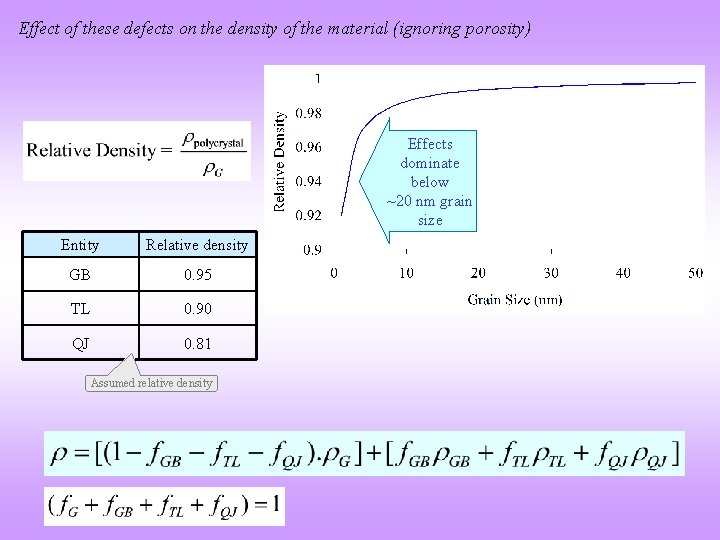
Effect of these defects on the density of the material (ignoring porosity) Effects dominate below ~20 nm grain size Entity Relative density GB 0. 95 TL 0. 90 QJ 0. 81 Assumed relative density

Elastic properties q For now we assume an isotropic material (i. e. properties do not change with position or direction). Note that we have already seen that density varies with position. q An isotropic material can be described by two independent elastic moduli (e. g. E and ). q Often ‘Modulus’ of some nanostructures are reported as below (it should be noted that Moduli are bulk macroscopic properties and their definition is extended to be applicable to these structures). Entity Young’s Modulus (GPa) SW-CNT 1002 (Yu et al. 2000) MW-CNT 11 -63* (Yu et al. 2000) Zn. O nanowires 140 -200 (Chen et al. 2006) Silica Nanowires 20 -100 (Silva et al 2006) *Range of values is due to diameter differences or number of walls Entity Young’s Modulus (GPa) Steel ~200 Diamond ~1050 W ~400 Al ~70
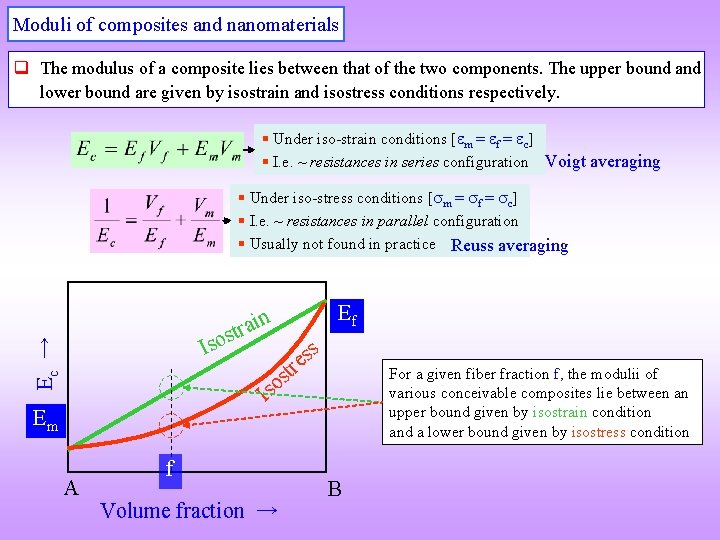
Moduli of composites and nanomaterials q The modulus of a composite lies between that of the two components. The upper bound and lower bound are given by isostrain and isostress conditions respectively. Under iso-strain conditions [ m = f = c] I. e. ~ resistances in series configuration Voigt averaging Under iso-stress conditions [ m = f = c] I. e. ~ resistances in parallel configuration Usually not found in practice Reuss averaging Ef in a r t s Ec → Iso s s e tr s o For a given fiber fraction f, the modulii of various conceivable composites lie between an upper bound given by isostrain condition and a lower bound given by isostress condition Is Em A f Volume fraction → B
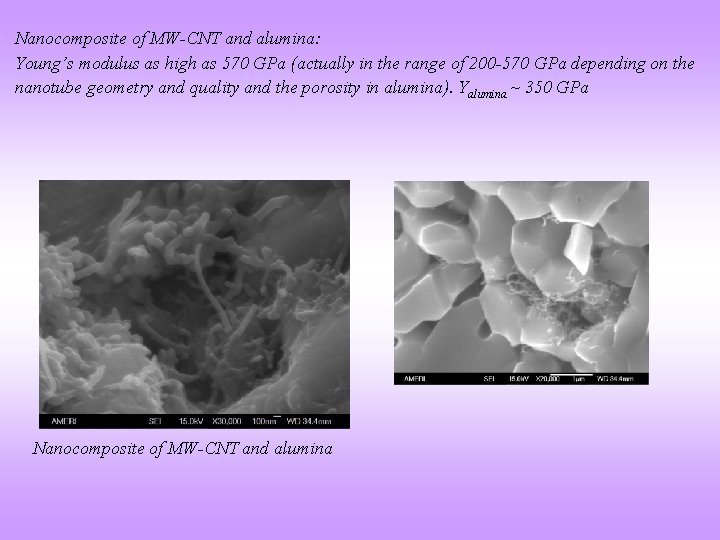
Nanocomposite of MW-CNT and alumina: Young’s modulus as high as 570 GPa (actually in the range of 200 -570 GPa depending on the nanotube geometry and quality and the porosity in alumina). Yalumina ~ 350 GPa Nanocomposite of MW-CNT and alumina
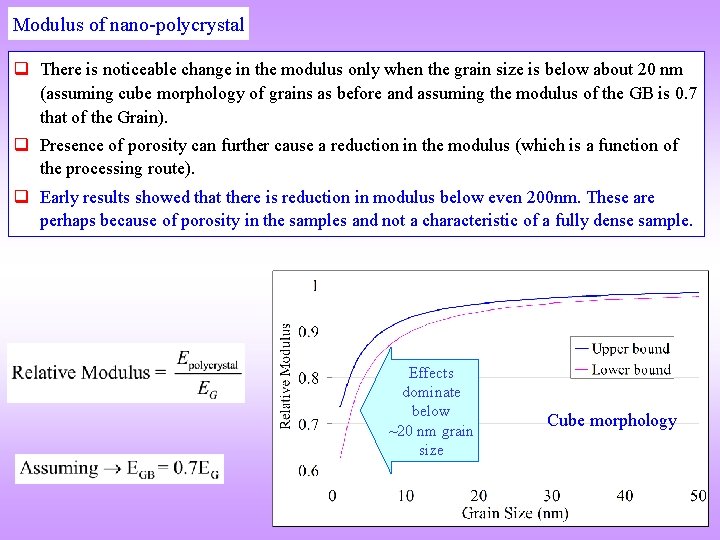
Modulus of nano-polycrystal q There is noticeable change in the modulus only when the grain size is below about 20 nm (assuming cube morphology of grains as before and assuming the modulus of the GB is 0. 7 that of the Grain). q Presence of porosity can further cause a reduction in the modulus (which is a function of the processing route). q Early results showed that there is reduction in modulus below even 200 nm. These are perhaps because of porosity in the samples and not a characteristic of a fully dense sample. Effects dominate below ~20 nm grain size Cube morphology
Supermodulus effect q In early observations of elastic properties it was noticed that there is large (>100%) enhancement of the elastic moduli in multilayers. q This phenomenon was termed the supermodulus effect. q More work in this area have attributed this effect to artifacts or anomalies (it seems now that only about 10% enhancement in the elastic moduli may be real). q Further work is needed in this area.

Though plasticity by slip is the most important mechanism of plastic deformation, there are other mechanisms as well: Plastic Deformation in Crystalline Materials Slip (Dislocation motion) Twinning Phase Transformation Creep Mechanisms Grain boundary sliding + Other Mechanisms Vacancy diffusion Dislocation climb Note: Plastic deformation in amorphous materials occur by other mechanisms including flow (~viscous fluid) and shear banding
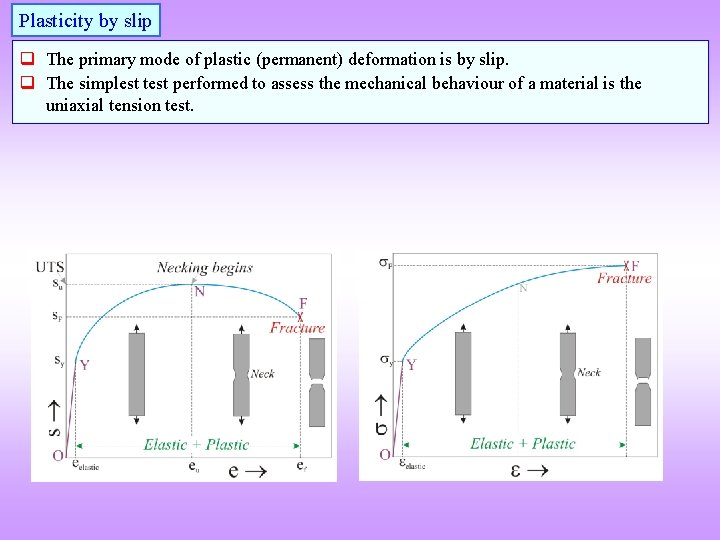
Plasticity by slip q The primary mode of plastic (permanent) deformation is by slip. q The simplest test performed to assess the mechanical behaviour of a material is the uniaxial tension test.
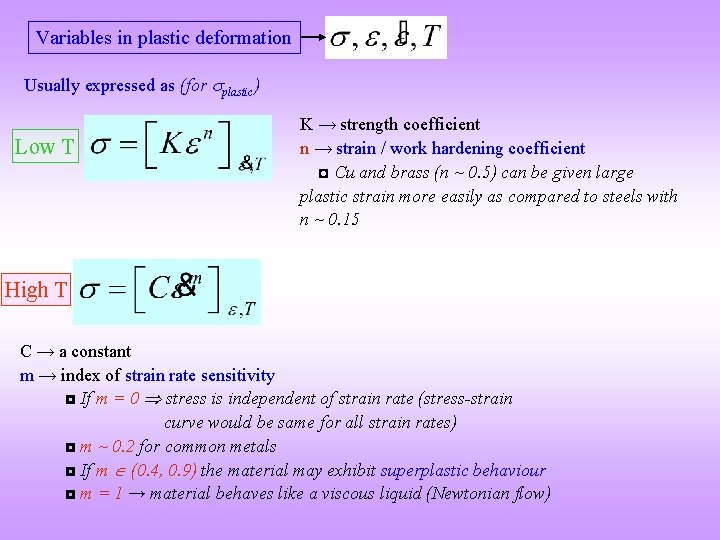
Variables in plastic deformation Usually expressed as (for plastic) Low T K → strength coefficient n → strain / work hardening coefficient ◘ Cu and brass (n ~ 0. 5) can be given large plastic strain more easily as compared to steels with n ~ 0. 15 High T C → a constant m → index of strain rate sensitivity ◘ If m = 0 stress is independent of strain rate (stress-strain curve would be same for all strain rates) ◘ m ~ 0. 2 for common metals ◘ If m (0. 4, 0. 9) the material may exhibit superplastic behaviour ◘ m = 1 → material behaves like a viscous liquid (Newtonian flow)
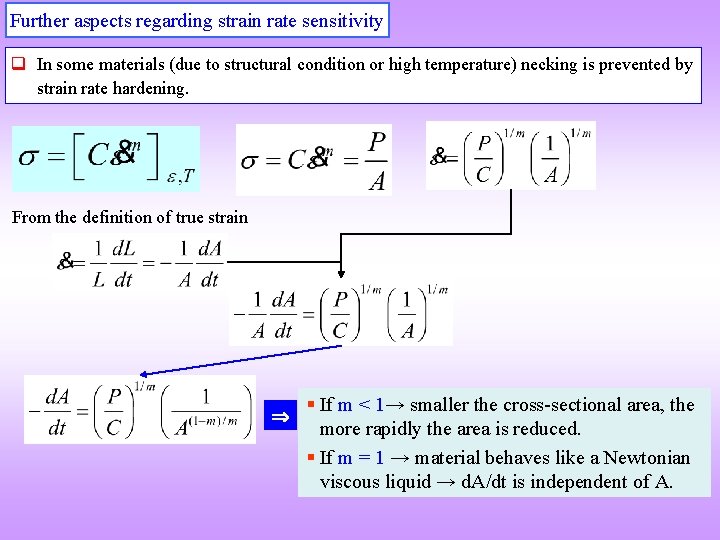
Further aspects regarding strain rate sensitivity q In some materials (due to structural condition or high temperature) necking is prevented by strain rate hardening. From the definition of true strain If m < 1→ smaller the cross-sectional area, the more rapidly the area is reduced. If m = 1 → material behaves like a Newtonian viscous liquid → d. A/dt is independent of A.
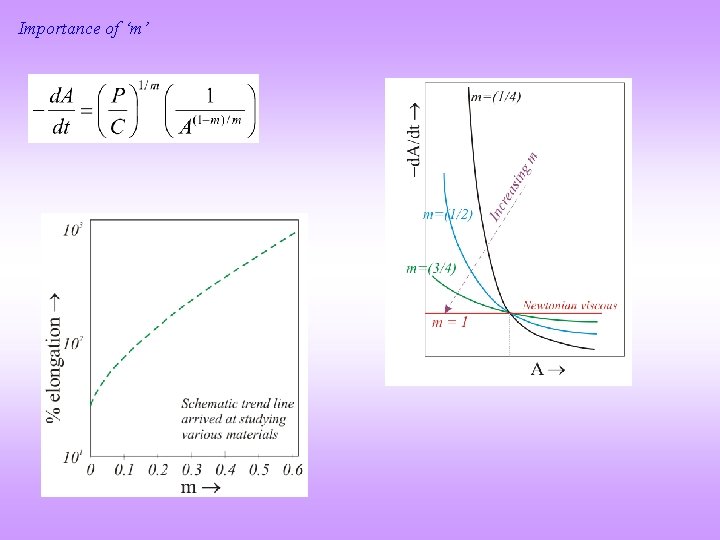
Importance of ‘m’
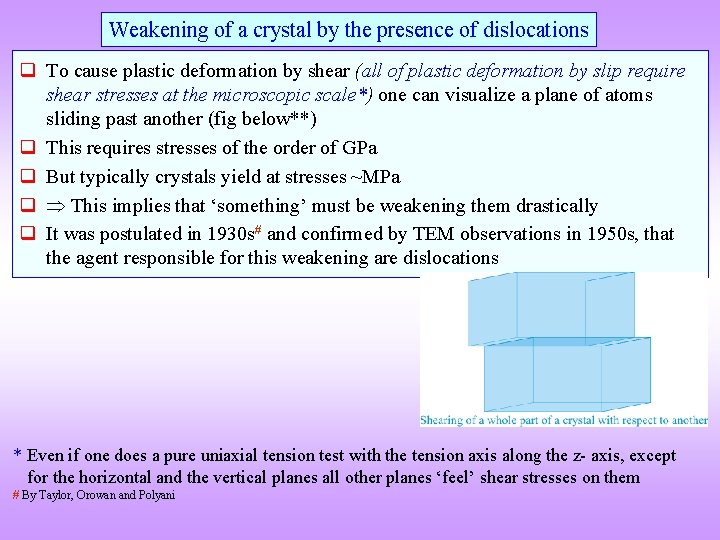
Weakening of a crystal by the presence of dislocations q To cause plastic deformation by shear (all of plastic deformation by slip require shear stresses at the microscopic scale*) one can visualize a plane of atoms sliding past another (fig below**) q This requires stresses of the order of GPa q But typically crystals yield at stresses ~MPa q This implies that ‘something’ must be weakening them drastically q It was postulated in 1930 s# and confirmed by TEM observations in 1950 s, that the agent responsible for this weakening are dislocations * Even if one does a pure uniaxial tension test with the tension axis along the z- axis, except for the horizontal and the vertical planes all other planes ‘feel’ shear stresses on them # By Taylor, Orowan and Polyani
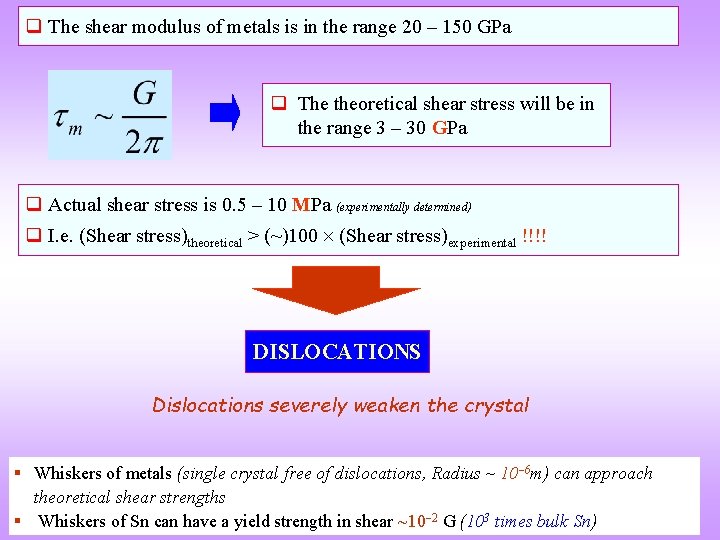
q The shear modulus of metals is in the range 20 – 150 GPa q The theoretical shear stress will be in the range 3 – 30 GPa q Actual shear stress is 0. 5 – 10 MPa (experimentally determined) q I. e. (Shear stress)theoretical > (~)100 (Shear stress)experimental !!!! DISLOCATIONS Dislocations severely weaken the crystal Whiskers of metals (single crystal free of dislocations, Radius ~ 10 6 m) can approach theoretical shear strengths Whiskers of Sn can have a yield strength in shear ~10 2 G (103 times bulk Sn)
Motion of dislocations and plasticity by slip q q Plastic deformation by slip occurs by the motion of dislocation and their leaving the crystal. Dislocations may move under an externally applied stress. At the local level, dislocations are driven only by shear stresses (on the slip plane). The minimum stress required to move a dislocation is called the Peierls-Nabarro (PN) stress or the Peierls stress or the Lattice Friction stress (i. e the externally applied stress may even be purely tensile but on the slip plane shear stresses must act in order to move the dislocation). q Dislocations may also move under the influence of other internal stress fields (e. g. those from other dislocations, precipitates, those generated by phase transformations etc. ). q In any case the Peierls stress must be exceeded for the dislocation to move. q The value of the Peierls stress is different for the edge and the screw dislocations. q The first step of plastic deformation can be considered as the step created when the dislocation moves and leaves the crystal → “One small step for the dislocation, but a giant leap for plasticity”. q When the dislocation leaves the crystal a step of height ‘b’ is created → with it all the stress and energy stored in the crystal due to the dislocation is relieved. More about the motion of dislocations in the chapter on plasticity
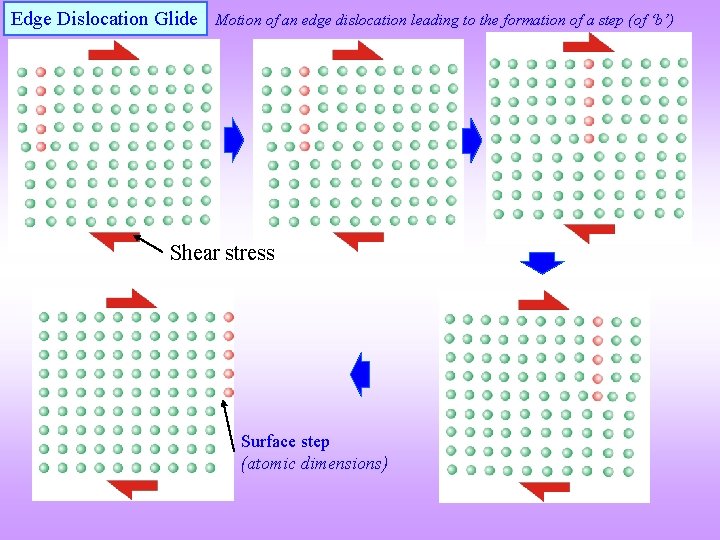
Edge Dislocation Glide Motion of an edge dislocation leading to the formation of a step (of ‘b’) Shear stress Surface step (atomic dimensions)
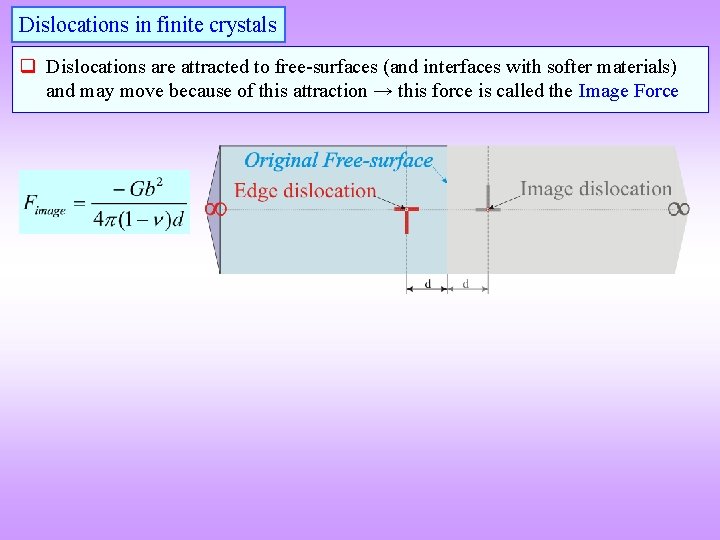
Dislocations in finite crystals q Dislocations are attracted to free-surfaces (and interfaces with softer materials) and may move because of this attraction → this force is called the Image Force
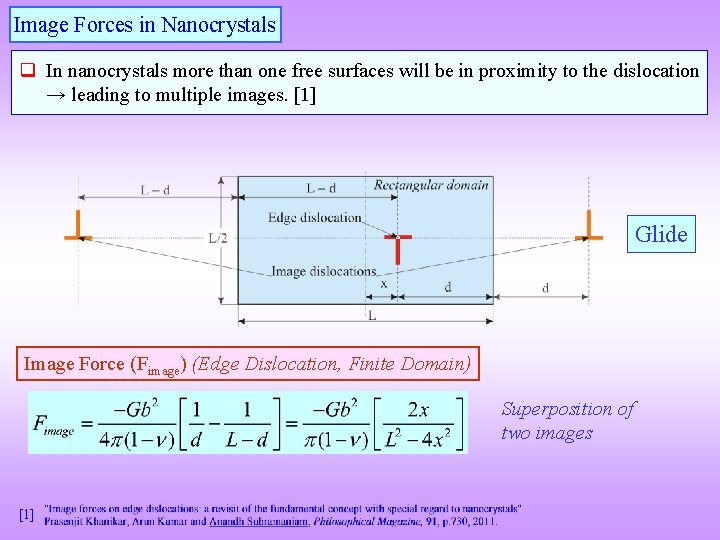
Image Forces in Nanocrystals q In nanocrystals more than one free surfaces will be in proximity to the dislocation → leading to multiple images. [1] Glide Image Force (Fimage) (Edge Dislocation, Finite Domain) Superposition of two images [1]
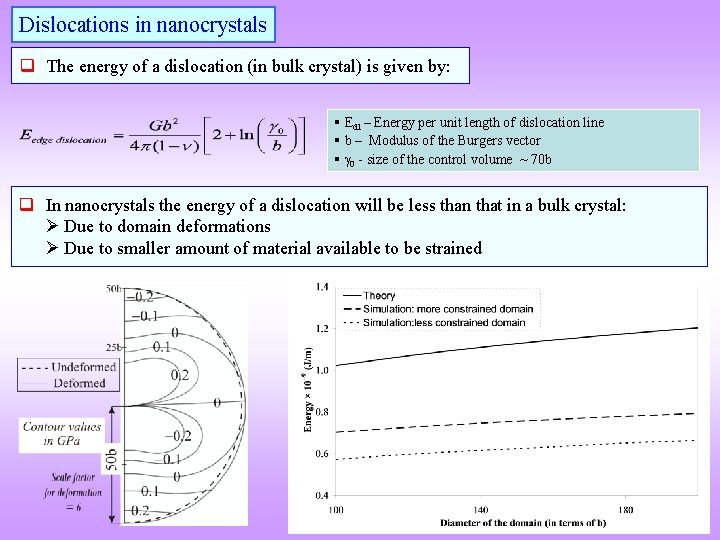
Dislocations in nanocrystals q The energy of a dislocation (in bulk crystal) is given by: Edl – Energy per unit length of dislocation line b – Modulus of the Burgers vector g 0 - size of the control volume ~ 70 b q In nanocrystals the energy of a dislocation will be less than that in a bulk crystal: Due to domain deformations Due to smaller amount of material available to be strained
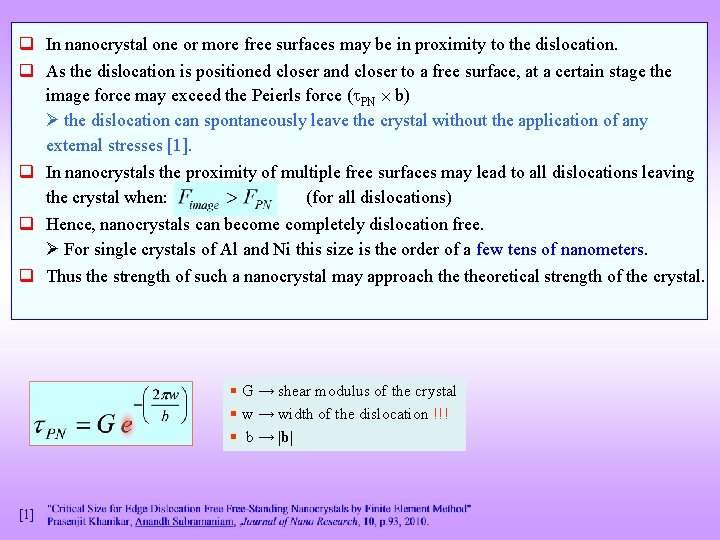
q In nanocrystal one or more free surfaces may be in proximity to the dislocation. q As the dislocation is positioned closer and closer to a free surface, at a certain stage the image force may exceed the Peierls force ( PN b) the dislocation can spontaneously leave the crystal without the application of any external stresses [1]. q In nanocrystals the proximity of multiple free surfaces may lead to all dislocations leaving the crystal when: (for all dislocations) q Hence, nanocrystals can become completely dislocation free. For single crystals of Al and Ni this size is the order of a few tens of nanometers. q Thus the strength of such a nanocrystal may approach theoretical strength of the crystal. G → shear modulus of the crystal w → width of the dislocation !!! b → |b| [1]
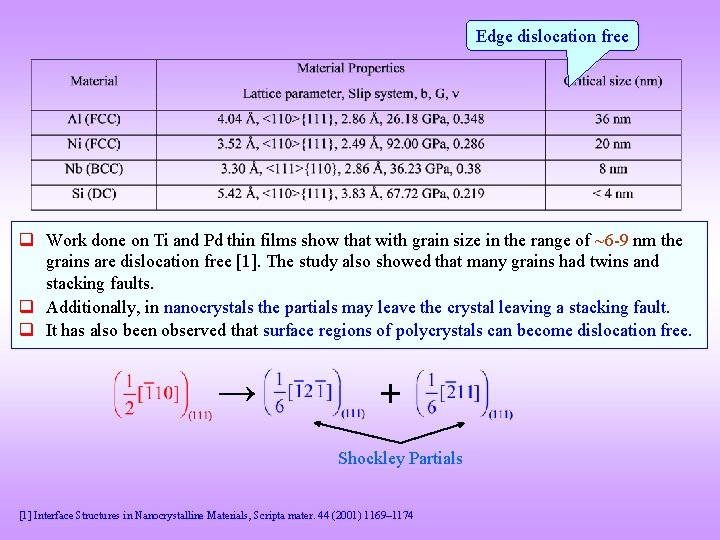
Edge dislocation free q Work done on Ti and Pd thin films show that with grain size in the range of ~6 -9 nm the grains are dislocation free [1]. The study also showed that many grains had twins and stacking faults. q Additionally, in nanocrystals the partials may leave the crystal leaving a stacking fault. q It has also been observed that surface regions of polycrystals can become dislocation free. → + Shockley Partials [1] Interface Structures in Nanocrystalline Materials, Scripta mater. 44 (2001) 1169– 1174
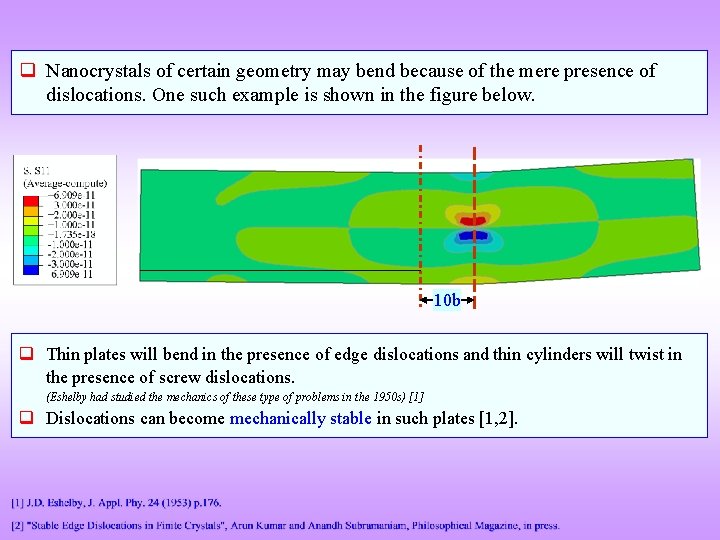
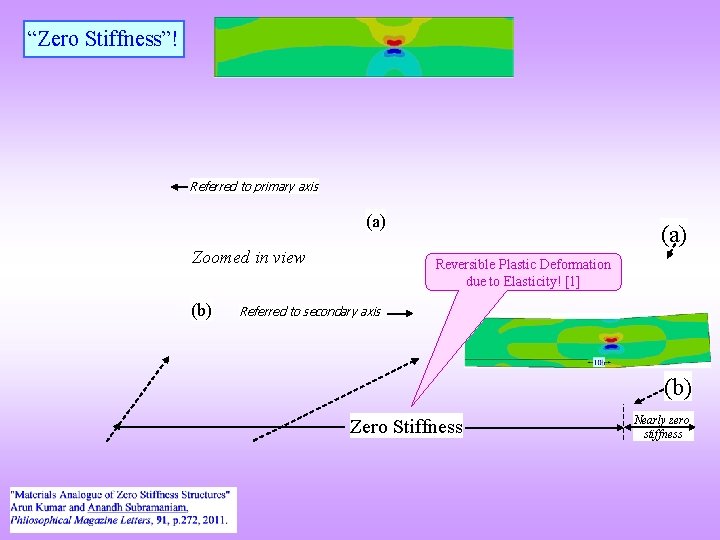
q Nanocrystals of certain geometry may bend because of the mere presence of dislocations. One such example is shown in the figure below. 10 b q Thin plates will bend in the presence of edge dislocations and thin cylinders will twist in the presence of screw dislocations. (Eshelby had studied the mechanics of these type of problems in the 1950 s) [1] q Dislocations can become mechanically stable in such plates [1, 2].
“Zero Stiffness”! Referred to primary axis (a) Zoomed in view (b) (a) Reversible Plastic Deformation due to Elasticity! [1] Referred to secondary axis (b) Zero Stiffness Nearly zero stiffness
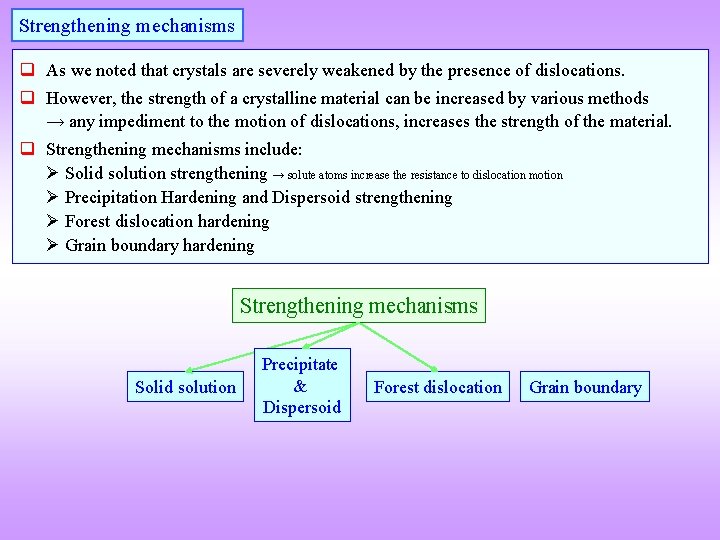
Strengthening mechanisms q As we noted that crystals are severely weakened by the presence of dislocations. q However, the strength of a crystalline material can be increased by various methods → any impediment to the motion of dislocations, increases the strength of the material. q Strengthening mechanisms include: Solid solution strengthening → solute atoms increase the resistance to dislocation motion Precipitation Hardening and Dispersoid strengthening Forest dislocation hardening Grain boundary hardening Strengthening mechanisms Solid solution Precipitate & Dispersoid Forest dislocation Grain boundary

Twinning versus slip q Twinning readily occurs in low stacking fault energy materials like Cu and Brass. In high stacking fault energy materials like Al twinning is difficult. Twinning can occur either during annealing or during deformation. Twinning is an important mechanism of plastic deformation and can give ductility to materials wherein slip may be limited. In BCC metals (e. g. Fe) at low temperatures, twinning may become the dominant mechanism of plastic deformation. TWIP (twinning induced plasticity) steels have been developed keeping this in view. q Process parameters (temperature, strain rate) and material parameters (stacking fault energy, grain size) determine the mechanism operative for plastic deformation (between slip and twinning). For a given strain rate, at higher temperatures slip would be favourable as compared to twinning (as slip is thermally activated, while twinning stress is essentially constant with temperature). On increasing the strain rate the stress required for both slip and twinning increase and the transition temperature (from twinning to slip) is shifted to higher temperatures.
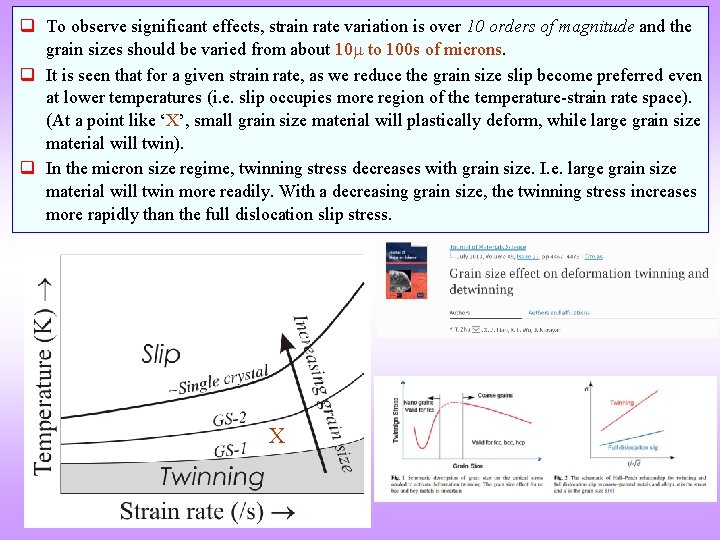
q To observe significant effects, strain rate variation is over 10 orders of magnitude and the grain sizes should be varied from about 10 to 100 s of microns. q It is seen that for a given strain rate, as we reduce the grain size slip become preferred even at lower temperatures (i. e. slip occupies more region of the temperature-strain rate space). (At a point like ‘X’, small grain size material will plastically deform, while large grain size material will twin). q In the micron size regime, twinning stress decreases with grain size. I. e. large grain size material will twin more readily. With a decreasing grain size, the twinning stress increases more rapidly than the full dislocation slip stress. X

Next slide inserted on ref’s comments
Before we leave this topic let us take up few additional points about twinning q Twinning/de-twinning is the main mechanism of deformation in shape memory alloys (though twinning typically does not contribute to large deformations). q Twinning can lead to large orientations changes, which is of help in formation of deformation textures in HCP metals.

Superplasticity q The phenomenon of extensive plastic deformation without necking is termed as structural superplasticity. Superplastic deformation in tension can be >300% (up to even 2000%). q Typically superplastic deformation occurs when: (i) T > 0. 5 Tm (ii) grain size is < 10 m (iii) grains are equiaxed (which usually remain so after deformation) (iv) grain boundaries are glissile (with a large fraction of high angle grain boundaries). q Presence of a second phase (of similar strength to the matrix- reduces cavitation during deformation), which can inhibit grain growth at elevated temperatures helps (e. g. Al 33%Cu, Zn-22% Al)). q Many superplastic alloys have compositions are close to eutectic or eutectoid points. q Superplastic flow is diffusion controlled (can be grain boundary or lattice diffusion controlled).
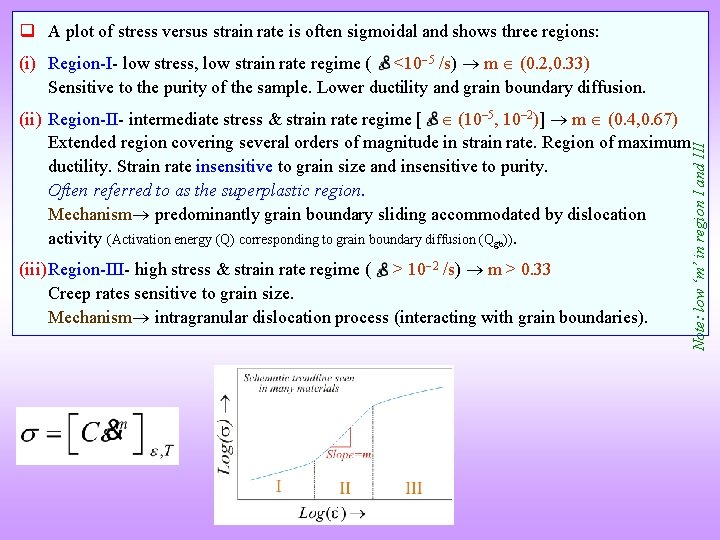
q A plot of stress versus strain rate is often sigmoidal and shows three regions: (i) Region-I- low stress, low strain rate regime ( <10 5 /s) m (0. 2, 0. 33) Sensitive to the purity of the sample. Lower ductility and grain boundary diffusion. (iii) Region-III- high stress & strain rate regime ( > 10 2 /s) m > 0. 33 Creep rates sensitive to grain size. Mechanism intragranular dislocation process (interacting with grain boundaries). Note: low ‘m’ in region I and III (ii) Region-II- intermediate stress & strain rate regime [ (10– 5, 10– 2)] m (0. 4, 0. 67) Extended region covering several orders of magnitude in strain rate. Region of maximum ductility. Strain rate insensitive to grain size and insensitive to purity. Often referred to as the superplastic region. Mechanism predominantly grain boundary sliding accommodated by dislocation activity (Activation energy (Q) corresponding to grain boundary diffusion (Qgb)).
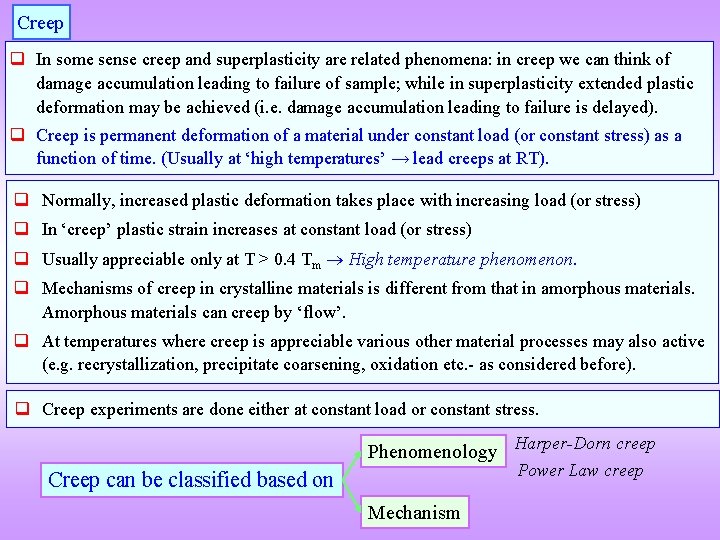
Creep q In some sense creep and superplasticity are related phenomena: in creep we can think of damage accumulation leading to failure of sample; while in superplasticity extended plastic deformation may be achieved (i. e. damage accumulation leading to failure is delayed). q Creep is permanent deformation of a material under constant load (or constant stress) as a function of time. (Usually at ‘high temperatures’ → lead creeps at RT). q Normally, increased plastic deformation takes place with increasing load (or stress) q In ‘creep’ plastic strain increases at constant load (or stress) q Usually appreciable only at T > 0. 4 Tm High temperature phenomenon. q Mechanisms of creep in crystalline materials is different from that in amorphous materials. Amorphous materials can creep by ‘flow’. q At temperatures where creep is appreciable various other material processes may also active (e. g. recrystallization, precipitate coarsening, oxidation etc. - as considered before). q Creep experiments are done either at constant load or constant stress. Phenomenology Harper-Dorn creep Power Law creep Creep can be classified based on Mechanism
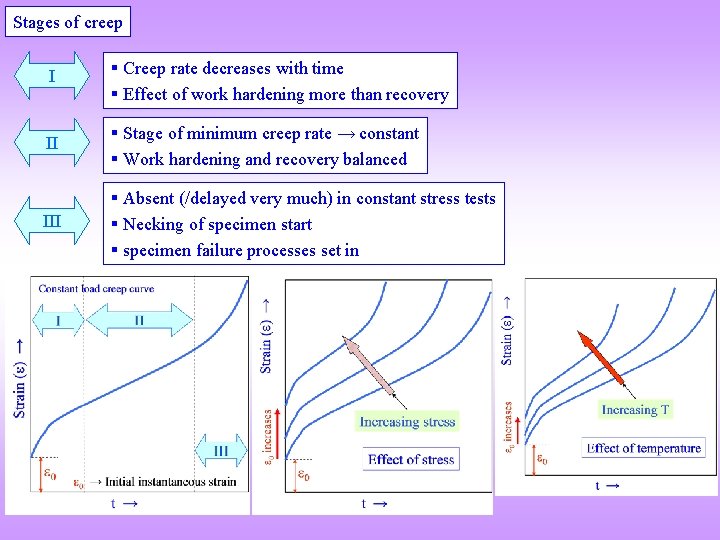
Stages of creep I Creep rate decreases with time Effect of work hardening more than recovery II Stage of minimum creep rate → constant Work hardening and recovery balanced III Absent (/delayed very much) in constant stress tests Necking of specimen start specimen failure processes set in
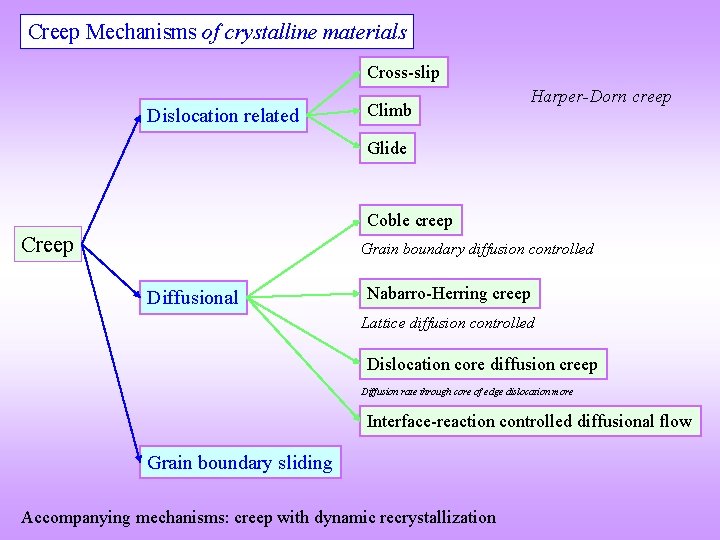
Creep Mechanisms of crystalline materials Cross-slip Dislocation related Climb Harper-Dorn creep Glide Coble creep Creep Grain boundary diffusion controlled Diffusional Nabarro-Herring creep Lattice diffusion controlled Dislocation core diffusion creep Diffusion rate through core of edge dislocation more Interface-reaction controlled diffusional flow Grain boundary sliding Accompanying mechanisms: creep with dynamic recrystallization
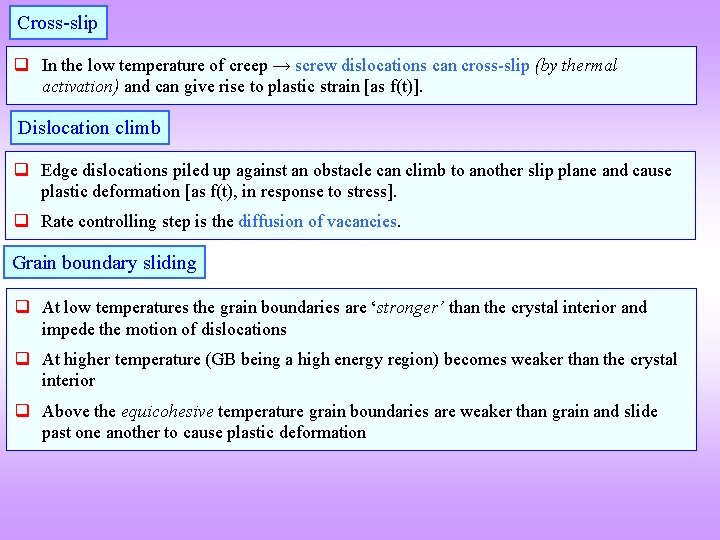
Cross-slip q In the low temperature of creep → screw dislocations can cross-slip (by thermal activation) and can give rise to plastic strain [as f(t)]. Dislocation climb q Edge dislocations piled up against an obstacle can climb to another slip plane and cause plastic deformation [as f(t), in response to stress]. q Rate controlling step is the diffusion of vacancies. Grain boundary sliding q At low temperatures the grain boundaries are ‘stronger’ than the crystal interior and impede the motion of dislocations q At higher temperature (GB being a high energy region) becomes weaker than the crystal interior q Above the equicohesive temperature grain boundaries are weaker than grain and slide past one another to cause plastic deformation
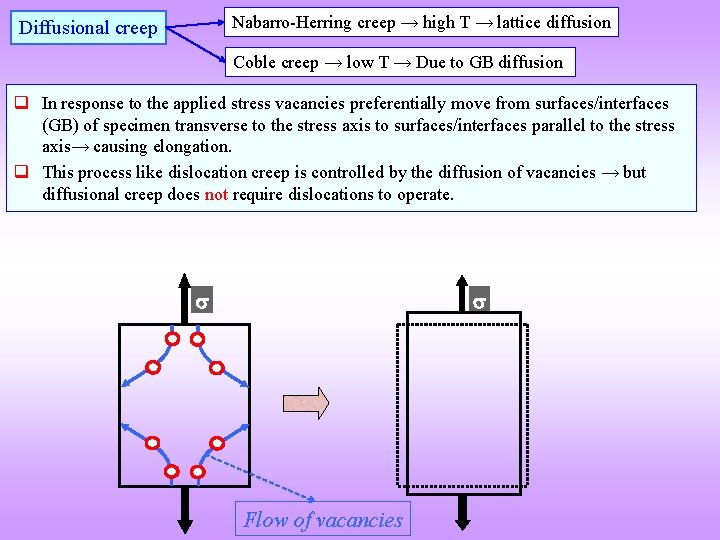
Nabarro-Herring creep → high T → lattice diffusion Diffusional creep Coble creep → low T → Due to GB diffusion q In response to the applied stress vacancies preferentially move from surfaces/interfaces (GB) of specimen transverse to the stress axis to surfaces/interfaces parallel to the stress axis→ causing elongation. q This process like dislocation creep is controlled by the diffusion of vacancies → but diffusional creep does not require dislocations to operate. Flow of vacancies
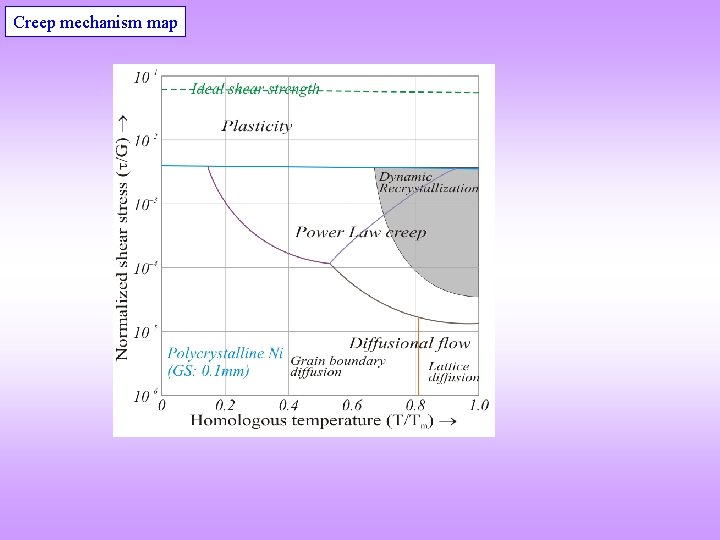
Creep mechanism map
Testing of Nanostructures and Nanomaterials



Grain boundaries in nanocrystals q Grain boundaries and interfaces can comprise of about 50% of the volume fraction in a nanostructured material with grains size of about 5 nm. q Grain boundaries in nanostructured materials seem to be similar in structure to their bulk counterparts (except in specific examples). q Both sharp and disordered grain boundaries (along with disordered triple junctions) were observed in Ti and Pd nanostructured thin films [1]. The region of disorder at the grain boundaries (with disorder) was about 0. 5 nm. The most natural model to explain grain boundaries and triple lines is the disclination model. q In a model by Suryanarayana [2], assuming a grain boundary thickness of 1 nm; when grain size is about 30 nm the volume fraction of grain boundaries is about 10% and that of triple lines (junctions) is ~1%. [1] S. Ranganathan, R. Divakar and V. S. Raghunathan, Scripta mater. 44 (2001) 1169– 1174. [2] C. Suryanarayana, D. Mukhopadhyay, S. N. Patankar, F. H. Froes, J. Mater. Res. 7 (1992) 2114
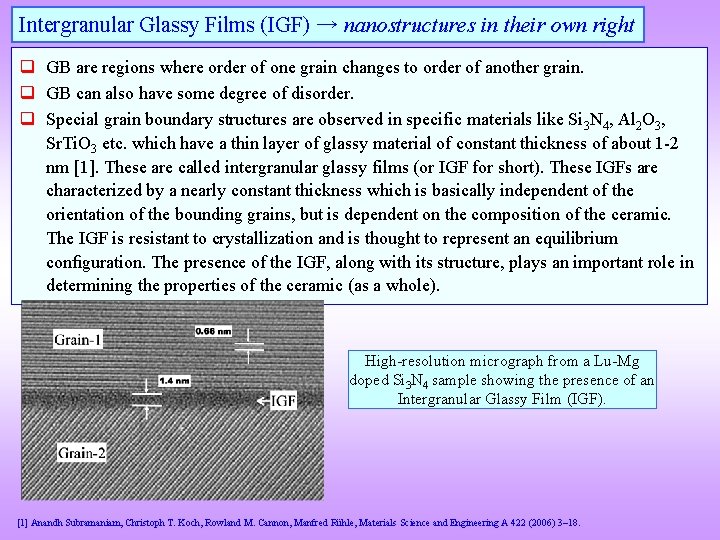
Intergranular Glassy Films (IGF) → nanostructures in their own right q GB are regions where order of one grain changes to order of another grain. q GB can also have some degree of disorder. q Special grain boundary structures are observed in specific materials like Si 3 N 4, Al 2 O 3, Sr. Ti. O 3 etc. which have a thin layer of glassy material of constant thickness of about 1 -2 nm [1]. These are called intergranular glassy films (or IGF for short). These IGFs are characterized by a nearly constant thickness which is basically independent of the orientation of the bounding grains, but is dependent on the composition of the ceramic. The IGF is resistant to crystallization and is thought to represent an equilibrium configuration. The presence of the IGF, along with its structure, plays an important role in determining the properties of the ceramic (as a whole). High-resolution micrograph from a Lu-Mg doped Si 3 N 4 sample showing the presence of an Intergranular Glassy Film (IGF). [1] Anandh Subramaniam, Christoph T. Koch, Rowland M. Cannon, Manfred Rühle, Materials Science and Engineering A 422 (2006) 3– 18.
What kind of mechanical behaviour should we expect in nanomaterials?
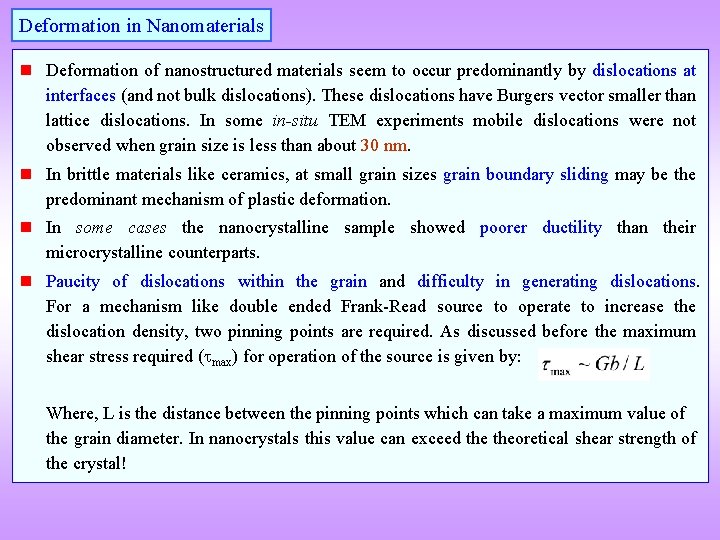
Deformation in Nanomaterials n Deformation of nanostructured materials seem to occur predominantly by dislocations at interfaces (and not bulk dislocations). These dislocations have Burgers vector smaller than lattice dislocations. In some in-situ TEM experiments mobile dislocations were not observed when grain size is less than about 30 nm. n In brittle materials like ceramics, at small grain sizes grain boundary sliding may be the predominant mechanism of plastic deformation. n In some cases the nanocrystalline sample showed poorer ductility than their microcrystalline counterparts. n Paucity of dislocations within the grain and difficulty in generating dislocations. For a mechanism like double ended Frank-Read source to operate to increase the dislocation density, two pinning points are required. As discussed before the maximum shear stress required ( max) for operation of the source is given by: Where, L is the distance between the pinning points which can take a maximum value of the grain diameter. In nanocrystals this value can exceed theoretical shear strength of the crystal!
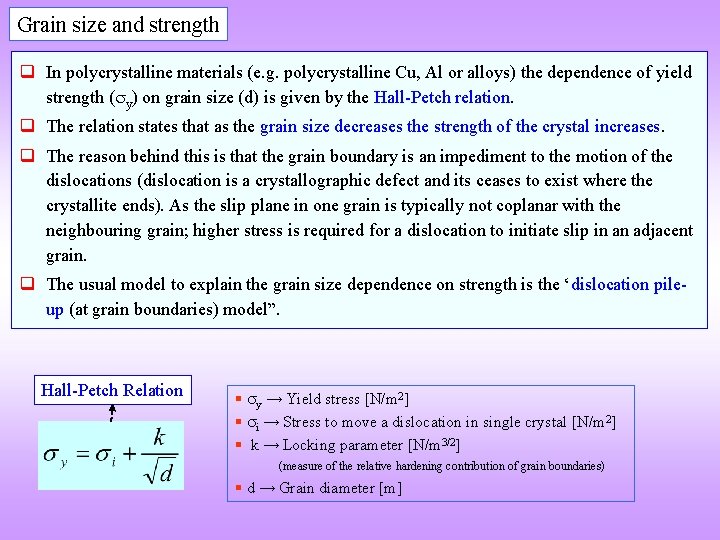
Grain size and strength q In polycrystalline materials (e. g. polycrystalline Cu, Al or alloys) the dependence of yield strength ( y) on grain size (d) is given by the Hall-Petch relation. q The relation states that as the grain size decreases the strength of the crystal increases. q The reason behind this is that the grain boundary is an impediment to the motion of the dislocations (dislocation is a crystallographic defect and its ceases to exist where the crystallite ends). As the slip plane in one grain is typically not coplanar with the neighbouring grain; higher stress is required for a dislocation to initiate slip in an adjacent grain. q The usual model to explain the grain size dependence on strength is the ‘dislocation pileup (at grain boundaries) model”. Hall-Petch Relation y → Yield stress [N/m 2] i → Stress to move a dislocation in single crystal [N/m 2] k → Locking parameter [N/m 3/2] (measure of the relative hardening contribution of grain boundaries) d → Grain diameter [m]
q Hardness also follows a relationship akin to that of yield stress. q Nanocrystalline Cu with grain size (d) = 6 nm is FIVE times harder that microcrystalline Cu (with d = 50 m). q The yield stress of nanophase Pd (d = 7 nm) is FIVE times greater than that in the corresponding bulk metal (d = 100 m). q This effect understood in terms of the difficulty in creating dislocations and from the existence of barriers to dislocation motion.
q The usual model to explain the origin of the d 1/2 dependence is the dislocation pile up model (at grain boundaries). (However, it must be noted that this model has not been universally validated). q As grain boundaries are obstacles to the motion of dislocations they pile up at the grain boundary and the stress caused by the pile up initiates slip in the next grain. q This relation is not expected to hold at very small grain sizes: if this form of the relation continues the yield strength will exceed theoretical strength of the crystal. at very small grain sizes there is not ‘enough length’ to support a pile up (i. e. at small sizes only a single dislocation can be accommodated in a grain). q Hence, at very small sizes the Hall-Petch relation breaks down. This typically occurs at grain sizes of about 10 nm.
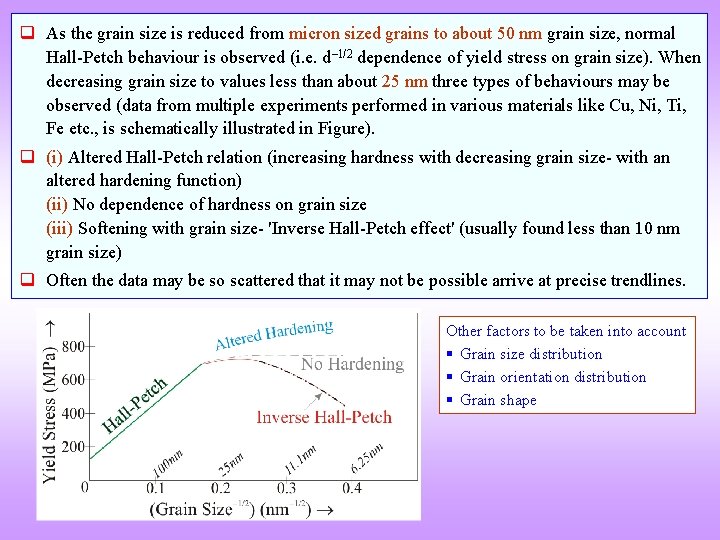
q As the grain size is reduced from micron sized grains to about 50 nm grain size, normal Hall-Petch behaviour is observed (i. e. d– 1/2 dependence of yield stress on grain size). When decreasing grain size to values less than about 25 nm three types of behaviours may be observed (data from multiple experiments performed in various materials like Cu, Ni, Ti, Fe etc. , is schematically illustrated in Figure). q (i) Altered Hall-Petch relation (increasing hardness with decreasing grain size- with an altered hardening function) (ii) No dependence of hardness on grain size (iii) Softening with grain size- 'Inverse Hall-Petch effect' (usually found less than 10 nm grain size) q Often the data may be so scattered that it may not be possible arrive at precise trendlines. Other factors to be taken into account Grain size distribution Grain orientation distribution Grain shape
q In nanostructured materials the dislocations needed for deformation maybe absent or sessile and new ones are prevented from forming. q Materials with poor ductility (like intermetallics or ceramics), the results of possible increase in ductility by grain-size reduction are contradictory. (results on some systems and investigators point in one direction while other investigations do not corroborate the results).
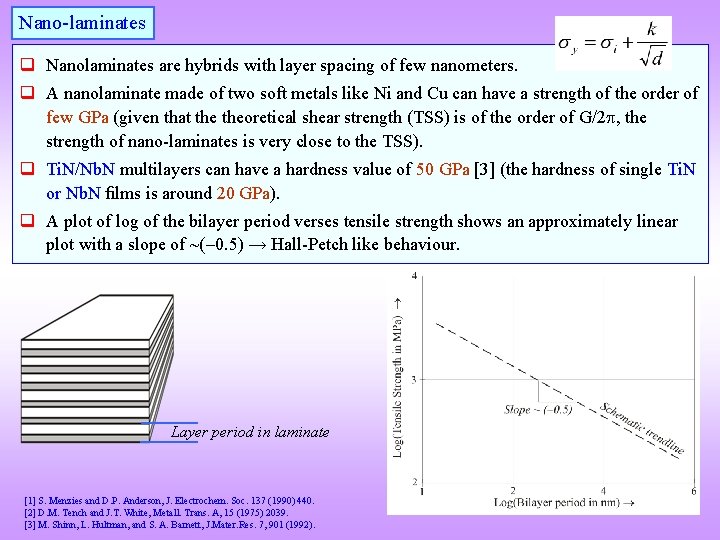
Nano-laminates q Nanolaminates are hybrids with layer spacing of few nanometers. q A nanolaminate made of two soft metals like Ni and Cu can have a strength of the order of few GPa (given that theoretical shear strength (TSS) is of the order of G/2 , the strength of nano-laminates is very close to the TSS). q Ti. N/Nb. N multilayers can have a hardness value of 50 GPa [3] (the hardness of single Ti. N or Nb. N films is around 20 GPa). q A plot of log of the bilayer period verses tensile strength shows an approximately linear plot with a slope of ~( 0. 5) → Hall-Petch like behaviour. Layer period in laminate [1] S. Menzies and D. P. Anderson, J. Electrochem. Soc. 137 (1990) 440. [2] D. M. Tench and J. T. White, Metall. Trans. A, 15 (1975) 2039. [3] M. Shinn, L. Hultman, and S. A. Barnett, J. Mater. Res. 7, 901 (1992).
q Hardening in multi-layers and superlattices have been explained using a number of concepts: (i) barrier strengthening, (ii) coherency stress strengthening, (iii) misfit dislocation density strengthening (iv) dislocation image force (due to discontinuity in the elastic modulus at the interfaces) (v) dislocation pileup and bowing processes occur (at larger bilayer periods). In the example cited before: Ni/Cu superlattices [1] q Decreasing bilayer period up 20 nm leads to increase in yield stress in tension test. q Further decrease in bilayer period leads to decrease in strength. q The peak strength corresponds to one dislocation per layer. [1] P. M. Anderson, T. Foecke, and P. M. Hazzledine, MRS Bull. 24, 27 (1999).
Nanocomposites: particulate reinforcements q Precipitation hardening is well known where nanometer (1 -100 nm) sized precipitates increase the hardness and strength of materials. (Strength of Al → 100 MPa Strength of Duralumin (Al + 4% Cu + other alloying elements) → 500 MPa). q When nanosized Mo (5– 20 vol. %) is dispersed in micrometer grain sized Al 2 O 3 → there is a considerable improvement in the hardness, fracture strength, and toughness. q Nanosized Si. C dispersions (200 nm) in a matrix of Al 2 O 3, leads to → increase in fracture strength by a factor of 3, enhanced high-temperature mechanical properties The decrease in hardness with increasing temperature is significantly less in nanocomposite Al 2 O 3/Si. C than in monolithic Al 2 O 3.
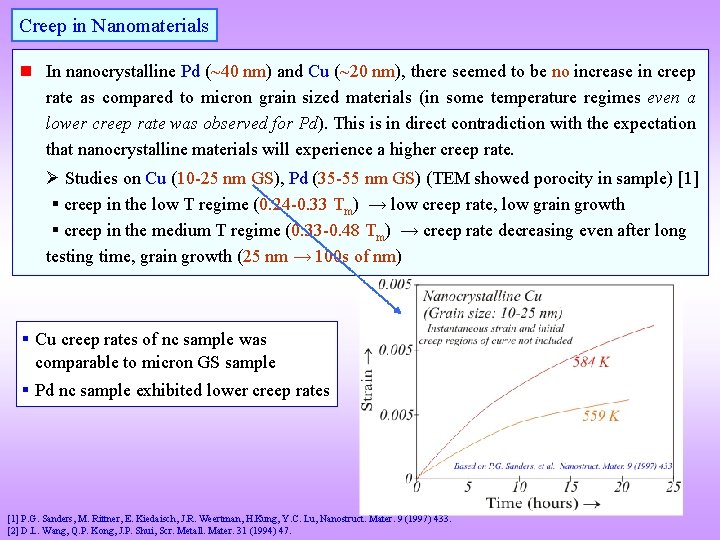
Creep in Nanomaterials n In nanocrystalline Pd (~40 nm) and Cu (~20 nm), there seemed to be no increase in creep rate as compared to micron grain sized materials (in some temperature regimes even a lower creep rate was observed for Pd). This is in direct contradiction with the expectation that nanocrystalline materials will experience a higher creep rate. Studies on Cu (10 -25 nm GS), Pd (35 -55 nm GS) (TEM showed porocity in sample) [1] creep in the low T regime (0. 24 -0. 33 Tm) → low creep rate, low grain growth creep in the medium T regime (0. 33 -0. 48 Tm) → creep rate decreasing even after long testing time, grain growth (25 nm → 100 s of nm) Cu creep rates of nc sample was comparable to micron GS sample Pd nc sample exhibited lower creep rates [1] P. G. Sanders, M. Rittner, E. Kiedaisch, J. R. Weertman, H. Kung, Y. C. Lu, Nanostruct. Mater. 9 (1997) 433. [2] D. L. Wang, Q. P. Kong, J. P. Shui, Scr. Metall. Mater. 31 (1994) 47.
n In some cases the creep rate increased with a decrease in grain size in the nanoscale regime of grain sizes (e. g. in Ni-P nanocrystalline material the creep rate of ~30 nm grain sized material was higher than that of 250 nm material [2]). n In cases where high creep rate expected for nanocrystalline materials (e. g. Pd, Cu) was not observed, the reason attributed are: (i) presence of low angle grain boundaries and twin boundaries (which are not prone to sliding and have low diffusivity for vacancies), (ii) reduced dislocation activity in nanocrystalline samples.
![n Creep of nc-Ni at RT (GS: 6, 20, 40 nm) [1]: Smaller grain](http://slidetodoc.com/presentation_image_h2/cc514d0f57592307afa35844825057b3/image-64.jpg "n Creep of nc-Ni at RT (GS: 6, 20, 40 nm) [1]: Smaller grain")
n Creep of nc-Ni at RT (GS: 6, 20, 40 nm) [1]: Smaller grain size (6 nm) showed faster creep rate. Behaviour consistent with Grain boundary sliding controlled by grain boundary diffusion mechanism. High stresses and larger GS (20, 50 nm)→ dislocation creep. [1] N. Wang, Z. Wang, K. T. Aust, U. Erb, Mater. Sci. Eng. , A 237 (1997) 150.
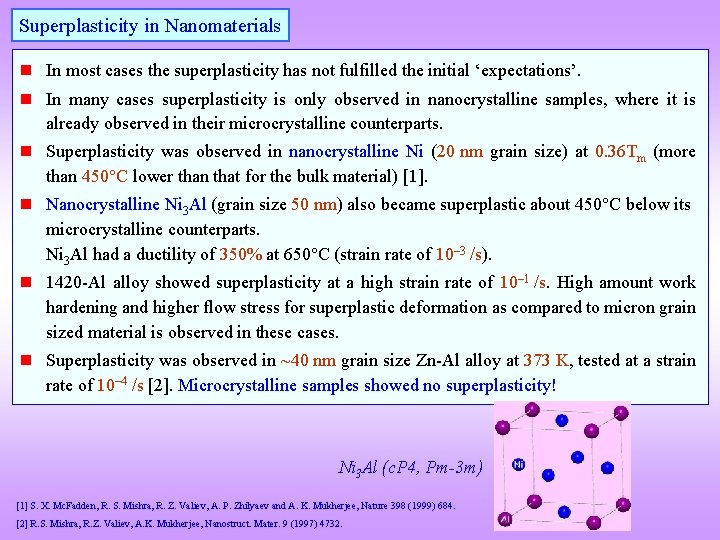
Superplasticity in Nanomaterials n In most cases the superplasticity has not fulfilled the initial ‘expectations’. n In many cases superplasticity is only observed in nanocrystalline samples, where it is already observed in their microcrystalline counterparts. n Superplasticity was observed in nanocrystalline Ni (20 nm grain size) at 0. 36 Tm (more than 450 C lower than that for the bulk material) [1]. n Nanocrystalline Ni 3 Al (grain size 50 nm) also became superplastic about 450 C below its microcrystalline counterparts. Ni 3 Al had a ductility of 350% at 650 C (strain rate of 10– 3 /s). n 1420 -Al alloy showed superplasticity at a high strain rate of 10– 1 /s. High amount work hardening and higher flow stress for superplastic deformation as compared to micron grain sized material is observed in these cases. n Superplasticity was observed in ~40 nm grain size Zn-Al alloy at 373 K, tested at a strain rate of 10– 4 /s [2]. Microcrystalline samples showed no superplasticity! Ni 3 Al (c. P 4, Pm-3 m) [1] S. X. Mc. Fadden, R. S. Mishra, R. Z. Valiev, A. P. Zhilyaev and A. K. Mukherjee, Nature 398 (1999) 684. [2] R. S. Mishra, R. Z. Valiev, A. K. Mukherjee, Nanostruct. Mater. 9 (1997) 4732.
n Superplasticity at low temperature (or equivalently Superplasticity at high strain rates (> 10– 2 /s) at a given temperature in the superplastic regime) is caused by: increased diffusion, grain boundary sliding and dislocation activity. n Grain growth is a serious issue during superplasticity experiments. In the case of nc-Ni it was seen that the grain size could increase to micron sizes, from the starting grain size of the order of 20 nm. In other materials the grain growth could be less. Grain growth is expected to be less is two phase mixtures (2 nd phase as a precipitate preferred) and intermetallic compounds. In two phase mixtures the 2 nd phase has a pinning effect on the grain boundaries; while in intermetallics (like Ni 3 Al) order (with respect to the sublattices) has to be maintained during grain growth, which restrains the process. n In cases where grain boundary sliding is the predominant mechanism for superplasticity (e. g. in some Mg alloys), it is seen that non-equilibrium grain boundaries give lower elongation as compared to equilibrium grain boundaries (due to the long range stress fields associated with non-equilibrium grain boundaries, which is expected to hamper grain boundary sliding). n In Ni 3 Al the high flow stresses and extensive strain hardening during superplastic deformation has been attributed to depletion of dislocations and high stresses required for the nucleation of new ones [1] R. S. Mishra, R. Z. Valiev, S. X. Mc. Fadden, A. K. Mukherjee, Mater. Sci. Eng. , A 252 (1998) 174.
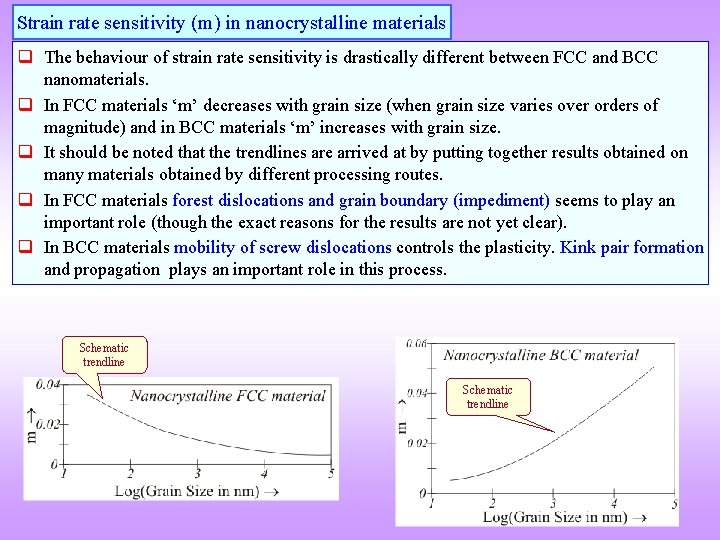
Strain rate sensitivity (m) in nanocrystalline materials q The behaviour of strain rate sensitivity is drastically different between FCC and BCC nanomaterials. q In FCC materials ‘m’ decreases with grain size (when grain size varies over orders of magnitude) and in BCC materials ‘m’ increases with grain size. q It should be noted that the trendlines are arrived at by putting together results obtained on many materials obtained by different processing routes. q In FCC materials forest dislocations and grain boundary (impediment) seems to play an important role (though the exact reasons for the results are not yet clear). q In BCC materials mobility of screw dislocations controls the plasticity. Kink pair formation and propagation plays an important role in this process. Schematic trendline
q Deformation of nanostructured materials seem to occur predominantly by dislocations at interfaces (and not bulk dislocations). These dislocations have Burgers vector smaller than lattice dislocations. In some in-situ TEM experiments mobile dislocations were not observed when grain size is less than about 30 nm. q In brittle materials like ceramics, at small grain sizes grain boundary sliding may be the predominant mechanism of plastic deformation.
Work that needs to be done and issues still to be understood regarding high temperature behaviour of nanocrystalline materials [1]: · Creep (i) Understand rate controlling mechanisms at various temperatures and strain rates; (ii) Creep tests need to be conducted over a wide range of temperatures and stress exponent and activation energy need to be determined; (iii) grain size sensitivity needs to be determined by synthesizing materials with a wide range of grain sizes; (iv) large strain steady state creep experiments need to be performed; (v) pure materials should be used (to reduce complications of multiphase materials and impurity content) but grain growth should be minimized; (vi) role of triple junction in creep needs to be ascertained. · Superplasticity (i) Obtained porosity free, surface scratch free samples; (ii) role of grain boundary sliding in deformation needs to be determined; (iii) role of grain size on flow stress and mechanisms operative need to be determined. [1] F. A. Mohamed, Y. Li : Materials Science and Engineering A 298 (2001) 1– 15
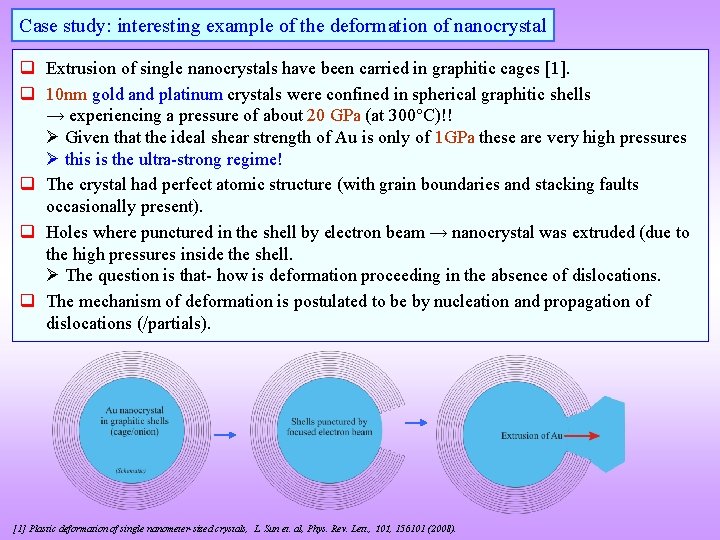
Case study: interesting example of the deformation of nanocrystal q Extrusion of single nanocrystals have been carried in graphitic cages [1]. q 10 nm gold and platinum crystals were confined in spherical graphitic shells → experiencing a pressure of about 20 GPa (at 300 C)!! Given that the ideal shear strength of Au is only of 1 GPa these are very high pressures this is the ultra-strong regime! q The crystal had perfect atomic structure (with grain boundaries and stacking faults occasionally present). q Holes where punctured in the shell by electron beam → nanocrystal was extruded (due to the high pressures inside the shell. The question is that- how is deformation proceeding in the absence of dislocations. q The mechanism of deformation is postulated to be by nucleation and propagation of dislocations (/partials). [1] Plastic deformation of single nanometer-sized crystals, L. Sun et. al, Phys. Rev. Lett. , 101, 156101 (2008).
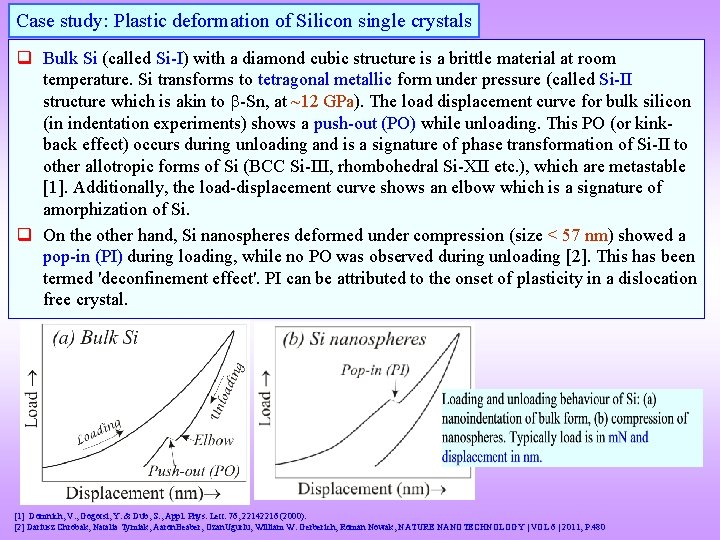
Case study: Plastic deformation of Silicon single crystals q Bulk Si (called Si-I) with a diamond cubic structure is a brittle material at room temperature. Si transforms to tetragonal metallic form under pressure (called Si-II structure which is akin to -Sn, at ~12 GPa). The load displacement curve for bulk silicon (in indentation experiments) shows a push-out (PO) while unloading. This PO (or kinkback effect) occurs during unloading and is a signature of phase transformation of Si-II to other allotropic forms of Si (BCC Si-III, rhombohedral Si-XII etc. ), which are metastable [1]. Additionally, the load-displacement curve shows an elbow which is a signature of amorphization of Si. q On the other hand, Si nanospheres deformed under compression (size < 57 nm) showed a pop-in (PI) during loading, while no PO was observed during unloading [2]. This has been termed 'deconfinement effect'. PI can be attributed to the onset of plasticity in a dislocation free crystal. [1] Domnich, V. , Gogotsi, Y. & Dub, S. , Appl. Phys. Lett. 76, 22142216 (2000). [2] Dariusz Chrobak, Natalia Tymiak, Aaron. Beaber, Ozan. Ugurlu, William W. Gerberich, Roman Nowak, NATURE NANOTECHNOLOGY | VOL 6 | 2011, P. 480

End
Mechanism of deformation q As the grain size is reduced grain boundary sliding starts to play an important role in plastic deformation. This is more so at high temperatures. q Nature of bonding plays an important role in deciding this cross-over. [1] R. W. Siegel and G. E. Fougere, Nanostruct. Mater. 6, 205 (1995).
- Slides: 73