
Defect investigation on MCz after 1 Me V
- Slides: 14
Defect investigation on MCz after 1 Me. V neutron irradiation I. Pintilie 1, E. Fretwurst 2, A. Junkes 2 and G. Lindstroem 2 National Institute of Materials Physics, Bucharest, P. O. Box MG-7, 077125, Romania 2 Institute for Experimental Physics, Hamburg University, D-22761, Germany 1 Ioana Pintilie, Vilnius 2 -6 june 2007
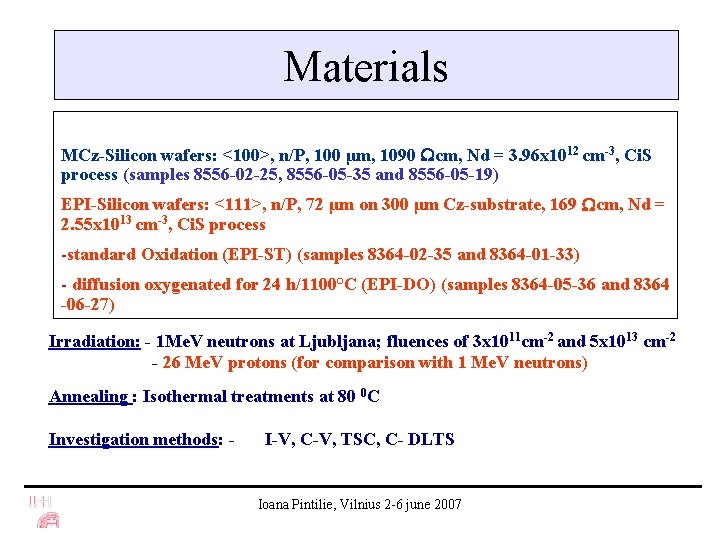
Materials MCz-Silicon wafers: <100>, n/P, 100 μm, 1090 cm, Nd = 3. 96 x 1012 cm-3, Ci. S process (samples 8556 -02 -25, 8556 -05 -35 and 8556 -05 -19) EPI-Silicon wafers: <111>, n/P, 72 μm on 300 μm Cz-substrate, 169 cm, Nd = 2. 55 x 1013 cm-3, Ci. S process -standard Oxidation (EPI-ST) (samples 8364 -02 -35 and 8364 -01 -33) - diffusion oxygenated for 24 h/1100°C (EPI-DO) (samples 8364 -05 -36 and 8364 -06 -27) Irradiation: - 1 Me. V neutrons at Ljubljana; fluences of 3 x 1011 cm-2 and 5 x 1013 cm-2 - 26 Me. V protons (for comparison with 1 Me. V neutrons) Annealing : Isothermal treatments at 80 0 C Investigation methods: - I-V, C-V, TSC, C- DLTS Ioana Pintilie, Vilnius 2 -6 june 2007
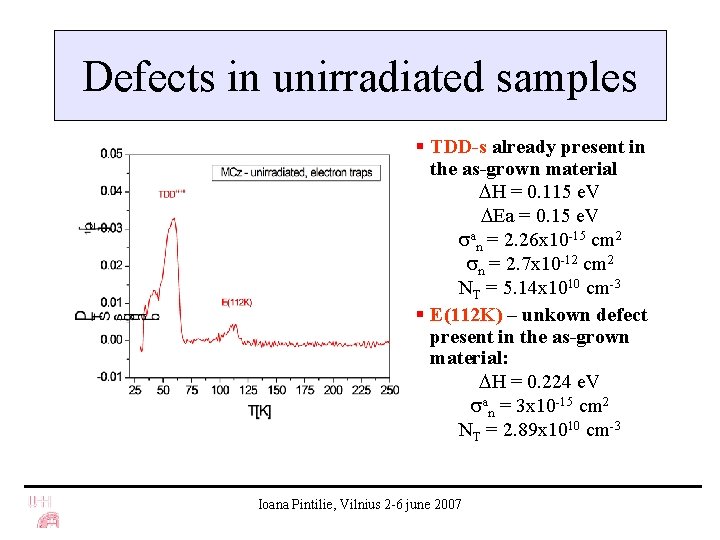
Defects in unirradiated samples § TDD-s already present in the as-grown material H = 0. 115 e. V Ea = 0. 15 e. V an = 2. 26 x 10 -15 cm 2 n = 2. 7 x 10 -12 cm 2 NT = 5. 14 x 1010 cm-3 § E(112 K) – unkown defect present in the as-grown material: H = 0. 224 e. V an = 3 x 10 -15 cm 2 NT = 2. 89 x 1010 cm-3 Ioana Pintilie, Vilnius 2 -6 june 2007
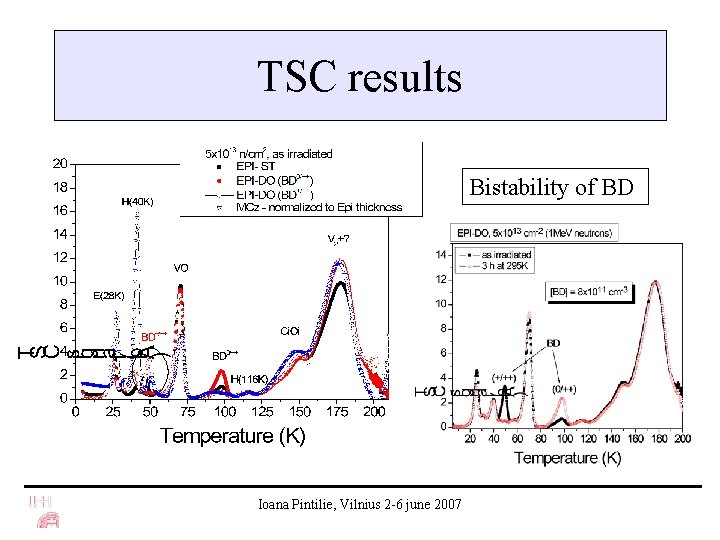
TSC results Bistability of BD Ioana Pintilie, Vilnius 2 -6 june 2007
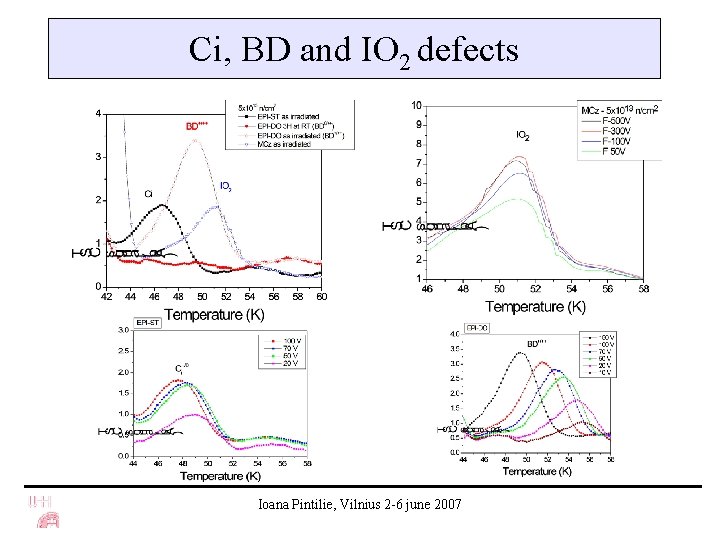
Ci, BD and IO 2 defects Ioana Pintilie, Vilnius 2 -6 june 2007
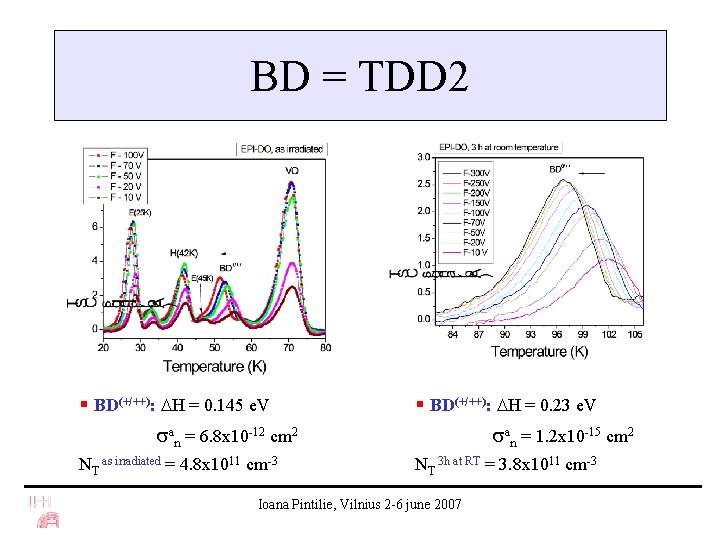
BD = TDD 2 § BD(+/++): H = 0. 145 e. V an = 6. 8 x 10 -12 cm 2 § BD(+/++): H = 0. 23 e. V an = 1. 2 x 10 -15 cm 2 NT as irradiated = 4. 8 x 1011 cm-3 NT 3 h at RT = 3. 8 x 1011 cm-3 Ioana Pintilie, Vilnius 2 -6 june 2007
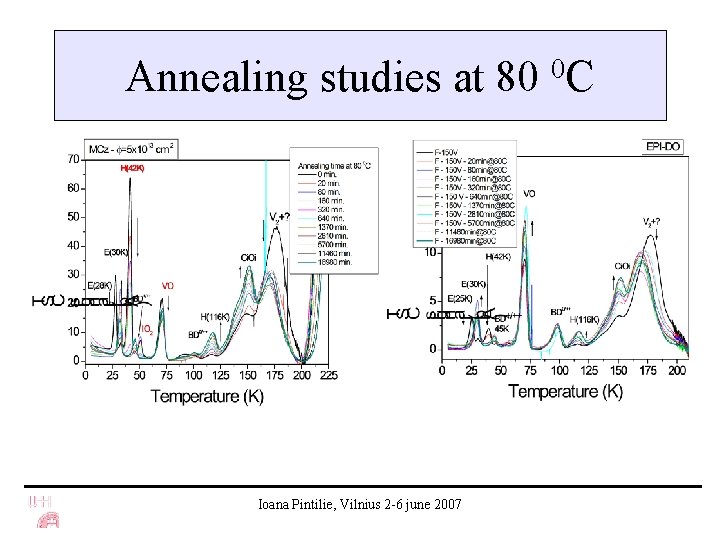
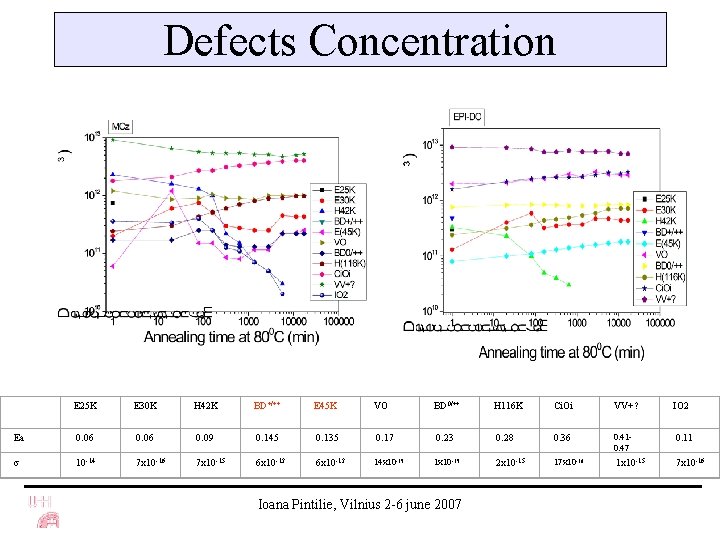
Annealing studies at 80 0 C Ioana Pintilie, Vilnius 2 -6 june 2007
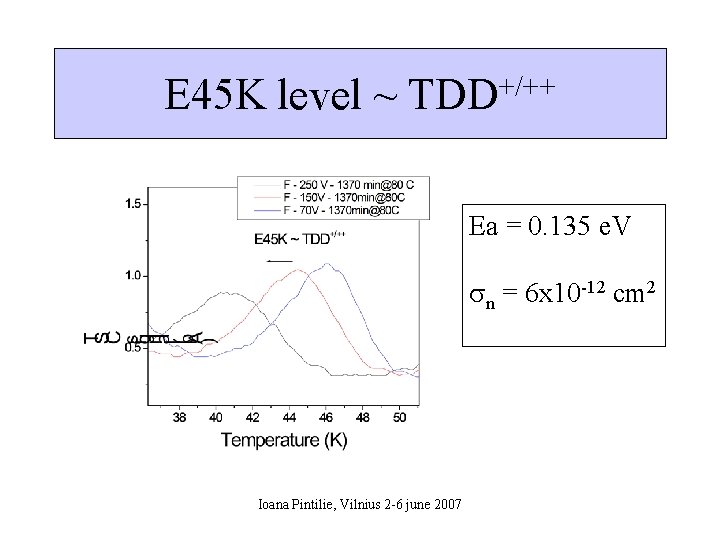
+/++ E 45 K level ~ TDD Ea = 0. 135 e. V n = 6 x 10 -12 cm 2 Ioana Pintilie, Vilnius 2 -6 june 2007
Defects Concentration E 25 K E 30 K H 42 K BD+/++ E 45 K VO BD 0/++ H 116 K Ci. Oi VV+? IO 2 Ea 0. 06 0. 09 0. 145 0. 135 0. 17 0. 23 0. 28 0. 36 0. 410. 47 0. 11 10 -14 7 x 10 -16 7 x 10 -15 6 x 10 -12 14 x 10 -15 1 x 10 -15 2 x 10 -15 17 x 10 -16 1 x 10 -15 7 x 10 -16 Ioana Pintilie, Vilnius 2 -6 june 2007
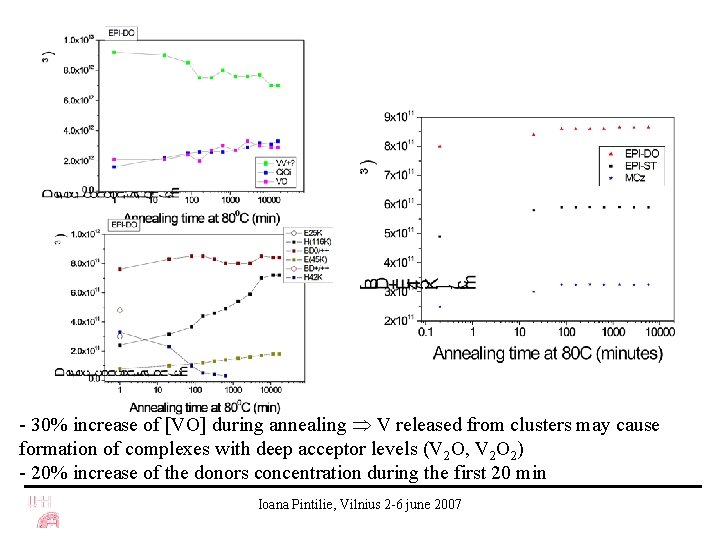
- 30% increase of [VO] during annealing V released from clusters may cause formation of complexes with deep acceptor levels (V 2 O, V 2 O 2) - 20% increase of the donors concentration during the first 20 min Ioana Pintilie, Vilnius 2 -6 june 2007
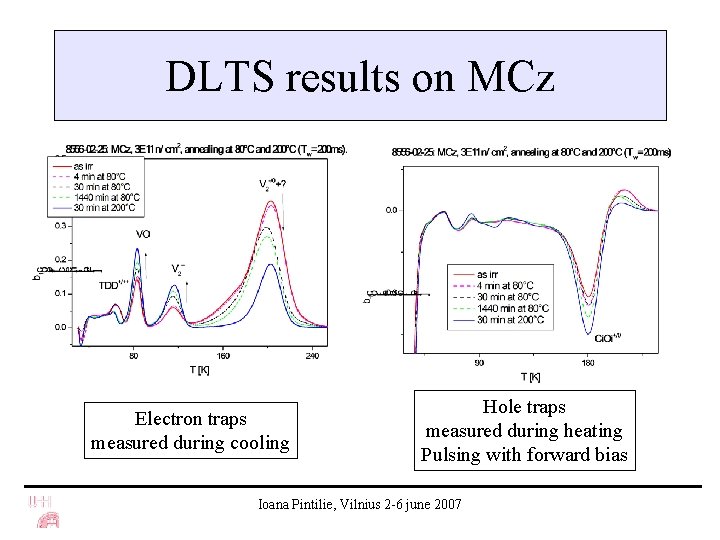
DLTS results on MCz Electron traps measured during cooling Hole traps measured during heating Pulsing with forward bias Ioana Pintilie, Vilnius 2 -6 june 2007
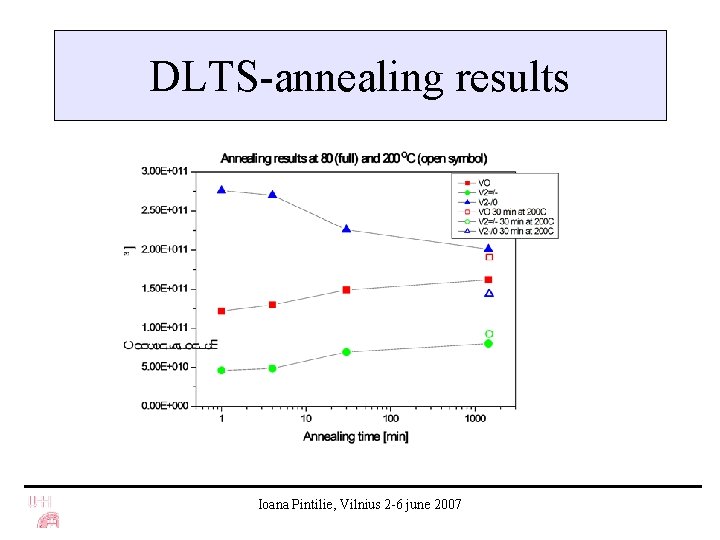
DLTS-annealing results Ioana Pintilie, Vilnius 2 -6 june 2007
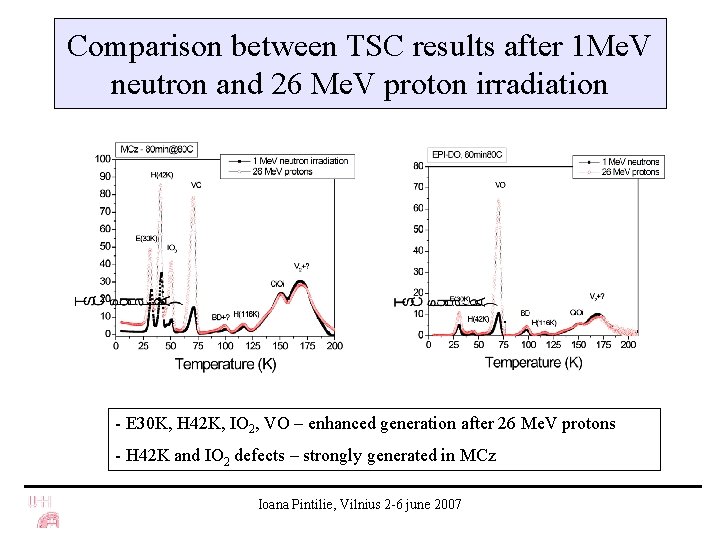
Comparison between TSC results after 1 Me. V neutron and 26 Me. V proton irradiation - E 30 K, H 42 K, IO 2, VO – enhanced generation after 26 Me. V protons - H 42 K and IO 2 defects – strongly generated in MCz Ioana Pintilie, Vilnius 2 -6 june 2007
Summary MCz, EPI-ST and EPI-DO were studied comparatively after irradiation with 1 Me. V neutrons and 26 Me. V protons Main radiation induced defects: • IO 2 – only in MCz • H(42 K) – strongly formed in MCz, impurity related • Ci - only in EPI-ST • BD&TDD - the lowest generation in MCz? ! - increase in the concentration during the first 20 min at 80 C • VO - the highest introduction rate in EPI-diodes (double compared with MCz) - 30% increase of [VO] during annealing V released from clusters may cause formation of complexes having deep acceptor levels (V 2 O, V 2 O 2) • H(116 K), Ci. Oi and V 2 & clusters – same generation rate in all materials Ioana Pintilie, Vilnius 2 -6 june 2007