
Deepwater Horizon Lessons Learned Coast Guard Policy Initiatives

- Slides: 10
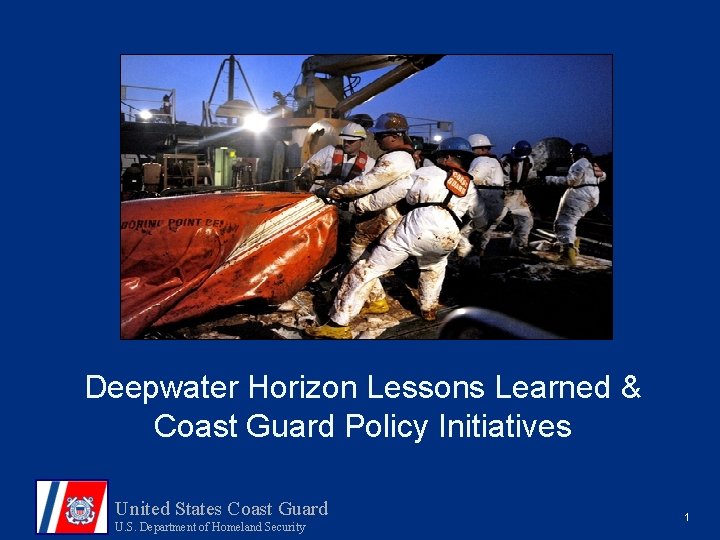
Deepwater Horizon Lessons Learned & Coast Guard Policy Initiatives United States Coast Guard U. S. Department of Homeland Security 1
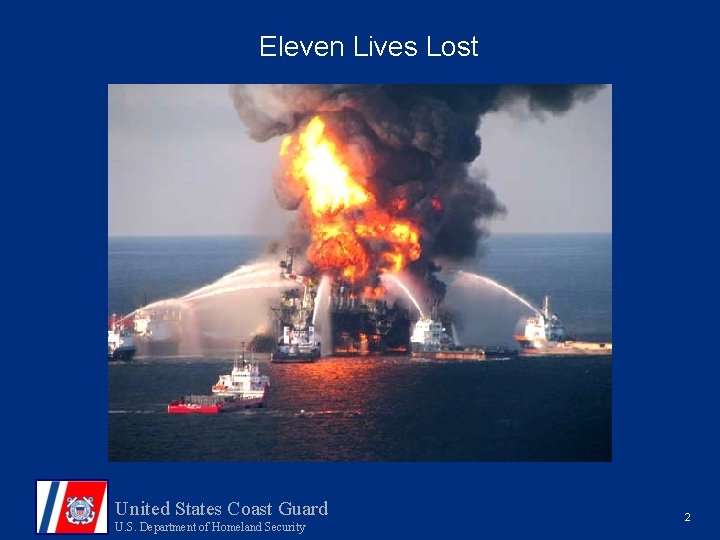
Eleven Lives Lost United States Coast Guard U. S. Department of Homeland Security 2
Lessons Learned Assessments The National Commission on the BP DEEPWATER HORIZON Oil Spill and Offshore Drilling. Deep Water: The Gulf Oil Disaster and the Future of Offshore Drilling. National Incident Commander’s Report: MC 252 DEEPWATER HORIZON. * Incident Specific Preparedness Review for the BP DEEPWATER HORIZON Oil Spill. * The Federal On-Scene Coordinator's Report. Rep. 2011. * Coast Guard Office of Contingency Exercises (CG-535). United States Coast Guard DEEPWATER HORIZON Strategic Lessons Learned After Action Report. United States Coast Guard U. S. Department of Homeland Security 3
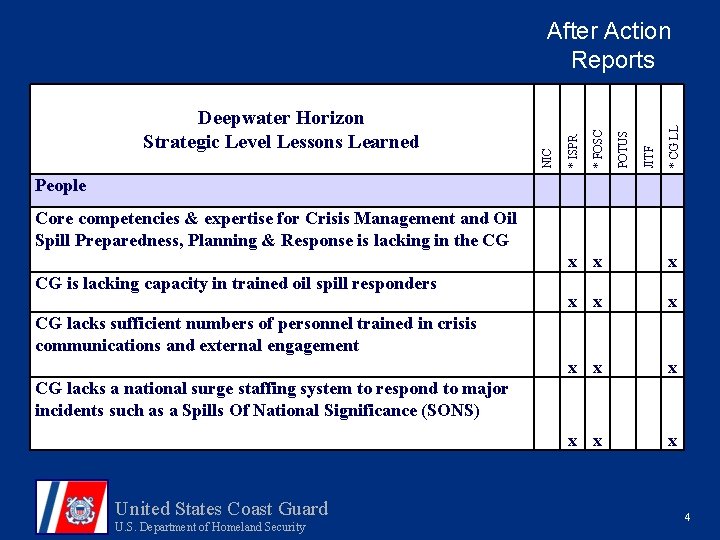
* CG LL JITF POTUS * FOSC * ISPR Deepwater Horizon Strategic Level Lessons Learned NIC After Action Reports People Core competencies & expertise for Crisis Management and Oil Spill Preparedness, Planning & Response is lacking in the CG CG is lacking capacity in trained oil spill responders x x x CG lacks sufficient numbers of personnel trained in crisis communications and external engagement CG lacks a national surge staffing system to respond to major incidents such as a Spills Of National Significance (SONS) United States Coast Guard U. S. Department of Homeland Security 4
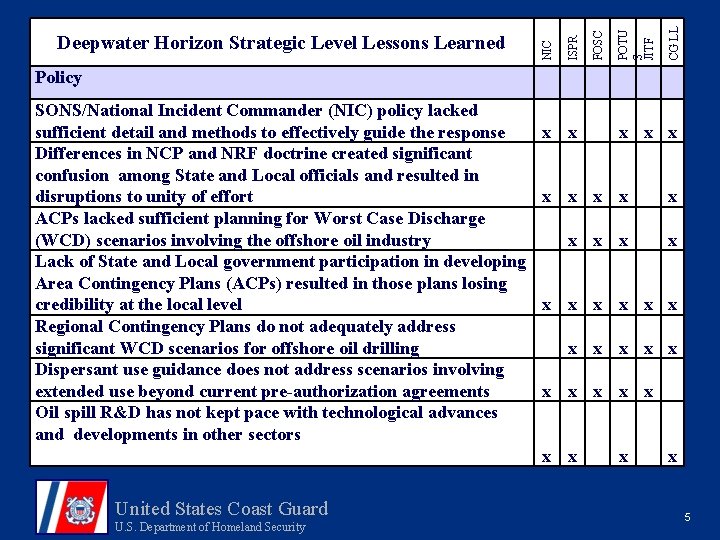
CG LL POTU S JITF FOSC ISPR NIC Deepwater Horizon Strategic Level Lessons Learned Policy SONS/National Incident Commander (NIC) policy lacked sufficient detail and methods to effectively guide the response Differences in NCP and NRF doctrine created significant confusion among State and Local officials and resulted in disruptions to unity of effort ACPs lacked sufficient planning for Worst Case Discharge (WCD) scenarios involving the offshore oil industry Lack of State and Local government participation in developing Area Contingency Plans (ACPs) resulted in those plans losing credibility at the local level Regional Contingency Plans do not adequately address significant WCD scenarios for offshore oil drilling Dispersant use guidance does not address scenarios involving extended use beyond current pre-authorization agreements Oil spill R&D has not kept pace with technological advances and developments in other sectors x x x x x x x x United States Coast Guard U. S. Department of Homeland Security x x x 5
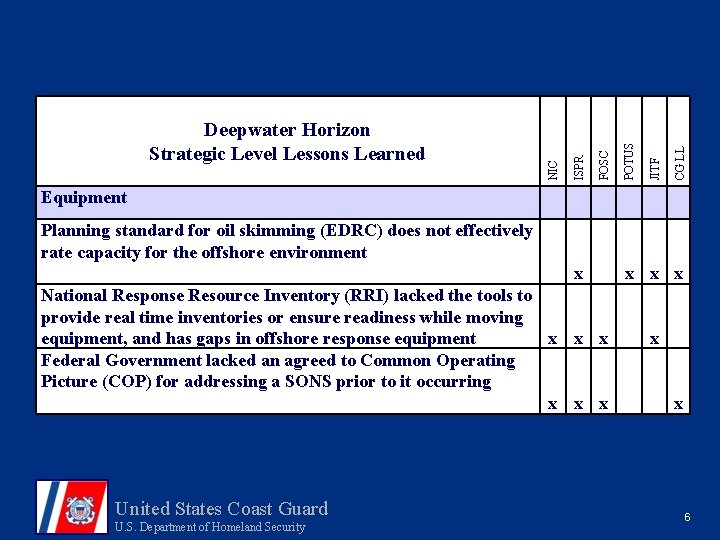
CG LL JITF POTUS FOSC ISPR NIC Deepwater Horizon Strategic Level Lessons Learned Equipment Planning standard for oil skimming (EDRC) does not effectively rate capacity for the offshore environment x National Response Resource Inventory (RRI) lacked the tools to provide real time inventories or ensure readiness while moving equipment, and has gaps in offshore response equipment x x x Federal Government lacked an agreed to Common Operating Picture (COP) for addressing a SONS prior to it occurring x x x United States Coast Guard U. S. Department of Homeland Security x x x 6
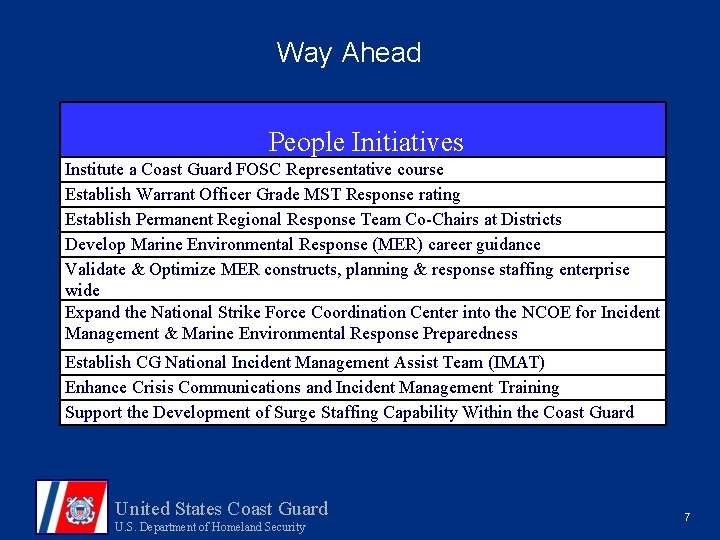
Way Ahead People Initiatives Institute a Coast Guard FOSC Representative course Establish Warrant Officer Grade MST Response rating Establish Permanent Regional Response Team Co-Chairs at Districts Develop Marine Environmental Response (MER) career guidance Validate & Optimize MER constructs, planning & response staffing enterprise wide Expand the National Strike Force Coordination Center into the NCOE for Incident Management & Marine Environmental Response Preparedness Establish CG National Incident Management Assist Team (IMAT) Enhance Crisis Communications and Incident Management Training Support the Development of Surge Staffing Capability Within the Coast Guard United States Coast Guard U. S. Department of Homeland Security 7
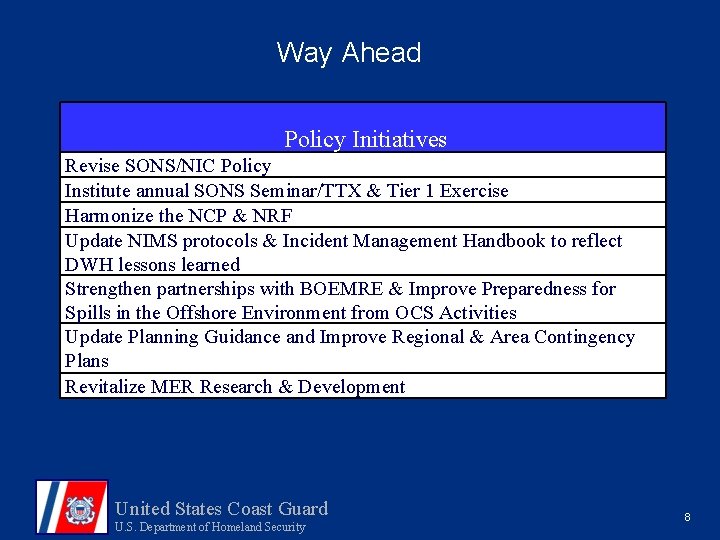
Way Ahead Policy Initiatives Revise SONS/NIC Policy Institute annual SONS Seminar/TTX & Tier 1 Exercise Harmonize the NCP & NRF Update NIMS protocols & Incident Management Handbook to reflect DWH lessons learned Strengthen partnerships with BOEMRE & Improve Preparedness for Spills in the Offshore Environment from OCS Activities Update Planning Guidance and Improve Regional & Area Contingency Plans Revitalize MER Research & Development United States Coast Guard U. S. Department of Homeland Security 8
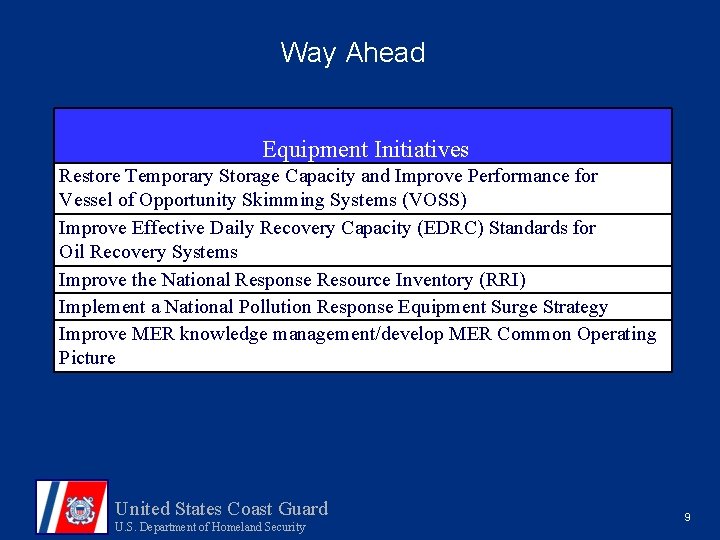
Way Ahead Equipment Initiatives Restore Temporary Storage Capacity and Improve Performance for Vessel of Opportunity Skimming Systems (VOSS) Improve Effective Daily Recovery Capacity (EDRC) Standards for Oil Recovery Systems Improve the National Response Resource Inventory (RRI) Implement a National Pollution Response Equipment Surge Strategy Improve MER knowledge management/develop MER Common Operating Picture United States Coast Guard U. S. Department of Homeland Security 9
Questions? Thank You Cornell. J. Rosiu@uscg. mil p: 617 -223 -8434 c: 617 -406 -9011 United States Coast Guard U. S. Department of Homeland Security 10