
DeepSea Hydrothermal Vent Communities Geol 104Bio ES 154
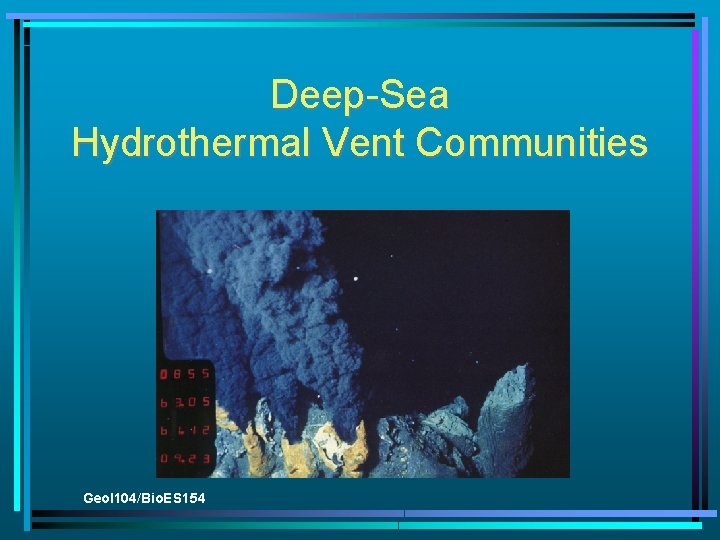
Deep-Sea Hydrothermal Vent Communities Geol 104/Bio. ES 154
Comparison with Other Deep-Sea Benthic Environments Most deep-sea environments are characterized by: �Low availability of food �No light, no photosynthesis �Falling remains of dead organisms, decaying organic matter �Low (0 -2°C), relatively constant temperature �High pressure (400 -500 times atmospheric) Geol 104/Bio. ES 154
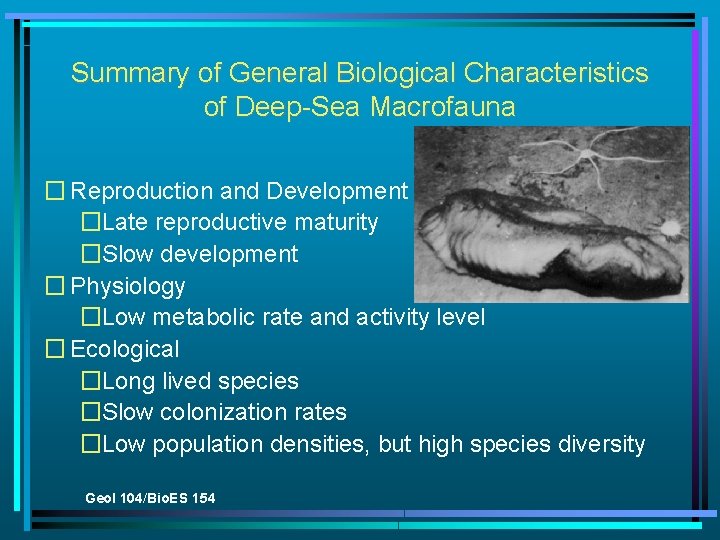
Summary of General Biological Characteristics of Deep-Sea Macrofauna � Reproduction and Development �Late reproductive maturity �Slow development � Physiology �Low metabolic rate and activity level � Ecological �Long lived species �Slow colonization rates �Low population densities, but high species diversity Geol 104/Bio. ES 154
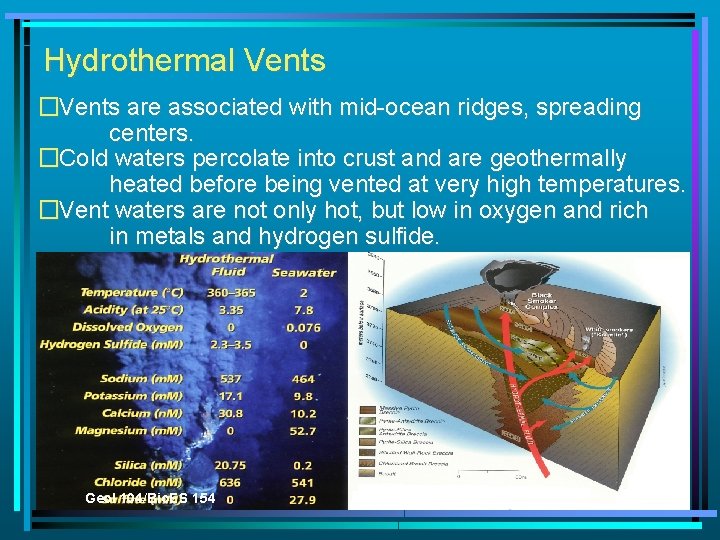
Hydrothermal Vents �Vents are associated with mid-ocean ridges, spreading centers. �Cold waters percolate into crust and are geothermally heated before being vented at very high temperatures. �Vent waters are not only hot, but low in oxygen and rich in metals and hydrogen sulfide. Geol 104/Bio. ES 154
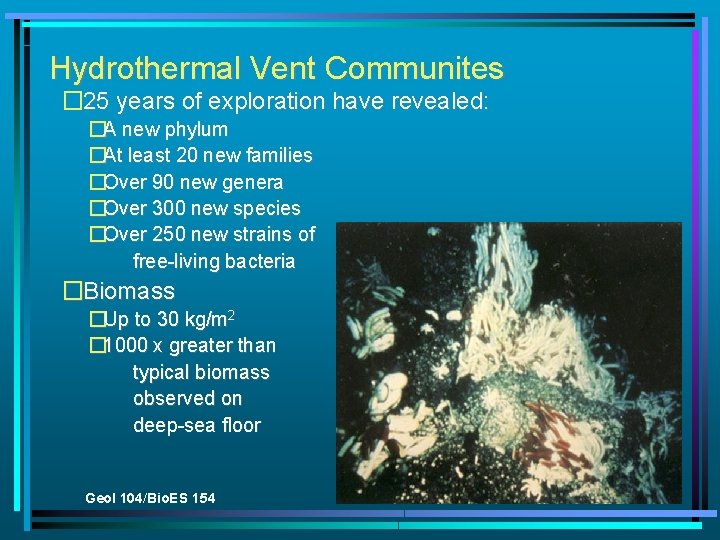
Hydrothermal Vent Communites � 25 years of exploration have revealed: �A new phylum �At least 20 new families �Over 90 new genera �Over 300 new species �Over 250 new strains of free-living bacteria �Biomass �Up to 30 kg/m 2 � 1000 x greater than typical biomass observed on deep-sea floor Geol 104/Bio. ES 154
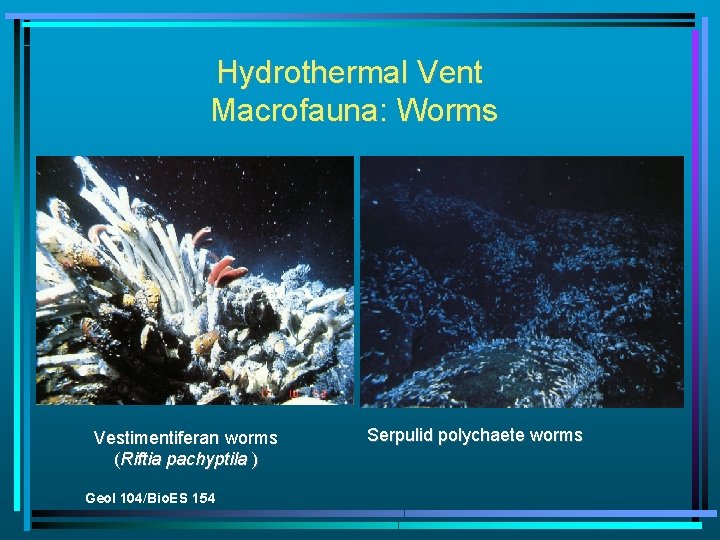
Hydrothermal Vent Macrofauna: Worms Vestimentiferan worms (Riftia pachyptila ) Geol 104/Bio. ES 154 Serpulid polychaete worms
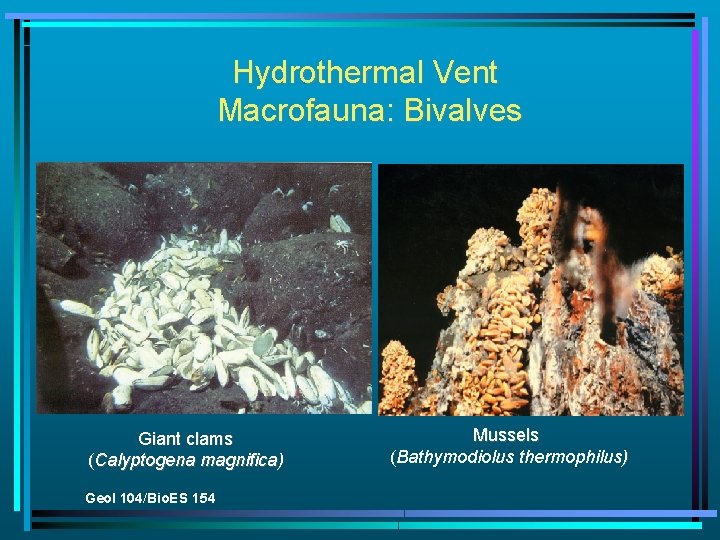
Hydrothermal Vent Macrofauna: Bivalves Giant clams (Calyptogena magnifica) Geol 104/Bio. ES 154 Mussels (Bathymodiolus thermophilus)
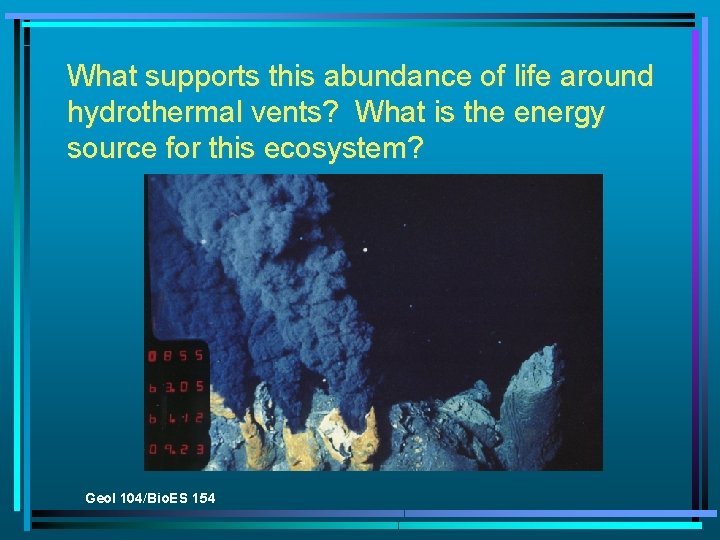
What supports this abundance of life around hydrothermal vents? What is the energy source for this ecosystem? Geol 104/Bio. ES 154
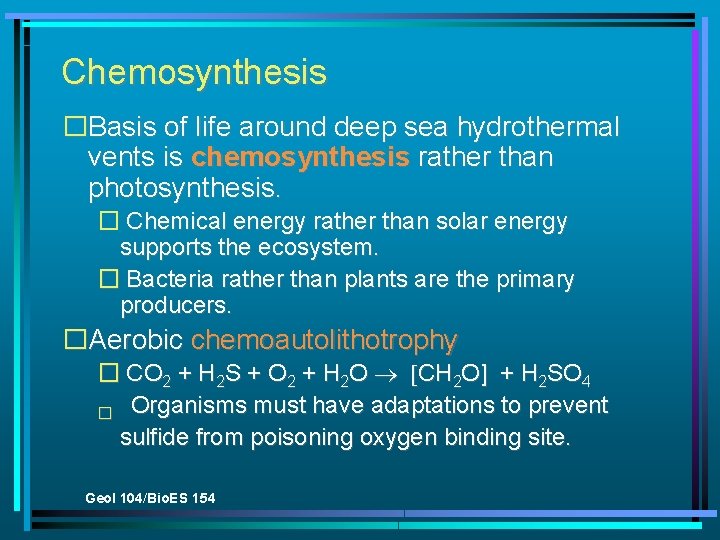
Chemosynthesis �Basis of life around deep sea hydrothermal vents is chemosynthesis rather than photosynthesis. � Chemical energy rather than solar energy supports the ecosystem. � Bacteria rather than plants are the primary producers. �Aerobic chemoautolithotrophy � CO 2 + H 2 S + O 2 + H 2 O CH 2 O] + H 2 SO 4 � Organisms must have adaptations to prevent sulfide from poisoning oxygen binding site. Geol 104/Bio. ES 154
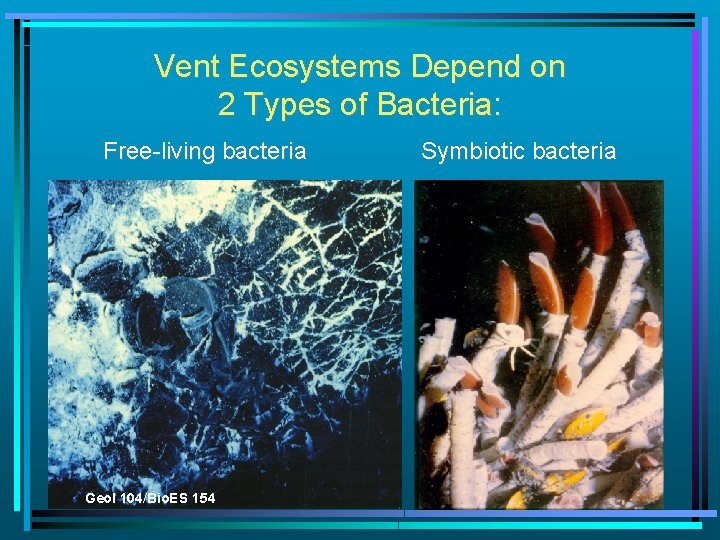
Vent Ecosystems Depend on 2 Types of Bacteria: Free-living bacteria Geol 104/Bio. ES 154 Symbiotic bacteria
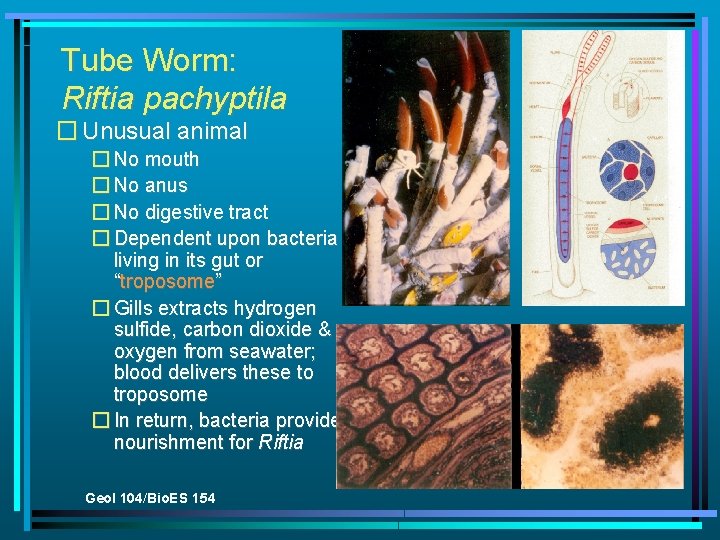
Tube Worm: Riftia pachyptila � Unusual animal � No mouth � No anus � No digestive tract � Dependent upon bacteria living in its gut or “troposome” � Gills extracts hydrogen sulfide, carbon dioxide & oxygen from seawater; blood delivers these to troposome � In return, bacteria provide nourishment for Riftia Geol 104/Bio. ES 154
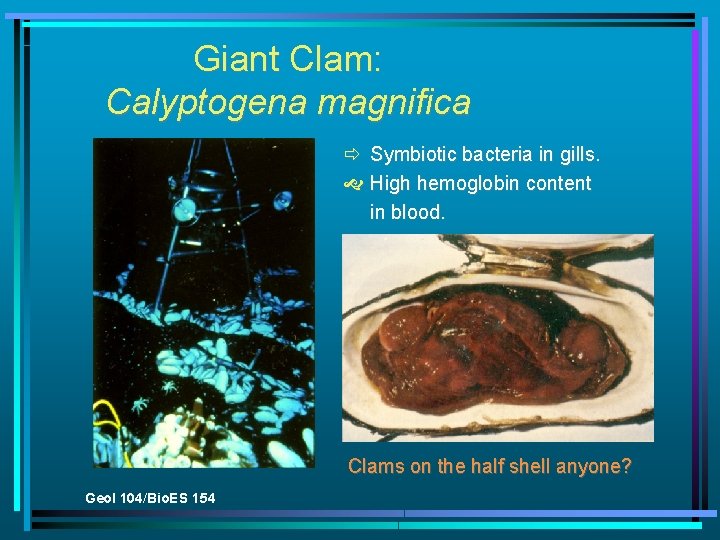
Giant Clam: Calyptogena magnifica ð Symbiotic bacteria in gills. High hemoglobin content in blood. Clams on the half shell anyone? Geol 104/Bio. ES 154
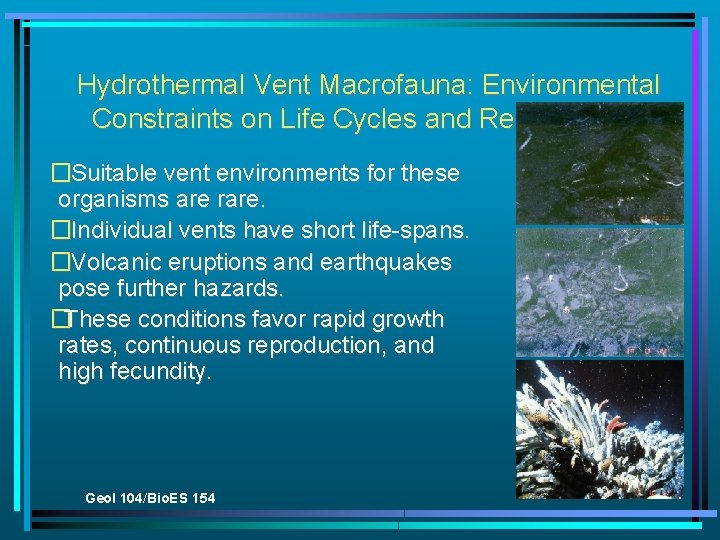
Hydrothermal Vent Macrofauna: Environmental Constraints on Life Cycles and Reproduction �Suitable vent environments for these organisms are rare. �Individual vents have short life-spans. �Volcanic eruptions and earthquakes pose further hazards. �These conditions favor rapid growth rates, continuous reproduction, and high fecundity. Geol 104/Bio. ES 154
- Slides: 13