
DeepInelastic Scattering at the Te V Energy Scale
- Slides: 43
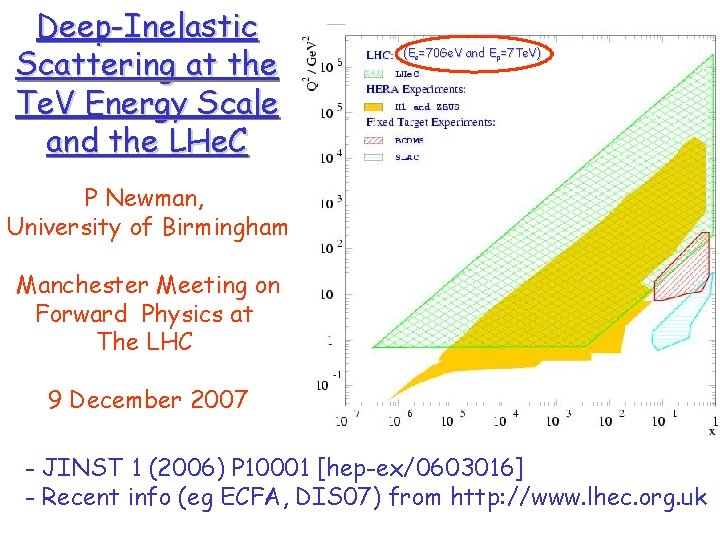
Deep-Inelastic Scattering at the Te. V Energy Scale and the LHe. C (Ee=70 Ge. V and Ep=7 Te. V) P Newman, University of Birmingham Manchester Meeting on Forward Physics at The LHC 9 December 2007 - JINST 1 (2006) P 10001 [hep-ex/0603016] - Recent info (eg ECFA, DIS 07) from http: //www. lhec. org. uk
Contents • DIS at the end of HERA • The Case for Te. V Scale DIS • Some first Physics case studies (emphasis on fwd / low x) • LHe. C Design Possibilities • First Detector Considerations • Organisation and workshop plans
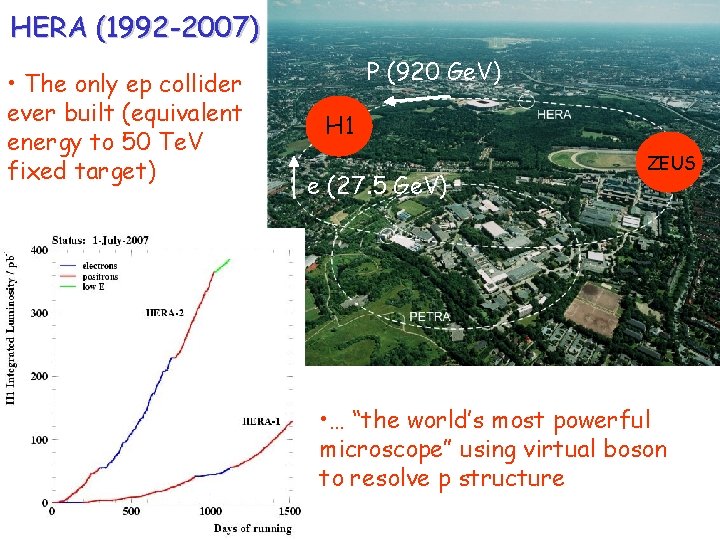
HERA (1992 -2007) • The only ep collider ever built (equivalent energy to 50 Te. V fixed target) P (920 Ge. V) H 1 e (27. 5 Ge. V) ZEUS • … “the world’s most powerful microscope” using virtual boson to resolve p structure
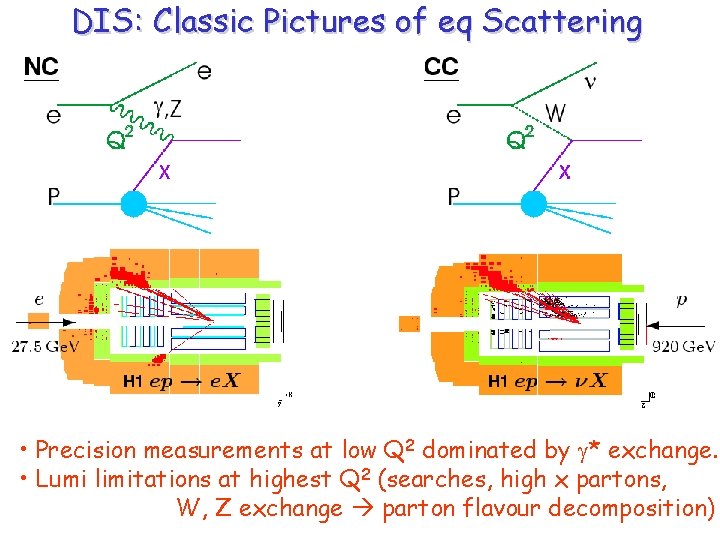
DIS: Classic Pictures of eq Scattering • Precision measurements at low Q 2 dominated by g* exchange. • Lumi limitations at highest Q 2 (searches, high x partons, W, Z exchange parton flavour decomposition)
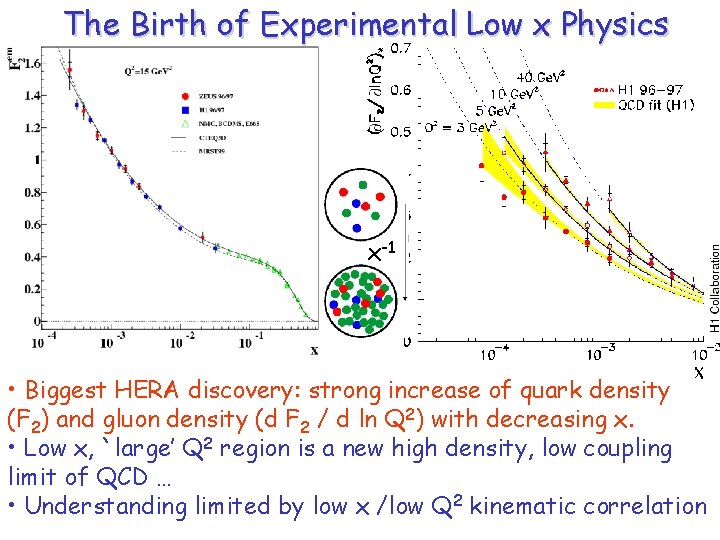
The Birth of Experimental Low x Physics x-1 • Biggest HERA discovery: strong increase of quark density (F 2) and gluon density (d F 2 / d ln Q 2) with decreasing x. • Low x, `large’ Q 2 region is a new high density, low coupling limit of QCD … • Understanding limited by low x /low Q 2 kinematic correlation
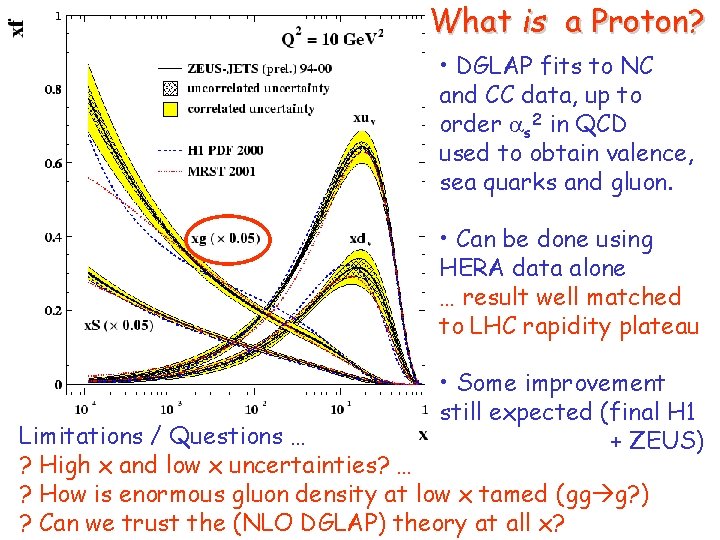
What is a Proton? • DGLAP fits to NC and CC data, up to order as 2 in QCD used to obtain valence, sea quarks and gluon. • Can be done using HERA data alone … result well matched to LHC rapidity plateau • Some improvement still expected (final H 1 + ZEUS) Limitations / Questions … ? High x and low x uncertainties? … ? How is enormous gluon density at low x tamed (gg g? ) ? Can we trust the (NLO DGLAP) theory at all x?
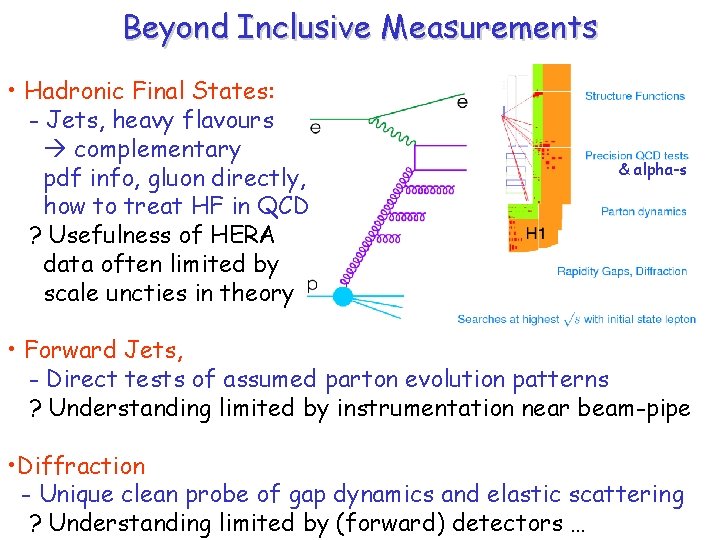
Beyond Inclusive Measurements • Hadronic Final States: - Jets, heavy flavours complementary pdf info, gluon directly, how to treat HF in QCD ? Usefulness of HERA data often limited by scale uncties in theory & alpha-s • Forward Jets, - Direct tests of assumed parton evolution patterns ? Understanding limited by instrumentation near beam-pipe • Diffraction - Unique clean probe of gap dynamics and elastic scattering ? Understanding limited by (forward) detectors …
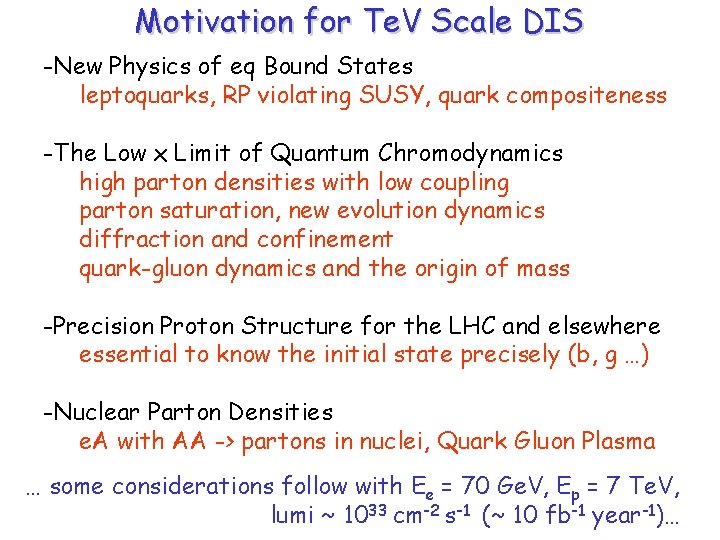
Motivation for Te. V Scale DIS -New Physics of eq Bound States leptoquarks, RP violating SUSY, quark compositeness -The Low x Limit of Quantum Chromodynamics high parton densities with low coupling parton saturation, new evolution dynamics diffraction and confinement quark-gluon dynamics and the origin of mass -Precision Proton Structure for the LHC and elsewhere essential to know the initial state precisely (b, g …) -Nuclear Parton Densities e. A with AA -> partons in nuclei, Quark Gluon Plasma … some considerations follow with Ee = 70 Ge. V, Ep = 7 Te. V, lumi ~ 1033 cm-2 s-1 (~ 10 fb-1 year-1)…
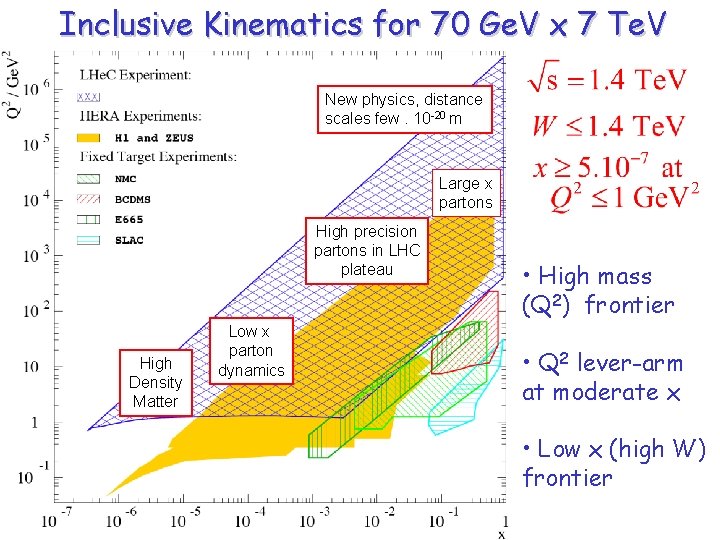
Inclusive Kinematics for 70 Ge. V x 7 Te. V New physics, distance scales few. 10 -20 m Large x partons High precision partons in LHC plateau High Density Matter Low x parton dynamics • High mass (Q 2) frontier • Q 2 lever-arm at moderate x • Low x (high W) frontier
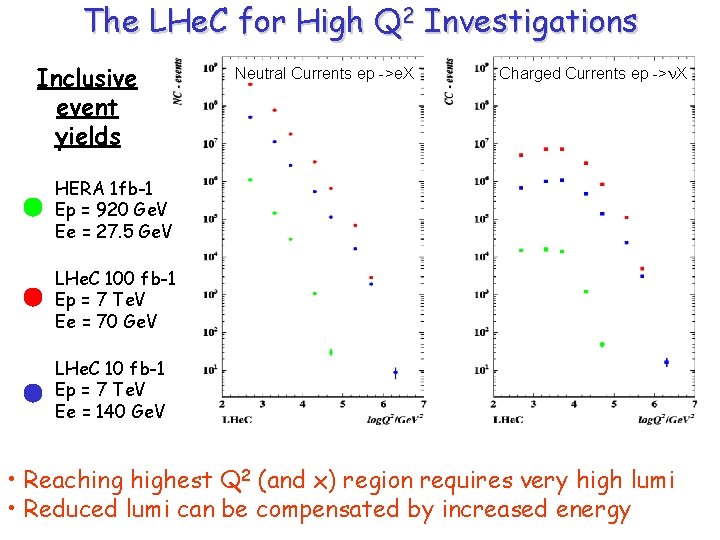
The LHe. C for High Q 2 Investigations Inclusive event yields Neutral Currents ep ->e. X Charged Currents ep -> X HERA 1 fb-1 Ep = 920 Ge. V Ee = 27. 5 Ge. V LHe. C 100 fb-1 Ep = 7 Te. V Ee = 70 Ge. V LHe. C 10 fb-1 Ep = 7 Te. V Ee = 140 Ge. V • Reaching highest Q 2 (and x) region requires very high lumi • Reduced lumi can be compensated by increased energy
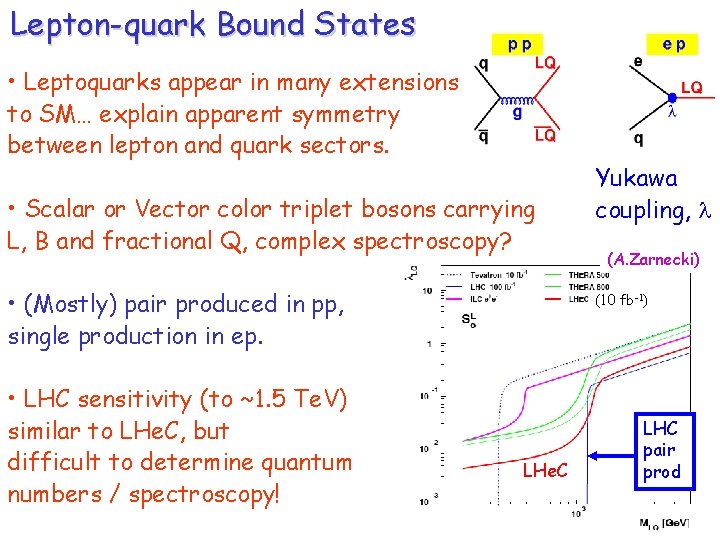
Lepton-quark Bound States • Leptoquarks appear in many extensions to SM… explain apparent symmetry between lepton and quark sectors. • Scalar or Vector color triplet bosons carrying L, B and fractional Q, complex spectroscopy? • (Mostly) pair produced in pp, single production in ep. • LHC sensitivity (to ~1. 5 Te. V) similar to LHe. C, but difficult to determine quantum numbers / spectroscopy! Yukawa coupling, l (A. Zarnecki) (10 fb-1) LHe. C LHC pair prod
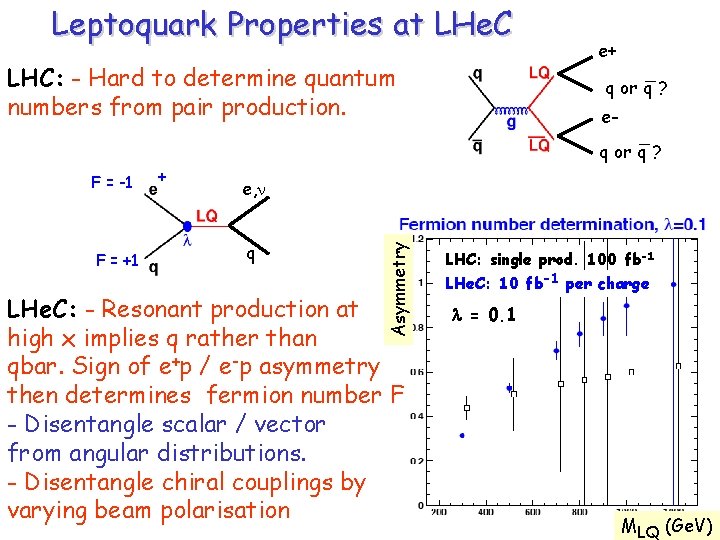
Leptoquark Properties at LHe. C _ q or q ? LHC: - Hard to determine quantum numbers from pair production. F = +1 + e- _ q or q ? e, q Asymmetry F = -1 e+ LHe. C: - Resonant production at high x implies q rather than qbar. Sign of e+p / e-p asymmetry then determines fermion number F - Disentangle scalar / vector from angular distributions. - Disentangle chiral couplings by varying beam polarisation LHC: single prod. 100 fb-1 LHe. C: 10 fb-1 per charge = 0. 1 MLQ (Ge. V)
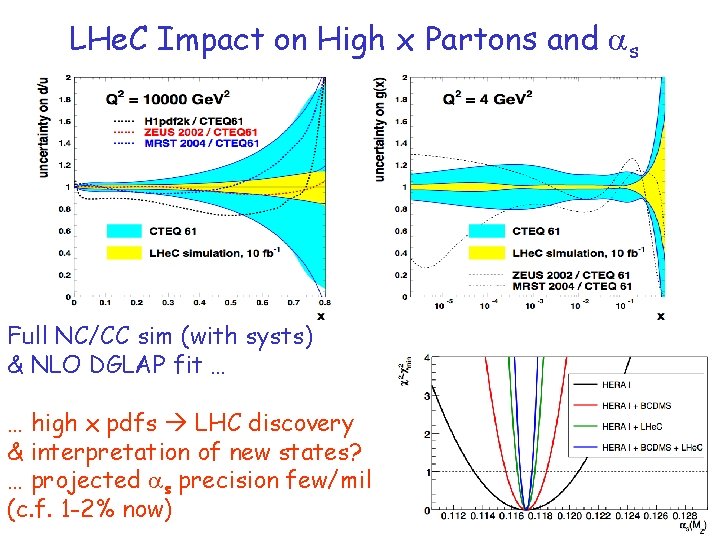
LHe. C Impact on High x Partons and as Full NC/CC sim (with systs) & NLO DGLAP fit … … high x pdfs LHC discovery & interpretation of new states? … projected as precision few/mil (c. f. 1 -2% now)
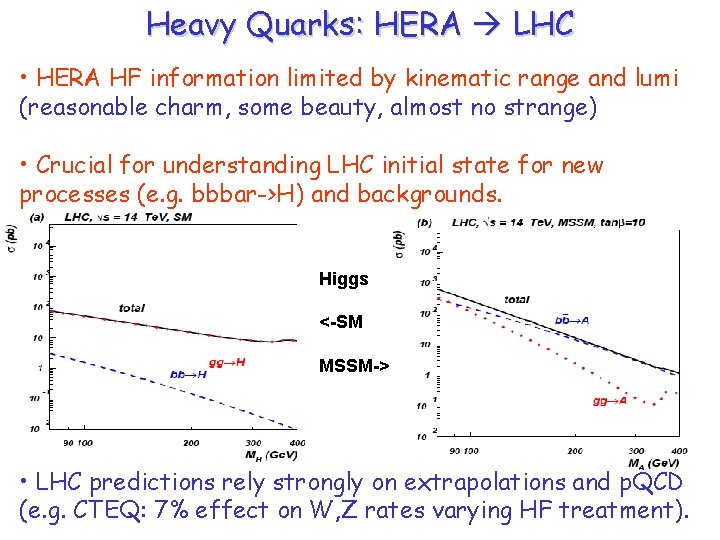
Heavy Quarks: HERA LHC • HERA HF information limited by kinematic range and lumi (reasonable charm, some beauty, almost no strange) • Crucial for understanding LHC initial state for new processes (e. g. bbbar->H) and backgrounds. Higgs <-SM MSSM-> • LHC predictions rely strongly on extrapolations and p. QCD (e. g. CTEQ: 7% effect on W, Z rates varying HF treatment).
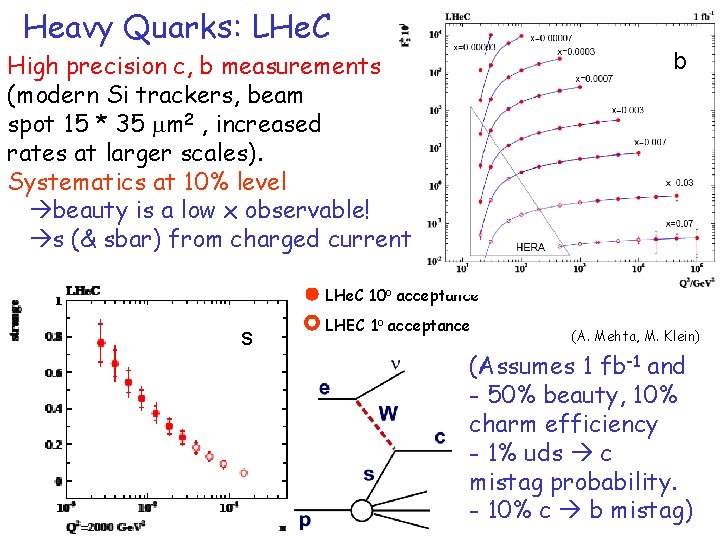
Heavy Quarks: LHe. C b High precision c, b measurements (modern Si trackers, beam spot 15 * 35 m 2 , increased rates at larger scales). Systematics at 10% level beauty is a low x observable! s (& sbar) from charged current LHe. C 10 o acceptance s LHEC 1 o acceptance (A. Mehta, M. Klein) (Assumes 1 fb-1 and - 50% beauty, 10% charm efficiency - 1% uds c mistag probability. - 10% c b mistag)
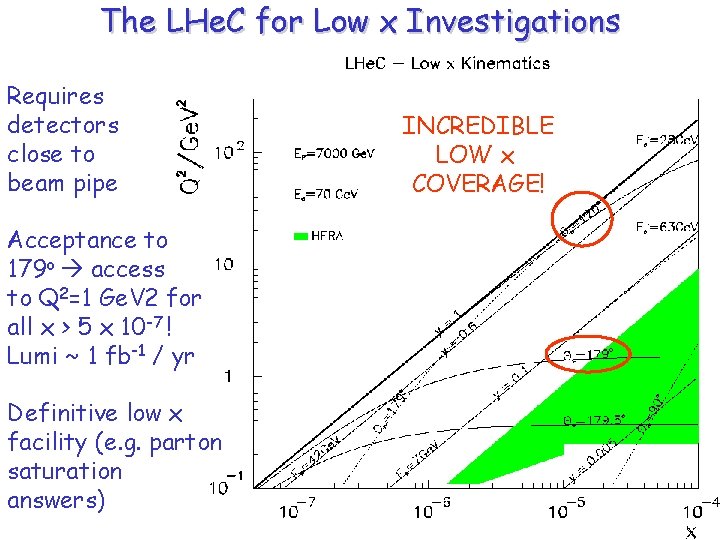
The LHe. C for Low x Investigations Requires detectors close to beam pipe Acceptance to 179 o access to Q 2=1 Ge. V 2 for all x > 5 x 10 -7 ! Lumi ~ 1 fb-1 / yr Definitive low x facility (e. g. parton saturation answers) INCREDIBLE LOW x COVERAGE!
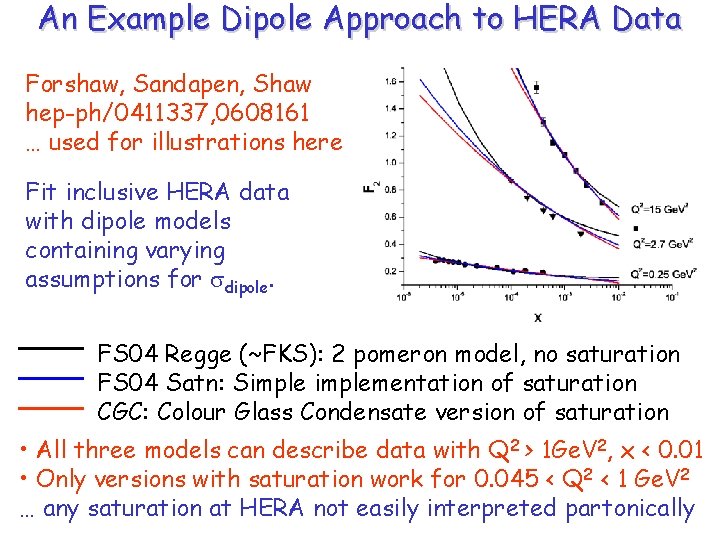
An Example Dipole Approach to HERA Data Forshaw, Sandapen, Shaw hep-ph/0411337, 0608161 … used for illustrations here Fit inclusive HERA data with dipole models containing varying assumptions for sdipole. FS 04 Regge (~FKS): 2 pomeron model, no saturation FS 04 Satn: Simplementation of saturation CGC: Colour Glass Condensate version of saturation • All three models can describe data with Q 2 > 1 Ge. V 2, x < 0. 01 • Only versions with saturation work for 0. 045 < Q 2 < 1 Ge. V 2 … any saturation at HERA not easily interpreted partonically
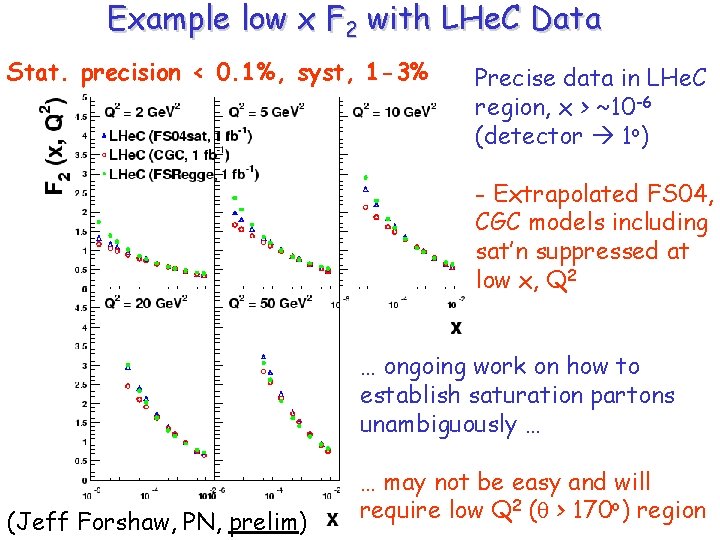
Example low x F 2 with LHe. C Data Stat. precision < 0. 1%, syst, 1 -3% Precise data in LHe. C region, x > ~10 -6 (detector 1 o) - Extrapolated FS 04, CGC models including sat’n suppressed at low x, Q 2 … ongoing work on how to establish saturation partons unambiguously … (Jeff Forshaw, PN, prelim) … may not be easy and will require low Q 2 (q > 170 o) region
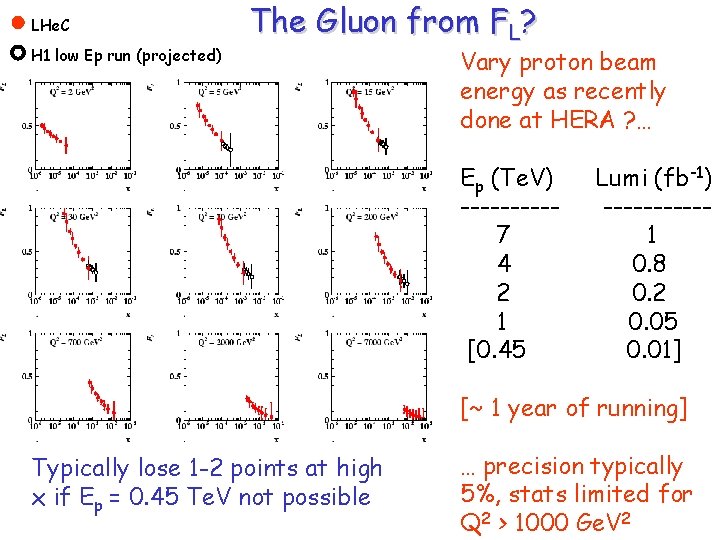
LHe. C H 1 low Ep run (projected) The Gluon from FL? Vary proton beam energy as recently done at HERA ? … Ep (Te. V) -----7 4 2 1 [0. 45 Lumi (fb-1) -----1 0. 8 0. 2 0. 05 0. 01] [~ 1 year of running] Typically lose 1 -2 points at high x if Ep = 0. 45 Te. V not possible … precision typically 5%, stats limited for Q 2 > 1000 Ge. V 2
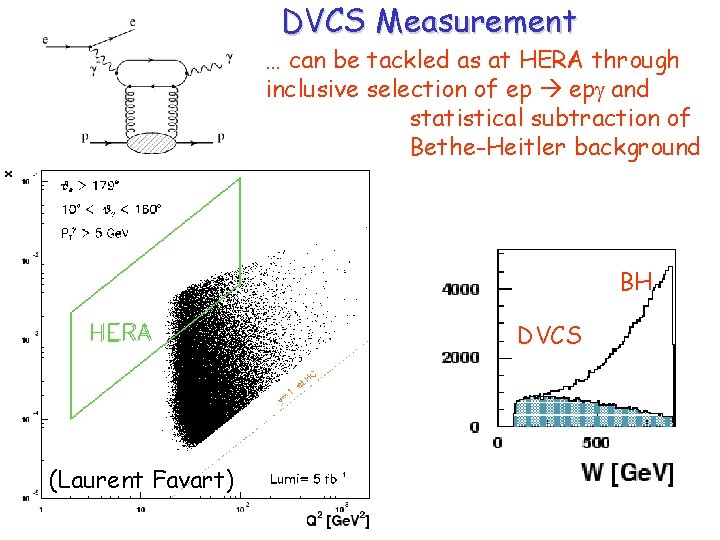
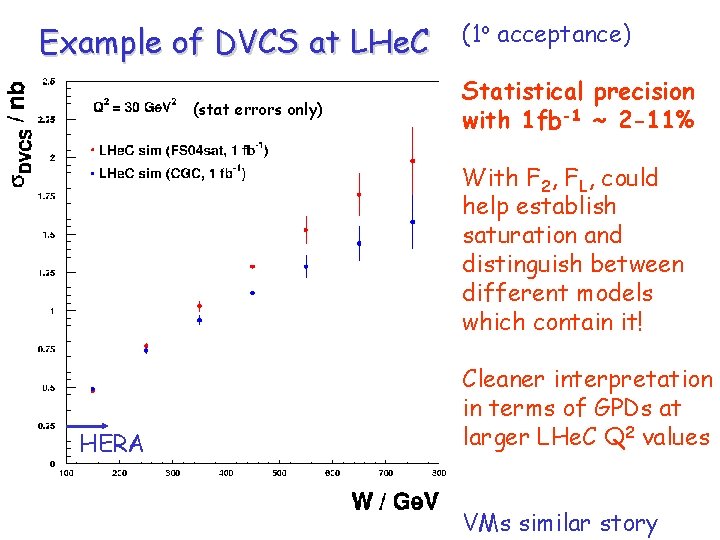
DVCS Measurement … can be tackled as at HERA through inclusive selection of ep epg and statistical subtraction of Bethe-Heitler background BH DVCS (Laurent Favart)
Example of DVCS at LHe. C (stat errors only) (1 o acceptance) Statistical precision with 1 fb-1 ~ 2 -11% With F 2, FL, could help establish saturation and distinguish between different models which contain it! HERA Cleaner interpretation in terms of GPDs at larger LHe. C Q 2 values VMs similar story
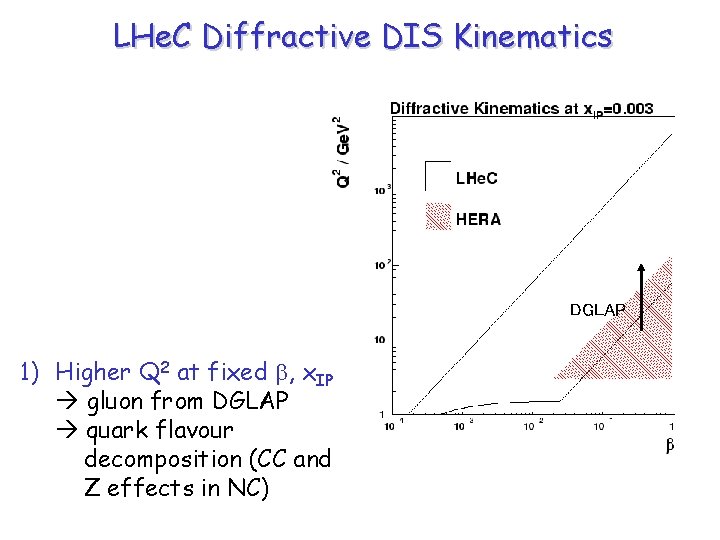
LHe. C Diffractive DIS Kinematics DGLAP 1) Higher Q 2 at fixed b, x. IP gluon from DGLAP quark flavour decomposition (CC and Z effects in NC)
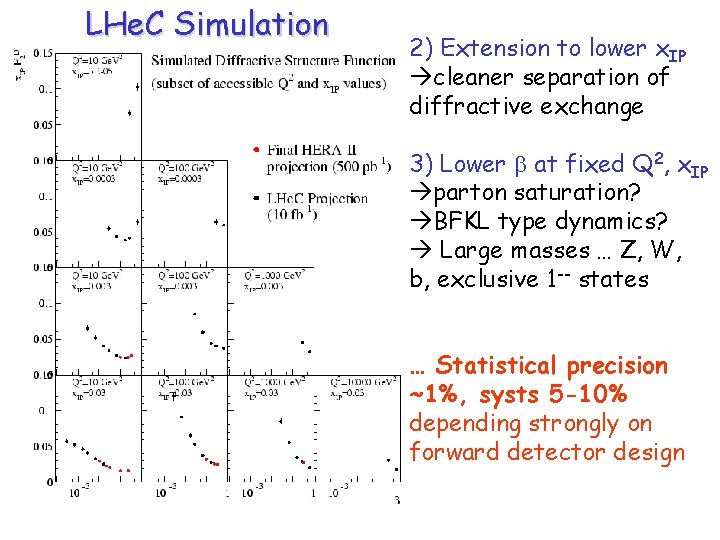
LHe. C Simulation 2) Extension to lower x. IP cleaner separation of diffractive exchange 3) Lower b at fixed Q 2, x. IP parton saturation? BFKL type dynamics? Large masses … Z, W, b, exclusive 1 -- states … Statistical precision ~1%, systs 5 -10% depending strongly on forward detector design
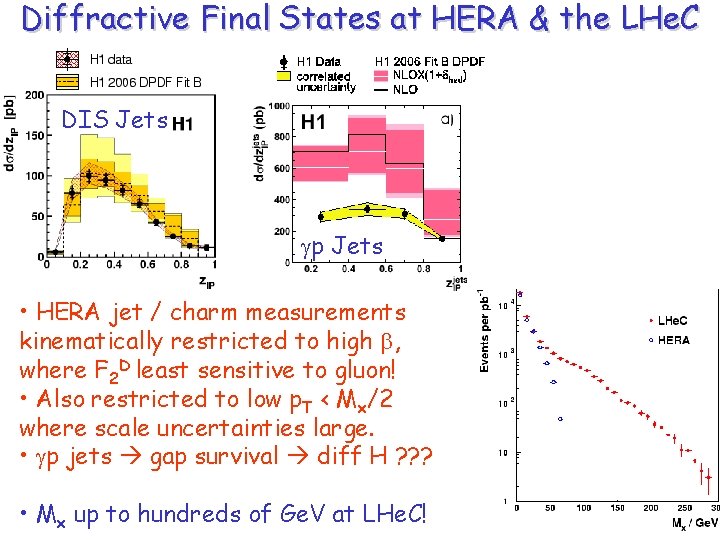
Diffractive Final States at HERA & the LHe. C DIS Jets gp Jets in gp • HERA jet / charm measurements kinematically restricted to high b, where F 2 D least sensitive to gluon! • Also restricted to low p. T < Mx/2 where scale uncertainties large. • gp jets gap survival diff H ? ? ? • Mx up to hundreds of Ge. V at LHe. C! (x. IP<0. 05) (RAPGAP)
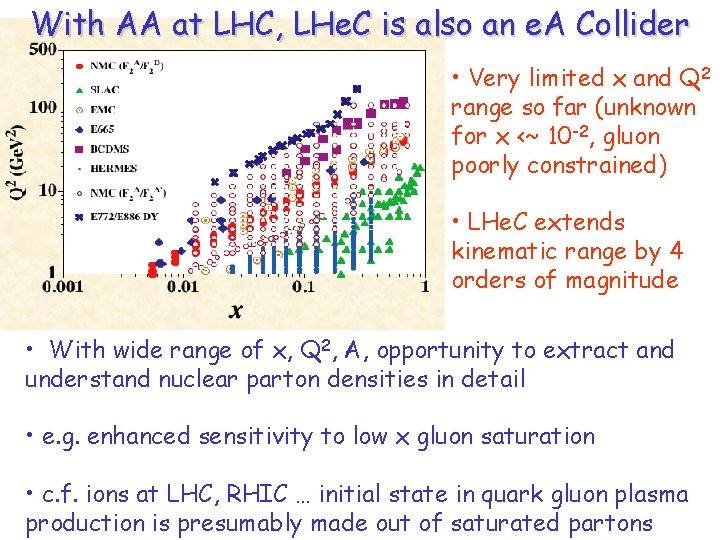
With AA at LHC, LHe. C is also an e. A Collider • Very limited x and Q 2 range so far (unknown for x <~ 10 -2, gluon poorly constrained) • LHe. C extends kinematic range by 4 orders of magnitude • With wide range of x, Q 2, A, opportunity to extract and understand nuclear parton densities in detail • e. g. enhanced sensitivity to low x gluon saturation • c. f. ions at LHC, RHIC … initial state in quark gluon plasma production is presumably made out of saturated partons
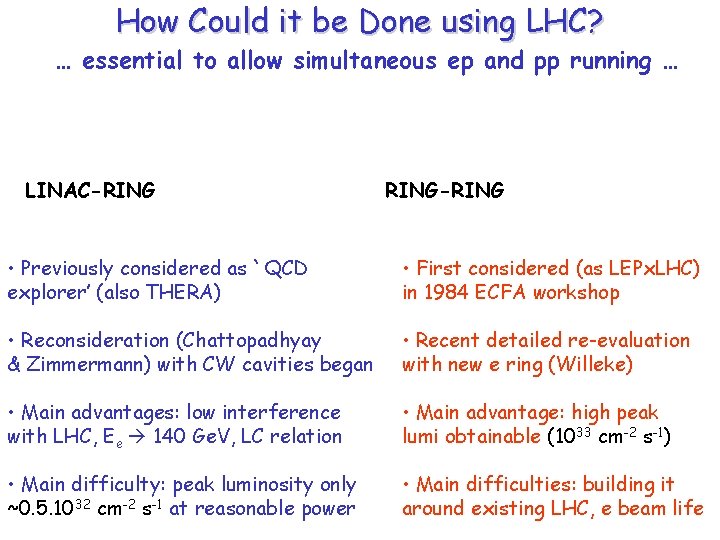
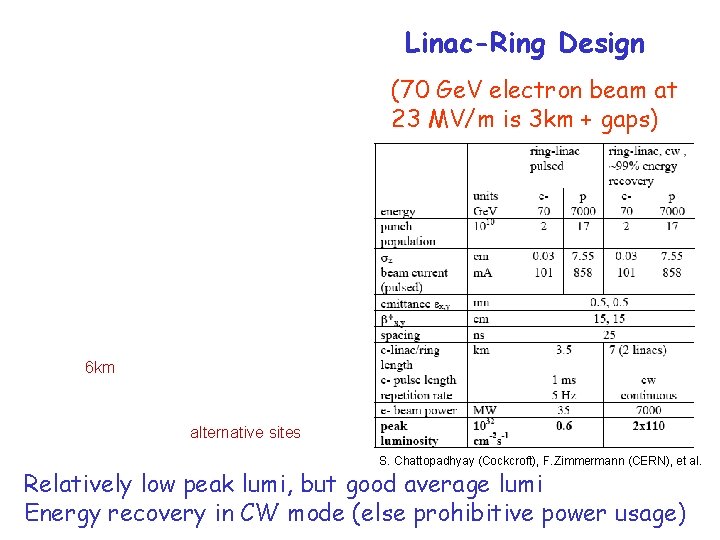
How Could it be Done using LHC? … essential to allow simultaneous ep and pp running … LINAC-RING-RING • Previously considered as `QCD explorer’ (also THERA) • First considered (as LEPx. LHC) in 1984 ECFA workshop • Reconsideration (Chattopadhyay & Zimmermann) with CW cavities began • Recent detailed re-evaluation with new e ring (Willeke) • Main advantages: low interference with LHC, Ee 140 Ge. V, LC relation • Main advantage: high peak lumi obtainable (1033 cm-2 s-1) • Main difficulty: peak luminosity only ~0. 5. 1032 cm-2 s-1 at reasonable power • Main difficulties: building it around existing LHC, e beam life
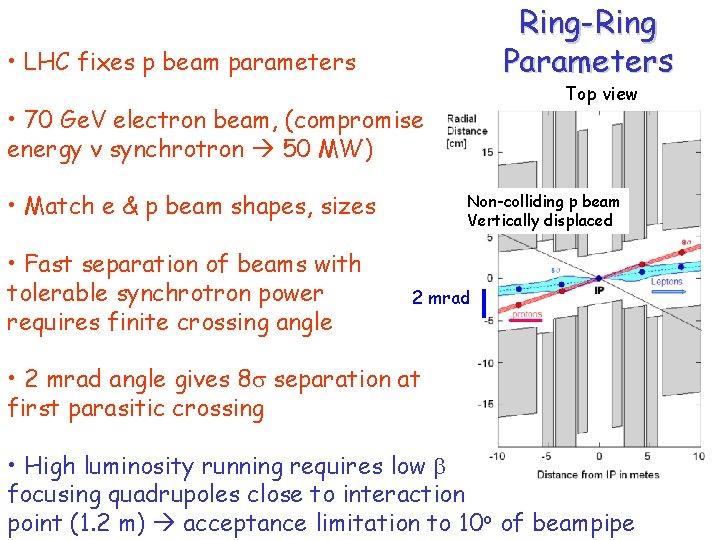
Ring-Ring Parameters • LHC fixes p beam parameters Top view • 70 Ge. V electron beam, (compromise energy v synchrotron 50 MW) • Match e & p beam shapes, sizes • Fast separation of beams with tolerable synchrotron power requires finite crossing angle Non-colliding p beam Vertically displaced 2 mrad • 2 mrad angle gives 8 s separation at first parasitic crossing • High luminosity running requires low b focusing quadrupoles close to interaction point (1. 2 m) acceptance limitation to 10 o of beampipe
Ring-Ring Design • e ring would have to bypass experiments and P 3 and 6 • ep/e. A interaction region could be in P 2 or P 8.
Linac-Ring Design (70 Ge. V electron beam at 23 MV/m is 3 km + gaps) 6 km alternative sites S. Chattopadhyay (Cockcroft), F. Zimmermann (CERN), et al. Relatively low peak lumi, but good average lumi Energy recovery in CW mode (else prohibitive power usage)
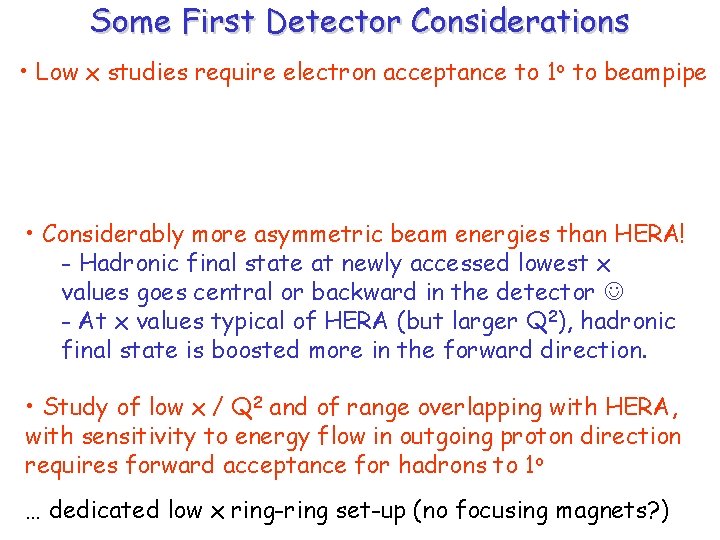
Some First Detector Considerations • Low x studies require electron acceptance to 1 o to beampipe • Considerably more asymmetric beam energies than HERA! - Hadronic final state at newly accessed lowest x values goes central or backward in the detector - At x values typical of HERA (but larger Q 2), hadronic final state is boosted more in the forward direction. • Study of low x / Q 2 and of range overlapping with HERA, with sensitivity to energy flow in outgoing proton direction requires forward acceptance for hadrons to 1 o … dedicated low x ring-ring set-up (no focusing magnets? )
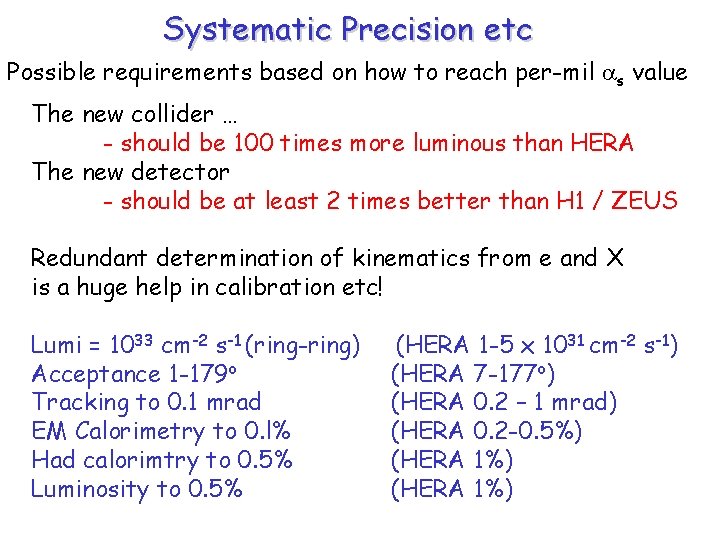
Systematic Precision etc Possible requirements based on how to reach per-mil as value The new collider … - should be 100 times more luminous than HERA The new detector - should be at least 2 times better than H 1 / ZEUS Redundant determination of kinematics from e and X is a huge help in calibration etc! Lumi = 1033 cm-2 s-1 (ring-ring) Acceptance 1 -179 o Tracking to 0. 1 mrad EM Calorimetry to 0. l% Had calorimtry to 0. 5% Luminosity to 0. 5% (HERA 1 -5 x 1031 cm-2 s-1) (HERA 7 -177 o) (HERA 0. 2 – 1 mrad) (HERA 0. 2 -0. 5%) (HERA 1%)
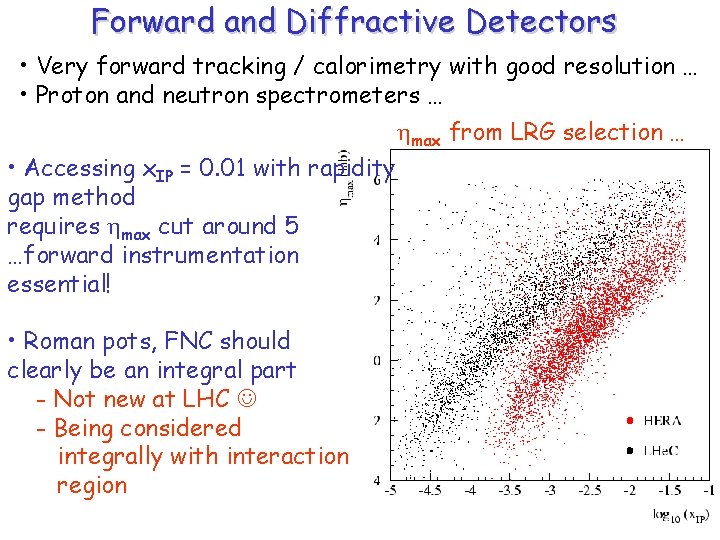
Forward and Diffractive Detectors • Very forward tracking / calorimetry with good resolution … • Proton and neutron spectrometers … • Accessing x. IP = 0. 01 with rapidity gap method requires hmax cut around 5 …forward instrumentation essential! • Roman pots, FNC should clearly be an integral part - Not new at LHC - Being considered integrally with interaction region hmax from LRG selection …
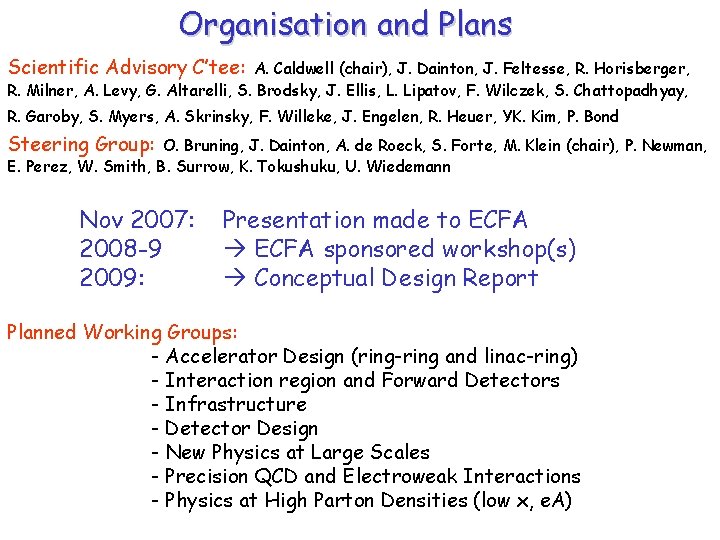
Organisation and Plans Scientific Advisory C’tee: A. Caldwell (chair), J. Dainton, J. Feltesse, R. Horisberger, R. Milner, A. Levy, G. Altarelli, S. Brodsky, J. Ellis, L. Lipatov, F. Wilczek, S. Chattopadhyay, R. Garoby, S. Myers, A. Skrinsky, F. Willeke, J. Engelen, R. Heuer, YK. Kim, P. Bond Steering Group: O. Bruning, J. Dainton, A. de Roeck, S. Forte, M. Klein (chair), P. Newman, E. Perez, W. Smith, B. Surrow, K. Tokushuku, U. Wiedemann Nov 2007: 2008 -9 2009: Presentation made to ECFA sponsored workshop(s) Conceptual Design Report Planned Working Groups: - Accelerator Design (ring-ring and linac-ring) - Interaction region and Forward Detectors - Infrastructure - Detector Design - New Physics at Large Scales - Precision QCD and Electroweak Interactions - Physics at High Parton Densities (low x, e. A)
Summary LHC is a totally new world of energy and luminosity! LHe. C proposal aims to exploit this for Te. V lepton-hadron scattering New discoveries expected at LHC … interpretation may require ep, e. A in comparable energy range LHe. C extends low x and high Q 2 frontiers of ep physics First ring-ring and linac ring accelerator considerations and early physics studies very encouraging 2008 workshop: Much to be done to fully evaluate physics potential, running scenarios and design detector [Thanks in particular to J Dainton, L Favart, J Forshaw, M Klein, A Mehta, E Perez, F Willeke]
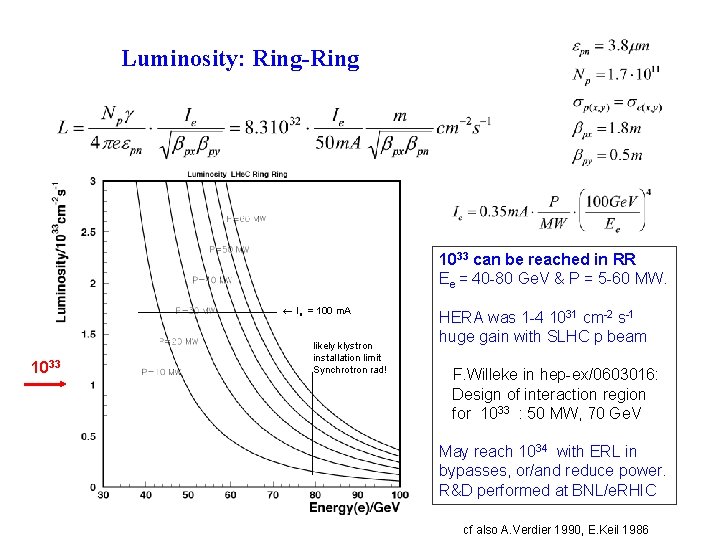
Luminosity: Ring-Ring 1033 can be reached in RR Ee = 40 -80 Ge. V & P = 5 -60 MW. Ie = 100 m. A 1033 likely klystron installation limit Synchrotron rad! HERA was 1 -4 1031 cm-2 s-1 huge gain with SLHC p beam F. Willeke in hep-ex/0603016: Design of interaction region for 1033 : 50 MW, 70 Ge. V May reach 1034 with ERL in bypasses, or/and reduce power. R&D performed at BNL/e. RHIC cf also A. Verdier 1990, E. Keil 1986
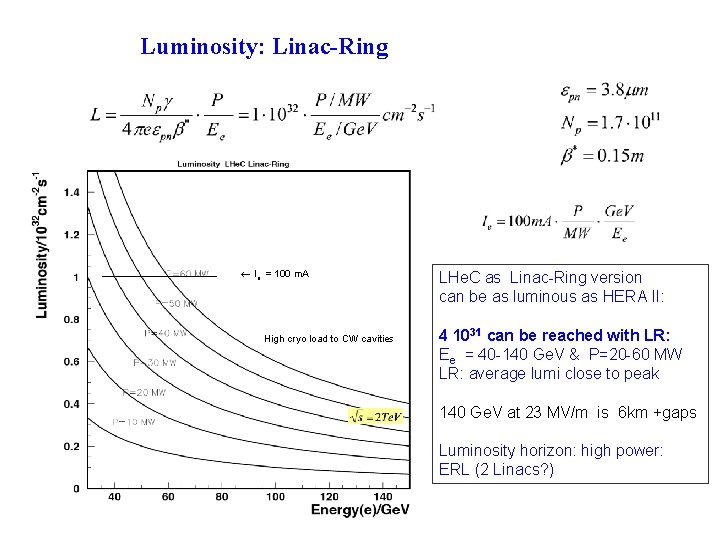
Luminosity: Linac-Ring Ie = 100 m. A High cryo load to CW cavities LHe. C as Linac-Ring version can be as luminous as HERA II: 4 1031 can be reached with LR: Ee = 40 -140 Ge. V & P=20 -60 MW LR: average lumi close to peak 140 Ge. V at 23 MV/m is 6 km +gaps Luminosity horizon: high power: ERL (2 Linacs? )
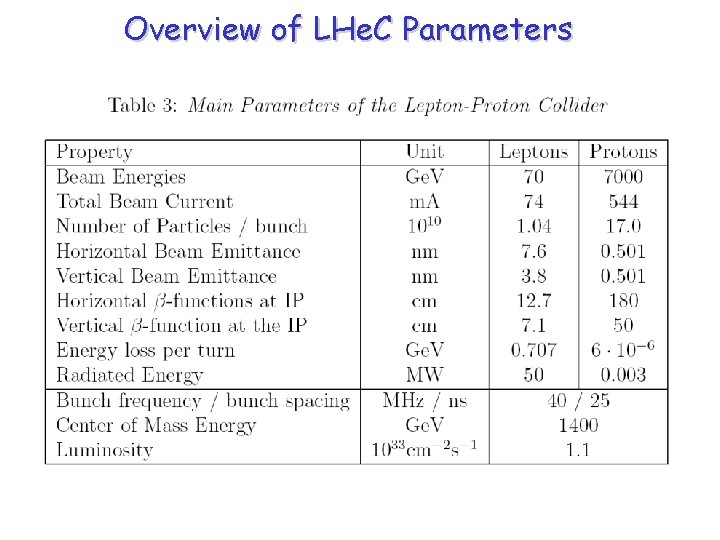
Overview of LHe. C Parameters
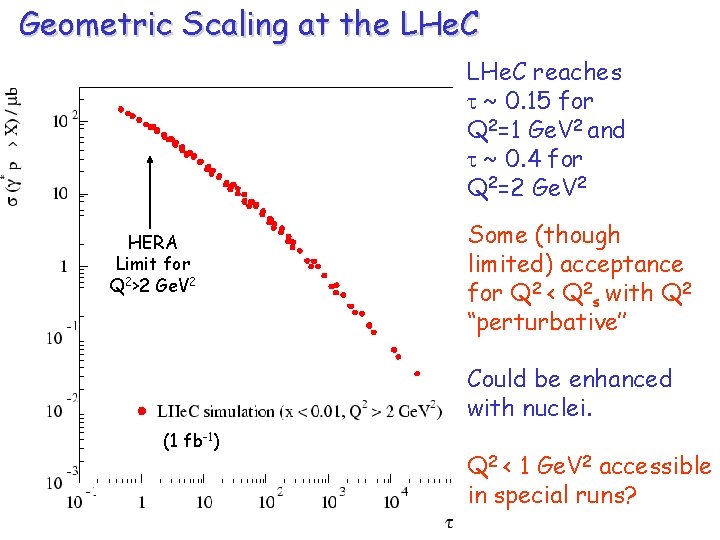
Geometric Scaling at the LHe. C reaches t ~ 0. 15 for Q 2=1 Ge. V 2 and t ~ 0. 4 for Q 2=2 Ge. V 2 HERA Limit for Q 2>2 Ge. V 2 Some (though limited) acceptance for Q 2 < Q 2 s with Q 2 “perturbative’’ Could be enhanced with nuclei. (1 fb-1) Q 2 < 1 Ge. V 2 accessible in special runs?
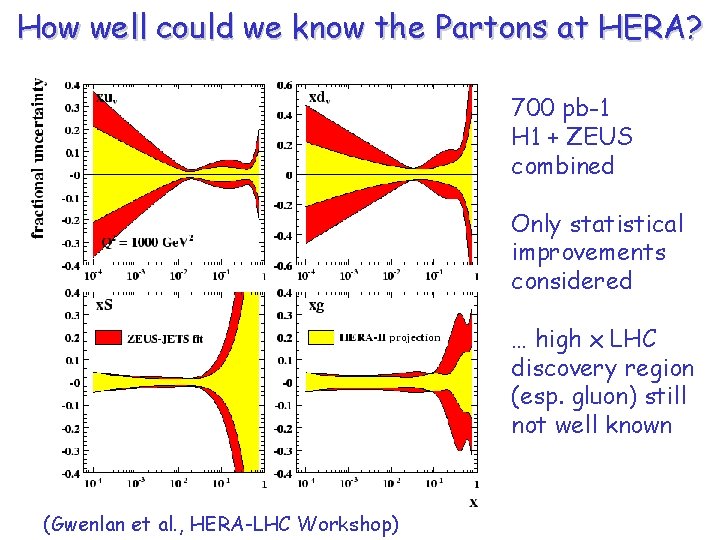
How well could we know the Partons at HERA? 700 pb-1 H 1 + ZEUS combined Only statistical improvements considered … high x LHC discovery region (esp. gluon) still not well known (Gwenlan et al. , HERA-LHC Workshop)
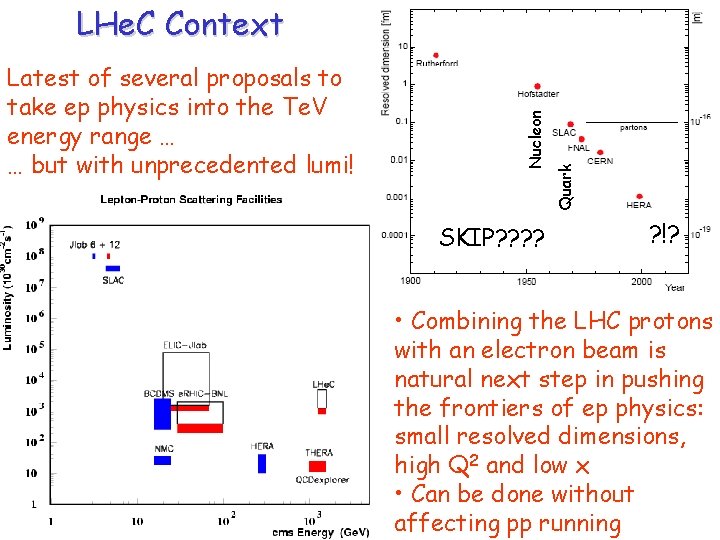
SKIP? ? Quark Latest of several proposals to take ep physics into the Te. V energy range … … but with unprecedented lumi! Nucleon LHe. C Context ? !? • Combining the LHC protons with an electron beam is natural next step in pushing the frontiers of ep physics: small resolved dimensions, high Q 2 and low x • Can be done without affecting pp running
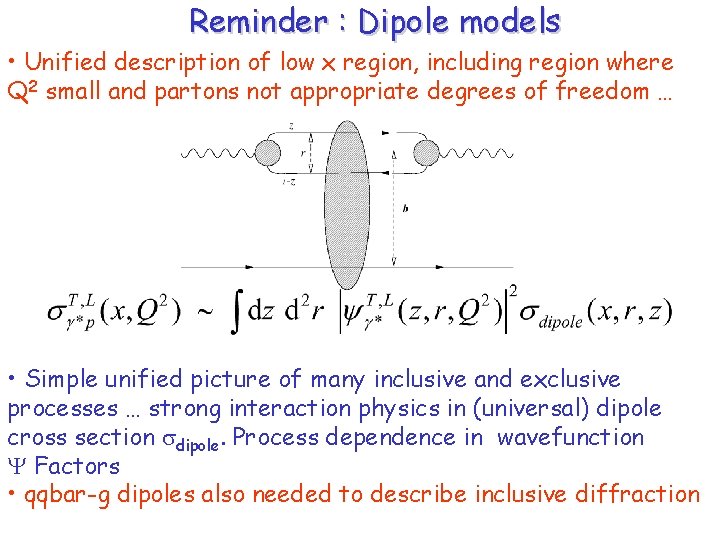
Reminder : Dipole models • Unified description of low x region, including region where Q 2 small and partons not appropriate degrees of freedom … • Simple unified picture of many inclusive and exclusive processes … strong interaction physics in (universal) dipole cross section sdipole. Process dependence in wavefunction Y Factors • qqbar-g dipoles also needed to describe inclusive diffraction
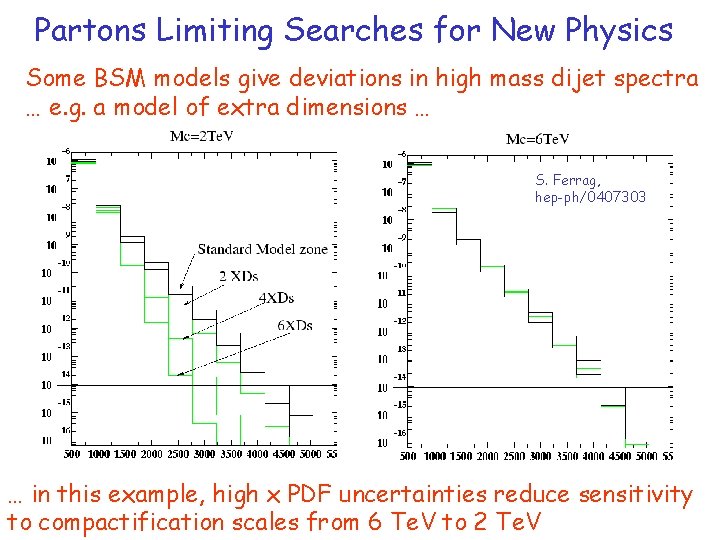
Partons Limiting Searches for New Physics Some BSM models give deviations in high mass dijet spectra … e. g. a model of extra dimensions … S. Ferrag, hep-ph/0407303 … in this example, high x PDF uncertainties reduce sensitivity to compactification scales from 6 Te. V to 2 Te. V
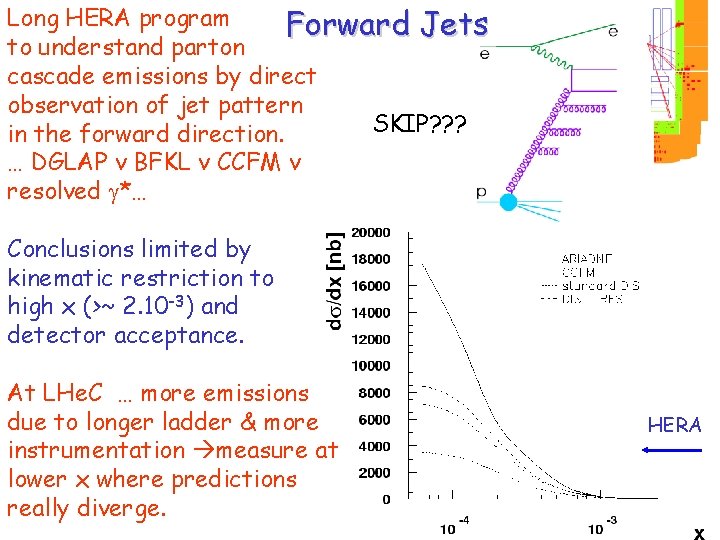
Long HERA program Forward Jets to understand parton cascade emissions by direct observation of jet pattern SKIP? ? ? in the forward direction. … DGLAP v BFKL v CCFM v resolved g*… Conclusions limited by kinematic restriction to high x (>~ 2. 10 -3) and detector acceptance. At LHe. C … more emissions due to longer ladder & more instrumentation measure at lower x where predictions really diverge. HERA