
Deep Venous Thrombosis OVERVIEW of treatment Anthony J
Deep Venous Thrombosis OVERVIEW (…of treatment) Anthony J. Comerota, MD, FACS, FACC Director, Jobst Vascular Center Adjunct Professor of Surgery, University of Michigan
DISCLOSURES Anthony J. Comerota, MD, RVT Consulting Fees – Aastrom, Cook Medical, Covidien, Bristol-Myers Squibb, sanofi-aventis U. S. LLC, Talecris Biotherapeutics, Inc. Honoraria – Bristol-Myers Squibb, Covidien, Otsuka, sanofi-aventis U. S. LLC, Servier, Zymo. Genetics Grants/Contracted Research – Aastrom Biosciences, Inc. , Abbott Vascular, Baxter Healthcare, Bristol. Myers Squibb, Boehringer Ingelheim, BSN, Colorado Prevention Center, CVRx, ev 3, Inc. , Lombard Medical, Medtronic Cardio. Vascular, Inc. , National Institutes of Health, Pfizer, sanofi-aventis U. S. LLC, Schering. Plough Corp. / Merck & Co. , Inc. , Talecris Biotherapeutics, Inc.
Acute Deep Venous Thrombosis - Treatment Not all DVTs are the same!

Acute DVT Management ACCP 2008 • Initial anticoagulation • Immobilization • Duration of anticoagulation • Intensity of long-term anticoagulation • Compression stockings

Acute DVT ACCP 2008 Early Anticoagulation “Initial Treatment” Objectives Prevent: • Thrombus extension • Embolization • Recurrent DVT Early Late Long-Term Anticoagulation Objectives • Reduce recurrence

Acute DVT Importance of Early Therapeutic Rx Recurrent VTE* PTT <1. 5 x (24 hrs. ) 24. 5% (15: 1) PTT >1. 5 x 1. 6% <0. 001 * • most occur > 4 weeks, • association with poor initial response not appreciated by attending MDs Hull, RD et al NEJM 1990

Acute DVT Background: Anticoagulation Duration of Initial Heparin Two randomized trials: Proximal DVT Result IV UFH x 5 -7 days is as effective as IV UFH x 14 days… …provided adequate long-term anticoagulation 1. Gallus A S et al Lancet 1986; 2: 1293 2. Hull R D et al NEJM 1990; 322: 1260
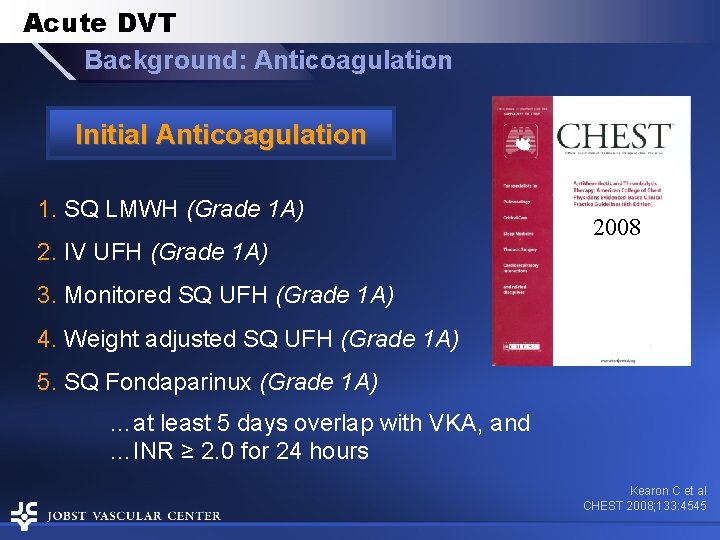
Acute DVT Background: Anticoagulation Initial Anticoagulation 1. SQ LMWH (Grade 1 A) 2. IV UFH (Grade 1 A) 2008 3. Monitored SQ UFH (Grade 1 A) 4. Weight adjusted SQ UFH (Grade 1 A) 5. SQ Fondaparinux (Grade 1 A) …at least 5 days overlap with VKA, and …INR ≥ 2. 0 for 24 hours Kearon C et al CHEST 2008; 133: 4545

Acute DVT Duration of Anticoagulation…how long? Studies have shown… …the longer the better!

Anticoagulation for DVT 4 Weeks vs. 3 Months: Study Design 406 Proximal DVT (venogram) Weeks Anticoagulation 34 mos. better than 4 weeks IPG Positive Negative (N=192) (N=214) All patients receiving 3 months of anticoagulation Anticoagulation who had recurrence had Randomize continuing risk factors (8 Weeks) Recurrence @ 8 wks @ 11 mos Placebo Anticoag x 8 Wks (N=105) (N=109) 8. 6% 11. 5% vs. 0. 9% 6% P =. 009 P =. 3 Levine MN et al Thromb Haemost 1995; 74: 6061
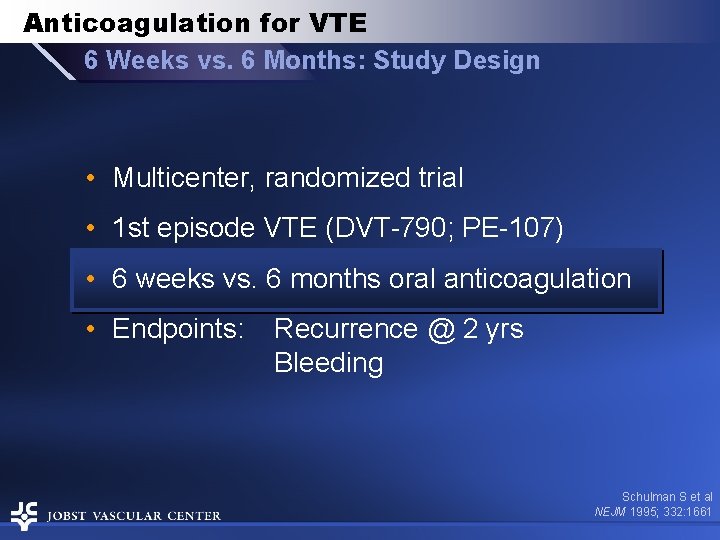
Anticoagulation for VTE 6 Weeks vs. 6 Months: Study Design • Multicenter, randomized trial • 1 st episode VTE (DVT-790; PE-107) • 6 weeks vs. 6 months oral anticoagulation • Endpoints: Recurrence @ 2 yrs Bleeding Schulman S et al NEJM 1995; 332: 1661
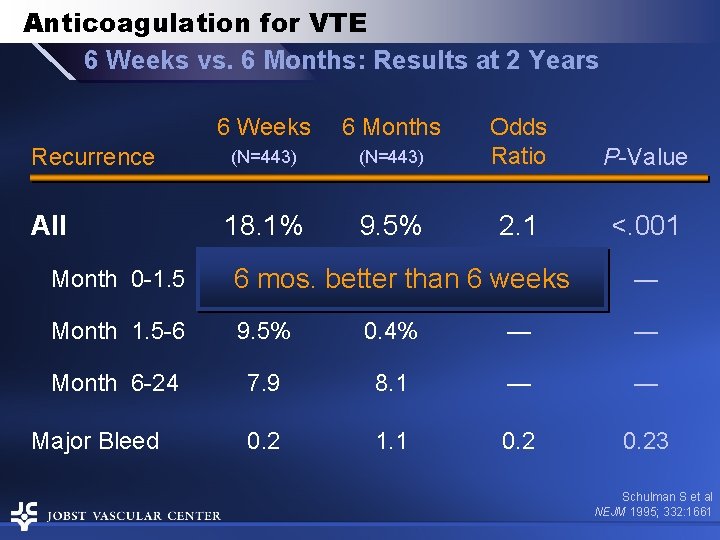
Anticoagulation for VTE 6 Weeks vs. 6 Months: Results at 2 Years Recurrence All 6 Weeks 6 Months (N=443) Odds Ratio (N=443) P-Value 18. 1% 9. 5% 2. 1 <. 001 Month 0 -1. 5 0. 9% — 60. 7% mos. better than 6 weeks — Month 1. 5 -6 9. 5% 0. 4% — — Month 6 -24 7. 9 8. 1 — — 0. 2 1. 1 0. 23 Major Bleed Schulman S et al NEJM 1995; 332: 1661

Anticoagulation for Acute DVT Duration of Warfarin: Randomized Trial 3 mos vs. Indefinite Anticoagulation Study Stopped @ Interim Analysis! Percent per Patient Year Endpoint Recurrent VTE Major Bleed 3 Mos >1 Year RRR P-value 24. 1 1. 3 95% <0. 001 0 3. 8 - 0. 09 (non-fatal) Indefinite better than 3 months (more bleeding) Kearon C et al NEJM 1999; 340; 901

Acute DVT Intensity of Anticoagulation Low-Intensity vs. Placebo Long-Term Low-Intensity Warfarin Therapy for the Prevention of Recurrent Venous Thromboembolism (INR 1. 5 - 2. 0 vs. Placebo) Ridker PM, Goldhaber SZ, Danielsen E, et al and the PREVENT Investigators New England Journal of Medicine 2003; 348: 15

Acute DVT Intensity of Anticoagulation Recurrent DVT Placebo (n = 253) Warfarin (n = 255) RRR P-value 14. 6% 5. 5% 62% <0. 001 0. 25 Major Bleed low-intensity 0. 8% anticoagulation 1. 9% -253% better Indefinite idiopathic VTE Death than 3 -6 months 0. 32% for 0. 16% 50% 0. 26 Composite 0. 01 16. 2% 8. 6% 48% Ridker PM, et al NEJM 2003; 348: 15
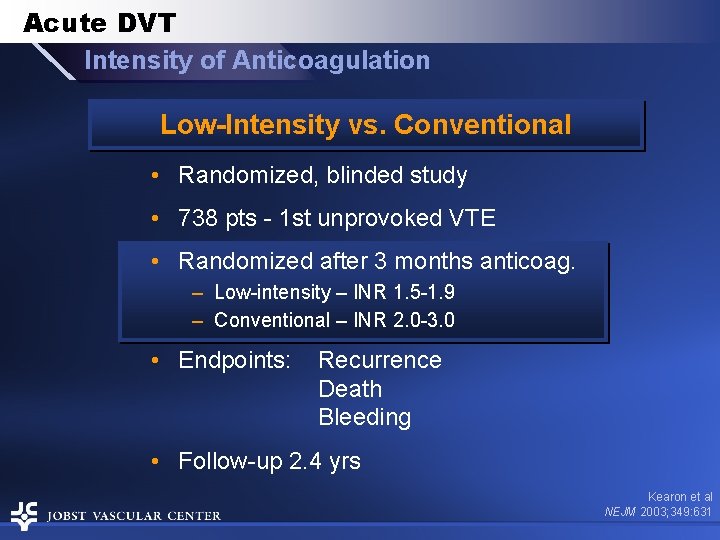
Acute DVT Intensity of Anticoagulation Low-Intensity vs. Conventional • Randomized, blinded study • 738 pts - 1 st unprovoked VTE • Randomized after 3 months anticoag. – Low-intensity – INR 1. 5 -1. 9 – Conventional – INR 2. 0 -3. 0 • Endpoints: Recurrence Death Bleeding • Follow-up 2. 4 yrs Kearon et al NEJM 2003; 349: 631

Acute DVT Intensity of Anticoagulation Low-Intensity vs. Conventional Results @ 2. 4 yrs No/100 person yr Low Conventional P-value (N=369) Hazard Ratio (N=369) Recurrent VTE 1. 9 0. 7 2. 8 0. 03 Death 1. 9 0. 9 2. 1 0. 09 Major bleed 1. 1 0. 9 1. 2 0. 76 Kearon et al NEJM 2003; 349: 631

Acute DVT: First-Time DVT ACCP 2008 Duration of Anticoagulation Transient risk: Recommend VKA for 3 mos. over shorter periods (Grade 1 A) Unprovoked DVT: VKA for at least 3 mos. (Grade 1 A)…then eval. for risk/benefit of continued Rx (1 C) 2008 Isolated distal DVT, rec. 3 mos. (2 B) For proximal DVT in patients at low risk for bleeding, rec. “long-term” (1 A) Kearon C et al CHEST 2008; 133: 4545
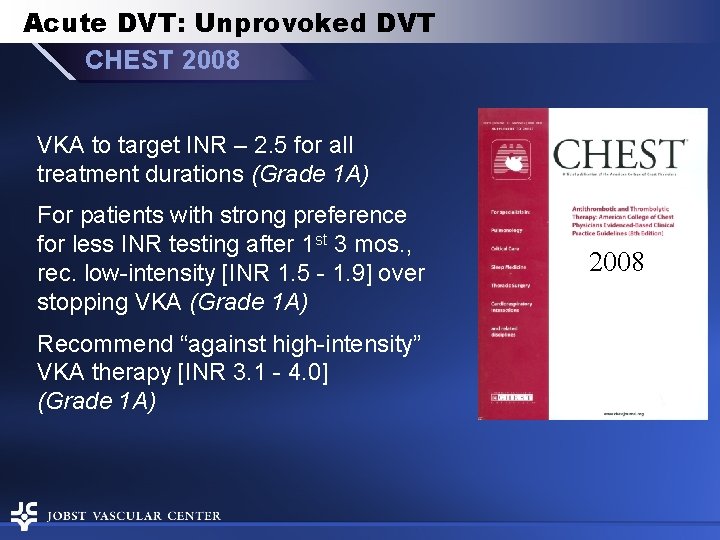
Acute DVT: Unprovoked DVT CHEST 2008 VKA to target INR – 2. 5 for all treatment durations (Grade 1 A) For patients with strong preference for less INR testing after 1 st 3 mos. , rec. low-intensity [INR 1. 5 - 1. 9] over stopping VKA (Grade 1 A) Recommend “against high-intensity” VKA therapy [INR 3. 1 - 4. 0] (Grade 1 A) 2008
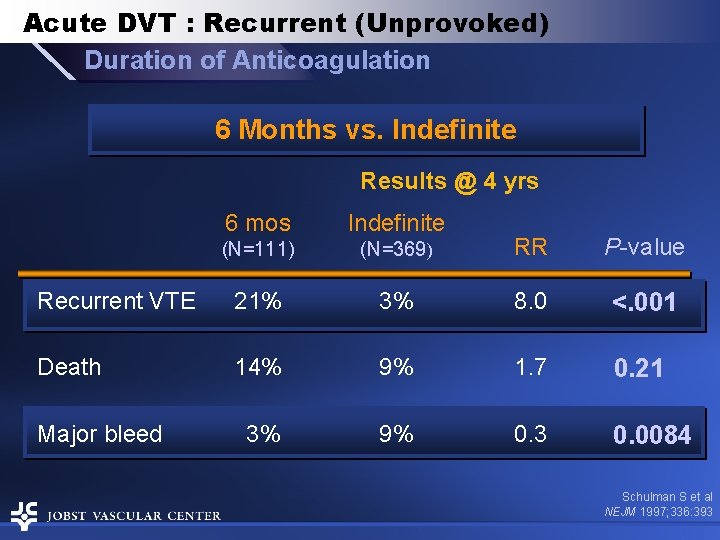
Acute DVT : Recurrent (Unprovoked) Duration of Anticoagulation 6 Months vs. Indefinite Results @ 4 yrs 6 mos Indefinite (N=111) (N=369) RR P-value Recurrent VTE 21% 3% 8. 0 <. 001 Death 14% 9% 1. 7 0. 21 3% 9% 0. 3 0. 0084 Major bleed Schulman S et al NEJM 1997; 336: 393
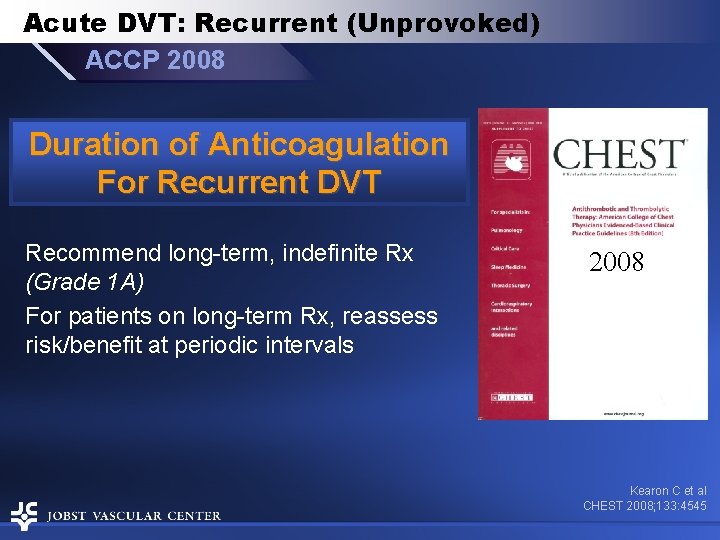
Acute DVT: Recurrent (Unprovoked) ACCP 2008 Duration of Anticoagulation For Recurrent DVT Recommend long-term, indefinite Rx (Grade 1 A) For patients on long-term Rx, reassess risk/benefit at periodic intervals 2008 Kearon C et al CHEST 2008; 133: 4545
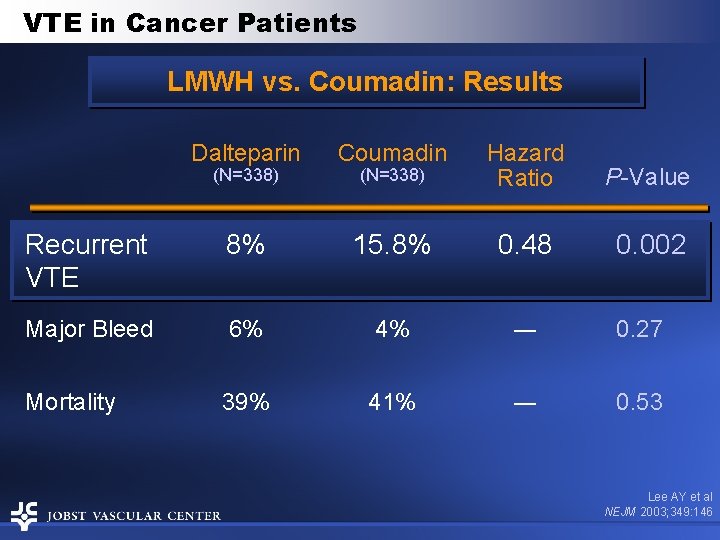
VTE in Cancer Patients LMWH vs. Coumadin: Results Dalteparin Coumadin (N=338) Hazard Ratio P-Value Recurrent VTE 8% 15. 8% 0. 48 0. 002 Major Bleed 6% 4% ― 0. 27 Mortality 39% 41% ― 0. 53 (N=338) Lee AY et al NEJM 2003; 349: 146
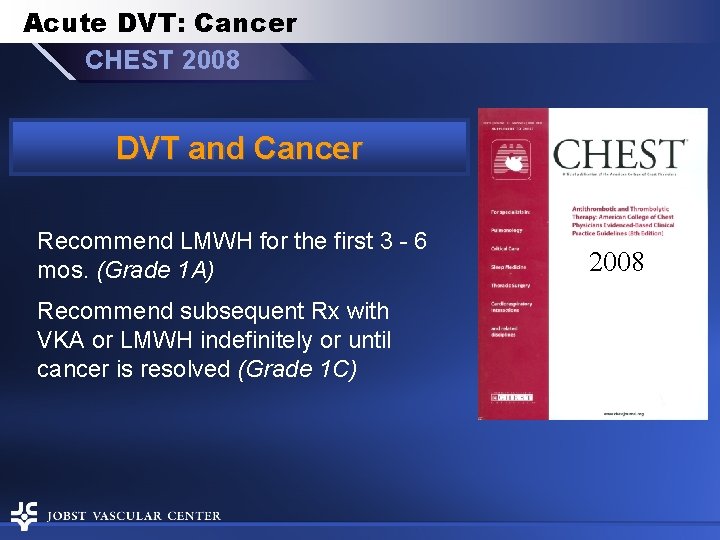
Acute DVT: Cancer CHEST 2008 DVT and Cancer Recommend LMWH for the first 3 - 6 mos. (Grade 1 A) Recommend subsequent Rx with VKA or LMWH indefinitely or until cancer is resolved (Grade 1 C) 2008

Acute DVT ACCP 2008 DVT and Ambulation Recommend early ambulation in preference to initial bed rest (Grade 1 A) 2008 Kearon C et al CHEST 2008; 133: 4545
Acute DVT ACCP 2008 Immobilization vs. Ambulation Randomized trials (N=5) Observational studies (N=3) Result Early ambulation with compression shows: 1. Faster resolution of pain 2. More rapid resolution of swelling 3. No increased risk of PE Kearon C et al CHEST 2008; 133: 4545
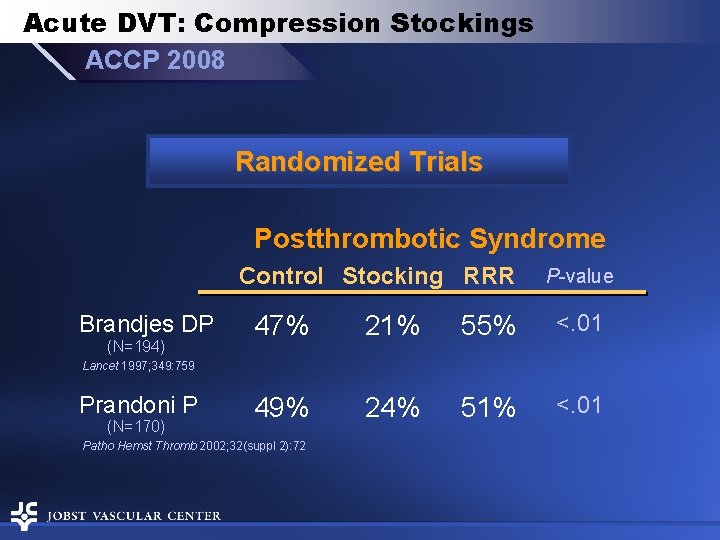
Acute DVT: Compression Stockings ACCP 2008 Randomized Trials Postthrombotic Syndrome Control Stocking RRR Brandjes DP (N=194) P-value 47% 21% 55% <. 01 49% 24% 51% <. 01 Lancet 1997; 349: 759 Prandoni P (N=170) Patho Hemst Thromb 2002; 32(suppl 2): 72
Acute DVT: Compression Stockings ACCP 2008 Compression Stockings “…we recommend the use of an elastic compression stocking with an ankle gradient of 3040 mm. Hg pressure…for a minimum of 2 years” …GRADE 1 A… 2008

Acute DVT ACCP 2008 Summary • More aggressive recommendations for management of acute DVT…strategy of thrombus removal • Emphasize need for: 2008 1. Early therapeutic anticoagulation 2. Long-term anticoagulation for unprovoked DVT and cancer patients 3. Good compression (30 -40 mm. Hg) 4. Early ambulation Kearon C et al CHEST 2008; 133: 4545

- Slides: 29