
Deep Vein Thrombosis What is it A deep
Deep Vein Thrombosis
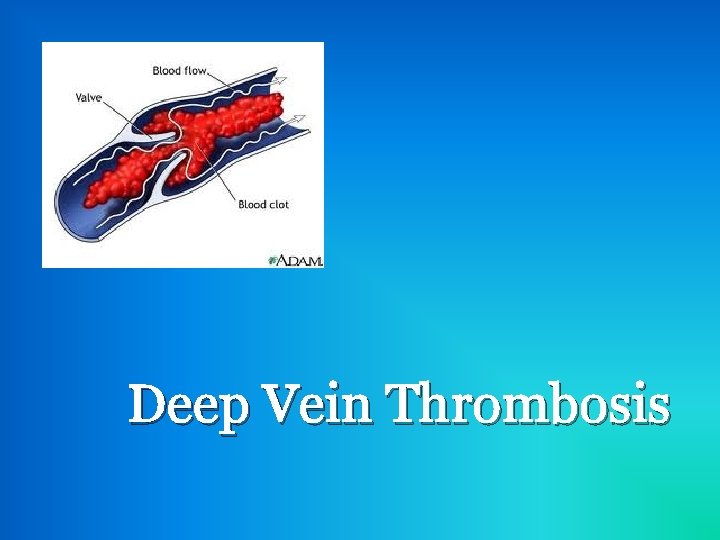
What is it? • A deep vein thrombosis is a condition where the blood clots in a distal, deep vein • A blood clot is considered a thrombosis as long as it is stationary in the vein. If it becomes dislodged it is considered an embolism • An embolism can become a life threatening condition if the clot gets lodged into a pulmonary artery

How does it develop? • Virchow's Triad describes how a DVT develops – Decreased rate of blood flow in a vein – Damage to the wall of that vein – Increased tendency for hypercoagulability • Many DVT’s are asymptomatic

Examination • Homan’s Sign – This test uses dorsiflexion of the ankle and gentle squeezing of the lower leg – A positive sign is pain in the deep calf area – This test is not very specific since there are other structures or conditions that can reproduce similar pain

Examination • Well’s clinical decision rule for DVT – Done by taking a clinical survey • Risk score interpretation (probability of DVT): – >/=3 points: high risk (75%) – 1 to 2 points: moderate risk (17%) – <1 point: low risk (3%) Clinical feature Points Active cancer (treatment within 1 6 months, or palliation) Paralysis, paresis, or 1 immobilization of lower extremity Bedridden for more than 3 days 1 because of surgery (within 4 weeks) Localized tenderness along 1 distribution of deep veins Entire leg swollen 1 Unilateral calf swelling of 1 greater than 3 cm (below tibial tuberosity) Unilateral pitting edema 1 Collateral superficial veins 1 Alternative diagnosis as likely -2 as or more likely than DVT Total points
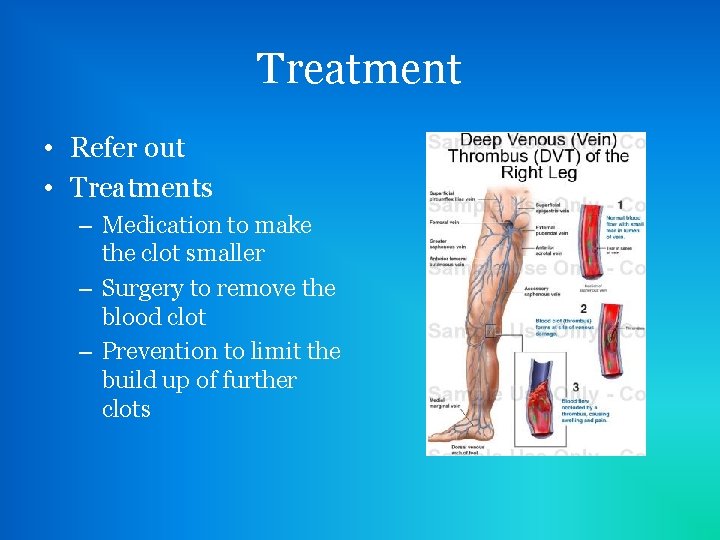
Treatment • Refer out • Treatments – Medication to make the clot smaller – Surgery to remove the blood clot – Prevention to limit the build up of further clots
References • Goodman CC, Snyder TE. Differential Diagnosis for Physical Therapists: Screening for referral. 2007.
- Slides: 7