
Deep SingleView 3 D Object Reconstruction with Visual

Deep Single-View 3 D Object Reconstruction with Visual Hull Embedding 1, 2 2 1 Hanqing Wang, Jiaolong Yang, Wei Liang, Xin Tong 1 Beijing Institute of Technology 2 Microsoft Research Asia Beijing, China AAAI 2019 2
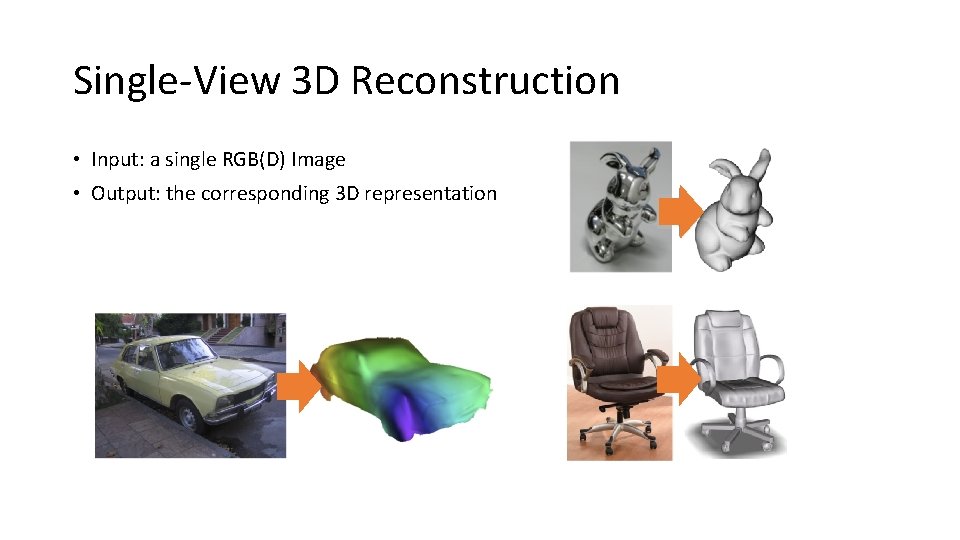
Single-View 3 D Reconstruction • Input: a single RGB(D) Image • Output: the corresponding 3 D representation
![Previous Works • Deep Learning based Methods: [Choy ECCV’ 16] [Girdhar ECCV’ 16] Other](http://slidetodoc.com/presentation_image_h2/770de633e2037057c4e15741614ee341/image-3.jpg "Previous Works • Deep Learning based Methods: [Choy ECCV’ 16] [Girdhar ECCV’ 16] Other")
Previous Works • Deep Learning based Methods: [Choy ECCV’ 16] [Girdhar ECCV’ 16] Other works: [Yan NIPS’ 16][Wu NIPS’ 16][Tulsiani CVPR’ 17][Zhu ICCV’ 17]
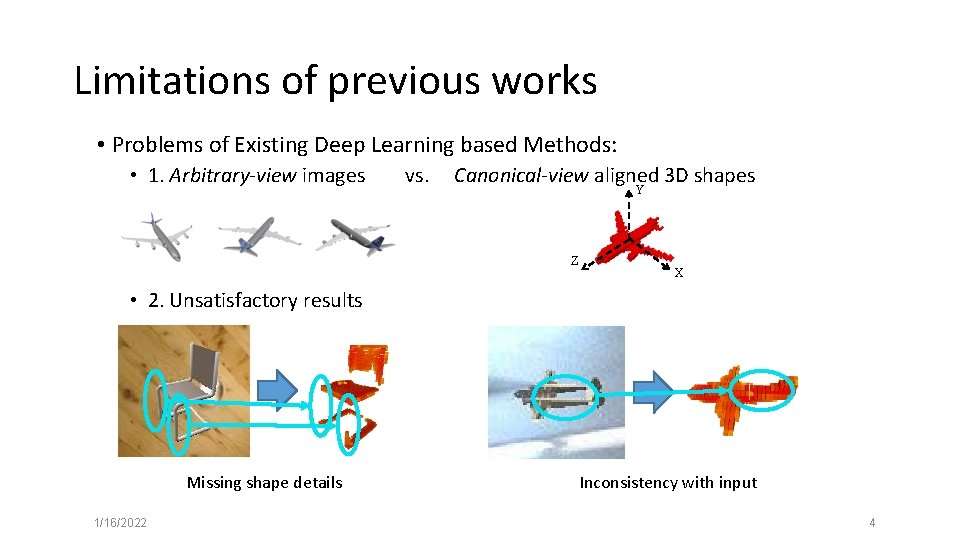
Limitations of previous works • Problems of Existing Deep Learning based Methods: • 1. Arbitrary-view images vs. Canonical-view aligned 3 D shapes Y Z X • 2. Unsatisfactory results Missing shape details 1/16/2022 Inconsistency with input 4
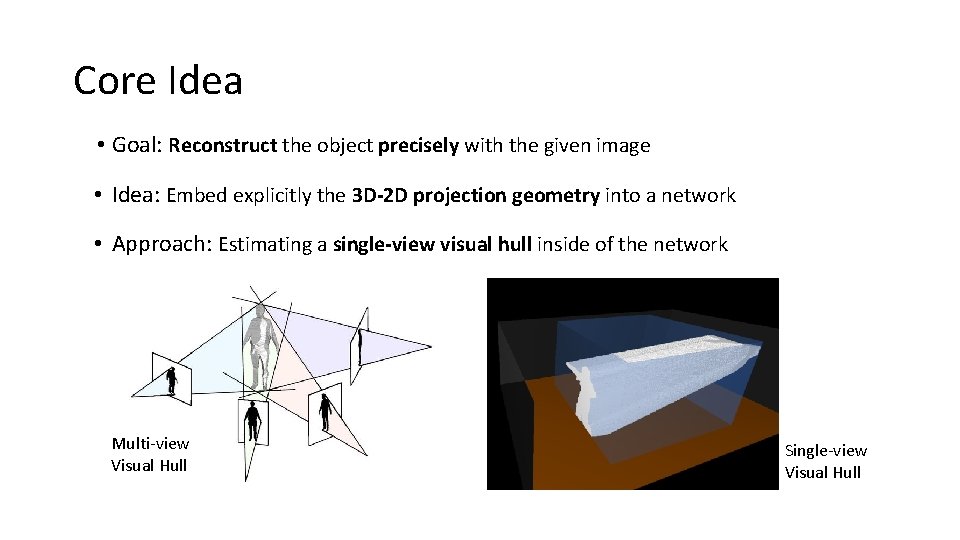
Core Idea • Goal: Reconstruct the object precisely with the given image • Idea: Embed explicitly the 3 D-2 D projection geometry into a network • Approach: Estimating a single-view visual hull inside of the network Multi-view Visual Hull Single-view Visual Hull
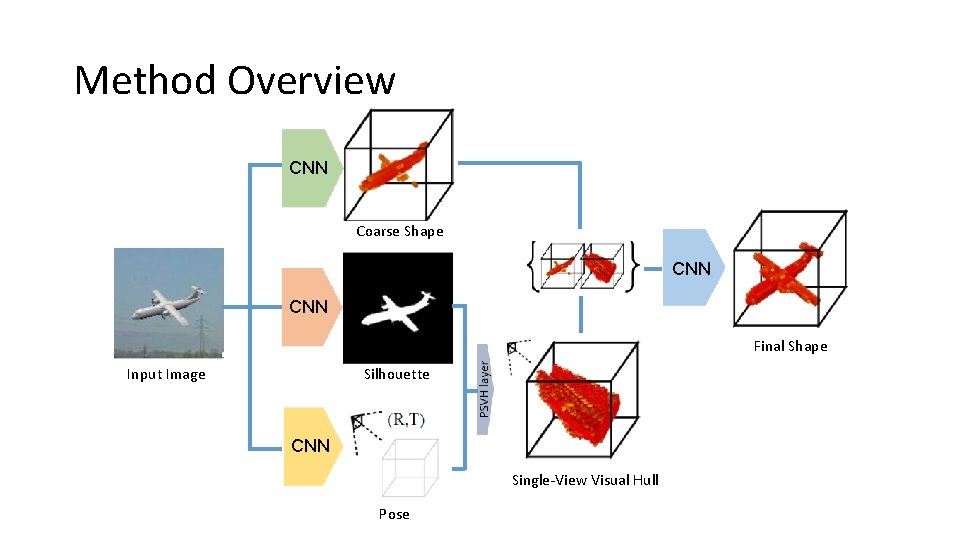
Method Overview CNN Coarse Shape CNN Final Shape Input Image Silhouette CNN Single-View Visual Hull Pose
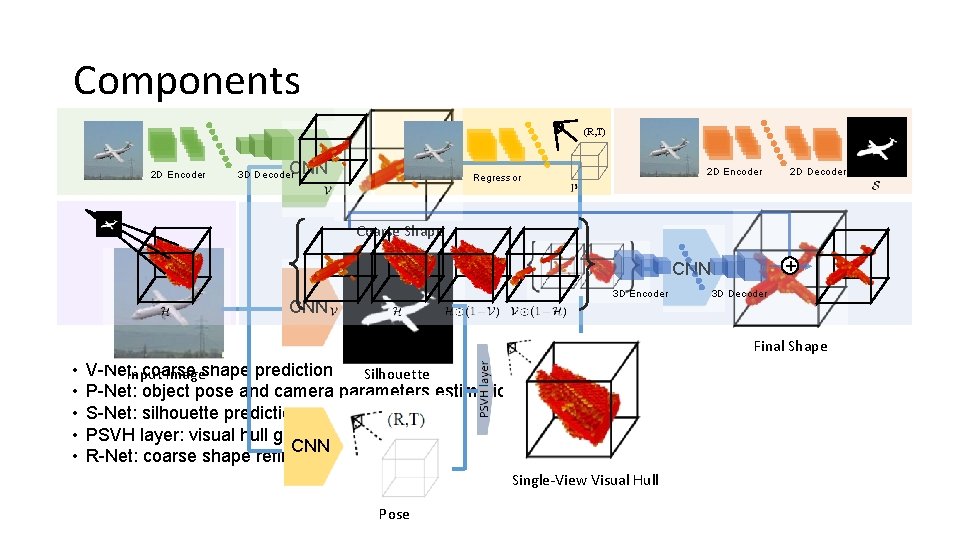
Components (R, T) 2 D Encoder CNN 3 D Decoder 2 D Encoder Regressor 2 D Decoder Coarse Shape + CNN 3 D Encoder CNN 3 D Decoder Final Shape • • • V-Net: coarse Input Imageshape prediction Silhouette P-Net: object pose and camera parameters estimation S-Net: silhouette prediction PSVH layer: visual hull generation CNN R-Net: coarse shape refinement Single-View Visual Hull Pose
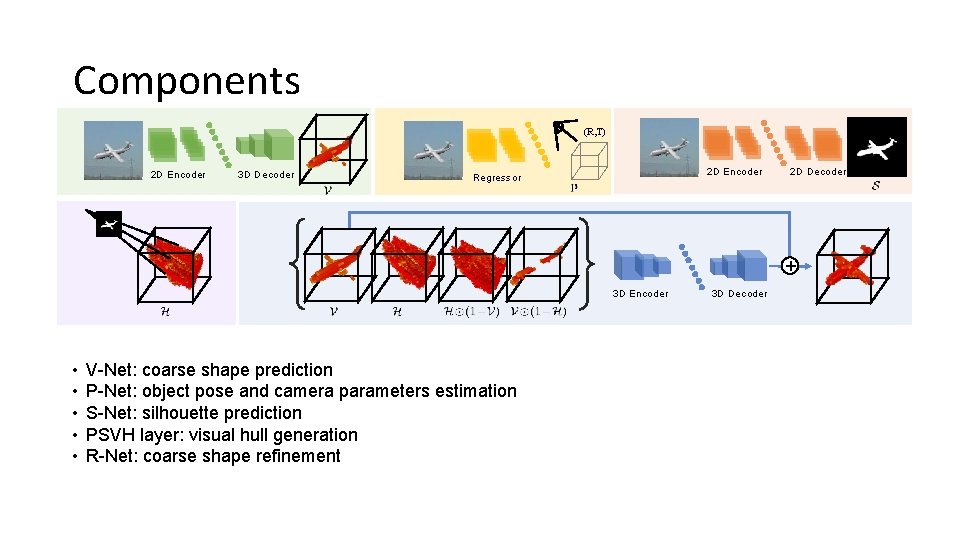
Components (R, T) 2 D Encoder 3 D Decoder 2 D Encoder Regressor 2 D Decoder + 3 D Encoder • • • V-Net: coarse shape prediction P-Net: object pose and camera parameters estimation S-Net: silhouette prediction PSVH layer: visual hull generation R-Net: coarse shape refinement 3 D Decoder
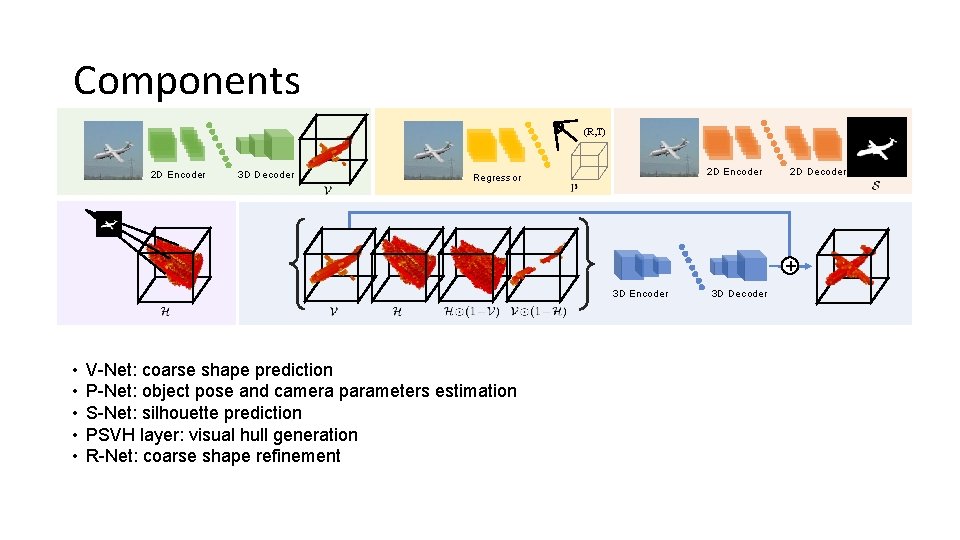
Components (R, T) 2 D Encoder 3 D Decoder 2 D Encoder Regressor 2 D Decoder + 3 D Encoder • • • V-Net: coarse shape prediction P-Net: object pose and camera parameters estimation S-Net: silhouette prediction PSVH layer: visual hull generation R-Net: coarse shape refinement 3 D Decoder
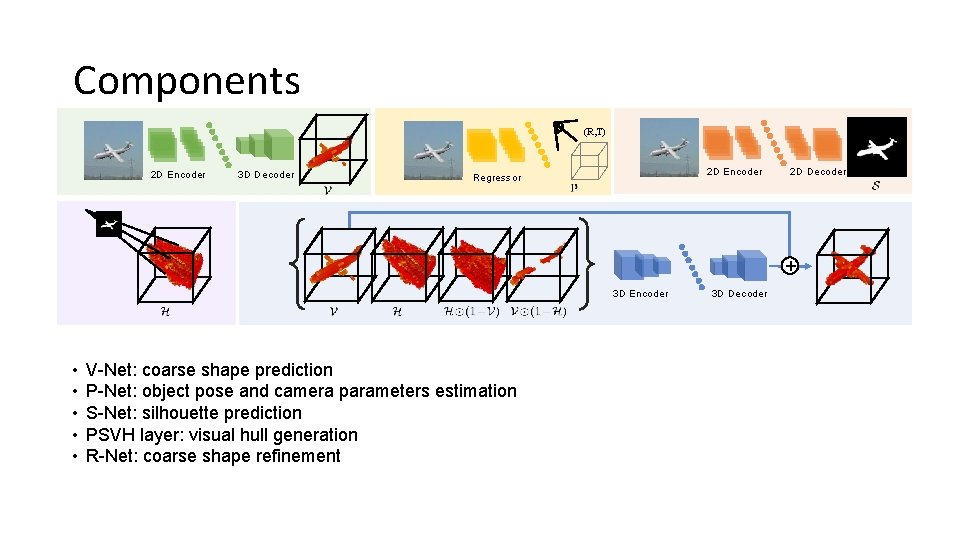
Components (R, T) 2 D Encoder 3 D Decoder 2 D Encoder Regressor 2 D Decoder + 3 D Encoder • • • V-Net: coarse shape prediction P-Net: object pose and camera parameters estimation S-Net: silhouette prediction PSVH layer: visual hull generation R-Net: coarse shape refinement 3 D Decoder
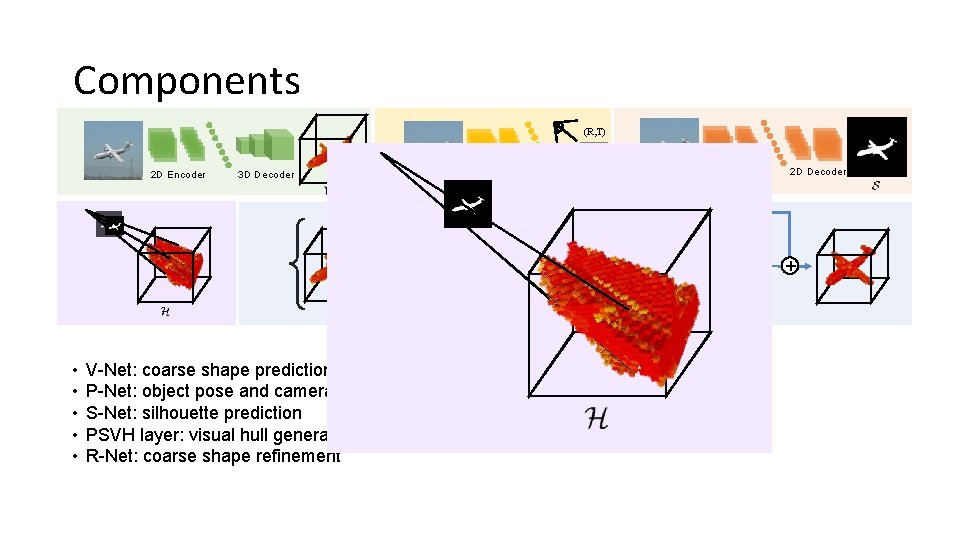
Components (R, T) 2 D Encoder 3 D Decoder 2 D Encoder Regressor 2 D Decoder + 3 D Encoder • • • V-Net: coarse shape prediction P-Net: object pose and camera parameters estimation S-Net: silhouette prediction PSVH layer: visual hull generation R-Net: coarse shape refinement 3 D Decoder
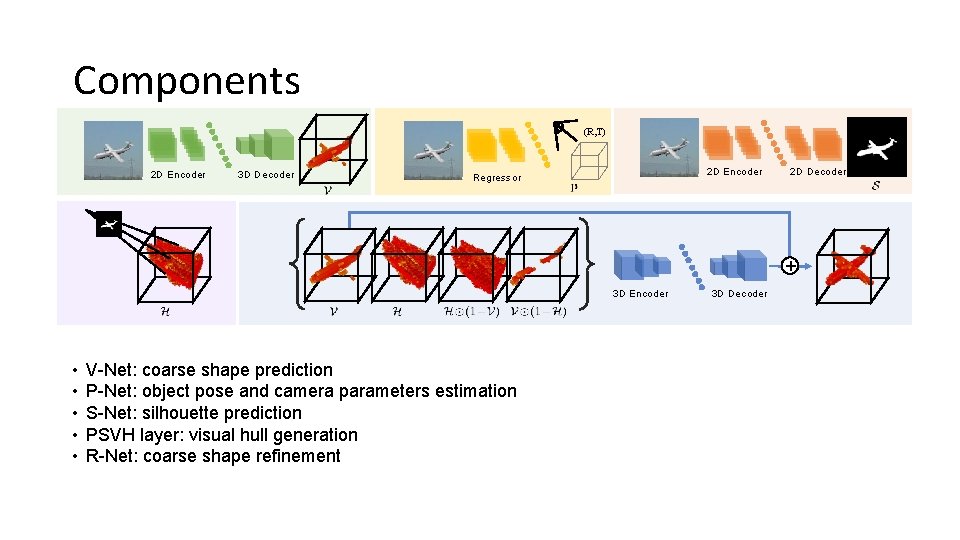
Components (R, T) 2 D Encoder 3 D Decoder 2 D Encoder Regressor 2 D Decoder + 3 D Encoder • • • V-Net: coarse shape prediction P-Net: object pose and camera parameters estimation S-Net: silhouette prediction PSVH layer: visual hull generation R-Net: coarse shape refinement 3 D Decoder
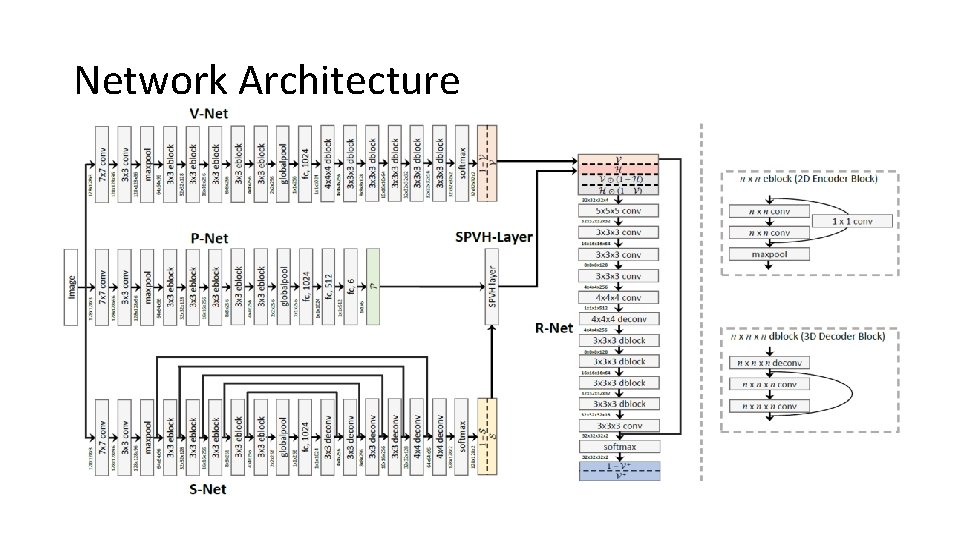
Network Architecture • Overview:
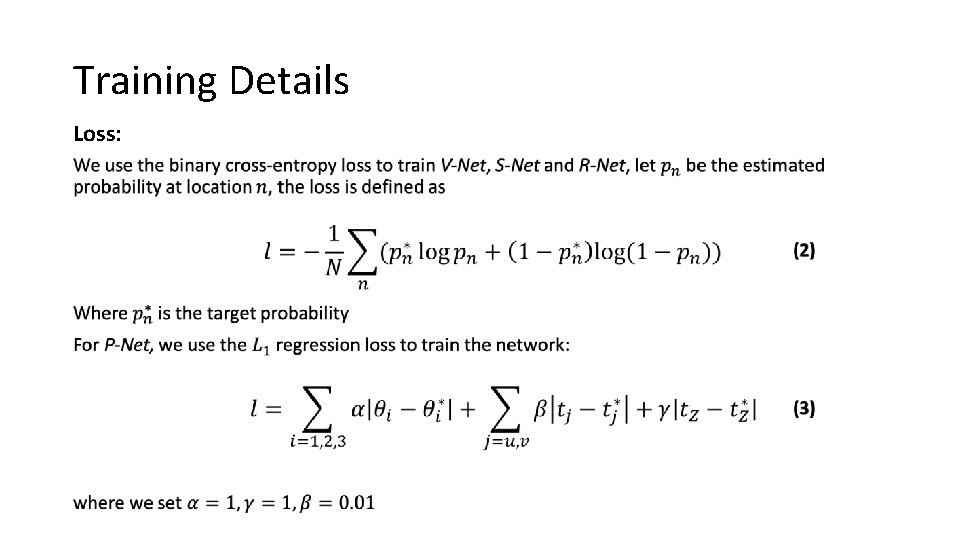
Training Details Loss: •
Training Details Steps: 1. Train the V-Net, S-Net, P-Net independently. 2. Train the R-Net with the coarse shape predicted by V-Net and the ground truth visual hull. 3. Train the whole network end-to-end.

Implementation Details • Network implemented in Tensorflow • Input image size: 128 x 3 • Output voxel grid size: 32 x 32
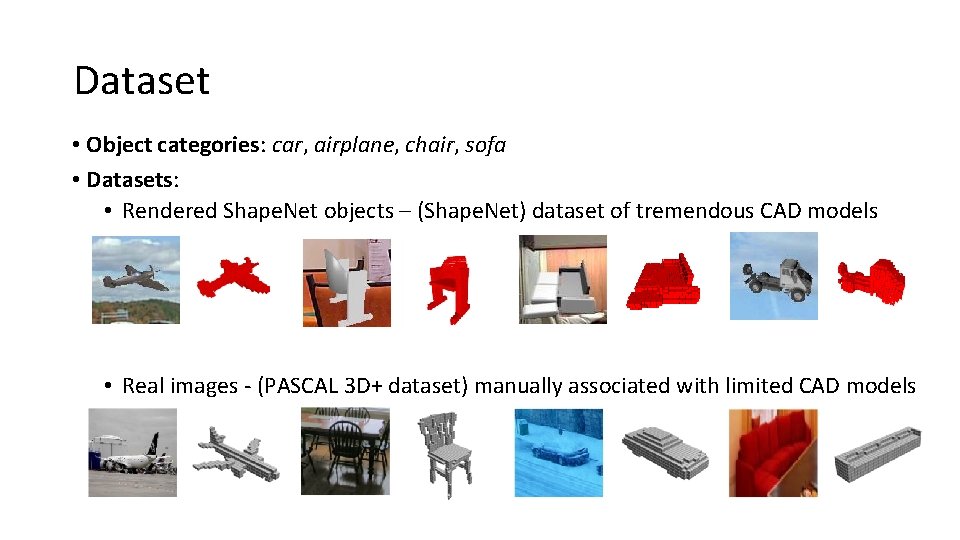
Dataset • Object categories: car, airplane, chair, sofa • Datasets: • Rendered Shape. Net objects – (Shape. Net) dataset of tremendous CAD models • Real images - (PASCAL 3 D+ dataset) manually associated with limited CAD models
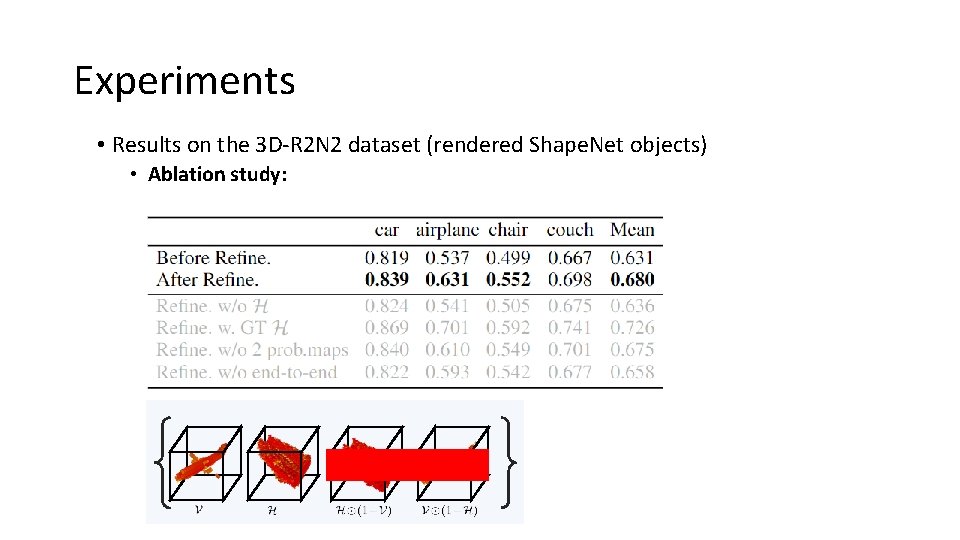
Experiments • Results on the 3 D-R 2 N 2 dataset (rendered Shape. Net objects) • Ablation study:
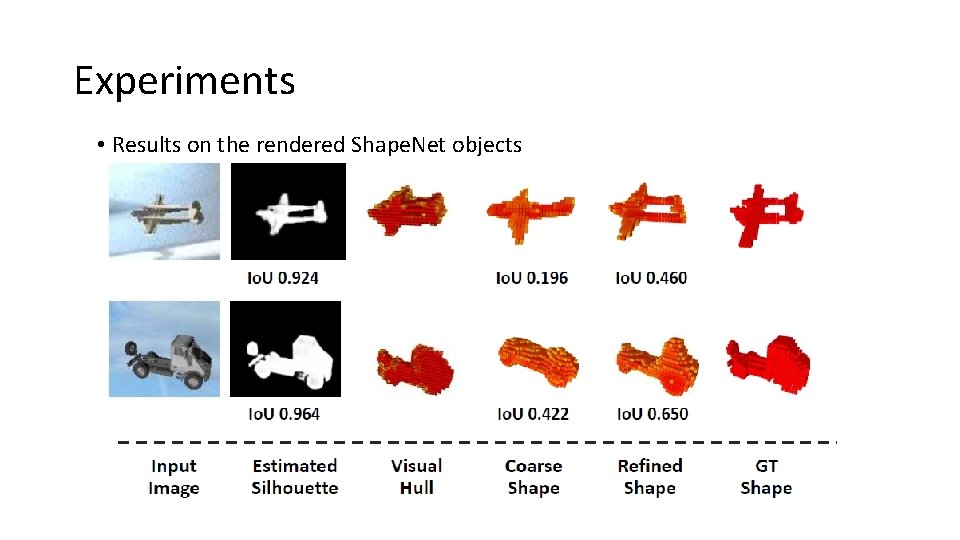
Experiments • Results on the rendered Shape. Net objects
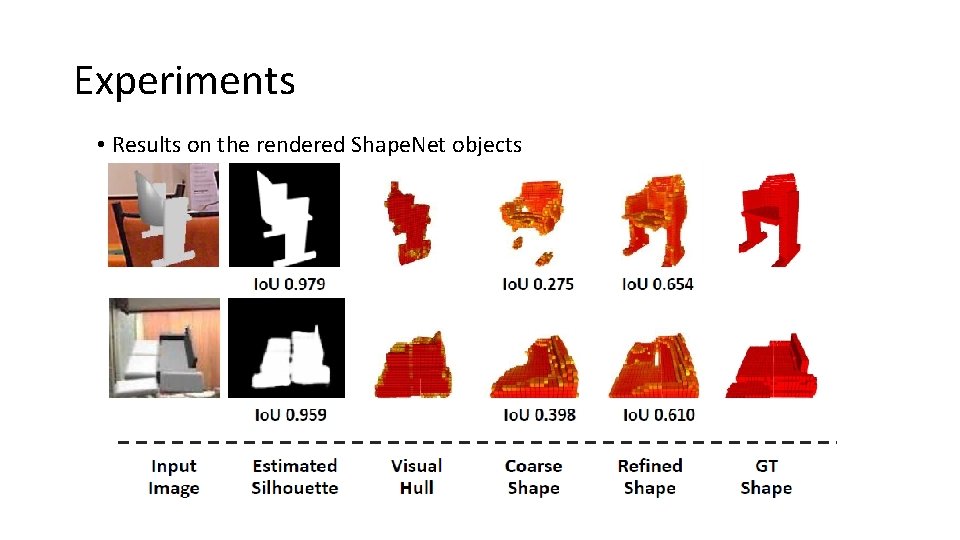
Experiments • Results on the rendered Shape. Net objects
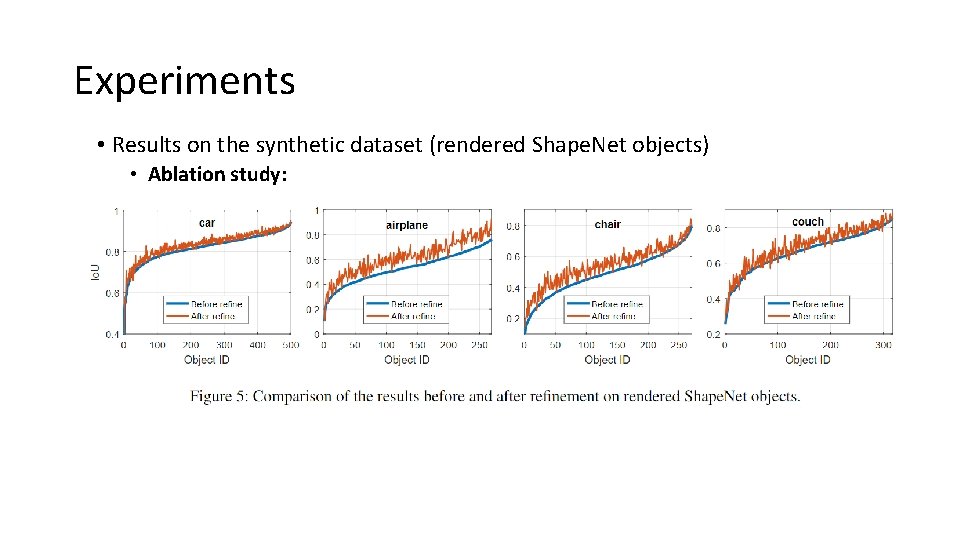
Experiments • Results on the synthetic dataset (rendered Shape. Net objects) • Ablation study:
![Experiments • Comparison with Marr. Net[Wu et al. 2017] on the synthetic dataset](http://slidetodoc.com/presentation_image_h2/770de633e2037057c4e15741614ee341/image-22.jpg "Experiments • Comparison with Marr. Net[Wu et al. 2017] on the synthetic dataset")
Experiments • Comparison with Marr. Net[Wu et al. 2017] on the synthetic dataset
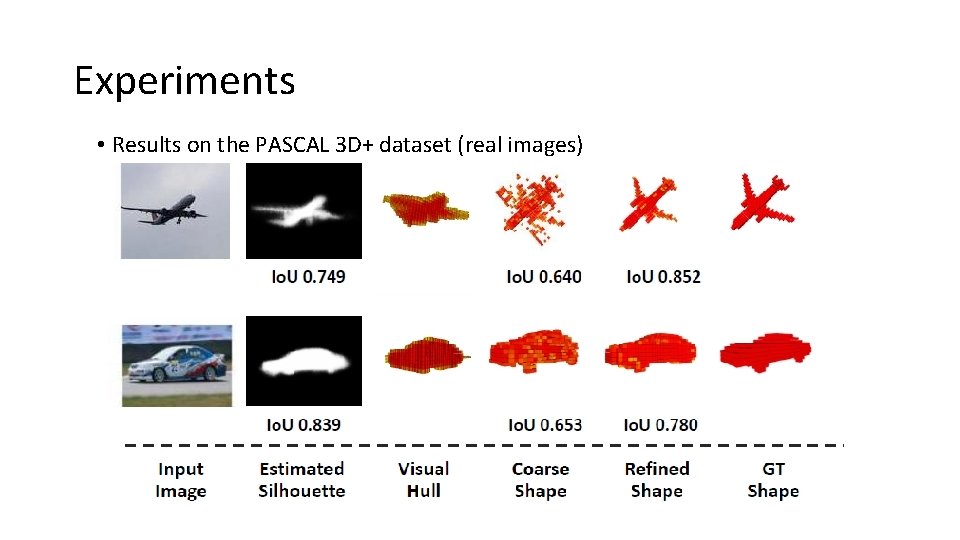
Experiments • Results on the PASCAL 3 D+ dataset (real images)
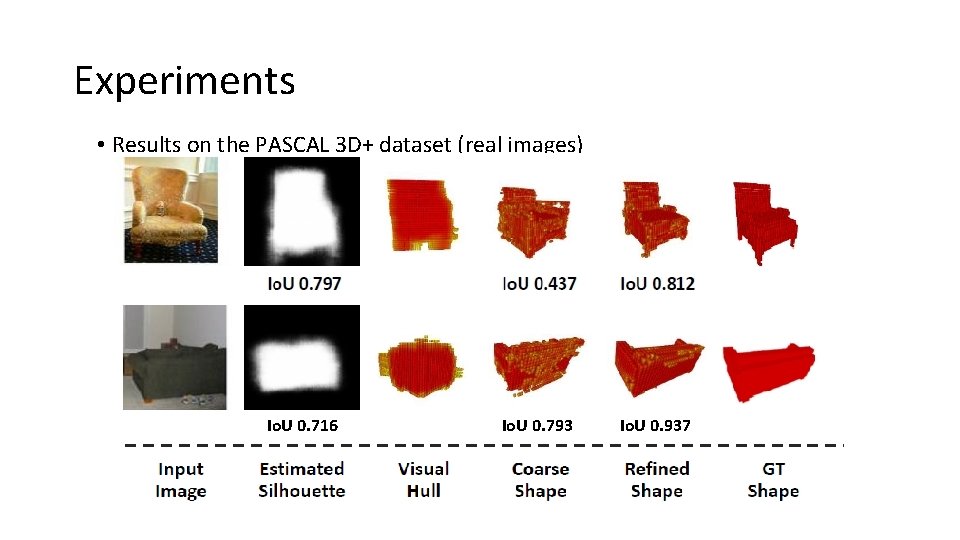
Experiments • Results on the PASCAL 3 D+ dataset (real images) Io. U 0. 716 Io. U 0. 793 Io. U 0. 937
Running Time • ~18 ms for one image (55 fps!) • (Tested with a batch of 24 images on a NVIDIA Tesla M 40 GPU)
Contributions • Embedding Domain knowledge (3 D-2 D perspective geometry) into a DNN • Performing reconstruction jointly with segmentation and pose estimation • A novel, GPU-friendly PSVH (Probabilistic Single-view Visual Hull) layer

Thanks for listening! • Welcome to ask any problem! • Email: hanqingwang@bit. edu. cn
- Slides: 27