
Deep phenotypic analysis of mutated and unmutated CLL
- Slides: 1
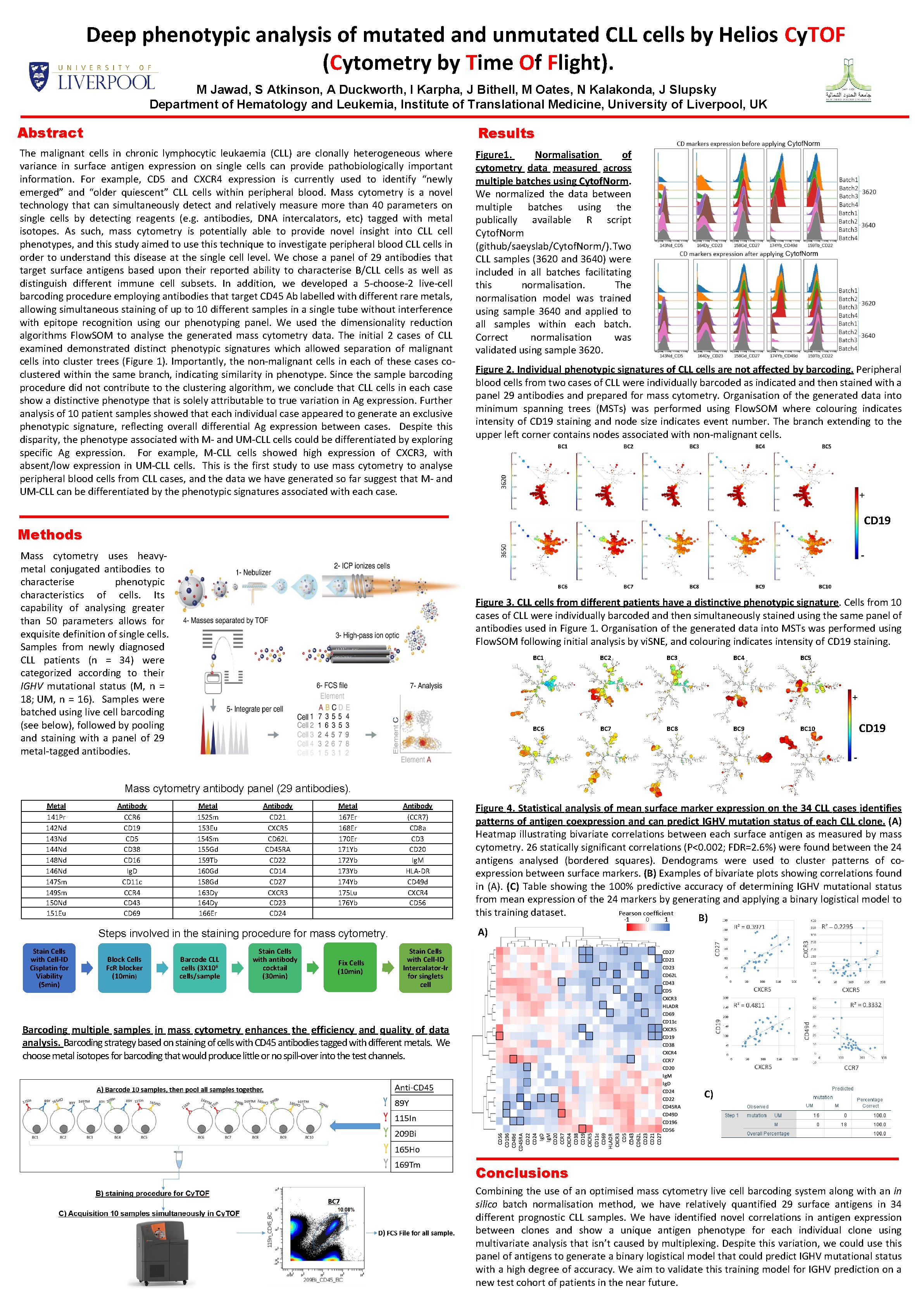
Deep phenotypic analysis of mutated and unmutated CLL cells by Helios Cy. TOF (Cytometry by Time Of Flight). M Jawad, S Atkinson, A Duckworth, I Karpha, J Bithell, M Oates, N Kalakonda, J Slupsky Department of Hematology and Leukemia, Institute of Translational Medicine, University of Liverpool, UK Abstract Results The malignant cells in chronic lymphocytic leukaemia (CLL) are clonally heterogeneous where variance in surface antigen expression on single cells can provide pathobiologically important information. For example, CD 5 and CXCR 4 expression is currently used to identify “newly emerged” and “older quiescent” CLL cells within peripheral blood. Mass cytometry is a novel technology that can simultaneously detect and relatively measure more than 40 parameters on single cells by detecting reagents (e. g. antibodies, DNA intercalators, etc) tagged with metal isotopes. As such, mass cytometry is potentially able to provide novel insight into CLL cell phenotypes, and this study aimed to use this technique to investigate peripheral blood CLL cells in order to understand this disease at the single cell level. We chose a panel of 29 antibodies that target surface antigens based upon their reported ability to characterise B/CLL cells as well as distinguish different immune cell subsets. In addition, we developed a 5 -choose-2 live-cell barcoding procedure employing antibodies that target CD 45 Ab labelled with different rare metals, allowing simultaneous staining of up to 10 different samples in a single tube without interference with epitope recognition using our phenotyping panel. We used the dimensionality reduction algorithms Flow. SOM to analyse the generated mass cytometry data. The initial 2 cases of CLL examined demonstrated distinct phenotypic signatures which allowed separation of malignant cells into cluster trees (Figure 1). Importantly, the non-malignant cells in each of these cases coclustered within the same branch, indicating similarity in phenotype. Since the sample barcoding procedure did not contribute to the clustering algorithm, we conclude that CLL cells in each case show a distinctive phenotype that is solely attributable to true variation in Ag expression. Further analysis of 10 patient samples showed that each individual case appeared to generate an exclusive phenotypic signature, reflecting overall differential Ag expression between cases. Despite this disparity, the phenotype associated with M- and UM-CLL cells could be differentiated by exploring specific Ag expression. For example, M-CLL cells showed high expression of CXCR 3, with absent/low expression in UM-CLL cells. This is the first study to use mass cytometry to analyse peripheral blood cells from CLL cases, and the data we have generated so far suggest that M- and UM-CLL can be differentiated by the phenotypic signatures associated with each case. Figure 1. Normalisation of cytometry data measured across multiple batches using Cytof. Norm. We normalized the data between multiple batches using the publically available R script Cytof. Norm (github/saeyslab/Cytof. Norm/). Two CLL samples (3620 and 3640) were included in all batches facilitating this normalisation. The normalisation model was trained using sample 3640 and applied to all samples within each batch. Correct normalisation was validated using sample 3620. Figure 2. Individual phenotypic signatures of CLL cells are not affected by barcoding. Peripheral blood cells from two cases of CLL were individually barcoded as indicated and then stained with a panel 29 antibodies and prepared for mass cytometry. Organisation of the generated data into minimum spanning trees (MSTs) was performed using Flow. SOM where colouring indicates intensity of CD 19 staining and node size indicates event number. The branch extending to the upper left corner contains nodes associated with non-malignant cells. CD 19 Methods Mass cytometry uses heavymetal conjugated antibodies to characterise phenotypic characteristics of cells. Its capability of analysing greater than 50 parameters allows for exquisite definition of single cells. Samples from newly diagnosed CLL patients (n = 34) were categorized according to their IGHV mutational status (M, n = 18; UM, n = 16). Samples were batched using live cell barcoding (see below), followed by pooling and staining with a panel of 29 metal-tagged antibodies. Figure 3. CLL cells from different patients have a distinctive phenotypic signature. Cells from 10 cases of CLL were individually barcoded and then simultaneously stained using the same panel of antibodies used in Figure 1. Organisation of the generated data into MSTs was performed using Flow. SOM following initial analysis by vi. SNE, and colouring indicates intensity of CD 19 staining. BC 1 BC 2 BC 3 BC 4 BC 5 + BC 6 BC 7 BC 8 BC 9 CD 19 BC 10 - Mass cytometry antibody panel (29 antibodies). Metal 141 Pr 142 Nd 143 Nd 144 Nd 148 Nd 146 Nd 147 Sm 149 Sm 150 Nd 151 Eu Antibody CCR 6 CD 19 CD 5 CD 38 CD 16 Ig. D CD 11 c CCR 4 CD 43 CD 69 Metal 152 Sm 153 Eu 154 Sm 155 Gd 159 Tb 160 Gd 158 Gd 163 Dy 164 Dy 166 Er Antibody CD 21 CXCR 5 CD 62 L CD 45 RA CD 22 CD 14 CD 27 CXCR 3 CD 24 Metal 167 Er 168 Er 170 Er 171 Yb 172 Yb 173 Yb 174 Yb 175 Lu 176 Yb Antibody (CCR 7) CD 8 a CD 3 CD 20 Ig. M HLA-DR CD 49 d CXCR 4 CD 56 -1 Block Cells Fc. R blocker (10 min) Barcode CLL cells (3 X 10⁶ cells/sample Stain Cells with antibody cocktail (30 min) Fix Cells (10 min) 0 1 A) Steps involved in the staining procedure for mass cytometry. Stain Cells with Cell-ID Cisplatin for Viability (5 min) Figure 4. Statistical analysis of mean surface marker expression on the 34 CLL cases identifies patterns of antigen coexpression and can predict IGHV mutation status of each CLL clone. (A) Heatmap illustrating bivariate correlations between each surface antigen as measured by mass cytometry. 26 statically significant correlations (P<0. 002; FDR=2. 6%) were found between the 24 antigens analysed (bordered squares). Dendograms were used to cluster patterns of coexpression between surface markers. (B) Examples of bivariate plots showing correlations found in (A). (C) Table showing the 100% predictive accuracy of determining IGHV mutational status from mean expression of the 24 markers by generating and applying a binary logistical model to Pearson coefficient this training dataset. B) Stain Cells with Cell-ID Intercalator-Ir for singlets cell Barcoding multiple samples in mass cytometry enhances the efficiency and quality of data analysis. Barcoding strategy based on staining of cells with CD 45 antibodies tagged with different metals. We choose metal isotopes for barcoding that would produce little or no spill-over into the test channels. C) Conclusions Combining the use of an optimised mass cytometry live cell barcoding system along with an in silico batch normalisation method, we have relatively quantified 29 surface antigens in 34 different prognostic CLL samples. We have identified novel correlations in antigen expression between clones and show a unique antigen phenotype for each individual clone using multivariate analysis that isn’t caused by multiplexing. Despite this variation, we could use this panel of antigens to generate a binary logistical model that could predict IGHV mutational status with a high degree of accuracy. We aim to validate this training model for IGHV prediction on a new test cohort of patients in the near future.