
Deep Nwell CMOS MAPS with inpixel signal processing
- Slides: 16
Deep N-well CMOS MAPS with in-pixel signal processing and sparsification capabilities for the ILC vertex detector G. Traversi, M. Manghisoni, L. Ratti, V. Re, V. Speziali Università di Pavia Dipartimento di Elettronica Università di Bergamo Dipartimento di Ingegneria Industriale INFN Sezione di Pavia Vertex 2007 – 16 th International Workshop on Vertex Detectors September 23 – 28, 2007 – Lake Placid, NY, USA
Outline 2 Introduction: standard CMOS monolithic active pixel sensors Deep N-Well pixel sensor Description of the sensor level processor Digital section and digital readout scheme Physical simulations Conclusions Sept. 23 - 28, 2007 – Lake Placid, NY, USA 16 th International Workshop on Vertex Detectors
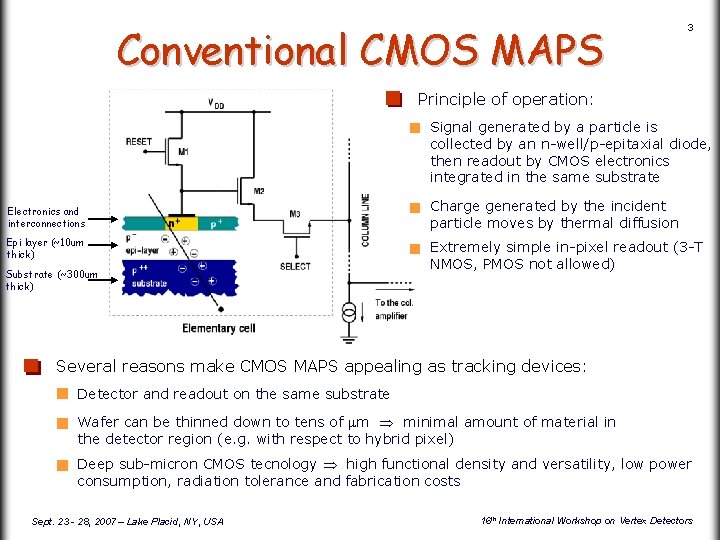
Conventional CMOS MAPS 3 Principle of operation: Signal generated by a particle is collected by an n-well/p-epitaxial diode, then readout by CMOS electronics integrated in the same substrate Electronics and interconnections Epi layer (~10 um thick) Substrate (~300 um thick) Charge generated by the incident particle moves by thermal diffusion Extremely simple in-pixel readout (3 -T NMOS, PMOS not allowed) Several reasons make CMOS MAPS appealing as tracking devices: Detector and readout on the same substrate Wafer can be thinned down to tens of mm minimal amount of material in the detector region (e. g. with respect to hybrid pixel) Deep sub-micron CMOS tecnology high functional density and versatility, low power consumption, radiation tolerance and fabrication costs Sept. 23 - 28, 2007 – Lake Placid, NY, USA 16 th International Workshop on Vertex Detectors
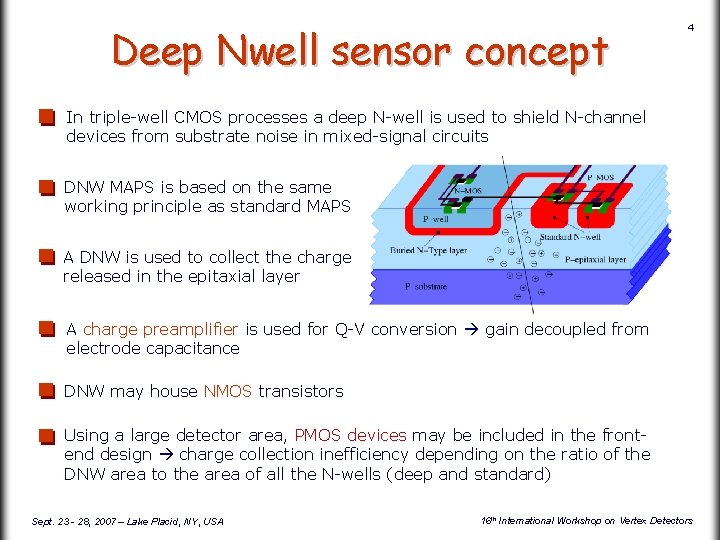
Deep Nwell sensor concept 4 In triple-well CMOS processes a deep N-well is used to shield N-channel devices from substrate noise in mixed-signal circuits DNW MAPS is based on the same working principle as standard MAPS A DNW is used to collect the charge released in the epitaxial layer A charge preamplifier is used for Q-V conversion gain decoupled from electrode capacitance DNW may house NMOS transistors Using a large detector area, PMOS devices may be included in the frontend design charge collection inefficiency depending on the ratio of the DNW area to the area of all the N-wells (deep and standard) Sept. 23 - 28, 2007 – Lake Placid, NY, USA 16 th International Workshop on Vertex Detectors
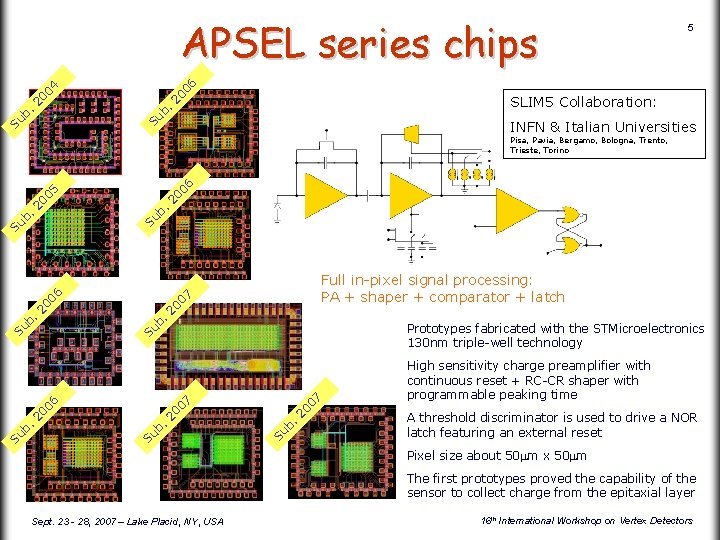
SLIM 5 Collaboration: Su Su b b. . 20 20 04 06 APSEL series chips 5 INFN & Italian Universities 20 06 b. b. 20 20 b. Prototypes fabricated with the STMicroelectronics 130 nm triple-well technology 20 b. Su Su b. 20 20 06 07 07 Su Su b. Su Full in-pixel signal processing: PA + shaper + comparator + latch 07 06 Su Su b. 20 05 Pisa, Pavia, Bergamo, Bologna, Trento, Trieste, Torino High sensitivity charge preamplifier with continuous reset + RC-CR shaper with programmable peaking time A threshold discriminator is used to drive a NOR latch featuring an external reset Pixel size about 50 mm x 50 mm The first prototypes proved the capability of the sensor to collect charge from the epitaxial layer Sept. 23 - 28, 2007 – Lake Placid, NY, USA 16 th International Workshop on Vertex Detectors
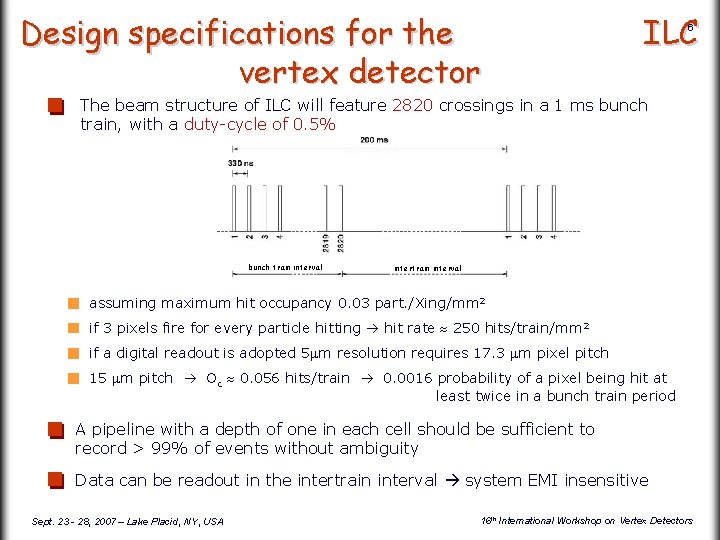
Design specifications for the vertex detector ILC 6 The beam structure of ILC will feature 2820 crossings in a 1 ms bunch train, with a duty-cycle of 0. 5% bunch train interval intertrain interval assuming maximum hit occupancy 0. 03 part. /Xing/mm 2 if 3 pixels fire for every particle hitting hit rate 250 hits/train/mm 2 if a digital readout is adopted 5 mm resolution requires 17. 3 mm pixel pitch 15 mm pitch Oc 0. 056 hits/train 0. 0016 probability of a pixel being hit at least twice in a bunch train period A pipeline with a depth of one in each cell should be sufficient to record > 99% of events without ambiguity Data can be readout in the intertrain interval system EMI insensitive Sept. 23 - 28, 2007 – Lake Placid, NY, USA 16 th International Workshop on Vertex Detectors
Sparsified readout architecture 7 In DNW MAPS sensors for ILC sparsification is based on a token passing readout scheme suggested by R. Yarema (R. Yarema, “Fermilab Initiatives in 3 D Integrated Circuits and SOI Design for HEP”, ILC VTX Workshop at Ringberg, May 2006) MAPS sensor operation is tailored on the structure of ILC beam Detection phase (corresponding to the bunch train interval) Readout phase (corresponding to the intertrain interval) Sept. 23 - 28, 2007 – Lake Placid, NY, USA 16 th International Workshop on Vertex Detectors
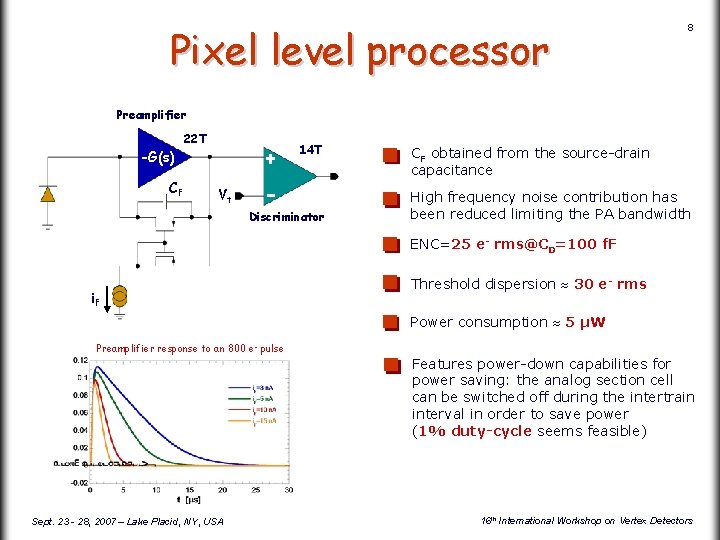
Pixel level processor 8 Preamplifier 22 T 14 T -G(s) CF Vt Discriminator CF obtained from the source-drain capacitance High frequency noise contribution has been reduced limiting the PA bandwidth ENC=25 e- rms@CD=100 f. F i. F Threshold dispersion 30 e- rms Power consumption 5 μW Preamplifier response to an 800 e - pulse Sept. 23 - 28, 2007 – Lake Placid, NY, USA Features power-down capabilities for power saving: the analog section cell can be switched off during the intertrain interval in order to save power (1% duty-cycle seems feasible) 16 th International Workshop on Vertex Detectors
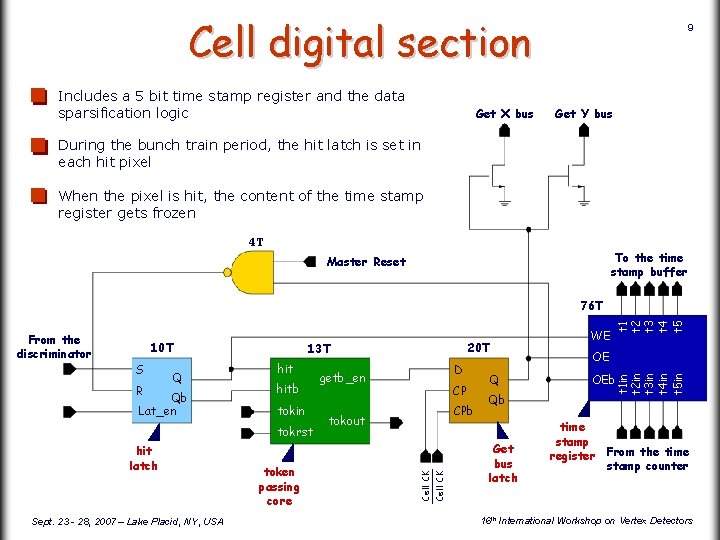
Cell digital section Includes a 5 bit time stamp register and the data sparsification logic Get X bus 9 Get Y bus During the bunch train period, the hit latch is set in each hit pixel When the pixel is hit, the content of the time stamp register gets frozen 4 T To the time stamp buffer Master Reset R Q Qb Lat_en hitb tokin tokrst hit latch Sept. 23 - 28, 2007 – Lake Placid, NY, USA token passing core D getb_en CP CPb tokout Cell CK S 20 T 13 T Q Qb Get bus latch WE OE OEb t 1 in t 2 in t 3 in t 4 in t 5 in 10 T Cell CK From the discriminator t 1 t 2 t 3 t 4 t 5 76 T time stamp register From the time stamp counter 16 th International Workshop on Vertex Detectors
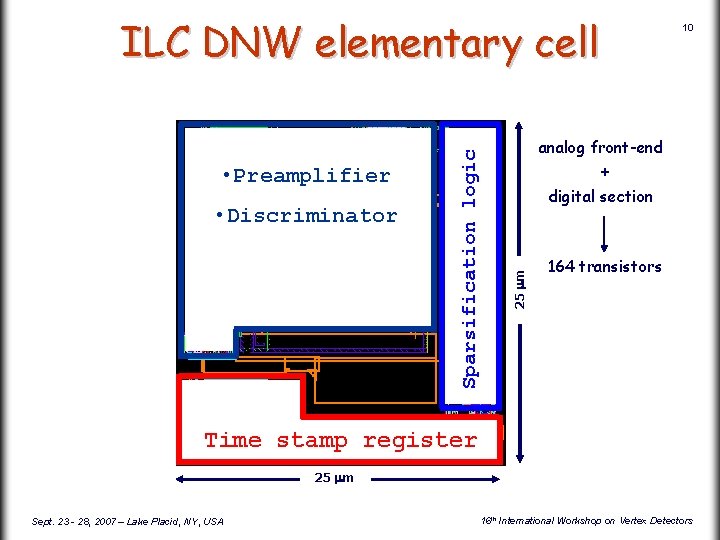
• Discriminator DNW sensor analog front-end + digital section 25 mm • Preamplifier Sparsification logic ILC DNW elementary cell 10 164 transistors Time stamp register 25 mm Sept. 23 - 28, 2007 – Lake Placid, NY, USA 16 th International Workshop on Vertex Detectors
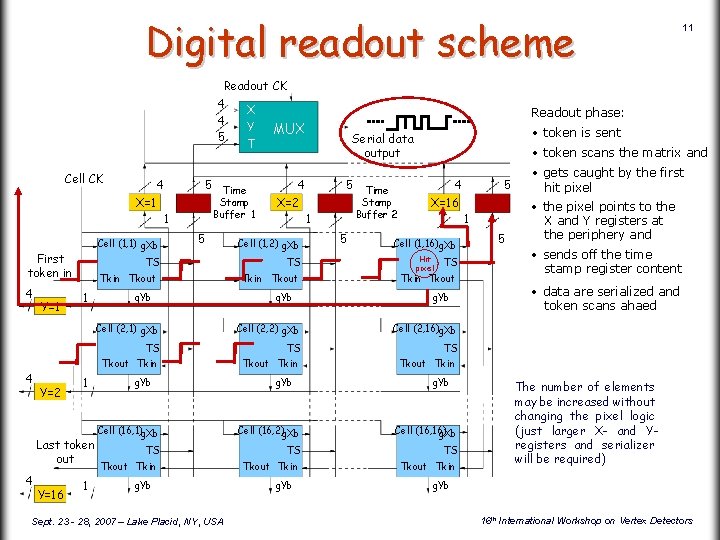
Digital readout scheme Readout CK 4 X 4 Y MUX 5 T Cell CK 4 X=1 Cell (1, 1) g. Xb First token in 4 Y=1 5 Time Stamp Buffer 1 1 5 TS Tkin Tkout 1 g. Yb Cell (2, 1) g. Xb TS 4 Tkout Tkin Y=2 1 Last token out 4 Y=16 1 g. Yb 4 X=2 Cell (1, 2) g. Xb TS Tkin Tkout g. Yb Cell (2, 2) g. Xb TS Tkout Tkin g. Yb Readout phase: • token is sent Serial data output 5 1 5 Time Stamp Buffer 2 • token scans the matrix and 4 X=16 Cell (1, 16)g. Xb Hit pixel TS Tkin Tkout g. Yb Cell (2, 16)g. Xb g. Yb Cell (16, 16) g. Xb TS TS TS g. Yb Sept. 23 - 28, 2007 – Lake Placid, NY, USA g. Yb • gets caught by the first Timehit pixel Stamp • the Buffer 16 1 5 pixel points to the X and Y registers at the periphery and g. Xb=get_X_bus • sends off the time content g. Yb=get_Y_bus stamp register TS=Time_Stamp • data are serialized and ahaed Tkin=token_in token scans Tkout=Token_out TS Cell (16, 2)g. Xb Tkout Tkin 5 Tkout Tkin Cell (16, 1)g. Xb Tkout Tkin 11 Tkout Tkin The number of elements may be increased without changing the pixel logic (just larger X- and Yregisters and serializer will be required) g. Yb 16 th International Workshop on Vertex Detectors
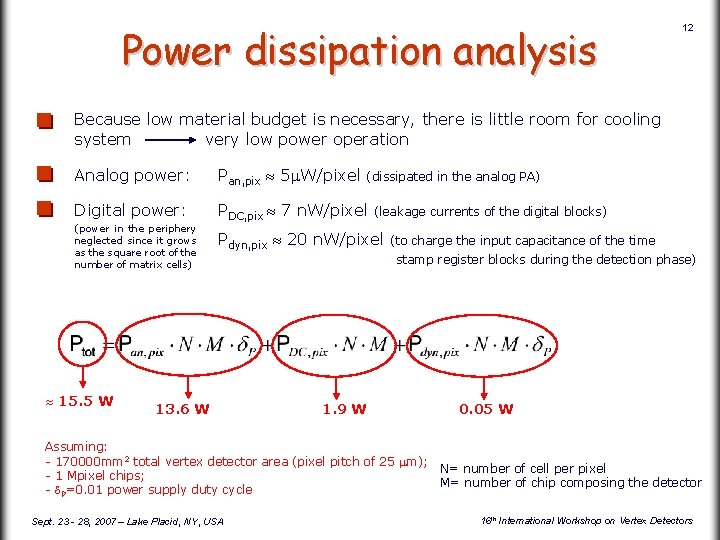
Power dissipation analysis 12 Because low material budget is necessary, there is little room for cooling system very low power operation Analog power: Pan, pix 5 m. W/pixel Digital power: PDC, pix 7 n. W/pixel (power in the periphery neglected since it grows as the square root of the number of matrix cells) 15. 5 W (dissipated in the analog PA) (leakage currents of the digital blocks) Pdyn, pix 20 n. W/pixel 13. 6 W (to charge the input capacitance of the time stamp register blocks during the detection phase) 1. 9 W 0. 05 W Assuming: - 170000 mm 2 total vertex detector area (pixel pitch of 25 mm); N= number of cell per pixel - 1 Mpixel chips; M= number of chip composing the detector - d. P=0. 01 power supply duty cycle Sept. 23 - 28, 2007 – Lake Placid, NY, USA 16 th International Workshop on Vertex Detectors
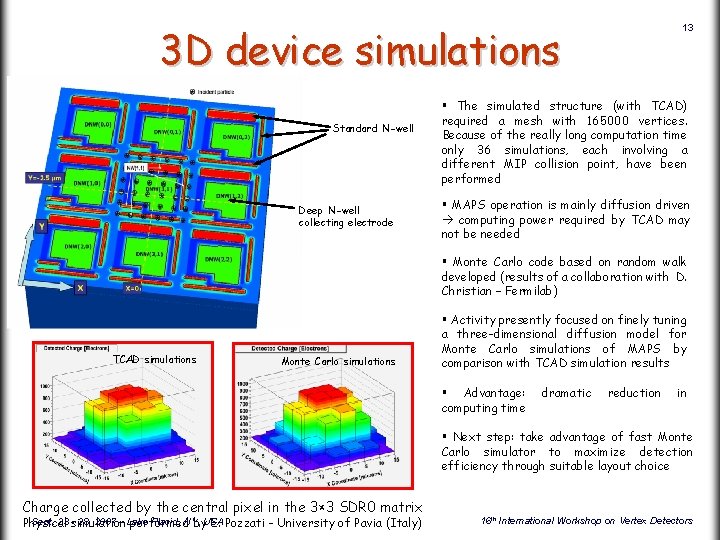
3 D device simulations Standard N-well Deep N-well collecting electrode 13 § The simulated structure (with TCAD) required a mesh with 165000 vertices. Because of the really long computation time only 36 simulations, each involving a different MIP collision point, have been performed § MAPS operation is mainly diffusion driven computing power required by TCAD may not be needed § Monte Carlo code based on random walk developed (results of a collaboration with D. Christian – Fermilab) TCAD simulations Monte Carlo simulations § Activity presently focused on finely tuning a three-dimensional diffusion model for Monte Carlo simulations of MAPS by comparison with TCAD simulation results § Advantage: computing time dramatic reduction in § Next step: take advantage of fast Monte Carlo simulator to maximize detection efficiency through suitable layout choice Charge collected by the central pixel in the 3× 3 SDR 0 matrix Sept. 23 simulation - 28, 2007 – Lake Placid, NY, Physical performed by. USA E. Pozzati - University of Pavia (Italy) 16 th International Workshop on Vertex Detectors
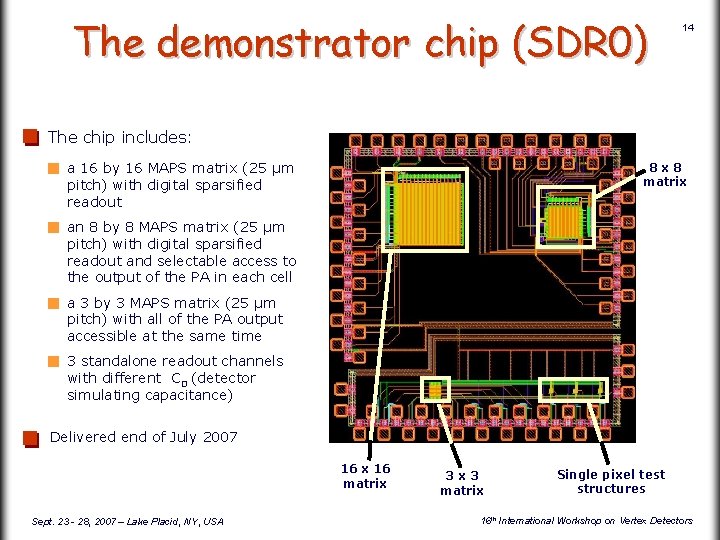
The demonstrator chip (SDR 0) 14 The chip includes: a 16 by 16 MAPS matrix (25 μm pitch) with digital sparsified readout 8 x 8 matrix an 8 by 8 MAPS matrix (25 μm pitch) with digital sparsified readout and selectable access to the output of the PA in each cell a 3 by 3 MAPS matrix (25 μm pitch) with all of the PA output accessible at the same time 3 standalone readout channels with different CD (detector simulating capacitance) Delivered end of July 2007 16 x 16 matrix Sept. 23 - 28, 2007 – Lake Placid, NY, USA 3 x 3 matrix Single pixel test structures 16 th International Workshop on Vertex Detectors
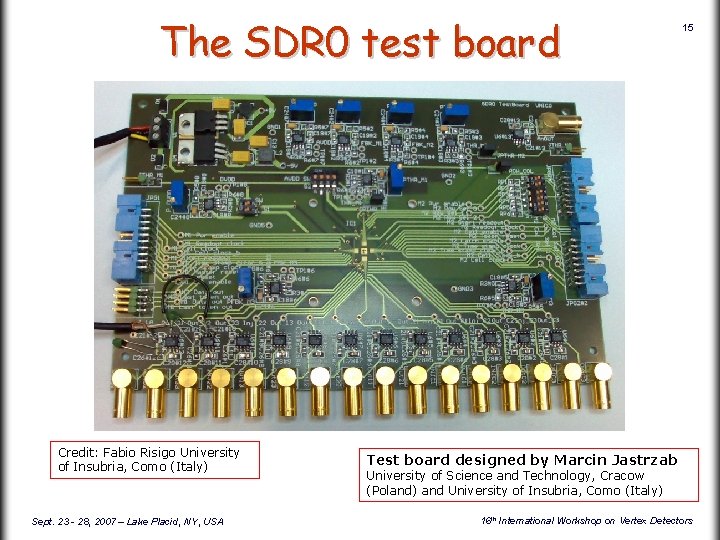
The SDR 0 test board Credit: Fabio Risigo University of Insubria, Como (Italy) Sept. 23 - 28, 2007 – Lake Placid, NY, USA 15 Test board designed by Marcin Jastrzab University of Science and Technology, Cracow (Poland) and University of Insubria, Como (Italy) 16 th International Workshop on Vertex Detectors
Conclusions 16 New DNW MAPS structures with optimized noise and threshold dispersion characteristics have been fabricated in the 130 nm, triple well STM CMOS technology Study of the charge collection efficiency and of charge spreading in the epi-layer is underway to assess their suitability for tracking and vertexing applications Monte Carlo method will be used, besides Synopsys TCAD software package, in the design of the next generation prototype chips Characterization of a DNW MAPS demonstrator aimed at vertexing applications at the ILC is foregoing Plans for the future: design of a 256 x 256 matrix for beam test evaluation of more scaled technologies (90 nm CMOS) Sept. 23 - 28, 2007 – Lake Placid, NY, USA 16 th International Workshop on Vertex Detectors