
Deep Lung 3 D Deep Convolutional Nets for
- Slides: 1
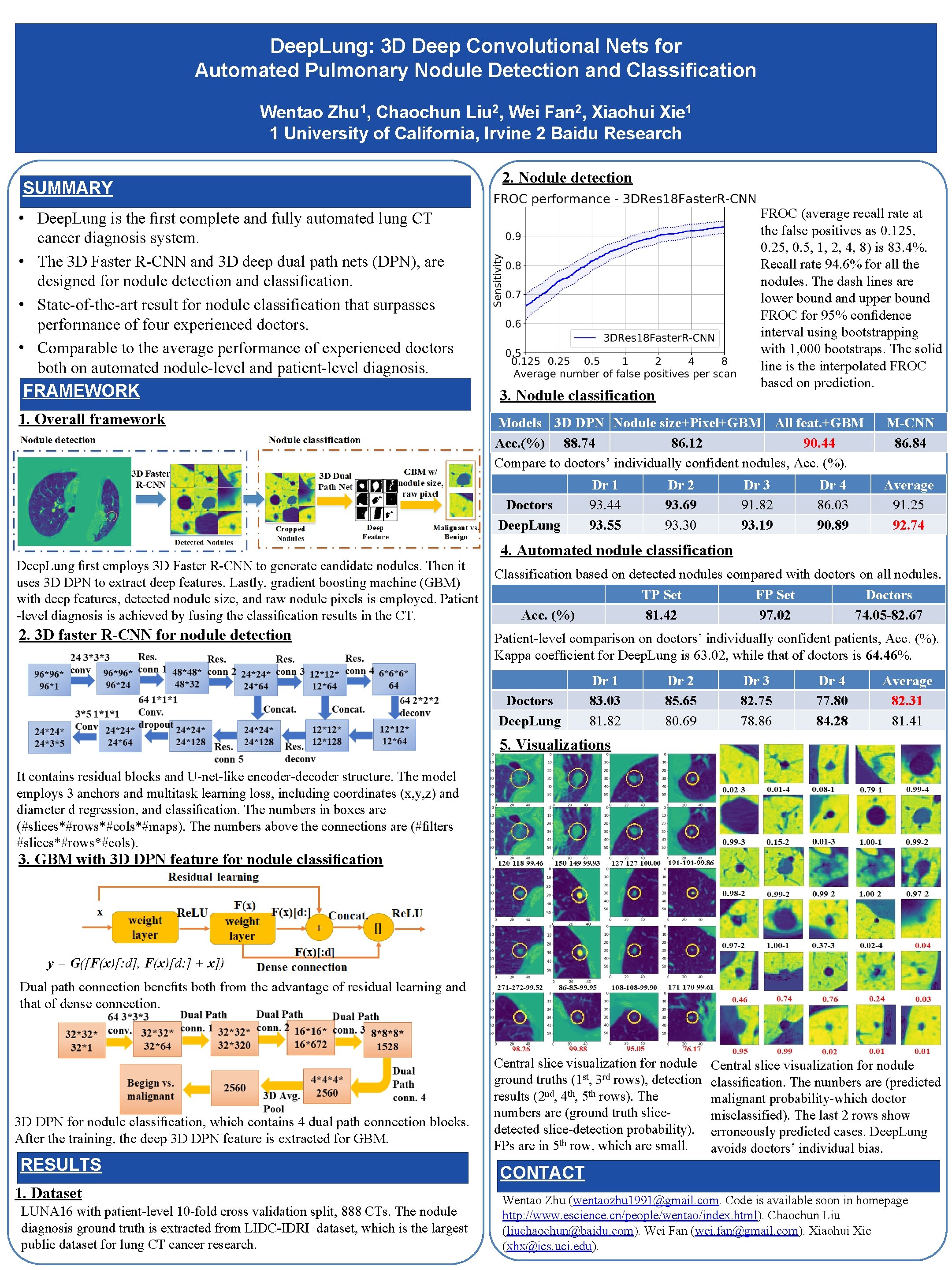
Deep. Lung: 3 D Deep Convolutional Nets for Automated Pulmonary Nodule Detection and Classification Wentao Zhu 1, Chaochun Liu 2, Wei Fan 2, Xiaohui Xie 1 1 University of California, Irvine 2 Baidu Research SUMMARY 2. Nodule detection FROC (average recall rate at the false positives as 0. 125, 0. 5, 1, 2, 4, 8) is 83. 4%. Recall rate 94. 6% for all the nodules. The dash lines are lower bound and upper bound FROC for 95% confidence interval using bootstrapping with 1, 000 bootstraps. The solid line is the interpolated FROC based on prediction. • Deep. Lung is the first complete and fully automated lung CT cancer diagnosis system. • The 3 D Faster R-CNN and 3 D deep dual path nets (DPN), are designed for nodule detection and classification. • State-of-the-art result for nodule classification that surpasses performance of four experienced doctors. • Comparable to the average performance of experienced doctors both on automated nodule-level and patient-level diagnosis. FRAMEWORK 1. Overall framework 3. Nodule classification Models 3 D DPN Nodule size+Pixel+GBM All feat. +GBM Acc. (%) 88. 74 86. 12 90. 44 Compare to doctors’ individually confident nodules, Acc. (%). Doctors Deep. Lung first employs 3 D Faster R-CNN to generate candidate nodules. Then it uses 3 D DPN to extract deep features. Lastly, gradient boosting machine (GBM) with deep features, detected nodule size, and raw nodule pixels is employed. Patient -level diagnosis is achieved by fusing the classification results in the CT. 2. 3 D faster R-CNN for nodule detection Dr 1 93. 44 93. 55 Dr 2 93. 69 93. 30 Dr 3 91. 82 93. 19 Dr 4 86. 03 90. 89 M-CNN 86. 84 Average 91. 25 92. 74 4. Automated nodule classification Classification based on detected nodules compared with doctors on all nodules. TP Set FP Set Doctors Acc. (%) 81. 42 97. 02 74. 05 -82. 67 Patient-level comparison on doctors’ individually confident patients, Acc. (%). Kappa coefficient for Deep. Lung is 63. 02, while that of doctors is 64. 46%. Doctors Deep. Lung Dr 1 83. 03 81. 82 Dr 2 85. 65 80. 69 Dr 3 82. 75 78. 86 Dr 4 77. 80 84. 28 Average 82. 31 81. 41 5. Visualizations It contains residual blocks and U-net-like encoder-decoder structure. The model employs 3 anchors and multitask learning loss, including coordinates (x, y, z) and diameter d regression, and classification. The numbers in boxes are (#slices*#rows*#cols*#maps). The numbers above the connections are (#filters #slices*#rows*#cols). 3. GBM with 3 D DPN feature for nodule classification y = G([F(x)[: d], F(x)[d: ] + x]) Dual path connection benefits both from the advantage of residual learning and that of dense connection. 3 D DPN for nodule classification, which contains 4 dual path connection blocks. After the training, the deep 3 D DPN feature is extracted for GBM. RESULTS 1. Dataset LUNA 16 with patient-level 10 -fold cross validation split, 888 CTs. The nodule diagnosis ground truth is extracted from LIDC-IDRI dataset, which is the largest public dataset for lung CT cancer research. Central slice visualization for nodule ground truths (1 st, 3 rd rows), detection results (2 nd, 4 th, 5 th rows). The numbers are (ground truth slicedetected slice-detection probability). FPs are in 5 th row, which are small. Central slice visualization for nodule classification. The numbers are (predicted malignant probability-which doctor misclassified). The last 2 rows show erroneously predicted cases. Deep. Lung avoids doctors’ individual bias. CONTACT Wentao Zhu (wentaozhu 1991@gmail. com. Code is available soon in homepage http: //www. escience. cn/people/wentao/index. html). Chaochun Liu (liuchaochun@baidu. com). Wei Fan (wei. fan@gmail. com). Xiaohui Xie (xhx@ics. uci. edu).