
Deep learning for visual recognition Thurs April 27
![Features have been key SIFT [Lowe IJCV 04] SPM [Lazebnik et al. CVPR 06]](https://slidetodoc.com/presentation_image_h2/7de5e9f391592d72d2d1d0850041c4f6/image-6.jpg "Features have been key SIFT [Lowe IJCV 04] SPM [Lazebnik et al. CVPR 06]")

![Neocognitron [Fukushima, Biological Cybernetics 1980] Deformation-Resistant Recognition S-cells: (simple) - extract local features C-cells:](https://slidetodoc.com/presentation_image_h2/7de5e9f391592d72d2d1d0850041c4f6/image-26.jpg "Neocognitron [Fukushima, Biological Cybernetics 1980] Deformation-Resistant Recognition S-cells: (simple) - extract local features C-cells:")
![Le. Net [Le. Cun et al. 1998] Gradient-based learning applied to document recognition [Le.](https://slidetodoc.com/presentation_image_h2/7de5e9f391592d72d2d1d0850041c4f6/image-27.jpg "Le. Net [Le. Cun et al. 1998] Gradient-based learning applied to document recognition [Le.")
![SIFT Descriptor Image Pixels Lowe [IJCV 2004] Apply oriented filters Spatial pool (Sum) Normalize](https://slidetodoc.com/presentation_image_h2/7de5e9f391592d72d2d1d0850041c4f6/image-35.jpg "SIFT Descriptor Image Pixels Lowe [IJCV 2004] Apply oriented filters Spatial pool (Sum) Normalize")
![Spatial Pyramid Matching SIFT Features Filter with Visual Words Lazebnik, Schmid, Ponce [CVPR 2006]](https://slidetodoc.com/presentation_image_h2/7de5e9f391592d72d2d1d0850041c4f6/image-36.jpg "Spatial Pyramid Matching SIFT Features Filter with Visual Words Lazebnik, Schmid, Ponce [CVPR 2006]")
![Applications • Handwritten text/digits – MNIST (0. 17% error [Ciresan et al. 2011]) –](https://slidetodoc.com/presentation_image_h2/7de5e9f391592d72d2d1d0850041c4f6/image-37.jpg "Applications • Handwritten text/digits – MNIST (0. 17% error [Ciresan et al. 2011]) –")
![CNN for Regression Deep. Pose [Toshev and Szegedy CVPR 2014] Jia-Bin Huang and Derek](https://slidetodoc.com/presentation_image_h2/7de5e9f391592d72d2d1d0850041c4f6/image-46.jpg "CNN for Regression Deep. Pose [Toshev and Szegedy CVPR 2014] Jia-Bin Huang and Derek")

- Slides: 48
Deep learning for visual recognition Thurs April 27 Kristen Grauman UT Austin
Last time • Support vector machines (wrap-up) • Pyramid match kernels • Evaluation • Scoring an object detector • Scoring a multi-class recognition system
Today • (Deep) Neural networks • Convolutional neural networks
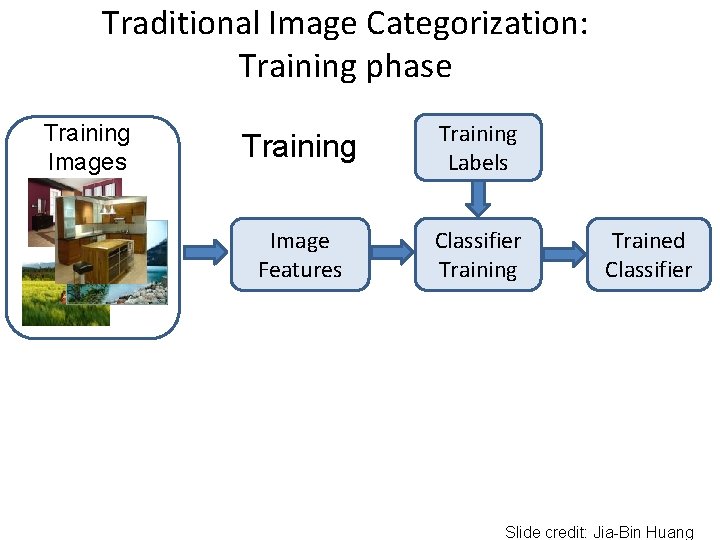
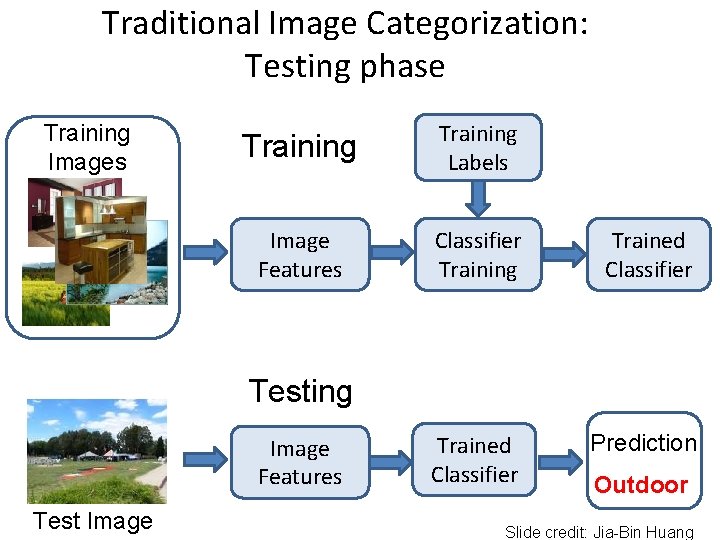
Traditional Image Categorization: Training phase Training Images Training Labels Image Features Classifier Training Trained Classifier Slide credit: Jia-Bin Huang
Traditional Image Categorization: Testing phase Training Images Training Labels Image Features Classifier Training Trained Classifier Prediction Testing Image Features Test Image Outdoor Slide credit: Jia-Bin Huang
Features have been key SIFT [Lowe IJCV 04] SPM [Lazebnik et al. CVPR 06] HOG [Dalal and Triggs CVPR 05] Textons and many others: SURF, MSER, LBP, Color-SIFT, Color histogram, GLOH, …. .
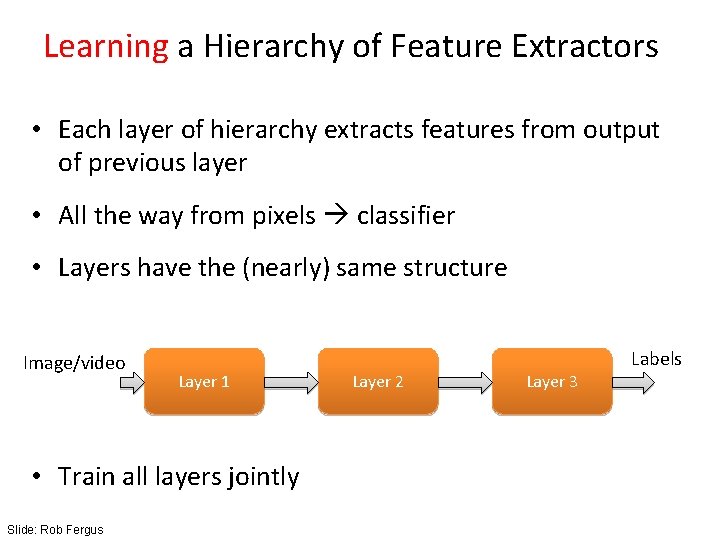
Learning a Hierarchy of Feature Extractors • Each layer of hierarchy extracts features from output of previous layer • All the way from pixels classifier • Layers have the (nearly) same structure Image/video Image/Video Pixels Layer 1 • Train all layers jointly Slide: Rob Fergus Layer 2 Layer 3 Labels Simple Classifie
Learning Feature Hierarchy Goal: Learn useful higher-level features from images Feature representation Input data 3 rd layer “Objects” 2 nd layer “Object parts” Lee et al. , ICML 2009; CACM 2011 1 st layer “Edges” Pixels Slide: Rob Fergus
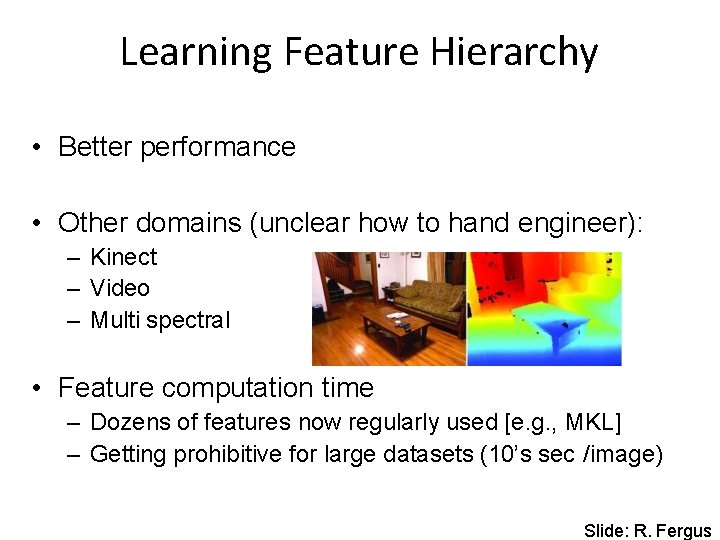
Learning Feature Hierarchy • Better performance • Other domains (unclear how to hand engineer): – Kinect – Video – Multi spectral • Feature computation time – Dozens of features now regularly used [e. g. , MKL] – Getting prohibitive for large datasets (10’s sec /image) Slide: R. Fergus
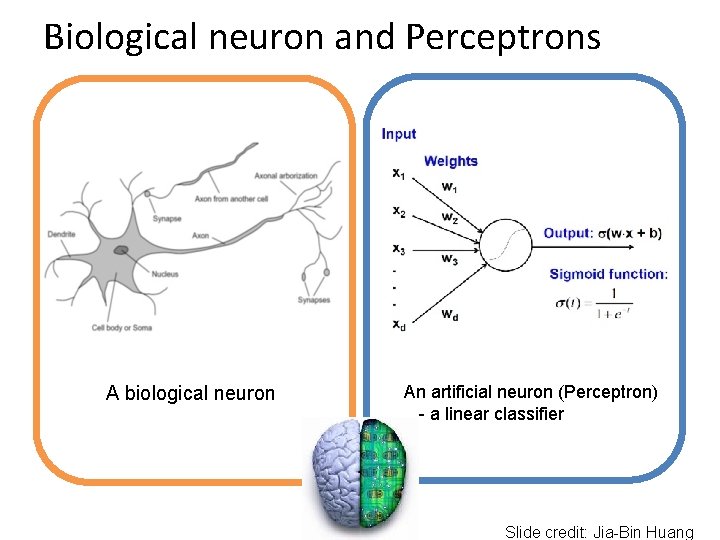
Biological neuron and Perceptrons A biological neuron An artificial neuron (Perceptron) - a linear classifier Slide credit: Jia-Bin Huang
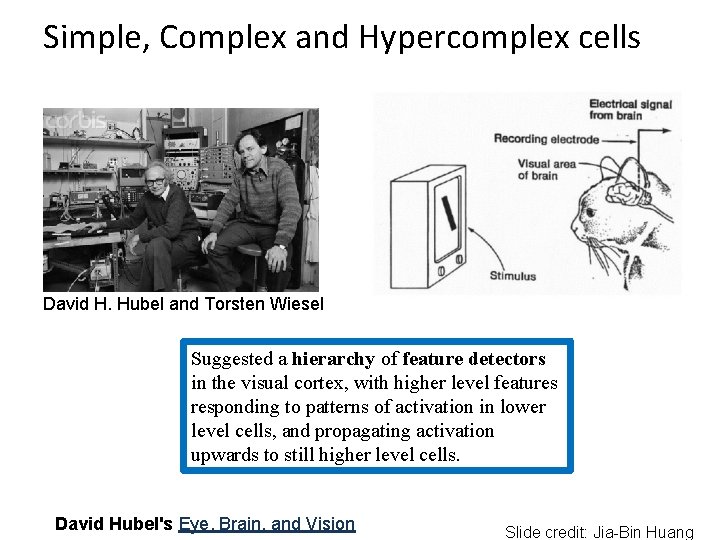
Simple, Complex and Hypercomplex cells David H. Hubel and Torsten Wiesel Suggested a hierarchy of feature detectors in the visual cortex, with higher level features responding to patterns of activation in lower level cells, and propagating activation upwards to still higher level cells. David Hubel's Eye, Brain, and Vision Slide credit: Jia-Bin Huang
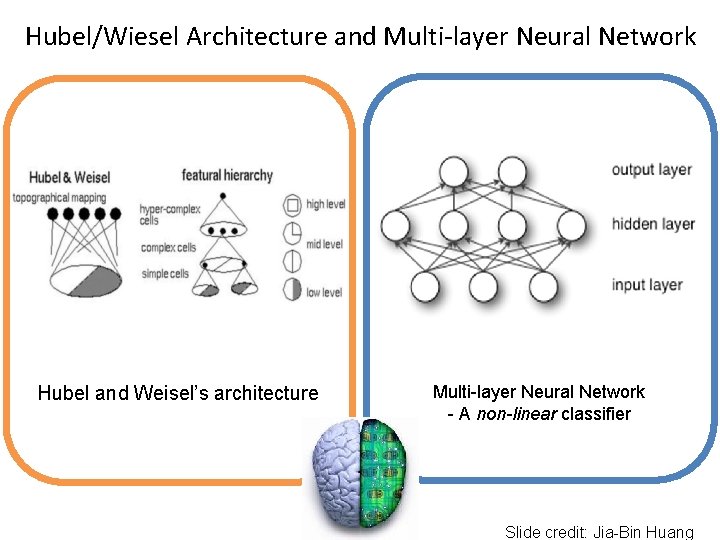
Hubel/Wiesel Architecture and Multi-layer Neural Network Hubel and Weisel’s architecture Multi-layer Neural Network - A non-linear classifier Slide credit: Jia-Bin Huang
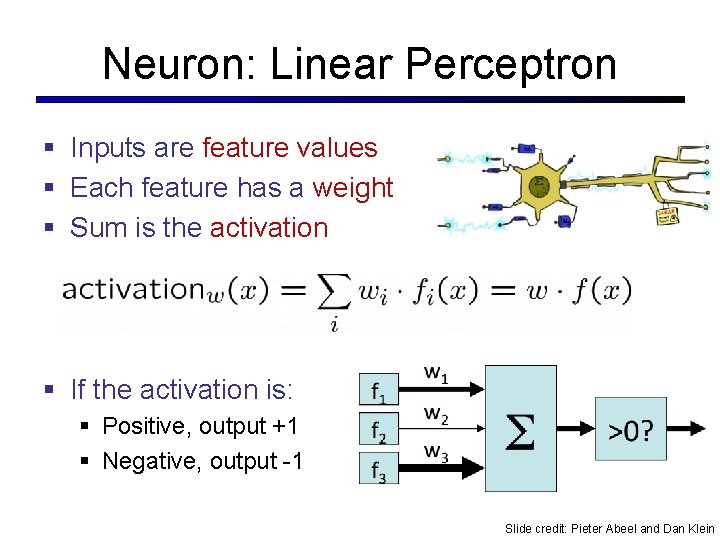
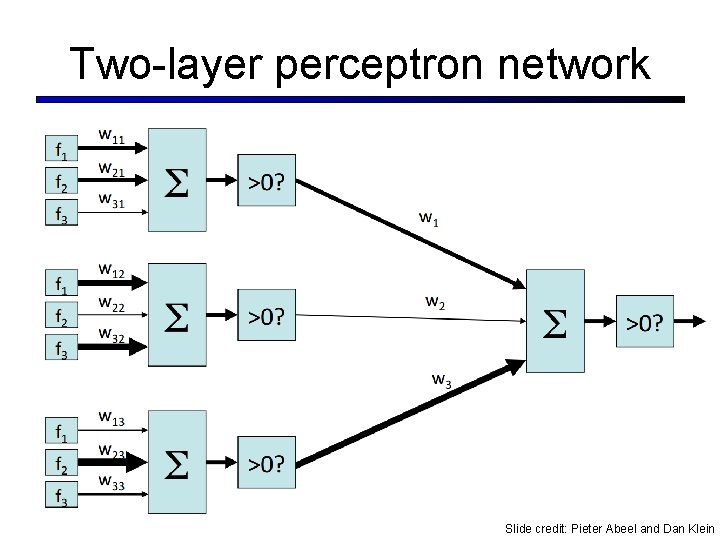
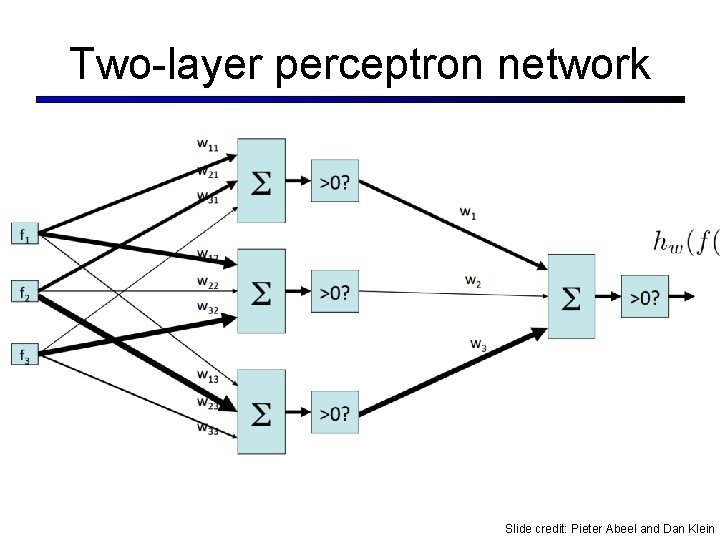
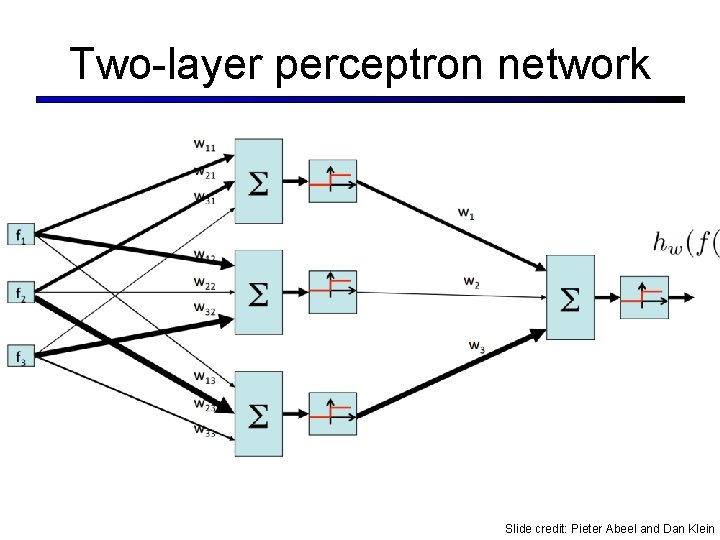
Neuron: Linear Perceptron § Inputs are feature values § Each feature has a weight § Sum is the activation § If the activation is: § Positive, output +1 § Negative, output -1 Slide credit: Pieter Abeel and Dan Klein
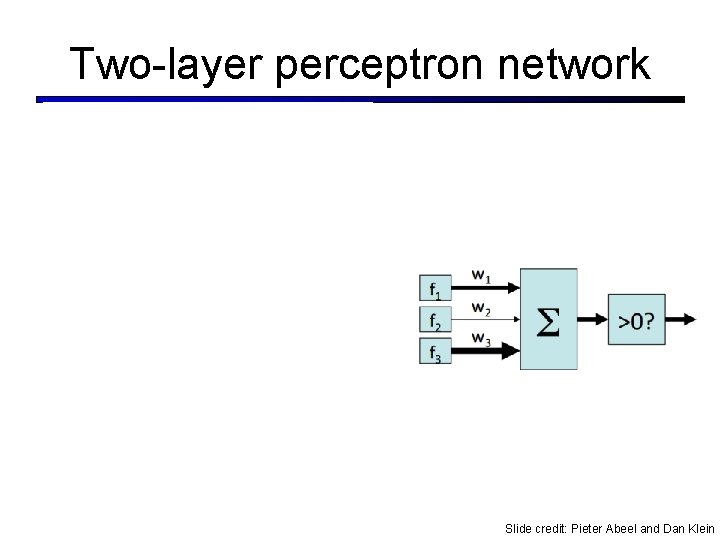
Two-layer perceptron network Slide credit: Pieter Abeel and Dan Klein
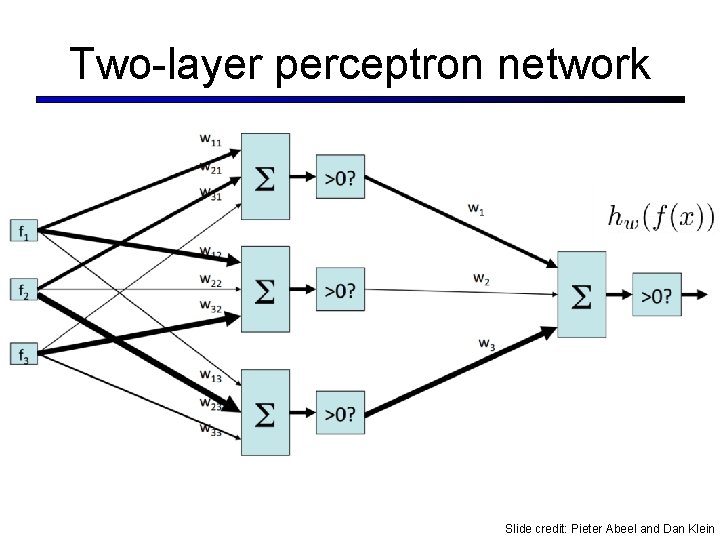
Two-layer perceptron network Slide credit: Pieter Abeel and Dan Klein
Two-layer perceptron network Slide credit: Pieter Abeel and Dan Klein
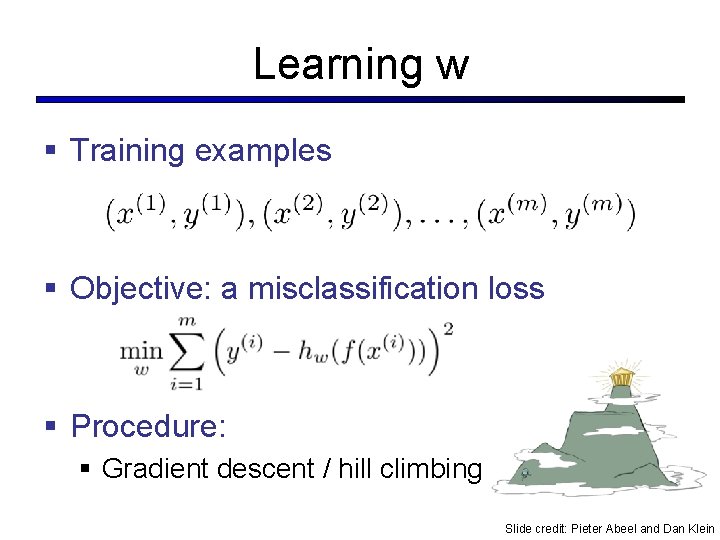
Learning w § Training examples § Objective: a misclassification loss § Procedure: § Gradient descent / hill climbing Slide credit: Pieter Abeel and Dan Klein
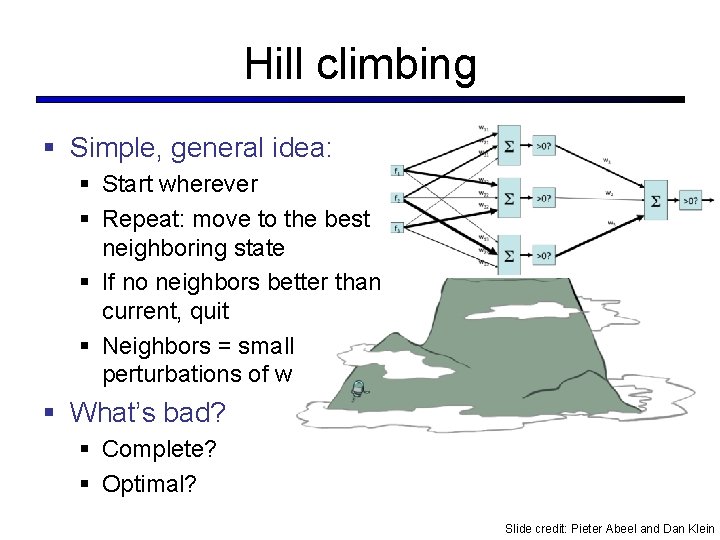
Hill climbing § Simple, general idea: § Start wherever § Repeat: move to the best neighboring state § If no neighbors better than current, quit § Neighbors = small perturbations of w § What’s bad? § Complete? § Optimal? Slide credit: Pieter Abeel and Dan Klein
Two-layer perceptron network Slide credit: Pieter Abeel and Dan Klein
Two-layer perceptron network Slide credit: Pieter Abeel and Dan Klein
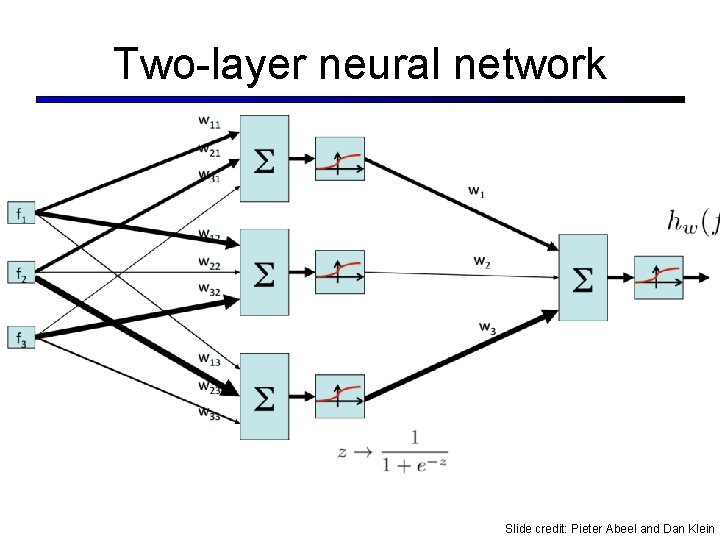
Two-layer neural network Slide credit: Pieter Abeel and Dan Klein
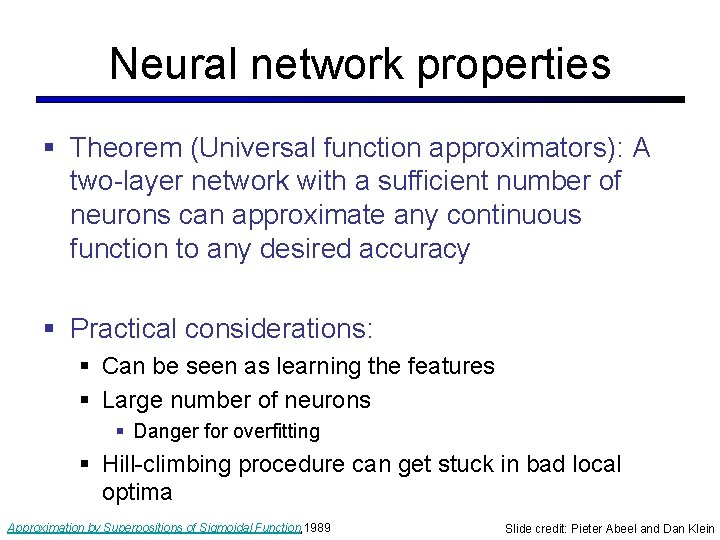
Neural network properties § Theorem (Universal function approximators): A two-layer network with a sufficient number of neurons can approximate any continuous function to any desired accuracy § Practical considerations: § Can be seen as learning the features § Large number of neurons § Danger for overfitting § Hill-climbing procedure can get stuck in bad local optima Approximation by Superpositions of Sigmoidal Function, 1989 Slide credit: Pieter Abeel and Dan Klein
Today • (Deep) Neural networks • Convolutional neural networks
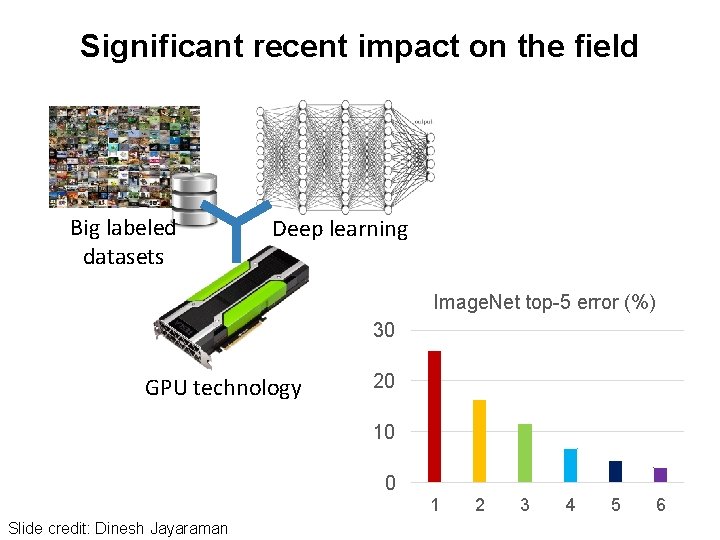
Significant recent impact on the field Big labeled datasets Deep learning Image. Net top-5 error (%) 30 GPU technology 20 10 0 1 Slide credit: Dinesh Jayaraman 2 3 4 5 6
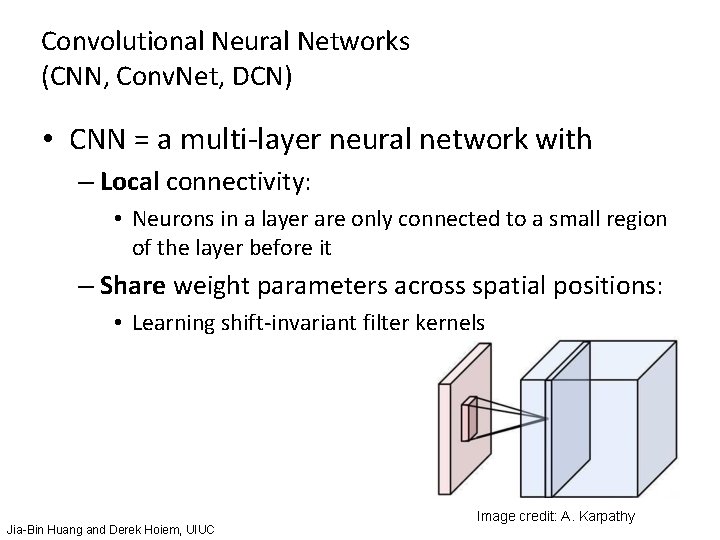
Convolutional Neural Networks (CNN, Conv. Net, DCN) • CNN = a multi-layer neural network with – Local connectivity: • Neurons in a layer are only connected to a small region of the layer before it – Share weight parameters across spatial positions: • Learning shift-invariant filter kernels Jia-Bin Huang and Derek Hoiem, UIUC Image credit: A. Karpathy
Neocognitron [Fukushima, Biological Cybernetics 1980] Deformation-Resistant Recognition S-cells: (simple) - extract local features C-cells: (complex) - allow for positional errors Jia-Bin Huang and Derek Hoiem, UIUC
Le. Net [Le. Cun et al. 1998] Gradient-based learning applied to document recognition [Le. Cun, Bottou, Bengio, Haffner 1998] Jia-Bin Huang and Derek Hoiem, UIUC Le. Net-1 from 1993
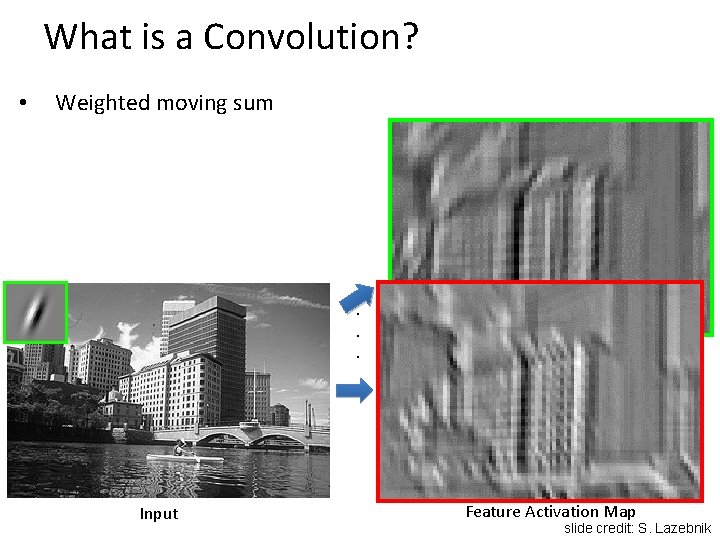
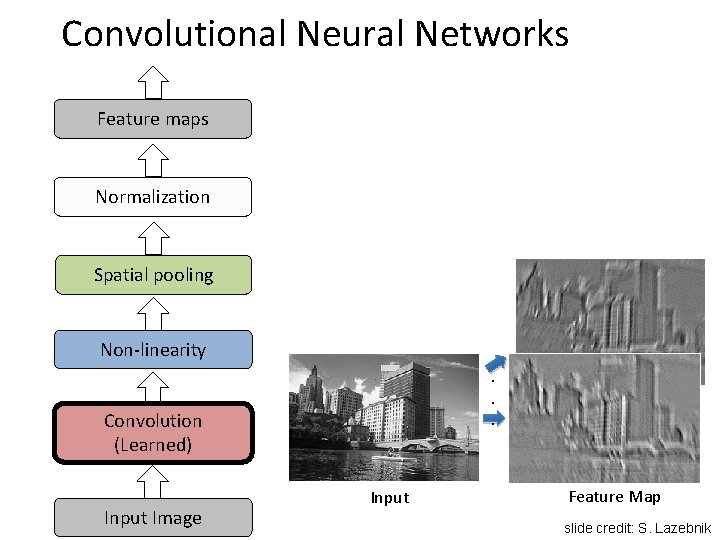
What is a Convolution? • Weighted moving sum . . . Input Feature Activation Map slide credit: S. Lazebnik
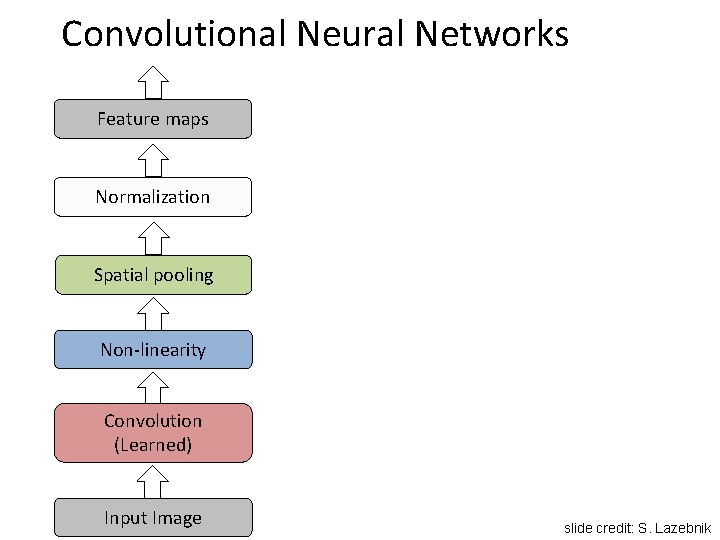
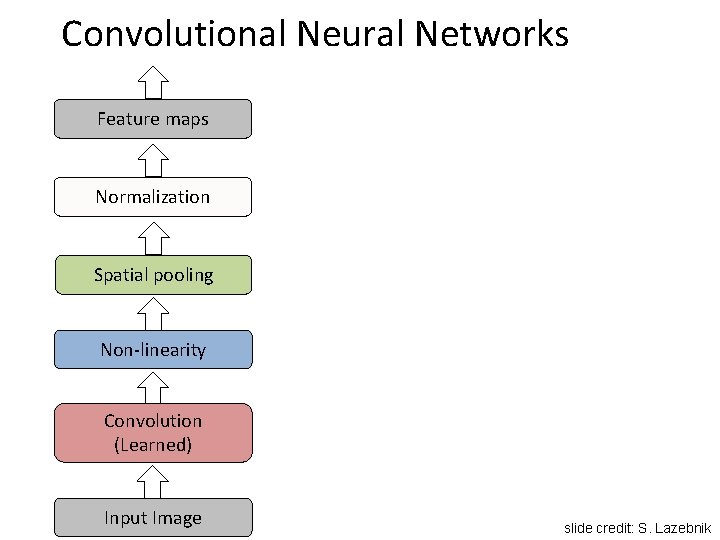
Convolutional Neural Networks Feature maps Normalization Spatial pooling Non-linearity Convolution (Learned) Input Image slide credit: S. Lazebnik
Convolutional Neural Networks Feature maps Normalization Spatial pooling Non-linearity. . . Convolution (Learned) Input Image Input Feature Map slide credit: S. Lazebnik
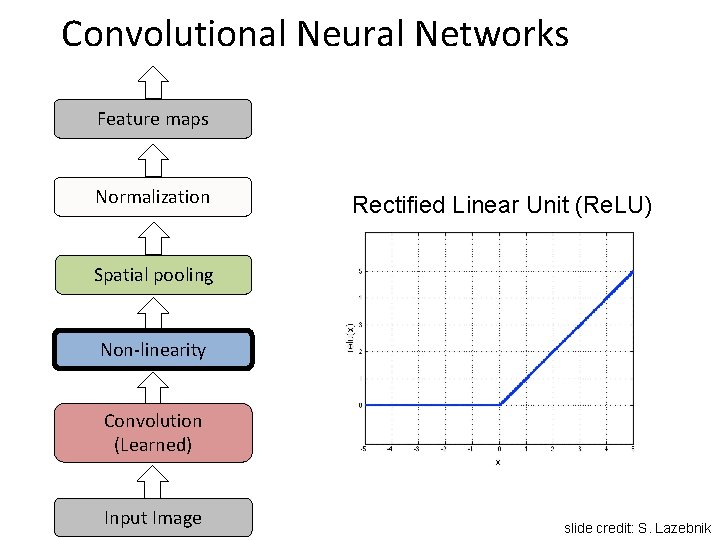
Convolutional Neural Networks Feature maps Normalization Rectified Linear Unit (Re. LU) Spatial pooling Non-linearity Convolution (Learned) Input Image slide credit: S. Lazebnik
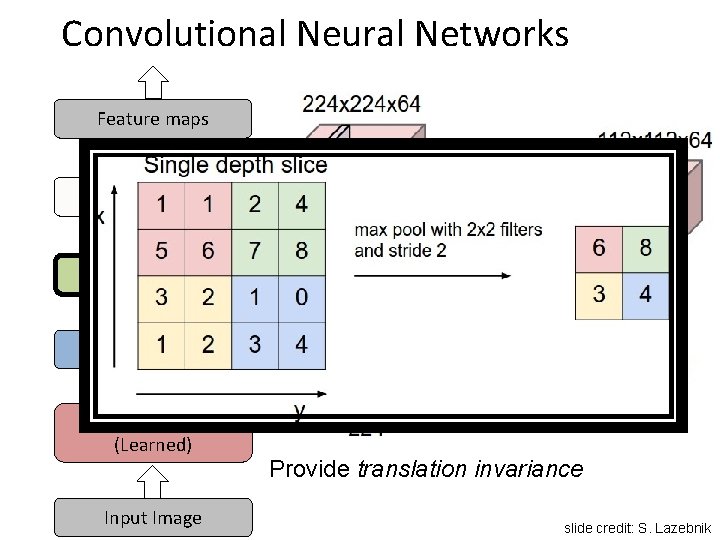
Convolutional Neural Networks Feature maps Normalization Max pooling Spatial pooling Non-linearity Convolution (Learned) Input Image Max-pooling: a non-linear down-sampling Provide translation invariance slide credit: S. Lazebnik
Convolutional Neural Networks Feature maps Normalization Spatial pooling Non-linearity Convolution (Learned) Input Image slide credit: S. Lazebnik
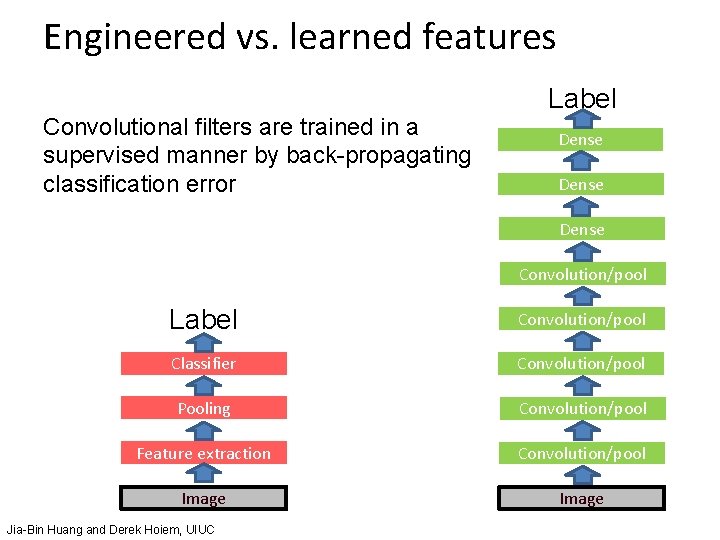
Engineered vs. learned features Convolutional filters are trained in a supervised manner by back-propagating classification error Label Dense Convolution/pool Label Convolution/pool Classifier Convolution/pool Pooling Convolution/pool Feature extraction Convolution/pool Image Jia-Bin Huang and Derek Hoiem, UIUC
SIFT Descriptor Image Pixels Lowe [IJCV 2004] Apply oriented filters Spatial pool (Sum) Normalize to unit length Feature Vector slide credit: R. Fergus
Spatial Pyramid Matching SIFT Features Filter with Visual Words Lazebnik, Schmid, Ponce [CVPR 2006] Max Multi-scale spatial pool (Sum) Classifier slide credit: R. Fergus
Applications • Handwritten text/digits – MNIST (0. 17% error [Ciresan et al. 2011]) – Arabic & Chinese [Ciresan et al. 2012] • Simpler recognition benchmarks – CIFAR-10 (9. 3% error [Wan et al. 2013]) – Traffic sign recognition • 0. 56% error vs 1. 16% for humans [Ciresan et al. 2011] Slide: R. Fergus
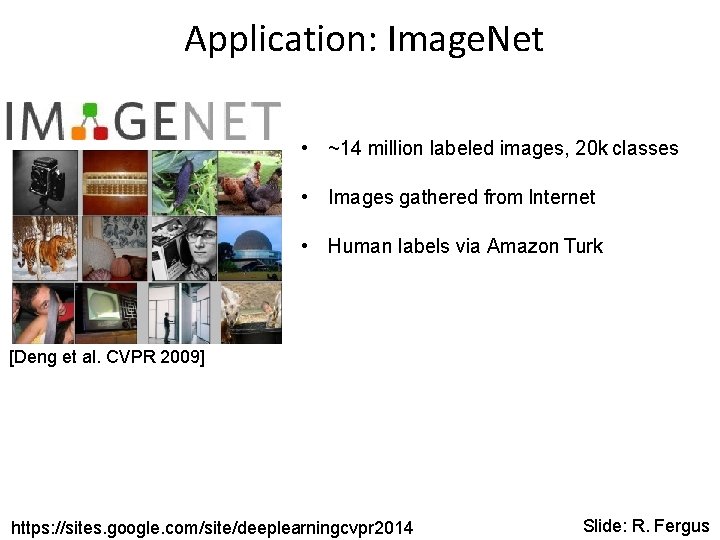
Application: Image. Net • ~14 million labeled images, 20 k classes • Images gathered from Internet • Human labels via Amazon Turk [Deng et al. CVPR 2009] https: //sites. google. com/site/deeplearningcvpr 2014 Slide: R. Fergus
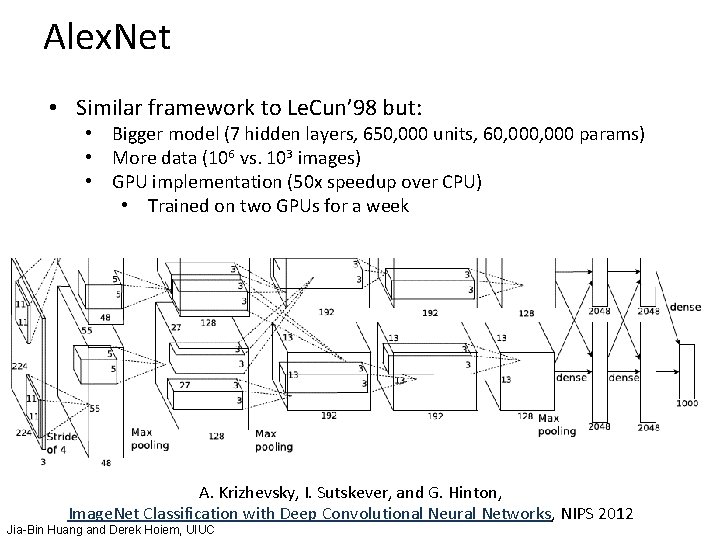
Alex. Net • Similar framework to Le. Cun’ 98 but: • Bigger model (7 hidden layers, 650, 000 units, 60, 000 params) • More data (106 vs. 103 images) • GPU implementation (50 x speedup over CPU) • Trained on two GPUs for a week A. Krizhevsky, I. Sutskever, and G. Hinton, Image. Net Classification with Deep Convolutional Neural Networks, NIPS 2012 Jia-Bin Huang and Derek Hoiem, UIUC
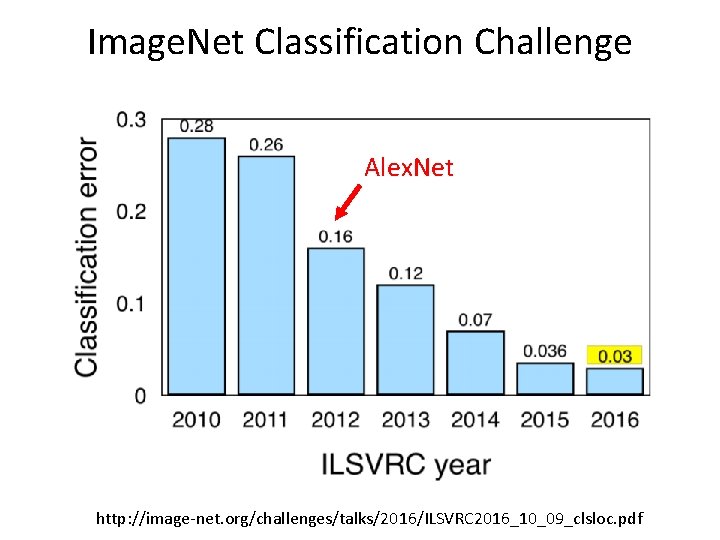
Image. Net Classification Challenge Alex. Net http: //image-net. org/challenges/talks/2016/ILSVRC 2016_10_09_clsloc. pdf
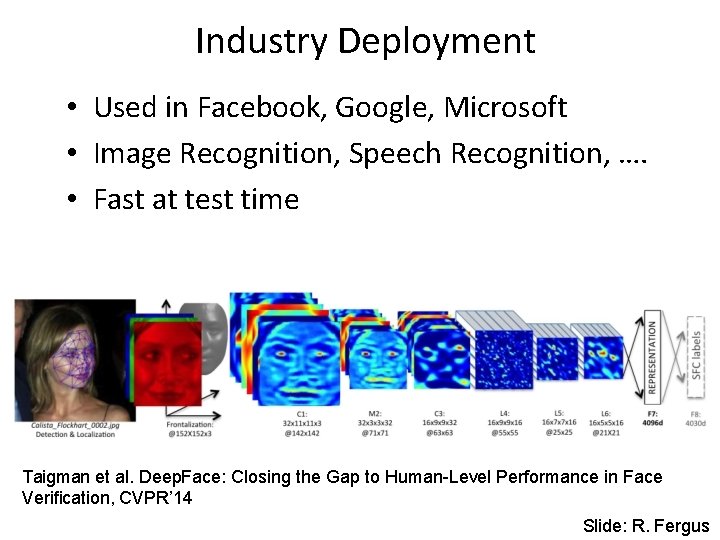
Industry Deployment • Used in Facebook, Google, Microsoft • Image Recognition, Speech Recognition, …. • Fast at test time Taigman et al. Deep. Face: Closing the Gap to Human-Level Performance in Face Verification, CVPR’ 14 Slide: R. Fergus
Beyond classification • • • Detection Segmentation Regression Pose estimation Matching patches Synthesis and many more… Jia-Bin Huang and Derek Hoiem, UIUC
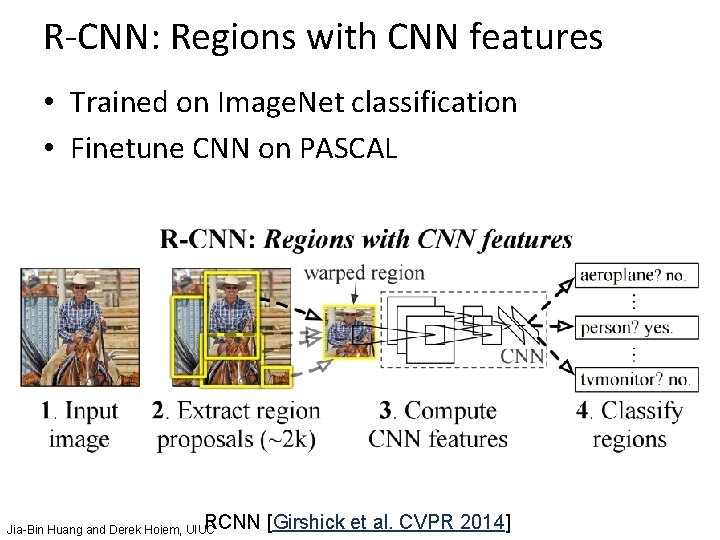
R-CNN: Regions with CNN features • Trained on Image. Net classification • Finetune CNN on PASCAL RCNN [Girshick et al. CVPR 2014] Jia-Bin Huang and Derek Hoiem, UIUC
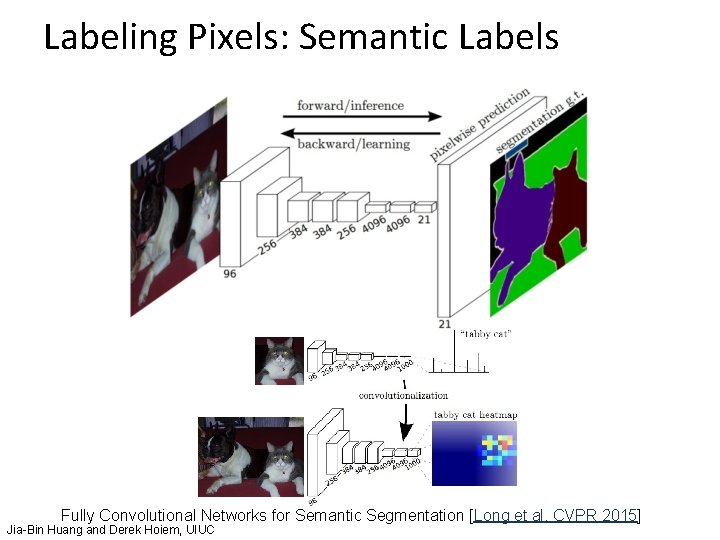
Labeling Pixels: Semantic Labels Fully Convolutional Networks for Semantic Segmentation [Long et al. CVPR 2015] Jia-Bin Huang and Derek Hoiem, UIUC
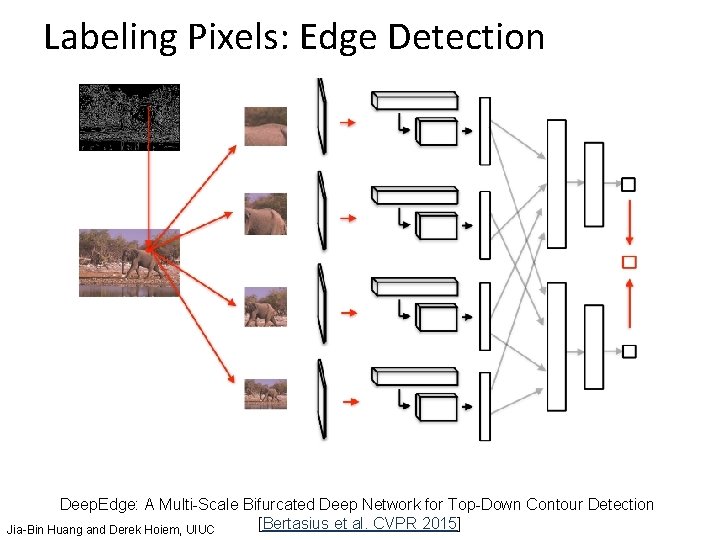
Labeling Pixels: Edge Detection Deep. Edge: A Multi-Scale Bifurcated Deep Network for Top-Down Contour Detection [Bertasius et al. CVPR 2015] Jia-Bin Huang and Derek Hoiem, UIUC
CNN for Regression Deep. Pose [Toshev and Szegedy CVPR 2014] Jia-Bin Huang and Derek Hoiem, UIUC
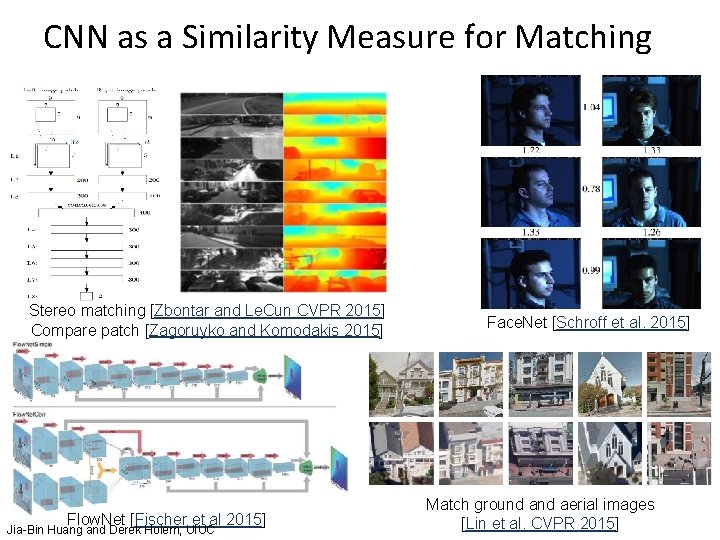
CNN as a Similarity Measure for Matching Stereo matching [Zbontar and Le. Cun CVPR 2015] Compare patch [Zagoruyko and Komodakis 2015] Flow. Net [Fischer et al 2015] Jia-Bin Huang and Derek Hoiem, UIUC Face. Net [Schroff et al. 2015] Match ground aerial images [Lin et al. CVPR 2015]
Recap • Neural networks / multi-layer perceptrons – View of neural networks as learning hierarchy of features • Convolutional neural networks – Architecture of network accounts for image structure – “End-to-end” recognition from pixels – Together with big (labeled) data and lots of computation major success on benchmarks, image classification and beyond